
Progressive Metal ADpak Review: What It Actually Does in a Mix (and Where It Falls Short)
Most producers will load Progressive Metal ADpak and get a usable drum sound in minutes.
The trade-off is control. This library locks you into a specific sonic profile—and that becomes obvious as soon as the mix gets dense.
As part of the Addictive Drums 2 ecosystem, Progressive Metal ADpak extends XLN Audio’s approach to mix-ready drum production. Full product details are available on the official XLN Audio page.
What Progressive Metal ADpak Actually Is (and Isn’t)
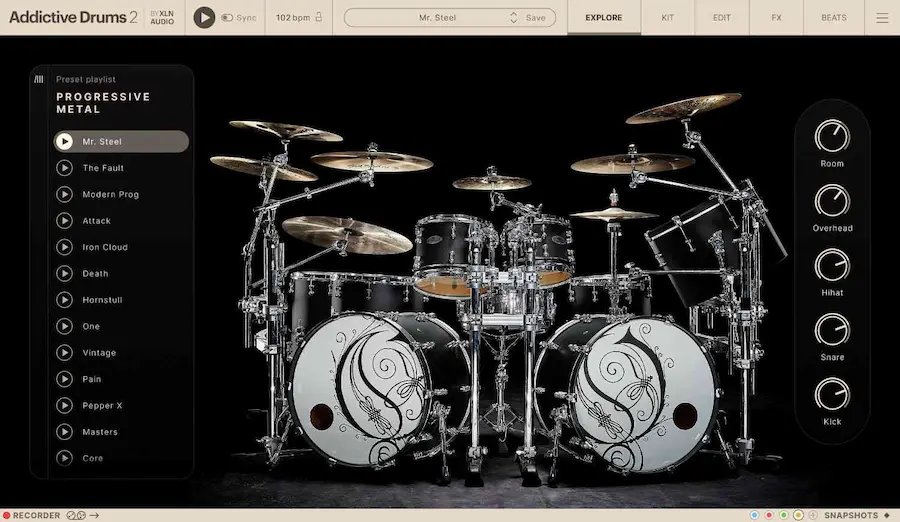
Progressive Metal ADpak is a performance-captured drum instrument, not a modular drum environment. The Pearl Reference Pure kit was recorded by David Castillo with a focus on transient consistency, velocity scaling, and articulation continuity under fast passages.
What you’re getting:
- Dual 22” kicks with alternating hits to avoid static repetition
- High-resolution velocity layers that preserve ghost note detail under compression
- Extended tom range (including gong drum) for linear and melodic phrasing
- Pre-shaped cymbal response with controlled upper-mid energy
What you’re not getting:
- Mic-level control (limited routing and bleed manipulation)
- Rebuildable kit architecture (no deep swapping or re-voicing)
- Independent room shaping beyond basic mix controls
Positioning: this is a mix-ready drum plugin with a fixed acoustic identity. It trades configurability for predictable translation in dense metal mixes.
How Progressive Metal ADpak Performs in Real Mixing Scenarios
In a mix, Progressive Metal ADpak is stable and predictable. The internal balance is already dialed, so it translates with minimal corrective processing.
Where it holds up:
- Kick placement is consistent in the 60–100 Hz region, with a defined attack that survives moderate bus compression
- Ghost notes retain level separation without collapsing into the snare body
- Cymbals sit without excessive buildup in the 2–5 kHz range, reducing the need for aggressive EQ cuts
This shortens the workflow: you’re not constructing a drum sound—you’re adjusting a signal that’s already mix-aligned.
Where it fails:
- Kick voicing is locked—difficult to adapt for tighter or more aggressive subgenres
- Room and bleed control is limited, restricting spatial shaping
- Cymbal tone is fixed, which can clash in brighter or more open mixes
Bottom line: if the kit integrates, it saves time. If it doesn’t, there’s no deep layer to rework—you switch libraries.
Why Progressive Metal ADpak Exposes Weak Production
 Progressive Metal ADpak is highly sensitive to MIDI input. It preserves dynamics rather than smoothing them, so programming errors remain fully audible.
This is not a forgiving instrument.
- Flat velocity curves remove dynamic contrast, especially in ghost notes and fast kick patterns
- Hard quantization eliminates micro-timing, resulting in mechanical playback even with multi-layer samples
- Uncontrolled low-end (kick vs bass overlap) reduces transient clarity and headroom
Unlike heavily processed drum libraries, Progressive Metal ADpak does not compensate for weak input. It maintains the original performance behavior—good or bad.
Practical takeaway: the realism of this plugin is directly proportional to the quality of your MIDI programming. Poor input will not translate.
In practice, most of these issues appear before mastering even starts—understanding how to prepare a mix for mastering is what prevents these failures from carrying into the final stage.
Mixing and Mastering Implications
Progressive Metal ADpak is engineered for mix consistency, not deep sound design. The internal balance—kick, snare, overheads, and room—arrives pre-aligned, so it translates predictably through bus processing.
In practice:
- Bus compression retains transient definition without collapsing kick/snare separation
- Limiting is more stable due to controlled peak structure and reduced inter-channel imbalance
- Low-end management requires less corrective EQ, but still depends on kick/bass coordination
This reduces prep time before mastering. The signal is already close to final-state behavior, so you’re refining dynamics rather than fixing structural issues.
Constraint: control is limited. There’s no granular mic routing or independent room shaping, which restricts corrective moves if the kit doesn’t fit the mix.
Conclusion: Progressive Metal ADpak optimizes for speed and predictability. It shortens the path to a master-ready signal, but removes the option to rebuild the drum image at the micro level—this is exactly where professional mastering becomes critical to control translation and final balance.
Progressive Metal ADpak vs Other Drum Plugins
Against current drum plugin standards, Progressive Metal ADpak sits in a narrow lane: fast, pre-shaped, and mix-oriented. It’s not competing on flexibility—it’s competing on speed and translation.
- GetGood Drums (GGD) — more aggressive transient profile, easier to push through dense guitars, wider mix control
- Superior Drummer 3 — full mic-level routing and bleed control, but significantly slower to dial in
- Steven Slate Drums — immediate results, but less articulation depth and dynamic nuance
Key difference:
GGD is built to be shaped inside the mix. Progressive Metal ADpak is built to arrive already shaped.
In dense, heavily limited sessions, GGD typically provides a more aggressive and controllable result. Its transient profile and mix-forward design give it more headroom for processing.
By contrast, Progressive Metal ADpak prioritizes natural articulation and internal balance. It holds up well without heavy processing, but offers less room for reshaping once inside the mix.
- ADpak — faster setup, more natural dynamics, limited re-voicing
- GGD — slower setup, stronger mix penetration, higher control ceiling
| Plugin | Best For | Strength | Limitation |
|---|---|---|---|
| Progressive Metal ADpak | Fast metal production | Natural dynamics, mix-ready balance | Limited control and re-voicing |
| GetGood Drums | Dense modern metal mixes | Strong punch, mix penetration | Less natural feel out of the box |
| Superior Drummer 3 | Full production control | Maximum routing and flexibility | Slow setup and workflow |
| Steven Slate Drums | Quick demo production | Fast results | Lower articulation detail |
Conclusion: Progressive Metal ADpak is a workflow tool optimized for speed and consistency. It does not replace high-control drum environments—it bypasses them when time matters more than flexibility.
Who Should (and Shouldn’t) Use Progressive Metal ADpak
Best fit:
- Producers in progressive metal and djent — where fast passages and dynamic articulation need to translate without heavy editing
- Mix engineers on tight timelines — sessions that require a stable, mix-ready drum signal with minimal setup
- Production workflows prioritizing efficiency — situations where speed matters more than deep customization
Not ideal for:
- Cross-genre production — the tonal profile is too specific for pop, rock, or electronic contexts
- Engineers requiring full routing control — limited mic and bleed options restrict detailed mix shaping
- Sound design-heavy workflows — no practical way to rebuild or significantly re-voice the kit
This positions Progressive Metal ADpak as a metal drum plugin within the addictive drums 2 metal ecosystem, competing directly with other realistic drum vst solutions.
Summary: Progressive Metal ADpak is optimized for a narrow use case. If the project aligns with its sonic profile, it accelerates the workflow. If not, it becomes a constraint rather than a solution.
Pricing and Value
Progressive Metal ADpak is priced at $89, which aligns with the standard tier for Addictive Drums expansions. The Progressive & Heavy Collection ($169) bundles an additional kit and MIDI content, effectively positioning this as a workflow package rather than a single-library purchase.
From a value standpoint, this is not about quantity—it’s about fit.
- If the sonic profile matches your mix approach, it reduces production time and offsets its cost quickly
- If it doesn’t, there’s no fallback layer of control to justify the purchase
Compared to full drum environments, you’re paying less—but also getting a narrower tool. Within the addictive drums 2 metal expansion ecosystem, the pricing is standard. Outside it, the value is conditional on how often you need this exact sound.
Final Verdict: Efficient, Focused, Limited
Progressive Metal ADpak is not built to compete with full drum production environments. It bypasses them by delivering a pre-defined, mix-aligned drum signal.
That efficiency comes with constraints.
Final assessment: this plugin does not enhance a production—it exposes its underlying quality. Accurate MIDI and balanced low-end translate into a convincing, mix-ready result. Weak programming or poor balance remain fully audible.
Use case: fast turnaround, controlled workflows, and projects that match its tonal profile.
Limitation: no practical path for deep reworking once the kit is in place.
Conclusion: Progressive Metal ADpak is a high-efficiency tool for a narrow range of applications. Inside that range, it saves time. Outside it, it becomes a restriction rather than an advantage.
If the drums still don’t translate after setup, the issue is no longer the plugin—it’s the mix and mastering stage, where most translation problems are explained in detail in common mastering issues.
FAQ: Progressive Metal ADpak
Does Progressive Metal ADpak work for genres outside metal?
No. The tonal profile is tightly optimized for progressive and modern metal. In genres like pop, rock, or electronic, the kick voicing and cymbal balance often feel mismatched and require more correction than replacement.
Can Progressive Metal ADpak replace Superior Drummer 3?
No. They solve different problems. Superior Drummer 3 is a full production environment with deep routing and mic control. Progressive Metal ADpak is a pre-shaped instrument designed to reduce setup time, not replace detailed drum engineering.
Is Progressive Metal ADpak good for beginners?
Not necessarily. While it’s fast to load, it requires clean MIDI programming to sound realistic. Without proper velocity variation and timing, results degrade quickly.
How does it compare to GetGood Drums in real projects?
GGD typically delivers a more aggressive and mix-forward result, especially in dense sessions. Progressive Metal ADpak sounds more natural out of the box but offers less control once inside the mix.
Does Progressive Metal ADpak require additional processing?
Minimal, but not zero. The kit is pre-balanced, so EQ and compression are often reduced. However, low-end management and kick/bass interaction still need to be handled at the mix stage.
Can you customize the drum sound significantly?
No. You can adjust levels and basic tone shaping, but the core character of the kit is fixed. If the sound doesn’t fit your mix, there’s no practical way to rebuild it.
Is it suitable for professional mixing and mastering workflows?
Yes, but only within its intended scope. It integrates well into fast-paced production pipelines, especially when consistency and speed matter more than deep control.
Does it work well with programmed MIDI or only live-style performance?
It works with both, but it favors performance-style MIDI. Static programming reduces realism significantly, especially in fast double-kick patterns.
Is the Progressive & Heavy Collection worth it?
If you’re already using Addictive Drums 2 and need multiple metal-oriented kits, the bundle offers better value. Otherwise, the decision depends on whether you need this specific sound profile.
What’s the biggest limitation of Progressive Metal ADpak?
Lack of control. Once the kit is in the session, you’re working with a fixed sound. That speeds up workflow, but removes the ability to reshape the drum image at a detailed level.