
Empirical Labs ParaDyn Review (2026): Adaptive Dynamic EQ for Modern Mixing and Mastering
Empirical Labs ParaDyn enters a market already dominated by surgical EQs, AI-assisted spectral processors, and increasingly complex mastering suites. Instead of competing on visual analysis or automation depth, ParaDyn takes a different approach: consolidating dynamic EQ, broadband compression, de-essing, and masking-aware spectral control into a single workflow-oriented plugin.
Most new dynamic EQ releases promise smarter processing. Very few actually change how engineers build sessions. In practice, ParaDyn is targeting a real problem inside modern mixing and mastering sessions — processor stacking.
Most dynamic EQ plugins today fall into two categories. Some prioritize ultra-clean corrective precision with deep visual editing. Others rely heavily on automated “smart” processing that removes control from the engineer. ParaDyn sits somewhere between those extremes. The plugin remains manual and mix-driven, but its dynamics engine reacts contextually enough to avoid the rigid behavior that makes many dynamic EQs sound overly controlled under heavy processing.
That becomes relevant quickly in dense sessions. Modern vocal chains alone often contain separate processors for resonance suppression, de-essing, tonal EQ, transient smoothing, and bus compression. ParaDyn is clearly designed to reduce that fragmentation rather than add another corrective layer to it.
More importantly, Empirical Labs is not positioning ParaDyn as a transparent surgical tool. The plugin behaves more like a dynamics processor with integrated spectral control than a conventional parametric EQ. That distinction shapes how it performs in real-world audio production workflows — especially during mix bus processing and adaptive mastering.
Contents
- What ParaDyn Actually Does
- Real Workflow Analysis
- Best Uses for Mixing
- Mastering Applications
- ParaDyn vs FabFilter, Kirchhoff, and Ozone
- CPU Usage and Performance
- Limitations and Weak Points
- Pros and Cons
- Verdict
- FAQ
Key Takeaways
- ParaDyn is designed more for adaptive tonal control than surgical correction.
- Dyn Mask mode helps reduce over-processing during dense mixes and mastering sessions.
- The plugin works especially well on vocals, buses, and streaming-oriented masters.
- ParaDyn prioritizes workflow consolidation over deep visual editing.
- FabFilter Pro-Q remains stronger for forensic EQ tasks and precision analysis.
- At $19 intro pricing, ParaDyn offers unusually high value for professional mixing workflows.
What Empirical Labs ParaDyn Actually Does
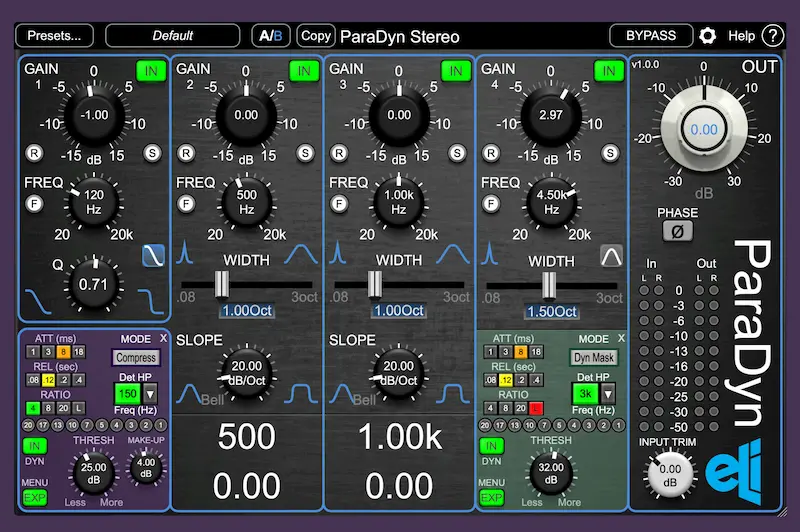
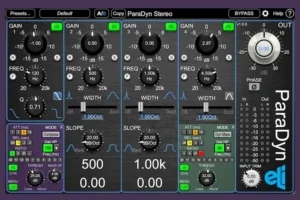
At its core, ParaDyn is a four-band parametric EQ built on technology derived from Empirical Labs’ big FrEQ platform. But describing it as “just” a dynamic EQ misses the point entirely. The plugin is really a spectral dynamics processor that can shift between corrective EQ, de-essing, tonal shaping, and compression depending on how the dynamics modules are configured.
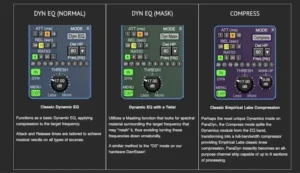
Bands 1 and 4 include fully integrated dynamics sections with three operating modes:
- Dynamic EQ
- Dyn Mask
- Compress
Dynamic EQ mode behaves conventionally. The selected frequency range triggers gain reduction or expansion once the detector crosses threshold. Useful, but not unique.
The more important mode is Dyn Mask.
Instead of reacting strictly to level, Dyn Mask analyzes whether the target frequency area is already being perceptually masked by surrounding content. If the masking already exists naturally in the mix, the plugin reduces processing activity instead of applying constant correction.
That sounds subtle until you compare it against typical dynamic EQ behavior.
Most dynamic EQ plugins react mechanically. A harsh frequency crosses threshold, the processor clamps down, and over time the source starts losing movement, texture, or transient realism. Engineers compensate by automating thresholds, splitting bands, or stacking additional processors.
ParaDyn is clearly designed to avoid that cycle.
In practice, Dyn Mask behaves less like surgical resonance suppression and more like adaptive tonal management. The result is generally smoother under sustained processing, especially on vocals, cymbals, upper-mid guitar content, and bright synth material where static correction tends to sound obvious quickly.
The third mode — Compress — changes the plugin’s role completely.
Once enabled, the dynamics engine detaches from the EQ band and operates as a full-range compressor using Empirical Labs’ proprietary knee behavior. That effectively turns ParaDyn into a modular dynamics processor rather than a dedicated EQ.
Depending on configuration, a single instance can realistically function as:
- dynamic EQ
- de-esser
- mix bus compressor
- mastering tone shaper
- spectral control processor
- broadband dynamics tool
That workflow flexibility is the actual product here — not the EQ curves themselves.
Empirical Labs is not chasing the ultra-clean digital mastering market occupied by FabFilter, Weiss, or linear-phase surgical processors. ParaDyn is aimed at engineers who prefer musical dynamics behavior and consolidated processing chains over purely analytical correction.
Real Workflow Analysis: Why ParaDyn Changes Mixing Behavior
 The most important thing about ParaDyn is not the EQ itself. It’s the way the plugin changes session architecture.
Modern mixing workflows have become unnecessarily fragmented. A typical vocal or mix bus chain now often includes separate processors for:
- dynamic resonance suppression
- de-essing
- corrective EQ
- tonal shaping
- bus compression
- spectral harshness control
Individually, none of those processors are a problem. The issue is cumulative interaction.
Every additional plugin introduces its own detector behavior, latency profile, phase response, gain staging, oversampling characteristics, and transient handling. Once multiple spectral processors begin stacking together, the chain often starts reacting inconsistently under dynamic material.
That inconsistency is one of the hidden reasons many modern mixes feel technically polished but dynamically lifeless.
In many cases, the issue is not the individual processors themselves, but the way excessive corrective stages accumulate across the mastering chain. Understanding how mastering chains actually behave under cumulative processing becomes critical once multiple dynamic EQs, compressors, and spectral tools begin interacting simultaneously. This mastering chain breakdown explains why excessive processor stacking often creates more tonal instability instead of less.
ParaDyn addresses that differently than most dynamic EQ plugins.
Instead of forcing engineers into separate corrective stages, the plugin combines tonal shaping, adaptive spectral control, and broadband dynamics inside one environment with shared behavior between modules.
That sounds like a workflow detail until you use it on dense material.
On vocals, for example, traditional dynamic EQ frequently creates a cycle of over-correction. A harsh upper-mid range triggers aggressive suppression, intelligibility drops, another EQ boost compensates for lost presence, then additional de-essing becomes necessary afterward.
ParaDyn reduces that chain reaction because the processing behaves more contextually instead of mechanically.
The same applies to drum buses and master buses.
Many dynamic EQs clamp onto cymbal energy or upper transient spikes too aggressively once thresholds are crossed repeatedly. Over time, the bus loses movement and starts sounding flattened even when gain reduction appears minimal numerically.
ParaDyn’s dynamics behavior generally feels less rigid under sustained processing, especially when Dyn Mask mode is used conservatively.
That distinction becomes most noticeable on:
- lead vocals
- drum buses
- master buses
- distorted guitars
- bright synth stacks
- dense upper-mid arrangements
Those are all situations where static EQ often sounds too fixed while conventional dynamic EQ reacts too aggressively once multiple sources compete for the same spectral space.
ParaDyn is not eliminating corrective processing. It is reducing the need for multiple independent correction stages fighting each other across the session.
That is a far more meaningful workflow improvement than most of the “AI-assisted” processing currently dominating the plugin market.
Best Uses for ParaDyn in Mixing
ParaDyn becomes most useful in dense modern mixes where static EQ starts sounding too rigid and conventional dynamic EQ begins overreacting to transient-heavy material.
The plugin is not designed for forensic correction. It performs best when used as an adaptive tonal control processor inside complex arrangements where frequency relationships shift constantly throughout the song.
Vocals
Vocals are easily one of ParaDyn’s strongest applications.
Most modern vocal chains already contain overlapping stages for:
- de-essing
- dynamic EQ
- compression
- presence shaping
- upper-mid harshness control
That layering often creates inconsistent tone because each processor reacts independently to the same problem areas.
ParaDyn reduces that fragmentation.
The Dyn Mask mode works particularly well around the 2–5 kHz range where vocal harshness becomes aggressive but intelligibility still needs to remain stable. Traditional dynamic EQ plugins tend to clamp that region repeatedly during sustained phrases, eventually dulling articulation and forward presence.
ParaDyn behaves differently because the processing relaxes once surrounding instrumentation naturally masks the same spectral area. That allows the vocal to remain controlled without sounding permanently attenuated.
The result is usually smoother long-term tonal stability rather than dramatic momentary correction.
Drum Bus Processing
ParaDyn also translates well to drum buses, particularly in modern productions built around bright overheads, aggressive cymbals, and transient-heavy snare content.
Conventional dynamic EQ often struggles here because repeated threshold triggering gradually collapses transient movement across the bus. Even small amounts of gain reduction can start flattening perceived punch over time.
ParaDyn’s adaptive behavior tends to preserve more motion inside the upper mids while still controlling harsh cymbal buildup and brittle attack spikes.
The plugin’s flat-top filter behavior also matters more than expected during drum bus shaping. Broad boosts and cuts remain smoother across wider frequency ranges without developing the exaggerated resonant edge common in traditional bell filters.
That makes tonal shaping feel less surgical and more cohesive across the full bus.
Guitars and Dense Midrange Arrangements
ParaDyn is particularly effective on layered guitars, synth stacks, and dense midrange-heavy arrangements where static corrective EQ quickly becomes destructive.
Modern rock, metal, and hybrid electronic productions often suffer from simultaneous low-mid buildup and upper-mid fatigue. Many engineers respond with increasingly narrow corrective cuts that eventually separate instruments unnaturally from the mix.
ParaDyn encourages broader spectral management instead of hyper-precise notch filtering.
That distinction is important.
Extremely surgical EQ moves may clean up individual tracks in solo, but they often weaken tonal cohesion once the entire arrangement is playing. ParaDyn generally behaves more like adaptive contour shaping than strict resonance removal, which tends to preserve density more naturally under heavy layering.
Is Empirical Labs ParaDyn Actually Useful for Mastering?
Yes — but not in the way many mastering EQ plugins are typically used.
ParaDyn is not a forensic mastering tool. It is not designed to replace ultra-transparent linear-phase EQs, precision spectral editors, or surgical restoration processors. Engineers expecting Weiss-level transparency or microscopic corrective control will probably find ParaDyn too behavior-driven for primary mastering duties.
That is not a flaw. It is simply a different philosophy.
ParaDyn becomes valuable during mastering when the problem is no longer correction, but translation.
Modern streaming workflows have changed how tonal balance behaves outside the studio. A static EQ move that sounds controlled on full-range monitors can become unstable once the master hits AAC encoding, loudness normalization, earbuds, phone speakers, Bluetooth systems, or aggressive consumer playback enhancement.
This is where static mastering EQ often starts failing.
A fixed upper-mid cut may reduce harshness on studio monitors while simultaneously weakening vocal projection on smaller playback systems. Likewise, aggressive low-mid cleanup can make a master sound cleaner in the studio but thinner once codec compression and normalization alter perceived density.
Adaptive spectral control reduces some of that translation risk because the processing reacts contextually instead of applying permanent tonal changes across the entire track.
That becomes especially relevant once loudness normalization, codec conversion, and streaming playback systems begin reshaping perceived tonal balance after export. Engineers dealing with unstable translation issues during mastering should also understand how LUFS targets and clipping behavior interact with spectral dynamics processing in modern release workflows. LUFS mastering standards and loudness versus clipping behavior both influence how adaptive EQ decisions translate outside the studio.
ParaDyn is particularly effective for:
- controlling upper-mid harshness without collapsing air
- reducing brittle vocal presence during dense choruses
- managing low-mid buildup dynamically instead of statically
- stabilizing transient-heavy masters
- softening aggressive cymbal energy
- maintaining tonal consistency across changing arrangements
The plugin also works well late in the mastering chain after primary corrective EQ has already been handled.
That distinction matters.
ParaDyn performs best as an adaptive finishing processor — not as the main surgical engine responsible for repairing tonal problems. It is more effective at refining movement and spectral balance than reconstructing flawed mixes.
That distinction mirrors the broader difference between mixing and mastering itself. ParaDyn is most effective when the mix already contains stable balance, controlled dynamics, and intentional tonal decisions before the mastering stage begins. Engineers still confusing corrective mixing work with mastering processing should understand the practical separation between mixing and mastering workflows before relying on adaptive spectral tools to solve arrangement or balance issues.
In real mastering sessions, ParaDyn makes considerably more sense for subtle dynamic contour management than for aggressive corrective intervention. During client work, the plugin performs best when used to stabilize tonal movement and upper-mid behavior instead of forcing major corrective changes onto unstable mixes.
Used conservatively, the plugin can smooth unstable upper mids and harsh transients while preserving more openness than many conventional dynamic EQs. Used aggressively, it can still flatten movement just like any other spectral processor.
The difference is that ParaDyn generally reaches that point later than most.
ParaDyn vs FabFilter Pro-Q, Kirchhoff EQ, and Ozone Dynamic EQ
| Plugin | Primary Focus | Strongest Advantage | Main Limitation |
|---|---|---|---|
| Empirical Labs ParaDyn | Adaptive spectral dynamics | Integrated tonal and dynamics workflow | Less precise for surgical correction |
| FabFilter Pro-Q | Corrective EQ and analysis | Fast visual editing and flexibility | Can sound overly controlled under heavy dynamic processing |
| Kirchhoff EQ | Advanced mastering EQ workflows | Extremely deep filter customization | More technical and slower to navigate |
| Ozone Dynamic EQ | Integrated mastering ecosystem | Broad mastering feature integration | More automated and less tactile during mixing |
 Comparing ParaDyn directly against FabFilter Pro-Q misses the actual purpose of the plugin.
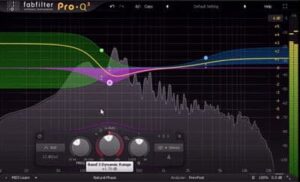
FabFilter remains one of the strongest tools available for surgical corrective EQ, fast visual editing, and transparent spectrum management. If the goal is precise resonance removal, steep filter manipulation, or detailed frequency analysis, Pro-Q still operates at a higher level.
ParaDyn is solving a different problem.
The plugin is less focused on visual precision and more focused on dynamic interaction between tonal shaping and compression behavior during real mixing sessions.
That distinction becomes obvious quickly once multiple processors start stacking together.
FabFilter excels at isolated corrective decisions. ParaDyn is generally stronger when the challenge is maintaining movement and tonal cohesion across dynamically unstable material.
Kirchhoff EQ sits somewhere else entirely.
Kirchhoff is arguably one of the most technically flexible EQ environments currently available for mastering engineers. Filter topology control, analog modeling options, dynamic behavior, and phase management are all significantly deeper than what ParaDyn offers.
But that flexibility comes with complexity.
Kirchhoff often rewards highly technical workflows where engineers intentionally fine-tune filter behavior at an extremely granular level. ParaDyn is noticeably faster and more immediate by comparison.
Ozone Dynamic EQ approaches the problem from the opposite direction.
Ozone is built around ecosystem integration and assisted mastering workflows. It prioritizes broad feature connectivity, AI-assisted analysis, loudness management, and multi-stage mastering convenience.
ParaDyn feels far more mix-oriented.
The plugin behaves less like a mastering suite component and more like a dedicated dynamics processor with spectral intelligence built into the workflow itself.
This ultimately comes down to engineering philosophy.
FabFilter prioritizes analytical control.
Kirchhoff prioritizes technical depth.
Ozone prioritizes ecosystem integration.
ParaDyn prioritizes dynamic musical behavior.
Engineers who work primarily by ear — especially during bus processing, vocal control, and tonal contour shaping — will probably adapt to ParaDyn faster than users who rely heavily on spectrum analyzers and visual editing.
That does not make ParaDyn objectively better than its competitors.
It makes it more specialized.
For engineers searching for a workflow-oriented alternative to heavily visual dynamic EQ plugins, ParaDyn currently occupies a relatively unique position in the market.
CPU Usage and Real-World Session Performance
CPU efficiency matters far more now than it did a few years ago. Modern mixing sessions routinely combine oversampled saturation, linear-phase EQ, spectral repair, transient shaping, multiband dynamics, and AI-assisted processing across dozens of tracks and buses simultaneously.
Under those conditions, even small inefficiencies scale aggressively.
ParaDyn is relatively controlled from a CPU standpoint compared to many current spectral dynamics processors, largely because the plugin avoids continuously rendering heavy visual analysis environments in the background.
That said, this is not a lightweight utility EQ.
Once both dynamics sections become active — particularly in mastering scenarios involving broadband compression and adaptive spectral processing simultaneously — CPU usage rises noticeably compared to conventional parametric EQ plugins.
Still, evaluating ParaDyn purely by instance load misses the more important point: consolidation.
In practical workflows, one ParaDyn instance can often replace multiple overlapping processors handling:
- dynamic EQ
- de-essing
- spectral harshness control
- broadband compression
- tonal contour shaping
That changes overall session efficiency considerably.
Running one moderately demanding processor is frequently more stable than chaining four separate plugins from different developers with independent oversampling behavior, latency compensation, detector timing, and transient response characteristics.
There is also a workflow advantage that rarely gets discussed in plugin reviews: predictability.
Large sessions become harder to manage once multiple spectral processors start interacting unpredictably across buses and subgroup chains. Small timing differences between plugins can subtly alter transient behavior, stereo image stability, and gain staging relationships throughout the mix.
ParaDyn reduces some of that inconsistency simply because several related processes operate inside the same environment.
Latency management also becomes cleaner compared to stacking multiple dynamic spectral tools in sequence, particularly during mastering where cumulative latency and oversampling can escalate quickly.
For smaller sessions, CPU load is unlikely to become a serious issue.
For large-scale productions with aggressive oversampling across every bus, ParaDyn still needs to be treated like a serious dynamics processor rather than a casual utility EQ.
Who Empirical Labs ParaDyn Is Actually For
ParaDyn is clearly aimed at engineers already comfortable with dynamic EQ workflows and tonal balance management.
The plugin makes the most sense for:
- mix engineers working with dense modern productions
- mastering engineers handling streaming-oriented releases
- vocal-heavy production workflows
- bus processing and tonal contour management
- engineers trying to reduce excessive plugin-chain fragmentation
ParaDyn is considerably less suitable for:
- forensic spectral restoration work
- extremely surgical corrective EQ tasks
- beginners expecting automatic mix repair
- engineers who rely heavily on visual spectrum editing
In real mastering sessions, ParaDyn works best as an adaptive finishing processor rather than a primary corrective tool. Engineers expecting one plugin to repair unstable mixes entirely will probably misunderstand where the plugin actually performs well.
Limitations, Weak Points, and Marketing Reality
ParaDyn is a smart plugin, but some of the marketing language around it needs context.
The “spectral masking detection” concept sounds more revolutionary than it actually is. Masking-aware dynamics processing can absolutely help reduce unnecessary gain reduction, but it does not eliminate the need for proper monitoring, careful tonal decisions, or disciplined gain staging.
If the source material is harsh, unstable, or poorly balanced, adaptive processing alone will not fix the mix.
That becomes obvious quickly in projects where unresolved mix problems are pushed into the mastering stage instead of being corrected earlier. Spectral processors can smooth certain issues temporarily, but they cannot rebuild damaged balance, weak arrangements, or collapsing low-end structure after the fact. Many of those failures are covered in this guide on common mastering problems and why tracks often sound worse after processing instead of better.
Inexperienced users may actually make worse decisions with ParaDyn because the plugin can hide excessive processing more effectively than traditional dynamic EQ. That is not always a good thing.
One of the dangers with adaptive spectral tools is that they encourage engineers to keep adding correction simply because the processing feels smoother and less obvious in isolation.
Eventually, the mix still loses movement.
ParaDyn reaches that point later than many competitors, but the limitation still exists.
Another potential drawback is workflow philosophy.
Engineers who rely heavily on visual spectral editing may find ParaDyn comparatively restrained. The plugin intentionally prioritizes listening-based interaction over deep graphical analysis.
There are fewer visual cues, less forensic spectrum detail, and less emphasis on surgical manipulation compared to tools like FabFilter Pro-Q or modern spectral restoration platforms.
For some engineers, that is exactly the appeal.
For others, especially users accustomed to highly visual corrective workflows, ParaDyn may initially feel less precise or less informative.
There is also a broader limitation that applies to all multi-function processors.
ParaDyn combines several processing categories intelligently, but dedicated tools still outperform it in highly specialized situations.
- Surgical EQ plugins still offer deeper corrective precision.
- Dedicated mastering compressors still provide more advanced dynamics control.
- Specialized restoration software remains superior for forensic repair work.
- Linear-phase mastering EQs still handle transparent broadband correction more accurately.
ParaDyn succeeds because it reduces workflow fragmentation — not because it replaces every specialist processor in a professional mix or mastering environment.
That distinction matters.
Engineers expecting a single plugin capable of replacing an entire mastering chain will probably misunderstand what ParaDyn actually does well. The plugin is strongest when used as an adaptive control layer inside an already competent workflow.
Used that way, it becomes genuinely useful.
Used as a shortcut for fixing unresolved mix problems, it quickly turns into another over-processed spectral tool.
Pros and Cons
| Pros | Cons |
|---|---|
| Excellent adaptive vocal and bus control | Less effective for forensic surgical EQ work |
| Dyn Mask mode reduces obvious over-processing | Can feel limited for engineers relying on deep visual analysis |
| Strong workflow consolidation inside large sessions | Not designed for automatic mix repair |
| More musical dynamics behavior than many dynamic EQ plugins | Dedicated mastering processors still outperform it in isolated tasks |
| Very aggressive value at launch pricing | Requires experienced decision-making to avoid over-processing |
Verdict: Is Empirical Labs ParaDyn Actually Worth Using?
 Yes — primarily because ParaDyn understands a problem many modern plugins ignore.
Most contemporary spectral processors are designed around visual complexity, feature expansion, and increasingly automated correction. The result is often technically impressive but musically disconnected processing that encourages engineers to keep fixing problems until the mix loses movement entirely.
ParaDyn moves in the opposite direction.
The plugin is not trying to become a surgical editing platform, AI mastering assistant, or all-in-one restoration suite. It is fundamentally a dynamics processor with integrated spectral control designed for engineers who still make decisions by listening instead of by staring at analyzers.
That difference shapes the entire workflow.
ParaDyn’s strongest feature is not Dyn Mask mode, compression behavior, or filter topology individually. It is the way the plugin consolidates several overlapping processing stages into a more coherent system.
In real sessions, that matters more than marketing buzzwords.
Modern mixes frequently suffer from excessive processor stacking: multiple dynamic EQs, de-essers, resonance suppressors, transient tools, and bus compressors all reacting independently to the same material. Even high-end plugins can start fighting each other once enough corrective layers accumulate.
ParaDyn reduces some of that fragmentation.
Used conservatively, the plugin can smooth unstable upper mids, control harshness, and stabilize tonal balance without sounding as rigid or mechanically reactive as many conventional dynamic EQ processors.
That makes it particularly effective on:
- lead vocals
- mix buses
- master buses
- dense guitar arrangements
- bright electronic productions
- modern streaming-oriented masters
At the same time, ParaDyn is not a universal replacement for specialized processors.
It will not outperform dedicated surgical EQs for forensic correction. It will not replace high-end mastering compressors for advanced dynamics shaping. It will not solve poor arrangement decisions or weak monitoring environments.
And beginners expecting automatic mix repair will probably misuse it quickly.
But that is also why the plugin feels more credible than many recent releases in the spectral processing category.
Empirical Labs is clearly targeting engineers who already understand compression behavior, tonal movement, and dynamic balance — not users searching for one-click mastering shortcuts.
At the introductory price, ParaDyn is an easy recommendation for experienced mixing and mastering engineers.
Even at full price, the plugin offers considerably more real-world workflow value than many larger, more expensive processing suites currently dominating the market.
FAQ
What is Empirical Labs ParaDyn?
Empirical Labs ParaDyn is a dynamic EQ and spectral dynamics plugin built around four parametric bands with integrated adaptive processing. Depending on configuration, the plugin can function as a dynamic EQ, de-esser, broadband compressor, tonal shaper, or mastering control processor.
Is ParaDyn good for mastering?
Yes, particularly for adaptive tonal refinement rather than surgical correction. ParaDyn works well for controlling upper-mid harshness, stabilizing vocal presence, managing low-mid buildup, and smoothing aggressive transients during mastering.
How is ParaDyn different from FabFilter Pro-Q?
FabFilter Pro-Q is primarily focused on precision editing, visual spectrum control, and corrective flexibility. ParaDyn is more focused on dynamic interaction, tonal movement, and consolidating multiple spectral processing tasks into a single workflow.
Does ParaDyn work as a compressor?
Yes. Compress mode detaches the dynamics engine from the EQ band and turns it into a full-range compressor using Empirical Labs’ proprietary compression behavior.
Is ParaDyn useful for vocal mixing?
Very much so. Vocal harshness control, adaptive de-essing, upper-mid smoothing, and tonal stabilization are among the plugin’s strongest real-world applications.
Can ParaDyn replace multiple plugins?
In many workflows, yes. A single ParaDyn instance can often replace separate processors handling dynamic EQ, de-essing, tonal contour shaping, broadband compression, and spectral harshness management.
Is ParaDyn a surgical EQ plugin?
No. ParaDyn is designed more around adaptive tonal behavior and dynamics interaction than ultra-precise corrective editing. Engineers looking for forensic spectral repair or extremely narrow surgical filtering may still prefer dedicated corrective EQ tools.
Does Dyn Mask mode actually make a difference?
Yes, especially during sustained processing. Dyn Mask mode reduces unnecessary gain reduction once problematic frequencies become naturally masked by surrounding instrumentation, which helps preserve movement and tonal openness compared to conventional dynamic EQ behavior.
Technical Specs
- Four-band parametric EQ architecture derived from Empirical Labs big FrEQ technology
- Integrated dynamics modules on Bands 1 and 4
- Three processing modes: Dynamic EQ, Dyn Mask, and Compress
- Masking-aware spectral detection for adaptive gain reduction behavior
- Flat-top filter shaping for broader tonal adjustments with reduced edge resonance
- Broadband compression mode using Empirical Labs compression knee behavior
- Focus mode for tighter parameter scaling and fine frequency adjustment
- Extended gain range up to ±30 dB
- Suitable for mixing, bus processing, de-essing, and mastering workflows
- Supports tonal shaping, spectral control, and adaptive dynamics processing within a single instance
- Available for macOS and Windows
- 15-day fully functional trial version available
Pricing and Availability
Empirical Labs ParaDyn is available now for both macOS and Windows systems.
The plugin launched with an introductory price of $19 USD during the first 30 days after release before moving to its standard price of $39 USD.
At the current pricing, ParaDyn sits unusually low for a processor targeting professional mixing and mastering workflows. Most competing spectral dynamics plugins with comparable functionality typically land in a significantly higher price bracket, especially once dynamic EQ, compression, and adaptive spectral processing are combined inside a single environment.
A fully functional 15-day trial version is also available, which is important in this case because ParaDyn’s value depends heavily on workflow interaction rather than instant “wow factor” processing.
This is not the kind of plugin that reveals itself fully through presets or quick demo sessions. Its strengths become more obvious over time during real mixing and mastering work — particularly on buses, vocals, and dynamically unstable material where traditional spectral correction often becomes too rigid.
This review focuses on real-world mixing and mastering workflows rather than isolated preset demonstrations or manufacturer marketing claims.