A convincing virtual 12-string acoustic guitar requires more than the characteristic shimmer of paired strings. Pick attacks, note releases, chord voicings, and transitions between articulations all influence whether a programmed part resembles an actual performance. These details become particularly exposed in sparse arrangements, where repeated samples and mechanically uniform timing are difficult to disguise.
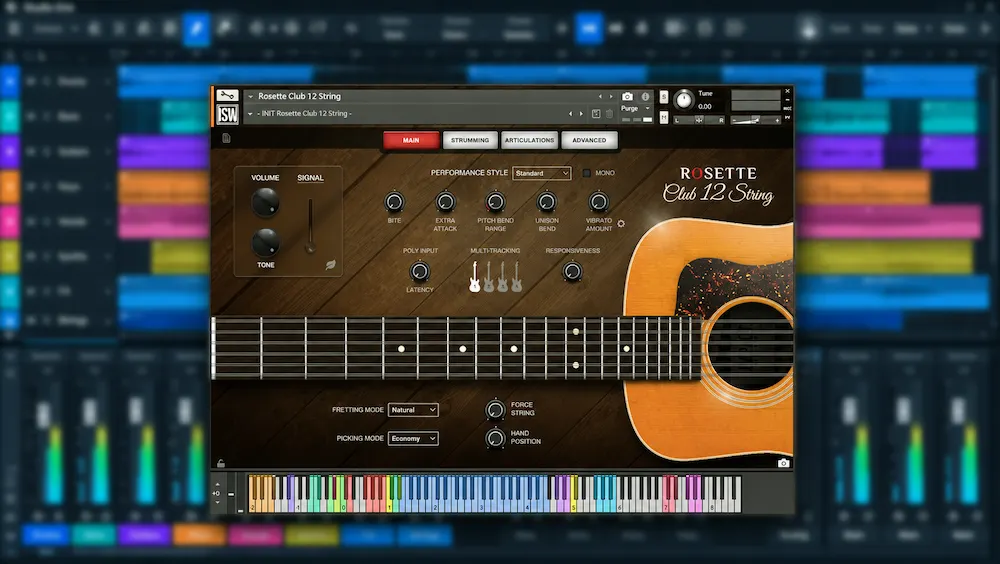
Impact Soundworks Rosette Club 12 String is a Kontakt instrument sampled from a 1973 Guild F212. Built around an acoustic adaptation of the company’s Shreddage 3.5 engine, it combines an extensive sample library with dedicated articulations, multiple microphone signals, and a keyboard-oriented performance mode. The design emphasizes control over individual notes and performance details rather than relying exclusively on preset strumming patterns.
That flexibility has practical implications for MIDI programming, but sample counts and feature lists cannot establish how naturally the instrument handles chord changes, repeated notes, or articulation transitions. Nor do they demonstrate whether its workflow is faster or its results more convincing than those of competing acoustic guitar libraries without comparative testing.
At its listed price of $159, the central question is whether Rosette Club 12 String offers enough expressive control and arrangement flexibility to justify choosing a dedicated 12-string instrument over a broader acoustic guitar library.
What Is Rosette Club 12 String?
 Impact Soundworks Rosette Club 12 String is a sample-based virtual guitar instrument designed for composers, songwriters, and producers who need a 12-string acoustic part without recording a physical instrument. Its value depends not just on the guitar’s tonal character, but on how well its samples and performance controls support the part being programmed.
A 12-string guitar pairs its strings in courses, typically combining unison strings with octave-paired strings in the lower courses. The interaction between these strings creates a denser, more complex sound than simply duplicating a six-string recording. In an arrangement, that character can add width and harmonic density to rock, pop, folk, Americana, country, and cinematic parts, although the result still depends on voicing, register, and how the part fits around other instruments.
Rosette Club 12 String is based on a Guild F212 built in 1973. Impact Soundworks describes the source instrument as having a resonant body and powerful attack. Those are manufacturer characterizations, not independently verified findings or evidence that the library outperforms competing virtual guitars.
According to the published specifications, the instrument runs in Kontakt or the free Kontakt Player version 7.6 or later. The stated requirements include 28 GB of disk space and 8 GB of RAM. The listed price is $159, with crossgrade discounts for eligible customers.
Sampling Architecture: Round Robins, Dynamic Layers, and Microphones
Impact Soundworks lists more than 15,000 24-bit samples, up to eight round robins, and five dynamic layers for Rosette Club 12 String. The library also provides multiple microphone signals and a range of guitar articulations. These figures describe the scale of the sample set, but they do not, on their own, establish how naturally the instrument responds to performance input.
For MIDI programming, the relevant question is how these resources behave across repeated notes, changing velocities, and articulation transitions. Sample count matters less than whether the available recordings cover the musical gestures in a part and switch between them convincingly.
Round Robins and Repeated Notes
Round robins rotate among alternative recordings when the same note is triggered repeatedly. This helps reduce the machine-gun effect that can occur when an identical attack repeats in a rhythmic pattern, particularly in exposed acoustic guitar parts.
According to the manufacturer, Rosette Club 12 String provides up to eight round robins. That creates the potential for more variation in repeated-note passages, but “up to” is important: the maximum does not confirm that every articulation or velocity layer has the same number of alternatives. Nor does the count alone establish how audible the variations are.
When evaluating a programmed guitar part, listen for repeated attacks that sound identical, abrupt changes between notes, and inconsistencies when switching articulations. Round-robin depth is one factor; the coverage and implementation of the samples matter just as much.
Dynamic Layers and Velocity Response
The library includes up to five dynamic layers. In a sample-based instrument, separate layers can capture changes in the guitar’s attack and tonal character at different playing intensities, rather than simply making one recording louder or quieter.
That distinction matters when programming a part that moves from a restrained accompaniment to a more forceful accent. Changes in picking intensity affect not only level but also transient character and perceived brightness. Multiple recorded layers can represent those differences, provided the velocity mapping and transitions between layers are convincing.
The number of dynamic layers does not establish how smoothly they transition. To assess the instrument’s practical response, compare soft notes, strong accents, and gradual velocity changes, paying attention to shifts in attack character and brightness as well as volume.
Microphone Blending
Impact Soundworks describes a stereo microphone pair intended to capture width and brightness, alongside a separate vintage microphone intended to emphasize the instrument’s body resonance. The library allows these microphone signals to be blended.
Blending the available signals provides a way to shape the source tone before adding EQ or other processing. A more prominent stereo pair may help the guitar retain articulation in a dense arrangement, while increasing the body-focused signal may add perceived weight. The useful balance depends on the part’s register, the arrangement, and how much space other instruments occupy.
More microphone options do not automatically mean a better result. A blend that sounds full in solo may build up low-mid energy in the mix or make the guitar harder to distinguish from bass, piano, or other acoustic instruments. The available information does not establish the phase relationships between the microphone signals, and no independent measurements were located for this review. Those aspects should not be assumed from the microphone descriptions alone.
Presets, Poly Input, and Console FX
Beyond the sample library itself, Impact Soundworks lists 24 dedicated presets, a Poly Input feature for chord performance, and Console, a modular effects rack and mixer. The documented effects include EQ, compression, modulation, spatial processing, distortion, reverbs, and more than 30 cabinet impulse responses. Console also supports saving and recalling effect chains, giving producers options for shaping the instrument within the library rather than relying exclusively on external processing.
These features broaden the instrument’s documented capabilities, but their presence does not establish how intuitive the interface is or how effective individual presets and effects sound in a finished production. Those questions require direct evaluation; the specifications establish the available tools, not their subjective quality.
Make Your Mix Translate With Clarity, Balance, and Definition
A detailed 12-string part can add harmonic richness and width, but it can also compete with vocals, percussion, and other instruments for space. Professional mastering helps assess the finished mix as a whole, with attention to tonal balance, transient definition, stereo image, and consistency across playback systems. Submit your track for a free mastering demo and upload up to 40 seconds of your mix to hear how a mastering approach could work with your material. Get Your Free Mastering Demo →
Workstation Fun: Keyboard-Oriented Guitar Performance
Workstation Fun is one of Rosette Club 12 String’s more distinctive advertised features. This performance mode is designed for keyboard players, with articulation selection that the manufacturer says responds to velocity. The aim is to make guitar-specific gestures more accessible without requiring the user to switch articulations entirely through manual programming.
Virtual guitar parts present a particular challenge for keyboard-based composition: even when a generator supplies guitar-oriented MIDI patterns, note duration, chord voicing, transitions between notes, slides, and the variation of repeated attacks all affect whether a part sounds like a plausible guitar performance or a sequence of MIDI events.
If Workstation Fun maps performance gestures and articulations effectively, it could reduce the amount of MIDI editing needed to shape a part. That would be especially useful for composers who work quickly at a keyboard but do not have the technique or time to program every guitar articulation individually.
The key distinction is between simplifying input and reproducing realistic playing behavior. Articulation selection alone cannot guarantee convincing note transitions, clean chord changes, or natural handling of overlapping notes and slides. The outcome also depends on how the instrument interprets the incoming MIDI data and how the part itself is programmed.
No controlled comparison is available to establish how Workstation Fun handles complex passages or how much corrective editing it requires relative to competing instruments. Its potential value is therefore best judged as a workflow advantage to evaluate, not as proof of superior guitar realism.
Articulations and MIDI Control
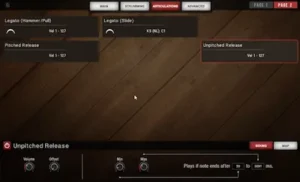 Impact Soundworks lists harmonics, chokes, slides, hammer-ons, pull-offs, tremolo, mutes, and release variations among the instrument’s articulations. Dedicated slide-up and slide-down options add further control over pitch transitions, which can help shape guitar phrases beyond static chord voicings.
Articulation affects more than the attack of a note. It determines how notes connect, sustain, and decay, all of which contribute to the impression of a played performance. A sustained chord may suit a slow introduction, while a more active passage may need slides, hammer-ons, pull-offs, or changes in note length to preserve a sense of continuous movement.
For rhythmic parts, variation in articulation and note endings can also help avoid a uniform, loop-like result. Release samples are relevant here because the sound that follows a note-off event can influence how naturally a phrase stops, particularly when the arrangement leaves the guitar exposed.
The listed techniques provide a range of expressive options, but their presence alone does not establish how naturally they transition or how consistently they behave across performance modes. The published feature list also does not explain the exact MIDI triggers or switching logic for every articulation.
For producers evaluating the library, the practical consideration is how efficiently these options can be used in a typical arrangement. Detailed control is valuable when it allows a phrase to be shaped convincingly without requiring excessive manual editing. That balance depends on both the articulation implementation and the complexity of the part being programmed.
Using a Virtual 12-String Guitar in a Mix
Rosette Club 12 String is an arrangement tool first and foremost. Its practical value lies in how its tonal character, articulation, and performance dynamics serve the musical part—not in the size of its sample library.
Managing Upper-Midrange Density
A bright 12-string guitar can compete with vocal presence, cymbal detail, keyboards, and other guitars. When an arrangement already feels crowded, understanding frequency balance in the mix can help identify whether the problem comes from excessive high-frequency energy or overlapping contributions from several instruments.
Start by checking the part’s level, register, and voicing. Simplifying the guitar arrangement or adjusting its microphone blend may create more separation than aggressive EQ. If processing is needed, make decisions in the context of the full mix rather than judging brightness in solo.
A dedicated 12-string instrument does not automatically solve masking. Its paired-string character can add harmonic density, but the arrangement still needs enough space for that density to serve the track.
Controlling the Attack
Impact Soundworks describes the sampled Guild F212 as having a powerful attack. A defined transient can help rhythmic parts establish a clear pulse, especially when the guitar carries an important role in the groove.
In a dense section, however, a pronounced attack may compete with snare transients, percussion, or pick attacks from other string parts. Whether it helps or distracts depends on the guitar’s rhythmic role, its programmed dynamics, and the surrounding arrangement.
The advertised dynamic layers and microphone controls offer potential ways to shape the instrument’s response and tonal balance. Their practical effectiveness should be assessed with representative musical passages; the specifications alone do not establish how much control they provide over the attack.
Stereo Width and Layering
The library’s microphone setup is designed to provide different tonal perspectives, including a stereo pair and a separate vintage microphone. Blending these signals may help balance spatial character and body resonance, although the actual result depends on the recorded signals and their interaction.
Layering a virtual 12-string with another guitar can add harmonic density, but it can also blur articulation and crowd the arrangement. The result depends on voicing, register, timing, tuning, and whether each part has a distinct musical role. Doubling the same line does not guarantee a wider or more defined sound.
When evaluating stereo width in a mix, check layered guitars in both stereo and mono. A part that sounds broad on headphones may contribute less clearly through a mono playback system, and any phase interaction between layers can change the combined tone. Judge the result by how clearly the guitar supports the arrangement, not by width alone.
Rosette Club 12 String vs. Strummed Acoustic 2
Native Instruments Session Guitarist – Strummed Acoustic 2 is a relevant alternative for producers who need a virtual acoustic guitar with a 12-string option. Both libraries cover that tonal territory, but their advertised feature sets suggest different approaches to performance programming.
Rosette Club 12 String focuses on a dedicated 12-string instrument, with extensive sampling, multiple articulations, microphone blending, and a keyboard-oriented performance mode. Strummed Acoustic 2 includes both six- and 12-string guitars and more than 160 advertised strumming patterns. That pattern-based approach is particularly relevant when the goal is to build a rhythmic accompaniment without programming every strum note by note.
| Feature | Rosette Club 12 String | Strummed Acoustic 2 |
|---|---|---|
| Listed price | $159 | $99 |
| 12-string guitar | Yes | Yes |
| Six-string guitar included | Not indicated as included | Yes |
| Strumming patterns | Not established as a core feature | More than 160 advertised patterns |
| Performance emphasis | Sampling depth and articulation control | Pattern-based strumming and performance controls |
| Best-fit workflow | Programming and shaping individual guitar parts | Building rhythmic accompaniment quickly from prepared patterns |
At the listed prices, Rosette Club 12 String costs $60 more than Strummed Acoustic 2. That premium may make sense for producers who specifically need its dedicated 12-string sampling and articulation options. If the main requirement is quickly assembling a strummed backing part, Strummed Acoustic 2’s pattern library may be the more direct workflow fit. Neither approach is inherently better; the choice depends on how much control the arrangement requires and how the producer prefers to work.
The feature lists do not establish which library sounds more realistic. A meaningful comparison would use comparable musical parts, level-matched playback, and close evaluation of attack variation, note transitions, timing, tonal balance, and the amount of MIDI editing required. Without that testing, claims of sonic superiority would be premature.
Recording a real acoustic 12-string is another option. A physical instrument captures the player’s phrasing and natural interaction between strings, but it requires access to a suitable guitar, a performance, and an appropriate recording setup. Whether that route is preferable depends on the available resources, the required level of control, and the production schedule.
Compatibility, Storage, and Ownership Considerations
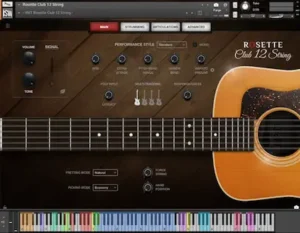 Impact Soundworks lists Kontakt Player 7.6 or later as the required host environment, along with 8 GB of RAM and 28 GB of disk space. The manufacturer recommends using a 7200 RPM hard drive or an SSD.
The 28 GB storage requirement is relevant for producers managing several large sample libraries, especially on systems with limited internal storage. However, library size alone says little about performance or efficiency. Storage requirements reflect factors such as the number and length of recordings, sample format, and the library’s overall content; they do not establish CPU load, loading speed, or playback stability.
Before purchasing, check the current Kontakt Player requirements alongside the operating system and DAW configuration used in your studio. A stated minimum Kontakt version does not, by itself, guarantee compatibility with every operating system, DAW release, or computer setup.
Impact Soundworks identifies Pulse Downloader as its digital delivery method and Native Access as the registration route for Kontakt Player-compatible products. Its general support information states that downloaded digital libraries are generally nonrefundable, while undownloaded orders may be reviewed by support. Because refund terms and exceptions can change, confirm the policy applicable to the specific purchase before ordering.
Overall Rating
These ratings assess the documented feature set and its suitability for the instrument’s intended production tasks. They are editorial judgments based on available specifications, not scores from independent listening tests, measurements, or controlled comparisons with competing libraries.
| Category | Rating |
|---|---|
| Sample Library Depth | 8.5/10 |
| Articulation Range & Control | 8.3/10 |
| Dynamic Response Design | 8.0/10 |
| Performance Input & Expression | 8.1/10 |
| Microphone Blending & Tonal Shaping | 7.8/10 |
| Overall | 8.1/10 |
The library’s stated sample count, round robins, and multiple dynamic layers provide a substantial foundation for varied note playback, although the specifications do not establish how convincingly the variations sound in practice.
Harmonics, slides, hammer-ons, pull-offs, tremolo, mutes, and release variations offer useful options for shaping phrases beyond static chord playback, while the exact switching behavior and consistency of transitions remain unverified.
Five advertised dynamic layers provide a framework for representing different playing intensities, but their number alone does not demonstrate smooth velocity transitions or realistic changes in picking character.
The Workstation Fun mode is designed to make guitar-oriented performance more accessible from a keyboard, with velocity-responsive articulation selection. Its practical advantage depends on how effectively it handles complex phrases and reduces corrective MIDI editing.
The stereo microphone pair and separate vintage microphone provide options for adjusting spatial character and body emphasis. Without independent listening tests or documented phase measurements, the effectiveness of these blends cannot be established conclusively.
Rosette Club 12 String presents a well-developed feature set for producers who need a dedicated sampled acoustic 12-string with detailed articulation and performance controls. Its strongest documented advantages are the breadth of its sampling architecture and the range of available performance options. The main limitation is evidential: specifications cannot confirm realistic playback, seamless transitions, or reduced editing time. It is most relevant to users who regularly program individual 12-string parts rather than relying primarily on preset strumming patterns.
Who Should Buy Rosette Club 12 String?
Rosette Club 12 String is most relevant to composers and producers who regularly need a dedicated acoustic 12-string sound and want control over how individual parts are programmed. Its advertised sampling depth, range of articulations, microphone blending, and keyboard-oriented performance mode are aimed at users who want to shape their own performances rather than depend entirely on preset strumming patterns.
It may also suit scoring, songwriting, and production workflows where guitar parts need to remain editable and recallable across revisions. A sample-based instrument can provide a practical alternative when a physical 12-string guitar or a suitable recording setup is unavailable, although the result still depends on MIDI programming and the instrument’s response to it.
The case is weaker for producers who need only occasional strummed accompaniment, already own a capable acoustic guitar library, or expect a sampled instrument to reproduce every nuance of a guitarist’s performance without editing. In those situations, the additional controls may offer little practical benefit.
The $159 listed price makes most sense when a dedicated 12-string instrument fills a recurring production need. For an occasional background layer, an existing library or a lower-cost alternative may be sufficient. The decision should rest on the parts you need to create and the degree of control your workflow actually requires—not on the sample count alone.
Frequently Asked Questions
Does Rosette Club 12 String work with the free Kontakt Player?
According to Impact Soundworks, the library supports Kontakt Player 7.6 or later. Before purchasing, check the current system requirements for your operating system and DAW setup.
How much storage space does Rosette Club 12 String require?
The published requirements specify 28 GB of disk space and 8 GB of RAM. Impact Soundworks recommends a 7200 RPM hard drive or an SSD.
Can Rosette Club 12 String replace a real acoustic 12-string guitar?
It can provide a recallable sampled guitar part without requiring a physical instrument or recording session. However, it should not be assumed to reproduce every nuance of a live performance, and expressive or technically complex parts may require MIDI editing.
What is Workstation Fun designed to do?
Workstation Fun is a keyboard-oriented performance mode that the manufacturer describes as translating expressive keyboard input into guitar-style playing, with articulation selection responding to velocity. Its effectiveness with complex passages has not been independently established.
Is Rosette Club 12 String better than Strummed Acoustic 2?
There is insufficient comparative testing to declare an overall winner. Rosette Club 12 String emphasizes a dedicated 12-string instrument and detailed articulation control, while Strummed Acoustic 2 includes six- and 12-string guitars and more than 160 advertised strumming patterns. The better fit depends on whether you need detailed note-level programming or a pattern-driven strumming workflow.
Is the $159 price justified?
The listed price is easier to justify for producers who regularly need a dedicated 12-string instrument and expect to use its articulation and performance controls. If you mainly need ready-made strumming patterns or an occasional acoustic layer, compare less expensive alternatives and your existing libraries first.
Does the library require a powerful computer?
The manufacturer specifies 8 GB of RAM and 28 GB of disk space and recommends a 7200 RPM drive or SSD. Independent CPU and memory benchmarks were not available for this review, so these specifications do not establish how efficiently the library performs in large sessions.
Final Verdict: A Specialized Tool for Detailed 12-String Programming
Impact Soundworks Rosette Club 12 String targets producers who need a dedicated virtual acoustic 12-string guitar with detailed performance controls. Its advertised combination of extensive sampling, multiple articulations, microphone blending, and the Workstation Fun mode gives it a clear role in MIDI-based composition and production.
Its main appeal is the opportunity to shape a 12-string part through articulation and performance controls rather than relying solely on preset strumming patterns. The key uncertainty is how convincingly those features translate into realistic performances and how much editing they require. Without independent comparative testing, claims about its realism, reliability, or superiority over competing libraries remain unproven.
At the listed price of $159, Rosette Club 12 String is best considered a specialized purchase, not a default recommendation for every producer. It is most relevant to users who regularly program editable 12-string parts and expect to use the instrument’s specific controls. Producers who mainly need quick strummed accompaniment should compare pattern-based alternatives before investing in a dedicated library.
Hear What Your Mix Reveals Before Mastering
A carefully programmed 12-string can add width and harmonic detail, yet the same density can mask vocals, soften separation between instruments, or make transients compete across the arrangement. Another plugin or another round of processing is not always the answer; first, it helps to hear how your finished mix responds to mastering. Submit up to 40 seconds of your track for a free mastering demo prepared by a real mastering engineer, then compare the original with the mastered version to evaluate changes in tonal balance, punch, stereo presentation, and overall translation. The result will depend on the source mix, but a direct comparison gives you a practical basis for deciding what your track needs next. Upload Your Mix for a Free Mastering Demo →

Yurii Ariefiev approaches virtual guitar instruments from an audio engineering perspective, with attention to transient consistency, tonal density, and how individual parts translate within a full arrangement. For sampled 12-string guitars, the important distinction is between technical features and convincing performance behavior: note transitions, dynamic response, and articulation changes must work together without making the part sound mechanically programmed.
Enjoyed this review?
If you found it useful, you can support independent audio research with a coffee.
☕ Buy me a coffee