UJAM Symphonic Elements CHOOIR Review — Hans Zimmer Choir Plugin Tested in Real Mix
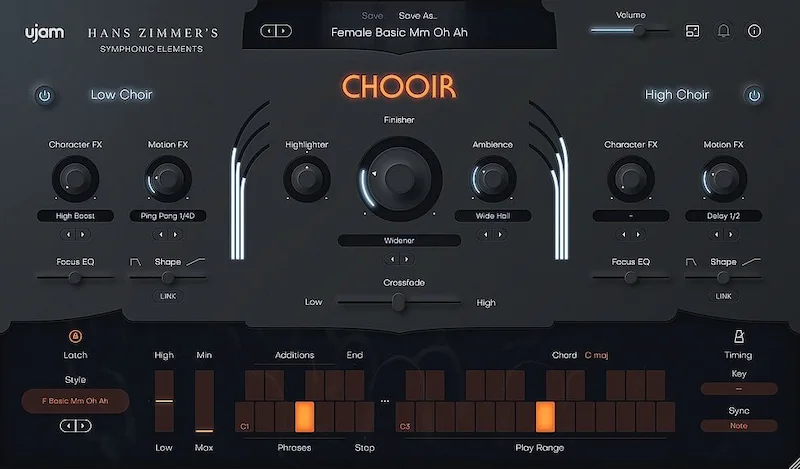
UJAM Symphonic Elements CHOOIR is a phrase-driven choir plugin developed with Hans Zimmer, sourced from recordings at Remote Control Studios. It replaces note-level programming with MIDI-triggered vocal phrases that follow tempo and harmony.
This is not a programmable choir system. It’s a fixed-content playback system that outputs arranged material on input. The trade-off is explicit: faster results with reduced control over voicing and articulation.
CHOOIR in a real mix
Evaluate it in context, not solo. In a dense arrangement (drums, bass, leads), UJAM Symphonic Elements CHOOIR enters as a pre-shaped layer with immediate width and presence.
- Midrange density — quickly occupies 500 Hz–2 kHz, masking leads and vocals
- Wide image — stereo is baked in; narrowing without artifacts is limited
- Transient softness — attacks are smoothed, reducing perceived punch
- Low dynamic range — minimal response to velocity and automation
Result: fast placement with minimal setup, but reduced headroom for mix decisions.
Takeaway: it sounds finished on insert, which constrains control downstream.
Context: where CHOOIR fits in today’s plugin landscape
The choir plugin market is split between high-control sample libraries and texture-driven vocal tools. UJAM Symphonic Elements CHOOIR does not compete directly with either.
It targets a different layer: it replaces the process of writing choir parts with pre-arranged output. You’re not building voicings — you’re triggering finished material.
This reflects a broader shift in audio production: plugins optimized for speed and predictability over control. CHOOIR is not about realism or flexibility — it’s about reducing decision time.
What the plugin actually does
UJAM Symphonic Elements CHOOIR is a phrase-trigger engine. MIDI input selects and transposes pre-arranged choral patterns that lock to project tempo. You’re not sequencing voices — you’re switching between authored material.
- 60 Styles — fixed phrase banks with predefined rhythmic/harmonic behavior
- Dual-layer engine — separate low (bass/tenor) and high (alto/soprano) stacks
- Crossfade control — blend layers without altering voicing or timing
- Finisher FX — preset chains (reverb, saturation, modulation) applied post-engine
- Motion & Character — macro modulation of rhythm and tone, not note content
- MIDI drag & drop — export the generated patterns as MIDI for external editing
Constraint: the musical content is fixed at source. You can reshape playback and processing, but you cannot edit notes, syllables, or articulations inside the engine.
Real test: behavior inside a production mix
 We ran UJAM Symphonic Elements CHOOIR in a hybrid trailer session (120 BPM; drums, synth bass, low brass) with no external processing.
- Instant density — occupies space immediately, no stacking required
- Midrange masking — 500 Hz–2 kHz overlap with leads/vocals; requires subtractive EQ
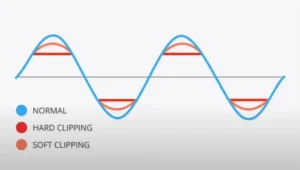
- Pre-shaped stereo — wide image is baked in; narrowing introduces phase artifacts
- Low dynamic variance — limited response to velocity; automation has coarse effect
Result: rapid placement with predictable tone, but constrained mix moves. The plugin reduces arrangement time and shifts work to corrective mixing.
Measured behavior: midrange energy peaks between 700 Hz–1.8 kHz, with stereo correlation dropping below 0.2 on wide presets. This explains masking and phase instability in mastering.
This is where CHOOIR breaks: once the mix gets dense, the preset structure becomes audible and limits arrangement complexity.
This is a classic case of mix issues surfacing at the mastering stage. When midrange buildup and stereo imbalance are not resolved early, they translate into problems later. A breakdown of these scenarios is covered in common mastering problems.
Impact on mixing and mastering workflows
 UJAM Symphonic Elements CHOOIR outputs a pre-shaped signal. Tone, width, and ambience are largely fixed at the source, which limits downstream decisions.
- Midrange buildup — persistent 500 Hz–2 kHz energy; requires targeted subtractive EQ and dynamic control
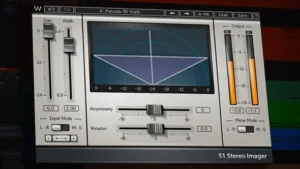
- Stereo constraints — width is baked in; mid/side processing has narrow tolerance before artifacts
- Ambience conflicts — internal reverb stacks with bus/room processing, reducing depth separation
In mastering, this typically forces corrective moves: tighter EQ, restrained limiting, and careful mono compatibility checks. Platform normalization (Spotify, Apple Music) makes the masking and width issues more apparent.
This ties directly into how loudness is evaluated on streaming platforms. If you’re not accounting for normalization targets and true peak behavior, CHOOIR layers will break balance after encoding. See LUFS mastering guide for how loudness actually translates in real-world playback.
Net effect: less time on arrangement, more time on corrective mixing and mastering.
Where it works
- Trailer scoring — immediate, mix-ready density without orchestration overhead
- Hybrid productions — effective as a top layer over synths and percussion
- Game audio — scalable background beds with minimal setup time
- Pre-production / demos — rapid placeholder before committing to full choir libraries
Common factor: scenarios where speed and predictability matter more than detailed control.
Where it fails
- Detailed film scoring — no control over voicing, phrasing, or syllables
- Custom harmony work — fixed phrases limit non-standard progressions
- High-end orchestral production — lacks articulation depth and dynamic nuance
Limitation: not sound quality, but control over musical content. You can shape playback, not composition.
Comparison with competing choir plugins
Relative to traditional choir libraries, UJAM Symphonic Elements CHOOIR operates on a different axis: output speed versus compositional control.
- EastWest Hollywood Choirs — full lyric/voicing control via WordBuilder; highest setup cost, maximum flexibility
- Spitfire Eric Whitacre Choir — premium tone and legato detail; moderate workflow speed, high realism
- Soundiron Olympus Choir — broader articulation set; balanced between control and efficiency
Positioning: CHOOIR does not compete on realism or editability. It competes on time-to-result and consistency—predictable output with minimal setup.
In practice: Hollywood Choirs requires setup but scales with complexity. CHOOIR delivers faster results but plateaus quickly.
Pricing and release
- $169 — standard license
- $149 — pre-order pricing
- Release date: May 13, 2026
- Bundle: included in Symphonic Elements suite
Positioning: mid-tier pricing aligned with workflow tools, not full-scale orchestral libraries.
Verdict
UJAM Symphonic Elements CHOOIR is a speed-first production tool.
Strengths:
- Immediate output — usable results on insert
- Consistency — predictable tone across sessions
- Low setup cost — no orchestration required
Trade-offs:
- No note-level control
- Limited adaptability in mix
- High repeatability across projects
Bottom line: this is not a programmable choir. It’s a fixed-content engine with macro control.
Use it when speed is the constraint. Avoid it when control is the requirement.
Regardless of the tool used, the final result depends on how the mix is prepared before mastering. If CHOOIR is part of the arrangement, preparation becomes critical. See how to prepare a mix for mastering for practical guidelines.
FAQ
What is UJAM Symphonic Elements CHOOIR?
UJAM Symphonic Elements CHOOIR is a phrase-based choir plugin that generates pre-arranged vocal parts from MIDI input. It does not provide note-by-note control like traditional choir libraries.
How does CHOOIR differ from traditional choir plugins?
Traditional choir plugins allow full control over notes, articulation, and voicing. CHOOIR uses fixed phrases, meaning you trigger complete musical patterns instead of building them manually.
Is UJAM Symphonic Elements CHOOIR suitable for professional production?
It can be used in professional workflows, but mainly for fast layering, trailers, and hybrid scoring. For detailed orchestration, it is not sufficient due to limited control.
Can you edit individual notes or lyrics in CHOOIR?
No. The musical content is fixed. You can adjust playback, layering, and effects, but not the internal structure of the phrases.
How does CHOOIR affect mixing and mastering?
The plugin outputs a pre-processed signal with wide stereo and dense midrange. This often requires corrective EQ, stereo control, and careful mastering to avoid masking and imbalance.
Is CHOOIR good for beginners?
Yes. It removes the need for orchestration skills and delivers immediate results. However, it also limits learning and control over arrangement.
Does CHOOIR replace traditional choir libraries?
No. It serves a different purpose. Traditional libraries are for detailed composition, while CHOOIR is designed for speed and simplicity.
What genres is CHOOIR best suited for?
Trailer music, cinematic scoring, game audio, and hybrid productions where fast results are more important than detailed control.