Warm Audio Reamper Review: Hybrid Re-Amping, Pedal Integration and Modern Studio Workflow
Modern production workflows are increasingly disconnected from the hardware behavior that originally shaped recorded music. Guitars are tracked direct, synths remain entirely in-the-box, pedals get replaced by plugins, and tube amplifiers rarely operate near their actual dynamic range because most studios can’t justify the volume. The technical result is cleaner production. The sonic result is often flatter transient behavior, less dimensional harmonic movement and mixes that feel overly controlled under heavy digital processing.
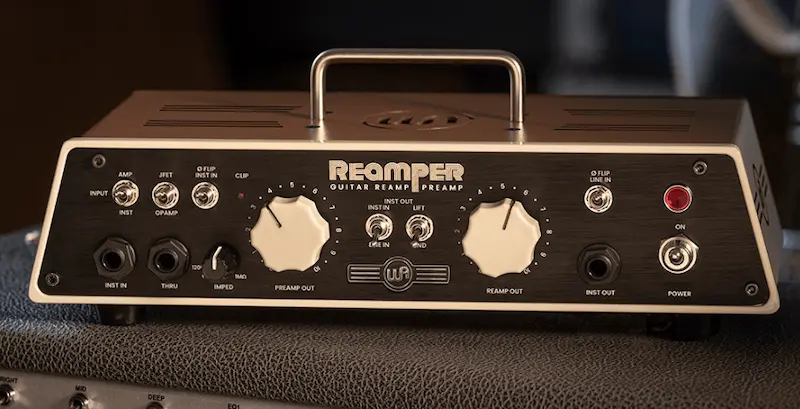
The Warm Audio Reamper is designed around that exact problem. On the surface, it looks like a conventional re-amping box. In practice, it functions more like a hybrid routing system built to connect instrument-level hardware with modern DAW-based production environments. Alongside standard re-amping duties, the unit combines pedal integration, variable impedance handling, instrument preamp functionality and silent tube amp capture into a single analog signal path.
Re-amping is no longer limited to guitar production. Modern engineers routinely route drum busses through amps, process vocals with modulation pedals, re-amp synths for harmonic instability and use hardware saturation as an alternative to stacking increasingly predictable analog-modeling plugins. The Reamper enters a market where routing flexibility has become just as important as sound quality itself.
The more important question, however, is whether an all-in-one workflow device can realistically replace dedicated specialist hardware — or whether convenience introduces compromises that experienced engineers will immediately notice under serious mixing and production conditions.
- Why Re-Amping Became Relevant Again in Modern Production
- What the Warm Audio Reamper Actually Brings to a Studio Workflow
- The Technical Reality Behind Re-Amping: Impedance Interaction
- Why Guitar Pedals Are Showing Up Inside Modern Mixing Workflows
- The Built-In Power Soak and Silent Amp Capture Workflow
- Where the Reamper’s Marketing Simplifies Reality
- How the Reamper Fits Into Modern Mixing and Mastering Workflows
- Competitive Positioning and Real-World Use Cases
- Verdict
- FAQ
Why Re-Amping Became Relevant Again in Modern Audio Production
Re-amping used to be a niche engineering technique mostly associated with rock and metal guitar production. Engineers tracked clean DI signals, sent them back through amplifiers later and adjusted tone during mixing instead of locking decisions during recording. That workflow still exists, but the role of re-amping inside modern production has changed significantly.
Today, re-amping is increasingly used as a nonlinear processing stage across entire mixes rather than as a guitar-only tool. Producers route synths through fuzz circuits, slam drum busses into small combo amps, process vocals through modulation pedals and use speaker interaction as a form of transient shaping that plugins still struggle to reproduce convincingly.
The reason is less about nostalgia and more about the limitations of modern in-the-box production.
Many producers blame plugins for sterile mixes when the actual problem is excessive transient control and arrangement density.
Large DAW sessions built entirely around analog-modeling plugins often develop the same problems:
- Transient response becomes overly uniform.
- Harmonic movement stays too stable under compression.
- Parallel saturation chains start collapsing depth instead of adding dimension.
- Midrange density increases while perceived size decreases.
- CPU-heavy processing introduces latency management and workflow friction.
Real hardware behaves differently because the signal path remains electrically reactive. Pedals, transformers, amplifiers and speaker loads constantly influence each other in ways that are difficult to fully replicate inside static plugin architectures.
That interaction becomes especially noticeable in modern streaming workflows where codec conversion, loudness normalization and aggressive limiting tend to expose flat harmonic structures very quickly. Hardware re-amping is increasingly being used not to “add warmth,” but to restore movement, instability and dynamic variation inside hyper-controlled digital mixes.
This is the market the Warm Audio Reamper is actually entering. Not simply guitar recording, but the broader shift toward hybrid production workflows where engineers want faster integration between DAWs, pedals, amplifiers and analog processing chains without building an entire studio around complex patchbay infrastructure.
What the Warm Audio Reamper Actually Brings to a Studio Workflow
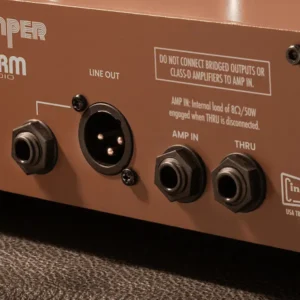 The Warm Audio Reamper is positioned as more than a standard re-amp box, and the hardware layout reflects that. Instead of focusing on a single task, the unit combines several functions that normally require separate pieces of gear and additional routing infrastructure.
The feature set includes:
- Traditional DAW-to-amp re-amping
- Dedicated instrument preamp circuitry
- Balanced line-level to pedal-level conversion
- Pedal-to-studio hardware integration
- Built-in 50W / 8Ω power soak functionality
- Variable impedance control
- Independent instrument and re-amp signal paths
The independent signal architecture is arguably the most important part of the design. Many lower-cost re-amp devices solve only one technical problem: converting balanced line-level output into something a guitar amplifier can accept without impedance issues. The Reamper attempts to handle both directions of the workflow simultaneously — from instruments into the studio environment and from the DAW back into analog hardware.
Modern hybrid production is rarely limited by sound quality alone. More often, sessions break down at the routing stage.
Integrating pedals, amplifiers and instrument-level hardware into professional DAW environments creates multiple technical problems at once:
- Improper gain staging
- Noise accumulation
- Ground loop issues
- Impedance mismatch
- Level inconsistency between mono and stereo chains
- Unstable transient response under analog saturation
Most improvised setups technically work, but they rarely behave predictably once sessions become complex. This unpredictability is one reason many producers eventually abandon external hardware and default back to plugins, even when the sonic results feel less dimensional.
The Reamper is clearly designed to reduce that friction by functioning as a central translation layer between instrument-level hardware and balanced studio signal paths rather than as a single-purpose guitar utility.
The Technical Reality Behind Re-Amping: Impedance Interaction
Most marketing around re-amping eventually collapses into vague language about “analog warmth.” From an engineering perspective, that explanation is mostly useless. The real issue is impedance interaction and how analog circuits respond dynamically under changing electrical loads.
Passive pickups, pedals, transformers and amplifier input stages do not behave as isolated processors. They continuously influence each other depending on output level, source impedance, cable capacitance and gain structure across the entire signal path.
That interaction directly affects:
- Transient attack behavior
- Low-frequency damping
- Upper-midrange harshness
- Harmonic saturation density
- Compression response under dynamic playing
- Perceived depth and separation
This is one reason many plugin-based saturation chains start sounding increasingly two-dimensional as sessions become denser. Most software models recreate isolated stages of analog coloration reasonably well, but they rarely reproduce the constantly shifting electrical relationships between pedals, amplifiers and instrument-level circuits under real signal conditions.
The Reamper’s variable impedance design is therefore more important than the product marketing makes it sound. In practical use, impedance behavior often determines whether external hardware feels physically reactive or simply distorted.
The difference becomes obvious in modern production workflows where re-amping is used less for traditional guitar tone and more for nonlinear mix processing. Soft synth pads are another common re-amping target. Many virtual instruments sound overly stable in dense arrangements, and routing them through pedals or small tube amplifiers can introduce movement that survives compression more naturally.
Common examples include:
- 808 saturation through small tube amps
- Parallel drum bus distortion
- Dynamic vocal processing through stompboxes
- Synth re-amping for harmonic instability
- Passive pickup instruments with low-output signals
Most modern re-amping discussions obsess over tone.
In practice, routing stability matters more once sessions become large enough.
Cheap re-amp circuits tend to expose the worst parts of those workflows. Transients flatten, low-end response loses control and upper mids become brittle once gain staging gets aggressive. The result often sounds smaller instead of heavier.
Higher-quality re-amping systems preserve movement inside the signal path. Harmonics remain unstable in a useful way, compression reacts more naturally and the interaction between pedals and amplifiers retains depth instead of collapsing into static saturation.
The inclusion of CineMag transformers on both stages suggests Warm Audio understands that serious users are not simply looking for added coloration. They are looking for believable electrical interaction between studio-level and instrument-level hardware without the disconnected feel that cheaper routing devices often introduce.
Why Guitar Pedals Are Showing Up Inside Modern Mixing Workflows
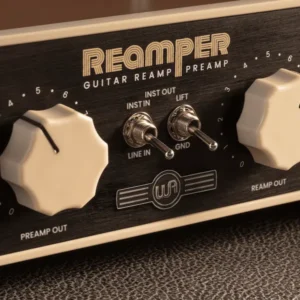 One of the more interesting aspects of the Warm Audio Reamper has very little to do with traditional guitar recording. Its real relevance may be in how easily it integrates pedals into modern mixing and production environments.
Over the last several years, pedals have increasingly moved beyond instrument rigs and into parallel mix processing. Engineers now run drum busses through fuzz circuits, vocals through chorus and vibrato pedals, synths through analog delays and entire stereo stems through overloaded amp chains to introduce instability that standard plugin processing often struggles to generate naturally.
The reason is partly technical and partly psychological.
Modern DAW sessions tend to become hyper-controlled very quickly. The problem is not saturation anymore. Timing is quantized, automation is sample-accurate, transient shaping becomes predictable and saturation chains behave identically every playback pass. Even high-end analog-modeling plugins often maintain a level of consistency that starts collapsing depth once dozens of nonlinear processors stack together inside dense mixes.
Pedals behave differently because most of them were never designed for clean studio integration in the first place. Their imperfections become part of the result.
A fuzz pedal reacting to a drum parallel bus will compress differently depending on transient spikes. Analog modulation circuits drift slightly under changing signal levels. Delay repeats smear unpredictably under saturation. Small impedance shifts alter how aggressively pedals respond to synth transients and vocal consonants.
Those micro-instabilities are difficult to fully emulate inside static digital processing chains, especially once aggressive limiting and streaming codec conversion start reducing low-level detail during playback.
One practical example is running a parallel drum crush chain through a small combo amp while blending the return underneath the dry bus. The instability created by the speaker interaction often feels less static than plugin distortion under aggressive limiting.
The problem has traditionally been integration.
This is where many hybrid setups fail.
Most pedals operate at instrument level, while professional studio hardware and DAW outputs run balanced line level. Improvised routing usually creates some combination of:
- Ground-loop noise
- Phase shift between parallel hardware returns
- Stereo image collapse from mono pedal chains
- Improper line-level conversion
- Converter clipping before amplifier input
- Noisy pedalboard power supplies
These issues are one reason many hybrid workflows sound impressive in isolation but collapse once inserted into full production sessions.
Ground loops alone can destroy otherwise excellent re-amping chains once multiple pedals and balanced outputs enter the same routing environment.
The Reamper is clearly designed to remove that barrier by allowing pedals to function more naturally inside balanced studio workflows without requiring ad-hoc routing workarounds every session.
The result is a much more practical hardware workflow for:
- Hybrid mix engineers building analog parallel chains
- Electronic producers using pedals for texture design
- Film and game composers creating unstable atmospheres
- Sound designers processing synth layers through hardware
- Studios integrating instrument-level hardware into DAW-centric production systems
In that context, the Reamper feels less like a guitar utility and more like a modern hardware translation layer between pedals, amplifiers and contemporary digital production workflows.
The Built-In Power Soak May Be the Most Practical Feature in the Entire Unit
The Reamper’s integrated 50W / 8Ω power soak is easy to overlook beside the routing and pedal integration features, but from a real-world production perspective, it may solve the most important problem in the entire device.
Tube amplifiers behave very differently once the power section starts working hard. Preamp saturation alone does not recreate the same transient sag, low-frequency bloom, harmonic compression or dynamic softness that develops when the output stage approaches its nonlinear operating range.
That distinction matters because many recorded guitar tones people associate with “real amp sound” are actually power-stage behaviors rather than preamp distortion.
The problem is volume.
Capturing a pushed tube amp properly usually requires sound pressure levels that are unrealistic for:
- Home studios
- Apartment production setups
- Late-night tracking sessions
- DAW-centered hybrid studios
- Content production environments
As a result, many modern recordings rely heavily on low-volume amp tracking, reactive load systems or fully digital amp simulation chains. Some solutions sound excellent. Others lose the physical interaction that makes real amplifiers feel dynamically alive under aggressive playing or dense mix conditions.
The Reamper’s silent load functionality is designed to address that gap by allowing users to push an amplifier’s output stage without requiring a speaker cabinet operating at full volume. Some engineers also track a clean DI safety signal while monitoring through a pushed tube combo in real time, allowing performance decisions to remain connected to amplifier dynamics without permanently committing the printed tone.
However, this is also where the engineering discussion becomes more complicated than the marketing.
Not all load systems respond the same way under real amplifier conditions. The quality of the reactive load directly affects:
- Power amp compression behavior
- Low-frequency resonance
- Transient realism
- Top-end smoothness
- Cab simulation response
- Perceived “feel” under dynamic playing
Cheap resistive loads often flatten amplifier response and create an unnaturally stiff upper midrange. Better reactive designs preserve some of the electrical interaction that normally exists between an amplifier and a real speaker cabinet.
Unlike dedicated reactive load systems from Two Notes, Fryette or Universal Audio’s OX Box, the Reamper appears designed more around workflow flexibility than absolute cabinet interaction realism. Those products are built specifically around speaker-load realism and advanced cabinet interaction.
The Reamper approaches the problem differently. Its silent amp capture functionality appears designed primarily around workflow efficiency and hybrid studio practicality rather than absolute reactive-load accuracy.
For many producers, that tradeoff will make complete sense. The ability to track real tube amps silently inside a modern DAW workflow without additional hardware complexity is valuable on its own — especially for smaller studios where speed and flexibility matter more than building a fully isolated amp room.
Where the Reamper’s Marketing Simplifies the Reality
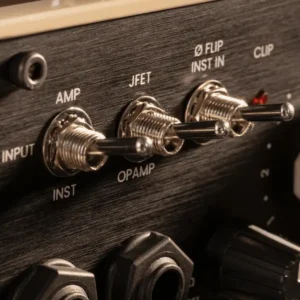 Every all-in-one studio device faces the same problem: the broader the feature list becomes, the harder it is for every section of the hardware to compete with dedicated specialist gear.
The Warm Audio Reamper is no exception.
Its strongest argument is not that it outperforms elite standalone products in every category. Some hybrid setups sound worse than plugins because the analog chain is never gain-matched correctly in the first place. The real advantage is workflow consolidation. The unit reduces the technical friction between DAWs, pedals, amplifiers and instrument-level hardware enough that hybrid processing becomes practical inside everyday production sessions.
That distinction matters because convenience and technical performance are not always the same thing.
There are still legitimate reasons experienced engineers may prefer separate dedicated systems:
- High-end re-amp boxes often preserve transients more transparently under aggressive gain staging.
- Premium reactive load systems usually provide more convincing speaker interaction and power-amp realism.
- Dedicated DI stages can offer lower self-noise, wider headroom and more stable impedance behavior.
- Advanced routing ecosystems allow more complex parallel hardware integration across large sessions.
Those differences become increasingly noticeable in high-resolution monitoring environments where subtle changes in transient depth, harmonic movement and stereo stability are easier to evaluate critically.
Pedals inserted into line-level studio chains without proper impedance handling often create the illusion of analog depth while actually reducing transient clarity.
Many studios are not struggling because their gear lacks ultimate fidelity.
They are struggling because complex analog workflows interrupt creative momentum.
That is where the Reamper becomes more interesting.
A technically perfect hybrid chain that takes twenty minutes to reconnect rarely survives real production deadlines. Most producers eventually default back to plugins because external hardware routing becomes tedious once sessions scale beyond a few isolated effects passes.
The Reamper appears designed around solving that behavioral problem as much as the technical one. Instead of functioning as a boutique mastering-grade utility, it operates more like a central access point between instrument hardware and DAW-based production.
For many modern producers, that tradeoff is entirely rational. A slightly less specialized signal path that actually gets used consistently can produce stronger records than an elite analog setup that remains disconnected most of the time.
How the Reamper Fits Into Modern Mixing and Hybrid Production Workflows
The most relevant aspect of the Warm Audio Reamper may have little to do with traditional guitar production. Its larger value is how it fits into the current reality of modern mixing workflows, where producers are increasingly trying to escape the sonic side effects of fully in-the-box processing.
Streaming-era mixes are no longer competing primarily through raw loudness. The bigger problem is how harmonic density, clipping behavior and limiter pressure interact once tracks are normalized by streaming platforms. Modern loudness management is increasingly about preserving impact without collapsing depth or transient contrast. Most platforms normalize playback aggressively enough that engineers now push records through density, harmonic intensity and upper-midrange presence instead.
That approach creates a different problem: fatigue.
Most modern productions do not lack saturation.
They lack contrast.
Large ITB sessions built around stacked analog-modeling plugins often develop the same sonic fingerprints:
- Overloaded upper midrange
- Flattened front-to-back depth
- Transient softening under heavy saturation
- Overly stable harmonic behavior
- Reduced separation after codec conversion
Many of these issues eventually appear as translation problems during mastering, especially once excessive saturation and transient flattening start reducing separation inside dense arrangements. Those problems are often misdiagnosed as mastering failures even though the actual damage happened earlier in the mix process. This is one reason some masters sound smaller after processing instead of larger.
Those issues become more noticeable after AAC encoding, streaming normalization and low-bitrate playback processing start reducing low-level detail and collapsing microdynamics.
Expensive hardware does not automatically create dimensional mixes if every nonlinear stage is still being over-limited later in the chain.
Hardware re-amping chains frequently react differently under those conditions because the nonlinear behavior is less static. Small variations in transformers, pedals, amplifier stages and impedance interaction create harmonic movement that often survives codec degradation in a more natural way than heavily layered plugin distortion.
That becomes particularly relevant for:
- Spotify loudness normalization
- YouTube transcoding
- AAC and low-bitrate streaming codecs
- Earbud-heavy consumer playback
- Dense limiter-driven modern mixes
Another increasingly common workflow involves printing pedal saturation before the final limiter stage instead of stacking additional clipping plugins across the stereo bus.
The Reamper also addresses a more practical production issue: CPU and latency management inside large sessions.
Modern analog-modeling chains can become extremely resource-heavy once multiple saturation stages, oversampling processes and nonlinear parallel busses start stacking together across a mix. That becomes even more noticeable inside complex stereo processing environments where every stage of the mastering chain affects transient behavior differently. Mastering chain architecture becomes far more complicated once external analog hardware starts interacting with limiter-driven workflows. Some engineers increasingly bypass that problem entirely by printing hardware-driven saturation, pedal processing or amplifier coloration directly into audio tracks.
That workflow is less flexible, but often more decisive.
And that matters.
One of the hidden problems in modern production is that unlimited recall encourages endless revision. Sessions stay editable forever, but decisions become weaker. Hardware processing tends to reverse that behavior because committing a printed analog pass forces engineers to evaluate the actual musical result instead of endlessly tweaking plugin parameters in isolation.
In that context, the Reamper is less about recreating vintage workflow nostalgia and more about restoring commitment-based production decisions inside modern DAW environments.
Competitive Positioning: Where the Reamper Actually Fits in the Market
The Warm Audio Reamper occupies a category that currently has very little direct competition: hybrid workflow hardware aimed at producers who want easier integration between DAWs, pedals, amplifiers and studio-level routing without building an entire analog infrastructure around the process.
That positioning puts it somewhere between traditional re-amp utilities, pedal-routing systems and compact studio integration hardware.
That places it closer to a hybrid utility category alongside products from Radial and Little Labs rather than purely traditional re-amp hardware.
Importantly, it is not trying to compete with ultra-budget passive re-amp boxes designed for occasional guitar tracking. At the same time, it is also not positioned as boutique mastering-grade routing equipment aimed at high-end commercial facilities.
The Reamper makes the most sense for:
- Hybrid producers combining analog hardware with DAW-centric sessions
- Mix engineers integrating pedals into parallel processing chains
- Electronic producers using amplifiers as harmonic processors
- Guitarists recording tube amps silently in untreated environments
- Smaller studios that need flexible routing without large-format patchbay systems
- Sound designers building nonlinear processing chains around pedals and amps
It makes considerably less sense for:
- Fully in-the-box producers with no interest in external hardware processing
- Studios already built around dedicated high-end re-amp ecosystems
- Mastering rooms prioritizing maximum transparency and minimal coloration
- Engineers expecting flagship-level reactive load realism
- Facilities requiring large-scale analog recall infrastructure
That distinction matters because the Reamper is easy to misinterpret if viewed through the wrong category.
This is not a boutique mastering processor, a high-end patching matrix or a dedicated premium load-box replacement. It is a workflow-focused hardware bridge designed to make analog experimentation faster and more practical inside modern production environments.
Viewed from that angle, the product makes substantially more sense. The Reamper is less about chasing absolute technical perfection and more about reducing the friction that usually prevents hybrid workflows from surviving beyond the initial experiment stage.
Verdict
The Warm Audio Reamper makes the most sense when viewed as hybrid workflow infrastructure rather than as a traditional re-amp box.
Its value is not based on reinventing re-amping itself. That workflow has existed for decades. The more important contribution is that the Reamper reduces the technical friction between DAW production, pedals, amplifiers and instrument-level hardware enough that analog processing becomes realistically usable inside everyday sessions.
That distinction matters because modern production increasingly suffers from workflow fatigue as much as sonic fatigue. Engineers may own pedals, amps and outboard gear capable of producing more dimensional results than plugin chains, but complex routing requirements often push those tools out of the creative process entirely.
The Reamper appears designed specifically around solving that problem.
At the same time, it is important to stay realistic about where the hardware sits in the market.
This unit is not replacing elite standalone reactive load systems, mastering-grade analog routing infrastructure or boutique re-amp chains built for ultra-critical commercial environments. Engineers operating at the highest technical level will still find advantages in dedicated specialist hardware with deeper routing flexibility, more advanced load behavior and greater signal transparency.
But that also misses the actual audience.
The Reamper is aimed at producers, mixers and hybrid studios that want faster access to analog interaction without turning every session into a technical routing exercise. That distinction also matters because hybrid analog processing affects mixing decisions long before mastering begins. Engineers often treat saturation, re-amping and tonal density as mastering concerns when they are actually arrangement and mix-structure decisions first. The line between mixing and mastering becomes increasingly blurred once nonlinear hardware processing starts shaping the mix bus itself. In that role, the product feels considerably more relevant than a surface-level reading of the feature list initially suggests.
For engineers trying to reconnect modern DAW production with real amplifier dynamics, pedal behavior and nonlinear hardware processing, the Reamper is less about vintage nostalgia and more about restoring physical interaction to increasingly sterile digital workflows.

Yurii Ariefiev is a mastering engineer and audio production editor specializing in hybrid analog workflows, streaming translation and real-world playback behavior across modern digital platforms. His work focuses on the interaction between analog hardware, DAW-based production systems and the practical limitations introduced by loudness normalization, codec conversion and consumer playback environments.
This editorial analysis of the Warm Audio Reamper was written from a studio-engineering perspective with emphasis on impedance interaction, analog routing architecture, hybrid production workflow efficiency and the role of re-amping inside contemporary mixing environments rather than from a press-release or affiliate-review angle.

FAQ
Is the Warm Audio Reamper only designed for guitar players?
No. The hardware arguably makes more sense in hybrid production and mixing environments than in traditional guitar-only setups. Synths, drum busses, vocals and parallel saturation chains are all realistic applications.
Can the Reamper replace a dedicated high-end reactive load box?
Not completely. The integrated 50W load handling is practical for silent tracking and compact studio workflows, but dedicated premium reactive loads still offer more advanced speaker interaction and amplifier realism under critical monitoring conditions.
Does hardware re-amping sound noticeably different from plugin saturation?
Yes — but usually for reasons people describe poorly. The difference is usually less about “warmth” and more about nonlinear interaction between pedals, transformers, amplifiers and impedance behavior under changing signal conditions.
Is the Reamper useful for mixing engineers who do not record guitars?
For many hybrid mix engineers, this may be the strongest reason to buy it. Pedal integration alone opens multiple mix-processing workflows involving vocals, synths, drums and parallel analog saturation chains.
Can re-amping help mixes survive streaming codec conversion better?
In some cases, yes. Hardware-generated harmonic movement can remain more dimensional after AAC encoding, normalization and low-bitrate playback compared to heavily stacked plugin saturation.
Does the Reamper reduce CPU load inside large DAW sessions?
In larger sessions, absolutely. Printing hardware-driven saturation and amplifier processing into audio tracks can reduce reliance on oversampled analog-modeling plugins across multiple buses.
Why does impedance matching matter in re-amping?
Impedance interaction affects transient response, harmonic behavior, low-end control and how pedals or amplifiers react dynamically. Poor matching can make external hardware sound smaller, harsher or unnaturally compressed.
Is the Reamper suitable for mastering applications?
Not as a primary transparent mastering processor. It is more relevant for creative parallel coloration, harmonic enhancement and experimental analog processing chains.
Can the Reamper be useful in electronic music production?
Absolutely. Re-amping synths, drum machines and sampled material through pedals or tube amplifiers has become increasingly common in electronic, industrial and cinematic production workflows.
Who is the Warm Audio Reamper competing against?
Depending on the application, alternatives include Radial re-amp systems, Little Labs routing hardware, Universal Audio OX, Suhr reactive loads, Fryette load boxes and Two Notes amplifier integration systems.