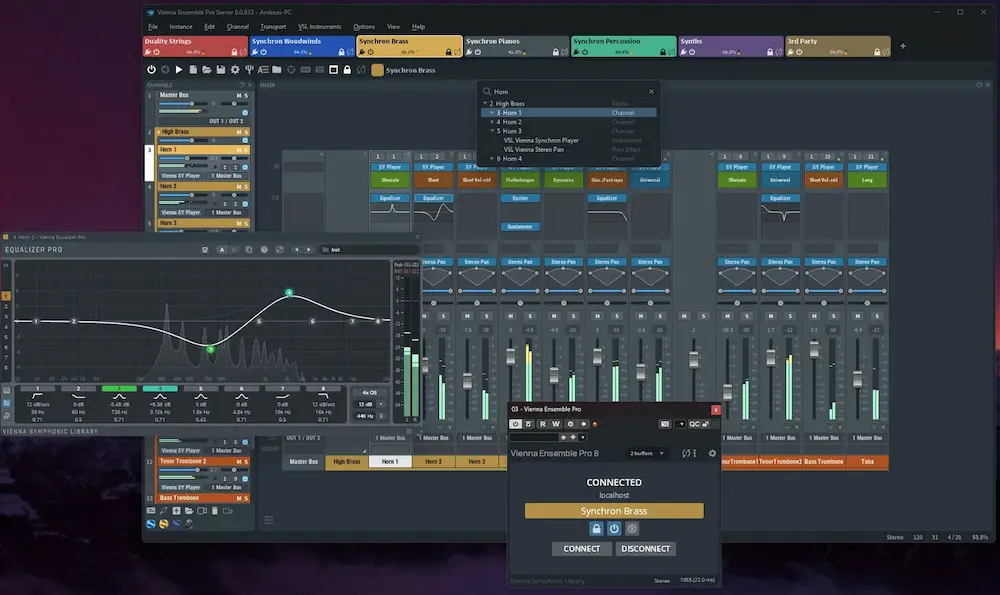
Vienna Ensemble Pro 8.1 Review: Workflow, Kontakt Hosting, Sample Servers and Real-World Performance
Most producers never need Vienna Ensemble Pro. Modern computers can handle typical recording, mixing, and mastering sessions without external hosting, network routing, or dedicated sample servers.
The equation changes when projects move into film scoring, trailer music, game audio, large orchestral production, or immersive formats. A template containing hundreds of Kontakt instruments, multiple orchestral libraries, and complex routing structures can push even powerful systems into workflow bottlenecks long before they reach their theoretical CPU limits. At that scale, project management becomes as important as raw processing power.
That is the environment Vienna Ensemble Pro was built for. Rather than functioning as another plugin inside a DAW, VEP operates as a production infrastructure layer that distributes instruments, effects, and routing across separate host environments or additional computers. The goal is not better sound quality. The goal is maintaining stability, responsiveness, and flexibility in sessions that would otherwise become difficult to manage.
Version 8.1 continues that philosophy. The headline additions include AI-assisted template management, expanded immersive audio support, improvements to the video-enabled VEP 8V platform, and workflow refinements aimed at large production environments. The more important question is not whether these features are new, but whether they solve meaningful problems for composers, producers, and engineers working at scale.
Contents
- Why Vienna Ensemble Pro Still Matters in Modern Production
- Why Vienna Ensemble Pro Remains a Kontakt Powerhouse
- The Real Significance of the 8.1 Update
- How Vienna Ensemble Pro Affects Mixing Workflows
- A Typical Vienna Ensemble Pro Workflow in a Modern Scoring Template
- When Vienna Ensemble Pro Is Worth the Investment — And When It Isn’t
- Do Modern Mac Studio Systems Reduce the Need for Vienna Ensemble Pro?
- Overall Rating
- Verdict
- FAQ
Why Vienna Ensemble Pro Still Matters in Modern Production
Faster CPUs and larger memory pools have reduced many of the technical limitations that once defined computer-based music production. Modern DAWs can handle workloads that would have required dedicated systems a decade ago. Yet Vienna Ensemble Pro remains widely used among film composers, trailer producers, television composers, and large-scale orchestral programmers.
The reason is straightforward: orchestral templates have grown faster than workstation capabilities. Professional Cubase, Nuendo and Logic Pro scoring templates routinely contain hundreds of Kontakt instances, multiple sample libraries, dedicated stem structures and increasingly large memory footprints.
Loading a project is rarely the biggest problem. Maintaining a responsive workflow is. Large productions must remain editable throughout composition, orchestration, revision, and delivery. Rebuilding templates, waiting for sample libraries to reload, or reopening hundreds of instruments after every project change creates friction that quickly becomes more expensive than the hardware itself.
This is where Vienna Ensemble Pro separates itself from traditional plugin hosting. Instead of treating every virtual instrument as part of a single DAW session, VEP allows instruments, effects, and routing structures to remain active inside dedicated host environments. Templates can stay loaded independently of the DAW, reducing reload times and allowing composers to move between projects without constantly rebuilding complex sessions.
The multi-computer architecture is only part of the story. For many professionals, the greater advantage is persistence. Large orchestral templates become production infrastructure rather than individual project assets. The workflow shifts from opening instruments every day to maintaining a permanently available production environment.
That distinction explains why Vienna Ensemble Pro continues to occupy a unique position in modern audio production. It does not solve a mixing problem, a mastering problem, or a sound-quality problem. It solves a workflow management problem that becomes increasingly difficult as production systems scale.
Why Vienna Ensemble Pro Remains a Kontakt Powerhouse
Although Vienna Ensemble Pro supports a wide range of virtual instruments and effects, its reputation was built largely around one ecosystem: Kontakt. For many composers, VEP is not simply a hosting platform. It is the infrastructure layer that makes large Kontakt-based production environments practical.
That relationship remains relevant in 2026 despite dramatic increases in CPU performance, memory capacity, and storage speed. Modern workstations are undeniably more capable than the systems that originally drove demand for dedicated sample servers. Yet orchestral production has evolved just as aggressively. Sample libraries have become larger, articulation counts have expanded, microphone options have multiplied, and composers routinely maintain templates that would have been considered excessive only a few years ago.
The challenge is not merely loading Kontakt instruments. The challenge is maintaining a production environment that remains responsive after hundreds of Kontakt instances have already been loaded.
A modern scoring template may contain separate string sections, multiple brass libraries, layered woodwinds, percussion collections, choir instruments, synth layers, sound-design elements, and alternative microphone configurations. Even when a system can technically load all of those resources, project management becomes increasingly difficult as complexity grows.
Many professional composers no longer build templates around a single orchestral library. A modern scoring rig may combine Kontakt-based strings from one developer, brass from another, percussion from several specialized collections, and dedicated sound-design libraries loaded simultaneously.
Modern scoring systems frequently combine libraries from Spitfire Audio, Orchestral Tools, Cinesamples, Performance Samples, Heavyocity, and numerous Kontakt-based developers inside a single production environment. Maintaining consistency across those ecosystems is one of the workflow challenges that originally helped establish Vienna Ensemble Pro as a standard component of large-scale orchestral rigs.
In those environments, the challenge is not launching Kontakt itself. The challenge is maintaining hundreds of loaded instruments across dozens of revisions without constantly rebuilding the production environment.
In a conventional workflow, reopening large Kontakt environments repeatedly can become a meaningful productivity cost. Persistent hosting changes that equation. The production environment becomes available before a project is even opened.
Another factor frequently overlooked in discussions about Vienna Ensemble Pro is template standardization. Large-scale composers often maintain highly structured Kontakt ecosystems across multiple projects. Routing structures, articulation layouts, stem assignments, output configurations, and organizational hierarchies remain consistent from one production to the next.
Consistency becomes increasingly valuable as projects scale. When every cue uses the same architectural foundation, revisions become easier to manage, assistants can work more efficiently, and delivery workflows become more predictable.
Kontakt-heavy environments also expose one of the biggest differences between hardware performance and workflow performance. A powerful computer may have no difficulty running a large template. That does not automatically mean the workflow is efficient. Long loading times, repeated initialization processes, template duplication, and project-specific instrument management can still create bottlenecks even when CPU resources remain available.
Vienna Ensemble Pro addresses many of those workflow limitations by separating template management from project management. The DAW handles composition, editing, automation, and mixing. VEP handles instrument infrastructure. Those responsibilities remain connected but no longer depend entirely on the same environment.
This separation becomes particularly attractive for composers operating multiple machines. Rather than treating additional computers as isolated systems, VEP can integrate them into a single production architecture. Kontakt libraries can be distributed across dedicated sample servers while remaining accessible through a unified workflow.
The result is not necessarily greater processing power. In many cases, the larger benefit is operational stability. Large templates become easier to maintain, easier to recall, and easier to scale over time.
That is one reason Vienna Ensemble Pro continues to occupy a unique position within professional orchestral production. The software is often discussed as a network-hosting solution, but many users ultimately adopt it because it provides a practical framework for managing Kontakt at a scale that traditional DAW workflows were never designed to accommodate.
As long as Kontakt remains the dominant platform for orchestral sampling, cinematic scoring, and large virtual-instrument environments, Vienna Ensemble Pro is likely to remain relevant. The software’s value is not tied to any individual library, developer, or production trend. It is tied to the ongoing challenge of managing increasingly complex Kontakt ecosystems without sacrificing flexibility, recall speed, or workflow efficiency.
The Real Significance of the 8.1 Update
 Version 8.1 is not a feature-heavy release in the traditional sense. There are no new instruments, no headline processing tools, and no dramatic changes to the core hosting architecture. Most of the update is focused on reducing friction inside large production environments.
That may sound unremarkable until viewed through the lens of real-world orchestral workflows. Once a template reaches several hundred tracks, maintaining the environment often requires as much attention as writing music. Folder hierarchies, articulation management, output routing, stem structures, naming conventions, and automation organization become ongoing maintenance tasks rather than one-time setup decisions.
The most visible addition in 8.1 is MCP-based AI integration. Supported AI assistants can connect directly to Vienna Ensemble Pro and interact with template structures through natural-language instructions. In practical terms, users can delegate portions of template administration rather than manually navigating complex project layouts.
Whether this becomes genuinely useful depends on the size of the workflow. A producer working inside a 50-track session is unlikely to gain much from AI-assisted organization. A composer maintaining a persistent orchestral template across multiple machines may view the feature very differently.
The strongest use case is not composition, orchestration, mixing, or sound design. It is template maintenance. Large templates inevitably accumulate organizational debt over time. Channel structures evolve, routing becomes inconsistent, and project layouts drift away from their original design. Administrative work begins consuming time that could otherwise be spent producing music.
MCP integration addresses that problem more directly than many recent AI implementations in audio software. Instead of attempting to generate creative decisions, it targets repetitive technical tasks that experienced users rarely enjoy performing manually.
The limitation is equally clear. AI can reorganize a template, but it cannot determine the most effective stem architecture for a delivery spec, optimize an orchestral balance, or make meaningful production decisions. The expertise still belongs to the composer, engineer, or programmer operating the system.
Viewed through that lens, the AI functionality feels less revolutionary than some marketing headlines suggest. The larger value of the 8.1 update comes from a collection of workflow improvements that make large production environments easier to maintain, scale, and manage over time.
AI Integration: Useful Tool or Marketing Checkbox?
The AI functionality introduced in Vienna Ensemble Pro 8.1 will likely generate more discussion than any other feature in the release. Whether it becomes an essential part of professional workflows is far less certain.
Unlike many recent AI initiatives in audio software, VEP’s implementation focuses on organization rather than creativity. That is a sensible decision. Large orchestral environments often suffer more from administrative complexity than processing limitations.
As templates grow into hundreds of channels, maintaining routing structures, folder hierarchies, stem outputs, and naming conventions becomes increasingly time-consuming. These repetitive tasks are precisely the type of work conversational AI can assist with effectively.
The limitations are equally clear. AI can reorganize a template, but it cannot determine the best orchestration strategy, solve balancing problems, or make production decisions on behalf of the composer. Those responsibilities remain dependent on experience rather than automation.
For that reason, the MCP integration is best viewed as workflow acceleration rather than production intelligence. It may reduce template-management overhead in large scoring environments, but it is unlikely to change how professional music is written, mixed, or delivered.
Immersive Audio Support May Matter More Than the AI Features
The AI integration will attract most of the headlines, but the expanded immersive audio support may prove more significant over the long term.
Vienna Ensemble Pro 8.1 extends support for a wider range of multichannel and immersive routing configurations, including large-format environments such as 22.2 and Auro-3D. While those formats remain niche, the broader trend behind them is difficult to ignore. Music, film, broadcast, and game production continue moving toward increasingly complex channel-based and object-based delivery formats.
The immediate relevance is less about 22.2 deployment and more about Dolby Atmos. Atmos production is no longer limited to major film facilities or high-end post-production houses. Record labels, streaming platforms, independent composers, and commercial studios are all investing in immersive workflows, creating new demands on routing architecture and session management.
As channel counts increase, production complexity rises faster than most hardware specifications suggest. A project that feels manageable in stereo can become substantially more difficult once immersive buses, object assignments, monitoring paths, print masters, and delivery stems enter the workflow. The challenge shifts from processing audio to managing signal flow.
This is where infrastructure software becomes increasingly important. Vienna Ensemble Pro was originally designed to distribute computing resources, but large immersive projects benefit just as much from centralized routing, persistent templates, and scalable session architecture. The more complex the production environment becomes, the more valuable organizational consistency becomes.
That dynamic helps explain why immersive support may outlast the current AI cycle in terms of practical impact. Production workflows continue evolving toward larger session sizes, more delivery formats, and greater routing complexity. Expanded immersive compatibility directly addresses those realities, making it one of the most strategically important additions in the 8.1 release.
How Vienna Ensemble Pro Affects Mixing Workflows
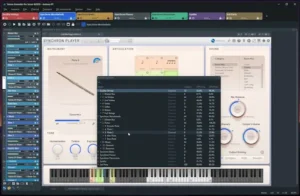 Vienna Ensemble Pro is typically discussed as a composition tool, but its influence often extends well into the mixing stage. That distinction is important because large orchestral productions rarely move through clearly separated production phases, and the line between composition, mixing, and final delivery is often less rigid than many engineers assume. Understanding where those responsibilities diverge becomes easier when examining the practical differences between mixing and mastering in modern production workflows. In large orchestral and hybrid productions, the boundary between composition and mixing is rarely clean. Instrumentation, orchestration, balance decisions, and routing structures continue evolving long after the writing process is technically complete.
That creates a practical problem. As projects grow, engineers must choose between preserving flexibility and maintaining system performance. Freezing tracks reduces CPU load but limits revision options. Printing stems simplifies the session but commits decisions that may need to change later. External hosting offers a third path by allowing instruments to remain accessible without forcing every resource into the DAW itself.
For composers who handle their own mixing, this can significantly alter the revision process. Instrument-level changes remain available deep into production, making it easier to adjust orchestration, rebalance sections, replace articulations, or modify arrangements without rebuilding large portions of the session. What would normally require reloading extensive templates can often be handled inside an already active environment.
The benefit becomes most apparent during client revisions. Film, television, and game projects rarely move through a linear production cycle. Cue updates, picture changes, orchestration revisions, and delivery adjustments can continue until final approval. Persistent hosting environments reduce the friction associated with reopening and reconstructing complex projects multiple times.
The advantages come with operational costs. Session portability becomes more complicated, collaboration requires greater technical consistency between systems, and troubleshooting extends beyond the DAW itself. Managing servers, network connections, plugin versions, and template integrity introduces responsibilities that do not exist in a traditional production workflow.
For large orchestral productions, the tradeoff is often justified. For conventional music projects, pop productions, singer-songwriter sessions, or most electronic releases, the additional infrastructure rarely produces enough workflow benefit to outweigh the added complexity.
A Typical Vienna Ensemble Pro Workflow in a Modern Scoring Template
The easiest way to understand Vienna Ensemble Pro is to stop thinking about it as a plugin and start thinking about it as production infrastructure.
Many discussions surrounding VEP focus on features, network hosting, or sample servers. Those topics matter, but they rarely explain how the software is actually used inside a professional scoring environment.
A typical modern orchestral workflow often begins inside the DAW. Cubase, Nuendo, Logic Pro, Digital Performer, and Pro Tools remain common front-end environments responsible for sequencing, automation, synchronization, video playback, editing, and final mixing decisions.
Instead of loading every instrument directly inside the DAW, the composer connects to one or more Vienna Ensemble Pro servers running locally or on dedicated machines.
Inside those servers, instruments are usually organized into persistent template structures rather than project-specific sessions.
A large scoring template might contain separate environments for strings, brass, woodwinds, percussion, choir libraries, synth layers, sound-design elements, and specialty instruments. Each section remains permanently available regardless of which cue is currently open inside the DAW.
In practice, the workflow often resembles something like this:
↓
Vienna Ensemble Pro Server
↓
Strings Template
↓
Brass Template
↓
Woodwinds Template
↓
Percussion Template
↓
Stem Buses
↓
Mix Bus Structure
The important detail is that these layers do not necessarily load and unload with every project. The template itself remains active. Individual cues connect to the existing infrastructure rather than rebuilding it from scratch.
That distinction becomes increasingly valuable as orchestral environments grow. A composer may spend months refining a template containing hundreds of instruments, carefully organized articulations, routing assignments, expression systems, and stem structures. Reconstructing that environment every time a project opens would be highly inefficient.
Persistent templates change the relationship between projects and instruments. Instead of opening a project and waiting for instruments to load, composers often begin with a fully operational production environment and simply connect new cues to it.
The benefits become particularly apparent during revisions.
Film and television projects rarely move through production in a straight line. Editorial updates, picture changes, timing adjustments, orchestration revisions, and client notes frequently require previously completed cues to be reopened and modified. Maintaining access to a permanently loaded template dramatically reduces the friction associated with those revisions.
Mixing workflows also benefit from this architecture.
Because instruments remain active throughout the project lifecycle, composers and mixing engineers can continue making orchestration decisions long after the writing phase is technically complete. String balances can be adjusted, percussion layers can be modified, articulations can be replaced, and instrument groups can be re-routed without rebuilding large sections of the production environment.
This flexibility often proves more valuable than raw CPU savings. Modern processors are powerful enough to handle many demanding workloads. The greater challenge is maintaining an efficient workflow while preserving creative options throughout production.
Stem generation is another area where Vienna Ensemble Pro frequently plays an important role.
Large scoring projects rarely deliver a single stereo mix. Clients often require separate orchestral stems, percussion stems, synth stems, choir stems, alternate versions, television mixes, trailer mixes, Atmos deliverables, or localization packages. Consistent routing structures become essential when managing these requirements across dozens or hundreds of cues.
By centralizing routing inside a persistent environment, VEP helps ensure that output structures remain consistent throughout the production cycle. That consistency simplifies mixing, accelerates revisions, and reduces the likelihood of delivery errors during final export.
This is ultimately why Vienna Ensemble Pro continues to occupy a unique position within professional scoring workflows. Its greatest contribution is not additional processing power. It is the ability to transform a collection of instruments, sample libraries, and computers into a single organized production environment that remains manageable as projects scale.
Critical Evaluation: Where Vienna Ensemble Pro Is Overrated
Vienna Ensemble Pro is often described as a performance optimization tool. That description is only partially accurate.
VEP does not eliminate complexity. It redistributes it.
CPU load, memory usage, plugin hosting, routing, and session management may become easier to scale, but they are replaced by another set of responsibilities involving server configuration, network stability, template maintenance, backup management, software compatibility, and long-term system administration.
For composers operating large production environments, that tradeoff is usually acceptable. The efficiency gains outweigh the additional overhead. For smaller studios, the calculation can look very different.
Many producers evaluating Vienna Ensemble Pro never reach the point where its core advantages become relevant. Modern DAWs are capable of handling surprisingly large workloads, particularly in pop, rock, electronic music, podcast production, and conventional mixing environments. A well-optimized workstation can often solve problems that users initially assume require additional infrastructure.
This is where VEP is sometimes oversold. The software is occasionally presented as a universal solution for performance limitations when it is really a specialized solution for scalability limitations. Those are not the same problem.
The distinction becomes important when purchasing decisions are involved. If a project contains a few dozen tracks and a manageable number of virtual instruments, introducing a network-hosted architecture may create more operational complexity than it removes. The benefits become easier to justify when templates expand into hundreds of instruments, multiple computers, persistent sample servers, or large immersive production environments.
Template design presents another overlooked factor. Some workflow bottlenecks originate from inefficient project architecture rather than hardware limitations. Poor routing structures, excessive articulation duplication, unnecessary plugin instances, and disorganized templates can create performance issues that no hosting platform will fully resolve.
The same principle applies to the AI-assisted management tools introduced in version 8.1. Organizing channels is rarely the difficult part of building a professional template. The difficult part is designing a structure that remains efficient across months or years of production work. Experience, not automation, determines whether a template scales successfully.
Viewed from that perspective, the most valuable aspects of the 8.1 release are not the AI features. The stronger case can be made for the cumulative impact of workflow refinements, improved automation management, expanded immersive routing support, backup reliability, and overall platform stability. Those improvements directly affect daily operation in ways that tend to outlast headline features.
Competitive Positioning: How Vienna Ensemble Pro Compares to Alternatives
Comparing Vienna Ensemble Pro to competing products is not as straightforward as comparing two synthesizers or two effects plugins. Unlike instrument-focused products such as the Cherry Audio ESQ-1, which are evaluated primarily on sound, workflow, and mix integration, VEP is designed to solve infrastructure and scalability challenges that emerge in large production environments. Most alternatives solve only a portion of the workflow challenges VEP was designed to address. Some focus on network processing, others on audio transport, plugin hosting, or multi-system connectivity. Few attempt to function as a complete production infrastructure platform.
The real competition is not always another product. In many studios, the primary alternative is simply a powerful computer running everything inside a single DAW session.
| Solution | Best At | Ideal User | Primary Limitation |
|---|---|---|---|
| Vienna Ensemble Pro 8.1 | Persistent templates, large-scale hosting, multi-computer orchestral workflows | Film, television, trailer and game composers | Higher infrastructure complexity and cost |
| Audiogridder | Network-based plugin processing | Producers seeking low-cost distributed computing | Less comprehensive template management and workflow integration |
| Blue Cat Connector | Audio and MIDI transport between systems | Studios requiring flexible routing configurations | Not designed for large persistent orchestral environments |
| Native DAW Workflow | Simplicity, portability, collaboration | Most music producers and mixing engineers | Scaling limitations as template complexity increases |
| Multiple Independent DAWs | Maximum separation of workloads | Large scoring facilities | Synchronization, recall, and session-management overhead |
For many modern composers, the primary alternative is not another software platform but a hardware upgrade. A Mac Studio with large unified memory, a high-core-count Windows workstation, or an additional dedicated sample computer can often solve the same bottlenecks VEP was originally designed to address. The difference is that hardware upgrades increase available resources, while Vienna Ensemble Pro changes how those resources are organized and managed.
What separates Vienna Ensemble Pro is not raw processing capability. Modern workstations are often powerful enough to compete on that front. The differentiator is persistence. Templates remain available independently of the DAW, large sample libraries stay loaded between sessions, and production environments can be maintained as long-term infrastructure rather than rebuilt on a project-by-project basis.
That distinction matters most in film scoring, orchestral production, trailer music, and game audio, where project recall speed can influence productivity as much as CPU performance. A composer opening multiple revisions throughout a production cycle faces a very different set of requirements than a producer building a new session from scratch every day.
It also explains why many producers ultimately decide they do not need Vienna Ensemble Pro. If a workstation comfortably handles current projects, the additional infrastructure may offer little practical benefit. The software becomes significantly more compelling when templates grow large enough that loading times, memory management, routing complexity, and session recall begin affecting day-to-day productivity.
Viewed through that lens, Vienna Ensemble Pro is less a direct competitor to traditional audio software and more a specialized solution for studios operating beyond the practical limits of a conventional single-system workflow.
Who Should Use Vienna Ensemble Pro 8.1?
The usefulness of Vienna Ensemble Pro has less to do with genre and more to do with workflow scale.
Studios managing large orchestral templates are the clearest beneficiaries. Film scoring, television composition, trailer production, and game audio frequently involve hundreds of virtual instruments, complex routing structures, multiple sample libraries, and extensive revision cycles. In these environments, template persistence and distributed hosting can deliver measurable workflow improvements long before system resources are fully exhausted.
The software is equally relevant for facilities operating dedicated sample servers or maintaining production environments that remain active across multiple projects. When loading times, template management, and project recall become recurring bottlenecks, Vienna Ensemble Pro begins functioning as infrastructure rather than an optional utility.
Immersive production represents another strong use case. As Atmos and other multichannel formats introduce additional routing complexity, scalable hosting environments become easier to justify, particularly when multiple deliverables must be maintained throughout a project’s lifecycle.
The calculation changes for most conventional music production workflows. A producer creating electronic tracks entirely inside a single DAW, a mixing engineer handling standard commercial releases, or a songwriter working with relatively modest session sizes may see little practical benefit from adding another technical layer to the system.
That does not mean Vienna Ensemble Pro lacks value in those environments. It means the workflow problems it solves may not be significant enough to justify the additional infrastructure.
A useful rule of thumb is simple: if project complexity is already forcing compromises in template design, loading times, system responsiveness, or session management, VEP deserves serious consideration. If current projects remain efficient inside a single workstation, the advantages become considerably harder to quantify.
When Vienna Ensemble Pro Is Worth the Investment — And When It Isn’t
One of the most common questions surrounding Vienna Ensemble Pro has little to do with features. Most potential buyers are not asking what VEP does. They are asking whether they actually need it.
That distinction matters because Vienna Ensemble Pro occupies a very unusual position within the audio software market. Unlike a synthesizer, compressor, sampler, or effects suite, its value is rarely obvious during the first hour of use. The software becomes more valuable as production complexity increases.
This creates a situation where two producers can evaluate the same product and arrive at completely different conclusions. One may consider it indispensable infrastructure. Another may see it as unnecessary complexity.
Both can be correct.
The strongest case for Vienna Ensemble Pro emerges when workflow limitations begin costing more time than hardware upgrades can realistically solve.
Consider a composer maintaining a 700-track orchestral template spread across multiple sample libraries. Opening a project may involve hundreds of Kontakt instruments, extensive articulation systems, dedicated stem structures, alternate microphone configurations, and multiple layers of routing. Even on powerful modern hardware, managing that environment can become a daily operational challenge.
In that scenario, Vienna Ensemble Pro is not competing against another plugin. It is competing against lost production time.
Template reloads, project initialization, memory management, system responsiveness, and revision turnaround all carry costs. As projects become larger, those costs accumulate.
For many professional composers, VEP pays for itself by reducing friction rather than increasing capability.
That distinction often gets overlooked during product comparisons. Buyers frequently focus on CPU performance while ignoring workflow performance. Yet workflow inefficiencies can consume more time than processing limitations ever will.
The economics become particularly compelling in environments where projects remain active for months. Film scoring, television production, game audio, and trailer music rarely follow a simple start-to-finish process. Projects evolve continuously through revisions, client notes, editorial changes, and delivery updates.
The ability to maintain a persistent production environment throughout that cycle can provide measurable operational advantages.
Large facilities frequently reach the same conclusion for different reasons. In those environments, multiple composers, programmers, assistants, and engineers may interact with the same production architecture. Consistency becomes a business requirement rather than a workflow preference.
Standardized templates, predictable routing structures, centralized sample management, and repeatable delivery processes all become easier to maintain when the underlying infrastructure remains stable.
The argument becomes much weaker for conventional music production.
A producer creating electronic tracks inside Ableton Live, a songwriter working in Logic Pro, or a mixing engineer handling typical commercial releases rarely encounters the same scaling problems. Modern workstations can comfortably manage most pop, rock, hip-hop, and EDM productions without requiring dedicated hosting environments.
In those situations, Vienna Ensemble Pro often addresses a problem that does not yet exist.
This is where many purchasing mistakes occur.
Users sometimes buy VEP because they believe it will automatically improve performance, increase sound quality, or transform their workflow. After installation, they discover that their actual bottleneck was poor template organization, inefficient project design, excessive plugin usage, or outdated hardware.
No infrastructure platform can fully compensate for those issues.
Another consideration is the total cost of ownership.
The purchase price represents only part of the investment. Large VEP environments often require additional planning, maintenance, troubleshooting, and ongoing management. Dedicated sample servers, network infrastructure, backup strategies, software updates, and template maintenance all contribute to the long-term workload.
For professionals operating large-scale scoring environments, those responsibilities are generally acceptable because the productivity gains outweigh the effort required to maintain the system.
For smaller studios, the opposite may be true.
This is why Vienna Ensemble Pro should not be viewed as a universal recommendation. It is best understood as a specialized infrastructure tool designed for workflows that have already exceeded the practical limits of a conventional DAW-centric approach.
A useful test is simple.
If project loading times, template management, session recall, routing complexity, sample-library organization, or multi-system coordination have become recurring production obstacles, Vienna Ensemble Pro deserves serious consideration.
If current projects remain fast, stable, and manageable inside a single workstation, the software may provide surprisingly little benefit relative to its complexity.
The most successful VEP users rarely buy the software because they want it. They buy it because their workflow has reached a point where the underlying problems are impossible to ignore.
That reality explains both the product’s longevity and its relatively narrow audience. Vienna Ensemble Pro is not designed to make every studio better. It is designed to solve a specific set of scalability problems that become increasingly expensive as professional production environments grow.
Do Modern Mac Studio Systems Reduce the Need for Vienna Ensemble Pro?
One of the biggest questions surrounding Vienna Ensemble Pro in 2026 has little to do with AI integration, immersive audio, or workflow refinements. It revolves around hardware.
Apple Silicon systems have fundamentally changed expectations regarding workstation performance. A modern Mac Studio equipped with an M3 Ultra can run workloads that previously required multiple computers, dedicated sample servers, or complex distributed-processing environments. As a result, many composers are asking a reasonable question: if modern computers are this powerful, do we still need Vienna Ensemble Pro?
The answer depends on what problem VEP is actually solving.
If the goal is simply running more plugins, the argument for Vienna Ensemble Pro is weaker than it was five or ten years ago. Modern Apple Silicon systems deliver extraordinary CPU performance, impressive memory bandwidth, and storage speeds that dramatically reduce loading times compared to previous workstation generations.
Many composers who once relied on secondary computers can now run surprisingly large orchestral templates entirely inside a single Mac Studio. Projects that previously required distributed computing may now operate comfortably within one machine.
This is particularly true for composers working on independent productions, television cues, advertising projects, and hybrid orchestral arrangements where template sizes remain relatively controlled.
From a purely computational perspective, Apple Silicon has reduced one of the historical reasons for adopting Vienna Ensemble Pro.
Another factor often overlooked in modern VEP discussions is native Apple Silicon support. Earlier generations of orchestral workflows frequently relied on Rosetta translation layers, creating uncertainty around compatibility and performance. Today, most professional environments operate natively on Apple Silicon, shifting the conversation away from compatibility concerns and toward workflow architecture, memory management, and long-term template scalability.
VEP vs Buying a Bigger Mac Studio
For many composers evaluating Vienna Ensemble Pro in 2026, the most realistic alternative is not another software platform. It is a hardware upgrade.
The rapid performance growth of Apple Silicon has changed the economics of large-scale production. A modern Mac Studio equipped with an M3 Ultra and substantial unified memory can comfortably handle workloads that previously required dedicated sample servers, multiple computers, or distributed hosting environments.
This naturally raises a practical question: why invest in Vienna Ensemble Pro when the same budget could be directed toward a more powerful workstation?
The answer depends entirely on the bottleneck.
If the primary limitation is CPU performance, memory capacity, or storage speed, upgrading hardware often delivers the most immediate improvement. A faster computer reduces loading times, increases available processing resources, and simplifies workflow by keeping everything inside a single environment.
For many producers, that is the correct decision.
A composer working with a 100-track template, moderate Kontakt usage, and a single active project may gain more from upgrading to a modern Mac Studio than from introducing additional infrastructure. The workflow remains simple, session portability improves, and technical overhead remains minimal.
The difference becomes more apparent once templates move beyond 500 instruments, 128GB of memory usage, or multiple simultaneous scoring projects. At that scale, workflow architecture often becomes more important than raw benchmark performance.
The equation changes as projects become larger and more persistent.
A bigger computer provides more resources. It does not fundamentally change how those resources are organized. Large templates still need to be maintained. Routing structures still need to remain consistent. Sample libraries still need to be managed across revisions. Project recall, template persistence, and multi-project workflows continue to create operational challenges regardless of processor performance.
This is where Vienna Ensemble Pro and a hardware upgrade stop competing directly.
A Mac Studio increases available horsepower. Vienna Ensemble Pro changes workflow architecture.
The distinction becomes increasingly important in environments where production infrastructure remains active for months rather than days. Film scoring, game audio, trailer music, and large orchestral projects often require persistent templates that stay available across multiple cues, revisions, and delivery cycles. In those situations, workflow efficiency frequently becomes a larger concern than benchmark performance.
Many professional composers ultimately use both approaches simultaneously. Powerful Apple Silicon workstations provide the processing foundation, while Vienna Ensemble Pro provides the organizational framework that allows large production environments to remain scalable over time.
Viewed through that lens, the choice is rarely Vienna Ensemble Pro versus Mac Studio. The more relevant question is whether project complexity has reached a point where additional processing power alone no longer solves the workflow problem.
However, CPU performance was never the only reason professionals invested in VEP.
The software’s long-term value has always been closely tied to workflow architecture rather than raw processing power. That distinction becomes important when evaluating whether modern Mac Studio systems truly replace the need for a dedicated hosting platform.
Large scoring environments create challenges that remain largely independent of processor speed. Template persistence, project recall, multi-project workflows, centralized routing structures, stem consistency, sample-library organization, and multi-machine scalability all continue to matter regardless of how powerful a workstation becomes.
A composer working inside a 100-track orchestral template may find that a modern Mac Studio eliminates the need for Vienna Ensemble Pro entirely.
A composer managing a 700-track scoring environment across multiple ongoing productions may reach a very different conclusion.
The question shifts from “Can my computer run this?” to “Can I manage this efficiently over time?”
That distinction explains why Vienna Ensemble Pro remains common in high-end scoring environments despite dramatic improvements in workstation hardware.
A typical modern film-scoring template may easily exceed 500 instrument channels, run across two or three computers, and consume more than 128GB of combined memory. At that scale, workflow architecture often becomes a larger concern than raw CPU performance.
Even if a powerful Apple Silicon system can technically host the entire environment, many composers still prefer separating template infrastructure from project infrastructure. Persistent templates remain loaded independently of individual cues, reducing session management overhead and simplifying revision workflows throughout long production cycles.
Another factor often overlooked in the “Do I still need VEP?” discussion is redundancy.
Large facilities rarely evaluate systems based solely on average performance. They evaluate reliability, recovery speed, and operational flexibility. Distributed environments provide additional options when projects scale unexpectedly, delivery schedules tighten, or hardware failures occur during active productions.
For those users, Vienna Ensemble Pro functions less like a performance enhancer and more like production infrastructure.
Apple Silicon has undoubtedly reduced the number of users who genuinely require network-hosted workflows. Smaller studios, independent composers, and producers operating moderate template sizes may find that a single modern workstation provides all the performance they need.
At the same time, the growth of orchestral libraries, Atmos production, immersive workflows, and increasingly complex scoring environments continues to create use cases where centralized hosting remains valuable.
This is why the relationship between Apple Silicon and Vienna Ensemble Pro should not be viewed as a direct competition.
Modern Mac Studio systems reduce the need for VEP as a performance solution. They do not necessarily eliminate the need for VEP as an organizational solution.
For many producers, Apple Silicon is powerful enough to replace distributed computing entirely.
For large-scale composers managing persistent templates, multiple productions, dedicated sample servers, and complex routing architectures, Vienna Ensemble Pro remains relevant for reasons that extend far beyond CPU benchmarks.
In practical terms, the question is no longer whether a Mac Studio can run a large orchestral template. In many cases, it absolutely can.
The more important question is whether maintaining that template entirely inside the DAW remains the most efficient workflow once project complexity continues growing.
Real-World Production Perspective
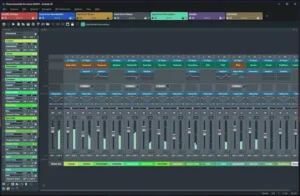 One of the easiest mistakes when evaluating Vienna Ensemble Pro is expecting a direct sonic benefit. Unlike synthesizer emulations such as the Prophet-5 plugin, where the discussion revolves around tone, character, mix translation, and musical performance, VEP operates almost entirely at the workflow and infrastructure level. VEP does not change the sound of a project in the way a converter, monitoring upgrade, room treatment, or processing chain might. Its value is operational rather than tonal.
That distinction matters because workflow decisions often have a greater influence on finished productions than many engineers are willing to acknowledge. Creative momentum is easier to maintain when sessions remain responsive, large templates stay available, and revisions can be executed without rebuilding substantial portions of a project. The technical environment surrounding a production inevitably affects the decisions made inside it.
This becomes particularly relevant in orchestral and hybrid scoring workflows where arrangements continue evolving deep into the production cycle. Instrumentation changes, articulation swaps, orchestration revisions, stem modifications, and client requests frequently occur long after the initial writing phase. Systems that preserve flexibility throughout those revisions reduce the pressure to commit decisions prematurely.
From a mixing perspective, the greatest advantage is often recall efficiency. Engineers and composer-producers can revisit source instruments, rebalance sections, modify orchestration, or update cue elements without reconstructing large template environments. The workflow remains connected to the original production architecture rather than relying exclusively on frozen tracks or printed stems.
The mastering stage benefits far less directly. Mastering engineers are unlikely to care whether a mix originated from Vienna Ensemble Pro, a standalone DAW session, or a collection of dedicated sample servers. What matters is the quality and consistency of the delivered material. Once a project reaches mastering, the focus shifts away from production infrastructure and toward the evaluation and refinement stages that define professional mastering workflows.
The connection becomes visible earlier in the chain. Well-organized production environments tend to generate cleaner stem structures, more predictable deliverables, and fewer routing mistakes during final export. Those advantages become increasingly important as projects expand into orchestral, cinematic, and immersive formats. The same organizational discipline becomes critical when preparing a mix for mastering, where routing consistency and clean exports often matter more than additional processing.
Atmos production provides a useful example. As channel counts increase, session management often becomes a larger challenge than signal processing itself. Routing inconsistencies, object assignment errors, version-control problems, and delivery mismatches can create issues that persist all the way through final approval. Many of the same problems later appear during final release preparation, which is why experienced engineers often rely on a structured mastering checklist before delivery. Infrastructure platforms that help maintain organizational consistency become more valuable as production complexity grows.
Viewed from that perspective, Vienna Ensemble Pro is best understood as a workflow platform rather than a sound-quality upgrade. Its contribution is not found in the audio path itself, but in the stability, scalability, and production discipline it can bring to large-scale projects.
Does Vienna Ensemble Pro 8.1 Future-Proof a Studio?
No software guarantees long-term relevance. Production technology evolves too quickly for any platform to serve as a permanent solution. The more useful question is whether a product remains aligned with the direction of professional workflows.
Vienna Ensemble Pro has survived multiple generations of DAWs, operating systems, processors, and plugin formats because the underlying problem it addresses has not disappeared. If anything, it has become more pronounced. Production environments continue growing in complexity as sample libraries expand, orchestral templates become larger, immersive formats gain adoption, and composers increasingly expect immediate access to persistent working environments.
The software’s long-term value is tied less to any individual feature than to its role inside large-scale production systems. AI integration may evolve. Plugin formats will change. Computer hardware will continue improving. The need to organize, manage, recall, and scale complex projects is unlikely to disappear.
That does not mean every studio should view Vienna Ensemble Pro as a strategic investment. Many modern production workflows operate comfortably inside a single workstation. For those users, future-proofing may simply mean upgrading hardware as needed and maintaining an efficient DAW environment.
Studios operating at the opposite end of the spectrum face a different reality. When production depends on persistent templates, dedicated sample servers, distributed computing resources, extensive orchestral libraries, or immersive delivery formats, infrastructure becomes increasingly important. In those environments, VEP functions less like a software purchase and more like a foundational component of the production ecosystem.
That distinction explains why Vienna Ensemble Pro remains highly relevant within specific professional circles while remaining largely invisible to much of the broader audio production market. It is not attempting to solve a universal problem. It is solving a problem that becomes increasingly important as production systems scale.
Overall Rating
| Category | Rating |
|---|---|
| Workflow Scalability | 10/10 |
| Template Management | 9.5/10 |
| Multi-Computer Integration | 10/10 |
| Immersive Audio Readiness | 9/10 |
| Ease of Use | 7/10 |
| Value for Money | 8.5/10 |
| Overall | 9.0/10 |
Vienna Ensemble Pro 8.1 is not a product designed to improve sound quality, mix translation, or mastering results directly. Its value lies in workflow architecture. For composers, orchestral programmers, scoring facilities, and immersive-production environments operating beyond the practical limits of a single DAW session, VEP remains one of the most mature infrastructure platforms available. The learning curve and additional system complexity prevent it from being a universal recommendation, but within its intended market, few alternatives offer the same combination of scalability, template persistence, routing flexibility, and long-term workflow efficiency.
Verdict
Vienna Ensemble Pro 8.1 succeeds because it remains focused on a problem that still exists in professional production. Large orchestral templates, persistent sample-server environments, immersive routing structures, and multi-system workflows continue pushing beyond the practical limits of conventional DAW sessions. VEP remains one of the few mature platforms designed specifically for that reality.
The headline AI integration will generate attention, but it is unlikely to become the deciding factor for most professionals. The more meaningful developments are found in the platform’s continued refinement: improved workflow management, expanded immersive support, stronger automation handling, more reliable project maintenance, and better scalability for increasingly complex production environments.
Potential buyers should evaluate Vienna Ensemble Pro based on workflow requirements rather than feature lists. If projects routinely involve hundreds of instruments, dedicated sample servers, large template ecosystems, or ongoing orchestral revisions, the software addresses problems that few competing solutions solve as effectively. In those scenarios, VEP is easier to justify as infrastructure than as a plugin purchase.
The opposite is equally true. Producers working comfortably inside a single DAW environment should be cautious about assuming they need additional architecture. Faster hardware, better template organization, and improved session management often provide greater returns than introducing another layer of technical complexity.
Viewed objectively, Vienna Ensemble Pro 8.1 is not attempting to redefine music production. It is refining a specialized workflow platform for users operating at a scale where traditional approaches begin to break down. For that audience, it remains one of the most mature and practical solutions currently available.

Yurii Ariefiev is a mastering engineer and audio production editor whose work focuses on real-world production workflows, mix translation, release preparation, and modern mastering practices. His editorial research covers the technologies that shape professional music production, from orchestral template management and immersive audio systems to final delivery standards for commercial releases.
This analysis examines Vienna Ensemble Pro from the perspective of workflow scalability, session management, and production infrastructure rather than feature marketing, with particular attention to how large orchestral environments affect mixing, mastering, stem preparation, and final release delivery.
FAQ
Can Vienna Ensemble Pro run Kontakt on a separate computer?
Yes. One of the most common VEP workflows involves hosting Kontakt libraries on dedicated sample servers while controlling them from a primary DAW workstation.
Does Vienna Ensemble Pro reduce project loading times?
It can. Persistent templates allow instruments and sample libraries to remain loaded independently of the DAW, reducing the need to reload large environments every time a project is opened.
Which DAWs work best with Vienna Ensemble Pro?
VEP supports major professional platforms including Cubase, Nuendo, Logic Pro, Pro Tools, Digital Performer, and Reaper. The choice of DAW typically has less impact than the overall workflow design.
How much latency does Vienna Ensemble Pro add?
Latency depends on network configuration, buffer settings, and project complexity. On properly configured systems, the added latency is generally small enough for composition and production work.
Is Vienna Ensemble Pro still relevant with modern CPUs?
For many producers, modern hardware is sufficient. VEP remains most relevant when template size, memory requirements, project recall speed, or multi-system workflows become limiting factors.
Can Vienna Ensemble Pro be used for Dolby Atmos production?
Yes. The platform supports advanced multichannel routing and can be integrated into Atmos-oriented production workflows where session complexity exceeds traditional stereo projects.
What is the main advantage of Vienna Ensemble Pro over Audiogridder?
Audiogridder focuses primarily on distributed processing. Vienna Ensemble Pro offers a broader ecosystem that includes persistent templates, advanced routing, large-scale orchestral workflow management, and mature multi-computer integration.
Can Vienna Ensemble Pro run multiple Kontakt libraries simultaneously?
Yes. Large orchestral templates often combine multiple Kontakt-based libraries from different developers inside a single VEP environment. Managing those libraries efficiently is one of the primary reasons many composers adopt Vienna Ensemble Pro.
How much RAM do professional Vienna Ensemble Pro systems typically use?
Large scoring systems frequently operate with 64GB, 128GB, or substantially more memory depending on template size, sample-library requirements, and the number of connected computers.
Is Vienna Ensemble Pro useful for composers who deliver stems?
Yes. Complex orchestral and cinematic productions often require extensive stem structures, and VEP can simplify the organization and management of those deliverables throughout the production cycle.
Can Vienna Ensemble Pro replace multiple standalone sample servers?
In many environments, yes. VEP is commonly used as a centralized layer that manages instruments, routing, and communication between multiple production systems.
Do I still need Vienna Ensemble Pro with an Apple Silicon Mac Studio?
For many music producers, no. Modern Mac Studio systems can comfortably handle workloads that previously required distributed hosting. Vienna Ensemble Pro remains most valuable when projects depend on persistent templates, multi-computer workflows, large Kontakt environments, or dedicated sample servers.
Is Vienna Ensemble Pro better than upgrading to a Mac Studio?
Not necessarily. A Mac Studio upgrade increases available processing power, while Vienna Ensemble Pro changes how production resources are managed. For many producers, new hardware solves the problem. For large-scale scoring environments, workflow architecture often remains the larger concern.
Can Vienna Ensemble Pro run on a Mac Studio without a second computer?
Yes. Many composers run Vienna Ensemble Pro entirely on a single Mac Studio system. While VEP is commonly associated with dedicated sample servers, it can also be used locally to manage large templates, improve project organization, and maintain persistent instrument environments within a single workstation workflow.
Is Vienna Ensemble Pro still necessary with 192GB or 512GB Mac Studio configurations?
Not always. Large-memory Mac Studio systems can comfortably handle workloads that previously required multiple computers. Vienna Ensemble Pro becomes most valuable when workflow complexity, template persistence, project recall speed, or multi-system management create limitations that additional RAM alone cannot solve.
Can Vienna Ensemble Pro run natively on Apple Silicon Macs?
Yes. Modern VEP workflows support Apple Silicon systems natively, allowing composers to take advantage of current Mac Studio and Mac Pro hardware without relying on older Intel-based production environments.