UVI Synth Anthology 5 Review: 300 Hardware Synths in One Production Instrument
Synth Anthology 5 review discussions tend to start with scale: 300 hardware synthesizers and a library of more than 6,000 presets. Version 5 alone adds more than 100 hardware sources, over 1,000 new sound layers, more than 16,000 new samples, and 300 new presets. Those numbers describe the scale of the update, but not what the instrument is actually like to use. The real question is whether access to that much hardware-derived material improves audio production or simply creates a larger search problem.
Synth Anthology 5 is not a collection of 300 modeled synthesizers. UVI recorded the original hardware and rebuilt that material inside a shared dual-layer engine, so the source machines provide the sonic foundation rather than the complete synthesis architecture. There are no individual recreations of their front panels, oscillator structures, modulation systems, or hardware-specific programming quirks. What you get is a large set of captured hardware sounds that can be layered, filtered, modulated, sequenced, and processed inside one consistent instrument.
That distinction defines the product. Synth Anthology 5 gives producers access to a wide range of analog, digital, vintage, and modern hardware without breaking the session across dozens of interfaces. The tradeoff is equally clear: it preserves the sound of the source instruments more readily than the experience of programming them. Whether that is a limitation or an advantage depends on the job. For fast sound selection, layering, and arrangement, the unified workflow has obvious value. For detailed synthesis at oscillator level, it is not a substitute for a dedicated emulation or a fully programmable synth.
Synth Anthology 5: Quick Verdict
UVI Synth Anthology 5 earns an 8.7/10 rating. Its strongest advantage is workflow: 300 sampled hardware synthesizers can be searched, layered, and reshaped inside one consistent dual-layer engine. It is an excellent fit for producers who want broad hardware-derived sound coverage without opening dozens of separate synth plugins. It is less convincing for sound designers who need oscillator-level programming or exact recreations of individual hardware architectures.
| Best For | Not Ideal For |
|---|---|
| Fast hardware-derived sound selection | Deep oscillator-level synthesis |
| Layering contrasting synth sources | Exact recreation of individual synth architectures |
| Composers and producers working across multiple genres | Users already satisfied with a small, deeply learned synth collection |
Why a Hardware Synth Archive Still Makes Sense
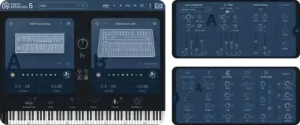 Software producers are not short of synthesis options. A serious setup may already include modeled analog instruments, wavetable synths, granular engines, modular environments, and sample-based libraries. The practical problem is often the opposite: too many capable instruments spread across different browsers, interfaces, modulation systems, and preset formats. That pressure has created a separate category of workflow-focused instruments, including sample-based hybrid instruments such as Zensphere V2, where faster source selection matters more than unrestricted synthesis depth.
This is where Synth Anthology 5 has a clearer purpose than its 300-synth headline suggests. It does not ask the producer to treat every source machine as a separate instrument. Analog polysynths, digital hardware, workstations, and newer boutique designs become part of the same searchable pool and can be combined without changing plugins or rebuilding the signal path.
That can remove a surprising amount of friction from a session. A collection of individually modeled synths may offer deeper access to each machine, but finding one specific bass, pad, transient layer, or digital texture can mean moving through several plugins with different browsers, output levels, effects, and automation behavior. Synth Anthology 5 trades some of that individual depth for faster comparison between sources.
The distinction matters most during arrangement. Producers rarely need “a vintage synthesizer” in the abstract; they need a sound with a specific job. It may need a short attack that stays clear around the drums, a stable center beneath a wider layer, or enough midrange identity to remain audible without dominating the mix. A broad hardware-derived library is useful when it shortens that search.
That does not make a large collection efficient by default. More sources can just as easily produce slower decisions and endless preset browsing. Synth Anthology 5 only earns its scale if the user can move from search to selection quickly, then reshape the result without opening another instrument. The value is not access to 300 synths. It is whether those sources reduce the time between identifying an arrangement problem and finding a sound that solves it.
How the Synth Anthology 5 Engine Changes the Workflow
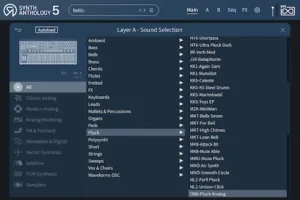
The dual-layer engine is the part of Synth Anthology 5 that matters most in practice. Two sound sources can be combined in a single patch, with each layer retaining its own editing controls. That architecture turns the library from a collection of captured hardware sounds into something that can be shaped around an arrangement.
The Proximity Explorer may be just as important for navigating the library. Instead of forcing the user back into a broad preset search, it analyzes the loaded sound and presents eight related voices for comparison. In a collection this large, that is more than a browser convenience. It creates a faster route from “almost right” to a source that better fits the arrangement.
The limitation is that similarity does not equal suitability. A related sound may share the same broad character while creating the same low-mid buildup, stereo density, or envelope problem in the mix. The feature is most useful as a controlled search tool: it narrows the field without pretending that an algorithm can make the final production decision.
The most useful layers are usually complementary rather than simply bigger. A short digital attack can add definition to a slower analog body. A centered source can carry the musical part while a second layer provides width or movement. One layer can establish the note; the other can supply texture. Dividing those jobs is more effective than stacking two full-range presets and trying to repair the overlap later.
This becomes important in dense mixes. Layered synths often lose definition because both components occupy the same frequency range, sustain for the same length of time, and spread across the same stereo space. Independent control over the two sources makes it possible to shorten one layer, filter another, change their balance, or give movement to only part of the sound. The patch can be built for its role in the arrangement before corrective EQ and dynamics become necessary.
Analog Drift addresses a different weakness of sample-based instruments: repetition can expose how stable the underlying material is. Controlled variation can keep sustained chords, pads, and stacked voices from feeling mechanically identical. Too much drift creates another problem. Pitch focus softens, close harmonies become less defined, and low-register parts can lose authority. In a finished production, subtle instability is usually more useful than an obvious vintage effect.
The new hardware-modeled Ladder and VCF4023 filters give the captured sources more room to move away from their starting point. This does not erase the difference between sampling and full synthesis; filtering a recorded source still does not restore access to the original oscillator structure or signal path. It does, however, make the source material less fixed. A layer can be darkened, narrowed spectrally, pushed into resonant movement, or separated more clearly from the second source without leaving the instrument.
That flexibility matters because the two layers do not always need the same treatment. Filtering one source while leaving the other intact can preserve attack while reducing sustain density, or keep the body of a patch stable while a secondary layer carries more obvious movement. This is a more useful way to judge the new filters than asking whether they reproduce every detail of the original circuits.
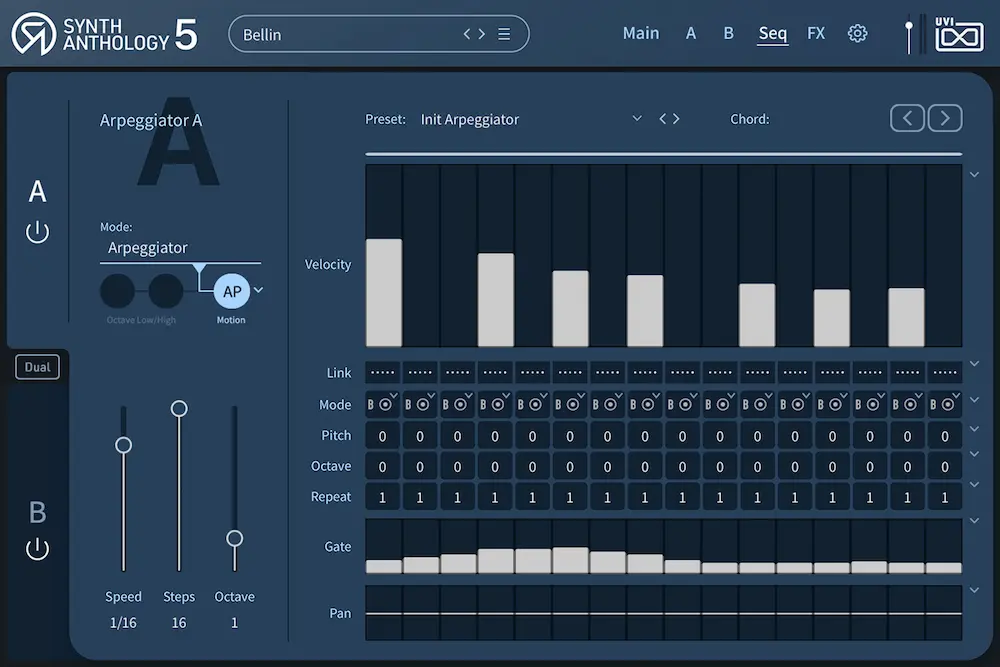
Modulation remains focused rather than exhaustive. Two LFOs and two multi-step modulators provide enough internal movement for evolving layers and repeating patterns without turning Synth Anthology 5 into a modular sound-design environment. For producers working with recorded source material, that scope is sensible: the modulation system is there to animate the sound, not replace a dedicated synthesis platform.
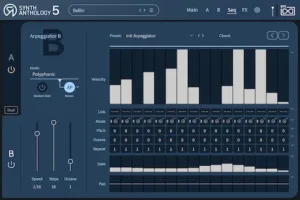
The multi-step modulators, polyphonic sequencer mode, and per-step note repeat extend the same idea into rhythmic programming. Filter movement, amplitude changes, and repeating figures can be developed inside the patch instead of being drawn across multiple DAW automation lanes. That is useful for bass patterns, pulsing textures, and sequenced parts that need to remain editable as one instrument.
There are still better tools for probability-based sequencing, generative systems, and complex modulation networks. Synth Anthology 5 is not trying to win that comparison. Its engine is strongest when the task is simpler and more common: find a useful hardware-derived source, combine it with a second layer when necessary, and shape the result far enough that it belongs in the track rather than remaining a preset audition.
How Synth Anthology 5 Sounds Behave in a Real Mix
 A synth preset should be judged differently once the rest of the arrangement is playing. Sounds that make the strongest first impression are often the ones that require the most work later: wide stereo information, long release tails, dense low mids, layered effects, and enough high-frequency detail to dominate a solo audition.
That matters with Synth Anthology 5 because its dual-layer engine makes complex sounds easy to build. Two individually useful sources can become a poor combination when both carry full-range harmonic information, sustain across the same part of the bar, or compete for the same stereo space. The result may sound larger in isolation while leaving less room for drums, bass, vocals, and other harmonic parts.
The useful approach is to decide what each layer contributes before processing the combined patch. If one source already provides the body and pitch definition, the second may only need to add attack, width, or movement. If both layers are doing the same job, extra EQ rarely fixes the underlying problem. It simply reshapes an arrangement decision that should have been made earlier, which is one reason the boundary between mixing and mastering matters long before the final stereo file exists.
Source selection is especially important with hardware-derived material because two sounds can overlap in ways that are not obvious during preset browsing. Similar low-mid emphasis can make a layer feel thick but reduce separation. Independent stereo movement can create width on headphones while weakening the center image. Long envelopes can raise average energy without adding useful musical information. None of these problems is specific to Synth Anthology 5, but a library built around rapid access to hundreds of sources makes it easy to keep adding instead of choosing.
The consequences become clearer further down the signal chain. Sustained synth energy can consume headroom without producing dramatic peaks, leaving less room for drums and vocals as the mix is pushed toward release level. Heavy limiting then exposes the imbalance: transients flatten while dense harmonic material remains forward, and upper-midrange congestion can become more aggressive. This is where the relationship between loudness, limiting, and clipping in mastering becomes relevant, even though the underlying problem was created much earlier in the sound selection and arrangement.
Mono and reduced-width playback reveal a different weakness. A large patch may depend on side information for much of its apparent size, then lose definition when reproduced through a narrower system. The safer approach is not to avoid width, but to make sure the musical function of the part survives without it. One layer can carry the stable center while the other provides space and motion.
This is where the size of Synth Anthology 5 becomes genuinely useful. The library gives producers enough contrasting source material to replace a poor fit instead of forcing it into place with another processing chain. In a serious mixing workflow, finding the right source is often faster and cleaner than repairing the wrong one.
The Limits of a Sample-Based Hardware Collection
The central limitation is built into the format: captured hardware is not the same as modeled hardware. Synth Anthology 5 preserves the sound of its source instruments, but not their complete programming architecture.
That distinction becomes obvious as soon as a patch needs to be rebuilt from the oscillator level. You cannot freely change the interactions that defined the original machine, redesign its signal path, explore hardware-specific sync or cross-modulation behavior, or work around the same restrictions that shaped the original instrument. The sampled source is the starting point, and all subsequent editing happens inside UVI’s engine.
This makes the “300 synthesizers” figure easy to misread. Synth Anthology 5 does not provide 300 independent virtual instruments. It is better understood as a large collection of hardware-derived sources placed inside one shared synthesis, modulation, sequencing, and effects environment. For producers who want fast access to contrasting timbres, that is an efficient design. Anyone expecting detailed recreations of individual machines is looking at the wrong product category; a dedicated hardware emulation such as the Waldorf Microwave 1 Plugin v2 preserves far more of a specific instrument’s synthesis architecture and programming identity.
The unified engine also removes some of the behavior that makes a specific synthesizer worth learning. Instrument design affects musical decisions. An unusual modulation path, a restricted oscillator section, or an awkward envelope can push a programmer toward results that would not emerge from a standardized interface. Synth Anthology 5 keeps much of the sonic character while leaving that creative friction behind.
Existing plugin collections create a different problem: overlap. A producer who already owns several analog emulations, digital instruments, workstation libraries, and modern hybrid synths may find plenty of familiar territory here. More source material does not automatically create a better production setup. In a mature studio, another large library can increase search time without filling a meaningful sonic gap.
This is why the product makes more sense for some workflows than others. A composer moving quickly between analog, digital, vintage, and modern textures can benefit from having those sources under one roof. A producer who knows two or three synthesizers deeply and prefers to build patches from scratch may find the breadth unnecessary.
Library size creates its own maintenance cost as well. Thousands of presets are only useful if the right source can be found quickly and remembered later. Without a disciplined system for favorites and project-specific curation, a collection this large can produce shallow familiarity: plenty of usable sounds, but no clear memory of where they are or why one was chosen over another.
That is the part of the 300-synth headline worth treating with skepticism. Scale is not the same as depth, and access is not the same as fluency. Synth Anthology 5 solves the problem of hardware variety far better than it solves the problem of mastering any one instrument.
Synth Anthology 5 vs Arturia V Collection and UVI Vintage Vault 5
Synth Anthology 5 competes with several kinds of instrument, but the closest alternatives solve different production problems. The relevant question is not which collection contains more synths. It is whether you want broad access to hardware-derived source material, detailed recreations of specific instruments, or a smaller number of engines with much deeper programming control.
Arturia V Collection is the clearest comparison because both products cover decades of synthesizer history. The workflows are fundamentally different. V Collection presents its instruments separately, preserving more of the identity, architecture, and programming logic associated with each model. Synth Anthology 5 removes those boundaries and places a much larger pool of hardware-derived sources inside one engine.
For producers who want to learn a specific classic synth, build patches around its original architecture, or automate controls that reflect the individual instrument, V Collection is the stronger fit. Synth Anthology 5 is faster when the source machine matters less than the role of the sound. Searching for a bass, pad, sequence, or texture across one environment is more direct than opening several emulations to compare them.
Vintage Vault is the more complicated comparison because it comes from the same UVI ecosystem and overlaps with the same hardware-archive concept. Its advantage is depth: individual instrument families and hardware collections receive more space than they do inside Synth Anthology 5. The disadvantage is commitment. Vintage Vault is a much larger purchase and makes the most sense for users who specifically want an extensive UVI-centered hardware library.
Synth Anthology 5 is the tighter option. It covers more ground than most producers could realistically explore in detail, but keeps that material inside a single instrument. For someone deciding whether to enter the UVI ecosystem, that difference matters more than the raw number of sounds.
A deep wavetable, modular, or hybrid software synth presents almost the opposite proposition. One capable engine may offer far more control over oscillators, modulation, routing, and sound generation than Synth Anthology 5. The cost is that the user has to create or locate the desired character inside that engine. Synth Anthology 5 starts with recorded hardware character and provides less freedom to redefine what sits underneath it.
| Option | What You Get | Best Fit | What You Give Up |
|---|---|---|---|
| UVI Synth Anthology 5 | A broad pool of sampled hardware sources inside one dual-layer engine | Fast source selection, layering, and hardware variety | The original architecture and programming behavior of each source instrument |
| Arturia V Collection | Separate virtual instruments built around specific hardware designs | Learning and programming individual classic synth architectures | The speed and consistency of working inside one shared engine |
| UVI Vintage Vault | A larger hardware archive with deeper coverage of individual instrument families | Producers building a broad collection around the UVI ecosystem | A lower-cost, more focused entry point |
| Deep wavetable or hybrid synth | Extensive control over sound generation, routing, and modulation | Original patch design and complex synthesis | Immediate access to a large catalog of recorded hardware sources |
The decision becomes straightforward once the workflow is defined. Choose Synth Anthology 5 when speed, source variety, and a consistent interface matter more than reconstructing a specific synthesizer. Choose an individual emulation when the architecture of that instrument is part of the reason you want it. Choose a deep modern synth when the goal is to design sounds beyond the boundaries of recorded source material.
For Synth Anthology 4 owners, the comparison is narrower. Version 5 adds 100 new hardware synthesizers, more than 1,000 new sound layers, over 16,000 new samples, and 300-plus new creative presets, while adding Analog Drift, two modeled filters, polyphonic sequencing, and per-step note repeat. The upgrade is meaningful for regular users because it expands both the source pool and the ways those sources can be shaped.
It is a weaker proposition for anyone who already avoids version 4 because of its underlying architecture. Version 5 adds material and improves the engine, but it does not turn Synth Anthology into a collection of fully modeled instruments. If the sample-based approach was the reason version 4 stayed out of your sessions, the new features do not remove that objection.
How Synth Anthology 5 Fits Into a Finished Production
 Preset demos and finished records reward different qualities. A patch can sound detailed, wide, and expensive on its own yet contribute very little once the arrangement is balanced at working level. With Synth Anthology 5, the useful question is not whether the source hardware can be heard. It is whether the chosen sound still performs its musical role after level matching, automation, bus processing, and final delivery.
Monitoring level is an important part of that judgment. Large synth patches are easy to overvalue when auditioned louder than the surrounding arrangement. The extra level exaggerates bass extension, stereo detail, and harmonic density, making a new source appear more effective than the part it replaces. Level-matched comparison is less flattering but more useful. If the new patch only sounds better when it is louder, the source change has not solved much.
The size of the library can help here. When a sound needs extensive EQ, envelope correction, stereo control, and additional processing before it works, replacing the source is often the better decision. Synth Anthology 5 makes that option practical because contrasting hardware families can be auditioned without rebuilding the track around another plugin. Correcting that decision early also matters when preparing a mix for mastering, because source and arrangement problems become harder to separate once they are committed to the stereo file.
Session resources deserve separate consideration. A sample-based instrument shifts part of the workload away from pure synthesis and toward storage, memory, and sample access. In a large project, CPU percentage alone does not describe the full cost. Patch complexity, polyphony, effects, active layers, loading behavior, RAM availability, and drive performance all affect how comfortably the instrument sits in the session.
That makes real project testing more useful than an isolated CPU benchmark. A single patch in an empty DAW says little about a production containing multiple instances, large sample libraries, oversampled processors, and a low audio buffer. Producers working on dense arrangements should judge Synth Anthology 5 under the same conditions in which they expect to use it.
Host integration is another practical factor. Synth Anthology 5 runs in UVI Workstation and Falcon rather than as a completely independent synthesis platform. Existing UVI users already understand that environment and can add the library without changing much about session management. New users are adopting the host ecosystem along with the sounds, which should be part of the purchase decision even if UVI Workstation itself is not the main reason for buying the instrument.
For professional production, recall is one of the clearer advantages over the hardware that supplied the source material. A patch can reopen with the session, follow automation, survive revisions, and move between collaborators without documenting an external signal chain or recreating a hardware setup. That matters when a mix returns weeks later with a request to change the arrangement rather than simply adjust the balance.
The final test is whether the sound survives the production process without requiring special treatment. Level changes, narrower playback, bus compression, limiting, and distribution encoding can all reduce the qualities that made a patch impressive in solo. Those changes become especially relevant when mastering for streaming platforms, where the finished record has to survive playback conditions that are far less controlled than the studio. The safest approach is to commit to sounds for their function in the record, not for the amount of detail they reveal during browsing.
Synth Anthology 5 Price, Installation Size, and System Requirements
Synth Anthology 5 has a regular price of $149. UVI launched the instrument at an introductory price of $89 through July 20, 2026, while Synth Anthology 4 owners were offered a $49 upgrade during the same promotional period. Temporary pricing should not define the long-term value of the instrument, but the difference between the launch price and full price is significant for buyers comparing it with larger synth collections.
| Regular Price | $149 |
| Installation Size | Approximately 28.45 GB |
| Host | UVI Workstation or Falcon |
| Formats | VST, VST3, AU, AAX, and standalone |
| Windows | Windows 10 or 11, 64-bit |
| macOS | macOS 10.14 or later |
| Authorization | iLok account required; physical dongle not required |
| Activations | Up to three computers or iLok keys |
The 28 GB-plus installation matters more than a simple CPU figure suggests. Synth Anthology 5 is sample-based, so storage speed, available RAM, patch complexity, polyphony, active effects, and the number of simultaneous instances all contribute to real session performance. Producers working from smaller system drives or using several large sample libraries should factor that footprint into the purchase decision.
Verdict: Is Synth Anthology 5 Worth It?
Synth Anthology 5 makes sense for producers who want broad access to hardware-derived sounds without managing a large collection of separate emulations. Its real strength is not the 300-synth figure. It is the speed with which those sources can be searched, compared, layered, and reshaped inside one production environment.
That strength comes with a fixed boundary. Synth Anthology 5 captures source material from the original hardware, but it does not recreate 300 complete synthesizers. If oscillator-level programming, hardware-specific modulation behavior, or the architecture of a particular instrument is central to the way you work, an individual emulation or a deeper programmable synth is the better purchase.
The product is easier to justify for producers and composers who need contrasting source material quickly. It is harder to justify for studios already overloaded with synth plugins or for sound designers who prefer to build patches from the ground up. In those cases, another large library may add more search time than capability.
The buying decision is therefore straightforward. Choose Synth Anthology 5 if finding the right source is a recurring bottleneck in your sessions and you value one consistent workflow over detailed access to individual machines. Skip it if you already work faster with a small group of synthesizers you know deeply. The collection offers genuine breadth, but breadth only matters when it removes friction from the work.
Overall Rating
| Category | Rating |
|---|---|
| Source Quality | 9/10 |
| Workflow | 9.5/10 |
| Mix Translation | 8.5/10 |
| Sound Design Flexibility | 7.5/10 |
| Session Workflow | 9/10 |
| Value for Money | 9/10 |
| Overall | 8.7/10 |
Source Quality — 9/10. The strength of Synth Anthology 5 starts with the hardware-derived source material. The library covers enough analog, digital, vintage, and modern territory to make source replacement a realistic production decision rather than a search across multiple plugins. The missing point reflects the unavoidable limitation of the format: captured hardware sound is not the same as having full access to the original instrument.
Workflow — 9.5/10. This is the instrument’s strongest category. A consistent browser, one engine, and a dual-layer architecture remove much of the friction associated with moving between separate synth emulations. The workflow is especially effective when the producer knows the role a sound needs to fill and wants to compare contrasting source characteristics quickly.
Mix Translation — 8.5/10. Synth Anthology 5 provides enough control to build patches around an arrangement rather than relying on oversized presets. Independent layers make it easier to separate attack, body, width, and movement before corrective processing becomes necessary. The score stops short of nine because dense dual-layer patches can still create masking, excessive average energy, and unstable stereo balance when the architecture is used without restraint.
Sound Design Flexibility — 7.5/10. The filters, modulation system, sequencing tools, Analog Drift, and dual-layer structure provide meaningful room to reshape the captured material. The ceiling is still defined by the sample-based architecture. Producers who need oscillator-level control, hardware-specific interactions, or complex modulation networks will reach that ceiling much sooner than they would in a deep modern synthesizer.
Session Workflow — 9/10. Fast recall, automation, project reopening, and access to a large hardware-derived palette inside one environment are significant advantages in production sessions. The deduction is for the additional UVI host layer and the resource considerations that come with a large sample-based instrument, particularly when multiple instances and complex patches are used in dense projects.
Value for Money — 9/10. The value is strong for producers who will use the breadth of the library as a working resource rather than a preset archive. It is less compelling for studios that already own a mature collection of hardware emulations and programmable synths, where overlap can be substantial.
Overall — 8.7/10. Synth Anthology 5 is not a replacement for 300 fully modeled synthesizers, and it should not be judged as one. Its value lies in turning a large hardware archive into a fast production instrument. For producers who lose time searching across disconnected plugins, that workflow is genuinely useful. For synthesists who prefer to master a small number of deep instruments, the same breadth may be unnecessary.
Synth Anthology 5 FAQ
Does Synth Anthology 5 require Falcon?
No. Synth Anthology 5 runs in UVI Workstation, so buying Falcon is not required. Falcon is relevant if you already use UVI’s deeper synthesis and sound-design environment, but it is not necessary to load and play the library.
Can Synth Anthology 5 run as a standalone instrument?
Yes. UVI Workstation is available as a standalone application as well as in plugin formats, so Synth Anthology 5 does not have to run inside a DAW.
Which plugin formats does Synth Anthology 5 support?
Synth Anthology 5 runs through the UVI host environment, with VST, VST3, AU, and AAX support available for compatible systems. The practical point is that the library is loaded through UVI Workstation or Falcon rather than installed as a separate Synth Anthology plugin.
Is the Synth Anthology 5 upgrade worth it for version 4 owners?
The upgrade is easiest to justify if version 4 already appears regularly in your sessions. The larger source library, Analog Drift, new filters, and expanded sequencing tools extend the existing workflow. If you rarely use version 4 because you prefer fully programmable synths, version 5 does not remove that basic limitation.
How demanding is Synth Anthology 5 on CPU and RAM?
There is no single useful figure because session load changes with polyphony, active layers, effects, modulation, and the number of instances. As a sample-based instrument, storage performance and memory availability can matter alongside CPU use. Test demanding patches inside a representative project, not an empty DAW session.
Is Synth Anthology 5 useful if I already own a large synth collection?
Only if it solves a workflow problem your current instruments do not. The main reason to add it is faster access to a broad range of hardware-derived sources through one interface. If your existing synths already cover the sounds you need and you can find them quickly, the overlap may outweigh the benefit.
Can Synth Anthology 5 replace Arturia V Collection?
Not cleanly. Synth Anthology 5 favors broad source selection and a consistent interface, while Arturia V Collection gives more attention to individual instrument identities and programming architectures. The better choice depends on whether you value fast access across many sources or deeper interaction with specific synth designs.
Can Synth Anthology 5 be used in professional mixing and mastering sessions?
Yes, but it remains a production instrument rather than a mixing or mastering processor. Its engineering value is upstream: better source selection, controlled layering, and sensible stereo decisions can reduce corrective processing later and leave a cleaner balance for mastering.
Is Synth Anthology 5 suitable for live performance?
The standalone UVI environment makes live use possible, but the practical setup should be tested for patch loading, controller mapping, audio-buffer stability, and transitions between sounds. A large studio library is not automatically an efficient stage instrument.
Is Synth Anthology 5 better for preset users or sound designers?
It is strongest between those two workflows. Preset users get a large ready-made library, while producers can combine and reshape two sources with filtering, modulation, and sequencing. Sound designers who want unrestricted oscillator-level control will reach the limits of the sample-based architecture sooner.

Yurii Ariefiev is a mastering engineer and audio production editor focused on how production choices survive real mixing, mastering and playback conditions. His work examines source selection, spectral density, stereo behavior and the way layered instruments affect headroom and translation in finished records.
This Synth Anthology 5 review evaluates the instrument from that workflow perspective: not by counting presets, but by examining how its hardware-derived sources, dual-layer engine and sound-design limits affect arrangement decisions and the final mix.