MotionTones Review: Quiet Music’s Physics-Based Generative Instrument in Practice
Quiet Music MotionTones is a physics-based generative instrument built around a simple question: can bouncing objects produce musical material that still earns its place in a production after the visual novelty wears off?
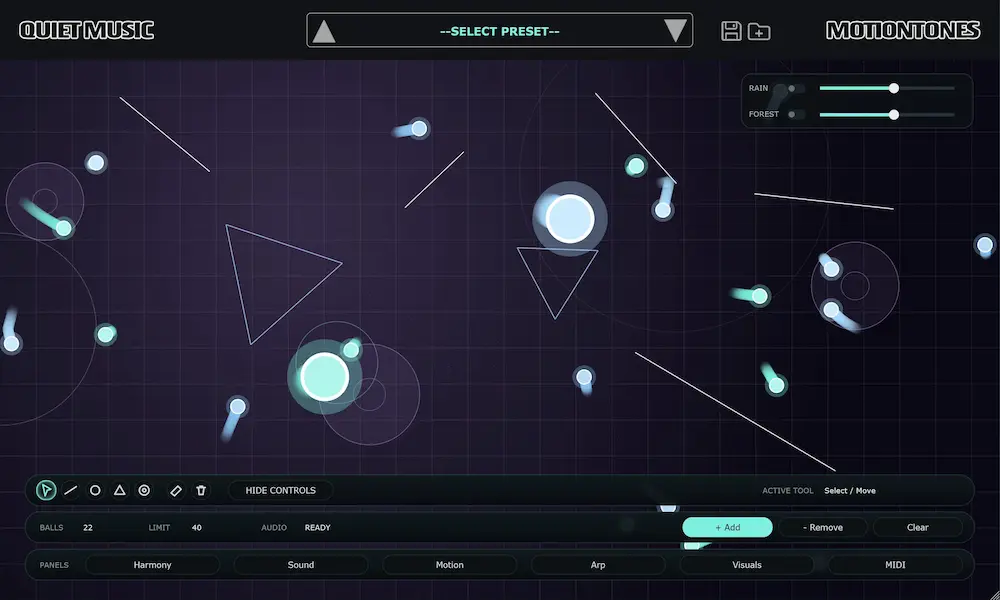
Quiet Music builds MotionTones around a real-time 2D physics environment. Balls fall, bounce, and collide with walls or user-drawn shapes, with each impact triggering a note from the selected scale or chord through one of 25 built-in ambient instruments. A separate tempo-synced Bounce engine brings the same idea closer to structured, DAW-locked pattern generation.
This makes MotionTones neither a conventional probability sequencer nor a synthesizer with a visual layer added for effect. The physics engine determines when musical events occur. Geometry, gravity, collision paths, and object density therefore function as compositional controls, shifting part of the writing process from placing notes to designing the conditions that trigger them.
That approach has clear potential for ambient and experimental production, but it also defines the plugin’s limits. MotionTones favors discovery over exact note placement and evolving behavior over deterministic sequencing. The real test is whether those generated patterns remain useful once they leave the interface and have to function inside an arrangement, survive a mix, and justify their space in the final master.
Why Physics-Based Sequencing Is Different from Randomization
 Generative music software has moved well beyond simple randomization, but most systems still organize musical events through familiar sequencing logic. Probability controls decide whether a programmed step plays. Euclidean sequencers redistribute pulses across a defined cycle. Algorithmic arpeggiators reorder existing notes. MIDI generators create phrases within a set of rules. The methods differ, but time usually remains an explicit part of the interface.
Physics-based sequencing removes that direct relationship. Instead of deciding when a note should occur, the producer designs the conditions that cause it. Release a ball and gravity determines its acceleration. A surface changes its trajectory. The distance to the next collision affects the interval before another trigger. Move the surface, alter the geometry, or add another object, and the timing changes without editing a sequence.
The distinction is not cosmetic. In a conventional sequencer, variation is applied to an existing pattern. In a physics-driven system, the behavior of the environment creates the pattern. The result can be unpredictable without being arbitrary because every event still has a visible cause. That makes spatial relationships part of the composition process rather than a visual representation of decisions made elsewhere.
MotionTones is not the first plugin to explore this territory. Generative sequencers, modular systems, probability tools, and earlier physics-based instruments already offer alternatives to fixed piano-roll programming. The relevant question is therefore not whether the concept is original. It is whether MotionTones makes that concept controllable enough for real production: how quickly it can produce a coherent phrase, how easily that phrase can be shaped, and whether the result remains useful once other instruments enter the arrangement.
Quiet Music narrows the system toward a specific musical vocabulary. Its 25 built-in instruments focus on resonant and atmospheric sources, including kalimba, handpan, marimba, bowls, bells, pads, chimes, and felt piano. The pitch system includes 62 scales, many based on handpan tunings, a 45-chord library, and tools for building custom scales and chords.
That focus is both a strength and a constraint. MotionTones is better suited to evolving tonal material than conventional hook writing: sparse pulses, irregular ostinatos, overlapping resonances, and textures that develop without obvious loop repetition. The supplied sound palette makes those results easier to reach, but it also places the plugin firmly in ambient and experimental territory rather than presenting it as a general-purpose generative sequencer.
How MotionTones Turns Space and Motion into Musical Structure
MotionTones changes the usual relationship between time and interface. In a piano roll, horizontal position defines when an event occurs. Here, timing emerges from distance, velocity, gravity, trajectory, and collision. Move a surface and the rhythm changes. Add another ball and event density increases. Change the geometry and a stable pattern can become irregular without editing a single note.
The producer is effectively building an event system rather than writing a sequence. Geometry determines when collisions occur; the selected scale or chord determines which pitches those collisions can trigger. Keeping those two functions separate is central to the workflow. Rhythmic behavior can become complex while the harmonic vocabulary remains tightly constrained. It reflects a broader shift toward tools that move composition away from direct note placement: Forma Labs Filament approaches the same workflow problem through real-time MIDI orchestration, while MotionTones does it by turning physical behavior into event timing.
This is where the 62-scale library becomes more than a large preset count. Unrestricted physical motion could easily produce an interesting rhythm with unusable pitch content. Constraining collisions to a defined tonal set turns that motion into controlled variation. Custom scales and chords go further by allowing MotionTones to work inside an existing composition instead of forcing the composition to follow the plugin.
The most productive approach is likely to use fewer moving objects than the interface can accommodate. A single ball can establish a pulse; a second can create a counter-rhythm or disturb the first pattern. Additional objects should serve a defined function, whether that is increasing density, introducing interruption, or creating contrast. Filling the canvas may produce more activity, but rarely more musical information.
Complexity is cheap; hierarchy is not. Multiple collisions can create constant movement without producing a part that the arrangement actually needs. The producer still has to decide which events establish the groove, which belong in the background, and which should be removed. MotionTones can generate variation quickly, but the faster a system creates possibilities, the more important selection becomes.
The tempo-synced Bounce engine provides a different route through the same concept. Free-running physics suits drifting textures and irregular movement; synchronized behavior is more useful when a generated part must lock to drums, bass, or other grid-based elements. That distinction may matter more in daily production than the plugin’s visual novelty. One mode favors emergence, while the other gives the motion a clearer rhythmic function.
The built-in instrument library keeps the initial workflow self-contained, but MotionTones is not limited to its 25 internal sounds. MIDI input can spawn balls, generated notes can be sent to external instruments, and performances can be captured internally and dragged into the DAW as MIDI clips. That changes the practical value of the physics engine. A producer can use the supplied ambient sounds to develop the behavior, then move the resulting note data into a different synthesizer, sampler, or orchestral instrument without rebuilding the pattern.
This makes the internal sound palette less restrictive than it first appears. The built-in instruments are still the fastest route to a finished MotionTones texture, but the deeper workflow may be to treat the plugin as a physics-driven event generator and separate its compositional behavior from its final sound source.
In practice, the plugin is strongest in four roles. As a texture generator, sparse collisions and resonant sounds can create beds that evolve without obvious loop repetition. As an ostinato source, synchronized motion can introduce variation while preserving a recognizable pulse. As a sampling source, a longer generative pass can be recorded and edited down to the strongest moments. And as a compositional disruptor, MotionTones can expose timing relationships that are unlikely to emerge from habitual piano-roll programming.
The last two uses may have the most value in serious production. A generative system does not need to perform continuously from the first bar to the last. Often the better workflow is to let it produce material, capture the useful section, and turn that result into a fixed arrangement decision. The same principle applies to more sound-design-driven tools such as BOOM Library TRANSFORCE: systems that generate evolving source material are often most useful when the producer records broadly, selects narrowly, and commits the strongest result to the arrangement.
MotionTones Features That Matter in a Real DAW Workflow
Beyond the physics canvas, several less visual features determine whether MotionTones can function as more than a standalone idea generator. The plugin includes 65 factory presets, MIDI input for spawning balls, MIDI output for driving external instruments, and internal performance capture with drag-to-DAW MIDI export. Those functions make it possible to separate the generated behavior from the supplied sound library rather than committing every pattern to one of the 25 internal instruments.
The Bounce engine also goes further than simple host synchronization. Its nine motion shapes cover different directional and arpeggiated behaviors, while the Custom mode adds a step grid with accents, swing, octave controls, and Euclidean rhythm generation. Note-range and anti-repetition controls provide another layer of constraint when free motion produces too much pitch activity.
For production, MIDI capture may be the most consequential feature. A useful collision pattern can be converted into editable note data, tightened selectively, reassigned to another instrument, or reduced to the few events the arrangement actually needs. That does not remove the value of the physics system; it gives the producer a practical exit from it once discovery is finished.
MotionTones runs as VST3 and standalone software on 64-bit Windows systems, while macOS users get VST3, AU, and standalone versions with Intel and Apple Silicon support. The absence of AAX support matters mainly to Pro Tools-centered workflows; for most native DAW environments, the available formats cover the expected production setup.
Where Physics-Based Generation Starts to Break Down
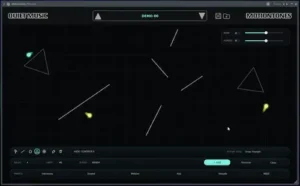 MotionTones has an obvious visual advantage: the relationship between movement and sound is easy to follow. The same visual feedback can distort judgment. A pattern may be compelling to watch while contributing very little to the track.
Physics provides causality, not musical hierarchy. The engine can determine why an event occurs, but not whether the arrangement needs it. It does not know that a vocal requires more space, that another instrument already occupies the same transient range, or that a harmonic transition needs less activity rather than more. The simulation generates behavior; the producer still has to assign function.
This becomes more obvious as resonant sounds accumulate. Bells, bowls, handpans, mallets, pads, and felt-piano textures can each feel sparse in isolation, yet their decays overlap across time. The result may be persistent low-mid energy, dense upper harmonics, blurred transients, and a stereo field with no clear center of attention. Low note density does not necessarily mean low mix density.
Solo auditioning is particularly unreliable with this kind of material. An evolving pattern can sound detailed and immersive on its own, then lose its purpose as soon as the rest of the arrangement enters. The useful test is whether the part still has a recognizable function at realistic mix level. If muting it changes little beyond removing atmosphere, the production may not need the full pattern.
Repeatability is another practical constraint. The appeal of a live physics system comes from variation, but revisions, alternate edits, stem delivery, and mix recalls depend on predictable playback. If a generated performance becomes essential to the track, printing it to audio early is safer than assuming the same interaction can be recreated later.
This is not a MotionTones-specific flaw; it is a workflow requirement for any stochastic or semi-deterministic system. Once the plugin produces a performance worth keeping, capture it. The cost of committing early is small compared with rebuilding an unrepeatable part during a revision.
MotionTones can also be mistaken for an arrangement engine. An evolving sequence may change continuously without creating meaningful development across a song. Structural progression requires changes in density, register, tension, foreground, and function. A simulation can supply material for those changes, but it does not decide when the track needs an introduction, transition, climax, or release.
The internal sound palette imposes a narrower limitation. Its resonant, organic, and atmospheric character is well matched to ambient, meditative, cinematic, and experimental production. Producers working in aggressive club music, tightly voiced pop, heavy bass genres, or detailed orchestral arrangements may find the motion system more useful than the supplied instruments.
MotionTones is therefore strongest when treated as an instrument for generating controlled behavior, not as a universal composition system. It can create events, interactions, and variation. It cannot decide which of them deserve to survive the arrangement.
MotionTones vs. Generative Sequencers: Which Workflow Fits the Job?
MotionTones is not competing only with other ambient instruments. Its real alternatives are tools that generate variation through different control models: probability, Euclidean distribution, modular logic, or physical simulation. The relevant comparison is therefore not which plugin produces the most interesting demo, but which method gives the producer the right balance of discovery, control, and repeatability.
Probability sequencers are more efficient when the basic pattern already exists and only needs controlled variation. Euclidean systems are better at distributing rhythmic events across a fixed cycle. Modular environments offer far greater control over relationships between triggers, pitch, modulation, and external instruments, but require more setup. Physics-based sequencers generate timing through movement and collision, making them better suited to discovering patterns that would be difficult to design directly.
MotionTones sits at the accessible end of that spectrum. It combines the physics environment with built-in instruments, scale and chord constraints, and a tempo-synced Bounce mode. That reduces the amount of routing required before the system produces something musically coherent, but it also means the workflow is more self-contained than a modular generative setup.
| Approach | Best Use | How Variation Is Created | Main Trade-Off |
|---|---|---|---|
| MotionTones | Evolving tonal patterns, ambient textures, generative sampling | 2D motion, collisions, geometry, tonal constraints, synced Bounce behavior | Fast to explore, less direct for exact sequencing |
| Other Physics-Based Sequencers | Organic timing and unexpected pattern discovery | Gravity, trajectory, collision, spatial relationships | Precise timing changes may require rebuilding the physical setup |
| Probability Sequencers | Adding controlled variation to an existing pattern | Per-step probability, conditions, and repeat rules | Variation remains tied to a predefined sequence |
| Euclidean Sequencers | Polyrhythms and evenly distributed rhythmic events | Pulses distributed across a fixed number of steps | Less suited to free-form melodic development |
| Modular Generative Systems | Custom event logic and complex interaction between parameters | User-built trigger, modulation, probability, and routing networks | Greater setup time and more decisions before useful output |
MotionTones makes the most sense for producers who want generative behavior without first building the system that produces it. The visual relationship between movement and sound also makes complex timing easier to read: when the pattern changes, the cause is usually visible on the canvas rather than buried in a probability matrix or modulation network.
That advantage disappears when the producer already knows what the part should play. Exact note placement, detailed voice leading, repeatable articulation, and fast transcription remain easier in a conventional sequencer. If the musical idea is already defined, physics adds an unnecessary layer between intention and result.
Experienced modular users face a different trade-off. A custom generative environment can exceed MotionTones in routing depth, modulation, and integration with external instruments. MotionTones offers less freedom, but reaches coherent results with less infrastructure. The choice is not between simple and advanced; it is between a focused instrument and a system the producer must design.
For ambient and experimental production, that workflow compression is the strongest argument in MotionTones’ favor. The plugin brings event generation, tonal constraint, sound production, and synchronized motion into one environment. Its value depends on whether immediate discovery matters more than the control sacrificed by not building those functions separately.
Mixing MotionTones: Managing Density, Dynamics, and Translation
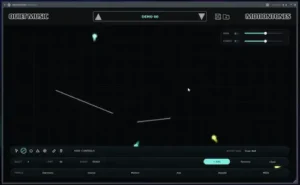 Generative instruments create a problem that fixed MIDI parts usually do not: the mix has to accommodate a range of possible states. A MotionTones texture may remain sparse for several bars, then produce a cluster of overlapping impacts that changes its peak level, spectral density, and masking behavior. Processing tuned to the quiet passage may react very differently when the physics system becomes busy.
The first requirement is to evaluate the performance over time. A short loop is not enough. Record an extended pass and locate the highest-density sections before setting compression, saturation, or downstream bus processing. The busiest collision cluster—not the average passage—often determines how much headroom the part needs and how aggressively its dynamics can be controlled.
Long-decay sounds require particular attention. Repeated impacts can accumulate energy even when the individual notes are quiet. High-pass filtering may do little if the actual conflict sits in the low mids, presence range, or overlapping harmonic tails. In those cases, fewer active objects, shorter decays, narrower register, or arrangement changes may solve the problem more cleanly than corrective EQ.
This is why low note density should not be confused with low mix density. A sparse pattern built from bells, bowls, pads, or other resonant sources can occupy substantial spectral space between triggers. The fader may be low while the part continues masking vocals, percussion, or other sustained elements.
Stereo behavior also needs to be judged outside the soloed plugin. Wide, evolving material can sound expansive on studio monitors but lose definition through mono playback and small speakers. The goal is not to force every atmospheric layer toward the center. It is to make sure the part’s timing, tonal identity, and arrangement function remain intelligible when the stereo image narrows.
The mastering problem begins when uncontrolled variation has already been printed into the mix. Dense collision clusters can create short-term peaks while long resonances maintain energy between them. A limiter then responds to the transient activity without restoring the contrast lost to sustained buildup. This is one reason professional mastering depends on the condition of the mix rather than on how aggressively the final stage is processed. The result can otherwise measure louder while feeling flatter and less defined.
That problem cannot be solved reliably at the stereo stage. Print the generative performance, edit redundant events, control the densest sections, and automate the part according to the arrangement before the mix reaches mastering. These are the same decisions that matter when you prepare a mix for mastering: the stereo file should arrive with its density and arrangement problems already under control. A mastering chain cannot determine which collisions were musically unnecessary.
Lossy playback can expose a related weakness. Dense high-frequency tails, diffuse stereo information, and multiple low-level events may lose separation after encoding, particularly when several elements are already competing in the same range. The issue is not that streaming platforms treat generative music differently. As with mastering for streaming platforms more broadly, complex textures simply leave less margin for detail to remain distinct after encoding and across real-world playback systems.
Low-level monitoring is an efficient reality check. If the MotionTones part disappears completely, it may be contributing atmosphere without carrying structural information. If it remains dominant at a low fader level, its resonances may be occupying more perceptual space than expected. Either result can reveal an arrangement problem that is less obvious at normal monitoring level.
Once a performance is approved, committing it to audio also improves recall and collaboration. The mixer receives a defined performance rather than a live system whose behavior may change, while edits, fades, automation, and revision matching become more predictable. With generative material, early commitment is not a technical compromise; it is part of turning a moving system into a record.
MotionTones Verdict: Who This Plugin Is Actually For
MotionTones works best as a discovery instrument. Its physics engine turns gravity, geometry, and collision into timing controls, while scales and chords keep the resulting motion inside a usable tonal framework. The built-in ambient instruments make the process immediate, and the tempo-synced Bounce engine extends it beyond free-running textures into more structured rhythmic material.
The plugin is a good fit for ambient producers, experimental electronic musicians, cinematic sound designers, and anyone who regularly records long performances, resamples ideas, or builds arrangements from discovered material. It is less convincing for composers who already know exactly what each note should do. Detailed voice leading, fixed articulation, and precise repeatability remain faster in a conventional sequencer.
The buying decision therefore comes down to workflow rather than feature count. If probability lanes and piano-roll programming already produce the variations you need, MotionTones adds another layer of control without solving a real problem. If your work benefits from setting a system in motion, reacting to unexpected patterns, and editing the strongest results into the track, its physics interface offers a genuinely different way to generate material.
MotionTones does not remove composition from the process. It moves part of composition upstream: the producer designs the conditions, the system generates the behavior, and the arrangement determines what survives. That is a useful distinction, and it is the clearest reason to choose this plugin over another conventional generative sequencer.
Overall Rating
| Category | Rating |
|---|---|
| Sound Quality | 8.5/10 |
| Generative Workflow | 9/10 |
| Musical Control | 8/10 |
| Mix Translation | 8/10 |
| Sound Design Flexibility | 7.5/10 |
| Value for Money | 9/10 |
| Overall | 8.4/10 |
MotionTones earns its score by doing one difficult thing well: turning generative behavior into a workflow that remains understandable while the system is moving. It is not the deepest sequencing environment or the broadest virtual instrument, but its combination of physics, tonal constraints, built-in sounds, and synchronized motion gives it a clear production identity.
Sound Quality — 8.5/10. The internal instruments suit the concept well. Resonant mallets, bells, bowls, pads, handpan-derived colors, and felt-piano textures respond naturally to irregular triggering and overlapping motion. The limitation is range rather than basic quality: the palette is strongly biased toward atmospheric and organic material, so its usefulness drops when a production needs harder transients, aggressive synthesis, or a less recognizable ambient character.
Generative Workflow — 9/10. This is MotionTones’ strongest area. The connection between geometry, movement, collision, and musical events is easy to understand without reducing the system to conventional step sequencing. Useful variation can emerge quickly, and the visual cause-and-effect makes complex behavior easier to diagnose than a dense probability matrix. It stops short of a perfect score because more activity does not automatically produce more usable material; selection remains a major part of the workflow.
Musical Control — 8/10. The scale library, chord system, custom tonal sets, and synchronized Bounce engine provide enough constraint to keep physical motion musically relevant. That is considerably more useful than unrestricted random note generation. Precision is still the trade-off. Exact note placement, detailed voice leading, fixed articulation, and repeatable phrasing remain faster in a piano roll or a more deterministic sequencer.
Mix Translation — 8/10. MotionTones can produce spacious, detailed parts that work well at moderate density, but its resonant sound palette requires discipline. Overlapping decays can build spectral energy faster than the note count suggests, while wide atmospheric material may lose definition outside the studio. The plugin does not create these problems by default, but it makes over-generation easy enough that arrangement and monitoring decisions directly affect how well the result translates.
Sound Design Flexibility — 7.5/10. The built-in instruments give MotionTones an immediate and coherent sound world, which is useful for sketching and standalone use. That same focus limits its reach. Producers with established synthesizer, sampler, or modular workflows may value the physics system more than the internal sonic palette, particularly outside ambient, cinematic, and experimental production.
Value for Money — 9/10. At its regular price of €35 before applicable VAT, MotionTones is inexpensive relative to the amount of workflow it consolidates. Event generation, tonal constraint, built-in instruments, MIDI output, performance capture, and synchronized motion are available without assembling a chain of separate tools. The value is much lower for producers whose existing generative environment already solves the same creative problem, but the regular price remains reasonable enough that MotionTones does not need to justify itself as an all-purpose composition system.
Overall — 8.4/10. MotionTones is a focused generative instrument with a genuinely different control model, not a universal composition platform. Its physics engine is most valuable when discovery, resampling, evolving textures, and non-obvious timing relationships are part of the production process. Producers who need exact programming should stay with conventional sequencing; producers who want to design conditions and edit the strongest consequences will find far more value here.

MotionTones FAQ
Can MotionTones follow the key of an existing track?
Yes. The plugin can constrain generated notes to its scale and chord system, including custom tonal sets. For an existing production, a narrow custom pitch set is usually more useful than a broad scale because it reduces notes that are technically in key but wrong for the current chord or voicing.
Is MotionTones a MIDI generator or a virtual instrument?
MotionTones is built as a playable generative instrument rather than a conventional MIDI utility. Its physics system and internal sound library are part of the same workflow, so it can generate musical material without requiring a separate synthesizer or sampler.
Can MotionTones replace a conventional arpeggiator?
Only when discovery matters more than exact programming. The tempo-synced Bounce engine can create structured repeating motion, but a conventional arpeggiator remains faster for fixed note order, octave patterns, gate control, and precisely repeatable parts.
Can MotionTones stay synchronized with a DAW?
The tempo-synced Bounce engine is the relevant option for patterns that need a defined relationship with the project tempo. Free-running physics is better suited to irregular textures where strict grid alignment is not the objective.
Should MotionTones performances be recorded to audio?
Yes, once a generated performance becomes important to the arrangement. Printing the part makes edits, fades, automation, recalls, stem delivery, and later mix revisions more predictable than leaving an evolving system live throughout the project.
Is MotionTones useful outside ambient music?
Yes, but the use case changes. Cinematic cues, minimal electronic music, experimental pop, sound design, and resampling can all benefit from the motion engine. Producers in harder genres may find the generated timing more useful than the plugin’s ambient-focused internal sounds.
What are the best alternatives to MotionTones?
The closest alternatives are other physics-based sequencers, while probability sequencers, Euclidean tools, and modular generative systems cover adjacent workflows. Physics is better for spatial pattern discovery; probability is better for controlled variation of an existing sequence; modular systems offer deeper custom logic at the cost of setup time.
Is MotionTones worth buying if I already own generative sequencers?
Only if physics changes the way you generate ideas. If your current tools already provide the variation and control you need, MotionTones may duplicate an existing function through a different interface. Its strongest case is for producers who get useful results faster from spatial cause-and-effect than from probability lanes or custom generative patches.
Does MotionTones use a lot of CPU?
There is no reliable universal CPU figure because performance depends on the computer, DAW, buffer size, project load, and the complexity of the active MotionTones setup. CPU usage should be tested in the intended session rather than inferred from a standalone demo or another user’s system.
Is MotionTones better for finished parts or generating source material?
It can do both, but its strongest advantage is generating source material that would be difficult to program deliberately. Recording longer passes and editing the best sections often produces a more controlled result than expecting the physics system to deliver a complete arrangement-ready performance in one run.

Yurii Ariefiev is a mastering engineer and audio production editor focused on how production tools behave beyond the plugin interface—inside arrangements, mixes, final masters, and real-world playback systems.
His analysis of MotionTones examines physics-based sequencing as a production workflow, with particular attention to generative density, repeatability, spectral buildup, mix translation, and the point where evolving material should be committed to audio.