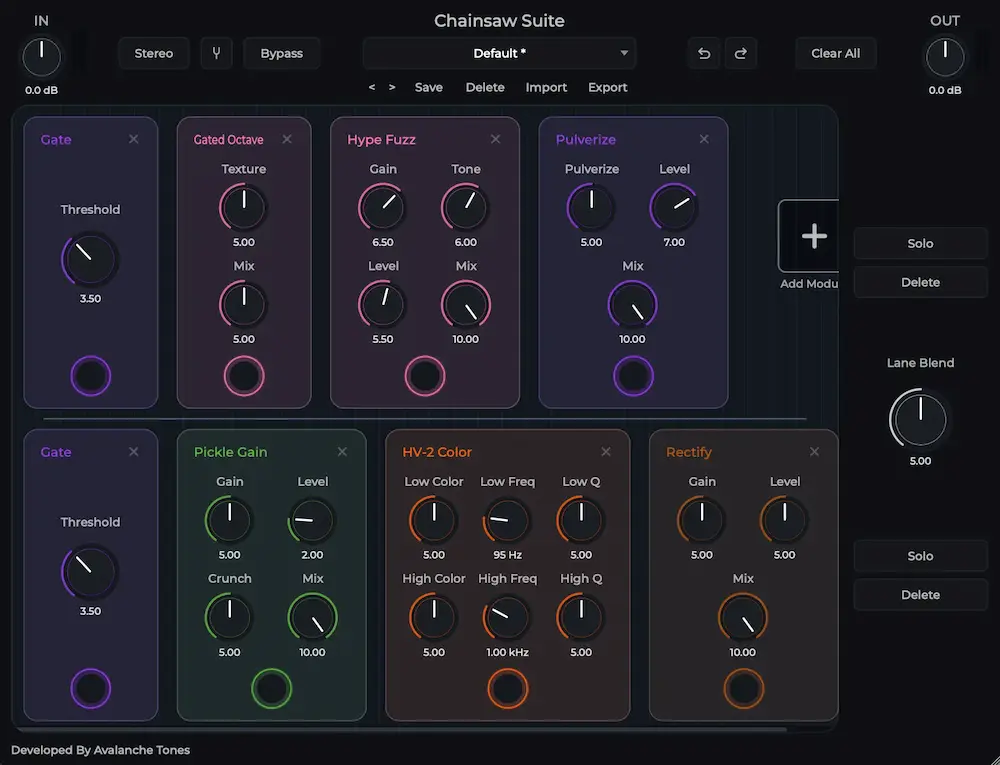
Avalanche Tones has released Chainsaw Suite, a modular guitar plugin for metalcore, djent, thall, and other low-tuned heavy styles. Rather than locking the user into a fixed amp-and-cab signal path, it provides 20 movable processing modules, up to 10 module slots per chain, two parallel signal lanes, and support for two Neural Amp Modeler captures inside the same workspace.
The routing architecture matters more than the module count. Heavy guitar production rarely suffers from a shortage of distortion options; the harder problem is controlling what enters each nonlinear stage and keeping the result usable once bass and drums fill the arrangement. Low-end buildup, smeared pick attack, excessive midrange density, and increasingly fragile DAW routing are common consequences of stacking processors without a clear division of roles. Chainsaw Suite is designed around that problem rather than another attempt to recreate a specific amplifier.
The plugin is the flagship release from Avalanche Tones, founded by guitarist, songwriter, producer, and developer Ava Toton. Chainsaw Suite grew out of her own production work, where conventional modeling software often required too much adjustment before an aggressive guitar tone would hold together in a dense mix. That gives the product a narrower purpose than an all-in-one amp suite: it is a routing and tone-building environment for producers who need more control than a conventional serial chain provides.
Chainsaw Suite Treats Guitar Tone as a Modular Signal Path
Most guitar plugins are organized around a complete rig: amplifier, cabinet or impulse response, pedals, and post-processing arranged around a largely fixed signal flow. Chainsaw Suite works differently. Its 20 modules include nine distortion, overdrive, and fuzz processors, three EQs, two pedal-style tone shapers, an octaver, and a bitcrusher. Up to 10 can be loaded at once and reordered freely.
The distinction matters in heavy guitar production because processor order is part of the sound. Moving an EQ, overdrive, fuzz stage, octave processor, or amp capture changes more than the final frequency balance. It changes pick definition, low-string stability, harmonic density, and the space left for bass beneath double-tracked guitars.
A low-frequency cut before a high-gain stage reduces the energy driving the nonlinear process. The same cut after distortion removes low end, but it cannot undo the harmonics and compression already generated by that energy. Upper-mid emphasis behaves differently for the same reason: placed before clipping, it changes which frequencies drive the distortion; placed afterward, it functions primarily as tonal shaping. With extended-range guitars and low tunings, that distinction often determines whether a tone stays defined or turns into broadband density.
That is the real case for the modular architecture. The 20-module count is secondary; most producers already own enough distortion plugins. Chainsaw Suite is useful if it makes the relationship between gain staging, spectral shaping, and routing easier to build, revise, and recall inside one signal path.
Parallel Processing Addresses a Real Problem With Low-Tuned Guitars
Chainsaw Suite can split the incoming guitar signal into two parallel lanes and blend them inside the plugin. For low-tuned material, that routing is more consequential than simply adding more distortion models.
Heavy guitar processing is a tradeoff between weight and intelligibility. Driving the full spectrum into aggressive distortion can destabilize the low end and blur pick attack. Filtering too aggressively before the nonlinear stage produces the opposite problem: a tone that sounds tight in isolation but loses authority against bass and drums. More upper-mid distortion can restore definition, yet the same energy often becomes abrasive once vocals, cymbals, and final mastering loudness enter the picture.
Parallel routing allows those jobs to be separated. One lane can preserve the controlled core of the guitar while the other supplies fuzz, octave content, additional saturation, or narrower-band aggression. The blend then determines how much of that secondary texture enters the sound without forcing the entire signal through the same processing sequence.
The technique itself is established; the practical advantage is keeping it inside the guitar chain. The same routing can be built with DAW buses, duplicate plugin paths, gain stages, and additional automation, but every external branch adds another point that has to be traced and revised. For productions where the guitar tone changes alongside the arrangement, an internal two-lane architecture can keep the relationship between the core tone and the processed layer easier to control.
Dual NAM Support Turns Captures Into Part of the Processing Chain
 Chainsaw Suite can host up to two Neural Amp Modeler modules at once. That moves the plugin beyond a closed collection of distortion and tone-shaping effects: NAM captures can sit inside the same modular path as the processing placed before and after them.
This addresses a common weakness of capture-based guitar workflows. The final tone is often distributed across several stages: input filtering, boost or overdrive, the NAM loader, cabinet processing where required, corrective EQ, and additional saturation. Parallel processing adds another layer of routing. Chainsaw Suite brings more of that structure into one environment instead of treating the capture as an isolated plugin instance.
Dual loading is especially relevant when two tones have different jobs. One path can provide pick response and midrange structure while the second contributes a narrower layer of saturation, texture, or frequency-specific weight. That is more controlled than simply stacking two full-range high-gain tones, which can increase low-mid density and harmonic overlap without creating useful separation.
The architecture does not eliminate the technical problems of blending processed guitar paths. Phase relationships, gain matching, and spectral masking still have to be managed. What it changes is the routing overhead: the two capture paths and surrounding processing can be built and adjusted within the same modular system.
The limitation is the same as the advantage. Two NAM loaders, parallel lanes, 10 module slots, multiple nonlinear stages, and automation provide enough flexibility to overbuild a tone quickly. The strongest use case is not maximum complexity, but assigning each path a specific function and removing anything that does not improve the guitar inside the full arrangement.
Chainsaw Suite Separates Aggression From the Rest of the Guitar Tone
The name suggests the familiar chainsaw guitar aesthetic: abrasive mids, heavy saturation, and a pedal-driven sound that can dominate the entire signal path. Chainsaw Suite takes a less literal approach. Instead of recreating one fixed chainsaw tone, it separates distortion, EQ, tone shaping, octave processing, and lo-fi effects into modules that can be placed around the rest of the chain.
That distinction matters for metalcore, djent, thall, and other low-tuned styles. Extreme distortion across the full guitar spectrum can produce impressive width and density in isolation while weakening low-string definition and pick attack in the mix. A single aggressive pedal stage also ties several characteristics together: more grind may bring more low-end compression, more sustain may reduce transient contrast, and additional harmonic density may leave less space for bass and drums.
A modular chain allows those characteristics to be separated. Upper-mid abrasion can be added without sending the full low end through the same stage. Fuzz or octave content can occupy a secondary lane instead of defining the core tone. Additional saturation can be introduced where the arrangement needs density rather than remaining fixed across the entire performance.
This is the more useful interpretation of the chainsaw concept for modern audio production. The objective is not maximum aggression at every stage; it is deciding where the aggression should occur, which frequencies should drive it, and how much of the processed signal the mix can support.
A Mix-Ready Guitar Tone Depends on More Than the Sound in Solo
“Mix-ready” is one of the least useful promises in guitar plugin marketing. A tone cannot be judged independently of the tuning, performance, bass arrangement, drum balance, and final loudness target. A sound that feels controlled in solo may lose weight against the rhythm section; one that sounds enormous on its own may consume too much low-mid and upper-mid space to survive the full mix.
The workflow problem appears when the tone is spread across multiple plugin instances, buses, and automation lanes. A change to the arrangement can force the engineer to revisit several parts of the signal path. More aggression in the chorus may require changes to a parallel bus as well as the main chain. A new bass sound can expose low-frequency distortion that was previously masked. Small revisions become slower because the guitar tone exists as a network of settings rather than one clearly organized system.
Chainsaw Suite’s strongest argument is therefore consolidation, not access to processing that cannot be built elsewhere. Separate plugins and DAW routing can reproduce the same basic architecture. The advantage exists only if the modular environment makes the chain faster to understand, revise, automate, and recall.
That is also the standard by which the plugin should be judged. More modules do not automatically improve a production workflow. If routing becomes harder to read inside one interface than across a conventional DAW session, consolidation has failed. If the relationship between the core tone, parallel processing, NAM captures, and section-specific changes remains clear, Chainsaw Suite solves a practical problem that feature counts alone do not address.
DAW Automation Extends Chainsaw Suite Beyond Static Guitar Tones
Full DAW automation matters because heavy guitar processing rarely needs to remain identical from the first bar to the last. A verse may require tighter low-end control, a breakdown may support more parallel distortion, and octave or bitcrusher processing may belong to a single transition rather than the entire guitar track.
Keeping those changes inside one plugin can reduce the number of duplicate tracks, auxiliary buses, and bypass states needed to manage section-specific tones. The practical use is not constant movement. It is changing a defined part of the chain when the arrangement requires a different amount of weight, texture, or aggression.
The main risk is level bias. Increasing distortion or bringing up a parallel lane can sound better simply because the result is louder. Additional saturation may also increase average energy and harmonic density without producing an obvious peak-level change, which can alter how the guitars interact with the mix bus and final limiter.
Useful automation therefore depends on gain matching and clear intent. A processing change should solve a section-specific problem or create a deliberate contrast, not animate the chain for its own sake. Used that way, Chainsaw Suite can function as an arrangement-level guitar processor rather than a static preset loaded at the start of the session.
Chainsaw Suite Competes on Workflow, Not the Size of Its Guitar Library
The guitar software market is already saturated with amp suites, capture ecosystems, standalone NAM loaders, impulse-response tools, pedal emulations, and modular effects. A smaller developer has little reason to compete by offering fewer versions of the same components.
Chainsaw Suite takes a narrower position. It is built around aggressive, low-tuned guitar processing and the routing decisions that come with it: pre-distortion shaping, multiple nonlinear stages, parallel paths, and capture-based tones. Its value depends on whether those chains become faster to build and easier to revise than the equivalent setup spread across a DAW.
That specialization also limits the audience. Producers who want a finished amp sound from a single preset may have little use for another modular environment. The more obvious fit is a user who already works with NAM captures, parallel distortion, frequency-dependent gain staging, and separate layers of harmonic texture.
At $39.99, Chainsaw Suite is priced as an additional production utility rather than a replacement for an established amp-modeling platform. The fully functional seven-day trial is therefore more important than the feature list. The decisive question is whether consolidating the chain saves enough time in an actual session to justify adding another plugin to the workflow.
How Modular Guitar Processing Affects Mixing and Mastering
For a mixing engineer, the relevant question is not how much distortion Chainsaw Suite can generate. It is whether the processing remains controllable once the guitars are placed against bass, drums, vocals, and the rest of the arrangement. Low-tuned guitars already occupy substantial spectral space before additional nonlinear stages begin generating harmonics above the fundamental range.
A tone can sound wide and aggressive in solo while creating persistent low-mid density and upper-mid energy in the full mix. The usual response is heavier post-EQ, but that cannot fully reverse compression and harmonic content created earlier in the chain. Once excessive low-frequency energy has driven a distortion stage, removing the original low end afterward does not remove the nonlinear products it generated. This is also why preparing a mix for mastering is less about leaving arbitrary headroom and more about resolving problems that the final stage cannot cleanly undo.
The downstream effect becomes clearer at higher mix density. Sustained harmonic energy can reduce the contrast between guitar transients and the rest of the arrangement, consume headroom without producing useful impact, and make the mix bus react more continuously. Excessive upper-mid saturation may also become substantially more fatiguing when the final master is pushed louder.
Low-frequency distortion creates a different problem. It can increase average energy and make limiting less efficient even when the guitar does not appear to produce the highest peaks in the session. The result may be less available level before the master begins to feel congested or unstable—one of several cases where problems that appear during mastering actually originate earlier in the production chain.
Chainsaw Suite does not solve these problems automatically. Its advantage is structural: separate stages and parallel paths make it possible to decide which part of the guitar needs weight, which part needs harmonic aggression, and which layer should remain controlled. That is a more useful approach to heavy guitar mixing than forcing one full-range tone to provide size, attack, saturation, and texture at the same time.
Chainsaw Suite Comes From a Production-First Development Loop
Avalanche Tones was founded by 17-year-old guitarist, songwriter, producer, and developer Ava Toton. Her age makes the launch unusual, but it says little about whether Chainsaw Suite will succeed as professional audio software. Stability, support, workflow, and results in real sessions will matter far more after the initial release cycle.
The more relevant part of the story is where the software came from. Toton developed Chainsaw Suite around problems encountered while writing and producing her own music, including work with Cataclysmic. That creates a direct feedback loop between software design and actual production use rather than starting with a broad feature list and searching for a market afterward.
That focus will be worth preserving. Specialist audio tools often become less useful when development turns into feature accumulation: more modules, more modes, and more options that do not make the core task faster. Chainsaw Suite currently has a specific job—organizing aggressive guitar processing around modular routing, parallel paths, and NAM integration. Improving that workflow is likely to matter more than simply increasing the number of processors in future versions.
Chainsaw Suite Price, Formats, and Availability
Chainsaw Suite is available for $39.99, with a fully functional seven-day free trial offered by Avalanche Tones. The plugin supports Windows and macOS and is available in VST3 and AU formats. The initial release includes 20 processing modules, up to 10 module slots per chain, two parallel signal lanes, dual Neural Amp Modeler loading, and full DAW automation.
NAM Lets Smaller Developers Compete Without Building Another Closed Amp Ecosystem
Access to convincing guitar tones is no longer the main bottleneck in audio production. Producers can combine commercial amp models, NAM captures, impulse responses, distortion plugins, and specialized utilities from different developers. The harder task is turning those components into a repeatable signal path.
That changes what a small audio software company needs to build. Native NAM support means Avalanche Tones does not have to compete on the size of a proprietary amp library. The capture can come from elsewhere; Chainsaw Suite can concentrate on the processing around it—routing, gain staging, distortion, tone shaping, parallel paths, and automation.
This is a more defensible position than trying to match established amp platforms model for model. Many producers already assemble guitar tones from multiple ecosystems, so the value can sit in the layer that connects those tools rather than in owning every component of the signal chain. The same workflow-first direction is becoming visible in other areas of audio production, including local AI processing, as explored in our OBSIDIAN Neural Local Edition review.
Whether Chainsaw Suite becomes an important part of that workflow will depend on execution, not architecture alone. NAM integration gives the plugin access to an existing capture ecosystem; the product still has to make those captures faster to organize and easier to use than a conventional chain of separate plugins.

Chainsaw Suite Will Succeed or Fail on Workflow
Chainsaw Suite enters a guitar plugin market that already has more amp models, captures, distortion options, and presets than most producers can use. Its reason to exist is not access to another set of heavy tones. It is the attempt to make a complicated guitar signal path easier to build and keep under control.
That distinction gives the plugin a credible position, but also a clear test. The modular environment has to remain fast when the session becomes complicated: double-tracked rhythms, layered sections, changing arrangements, bass interaction, automation, and repeated revisions. If managing the chain inside Chainsaw Suite becomes slower than using separate plugins and buses, the architecture loses its advantage.
If it holds up under that pressure, the plugin fills a real gap between a fixed amp suite and a manually assembled DAW routing system. At $39.99, with a seven-day trial and dual NAM support, the barrier to testing that claim is low. The important question is not how aggressive Chainsaw Suite can sound in isolation, but how much control it preserves once the rest of the production is playing.