New audio plugins rarely introduce genuinely new processing concepts. Most releases refine familiar ideas—another analog emulation, another intelligent EQ, or another variation on a classic bus compressor. Emetic DSP enters the market from a different angle. Its first two plugins focus less on expanding feature sets and more on simplifying the decisions engineers make during the earliest stages of a mix.
Parametic and Smile Bus 3000 are the debut releases from UK developer Emetic DSP, founded by producer Martyn Hare. Rather than recreating vintage hardware or relying heavily on automated processing, both plugins reorganize familiar EQ and compression workflows around broader musical decisions. The premise is straightforward: reduce the time spent configuring processors so engineers can spend more time evaluating the mix itself.
Because the software has only recently been introduced, there is not yet enough independent testing to draw firm conclusions about audio quality, CPU efficiency, or long-term reliability. Instead of repeating launch claims, this editorial examines the underlying design philosophy, the practical workflow these plugins are intended to support, and where they could realistically fit alongside established tools used in professional mixing and mastering.
Contents
- Why Modern Mixing Plugins Prioritize Workflow
- Parametic & Smile Bus 3000 Overview
- Professional Mixing Applications
- Workflow Innovation Explained
- Mastering Applications
- Performance & Reliability
- Overall Rating
- Final Verdict
Innovative plugins can speed up your workflow, but they can’t replace the experience behind critical mastering decisions. Upload up to 35 seconds of your mix and receive a free mastering demo to hear how professional mastering can improve clarity, balance, punch, and translation before you commit to a full project.
Why Modern Mixing Plugins Are Prioritizing Workflow Over More Controls
 The modern mixing engineer isn’t limited by processing power or plugin choice. Most professional studios already own multiple EQs, compressors, saturation processors, transient shapers, and spectral repair tools capable of delivering excellent results. The bottleneck has shifted elsewhere: making confident decisions quickly while maintaining consistency across increasingly demanding sessions.
That change has influenced plugin development over the past several years. Intelligent frequency analysis, adaptive dynamics, perceptual processing, and context-aware assistants have become common features—not because engineers need more automation, but because they spend less time searching for problems and more time making creative decisions. The strongest workflow tools don’t replace experience; they reduce repetitive setup before critical listening begins.
Emetic DSP fits into that broader trend, although its approach differs from fully adaptive processors. Rather than letting algorithms shape the mix automatically, Parametic and Smile Bus 3000 appear to simplify how engineers reach familiar decisions in the first place.
Traditional compressors expose attack, release, ratio, knee, sidechain filtering, and other timing controls before a single gain reduction decision has been made. Conventional parametric EQs often encourage engineers to sweep frequencies manually before broader tonal balance has even been established. Emetic DSP reorganizes those workflows around higher-level musical choices instead of asking users to build every processing stage from individual parameters.
That philosophy reflects how many experienced engineers actually work. The first pass through a mix is usually about establishing weight, depth, movement, and tonal balance—not chasing narrow resonances or refining half-decibel adjustments. Broad decisions shape the direction of the mix; detailed corrections simply reinforce those choices later in the session.
Whether this design philosophy proves successful depends less on its interface than on the quality of its underlying DSP. Experienced engineers adopt simplified tools only when they produce consistent, repeatable results. If Emetic DSP can deliver that balance, its biggest contribution may not be new algorithms at all, but a workflow that reduces unnecessary technical overhead without limiting creative control.
Breaking Down Parametic and Smile Bus 3000
Although released together, Parametic and Smile Bus 3000 address different stages of the mixing process. One focuses on broad tonal balance before corrective EQ becomes necessary, while the other rethinks how engineers approach bus compression.
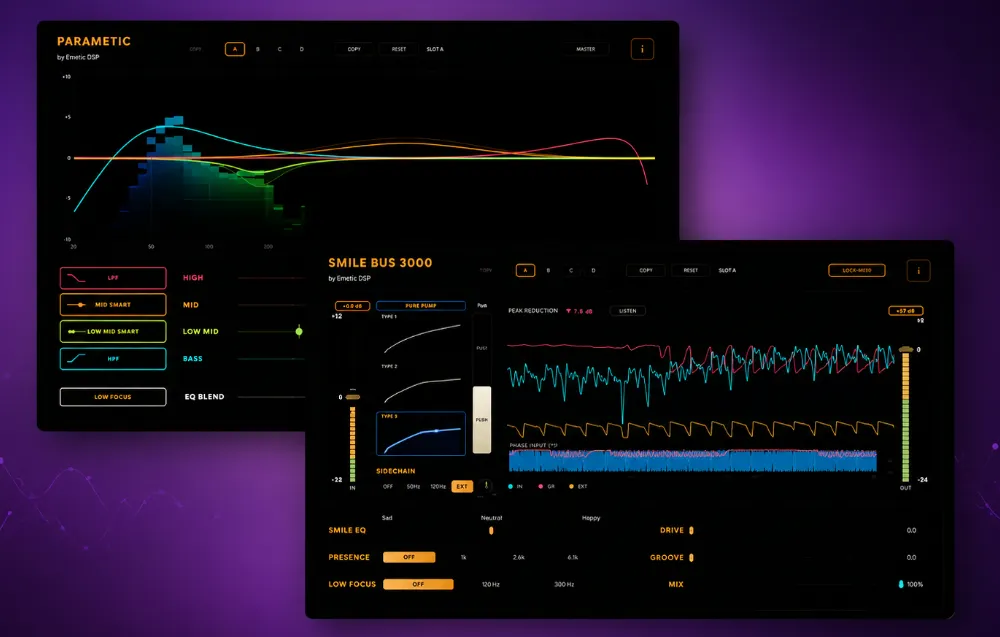
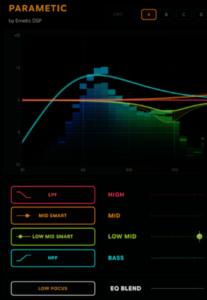
Parametic is not intended to replace a traditional parametric EQ. Its architecture combines four parallel bands—analog-style low and high shelves with two proportional-Q midrange bells—and emphasizes tonal shaping over surgical correction.
The plugin’s most distinctive feature is its Smart frequency suggestion system. Instead of automatically boosting or cutting frequencies, it analyzes incoming material and recommends potential operating ranges for the two mid bands. The engineer still decides whether those suggestions deserve attention, keeping critical listening at the center of the workflow rather than handing control to an adaptive algorithm.
That distinction matters. Many intelligent EQs attempt to solve tonal problems automatically. Parametic appears to function more as an assistant than an autonomous processor, reducing the time spent searching for useful frequencies without making creative decisions on the user’s behalf.
Another notable addition is the Truth Graph, which overlays the effective EQ curve against the signal’s spectral energy. Unlike a conventional spectrum analyzer that displays audio independently from the filter response, this visualization attempts to show how equalization interacts with the material in real time.
Whether the Truth Graph becomes genuinely useful will depend on implementation rather than concept alone. Experienced engineers rarely trust visual feedback over monitoring, but a well-designed display can confirm decisions and reduce unnecessary frequency hunting during the early stages of a mix.
Features such as Headroom Hold and EQ Blend reinforce the plugin’s intended role as a broad tone-shaping processor. They suggest a workflow built around parallel enhancement and level consistency rather than detailed corrective equalization.
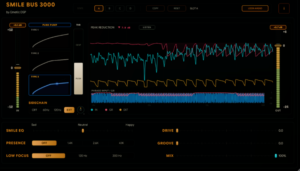
Smile Bus 3000 takes a similarly unconventional approach to dynamics processing. Instead of exposing attack, release, ratio, and knee controls from the outset, it organizes compression around three behavioral models—Variable, Stress, and Punk Pump. The goal is to let engineers choose the overall movement of the compressor before refining its behavior.
The defining feature is Groove Hold, described as a system that shapes gain reduction using both program material and host tempo as references. At present, it is impossible to determine whether Groove Hold represents a genuinely new envelope-generation method or a macro controlling several internal timing parameters. That distinction matters technically, but not necessarily in practice. If the compressor responds consistently and musically, engineers are unlikely to care how the behavior is achieved.
Automatic input compensation, integrated tone shaping, and flexible sidechain routing complete the feature set. None of those capabilities are unique on their own. Their value depends on how naturally they work together during an actual mix rather than how many functions appear on the specification sheet.
Taken together, Parametic and Smile Bus 3000 reveal a consistent design philosophy. Emetic DSP is not trying to build more feature-rich EQs or compressors. The company is attempting to reduce the number of technical decisions required before meaningful musical decisions can be made. That is a subtle distinction, but it is also the idea that will determine whether these plugins become everyday production tools or simply another interesting launch.
Where Parametic and Smile Bus 3000 Fit in a Professional Mix
Neither of Emetic DSP’s debut plugins is designed to replace the precision processors that already define professional mixing. Corrective equalizers such as FabFilter Pro-Q, Kirchhoff EQ, or DMG Audio Equilibrium remain the better choice for resonance control, surgical filtering, and detailed tonal correction. The same applies to established bus compressors from SSL, API, Vertigo, and other manufacturers when precise envelope shaping is the priority.
Parametic and Smile Bus 3000 occupy a different part of the workflow. They target the stage where a mix is still taking shape—before fine corrective work begins and before every technical decision becomes permanent.
Most experienced engineers don’t start a session by chasing narrow resonances or adjusting compressor timing in isolation. The first objective is establishing the overall character of the record: how much weight the low end carries, whether the groove feels controlled or energetic, how forward the vocal sits, and whether the mix already communicates the intended emotion. Creative tone-shaping processors such as tape and cassette emulations often play an important role at this stage, as discussed in our The Asylum Analogue review. Once those larger decisions are in place, corrective processing becomes faster and more deliberate.
That perspective explains Emetic DSP’s design philosophy. Instead of asking engineers to build an EQ or compressor from individual parameters, both plugins encourage broader musical decisions first. The interface shifts attention away from attack times, Q values, and filter slopes toward questions that directly affect the finished mix: Does the balance feel right? Does the bus move naturally? Is the tonal foundation established before detailed refinement begins?
For experienced mixers, that approach may reduce one of the least productive parts of the process—constantly switching between technical adjustments and critical listening. If the underlying DSP proves reliable, the real advantage will not be fewer controls. It will be reaching confident mix decisions with fewer interruptions.
Which Ideas Are Actually New—and Which Aren’t
Audio software marketing has a habit of introducing new terminology for concepts engineers already know. A proprietary name doesn’t necessarily indicate a new DSP technique, just as a familiar interface doesn’t mean the underlying processing is conventional. Emetic DSP’s first releases contain examples of both.
Parametic’s Smart frequency suggestions shouldn’t be mistaken for a breakthrough on their own. Content-aware frequency analysis has become increasingly common in modern EQs from developers such as Sonible, iZotope, and Focusrite. The real question is not whether Parametic analyzes audio, but how useful those recommendations are during an actual mix.
If the system consistently directs engineers toward musically relevant frequency regions without making automatic EQ decisions, it occupies a practical middle ground between a conventional parametric EQ and a fully adaptive processor. That approach is likely to appeal more to experienced mixers, who generally prefer guidance over automation.
Truth Graph deserves similar scrutiny. Overlaying spectral information with an EQ curve is not inherently new, but displaying the effective interaction between processing and program material could be more informative than a conventional spectrum analyzer if implemented well. Its value will ultimately depend on whether it helps engineers reach decisions faster or simply adds another visualization competing for attention.
Smile Bus 3000 raises a different set of questions. Replacing traditional attack, release, and ratio controls with behavioral compression models changes how the processor is operated, but not necessarily how compression itself works. Whether that abstraction becomes a genuine workflow improvement depends entirely on the quality and consistency of the underlying dynamics engine.
Groove Hold is the least transparent feature introduced so far. Based on the available information, it appears to shape gain reduction around both program material and session tempo, but Emetic DSP has not disclosed enough technical detail to determine whether it represents a new envelope-generation method or a higher-level control over existing timing parameters.
That distinction matters from an engineering perspective, but it is unlikely to matter in daily production if the results are consistently musical. The audio industry has repeatedly shown that practical workflow improvements often outlast headline DSP innovations. If Groove Hold helps engineers reach the right compression behavior more quickly and with predictable results, its implementation becomes less important than its reliability.
What Will Ultimately Determine Whether These Plugins Succeed
 Launch features rarely determine whether a plugin becomes part of a professional workflow. Engineers adopt processors they can trust under deadline pressure—tools that behave predictably across different sessions, translate well between projects, and produce consistent results without constant second-guessing.
That is where Emetic DSP still has the most to prove.
For Parametic, the key question is consistency. Intelligent frequency suggestions are only valuable if they repeatedly identify musically useful areas across very different material, from close-miked vocals to dense electronic productions and full stereo buses. If similar sources produce wildly different recommendations, most experienced engineers will eventually stop paying attention to the analysis and rely on their ears instead.
Smile Bus 3000 faces a different challenge. Compressors earn long-term trust because their behavior becomes predictable over hundreds of mixes. Replacing traditional attack and release controls with behavioral models may simplify operation, but only if those models respond consistently across different tempos, arrangements, and dynamic material. Otherwise, experienced users will gravitate back toward compressors that offer more direct control.
Another factor is transparency. Intelligent processing works best when it remains understandable. Engineers do not necessarily need to know every mathematical detail behind an algorithm, but they do need to predict how it will react before committing it to an important mix. Once a processor starts feeling unpredictable, confidence disappears quickly.
Finally, there is the question every new workflow-oriented plugin must answer: does it actually save time? Reducing the number of controls has little value if engineers spend that time verifying suggestions or compensating for inconsistent behavior. A simplified interface only improves workflow when it consistently shortens the path to a decision without introducing uncertainty.
Those are the benchmarks that matter far more than launch-day feature lists. If Emetic DSP delivers predictable behavior under real production conditions, both plugins could establish a meaningful place alongside traditional EQs and compressors. If not, they risk becoming interesting ideas that engineers reach for only occasionally.
How Emetic DSP Compares to Established Mixing Tools
Emetic DSP isn’t competing with traditional EQs or bus compressors on feature count. Both plugins enter mature categories dominated by products that have already earned the trust of professional engineers. Their differentiation comes almost entirely from workflow.
Parametic sits somewhere between a conventional parametric EQ and an intelligent assistant. It isn’t designed for surgical correction like FabFilter Pro-Q or Kirchhoff EQ, nor does it attempt to automate tonal balancing as aggressively as Sonible smart:EQ. Instead, it appears to target the space between those approaches, using analysis to accelerate decisions while leaving tonal control entirely in the engineer’s hands.
Smile Bus 3000 follows a similar philosophy. Rather than recreating an SSL G Bus Compressor or another analog topology, it simplifies the process of shaping bus compression by replacing detailed timing controls with predefined behavioral models. That makes it less of a direct competitor to established bus compressors than an alternative workflow built around faster decision-making.
| Plugin | Best Used For | Where It Excels | Where Emetic DSP Differs |
|---|---|---|---|
| Emetic DSP Parametic | Broad tonal shaping | Guided EQ decisions with manual control | Prioritizes workflow over precision editing |
| FabFilter Pro-Q | Corrective and precision EQ | Complete control, transparency, dynamic processing | Requires every decision to be made manually |
| Kirchhoff EQ | Mastering and advanced corrective work | Highly configurable filter architecture | Optimized for precision rather than speed |
| Sonible smart:EQ | Adaptive tonal balancing | Automatic content-aware processing | Keeps more decision-making under user control |
| Smile Bus 3000 | Fast mix bus shaping | Behavior-driven compression workflow | Less parameter-focused than conventional compressors |
| SSL Bus Compressor Plugins | Traditional mix bus glue | Predictable compression with full timing control | Relies on established compressor parameters instead of behavioral models |
The comparison also highlights Emetic DSP’s biggest challenge. Professional engineers already have mature solutions for precision equalization, intelligent analysis, and bus compression. Convincing them to replace those tools is unrealistic. Convincing them to reach the same result with fewer decisions is a far more compelling proposition—and ultimately the one these plugins will be judged against.
That makes workflow, not sound quality alone, the defining metric. If Parametic and Smile Bus 3000 consistently reduce setup time without compromising predictability, they could earn a place alongside existing studio staples. If the simplified workflow proves inconsistent, most engineers will continue relying on processors they already know inside out.
How These Plugins Could Perform in Real Mixing Sessions
A mix rarely succeeds because an engineer chose the perfect attack time or boosted exactly the right frequency. Those refinements matter, but they come later. The first pass through a session is about establishing the record’s identity—its weight, energy, depth, punch, and tonal balance. Once those larger decisions are in place, detailed corrective processing becomes faster and far more deliberate.
That is the stage where Emetic DSP appears to position both of its debut plugins.
Parametic is unlikely to replace a precision EQ for corrective work. Tasks such as removing resonances, resolving masking, correcting microphone coloration, or making mastering-grade tonal adjustments still require the flexibility of established parametric equalizers. That kind of corrective work also contributes to a better mix preparation before mastering, reducing the amount of processing needed later in the mastering stage.
Consider a dense electronic mix where the low mids feel crowded, the kick and bass compete for space, and the upper spectrum lacks definition. Many engineers would first reshape the overall tonal balance before reaching for dynamic EQs or narrow corrective filters. If Parametic consistently identifies productive starting points, it could reduce the time spent searching for those broad adjustments without changing the engineer’s decision-making process.
Smile Bus 3000 follows the same philosophy from a dynamics perspective. Bus compression is often approached as a collection of technical settings, even though its real purpose is controlling musical movement. Engineers aren’t chasing attack and release values—they’re chasing the way a mix breathes.
If the plugin’s behavioral models consistently produce predictable groove and envelope characteristics, they may shorten the path between hearing a problem and correcting it. That would be a meaningful workflow improvement, regardless of whether the underlying DSP introduces a fundamentally new compression algorithm.
The deciding factor, however, is consistency. Professional engineers rarely reject simplified tools because they offer fewer controls. They stop using them when similar material produces different results or when the processor behaves unpredictably from one session to the next.
The most successful workflow-oriented plugins gradually become intuitive. After enough sessions, engineers stop thinking about the interface because they already understand how the processor will respond. If Parametic and Smile Bus 3000 reach that level of predictability, their streamlined workflows could become their strongest competitive advantage.
Could They Earn a Place in a Mastering Workflow?
Neither Parametic nor Smile Bus 3000 was developed primarily as a mastering processor, yet both naturally invite that question because they target broad tonal and dynamic shaping rather than corrective processing.
Parametic appears better suited to enhancement than precision mastering EQ. Gentle shelf moves, overall spectral balance, and parallel tonal shaping all fit naturally into a mastering workflow, provided the filters remain transparent and phase response stays well behaved. Fine corrective work, however, still belongs to dedicated mastering equalizers that form part of a properly structured mastering chain, where every processor serves a specific purpose.
That distinction reflects how mastering sessions are typically approached. Convenience ranks well below repeatability. Engineers working on commercial releases need processors that behave consistently across multiple songs, monitoring systems, and revision rounds. Intelligent analysis may speed up an initial decision, but it should never become the basis for a final mastering move.
Smile Bus 3000 raises similar considerations. Its behavioral compression models may prove useful on mix buses or during stem mastering, where shaping musical movement is often more important than absolute precision. Final stereo mastering is a different environment. Small changes in gain reduction, stereo linking, or transient behavior can have audible consequences, and those characteristics have not yet been independently evaluated.
The same caution applies to streaming delivery. Modern releases are ultimately encoded into AAC, Opus, Ogg Vorbis, and other perceptual codecs, all of which respond differently to aggressive tonal shaping and dynamics processing. There is currently no independent evidence that either plugin improves codec translation, loudness optimization, or streaming performance beyond what experienced engineers already achieve through established mastering for streaming platforms techniques.
For now, both processors appear better suited to shaping a mix before mastering than replacing dedicated mastering tools. Whether they eventually become trusted stereo bus processors will depend less on their feature sets than on how consistently they translate across real-world mastering projects.
Performance Matters as Much as Sound
Sound quality alone rarely determines whether a plugin becomes part of a professional workflow. In modern production sessions, reliability, responsiveness, and efficient resource usage are equally important. Large mixes routinely exceed one hundred tracks, often with multiple processing stages on every channel, leaving little room for inefficient plugins.
At the time of writing, Emetic DSP has not published detailed performance data beyond confirming support for VST3 and AU on Windows and macOS. Independent testing covering CPU usage, memory consumption, latency, oversampling behavior, offline rendering, and large-session stability has yet to appear.
That leaves several practical questions unanswered. Can dozens of instances run comfortably in complex sessions? Do the intelligent analysis functions introduce measurable processing overhead? Is latency low enough for tracking or hybrid analog workflows? And will projects containing many analyzed instances reopen just as quickly and reliably as conventional sessions?
These factors often determine whether a processor becomes a permanent part of an engineer’s template or remains a specialist tool used only when its particular strengths are needed. The same conclusion applies to modern spatial processors, where workflow and predictability often matter more than the number of available controls, as explored in our RocketVerb review. Most professionals are willing to accept higher CPU consumption when the sonic payoff justifies it, but they expect workflow-focused plugins to deliver efficiency in both operation and system performance.
Until independent benchmarks become available, the most sensible approach is to judge Parametic and Smile Bus 3000 on demonstrated reliability rather than assumptions about optimization. Consistent performance under demanding production conditions will ultimately matter just as much as their underlying DSP design.
Overall Rating
| Category | Rating |
|---|---|
| Workflow Innovation | 9.5/10 |
| Ease of Use | 9.5/10 |
| Mixing Potential | 9/10 |
| Mastering Suitability | 8/10 |
| Technical Transparency | 8.5/10 |
| Value for Money | 9/10 |
| Overall | 9.0/10 |
Emetic DSP introduces one of the more interesting workflow-focused approaches seen in recent mixing plugins. Parametic and Smile Bus 3000 won’t replace precision engineering tools, but they offer a fresh production philosophy that could help experienced mixers reach musical decisions more efficiently while preserving full creative control.
Workflow Innovation – 9.5/10
The strongest aspect of both plugins is their emphasis on reducing unnecessary technical decisions. Instead of exposing dozens of parameters immediately, they encourage engineers to establish the musical direction of a mix first, making the workflow feel faster and more intentional.
Ease of Use – 9.5/10
Both interfaces appear approachable without becoming oversimplified. Engineers familiar with traditional EQs and compressors should require very little time to understand the overall philosophy, while newer users may benefit from a more guided workflow.
Mixing Potential – 9/10
The design is clearly optimized for mixing rather than corrective processing. Broad tonal shaping, stereo bus enhancement, and musical compression are where these plugins appear most promising, although long-term confidence will ultimately depend on consistent behavior across real sessions.
Mastering Suitability – 8/10
Parametic may serve well for subtle tonal enhancement, while Smile Bus 3000 could become useful during stem or bus processing. For critical stereo mastering, however, dedicated mastering processors still provide greater precision and predictability based on the information currently available.
Technical Transparency – 8.5/10
Several functions, particularly Groove Hold and the intelligent frequency guidance, introduce interesting concepts but remain only partially documented. Experienced engineers generally appreciate understanding how a processor behaves before trusting it in demanding commercial work.
Value for Money – 9/10
If the released versions perform as consistently as their design philosophy suggests, the combination of streamlined workflow and modern production features should represent strong value for engineers looking to speed up everyday mixing without sacrificing manual control.
Final Verdict
Emetic DSP enters one of the industry’s most mature plugin categories with a surprisingly different objective. Rather than recreating classic analog hardware or pursuing fully automated mixing, Parametic and Smile Bus 3000 focus on reducing the number of technical decisions engineers make before they can concentrate on the music itself.
That philosophy is more interesting than it may initially appear. Professional workflows are rarely slowed by a lack of processing options—they are slowed by the time required to choose between them. If Emetic DSP’s approach consistently shortens that decision-making process without sacrificing transparency or predictability, these plugins could establish a meaningful role alongside more traditional studio tools.
Whether that happens now depends less on marketing than on evidence. Independent evaluation is still needed to assess audio quality, CPU efficiency, latency, long-term stability, and behavior across a wide range of source material. Those practical considerations ultimately determine whether a processor becomes part of an engineer’s daily workflow or remains an occasional creative option.
For now, Parametic and Smile Bus 3000 should be viewed as an interesting alternative rather than a replacement for established EQs and bus compressors. Their long-term success will depend on one simple question: do they help experienced engineers reach confident mix decisions more quickly without compromising the quality of the final result? If the answer proves to be yes, Emetic DSP will have introduced something far more valuable than another collection of plugin features.
A great mix isn’t defined by the number of plugins it uses—it’s defined by how confidently it translates across real listening environments. Professional mastering helps reveal issues that often remain unnoticed in the studio, from tonal balance and stereo depth to dynamics and playback consistency.
If you’d like to hear what those improvements sound like on your own music, upload up to 35 seconds of your mix and receive a free mastering demo. Get your free demo →
FAQ
Can Parametic replace a traditional parametric EQ?
No. Parametic is intended for broad tonal shaping and workflow acceleration rather than precision equalization. Tasks such as resonance removal, surgical filtering, and detailed corrective work still require a dedicated parametric EQ.
Is Smile Bus 3000 an SSL-style bus compressor?
No. Instead of modeling the controls and behavior of classic SSL bus compressors, Smile Bus 3000 groups compression into predefined behavioral modes designed to simplify mix bus processing.
Can these plugins be used for mastering?
They may be useful for subtle tonal shaping or stereo bus enhancement, but there is currently no independent evidence showing they outperform established mastering EQs or mastering compressors in critical mastering applications.
Do the smart features automatically process audio?
No. Based on the information currently available, Parametic’s intelligent analysis suggests frequency areas worth investigating while leaving every processing decision to the engineer.
How do Parametic and Smile Bus 3000 differ from AI mixing plugins?
They assist decision-making rather than automate mixing. Instead of generating EQ curves or compression settings automatically, they appear to guide engineers toward faster manual decisions.
Is CPU usage or latency independently verified?
Not yet. At the time of writing, no independent benchmarks covering CPU performance, latency, or large-session stability have been published.
Who will benefit most from these plugins?
Mixing engineers looking to reach broad tonal and dynamic decisions more quickly are likely to find the workflow most appealing, provided the processors prove consistent in everyday production.
Are they suitable for beginners?
Yes, but not because they remove the need to understand mixing fundamentals. Good results still depend on critical listening, tonal balance, and compression knowledge rather than simplified interfaces alone.
Should they replace existing studio EQs and compressors?
No. They are better viewed as complementary workflow tools that may sit alongside established processors, not as direct replacements for proven studio standards.

Yurii Ariefiev is a mastering engineer and audio production editor specializing in professional mixing and mastering workflows. His plugin reviews examine how new EQs, compressors, and production tools perform in real studio environments, with a focus on workflow efficiency, mix translation, and practical engineering value rather than marketing claims.
This review evaluates Emetic DSP Parametic and Smile Bus 3000 from the perspective of everyday production, exploring where they fit within modern mixing workflows, stereo bus processing, and mastering preparation alongside established professional tools.