Last updated: July 31, 2026
There is no shortage of excellent reverb plugins. The real challenge is finding one that reaches a production-ready result without slowing the mix. Modern sessions routinely rely on separate reverbs for vocals, drums, guitars, synths, effects, and parallel buses, and every additional processor introduces another set of decisions about decay, diffusion, modulation, damping, stereo image, and tonal balance. In professional work, the most valuable reverb is rarely the one with the deepest editing options—it’s the one that consistently sits in the mix with minimal effort.
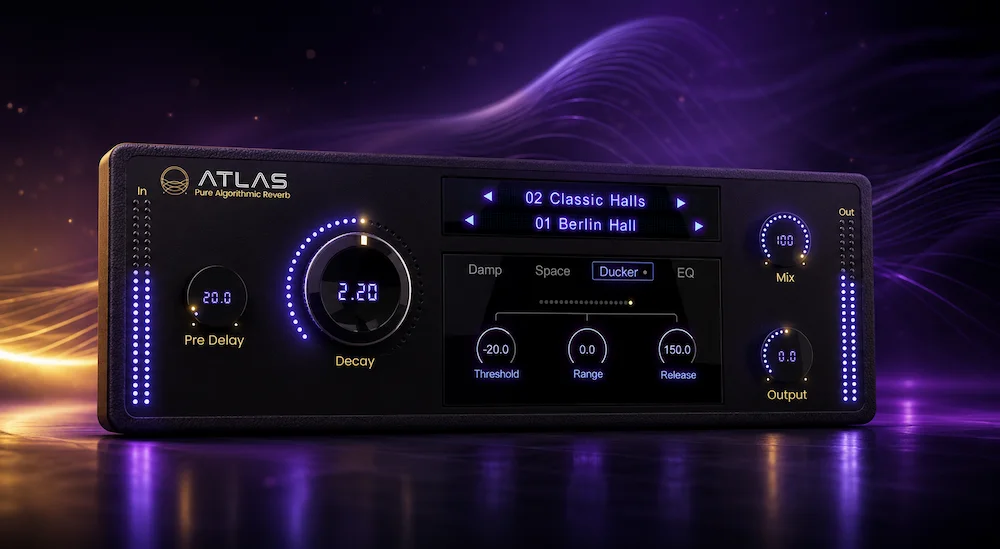
That’s the market Waves is targeting with Atlas Reverb. Instead of competing on hardware emulation or exposing dozens of algorithm parameters, Atlas is designed around workflow efficiency. The concept is straightforward: start with a musically voiced space, make a handful of meaningful adjustments, and move on with the mix instead of getting buried in technical refinement.
It’s an ambitious position to take. The algorithmic reverb market is already dominated by mature products such as Valhalla VintageVerb, FabFilter Pro-R 2, Relab LX480 Complete, and LiquidSonics Seventh Heaven—plugins that have earned long-term trust in commercial studios. For Atlas to justify its place alongside those tools, it has to deliver more than another polished reverb sound. It needs to make engineers noticeably faster without sacrificing the depth, movement, and transparency expected from a modern production reverb.
That makes Atlas more than just another plugin release. It raises a practical question for working engineers: can a workflow-first algorithmic reverb genuinely improve day-to-day mixing, or is this simply another refinement of technology the industry already knows well?
Quick Verdict
Best for:
- Commercial mixing
- Lead and backing vocals
- Pop, rock, electronic music
- Fast professional workflows
- Large sessions with multiple reverb instances
Less suitable for:
- Detailed algorithm programming
- Large orchestral and cinematic productions
- Engineers who prefer maximum parameter control
On This Page
Why Workflow Matters
 For decades, algorithmic reverb development revolved around the same race: more parameters, more modulation options, and increasingly faithful recreations of iconic digital hardware. Those advances unquestionably improved sound quality, but they also made many reverbs slower to use. Modern engineers rarely struggle to find a good-sounding algorithm—they struggle to reach the right sound before the session loses momentum.
That shift reflects how commercial production has changed. Large sessions regularly exceed one hundred tracks, combine dozens of effect returns, and require instant recalls across multiple revisions. Under those conditions, every plugin competes not only on sound quality but also on how efficiently it fits into an established workflow. Saving even a few minutes on routine decisions becomes meaningful when multiplied across an entire project.
As a result, many experienced mixers have quietly changed what they expect from a reverb. Absolute tweakability has become less important than predictable results. Engineers are increasingly looking for processors that produce a convincing vocal plate, drum chamber, or hall without requiring extensive adjustment before the mix can move forward.
Atlas Reverb is clearly built around that philosophy. Rather than asking users to construct an acoustic space from the ground up, it starts with programs that are already voiced for common production scenarios. The assumption is simple: most engineers already know the role the reverb should play—they don’t necessarily need to redesign the algorithm to get there.
That approach mirrors the reality of commercial mixing. Reverb decisions are rarely isolated. The ambience chosen for a lead vocal immediately affects compression, automation, delay balance, and even EQ choices throughout the session. Spending twenty minutes refining decay characteristics offers little advantage if a comparable result could have been achieved within the first few minutes of the mix.
This also explains why carefully curated presets have become more valuable than enormous preset libraries. Thousands of loosely organized patches rarely improve productivity. Engineers typically return to the same handful of dependable starting points, refining them only when the production demands something unusual. Atlas appears designed around that behavior rather than encouraging endless preset browsing.
Its design also reflects a broader shift away from treating hardware emulation as the ultimate goal. While Atlas borrows the musical character associated with classic DSP reverbs, it doesn’t attempt to recreate a single legendary processor. Instead, it focuses on producing spaces that integrate naturally into contemporary productions, where dense arrangements, aggressive bus processing, and streaming delivery place very different demands on ambience than they did during the late digital hardware era.
The same thinking helps explain why algorithmic reverbs continue to dominate everyday music production despite the accuracy of convolution technology. Convolution remains the preferred choice when reproducing a specific acoustic environment, but most commercial mixes benefit from reverbs that evolve with the source instead of repeating a fixed impulse response. Controlled modulation keeps tails from becoming static and allows ambience to remain convincing even as arrangements become denser.
Seen in that context, Atlas is less an attempt to reinvent algorithmic reverb than to streamline one of the most repetitive decisions in modern mixing. Its success won’t depend on introducing radically new DSP concepts. It will depend on whether engineers continue reaching for it once the excitement of a new release fades and everyday production work takes over.
Great Reverb Deserves a Great Master
A well-crafted mix is only part of the equation. Professional mastering preserves depth, clarity, and spatial balance while ensuring your music translates across streaming platforms and playback systems. Upload up to 35 seconds of your mix and receive a free mastering demo to hear the difference before starting your project.
Request your free mastering demo →
Real Mixing Performance
Atlas Reverb makes its strongest impression long before anyone starts comparing decay curves or modulation algorithms. Its real advantage is organizational. Instead of encouraging engineers to build a space from dozens of interconnected parameters, it presents reverb programs that already behave like familiar production tools. The interface asks fewer technical questions, allowing decisions to stay focused on the mix rather than the processor.
That philosophy runs against the direction many algorithmic reverbs have taken over the past decade. Modern processors often expose nearly every stage of the diffusion network, giving experienced users enormous flexibility. The tradeoff is equally obvious: every additional control creates another opportunity to second-guess a decision that probably wasn’t limiting the mix in the first place.
Atlas deliberately removes much of that friction. The underlying algorithms remain complex, but most of the engineering work happens before the plugin reaches the user. Instead of designing an acoustic environment from scratch, engineers choose a program that’s already voiced for a practical production role and make only the adjustments that affect the musical result.
Lead vocals illustrate the concept particularly well. In commercial mixes, the goal is rarely to build the perfect plate or hall. The objective is finding a space that adds depth without burying consonants, exaggerating sibilance, or pushing the vocal behind the instrumental. Most mixers cycle through several reverbs before finding one that simply feels right. Atlas attempts to reduce that search by presenting spaces that behave predictably from the outset.
The same approach benefits dense productions. Contemporary pop, rock, and electronic sessions leave very little room for excessive ambience. Every additional reflection competes with vocals, guitars, synthesizers, cymbals, and parallel effects occupying the same stereo field. A reverb that sounds spectacular in solo mode often becomes surprisingly difficult to control once the entire arrangement is playing.
Atlas generally avoids that trap. Rather than chasing oversized tails designed to impress during demonstrations, many of its factory programs prioritize integration. The spaces tend to support the source instead of drawing attention to themselves, which is usually the more valuable behavior in commercial mixing.
That balance becomes especially important on drums. Modern drum buses already combine transient shaping, saturation, compression, parallel processing, and layered samples before ambience enters the picture. An overly colored room can blur kick definition and make cymbals feel brittle, while an overly clean room often leaves the kit disconnected from the rest of the production. Atlas is tuned toward controlled depth rather than dramatic coloration, making it easier to place drums inside a mix without introducing another problem to solve.
Electronic productions present a different challenge. Wide synthesizer layers, stacked effects, and aggressive stereo processing leave little margin for unstable modulation. Excessive movement can weaken mono compatibility or cause reverbs to drift away from the source. Atlas generally favors restrained modulation that keeps spaces alive without destabilizing the stereo image, an approach that translates well across headphones, speakers, and streaming playback.
Spatial effects rarely work in isolation. Stereo widening and vocal doubling often shape the signal before reverb is applied, making the interaction between processors just as important as the reverb itself. Our Acon Digital Multiply 2 review looks at how subtle doubling can complement ambience without overwhelming a mix.
One of its more convincing design decisions is the emphasis on movement instead of strict realism. Waves describes the algorithms as reacting to musical material rather than behaving like static acoustic snapshots. That shouldn’t be interpreted as a breakthrough in DSP, but the production principle is sound. Carefully controlled modulation helps prevent repetitive reflection patterns, allowing long decays to remain natural without becoming obviously animated.
That behavior has practical consequences beyond sound quality. Engineers frequently add equalization, automation, or modulation after a reverb to compensate for tails that either build excessive energy or become static over time. If the reverb remains balanced without additional corrective processing, the entire effects chain becomes simpler to manage, especially in large sessions.
Efficiency is another area where Atlas makes a practical case for itself. Commercial mixes routinely rely on dozens of active ambience processors across instruments, buses, and effects returns. Low CPU usage and negligible latency allow engineers to treat reverb as part of the creative process rather than another resource that has to be rationed as the session grows.
Ultimately, Atlas isn’t trying to become the most programmable algorithmic reverb on the market or the definitive recreation of a classic hardware unit. Its value comes from shortening the distance between opening the plugin and arriving at a convincing production decision. For many engineers, that’s a more meaningful improvement than another page of advanced parameters.
Marketing Claims vs Real-World Performance
 Every premium reverb arrives with familiar promises: deeper spaces, more musical tails, greater realism, and a workflow that’s supposed to change the way engineers mix. Atlas Reverb follows that pattern, but its strongest selling point isn’t difficult to identify. The real story isn’t a breakthrough algorithm—it’s an attempt to remove unnecessary decisions from everyday production.
Waves places considerable emphasis on the amount of listening that shaped Atlas during development. That’s a perfectly legitimate design process, but it’s hardly unique. Every respected reverb developer voices diffusion, modulation, damping, and decay by ear. Companies such as Lexicon, Valhalla DSP, FabFilter, LiquidSonics, and TC Electronic have followed the same philosophy for decades. Extensive listening is part of competent DSP development, not evidence of a fundamentally new technology.
That distinction matters because it changes how Atlas should be evaluated. The plugin doesn’t need to reinvent algorithmic reverb to justify its place in a professional studio. It only needs to solve an everyday production problem more efficiently than the alternatives.
Viewed from that perspective, the strongest argument for Atlas is speed. Most engineers already own multiple excellent reverbs, and very few are searching for another processor simply because it sounds marginally better in isolation. The real question is whether it consistently reaches a usable result with less effort. For many commercial mixers, that has become a far more valuable metric than adding another page of advanced controls.
That same design philosophy also defines its biggest limitation. Engineers who routinely adjust diffusion structures, modulation behavior, crossover damping, or reflection density may find Atlas too restrictive. Much of the algorithm is intentionally hidden behind simplified controls. That’s exactly what makes the plugin approachable, but it also means experienced users surrender a level of precision available in more configurable reverbs.
The idea of a single reverb covering every production scenario deserves equal scrutiny. Atlas includes rooms, plates, chambers, halls, springs, and more experimental environments, but no algorithmic processor excels equally across every application. Engineers working primarily in orchestral production, immersive audio, or cinematic scoring will still find more convincing large spaces in specialized reverbs such as LiquidSonics Cinematic Rooms or Seventh Heaven.
The same applies to vintage hardware emulation. Atlas borrows from the musical behavior of classic DSP reverbs without attempting to recreate one specific processor. That broader approach increases versatility, but engineers chasing the unmistakable character of a Lexicon 480L, EMT 250, or Bricasti M7 are unlikely to abandon dedicated emulations designed around those individual units.
Long-term differentiation is another question entirely. Algorithmic reverb has reached a point where meaningful advances are increasingly measured in refinement rather than radical DSP innovation. Atlas fits comfortably into that reality. Its contribution isn’t a new mathematical model of reverberation—it’s a cleaner workflow built around production efficiency.
Marketing phrases such as “becoming part of the music” should also be viewed with healthy skepticism. Whether a reverb disappears naturally into a mix depends on far more than the algorithm itself. Arrangement density, automation, equalization, transient control, compression, and gain staging all influence how ambience is ultimately perceived. Even the best reverb cannot compensate for poor production decisions elsewhere in the session.
For that reason, Atlas is best understood as a productivity tool rather than a technological milestone. It won’t suddenly replace every established reverb in a professional template, nor does it eliminate the need for critical listening. What it offers is something more practical: fewer interruptions between opening a plugin and making a confident mixing decision. For many engineers, that’s a stronger selling point than another claim of revolutionary DSP.
Atlas vs Competing Reverbs
Atlas enters one of the most mature segments of the audio software market. Engineers already have access to exceptional reverbs covering nearly every workflow imaginable, from vintage hardware recreations to transparent modern algorithms and highly realistic acoustic spaces. Breaking into that group requires more than good sound—it requires a reason to reach for the plugin before the alternatives already sitting in the session template.
Rather than competing directly with any one product, Atlas occupies a middle ground. It isn’t the deepest editor, the most authentic hardware recreation, or the most cinematic spatial processor. Its strength lies in balancing sound quality, CPU efficiency, and workflow speed without forcing engineers to manage unnecessary complexity.
Engineers looking for a more specialized ambience may prefer dedicated chamber processors over general-purpose algorithmic reverbs. We explore that different design philosophy in our Blackbird Chamber D review, where realism and chamber character take priority over broad everyday versatility.
| Competing Reverb | Best Choice When… | Atlas Advantage | Competitor Advantage |
|---|---|---|---|
| Valhalla VintageVerb | You want extensive control over classic algorithmic spaces. | Cleaner workflow with less time spent tweaking. | Greater flexibility and outstanding value. |
| FabFilter Pro-R 2 | You need precise tonal shaping and detailed parameter control. | Faster decisions during everyday mixing. | Superior editing depth and integrated EQ tools. |
| LiquidSonics Seventh Heaven | Realistic concert halls and orchestral ambience are the priority. | Lower CPU demands and broader day-to-day versatility. | More convincing large acoustic environments. |
| Relab LX480 Complete | You want the classic Lexicon workflow and character. | More streamlined operation for modern production. | Authentic vintage hardware behavior. |
| LiquidSonics Cinematic Rooms | Film scoring and immersive productions require maximum realism. | Better suited to fast commercial mixing. | Greater scale and spatial realism. |
The comparison also explains why Atlas shouldn’t be viewed as a replacement for every reverb in a professional collection. Most commercial studios rely on multiple ambience processors because different productions demand different spatial characteristics. Atlas works best as a dependable everyday reverb rather than a universal solution.
That role makes particular sense for engineers moving quickly between clients and genres. Commercial mixers often transition from a vocal-heavy pop record to a podcast, a rock production, or an electronic session within the same day. In those environments, reducing setup time has measurable value because every saved minute can be spent balancing the mix instead of configuring effects.
The equation changes for engineers whose workflow depends on extensive customization. If a session already begins with carefully built templates containing dedicated reverbs for vocals, drums, orchestral sections, and effects, Atlas becomes less of a necessity and more of an alternative approach. Its simplified interface is designed to remove decisions, not expand them.
Pricing deserves similar context. At its introductory price, Atlas competes aggressively against established premium reverbs. At full retail, however, buyers inevitably compare it with processors that have spent years proving themselves in commercial studios. That makes the purchase decision less about absolute sound quality and more about whether its streamlined workflow offers a meaningful advantage over tools already in daily use.
Ultimately, Atlas isn’t trying to outperform every established reverb on the market. Its competitive position is built around something far more practical: delivering consistently usable spaces with minimal setup. For engineers who value efficiency as much as flexibility, that’s a compelling niche. For those who enjoy shaping every aspect of a reverb algorithm, the established alternatives remain difficult to beat.
Who Should Buy Atlas Reverb?
Atlas Reverb is aimed at engineers who value speed, consistency, and predictable results over endless parameter tweaking. It fits naturally into modern production environments where deadlines are tight and decisions need to happen quickly.
Atlas is an excellent choice if you:
- mix commercial music every day
- produce pop, rock, electronic, or hip-hop records
- need reliable vocal and drum reverbs
- work on large sessions where CPU efficiency matters
- prefer making musical decisions instead of programming algorithms
You may prefer another reverb if you:
- regularly build cinematic or orchestral spaces
- enjoy extensive DSP editing
- want complete control over diffusion and modulation structures
- primarily seek vintage hardware emulations
How Atlas Performs Once the Mix Gets Busy
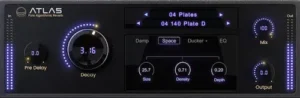 A reverb shouldn’t be judged by how it sounds in solo mode. Commercial mixes rarely leave ambience exposed for more than a few seconds. The real test begins when vocals, drums, guitars, synths, automation, parallel processing, and bus compression all compete for the same space. That’s where many impressive reverbs become surprisingly difficult to manage.
Atlas is clearly voiced with dense productions in mind. Instead of drawing attention to long, highly animated tails, most of its programs prioritize integration. The ambience tends to sit behind the source rather than expanding around it, making it easier to build depth without sacrificing definition. That behavior is particularly valuable on modern vocal productions, where reverb directly influences compression, delay balance, automation, and overall intelligibility.
The same restraint helps across complex arrangements. Excessive modulation and overly wide stereo processing often sound impressive during preset browsing but become liabilities once additional layers enter the mix. Atlas generally favors controlled movement over dramatic effects, allowing vocals, drums, and instruments to retain stable positioning while still feeling connected to a shared acoustic space.
Translation is another area where that approach pays off. Reverbs with exaggerated modulation or unstable stereo information frequently lose coherence on headphones, compact Bluetooth speakers, or mono playback systems. Although comprehensive independent testing is still limited, Atlas appears to avoid many of those problems by keeping modulation subtle and spatial movement well controlled.
Streaming platforms introduce another practical consideration. Modern masters are heavily optimized, leaving little room for excessive ambience before transient clarity begins to suffer. If you’re interested in how streaming services influence the final release beyond the mix itself, our guide to mastering for streaming platforms explains why music often changes after upload. That also reinforces why reverb decisions should be made during mixing rather than left for mastering. If you’re preparing a project for final delivery, our guide on how to prepare a mix for mastering explains which decisions should already be finished before the mastering stage begins.
Performance is equally important in large sessions. Commercial projects frequently run dozens of active reverbs across buses, instruments, and effects returns, making CPU efficiency almost as important as sound quality. Atlas continues Waves’ long-standing focus on lightweight native processing, allowing multiple instances without significantly increasing system load. Combined with its negligible latency, the plugin is equally comfortable during tracking, live monitoring, and large-scale mixing sessions where responsiveness matters as much as sonic quality.
Perhaps the most telling characteristic is that Atlas rarely encourages engineers to stop mixing in order to keep editing the reverb itself. Once a suitable program is selected, the focus quickly returns to balancing the production rather than refining diffusion networks or modulation behavior. That may be its biggest contribution. Not because it changes what algorithmic reverb can do, but because it reduces how often engineers need to think about it.
Atlas Reverb vs Waves H-Reverb
Many existing Waves users are asking the same question: should Atlas Reverb replace H-Reverb, or do both plugins serve different purposes? The answer depends less on sound quality and more on workflow.
H-Reverb remains one of the most configurable reverbs in the Waves catalog. It offers extensive control over early reflections, modulation, damping, dynamics, equalization, and tail shaping, making it well suited to engineers who enjoy building highly customized spaces from the ground up.
Atlas takes the opposite approach. Instead of exposing nearly every algorithm parameter, it focuses on delivering polished, mix-ready spaces with minimal setup. Most engineers can reach a convincing result much faster, which becomes increasingly valuable during commercial projects with tight deadlines.
| Feature | Atlas Reverb | H-Reverb |
|---|---|---|
| Workflow Speed | ★★★★★ | ★★★☆☆ |
| Parameter Control | ★★★☆☆ | ★★★★★ |
| CPU Efficiency | ★★★★★ | ★★★★☆ |
| Learning Curve | ★★★★★ | ★★★☆☆ |
| Sound Design Flexibility | ★★★☆☆ | ★★★★★ |
If your priority is building unique spaces from scratch, H-Reverb remains the stronger tool. If your goal is reaching polished results quickly while keeping the creative process moving, Atlas is likely to become the better everyday reverb.
Final Verdict
Atlas Reverb enters a market that no longer lacks excellent choices. Today’s engineers already have access to outstanding algorithmic reverbs covering everything from vintage hardware character to highly realistic acoustic spaces. The question is no longer whether another reverb can sound good. It’s whether it earns a permanent place in everyday sessions.
That’s ultimately where Atlas makes its strongest case. Rather than introducing a fundamentally new approach to algorithmic reverberation, it focuses on something far more practical: reducing the number of decisions required to reach a convincing result. In commercial production, where deadlines are tight and projects move quickly, that can be a meaningful advantage.
Atlas performs particularly well as an everyday mixing reverb. Vocals, drums, guitars, synthesizers, keyboards, and general-purpose effects buses all benefit from spaces that are easy to place, require minimal adjustment, and remain controlled inside dense arrangements. Instead of encouraging endless refinement, the plugin allows engineers to make a decision and continue mixing.
Its limitations are equally clear. Engineers working on orchestral scoring, immersive productions, or projects requiring highly specialized acoustic environments will still find stronger options elsewhere. The same applies to mixers who prefer unrestricted access to diffusion structures, modulation behavior, and every stage of an algorithm. Atlas intentionally sacrifices some flexibility in exchange for speed.
That tradeoff also explains its position alongside the competition. FabFilter Pro-R 2 remains the stronger choice for detailed shaping. Valhalla VintageVerb continues to offer exceptional flexibility and value. LiquidSonics Seventh Heaven still sets the benchmark for realistic large spaces. Atlas doesn’t replace those reverbs—it complements them by addressing a different part of the workflow.
For long-time Waves users, Atlas feels like a natural evolution of the company’s everyday reverb philosophy rather than an isolated flagship release. It emphasizes consistency, efficiency, and dependable results over feature counts or increasingly complex editing options.
Whether Atlas becomes a lasting studio standard will depend on something far less exciting than launch-day marketing. Engineers return to the same plugins year after year because they remove friction from the creative process without demanding constant attention. If Atlas continues to do that once the initial excitement fades, it will have achieved something more valuable than introducing another headline feature—it will have earned a permanent place in the session template.
Overall Rating
| Category | Rating |
|---|---|
| Sound Quality | 9.0/10 |
| Workflow | 9.8/10 |
| Mix Integration | 9.3/10 |
| CPU Efficiency | 9.5/10 |
| Editing Flexibility | 8.2/10 |
| Value for Money | 8.8/10 |
| Overall | 9.1/10 |
Waves Atlas Reverb doesn’t attempt to redefine algorithmic reverb. Instead, it succeeds by making everyday mixing faster, more predictable, and less distracting. Engineers who value efficient workflow, consistent results, and reliable mix translation will likely appreciate Atlas more than those searching for maximum parameter control or highly specialized sound design capabilities.
Sound Quality — 9.0/10
Atlas delivers polished, modern ambience that sits naturally in commercial productions. The algorithms remain clean, controlled, and musical without drawing unnecessary attention to the effect itself.
Workflow — 9.8/10
This is where Atlas clearly stands out. Programs are voiced intelligently, decisions happen quickly, and the plugin minimizes unnecessary tweaking, allowing engineers to stay focused on the mix instead of the processor.
Mix Integration — 9.3/10
One of Atlas’ biggest strengths is how easily it blends into dense productions. Vocals, drums, guitars, and synths retain clarity while gaining convincing depth that translates well across different playback systems.
CPU Efficiency — 9.5/10
Low processor usage and negligible latency make Atlas practical even in large sessions containing numerous effect buses and parallel processing chains.
Editing Flexibility — 8.2/10
The simplified interface intentionally hides many advanced parameters. That improves speed, but engineers who prefer extensive control over diffusion, modulation, and internal algorithm behavior may find competing reverbs more flexible.
Value for Money — 8.8/10
Atlas offers excellent value when purchased at Waves’ frequent promotional pricing. At full retail price, however, buyers should compare it carefully with other established premium algorithmic reverbs before making a decision.
Pros & Cons
| Pros | Cons |
|---|---|
|
|
The Final 5% Is What Listeners Actually Notice
A great reverb can create depth and atmosphere, but it can’t guarantee that your mix will translate after loudness processing, codec compression, or streaming normalization. Professional mastering preserves punch, clarity, stereo depth, and tonal balance so your music sounds consistent everywhere your audience listens.
Hear the difference before making any commitment. Upload up to 35 seconds of your mix and receive a free mastering demo created by a professional mastering engineer. Compare your original mix with the mastered version and decide based on what you hear—not marketing claims.
Request your free mastering demo →
FAQ
Is Waves Atlas Reverb designed for mixing or mastering?
Atlas is built primarily for mixing. While it can be used creatively during mastering, especially on ambient or cinematic material, its main purpose is adding depth to individual tracks, buses, and effects returns rather than processing a full stereo mix. If you’re unsure where reverb processing fits within the production process, see our guide to Mixing vs Mastering.
How does Atlas Reverb compare to Valhalla VintageVerb?
Valhalla VintageVerb offers deeper control, more vintage coloration, and greater flexibility for sound design. Atlas takes a different approach, emphasizing faster workflow, curated programs, and quicker decision-making during everyday mixing.
Can Atlas Reverb replace convolution reverbs?
Not entirely. Convolution reverbs remain the better choice when realistic acoustic spaces or specific room captures are required. Atlas is better suited to commercial music production, where adaptable, musical ambience is often more useful than exact acoustic reproduction.
Is CPU usage low enough for large sessions?
Yes. Atlas is designed for efficient native performance with minimal latency, making it practical to run multiple instances across large mixing sessions without placing excessive demands on modern systems.
Does Atlas work well for live vocal monitoring?
It can. Its low-latency design makes it suitable for tracking and live monitoring when performers prefer hearing a natural sense of space while recording.
Does Atlas provide enough control for experienced engineers?
For most mixing tasks, yes. Engineers who routinely adjust diffusion networks, modulation behavior, or advanced decay parameters may still prefer reverbs that expose more of the underlying algorithm.
Is Atlas Reverb a good choice for electronic music production?
Yes. Its factory programs work well with synthesizers, drum machines, vocals, and layered electronic arrangements, providing depth without overwhelming dense mixes.
Should existing Waves H-Reverb users upgrade?
That depends on your workflow. If you rely on H-Reverb’s extensive editing capabilities, Atlas isn’t a direct replacement. If your priority is reaching polished results with less setup, Atlas may become the more practical everyday option.
What are the strongest alternatives to Atlas Reverb?
Some of the closest competitors include FabFilter Pro-R 2, Valhalla VintageVerb, LiquidSonics Seventh Heaven, Relab LX480 Complete, and LiquidSonics Cinematic Rooms. Each excels in different areas, making them complementary choices rather than direct substitutes.
Is Atlas Reverb worth buying at full retail price?
That depends on your existing reverb collection. If you’re looking for an efficient everyday algorithmic reverb, Atlas offers a compelling workflow-focused approach. If you already own several premium reverbs, it’s worth comparing during a trial or promotional pricing before making a purchase.

Yurii Ariefiev is a mastering engineer and audio production editor who reviews mixing plugins from the perspective of real commercial sessions. His evaluations focus on how processors such as reverbs influence depth, stereo imaging, translation, and the quality of the mix before it reaches the mastering stage.
This Waves Atlas Reverb review examines workflow, algorithmic design, CPU efficiency, and practical mixing performance to help producers and engineers decide whether the plugin delivers meaningful advantages in everyday music production.