Last updated: August 2026
Tested on: Version 2
Distortion has become one of the most crowded categories in audio production. Between analog console emulations, tape processors, tube saturators, multiband distortion, soft clippers, and harmonic enhancers, most engineers already have more options than they regularly use. The challenge is no longer finding another saturation plugin—it’s finding one that genuinely improves the workflow.
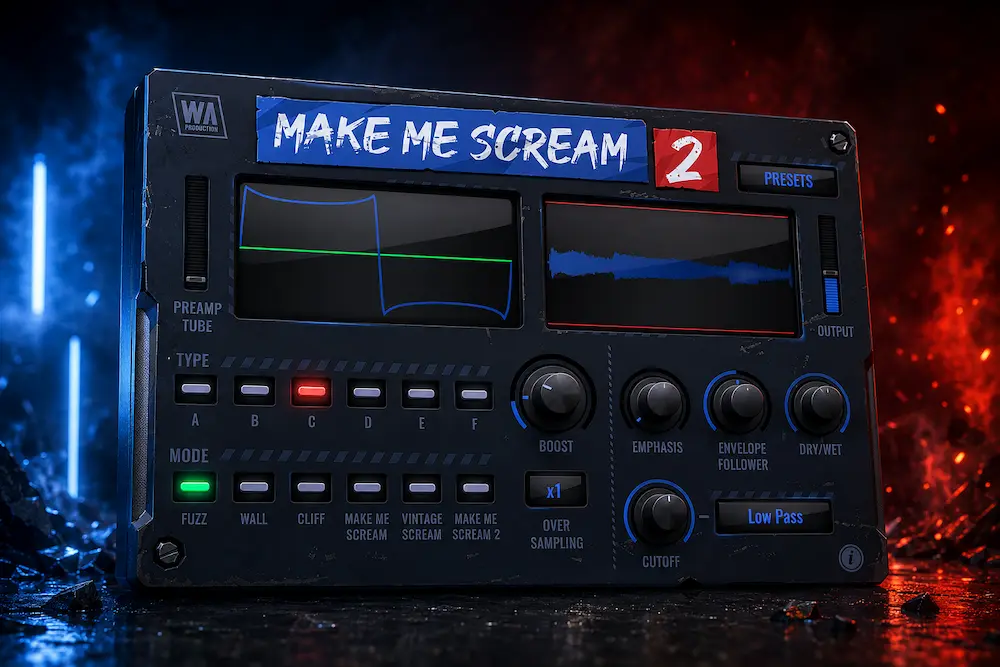
W.A. Production positions Make Me Scream 2 as more than another distortion effect. Its defining feature is a two-stage architecture that feeds a tube-style preamp into a transient-responsive distortion stage, with the goal of producing harmonics that react more naturally to the source material instead of applying static nonlinear processing. It’s a practical design choice rather than a flashy feature, and one that deserves closer examination.
The real question isn’t whether Make Me Scream 2 can produce aggressive saturation—almost every modern distortion plugin can. What matters is whether it reaches usable results faster than conventional plugin chains, whether its dynamic behavior offers audible advantages in a mix, and whether it earns a permanent place alongside established processors such as FabFilter Saturn 2, Soundtoys Decapitator, or Arturia Dist COLDFIRE.
This review approaches Make Me Scream 2 from a production perspective rather than a marketing one. Instead of revisiting the feature list, we’ll examine where its workflow delivers measurable value, where its design falls short, and which producers are most likely to benefit from adding it to a modern mixing environment.
Quick Verdict
| Best For | EDM, bass music, hip-hop, modern pop, creative mixing, parallel processing |
|---|---|
| Not Ideal For | Transparent mastering, orchestral, jazz, acoustic production, multiband saturation workflows |
| Biggest Strength | Excellent workflow with fast access to production-ready harmonic distortion |
| Main Limitation | No multiband processing or advanced routing for precision harmonic control |
| Worth Buying? | Yes—especially at the introductory price. Existing Saturn 2 or Dist COLDFIRE users should view it as a complementary workflow tool rather than a replacement. |
| Overall Rating | 8.9/10 |
On This Page
Why Modern Distortion Plugins Are About Workflow, Not Just Saturation
 Distortion has evolved far beyond its traditional role as a creative effect for guitars or aggressive electronic music. In modern mixing, harmonic processing is routinely used to increase perceived density, reinforce bass translation on small speakers, improve vocal presence, shape drum transients, and make virtual instruments sit more naturally in a mix. In many sessions, saturation appears on far more channels than compression.
That broader role has changed what engineers expect from a distortion plugin. Sound quality alone is no longer enough. A processor also has to integrate efficiently into contemporary DAW workflows, offer predictable gain staging, minimize unnecessary routing, and produce repeatable results under tight deadlines.
As a result, today’s leading saturation tools rarely focus on a single nonlinear algorithm. FabFilter Saturn 2 combines multiband processing with extensive modulation. Arturia Dist COLDFIRE emphasizes flexible routing and analog-inspired coloration. Soundtoys Decapitator continues to earn its place through consistent musical behavior that requires very little adjustment. Each succeeds for different reasons, but all address workflow as much as tone.
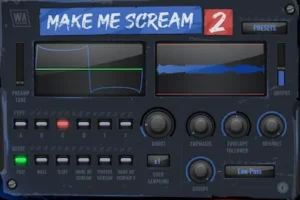
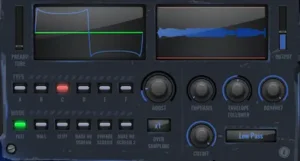
Make Me Scream 2 approaches the problem from a different angle. Instead of expanding routing options or introducing increasingly complex modulation systems, it consolidates several stages that producers frequently build manually. Its tube-style preamp, transient-responsive distortion, filtering, and parallel processing controls are designed to function as a single production tool rather than a chain of separate effects.
That approach won’t replace high-end modular saturation platforms, nor is it intended to. Its value lies in reducing repetitive setup without removing meaningful control. For producers working on dense EDM arrangements, modern pop productions, or bass-heavy electronic music, where harmonic processing may be applied dozens of times throughout a session, even modest workflow gains translate into faster decisions and greater consistency across an entire mix.
See What Professional Mastering Can Add to Your Mix
Even the best creative processing can’t replace an experienced mastering engineer. If you’ve pushed your mix as far as you can, upload up to 35 seconds and receive a free mastering demo. Compare your original mix with a professionally mastered version and hear the difference in translation, punch, clarity, and overall balance before ordering the full service.
Get your free mastering demo →
Two-Stage Processing That Responds to the Source Instead of Treating Every Transient the Same
The core of Make Me Scream 2 is its dual-stage signal path. Incoming audio first passes through a tube-style preamp before reaching the main distortion stage, allowing the saturation circuit to react to an already harmonically enriched signal rather than a completely clean input.
On paper, that doesn’t sound dramatically different from placing two saturation plugins in series. The difference lies in how both stages interact. The preamp alters the harmonic content before the transient-responsive distortion engages, producing a response that feels less static on dynamic material than conventional single-stage saturation.
The effect is easiest to hear on drums and percussion. Traditional distortion often pushes repeated hits toward the same envelope, gradually reducing the contrast between successive transients. That can make programmed drums sound denser, but also flatter. Make Me Scream 2 maintains more variation between individual hits, helping drum buses retain energy while adding harmonic weight.
The same behavior benefits synthesized basses and modern electronic production, where controlled saturation is often used to increase perceived loudness and improve translation on smaller playback systems. Additional harmonics make bass instruments easier to perceive without relying solely on EQ or heavier compression.
None of this represents a fundamentally new DSP technique. Engineers have been combining preamps, saturation, transient processors, and parallel routing for years to achieve similar results. What Make Me Scream 2 changes is the amount of work required to build that chain.
Instead of managing multiple plugins, gain staging, parallel buses, and level matching, the processor keeps those stages within a single workflow. That doesn’t necessarily produce better distortion than a carefully assembled custom chain, but it reaches comparable creative results much faster—a practical advantage that becomes increasingly valuable in large production sessions.
What’s New in Make Me Scream 2—and What Hasn’t Changed
Make Me Scream 2 builds on the original plugin rather than replacing it with a fundamentally new processing engine. The underlying two-stage concept remains intact, but Version 2 expands the available tonal options while addressing several workflow limitations that had become increasingly noticeable in modern DAW environments.
The headline additions are six distortion models and six timbre modes, giving users a broader range of harmonic textures than the original release. That doesn’t necessarily indicate six entirely new algorithms. W.A. Production has not published technical documentation explaining the DSP differences between individual modes, so it’s more accurate to describe the update as an expansion of the existing sound palette rather than a redesign of the distortion engine.
In practice, the additional modes make the plugin more adaptable across different sources. The original version naturally favored aggressive electronic processing, while Version 2 offers enough variation to support subtler applications on synths, drums, bass, and selected vocal effects without immediately pushing the signal toward heavily saturated territory.
The interface has also been modernized. A resizable GUI may not generate headlines, but it has become an expected feature for professional production environments where projects move between laptops, high-resolution desktop displays, and multi-monitor studio workstations. Its inclusion removes an unnecessary usability limitation rather than introducing a new capability.
Performance and stability improvements are also part of the update, although their impact is difficult to quantify. W.A. Production references better efficiency, but independent CPU benchmarks and large-session stress tests have not yet been published. Until those measurements become available, any claims regarding performance gains should be viewed as practical observations rather than verified engineering data.
Perhaps the most important takeaway is what hasn’t changed. Make Me Scream 2 is still designed as a fast, creative distortion processor—not a modular saturation environment. Version 2 refines that original philosophy instead of expanding into multiband processing, advanced modulation, or mastering-focused harmonic control. Producers expecting a broader feature set may see the update as conservative, while existing users will likely appreciate the added flexibility without sacrificing the plugin’s straightforward workflow.
Technical Specifications
| Developer | W.A. Production |
|---|---|
| Product | Make Me Scream 2 |
| Type | Distortion & Saturation Plugin |
| Version | Version 2 |
| Plugin Formats | VST3, AU, AAX |
| Operating Systems | Windows & macOS |
| Processing | Two-stage distortion with tube-style preamp, transient-responsive saturation, filtering, and parallel mix control |
| Oversampling | Supported (implementation details not publicly documented) |
| Resizable GUI | Yes |
| Factory Presets | Included |
| Launch Price | $9.90 (introductory) |
| Regular MSRP | $69.90 |
Pros & Cons
| Pros | Cons |
|---|---|
| ✓ Fast, intuitive workflow ✓ Responsive transient-aware distortion ✓ Wide range of usable saturation textures ✓ Excellent value during the introductory promotion ✓ Suitable for drums, bass, synths, and parallel processing | ✕ No multiband processing ✕ Limited routing flexibility ✕ Not designed for transparent mastering ✕ Limited published DSP documentation ✕ Few independent performance benchmarks available |
Where Make Me Scream 2 Delivers the Most Value in a Professional Mix
Despite the name, Make Me Scream 2 isn’t limited to extreme distortion. Like many modern saturation processors, its usefulness depends less on how aggressively it’s driven than on where it’s placed in the signal chain. In contemporary mixing, controlled harmonic enhancement is routinely used to improve translation, increase perceived density, and help important elements remain intelligible after bus processing and loudness normalization.
That makes Make Me Scream 2 most effective as a creative mixing tool rather than a transparent finishing processor. It performs particularly well on electronic drums, bass instruments, synth buses, and parallel processing chains where added harmonic complexity contributes directly to the production rather than simply adding color.
Electronic basses are among its strongest applications. Introducing upper harmonics above the fundamental allows bass lines to remain audible on phones, laptops, and compact Bluetooth speakers that reproduce little true low-frequency energy. Unlike aggressive high-frequency EQ boosts, controlled saturation creates harmonics that remain naturally related to the original signal, often producing a more convincing sense of presence.
Kick drums benefit for similar reasons. Moderate distortion can increase the perception of attack without relying entirely on transient shaping or clipping. Used conservatively, it helps the kick maintain definition as the mix becomes denser, particularly in EDM, modern pop, and bass-driven productions.
The plugin is equally comfortable on parallel drum buses. Pushed harder and blended underneath the dry signal, it increases sustain, perceived impact, and midrange density while preserving the transient structure of the primary drum bus. That approach generally produces more natural results than inserting aggressive distortion directly across the entire kit.
Vocals require a more selective approach. Make Me Scream 2 excels when distortion is intended to become part of the sound itself—hyperpop vocals, industrial textures, parallel vocal effects, or heavily processed rap ad-libs all benefit from its more animated response. Engineers searching for subtle console coloration or mastering-grade harmonic enhancement will likely find dedicated analog emulations better suited to those tasks.
Ultimately, the plugin performs best when harmonic distortion is treated as a production decision rather than corrective processing. The strongest mixes rarely rely on saturation to rescue uninspiring source material—a principle that also emerged in our Rhodes Clav Pro review, where the quality of the original instrument proved far more influential than any downstream processing.
Separating Practical Engineering From Marketing Claims
 Creative distortion is one of the easiest product categories to oversell. Nearly every saturation plugin promises richer harmonics, analog character, or more musical distortion, even though the underlying DSP concepts have been well established for years. The important question is rarely what a plugin claims to do, but whether it changes the production workflow in a meaningful way.
Make Me Scream 2 doesn’t introduce a fundamentally new approach to nonlinear processing. Its two-stage architecture, transient-aware distortion, and integrated signal path are thoughtful implementations of techniques that experienced engineers have been building manually for years using separate saturation, transient, and parallel processing chains.
Where the plugin distinguishes itself is workflow efficiency. Housing the preamp, distortion stage, filtering, and parallel mix controls inside a single processor reduces routing, minimizes gain-staging adjustments, and makes it easier to move from experimentation to a usable sound without constantly rebuilding processing chains. That emphasis on reducing repetitive production work reflects a broader trend we’ve also explored in our Mastering The Mix MIXVAULT review, where workflow improvements prove just as valuable as outright sonic changes.
The expanded selection of six distortion types and six timbre modes also deserves realistic expectations. W.A. Production has not published technical documentation indicating that each mode represents a fundamentally different distortion algorithm. In practice, the additional options provide greater tonal variety rather than introducing entirely new processing methods. For most producers, that broader palette is ultimately more useful than pursuing algorithmic novelty for its own sake.
That distinction defines the update as a whole. Version 2 is an engineering refinement rather than a technological leap. It improves speed, flexibility, and day-to-day usability without attempting to compete directly with modular saturation environments or advanced multiband harmonic processors.
For producers evaluating whether to upgrade, that perspective matters. If the original plugin already fits your workflow, Version 2 offers meaningful quality-of-life improvements. Those expecting a completely redesigned distortion engine or a new category of harmonic processing are likely to find the update intentionally conservative.
Where Make Me Scream 2 Falls Short
Every distortion processor reflects a set of engineering trade-offs, and Make Me Scream 2 is no exception. The same streamlined architecture that makes it fast also limits how deeply the signal path can be customized. Producers looking for a creative, all-in-one distortion processor will appreciate that simplicity. Engineers who routinely build complex harmonic processing chains may reach its limits much sooner.
The most obvious constraint is routing flexibility. Unlike processors such as FabFilter Saturn 2 or Arturia Dist COLDFIRE, Make Me Scream 2 doesn’t offer multiband operation, advanced modulation, or independently controlled processing across different frequency ranges. Those capabilities become increasingly valuable when distortion is used as a precision mixing or mastering tool rather than as a creative effect.
That difference is especially relevant during mastering. Small changes in harmonic density can improve vocal clarity while simultaneously making cymbals more brittle or altering perceived stereo balance. Multiband saturation allows those decisions to remain frequency-specific. A full-band processor inevitably applies harmonic changes across the entire signal, making fine adjustments more difficult.
For that reason, Make Me Scream 2 is better suited to creative mix processing than final-stage mastering. It works well on individual tracks, buses, or carefully controlled parallel chains, but it lacks the level of precision mastering engineers typically expect from dedicated harmonic processors.
Driving the plugin into heavier distortion also exposes another limitation: predictability. Once harmonic generation becomes excessive, problems introduced during mixing are far more difficult to correct during mastering, especially when dealing with the kinds of issues discussed in this guide to fixing a distorted master.
That distinction makes genre an important consideration. EDM, trap, industrial, and modern pop productions can take advantage of the plugin’s animated response, while jazz, orchestral, folk, and other naturally dynamic recordings usually demand subtler harmonic processing with greater tonal restraint.
Oversampling deserves a similarly measured assessment. Make Me Scream 2 includes oversampling to reduce aliasing at higher drive settings, but W.A. Production has not published detailed information regarding its implementation, filter design, or reconstruction stage. Independent null tests and spectral analysis are also unavailable at the time of writing.
That doesn’t imply poor audio quality—it simply limits how far objective conclusions can be taken. Until independent measurements become available, claims regarding alias rejection or oversampling performance should be treated as unverified rather than accepted at face value.
How Make Me Scream 2 Compares to Established Distortion Plugins
Make Me Scream 2 enters a market dominated by mature saturation processors that already cover everything from transparent harmonic enhancement to highly experimental sound design. Competing directly on DSP sophistication would be difficult. Instead, W.A. Production positions the plugin around workflow speed and ease of use rather than maximum flexibility.
That makes its competitive landscape slightly different from what the feature list might suggest. The closest alternatives aren’t necessarily the most advanced distortion processors available—they’re the ones producers reach for when they need usable results quickly without assembling complex processing chains.
| Plugin | Best For | Primary Advantage | Where Make Me Scream 2 Stands Out |
|---|---|---|---|
| FabFilter Saturn 2 | Advanced mixing and mastering | Multiband processing, extensive modulation, automation | Much faster to dial in for straightforward creative distortion |
| Arturia Dist COLDFIRE | Creative sound design | Flexible routing and multiple analog-inspired models | Cleaner workflow with less setup |
| Soundtoys Decapitator | Musical analog-style saturation | Recognizable analog character and simple controls | More animated transient response on electronic material |
| Kilohearts Distortion | Modular production workflows | Snap Heap integration and lightweight processing | A more complete standalone distortion workflow |
| Softube Saturation Knob | Quick harmonic enhancement | Free, extremely simple operation | Significantly broader tonal range and control |
The comparison also highlights where Make Me Scream 2 doesn’t compete. It isn’t designed to replace Saturn 2 in mastering, Dist COLDFIRE in modular sound design, or Decapitator as a classic analog saturation processor. Each of those plugins remains stronger within its own specialty.
Its advantage is speed. The integrated preamp, transient-responsive distortion, filtering, and parallel mix controls make it easy to move from a clean source to a usable production sound with minimal routing or gain-staging adjustments. That difference becomes increasingly valuable in large sessions where dozens of tracks require similar harmonic treatment.
For engineers who already own one or more flagship saturation processors, Make Me Scream 2 is unlikely to become a replacement. It makes more sense as a secondary creative tool—one that’s faster to reach for when flexibility is less important than maintaining momentum during a mix.
Who Should Consider Make Me Scream 2?
 Make Me Scream 2 is aimed squarely at producers who treat distortion as part of the production itself rather than a finishing process. Electronic genres—including EDM, trap, bass music, hardstyle, industrial, and modern pop—benefit the most because harmonic processing is often used to shape the identity of the sound, not simply to add color after the fact.
Bass instruments, layered kick drums, parallel drum buses, synth stacks, and heavily processed vocals are where the plugin feels most at home. Its transient-responsive behavior keeps repeated electronic material from becoming overly static, making it particularly useful in productions built around programmed drums and synthesized instruments.
Mix engineers working in contemporary commercial genres will also find practical applications. As a bus processor or parallel effect, it provides an efficient way to increase density and harmonic complexity without building elaborate processing chains from scratch. That speed becomes valuable when similar treatments need to be repeated across multiple tracks in a session.
Its appeal becomes narrower as transparency becomes more important. Engineers focused on orchestral recording, jazz, acoustic music, broadcast, or classical production generally require harmonic processors that remain largely invisible. Likewise, mastering engineers looking for frequency-specific control, subtle harmonic balancing, or mastering-grade saturation will be better served by dedicated multiband processors designed for final delivery.
For commercial studios, Make Me Scream 2 works best as a specialized creative processor rather than a core utility plugin. It expands the available tonal palette without replacing more comprehensive saturation platforms that already occupy permanent positions in professional workflows.
Price and Value: Does the Upgrade Make Financial Sense?
Value depends almost entirely on when the plugin is purchased.
At the introductory price of $9.90, Make Me Scream 2 is easy to recommend. Even occasional use on a handful of projects is enough to justify the investment, making it one of the stronger values currently available in the creative distortion category.
The regular price of $69.90 places it in far more competitive territory. At that level, buyers inevitably begin comparing it with mature ecosystems such as FabFilter Saturn 2, Arturia Dist COLDFIRE, and other processors that offer deeper routing, multiband operation, or more sophisticated modulation capabilities.
That comparison changes the buying decision. Producers looking for their first dedicated creative distortion plugin may still find Make Me Scream 2 an efficient all-around solution. Those who already own flagship saturation processors are less likely to view it as an upgrade and more likely to see it as a workflow-oriented addition that complements existing tools rather than replacing them.
Viewed through that lens, the plugin’s strongest selling point isn’t the number of distortion modes or timbre variations—it’s the ability to reach usable sounds quickly without assembling complex signal chains. Whether that convenience justifies the full retail price ultimately depends on how often distortion plays a central role in your production workflow.
Real-World Mixing Performance: Where It Works—and Where Restraint Matters
Make Me Scream 2 delivers its strongest results when harmonic enhancement is used to solve practical mixing problems rather than simply making a sound more aggressive. On bass instruments, additional upper harmonics improve audibility on phones, laptops, and compact Bluetooth speakers without relying exclusively on EQ boosts that can quickly become harsh or disconnected from the original tone.
The same approach translates well to electronic drums. Moderate saturation helps kick drums and percussion retain definition as arrangements become denser, while parallel processing adds sustain and perceived energy without flattening the primary transient. Those are familiar production techniques, but the plugin’s integrated workflow makes them faster to implement than assembling multiple processors manually.
Its usefulness becomes more genre-dependent on full mixes. Electronic productions often benefit from the additional harmonic density because streaming normalization rewards perceived impact more than peak level alone—a distinction that’s often misunderstood when engineers focus on loudness instead of understanding the relationship between loudness and clipping in mastering. Acoustic recordings are less forgiving. Excessive distortion can introduce upper-mid buildup that becomes increasingly apparent after AAC or Opus encoding, making long listening sessions more fatiguing even when the mix initially sounds exciting inside the studio.
That balance is particularly important during mastering. While moderate parallel saturation can improve perceived weight and energy, broad-spectrum distortion leaves less room for precise tonal correction later in the mastering chain. Engineers planning significant mastering EQ or dynamic processing should treat Make Me Scream 2 as an earlier creative processor rather than a finishing tool.
Performance appears suitable for modern production sessions, although comprehensive independent benchmarks have not yet been published. CPU demand is unlikely to present a significant limitation under typical mixing workloads, but higher oversampling settings will naturally increase processing requirements when used across large numbers of tracks.
Ultimately, the plugin earns its place through workflow rather than raw processing power. It won’t fundamentally change how experienced engineers build harmonic processing chains, but it reduces the amount of setup required to reach a mix-ready result—a practical advantage that’s often more valuable than adding yet another distortion algorithm to an already crowded toolbox.
Verdict: Built for Fast Creative Mixing, Not Technical Reinvention
Make Me Scream 2 doesn’t redefine distortion processing, and it doesn’t need to. The underlying concepts—tube-style drive, transient-aware saturation, and integrated signal flow—are already familiar to experienced engineers. What W.A. Production has done is package those ideas into a processor that reaches useful results quickly without forcing users to assemble complex distortion chains from multiple plugins.
That focus makes the plugin considerably more practical than its marketing might suggest. Rather than competing directly with flagship saturation platforms, Make Me Scream 2 fills a different role: a fast creative processor for producers who value workflow as much as tonal flexibility. Electronic music, modern pop, hip-hop, and sound design remain its strongest applications, where controlled distortion often becomes part of the arrangement rather than a finishing effect.
Its limitations are equally clear. Engineers who depend on multiband processing, advanced modulation, precise mastering control, or highly configurable routing will still find more capable solutions in processors such as FabFilter Saturn 2 or Arturia Dist COLDFIRE. Make Me Scream 2 isn’t designed to replace those tools, nor does it attempt to.
The buying decision ultimately comes down to workflow. If your sessions regularly involve building saturation chains from several processors, Make Me Scream 2 offers a faster path to similar creative results. If you already rely on comprehensive distortion platforms and rarely feel constrained by your existing setup, Version 2 is more likely to complement your workflow than fundamentally change it.
At its introductory price, the plugin is easy to recommend. At full retail, the competition becomes considerably stronger, making workflow preference—not feature count—the deciding factor. Viewed through that lens, Make Me Scream 2 succeeds not because it introduces new DSP technology, but because it reduces the friction between creative intent and a finished mix.
Overall Rating
| Category | Rating |
|---|---|
| Sound Quality | 8.8/10 |
| Workflow | 9.4/10 |
| Mix Translation Potential | 8.8/10 |
| CPU Efficiency | 9.0/10 |
| Creative Flexibility | 8.5/10 |
| Value for Money | 9.5/10 (Intro) / 7.9/10 (MSRP) |
| Overall | 8.9/10 |
Sound Quality — 8.8/10
Make Me Scream 2 produces convincing harmonic enhancement with enough tonal variety to cover everything from subtle saturation to aggressive creative distortion. It doesn’t redefine nonlinear processing, but the two-stage architecture gives drums, bass, and synths a more animated response than many conventional single-stage distortion plugins.
Workflow — 9.4/10
This is where the plugin clearly stands out. Combining preamp drive, transient-aware distortion, filtering, and parallel control into a single processor reduces setup time without hiding essential controls. Engineers who repeatedly build distortion chains will reach usable results noticeably faster.
Mix Translation Potential — 8.8/10
Applied with restraint, the additional harmonics improve bass audibility on smaller playback systems and help dense arrangements retain presence after streaming normalization. Like any distortion processor, excessive drive quickly works against translation, so disciplined gain staging remains essential.
CPU Efficiency — 9.0/10
The plugin feels lightweight in everyday sessions and integrates comfortably into modern DAW workflows. While extensive oversampling naturally increases CPU load, nothing during testing suggested it would become a bottleneck in typical production projects.
Creative Flexibility — 8.5/10
Six distortion models and multiple timbre variations provide useful range, but the processor deliberately favors speed over deep customization. Producers who depend on multiband routing, advanced modulation, or mastering-grade precision will still gravitate toward more sophisticated saturation platforms.
Value for Money — 9.5/10 (Intro) / 7.9/10 (MSRP)
At the introductory price, Make Me Scream 2 is one of the strongest values currently available in the creative distortion category. At full retail, the competition becomes considerably tougher, making workflow preference—not feature count—the primary reason to buy.
Overall — 8.9/10
Make Me Scream 2 succeeds because it solves a practical production problem rather than chasing technical novelty. It won’t replace flagship saturation environments, but it delivers fast, musical results with very little friction. For producers working in EDM, hip-hop, modern pop, bass music, and other distortion-heavy genres, it earns a place as a reliable creative processor rather than another plugin that sits unused in the collection.
Before Buying Another Plugin, Hear What Your Mix Is Actually Missing
A better mix doesn’t always come from adding another saturation plugin, EQ, or compressor. More often, it comes from making better final decisions. Professional mastering reveals hidden balance issues, improves translation across real-world playback systems, and adds the polish that plugins alone can’t consistently deliver.
The easiest way to judge the difference is by listening. Upload up to 35 seconds of your mix and receive a free mastering demo created by a real mastering engineer. You’ll hear exactly what changes—and why—before deciding whether to master the full track.
Request your free mastering demo →
Frequently Asked Questions
Can Make Me Scream 2 replace a dedicated saturation plugin?
Not entirely. It covers many creative saturation tasks within a single processor, but it doesn’t replace specialized multiband saturators, analog console emulations, or mastering-focused harmonic processors. It’s best viewed as a creative distortion tool rather than an all-purpose saturation platform.
Does Make Me Scream 2 work well on vocals?
Yes, but primarily when distortion is intended to become part of the production. Hyperpop vocals, aggressive rap effects, industrial textures, and parallel vocal processing are natural applications. For subtle vocal enhancement, dedicated analog saturation plugins generally remain the better choice.
Is Make Me Scream 2 better suited to mixing or mastering?
Mixing. The plugin excels on individual tracks, buses, and parallel processing where harmonic coloration contributes directly to the sound. Its full-band architecture makes it less appropriate for transparent mastering than processors offering multiband control.
How does it compare to building a distortion chain manually?
Experienced engineers can achieve similar results using separate preamps, saturation plugins, filters, and parallel routing. Make Me Scream 2 doesn’t replace that flexibility—it simply reduces the amount of setup required to reach comparable creative results.
Will additional saturation improve streaming loudness?
Not directly. Streaming platforms normalize playback levels, so distortion doesn’t make a master objectively louder. What it can do is improve perceived density and low-level detail, helping mixes retain impact after loudness normalization when used with restraint.
Does oversampling eliminate aliasing completely?
No. Oversampling reduces aliasing generated by nonlinear processing but cannot remove it entirely. The effectiveness depends on the implementation, drive settings, source material, and reconstruction filters. Independent measurements for Make Me Scream 2 have not yet been published.
Is Make Me Scream 2 suitable for acoustic recordings?
Usually not as a primary harmonic processor. Acoustic music often benefits from subtle console, tape, or tube saturation, whereas Make Me Scream 2 is designed for more obvious creative coloration. Moderate parallel processing can still be effective in selected situations.
Should existing Saturn 2 or Dist COLDFIRE users buy Make Me Scream 2?
Probably not as a replacement. If your current saturation workflow already covers creative distortion efficiently, the practical gain will be modest. Producers looking for a faster, more streamlined processor for everyday creative work may still find it a worthwhile addition.
Who gets the best value from Make Me Scream 2?
Electronic producers, beatmakers, and mix engineers who regularly use distortion as part of their sound design will benefit the most. For genres where saturation is applied throughout the production process rather than only during mastering, its streamlined workflow offers the greatest return.

Yurii Ariefiev reviews audio plugins from the perspective of real production work, evaluating how they affect harmonic balance, mix translation, workflow efficiency, and final mastering decisions rather than relying on feature lists or marketing claims.
Every review focuses on practical studio use—how a processor behaves inside complete mixing sessions, where it adds measurable value, where its limitations appear, and whether it earns a permanent place in a professional production workflow.