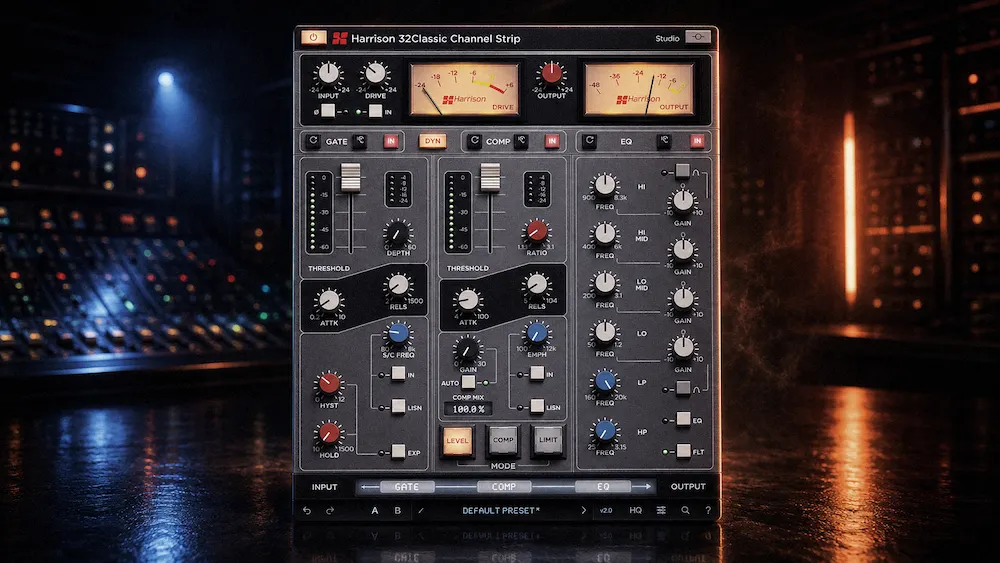
Harrison 32Classic Channel Strip V2 is a modern channel strip plugin designed around console-style mixing workflows.
Harrison 32Classic Channel Strip V2 arrives at a time when workflow efficiency is becoming just as important as processing quality. Large sessions are more demanding, plugin counts continue to grow, and many engineers are actively looking for ways to reduce decision fatigue without sacrificing control. Rather than reinventing the channel strip concept, Harrison has chosen to refine it.
The significance of V2 is not found in a new analog model or a dramatic change in sonic character. The underlying Harrison sound remains familiar. The real story is workflow. Native SSL 360° integration, UC1 support, external sidechain capability, compressor mix control, and auto-gain functionality are aimed at reducing friction during mixing rather than introducing a new processing philosophy.
That distinction matters. Harrison 32Classic Channel Strip V2 is less about chasing the latest DSP trend and more about making a console-based workflow viable inside contemporary DAW environments. Whether that approach is enough to compete with today’s most established channel strips is ultimately the question that determines the plugin’s value.
Quick Verdict
Harrison 32Classic Channel Strip V2 is a workflow-focused update rather than a sound-focused redesign. The plugin retains the balanced EQ behavior, controlled dynamics processing, and restrained console character of the original version while adding several features that make day-to-day mixing significantly more efficient.
The strongest improvements are SSL 360° integration, UC1 support, external sidechain routing, Auto-Gain, and the new Compressor Mix control. None of these fundamentally alter the sonic identity of the plugin, but together they remove many of the workflow limitations that previously separated Harrison from newer competitors.
Best for: mix engineers, SSL UC1 users, dialogue production, orchestral mixing, large-track-count sessions.
Less suitable for: engineers seeking heavy analog coloration, modular routing environments, or highly experimental channel-strip workflows.
Harrison 32Classic Channel Strip V2 at a Glance
- Type: Console-style channel strip plugin
- Best Feature: SSL 360° and UC1 integration
- Sound Character: Smooth, controlled, lightly colored
- Best For: Large mixing sessions
- CPU Load: Moderate
- Overall Rating: 8.9/10
Contents
Why Console-Centric Mixing Is Finding New Relevance
 Production workflows tend to move in cycles. A decade ago, building elaborate plugin chains became standard practice. Individual tracks often carried separate EQs, compressors, saturators, transient shapers, clippers, utility processors, and metering tools. The approach offered flexibility, but it also created larger sessions, slower decision-making, and more opportunities to lose perspective during a mix.
That reality has pushed many engineers back toward a console-oriented mindset. Not because analog nostalgia suddenly returned, but because modern sessions reward speed and consistency. A well-designed channel strip provides a repeatable processing framework that can be deployed across dozens of tracks without rebuilding the same signal path over and over again.
The appeal is particularly obvious in large projects. When EQ, dynamics, filtering, and gain management live inside a single interface, engineers spend less time opening plugin windows and more time evaluating musical decisions. The benefit is cumulative. Saving a few seconds on a single track is insignificant; saving those seconds across eighty or a hundred channels changes the pace of an entire mix.
The rise of hardware-assisted workflows has reinforced that trend. SSL’s UC1 controller demonstrated that many mixers still prefer tactile access to channel processing, even when working entirely in the box. Following SSL’s acquisition of Harrison, tighter integration between the two product lines became less a possibility and more an expectation.
Viewed through that lens, 32Classic Channel Strip V2 is not simply another channel strip update. It reflects a broader shift toward streamlined, console-style mixing workflows that prioritize speed, consistency, and focus over endlessly expanding plugin chains.
A Great Mix Still Needs a Final Reality Check
Channel strips, EQ decisions, compression settings, and workflow improvements can help build a stronger mix, but they do not guarantee translation outside the studio. The real test happens after export—on streaming platforms, earbuds, car speakers, laptops, and consumer playback systems. Upload up to 35 seconds of your mix and receive a free mastering demo to hear how professional mastering can improve balance, depth, low-end control, and playback consistency before release.
Request your free mastering demo →
The Real Upgrade Is Workflow, Not Sound
Engineers evaluating Harrison 32Classic Channel Strip V2 primarily on sonic grounds may find the update less dramatic than the version number suggests. This is not a new console emulation, nor does it introduce a fundamentally different EQ or dynamics architecture. The tonal identity that defined the original release remains largely unchanged.
The meaningful improvements are operational. V2 focuses on reducing friction inside a mix session rather than reinventing the underlying processing engine.
The most visible example is native SSL 360° and UC1 integration. For engineers already working within the SSL ecosystem, Harrison processing can now be accessed and controlled alongside SSL channel strips without additional setup or workflow compromises. That may sound like a niche feature until it is deployed across a large session. The ability to move between channels, adjust processing, and maintain physical control without constantly shifting attention between hardware and software becomes increasingly valuable as track counts grow.
In practical terms, faster navigation often has a greater impact on mix speed than another EQ curve or compressor mode. The less time spent managing tools, the more time remains for making critical balance, tone, and dynamics decisions.
The compressor updates follow the same philosophy. Auto-Gain is not a headline-grabbing feature, but it addresses one of the oldest problems in audio processing: level bias. Compression decisions become more reliable when gain differences are automatically compensated, allowing engineers to judge the actual effect of the processing rather than being influenced by a louder output signal.
The addition of a dedicated Compressor Mix control is equally pragmatic. Parallel compression is no longer a specialized technique reserved for drum buses. It is routinely used on vocals, bass, guitars, synths, and mix buses. Integrating wet/dry blending directly into the compressor eliminates extra routing, auxiliary tracks, or third-party utility plugins, making experimentation significantly faster.
External sidechain support represents the most substantial functional expansion in V2. Earlier generations of console-inspired channel strips often felt disconnected from modern production workflows, where sidechain processing has become a standard technique rather than a niche effect. Whether controlling vocal intelligibility against dense instrument arrangements, creating rhythmic movement in electronic productions, or managing dialogue clarity in post-production, sidechain capability dramatically increases the range of situations where a single channel strip can remain at the center of the workflow.
Importantly, none of these additions push Harrison into the territory occupied by dynamic EQs, spectral processors, or advanced problem-solving plugins. V2 is still a traditional channel strip at its core. What has changed is its ability to operate comfortably inside contemporary production environments without forcing engineers to abandon the efficiency that made console workflows attractive in the first place.
What’s New in Harrison 32Classic Channel Strip V2?
| Feature | Version 1 | Version 2 |
|---|---|---|
| SSL 360° Integration | No | Yes |
| SSL UC1 Support | No | Yes |
| External Sidechain | Limited | Yes |
| Compressor Mix Control | No | Yes |
| Auto-Gain | No | Yes |
| Resizable Interface | Limited | Improved |
Version 2 is primarily a workflow upgrade. Engineers expecting a new console model or a radically different sonic signature may be disappointed. However, users working in modern production environments will likely find the cumulative workflow improvements more valuable than another incremental change in analog emulation.
Harrison 32Classic vs Harrison 32C Channel
| Feature | 32C Channel | 32Classic V2 |
|---|---|---|
| Console Model | 32C | 32Classic |
| Transformer Saturation | No | Drive Control |
| SSL 360° Integration | No | Yes |
| SSL UC1 Support | No | Yes |
| Workflow Modernization | Limited | Extensive |
| Best For | Traditional Harrison users | Modern mixing workflows |
While both plugins share Harrison DNA, 32Classic V2 feels significantly more aligned with modern production workflows. Engineers moving from the older 32C Channel version will notice workflow improvements long before they notice major sonic differences.
Understanding the Harrison Sound in a Modern Mixing Environment
 Harrison has never built its reputation on extreme analog coloration. Unlike many modern console emulations that immediately announce their presence through obvious saturation, transformer weight, or aggressive transient shaping, Harrison processing tends to be far more understated. That restraint is precisely why many experienced mixers continue to gravitate toward it.
The tonal profile sits in a useful middle ground. It is generally less assertive than SSL-style channel strips and less colored than many Neve-inspired designs. Instead of imposing a strong sonic fingerprint, the plugin focuses on preserving balance while allowing incremental tonal adjustments to accumulate naturally across a mix.
That distinction becomes increasingly important as session size grows. A channel strip that sounds impressive on a single track can become problematic when instantiated across fifty or more channels. Excessive coloration compounds quickly. Harrison’s approach is better suited to engineers who want cohesion without feeling like every track is passing through the same obvious sonic lens.
The EQ section remains one of the strongest arguments for the plugin. It encourages corrective and tonal decisions that feel proportional rather than exaggerated. Broad adjustments tend to integrate naturally into the source material, making the processor particularly effective on vocals, guitars, acoustic instruments, orchestral recordings, and dialogue tracks where preservation of source character is often more important than dramatic enhancement.
The compressor follows a similarly disciplined design philosophy. It is not intended to deliver the aggressive attitude associated with API-style dynamics or the unmistakable punch that many engineers seek from SSL bus processing. Instead, it prioritizes control, stability, and predictable behavior. The result is a dynamics section that can remain active across large portions of a session without constantly drawing attention to itself.
For mix engineers, that consistency can be more valuable than character. When dozens of channels require compression, reliability often outweighs excitement. A compressor that consistently produces usable results with minimal adjustment can accelerate decision-making and reduce the need for corrective processing later in the mix.
Mastering engineers will likely view the plugin differently. While individual EQ and compression moves can be effective in mastering contexts, the overall design remains rooted in channel processing rather than final-stage program material optimization. Engineers searching for broader tonal shaping at the mastering stage will typically move toward dedicated mastering equalizers rather than channel-strip EQ sections. That distinction becomes particularly clear when comparing workflow-oriented processors like Harrison with purpose-built passive designs such as the Softube Reference 1998 & 1956 Equalizers, where the entire architecture is optimized for final tonal balance rather than track-level processing. There are no advanced loudness management tools, multiband dynamics, spectral processing capabilities, or mastering-focused monitoring functions built into the workflow. Those requirements typically live inside a dedicated mastering chain rather than a console-oriented channel strip.
As a result, 32Classic Channel Strip V2 is best understood as a mixing processor with occasional mastering utility, not a mastering solution. Its strength lies in shaping individual tracks and buses with consistency and musical restraint rather than serving as a comprehensive processor for final delivery formats.
How the EQ, Compressor and Drive Actually Sound
The easiest mistake when evaluating Harrison 32Classic V2 is assuming that it behaves like a typical analog-modeling channel strip. It does not. The plugin is noticeably more restrained than many modern console emulations and tends to prioritize balance over excitement.
The EQ is arguably the strongest part of the entire channel strip. Broad boosts remain smooth even when pushed harder than most engineers would normally attempt. High-frequency shelves add presence without becoming brittle, while low-frequency boosts retain weight without immediately introducing excessive mud. The overall impression is control rather than aggression.
The compressor follows a similar philosophy. It is capable of shaping dynamics effectively, but it rarely becomes the dominant character of the signal. Even at stronger settings, compression remains relatively composed and predictable compared to many API-inspired or FET-based alternatives.
The Drive section delivers subtle harmonic enhancement rather than dramatic saturation. Engineers expecting obvious console distortion may initially find it conservative. Used across multiple channels, however, the accumulated effect creates additional density and cohesion without overwhelming the mix.
The gate and filtering sections deserve more attention than they typically receive. Harrison’s filters remain among the most musical aspects of the workflow, making routine cleanup tasks feel faster and more transparent than with many competing channel strips.
Separating Meaningful Improvements from Marketing Narratives
Much of the conversation surrounding 32Classic Channel Strip V2 has focused on SSL integration, which is hardly surprising given Harrison’s position within the SSL family. The challenge for prospective buyers is determining whether the release represents a genuine advancement in audio processing or simply a better way to access existing functionality.
From a DSP perspective, the answer is fairly straightforward. V2 is not introducing a new console model, a redesigned analog-emulation engine, or a fundamentally different approach to EQ and dynamics processing. Engineers upgrading from the previous version should not expect a dramatic shift in tone, depth, punch, or harmonic behavior.
Most of the development effort appears to have been directed toward usability. Native SSL 360° integration, UC1 support, external sidechain routing, compressor mix control, auto-gain functionality, scalable graphics, and workflow enhancements all improve day-to-day operation. They make the plugin easier to navigate, easier to manage, and easier to integrate into contemporary sessions.
That distinction is important because workflow improvements and sonic improvements solve different problems. A faster workflow can shorten mix times, reduce repetitive tasks, and improve consistency across projects. It does not automatically produce a better-sounding mix.
In practical use, V2 feels more refined than transformed. The update removes several friction points that previously separated Harrison’s channel strip from more modern competitors, but it does not redefine what the plugin is capable of doing. The core strengths remain the same: efficient channel processing, a balanced tonal character, and a console-oriented approach to mixing.
For existing Harrison users, that may be exactly the right decision. Professional engineers often place greater value on reliability and familiarity than on constantly learning new processing paradigms. A tool that consistently delivers predictable results across hundreds of sessions can be more valuable than one that introduces additional complexity in pursuit of novelty.
For engineers evaluating a purchase today, the key question is not whether V2 sounds radically better than its predecessor. The more relevant question is whether its workflow improvements are significant enough to justify choosing it over competing channel strips from SSL, Brainworx, Waves, or Universal Audio. That is where the update succeeds—or fails—depending on the user’s preferred mixing workflow.
Best Channel Strip Plugins Compared: Harrison 32Classic V2 vs SSL, Waves and Brainworx
The channel strip market is far more crowded than it was when software console emulations first became popular. Engineers can now choose between highly detailed analog models, modular channel environments, controller-integrated workflows, and all-in-one processing suites. That makes direct comparisons unavoidable.
What separates Harrison 32Classic V2 from many competitors is not the number of features available on a spec sheet. It is the overall mixing experience. The plugin is designed around the idea that a channel strip should disappear into the workflow rather than constantly encourage experimentation with additional processing options.
| Plugin | Primary Advantage | Main Limitation | Best Fit |
|---|---|---|---|
| Harrison 32Classic V2 | Efficient console workflow and balanced tonal character | Few major innovations beyond workflow improvements | Mix engineers seeking consistency and speed |
| SSL Native Channel Strip 2 | Deep SSL ecosystem integration | More familiar than distinctive sonically | SSL-centric production environments |
| Waves Scheps Omni Channel | Exceptional routing and processing flexibility | Less focused console workflow | Hybrid mixers and power users |
| Brainworx bx_console Series | Wide range of console models and analog personalities | Greater complexity across large sessions | Engineers chasing specific console flavors |
| UAD API Vision Channel Strip | Strong character and punch | Higher ecosystem commitment | API-oriented tracking and mixing workflows |
The closest philosophical competitor is arguably SSL Native Channel Strip 2. Both products are built around traditional console concepts, both integrate naturally into controller-based workflows, and both prioritize efficiency over endless customization. The difference is largely tonal. SSL tends to present a more assertive personality, while Harrison remains comparatively restrained and easier to deploy across large numbers of channels without accumulating excessive coloration.
Scheps Omni Channel approaches the problem from a completely different angle. It is less concerned with replicating console workflow and more focused on flexibility. Engineers can rearrange modules, create unconventional processing paths, and solve a wider range of mixing problems inside a single plugin. For users who enjoy building highly customized channel architectures, Scheps remains the more powerful tool.
The Brainworx bx_console lineup serves a different audience altogether. Those plugins are often selected because engineers want the specific behavior of an SSL, Neve, API, or other classic console design. Harrison is less about collecting console personalities and more about establishing a stable, repeatable workflow across an entire project.
Perhaps the most important observation is that Harrison’s strongest selling point is not sound. Several competitors offer more aggressive analog character, deeper feature sets, or broader routing capabilities. Harrison’s advantage is operational efficiency. It encourages engineers to make decisions quickly, maintain consistency across a mix, and spend less time managing processing chains.
That philosophy will appeal to mixers who value speed, organization, and predictability. Engineers who view every channel strip as an opportunity for extensive customization may find more compelling options elsewhere.
Is Harrison 32Classic V2 a Good Channel Strip Plugin in 2026?
For engineers looking for a modern channel strip plugin, Harrison 32Classic V2 remains a surprisingly relevant option in 2026. While many developers continue adding AI-assisted processing, spectral tools, and increasingly complex workflows, Harrison focuses on the fundamentals of efficient mixing.
As a mixing plugin, it combines EQ, compression, filtering, gating, drive processing, and utility controls inside a single interface. That streamlined approach makes it particularly attractive for engineers managing large sessions where consistency and speed matter more than endless customization.
Unlike many modern console emulation plugins, Harrison does not rely on heavy coloration or aggressive analog character to create appeal. Its strength lies in maintaining balance across dozens of channels while reducing the need for large plugin chains.
The plugin is also a strong channel strip for vocals, acoustic instruments, dialogue, and orchestral material where transparent processing is often more valuable than dramatic sonic enhancement. Engineers searching for a reliable channel strip for mixing will likely appreciate its disciplined workflow, especially when combined with SSL 360° integration and UC1 controller support.
It may not be the most feature-rich channel strip on the market, but for professionals who prioritize workflow efficiency over feature accumulation, Harrison 32Classic V2 remains highly competitive among today’s channel strip options.
How Harrison 32Classic V2 Holds Up in Real Mixing Sessions
 The value of a channel strip is ultimately determined by what happens after the mix leaves the studio. A processor may sound impressive during solo auditioning yet encourage decisions that fail to translate across earbuds, laptops, soundbars, and streaming platforms. Harrison’s design philosophy has traditionally avoided that trap by favoring controlled, incremental processing over dramatic tonal reshaping.
That restraint is one of the reasons the plugin works particularly well across larger projects. Small EQ moves, moderate compression, and predictable gain structure tend to accumulate more gracefully across an entire mix than heavily colored processing chains. Engineers working on dense arrangements often benefit from that approach because it reduces the likelihood of fighting excessive buildup, exaggerated transients, or cumulative saturation artifacts later in the process.
In practical use, 32Classic V2 is especially comfortable on vocals, drum buses, bass, acoustic instruments, dialogue, and orchestral submixes. These sources often benefit more from consistency and control than from aggressive character processing, which aligns closely with Harrison’s overall design philosophy.
Mastering is a different conversation. While the EQ and compressor can certainly contribute to mastering chains, the plugin is not designed to function as a complete mastering environment. There is no multiband architecture, no spectral processing, no advanced loudness management, and no mastering-focused metering. Most mastering engineers will view it as a supporting processor rather than a primary mastering tool. The distinction becomes clearer when examining the different objectives of mixing vs mastering, where channel-level processing and final program optimization serve very different roles.
Even in mastering-oriented workflows, channel strips rarely operate alone. Once tonal and dynamic adjustments are complete, engineers still require dedicated peak management and loudness control processors. That final stage typically falls to a specialized limiter rather than a console-style channel strip, which is why tools such as TBProAudio LAxLimit V occupy a very different position within the production chain.
From a streaming perspective, the plugin’s relatively conservative approach is generally an advantage. It does not encourage excessive transient manipulation, extreme stereo widening, or the kind of harmonic density that can produce unwanted side effects after lossy codec conversion. As a result, mixes built around the channel strip tend to remain stable across common distribution formats. Those translation advantages become even more important during mastering for streaming platforms, where codec behavior and loudness normalization can expose weaknesses in overly aggressive processing.
Performance is equally practical. CPU consumption appears moderate by current standards and considerably lighter than many resource-intensive analog-modeling platforms. Even when deployed across large sessions, the plugin is unlikely to become the primary performance bottleneck on a modern production system.
The bigger efficiency gain comes from session management. When EQ, dynamics, filtering, and utility functions are consolidated inside a single channel strip, engineers spend less time navigating plugin stacks and more time evaluating balances, tone, and arrangement decisions. Over the course of a large mix, that workflow advantage is often more valuable than any incremental improvement in processing quality.
Overall Rating
| Category | Rating |
|---|---|
| Sound Quality | 8.5/10 |
| Workflow | 9.5/10 |
| Mix Translation | 9/10 |
| CPU Efficiency | 9/10 |
| Feature Set | 8.5/10 |
| Value for Money | 9/10 |
| Overall | 8.9/10 |
Harrison 32Classic Channel Strip V2 is not trying to become the most feature-rich channel strip on the market. Its strength lies in delivering a disciplined console workflow, reliable dynamics control, efficient session management, and a balanced tonal character that scales naturally across large mixes. The update focuses on removing workflow friction rather than reinventing the sound, and that decision ultimately makes it a stronger professional tool.
Sound Quality — 8.5/10
The EQ and compressor remain musical, predictable, and easy to trust across large sessions. Harrison avoids exaggerated coloration and preserves source integrity well. However, engineers seeking strong analog character, saturation, or distinctive console personality will find more exciting options elsewhere.
Workflow — 9.5/10
This is where V2 earns its highest score. SSL 360° integration, UC1 support, Compressor Mix, Auto-Gain, and sidechain functionality address real-world workflow bottlenecks. The plugin encourages faster decisions and reduces unnecessary session complexity without sacrificing control.
Mix Translation — 9/10
One of Harrison’s biggest strengths is how well processing decisions scale across an entire mix. The restrained EQ and dynamics architecture helps maintain balance and consistency across multiple playback systems while avoiding the cumulative artifacts often associated with heavily colored channel strips.
CPU Efficiency — 9/10
Resource consumption remains practical even in larger projects. Engineers can comfortably deploy the plugin across dozens of channels without creating the performance penalties often associated with more elaborate analog-modeling platforms.
Feature Set — 8.5/10
The feature set is strong but intentionally focused. Harrison covers the essentials exceptionally well, yet it does not attempt to compete with modular channel strips, dynamic EQ environments, spectral processors, or advanced corrective tools. Its philosophy favors efficiency over expansion.
Value for Money — 9/10
For engineers who prefer console-centric mixing, the combination of workflow improvements, mature processing architecture, and SSL ecosystem integration creates a compelling value proposition. Existing Harrison users and UC1 owners will likely extract the greatest benefit from the upgrade.
Pros and Cons
| Pros | Cons |
|---|---|
| Excellent workflow efficiency | No major sonic redesign over V1 |
| Native SSL 360° integration | Relatively restrained analog character |
| Full SSL UC1 compatibility | Limited advanced routing options |
| Built-in parallel compression control | No dynamic EQ functionality |
| Good CPU efficiency | Less flexible than Scheps Omni Channel |
| Reliable mix translation | Not designed as a mastering processor |
Who Should Buy Harrison 32Classic Channel Strip V2?
Harrison 32Classic Channel Strip V2 is best suited to engineers who value consistency, speed, and repeatable workflow across large sessions. The plugin excels when deployed across dozens of channels where small gains in efficiency accumulate into meaningful time savings.
- Mix engineers handling large track counts
- SSL UC1 owners seeking deeper controller integration
- Dialogue and post-production mixers
- Orchestral and acoustic music engineers
- Users looking to replace long plugin chains with a unified workflow
Engineers primarily chasing aggressive console coloration, advanced routing architectures, or modular channel-strip design may find stronger alternatives in Waves Scheps Omni Channel, Brainworx bx_console, or API-focused channel-strip platforms.
Verdict: A Stronger Mixing Workflow Without Reinventing the Channel Strip
Harrison 32Classic Channel Strip V2 remains one of the more workflow-focused channel strip plugins currently available for professional mixing. Rather than introducing a new console model or chasing the latest DSP trend, the update removes several workflow limitations that had begun to separate the plugin from newer competitors. SSL 360° integration, UC1 support, external sidechain functionality, compressor mix control, and auto-gain all contribute to a faster and more cohesive mixing experience.
That does not mean the plugin represents a major leap forward in audio processing. Engineers should not expect a dramatically different sound, a redesigned analog emulation engine, or a new benchmark for channel strip technology. The underlying strengths and limitations remain largely the same as before.
What has changed is usability. The plugin fits more naturally into contemporary production workflows, particularly in larger sessions where efficiency often becomes as important as sound quality. Reducing repetitive tasks, minimizing navigation, and keeping attention focused on the mix itself can have a measurable impact on both speed and consistency.
For existing Harrison users, V2 feels less like a reinvention and more like a long-overdue modernization. For SSL UC1 owners, the value proposition is considerably stronger because the plugin now operates as a native part of the broader SSL ecosystem rather than a parallel workflow.
Engineers already invested in SSL Native Channel Strip 2, Waves Scheps Omni Channel, Brainworx bx_console, or UAD channel strips will find fewer reasons to switch purely for sonic benefits. The decision ultimately comes down to workflow philosophy. Harrison favors a disciplined, console-centric approach that prioritizes consistency over customization and efficiency over feature expansion.
Viewed objectively, 32Classic Channel Strip V2 is neither a transformative release nor a superficial update. It is a mature refinement of an established tool. In a market increasingly crowded with feature-heavy processors, that focus on practical usability may be its most valuable characteristic.
The Last 5% Is Usually What Listeners Notice
Harrison 32Classic V2 is built around a simple idea: better decisions beat bigger plugin chains. The same principle applies at the mastering stage. Once a mix is already working, the biggest improvements often come from subtle corrections in tonal balance, dynamics, stereo presentation, and translation rather than additional processing.
If you’re unsure whether your mix is truly finished, let the audio answer the question. Upload up to 35 seconds of your track and receive a free mastering demo prepared by a real mastering engineer. Compare your original mix against a professionally mastered version and evaluate the difference on your own monitoring system before making any commitment.
Get your free demo →
FAQ
Can Harrison 32Classic Channel Strip V2 serve as a complete channel-strip solution across an entire mix?
For many projects, yes. The plugin covers filtering, EQ, compression, gating, stereo control, and utility functions well enough to become the default processor on most tracks. However, engineers will still reach for dedicated tools when dealing with dynamic EQ tasks, spectral repair, multiband dynamics, or advanced mastering requirements.
Is Harrison 32Classic V2 more about sound quality or workflow improvement?
The update is primarily a workflow release. Most of the meaningful additions focus on session efficiency, controller integration, sidechain functionality, and faster decision-making rather than a major change in sonic character.
How useful is the plugin for large mixing sessions?
Large sessions are arguably where the plugin makes the strongest case for itself. Consistent channel architecture across dozens of tracks reduces plugin management, speeds up navigation, and helps maintain a more disciplined mixing process.
Does the built-in Compressor Mix control eliminate the need for parallel routing?
In many situations, yes. Engineers can dial in parallel compression directly inside the channel strip without creating duplicate tracks or additional auxiliary routing. That can significantly speed up vocal, drum, bass, and mix-bus workflows.
How does Harrison 32Classic V2 compare with modern channel strips like Scheps Omni Channel?
The two products target different philosophies. Scheps Omni Channel emphasizes flexibility, routing options, and module customization. Harrison focuses on maintaining a traditional console workflow with fewer decisions and a more streamlined operating environment.
Is SSL UC1 integration a major advantage or simply a convenience feature?
For engineers who already own UC1 hardware, it is a meaningful workflow improvement. Direct controller access reduces dependence on mouse navigation and allows faster adjustments across large sessions. For users without UC1, the benefit is far less significant.
Does Harrison 32Classic V2 add noticeable analog coloration?
Compared with many console emulations, the coloration is relatively restrained. The plugin tends to prioritize balance and control over obvious saturation or aggressive console character, making it easier to deploy across a large number of channels.
Is Harrison 32Classic V2 a good choice for hybrid mixing and mastering workflows?
It can play a supporting role, particularly on stems, buses, and corrective processing tasks. Most mastering engineers, however, will continue to rely on dedicated mastering processors for loudness control, final EQ decisions, metering, and delivery preparation.
Will Harrison 32Classic V2 become a better investment than buying multiple single-purpose plugins?
That depends on workflow preferences. Engineers who prefer console-style mixing may find greater value in a unified channel strip than in assembling large chains of individual processors. Those who rely heavily on specialized processing will likely continue using both approaches together.
Is Harrison 32Classic V2 one of the best channel strip plugins for mixing in 2026?
For engineers who prioritize workflow efficiency, controller integration, and consistent processing across large sessions, Harrison 32Classic V2 remains one of the strongest channel strip plugins currently available. Users seeking extreme analog coloration or modular routing flexibility may prefer alternative solutions.

Yurii Ariefiev evaluates mixing plugins through the lens of real-world production efficiency, focusing on workflow design, gain staging, dynamics control, EQ behavior, and how processing decisions scale across large sessions. His reviews prioritize practical mixing results over marketing claims and feature lists.
At AREFYEV Studio, channel strips, compressors, EQs, and console emulations are assessed not only by their sound but also by their impact on mix translation, session speed, consistency, and preparation for mastering. The goal is to determine whether a tool genuinely improves decision-making inside professional production workflows.
☕ Buy me a coffee