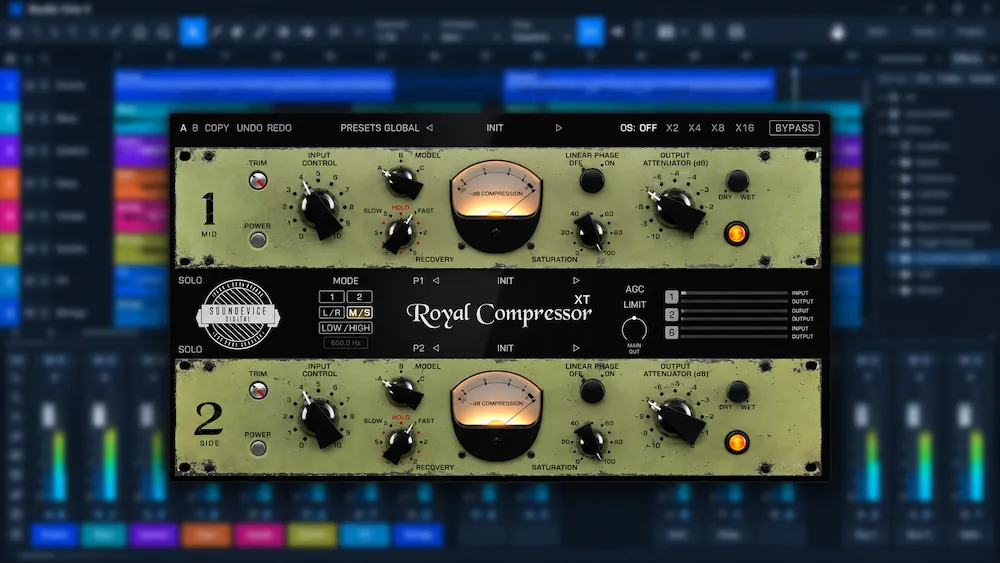
Royal Compressor XT expands Soundevice Digital’s original Royal Compressor with a second independently controlled compressor unit and three additional processing modes: left/right (L/R), Mid/Side (M/S), and Low/High frequency splitting. The plugin combines vari-mu-inspired compression with adjustable saturation, allowing engineers to process different stereo components or frequency ranges without building separate signal chains.
Released on October 26, 2026, through United Plugins, Royal Compressor XT targets producers, mixing engineers, and mastering engineers who want more control from a character compressor. Its defining feature is not a fundamentally new compression approach, but the ability to direct its two compressor units toward different parts of the signal.
This distinction has practical consequences. In conventional full-band compression, the detector responds to the signal feeding the compressor, so strong low-frequency content can influence gain reduction across the mix. Split processing offers a different approach: L/R and M/S modes allow separate treatment of stereo channels or mid and side components, while Low/High mode divides the signal by frequency. These options can help address specific balance or dynamics problems, but their usefulness depends on the source material and whether the additional control solves a problem that a simpler processing chain cannot.
What Is New in Royal Compressor XT?
 The original Royal Compressor established the plugin’s vintage-inspired compression approach. XT retains that foundation but expands it into a dual-unit design. Each compressor has its own Input, Trim, Model, Recovery, Saturation, Output Attenuator, and Dry/Wet controls, allowing the two processing paths to be adjusted independently.
The units can operate in the original configurations or process different signal components. In L/R mode, one unit handles the left channel and the other the right. M/S mode assigns them to Mid and Side components, while Low/High mode splits the signal around an adjustable crossover frequency.
Preset management is also relevant to the dual-unit workflow. The plugin provides separate preset handling for its two processing units alongside global presets for the complete setup. A/B comparison and copying settings between units can make it easier to compare configurations or transfer a starting point without rebuilding the processing chain manually.
This is the central change from the original Royal Compressor: XT brings these configurations into a single interface rather than requiring separate instances and additional routing. That can simplify setup when a mix or master needs different compression behavior across stereo components or frequency bands.
The manufacturer also specifies automatic gain control (AGC), a main-output limiter, and oversampling up to 16×. Independent power and solo controls for each processing unit provide additional flexibility when configuring or checking the two paths. These are workflow and processing features, however, not independent evidence of improved sound quality, reduced CPU usage, or better performance than competing compressors.
How the Dual-Compression Architecture Works
The value of Royal Compressor XT’s dual-unit design depends on how the two compressors are assigned and how independently their target signal components need to respond. Separate controls are most useful when those components benefit from different dynamic behavior or saturation settings; duplicating the same processing across both paths offers less of an advantage.
Left/Right Compression
L/R mode processes the left and right channels independently. This can be useful when a stereo recording has uneven transient activity or different levels of energy between its channels. Stereo drum overheads and double-tracked guitars, for example, may contain substantially different material on each side.
Independent compression lets each channel respond to its own dynamics instead of applying the same gain-reduction behavior to both. The trade-off is stereo stability: if gain reduction differs substantially between the channels, the perceived position of sounds can shift as the signal changes.
On a mix bus or mastering chain, linked stereo compression may be preferable when a stable stereo image is the priority. L/R mode is better treated as a deliberate choice for material that benefits from independent channel control, rather than an inherent improvement over linked compression.
Mid/Side Compression
Mid/Side processing separates a stereo signal into Mid information, derived from the sum of the left and right channels, and Side information, derived from their difference. The Mid component generally emphasizes centrally shared material, while the Side component carries the stereo differences.
Royal Compressor XT allows the two compressor units to process these components independently. An engineer can therefore apply one dynamic response to the center and another to the stereo information around it, rather than treating both components identically.
Potential applications include stereo mix buses and mastering chains where central elements, such as kick, bass, or lead vocals, require different dynamic treatment from reverberation, ambience, and other stereo content. The usefulness of this approach depends on the arrangement and on how much separation exists between the central and side information.
Mid/Side compression does not automatically improve stereo width, center definition, or mono compatibility. Strong processing of the Side component can change the perceived balance of the stereo field, while changes to either component affect their relationship when the signal is reconstructed. For a broader explanation of how width is created and controlled, see this guide to stereo width in mixing. Evaluate the result in stereo and check mono compatibility where it matters for the intended release.
Low/High Split Compression
Low/High mode divides the signal into two frequency regions using an adjustable crossover, with 600 Hz documented as the default frequency. Each region can then receive its own compression and saturation settings.
This mode may be useful when low-frequency energy drives gain reduction that also affects the rest of the signal. For example, a bass-heavy mix may need a different dynamic response in the lower range than in the upper frequencies. Separate processing can provide that control without requiring the same compression behavior across both regions.
The result still depends on crossover behavior, processing settings, and the source material. Splitting a signal into frequency regions can affect the way those regions interact, so level and tonal balance should be checked after processing. Independent phase-response measurements for Royal Compressor XT were not located; its crossover behavior should therefore not be described as phase-transparent without supporting evidence.
Low/High mode is a tool for selective dynamic control, not a guaranteed fix for muddy bass, excessive low-frequency energy, or an unbalanced master. Those problems can have several causes, and multiband-style processing is appropriate only when the specific issue calls for it.
Check Your Mix’s Dynamics, Balance, and Stereo Image Before Mastering
A compressor can shape transients and density, but the final master also depends on how the entire mix holds together. If you’re working with complex stereo material, uneven low-end energy, or dynamics that need careful control, a dedicated mastering assessment can help identify what deserves attention before the final processing stage. Submit up to 40 seconds of your mix for a free mastering demo and hear how your material responds to professional mastering.
Get Your Free Mastering Demo →
Models, Recovery, and Saturation
Royal Compressor XT offers three compressor models, labeled A, B, and C. According to the manufacturer, they recreate three hand-built units with different attack characteristics and tonal responses. The available specifications list a 70 ms attack for Model A and a 17 ms attack for Model C. Model A is described as the cleanest, while Model C is characterized as the most colorful. These descriptions reflect the manufacturer’s claims; independent measurements comparing the models with their hardware counterparts were not available for this review.
Attack behavior affects how much of a transient passes before gain reduction develops. A slower attack can retain more of the initial transient, while a faster attack can reduce its prominence. The actual response also depends on input level, recovery settings, signal content, and the amount of gain reduction. The stated attack times alone do not establish how the models will sound across different sources.
Recovery uses stepped settings rather than a continuously variable control, with additional HOLD positions for extended recovery behavior. This gives users defined settings for shaping the compressor’s envelope, but offers less granular adjustment than a fully variable release control. The practical trade-off is between selecting a repeatable setting and fine-tuning recovery to a specific groove or transient pattern.
Saturation has its own control, separate from the compression settings. This allows the engineer to adjust dynamic control and harmonic coloration as distinct parts of the signal chain—for example, increasing gain reduction without deliberately adding more saturation, or changing the saturation amount without making compression the primary source of coloration.
The manufacturer also describes a random element in the saturation behavior. Without independent technical documentation or measurements establishing how this process operates and affects the output, it should be treated as a stated design feature rather than proof of more authentic analog behavior.
AGC, Limiting, and 16× Oversampling
 Royal Compressor XT includes automatic gain control (AGC) and a limiter on the main output. These features provide additional control over output level when driving the processor harder, but they do not eliminate the need for careful gain staging in mixing or level-matched comparisons.
Output level is particularly important when evaluating compression and saturation. A louder processed signal can seem fuller or more impressive even when the underlying differences in tone and dynamics are relatively small. Comparing processed and bypassed signals at closely matched perceived loudness helps separate genuine changes in the sound from the effect of level differences.
The plugin also offers oversampling up to 16×. By increasing the internal processing sample rate, oversampling can reduce aliasing generated by nonlinear processes such as saturation. The extent of the reduction depends on the nonlinear algorithm, the oversampling implementation, and the selected operating mode.
Royal Compressor XT also provides a Linear Phase option for its processing units. This setting is relevant when evaluating frequency-split processing, but it does not establish that the crossover is free from audible artifacts under every condition. The additional latency is an important workflow trade-off, so the mode should be enabled when its behavior is useful for the task rather than assumed to be necessary in every session.
Independent aliasing measurements, distortion tests, and CPU benchmarks for Royal Compressor XT were not available for this review. The advertised 16× option should therefore be understood as a processing capability, not proof that aliasing becomes inaudible or that the plugin operates efficiently under heavy workloads.
Higher oversampling settings can increase CPU demand and may affect processing latency, depending on the implementation. In larger sessions, compare the available settings under realistic project conditions rather than assuming that 16× is always the best choice. Use the highest setting only when its audible or technical benefit justifies the additional processing cost.
Royal Compressor XT for Mixing and Mastering
Mix Bus Processing
On a mix bus, Royal Compressor XT’s main advantage is the ability to combine vari-mu-style compression with independent processing of stereo components. M/S mode allows the Mid and Side signals to respond differently to compression, while the original operating modes remain an option when the goal is to shape the dynamics of the signal more uniformly. For a broader look at the role of bus-level processing, see this guide to mix bus processing.
Restraint matters on a bus. Compression changes the balance between transients and sustain, affecting perceived density and punch. Independent processing paths offer more control, but they also make it easier to alter relationships that are already working well in the mix. Each additional adjustment should solve an identifiable problem rather than add processing for its own sake.
Mastering
In mastering, Low/High and M/S modes offer ways to target specific dynamic relationships. Low/High processing may help when low-frequency energy needs a different response from the upper range, while M/S processing allows the center and stereo sides to receive different compression settings. An alternative approach is to use an integrated mastering processor with its own multiband dynamics and saturation tools, as discussed in the Musik Hack Master Plan 2 review.
Neither approach is automatically preferable to conventional stereo compression. If a linked compressor already delivers the desired dynamics and tonal balance, splitting the signal adds complexity without necessarily improving the result.
When using Low/High mode, evaluate tonal balance and the interaction around the crossover. With M/S processing, monitor changes to stereo stability and check mono compatibility where relevant. The decision to use either mode should be based on the result and the specific problem being addressed, not on the number of available routing options.
Drums and Stereo Recordings
L/R mode can be useful on stereo drum recordings, overheads, and other sources with asymmetric transient activity. Independent compression lets each channel respond to its own dynamics, but differences in gain reduction can also cause the perceived stereo image to shift over time.
Where spatial stability matters more than independent transient control, linked stereo compression may be the better choice. L/R mode is an additional option for material that benefits from separate channel treatment, not a universal replacement for conventional stereo processing.
Royal Compressor XT vs. the Original Royal Compressor
The original Royal Compressor is the most direct point of comparison because XT builds on the same processing concept. The main difference is functional: XT adds a second independently controlled compressor unit and dedicated modes for processing left/right channels, Mid/Side components, or separate frequency ranges.
| Capability | Royal Compressor | Royal Compressor XT |
|---|---|---|
| Original compressor workflow | Yes | Retained in modes 1 and 2 |
| Dual independently controlled compressor units | Not the defining workflow | Yes |
| Independent left/right processing | No equivalent XT-style mode documented | Yes |
| Independent Mid/Side processing | No equivalent XT-style mode documented | Yes |
| Adjustable Low/High crossover processing | No equivalent XT-style mode documented | Yes |
| Upgrade eligibility | Eligible original owners may qualify | Free upgrade advertised for eligible original owners |
For existing owners, the advertised free upgrade makes XT worth evaluating if its additional routing options address a real need in their workflow. Eligibility depends on the manufacturer’s terms. New users should weigh those options against their actual processing requirements: if independent stereo or frequency-band compression is rarely needed, the added flexibility may not justify choosing XT over a simpler compressor.
How It Compares With Other Compressor Options
Royal Compressor XT combines vari-mu-inspired compression with routing options for processing separate stereo components or frequency ranges. The most useful alternatives depend on whether the priority is a similar compression character, analog hardware, or more specialized control over frequency-dependent dynamics.
| Product | Primary role | Key distinction |
|---|---|---|
| Royal Compressor | Vintage-inspired compression | The original processing concept without XT’s documented split-mode workflow |
| Pulsar Audio Mu | Vari-mu-style compression | An alternative for engineers focused on vari-mu compression and bus processing |
| Manley Variable Mu | Analog hardware compression | A hardware option with different signal-path, integration, maintenance, and ownership-cost considerations |
| FabFilter Pro-MB | Multiband dynamics processing | A more specialized approach to frequency-dependent dynamics rather than vintage-inspired coloration |
These processors serve different purposes and should not be treated as interchangeable. A dedicated multiband compressor is designed around frequency-dependent dynamics control, while a vari-mu compressor emphasizes a different compression approach. Hardware introduces further considerations, including physical integration, maintenance, and total cost of ownership.
Royal Compressor XT’s clearest functional distinction is its combination of two independently controlled compressor units with L/R, M/S, and Low/High modes. The available evidence does not establish that it sounds better than these alternatives or can replace a dedicated multiband processor in every workflow. The practical choice depends on the required controls, desired compression behavior, and whether XT’s integrated routing offers a real advantage for the task.
Price, Trial, and Upgrade Considerations
 At launch, United Plugins advertised Royal Compressor XT at €15 instead of €69, with the introductory offer scheduled to end on November 30, 2026. Some US-facing publications and retailers have listed prices of $15–$17, against regular prices of $69–$77. A 15-day fully functional trial is also advertised. Prices and promotional terms may vary by retailer and region, so check the official store for the current offer before purchasing.
Owners of the original Royal Compressor may qualify for a free XT upgrade under the manufacturer’s announced terms. The original plugin is also included in the United Plugins Free Bundle, giving new users a way to explore its processing approach before deciding whether XT’s additional capabilities are worth pursuing.
At the introductory price, XT is relatively inexpensive to evaluate. Its practical value, however, depends on how often its additional routing modes are needed. Engineers who regularly require independent L/R, M/S, or Low/High processing have a clearer use case than those who primarily need straightforward level control from a conventional compressor.
The manufacturer lists VST, VST3, AU, and AAX formats for Windows and macOS, but format availability does not guarantee compatibility with every host. Royal Compressor XT relies on sidechain routing, and United Plugins warns that applications without the required routing support, including GarageBand, may not work properly with the plugin. Check compatibility with your DAW before relying on XT in a production session.
What Has Not Been Independently Verified?
Royal Compressor XT was released on October 26, 2026, leaving limited time for independent evaluation. This review assesses the available product specifications, manufacturer documentation, and advertised functionality rather than claiming controlled listening tests or independent technical measurements.
The following performance characteristics remain independently unverified:
- How its harmonic distortion and aliasing compare with those of competing compressors that use saturation.
- How CPU usage and processing latency vary across oversampling settings.
- How the Low/High crossover performs in measured phase-response tests.
- Whether independent L/R compression provides consistent, measurable advantages on representative stereo material under controlled conditions.
- How reliably the plugin performs across different DAWs and demanding sessions during extended use.
These gaps are not evidence of poor performance; they limit the conclusions that can reasonably be drawn about sound quality, processing efficiency, and reliability. Controlled, loudness-matched listening comparisons, repeatable technical measurements, and broader compatibility testing would provide a stronger basis for evaluating the plugin’s performance.
Overall Rating
| Category | Rating |
|---|---|
| Dynamic Control | 8.2/10 |
| Stereo Routing Flexibility | 9.0/10 |
| Frequency-Split Processing | 7.5/10 |
| Attack & Recovery Control | 7.8/10 |
| Saturation Control | 7.5/10 |
| Output & Processing Options | 8.0/10 |
| Overall | 8.0/10 |
The dual-unit architecture provides substantial control over dynamic relationships, particularly when the left and right channels or Mid and Side components need different treatment. The documented attack options and independent saturation controls offer useful parameter separation, although stepped recovery settings limit fine adjustment. Low/High processing adds versatility, but the absence of independent crossover measurements leaves its phase behavior unverified.
Separate saturation adjustment earns a solid score for control flexibility, not for proven sonic quality. The manufacturer describes a random element in the saturation behavior, but the available evidence does not establish its measurable effect or demonstrate superiority over other coloration methods.
AGC, a main-output limiter, and oversampling up to 16× broaden the available processing options. However, independent measurements of aliasing, distortion, CPU usage, and latency are unavailable, so the advertised capabilities cannot be treated as verified performance results.
Royal Compressor XT is best suited to engineers who specifically need vari-mu-inspired compression with independent stereo or frequency-region processing in one plugin. Its routing architecture is the clearest strength; the principal compromises are stepped recovery controls and unverified technical performance. The rating reflects documented functionality and its potential practical usefulness, not firsthand listening tests or measured sound quality.
Final Verdict: Is Royal Compressor XT Worth Considering?
Royal Compressor XT is a specialist option for engineers who want vari-mu-inspired compression with independent control over stereo components or frequency ranges. Its main advantage over the original Royal Compressor is the expanded routing architecture, which brings L/R, Mid/Side, and Low/High processing into a single plugin interface.
The additional flexibility is most relevant to mix-bus processing, stereo recordings, and mastering tasks where different parts of a signal need distinct dynamic treatment. For engineers who primarily need conventional compression, or whose existing tools already cover these workflows, XT may add complexity without delivering a meaningful practical advantage.
The introductory price and advertised free upgrade for eligible owners of the original Royal Compressor make XT worth evaluating. Neither establishes that it will outperform an existing compressor or improve a mix simply by being added to the signal chain.
The practical recommendation: consider Royal Compressor XT if you have a specific use for its L/R, Mid/Side, or Low/High modes. Compare it with your existing tools at matched perceived loudness, check for changes in stereo stability and tonal balance, and keep it in your workflow only if the additional control produces a meaningful improvement. It is a specialized dynamics processor with a distinctive routing approach, not a proven universal replacement for conventional compression.
Before Adding Another Plugin, Hear What Your Mix Can Deliver
More compression, saturation, or stereo processing won’t necessarily solve a mix that lacks punch, has uneven low-end energy, or loses its balance across playback systems. As this review shows, extra processing is useful only when it addresses a specific problem without compromising dynamics, tonal balance, or stereo stability. A professional mastering perspective gives you another way to evaluate the result: submit up to 40 seconds of your mix and receive a free mastering demo prepared by a real mastering engineer. Compare the original with the mastered version to hear what changes in your own material before deciding on the next step.
Upload Your Mix for a Free Mastering Demo →
Frequently Asked Questions
What is the main difference between Royal Compressor XT and the original Royal Compressor?
XT adds a second independently controlled compressor unit and L/R, Mid/Side, and Low/High processing modes while retaining the original workflow in modes 1 and 2.
Can Royal Compressor XT be used for mastering?
Yes. Its M/S and Low/High modes offer additional options for selective dynamic processing during mastering. Their usefulness depends on the material and the problem being addressed. Check the results for changes in tonal balance, stereo stability, and crossover behavior.
What is the default Low/High crossover frequency?
The documented default is 600 Hz, and the crossover frequency is adjustable.
Does Royal Compressor XT support oversampling?
Yes. The manufacturer advertises oversampling up to 16×. Independent measurements comparing aliasing performance across the available settings were not found in the available research.
Is Royal Compressor XT free for existing Royal Compressor owners?
The manufacturer announced a free XT upgrade for eligible owners of the original Royal Compressor. Eligibility depends on the manufacturer’s terms.
Is Royal Compressor XT compatible with every DAW?
Universal compatibility should not be assumed. The manufacturer lists VST, VST3, AU, and AAX formats for Windows and macOS, but actual support depends on the DAW, operating system, and required routing capabilities.
Is Royal Compressor XT better than a dedicated multiband compressor?
Not necessarily. XT combines vari-mu-inspired compression with Low/High split processing, while a dedicated multiband compressor may provide a different range of crossover and dynamics controls. The better choice depends on the processing requirements and preferred workflow.
Should I always use Royal Compressor XT at 16× oversampling?
No. Higher oversampling may reduce aliasing from nonlinear processing, but the practical benefit and CPU cost depend on the implementation and session. Compare settings in your own DAW and use 16× when its benefits justify the additional processing demand.

Evaluating a compressor involves more than judging how much gain reduction it applies. Attack and recovery behavior affect transient definition and envelope shape, while saturation changes harmonic content independently of level control. For processors with stereo or frequency-split routing, the key question is whether that extra control solves a specific dynamic problem without compromising tonal balance, stereo stability, or translation across playback systems.
Enjoyed this review?
If you found it useful, you can support independent audio research with a coffee.
☕ Buy me a coffee