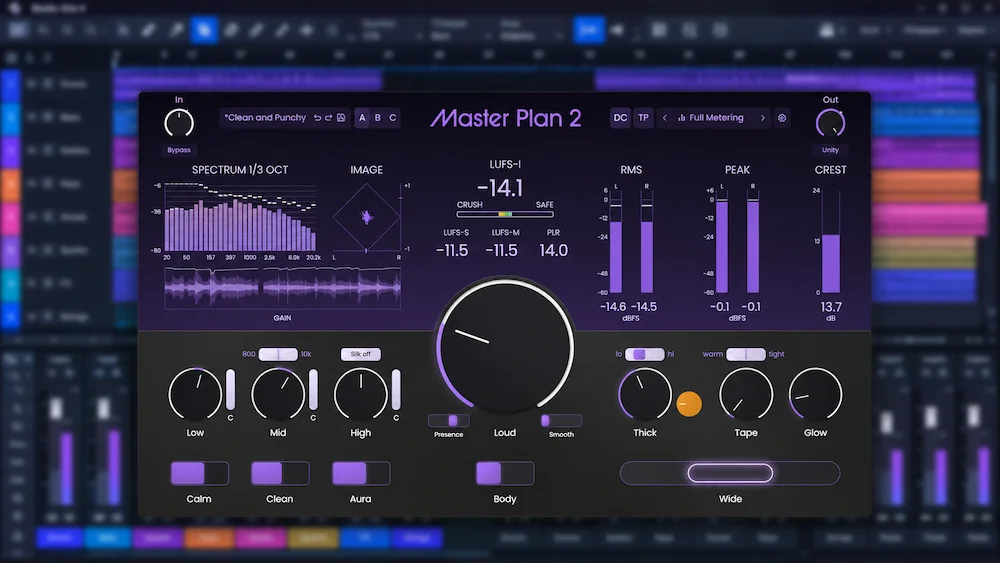
Musik Hack Master Plan 2 is a revised version of the company’s all-in-one mastering plugin, with a redesigned limiter, expanded saturation controls, updated dynamics processing, and more extensive metering and reference-comparison tools. Announced on October 25, 2026, the release focuses on loudness control, tonal shaping, and monitoring within a single mastering workflow.
The key question is whether these changes offer a practical advantage over the original or mainly add flexibility to an existing processing chain. The updated feature set gives engineers more options for shaping dynamics and evaluating processing decisions. However, claims of improved loudness, better transient preservation, and reduced aliasing should be treated as manufacturer claims until supported by independent testing.
At its displayed introductory price of $179, compared with a regular price of $249, Master Plan 2 may appeal to engineers looking for an integrated mastering environment. For existing owners, the value of upgrading depends on whether the revised limiter, additional controls, and monitoring workflow address limitations in their current setup.
What’s New in Musik Hack Master Plan 2?
 Master Plan 2 retains the original’s all-in-one mastering workflow while revising several parts of its processing chain and monitoring system. The main changes center on limiting, saturation, dynamics, metering, and reference-track comparison. Their practical value depends on how much control engineers need within a single plugin rather than across separate processors.
- Limiter 2.0: A redesigned limiter with Presence and Body controls, refined glue compression, and an updated True Peak circuit. These features target different aspects of limiting and tonal density, although their sonic benefits require independent evaluation.
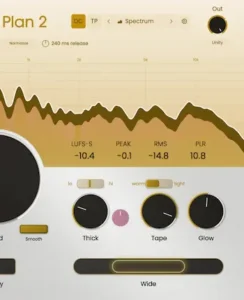
- Saturation and coloration: Targeted Saturation offers four flavors, including the Thick circuit, while Glow, Aura, and Silk provide additional options for shaping cohesion, overall coloration, and high-frequency character. The available controls expand the range of tonal choices, but their names alone do not establish how each circuit behaves.
- EQ and dynamics: Updated Low, Mid, and High EQ circuits, a redesigned multipressor, and Dynamic Calm for dynamic resonance suppression.
- Nonlinear processing: A hybrid architecture combining oversampling and Antiderivative Antialiasing (ADAA), intended to reduce aliasing during nonlinear processing. The extent of any improvement has not been independently verified.
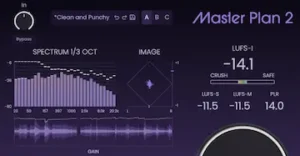
- Monitoring: Gain, Spectral, EQ, and Imaging views, plus a difference meter for evaluating changes associated with gain and saturation.
- Optimal Loudness Meter: A real-time loudness indicator designed to show when the mix is within the intended operating range, approaching the recommended range, or being pushed into excessive limiting. It provides additional visual guidance, but should not replace listening or independent assessment of the master.
- Reference comparison: In-plugin reference playback, automatic beat detection, and navigation between musical sections to streamline comparisons.
- Snapshots: The ability to save up to three settings and automate them, making it easier to compare processing configurations within a session.
- Auto-Input-Leveling: Automatically adjusts the input level to the operating range intended by the plugin. Its practical effect should be evaluated in the context of the signal and the selected processing settings.
- Low Latency Mode: Provides lower-latency versions of the processing circuits for tracking and performance workflows. The actual latency and CPU impact depend on the operating mode and session configuration.
- Interface and shortcuts: Updated settings include light and dark appearance options, additional customization, and keyboard shortcuts intended to make common operations easier to access.
- Legacy Mode: Access to the original Master Plan 1 signal chain, providing continuity for users who prefer the earlier processing behavior.
The feature set is described in the product announcement. Its inclusion does not, by itself, demonstrate better sound quality, more transparent limiting, lower aliasing, or a faster workflow than the original version or competing products. Those conclusions require controlled listening tests, technical measurements, and evaluation in representative mastering sessions.
Master Plan 2 Limiter: Loudness, Punch, and True Peak
Increasing loudness involves more than controlling peak levels, and understanding the relationship between loudness and clipping in mastering helps explain why aggressive limiting can compromise transient definition. As limiting becomes more aggressive, transients can lose impact, bass can become less defined, and distortion or pumping can become audible. The outcome depends on the source material, the amount and timing of gain reduction, and how the limiter interacts with other processors in the chain.
According to Musik Hack, Limiter 2.0 uses waveform-shape preservation techniques designed to increase loudness while retaining transients, low-frequency integrity, and the character of the mix. These are manufacturer claims; independent measurements and controlled listening comparisons would be needed to establish how consistently the limiter achieves those goals.
Presence and Body Controls
The Presence control introduces two frequency-adaptive release algorithms intended to alter the limiter’s response across the frequency spectrum. Depending on the material and settings, this approach may give engineers another way to manage perceived attack, clarity, and softness in a finished master. The actual result will depend on how the algorithms respond to the mix’s spectral and dynamic content.
Body is designed to bring quieter elements forward, increasing perceived density and loudness. That may help create a more consistent presentation, but greater density can also reduce the contrast between prominent transients and lower-level details. Whether the trade-off is beneficial depends on the arrangement and the intended dynamics of the master.
Neither control replaces corrective work earlier in the signal chain. If a mix has excessive low-frequency energy, an inconsistent kick, or a vocal that already dominates the balance, applying more limiting may exaggerate the underlying problem rather than solve it. Addressing these issues and preparing the mix for mastering can preserve more headroom for loudness processing.
The meaningful test is whether the controls improve the desired characteristics at matched perceived loudness. A louder output can seem more impactful in an uncontrolled comparison, even when it has lost transient definition or tonal balance.
True Peak Processing
Master Plan 2 includes an updated True Peak circuit that Musik Hack describes as more transparent and more effective at higher loudness levels. Without independent measurements, however, the degree of improvement remains unverified.
True Peak metering estimates the maximum amplitude of the reconstructed waveform between digital samples. Consequently, a signal whose sample peaks remain below a digital ceiling can still produce higher inter-sample peaks during digital-to-analog reconstruction or subsequent signal conversion.
A True Peak limiter can help control these excursions, which is particularly relevant when preparing masters for lossy encoding or distribution systems with strict peak requirements. Its presence alone does not guarantee artifact-free limiting or prevent every downstream peak excursion. The outcome also depends on the limiter’s implementation, the chosen ceiling, and subsequent processing or encoding.
No independent measurements are available here to establish Master Plan 2’s True Peak accuracy, distortion behavior, or performance relative to competing limiters. Its updated circuit is therefore a feature to evaluate, not evidence by itself of superior transparency.
Get More Punch and Balance From Your Mix
Limiting and saturation can increase perceived loudness, but the final master still depends on how well the mix preserves transient impact, tonal balance, low-end definition, and detail. If you want an independent perspective on how your track translates, AREFYEV STUDIO offers a free mastering demo. Upload up to 40 seconds of your mix to hear how professional mastering may shape its dynamics and overall balance.
Request Your Free Mastering Demo →
Saturation, EQ, and Dynamic Processing
Master Plan 2 expands its tonal-shaping options with targeted saturation, the Glow and Silk circuits, adjustable Aura, Tape Intensity, revised EQ, and Dynamic Calm. These tools address different aspects of harmonic coloration, frequency balance, and dynamic resonance control. Their practical value depends on the source material, the interaction between processors, and the amount of processing needed to achieve the intended result.
Targeted Saturation and Tape Intensity
The targeted saturation section offers four flavors, including the Thick circuit. Musik Hack describes this processing as a way to apply saturation selectively while minimizing phase distortion. The extent to which it achieves that depends on the implementation and operating conditions; the feature description alone does not establish its measured performance.
Targeted saturation can be useful when an engineer wants to add harmonic content or perceived density without applying the same degree of nonlinear processing across the entire mix. The practical distinction between saturation flavors, however, depends on their actual harmonic behavior, frequency response, and response to input level—not simply on the number of available modes.
Tape Intensity separates control over saturation amount from the choice of tape character. This can make it easier to adjust the degree of coloration without changing the selected flavor, although the resulting tonal and dynamic changes still depend on the signal entering the processor.
As with other nonlinear processors, input level, spectral content, and processing intensity all influence the result. Saturation can increase harmonic density and alter perceived tone, but excessive processing may soften transients, mask low-level detail, or shift the tonal balance. In mastering, these changes need to be judged in the context of the full mix rather than in isolation.
Glow, Aura, and Silk
Musik Hack positions Glow as a cohesion-oriented circuit, Aura as a control for the intensity of Master Plan’s signature coloration, and Silk as a source of analog-inspired high-frequency saturation intended to add sheen and perceived dimension.
Terms such as cohesion, sheen, and dimension describe perceived results rather than standardized technical properties. To determine what these controls actually contribute, engineers need to compare the processed and unprocessed signals at matched playback levels and listen for changes in tonal balance, transient definition, and high-frequency texture.
The relevant question in mastering is whether the coloration improves the relationship between tonal balance, transient definition, and perceived density without introducing unwanted side effects. A subtle change that remains beneficial at matched loudness is more meaningful than an initially impressive difference caused primarily by an increase in level.
Refined EQ and Dynamic Calm
The Low, Mid, and High EQ circuits have been revised, with Musik Hack emphasizing their natural-phase behavior. The product description does not provide enough detail to establish the precise phase response or quantify how it differs from other EQ implementations.
Dynamic Calm uses dynamic filters designed to suppress resonances as they become prominent, rather than applying a fixed cut throughout the entire track. This approach can be useful when harshness or spectral buildup varies between sections and a static EQ reduction would unnecessarily affect quieter or better-balanced passages. When the main problem is aggressive upper-frequency transients rather than changing resonances, the Schwabe Digital HiFAL 2 review examines a more specialized acceleration-limiting approach.
Dynamic processing is not automatically more transparent than static EQ. Its behavior depends on detection, filter bandwidth, attack and release characteristics, and the depth of attenuation. If those parameters are too aggressive, dynamic resonance suppression can dull desirable detail or cause audible changes in tonal balance.
The available product information does not establish how accurately Dynamic Calm identifies problematic resonances, how much phase distortion it introduces, or how its performance compares with dedicated dynamic EQ and resonance-suppression processors. Those questions require controlled listening comparisons and appropriate technical measurements.
Multipressor Redesign and Antialiasing
 Master Plan 2 revises both its multipressor crossover and its nonlinear-processing architecture. These changes matter because multiband dynamics processing can affect phase response around crossover frequencies, while saturation and other nonlinear processes can generate aliasing artifacts.
Musik Hack describes the multipressor crossover as providing near-linear-phase performance without pre-ringing. This is a specific design claim, but the available information does not establish the conditions under which it applies or quantify the crossover’s phase response and transient behavior.
The plugin also combines oversampling with Antiderivative Antialiasing (ADAA) to reduce aliasing during nonlinear processing. Oversampling raises the internal sample rate, moving aliasing products farther from the audible band before filtering and downsampling. ADAA uses an antialiasing approach based on the nonlinear processor’s transfer function to further reduce unwanted spectral components.
Musik Hack states that its hybrid architecture reduces aliasing without requiring ADAA compensation filters. However, the available product information does not provide independent spectral measurements or reproducible comparisons with the original version or competing processors. The magnitude of any improvement therefore remains unverified.
For engineers using substantial saturation or other aggressive nonlinear processing, the revised architecture is technically relevant. Its practical value depends on how effectively it controls aliasing and preserves the desired sound under real operating conditions. Until comparative measurements and controlled listening tests are available, these changes should be treated as design features rather than demonstrated improvements in audible performance.
Reference Tracks, LUFS Matching, and Mastering Workflow
Some of Master Plan 2’s most useful additions focus on evaluation rather than sound generation. Loudness-matched comparisons, latency-compensated bypass, reference playback, and snapshots can help engineers assess processing decisions more consistently without leaving the plugin.
LUFS-Matched Unity and Latency-Compensated Bypass
Louder playback creates a common bias in A/B comparisons. When the processed signal is louder than the original, it can seem clearer, fuller, or more detailed even when the processing has not improved the underlying balance or fidelity.
LUFS-matched Unity is designed to facilitate comparisons at matched loudness, while latency-compensated bypass is intended to keep the processed and bypassed signals aligned in time. Together, these functions can make it easier to judge whether a processing change is beneficial rather than simply louder or temporally offset.
Loudness matching does not eliminate every source of bias. Differences in spectral balance, transient shape, stereo width, and short-term dynamics can still influence perception. The matching method and measurement window also matter, particularly when comparing material with different dynamic profiles; a LUFS mastering guide provides further context for interpreting loudness measurements in mastering.
For mastering, the goal is to assess whether a change improves the intended presentation at comparable playback levels, then verify that the result remains appropriate for the release. Loudness-matched listening is a more reliable starting point than comparing outputs at their unadjusted levels.
Reference-Track Comparison
Master Plan 2 supports reference-track playback within the plugin, with automatic beat detection intended to speed up looping and navigation between musical sections.
Keeping the reference and the working master in the same interface can reduce friction when comparing corresponding sections. This is useful for evaluating broad tonal balance, perceived density, low-frequency weight, vocal placement, and the relationship between transients and sustained elements. The comparison is most informative when playback levels are reasonably matched and the listening sections are musically comparable.
A reference track is a point of comparison, not an absolute target. Arrangement, production style, instrumentation, and mastering choices all affect the spectral and dynamic profile of a finished record. The aim is to identify meaningful differences and decide which ones matter for the project—not to force every mix toward the same frequency curve or loudness profile.
Snapshots and Automation
Master Plan 2 supports up to three saved settings that can be automated. This allows engineers to compare alternative processing configurations or vary settings across different sections of a song without rebuilding the entire chain.
Snapshots can streamline decisions when testing different approaches to tonal balance, density, or dynamics. They may also be useful for arrangements that change substantially between sections, provided the plugin’s automation behavior suits the session workflow.
Section-specific processing is not inherently better than a consistent mastering treatment. Changes should respond to meaningful differences in the arrangement or mix, rather than introduce variation simply because automation is available. Any transition between settings should also be checked for audible shifts in loudness, tone, or dynamics.
Master Plan 2 vs. Master Plan 1: Is the Upgrade Worth It?
Master Plan 2 retains the original Master Plan 1 signal chain through Legacy Mode, allowing existing users to access the earlier processing approach while evaluating the revised version. This is useful for direct comparisons without immediately abandoning familiar settings and behavior.
The strongest reasons to consider upgrading are the redesigned limiter, expanded saturation controls, additional metering views, integrated reference-track comparison, and automatable snapshots. Their value depends on whether they address specific limitations in an engineer’s current mastering workflow or duplicate capabilities already available in other tools.
| Upgrade consideration | Potential benefit | What remains unverified |
|---|---|---|
| Redesigned limiter | More options for controlling loudness, density, and limiter response | Whether it improves transient preservation or transparency in practice |
| Expanded saturation tools | More options for shaping harmonic content and perceived density | Whether the new circuits offer a meaningful advantage over existing processors |
| Reference comparison and LUFS matching | A more integrated workflow for evaluating processing decisions | How much time these features save in typical sessions |
| Expanded metering | More visibility into gain, spectral balance, EQ, and stereo imaging | Whether the additional views materially improve decision-making for a given user |
| Legacy Mode | Continued access to the original Master Plan 1 signal chain | Whether the new features justify the upgrade cost for existing owners |
Existing owners should not assume that a major version release automatically warrants an upgrade. A more reliable approach is to compare both versions using representative material, level-matched listening, and settings typical of the engineer’s actual workflow. The decision should rest on demonstrable improvements in processing, monitoring, or efficiency—not simply on the number of new features.
Master Plan 2 vs. Ozone 12, Pro-L 2, and Limitless
Master Plan 2 is an integrated mastering processor, while FabFilter Pro-L 2 and DMG Audio Limitless are dedicated limiters. iZotope Ozone 12 offers a modular mastering suite, and Brainworx bx_masterdesk PRO follows a more console-oriented workflow. These products therefore overlap in some functions but differ in processing depth and workflow. The comparison below focuses on their primary roles and the situations in which each approach may be more suitable, rather than claiming a sonic winner without controlled testing.
| Product | Primary role | When it may be preferable |
|---|---|---|
| Musik Hack Master Plan 2 | Integrated mastering processing and workflow | When centralized controls, reference comparison, and multiple processing stages are priorities |
| iZotope Ozone 12 | Modular mastering suite | When a broader range of mastering modules and assisted workflows better suits the session |
| FabFilter Pro-L 2 | Dedicated mastering limiter | When detailed control over limiting is needed within an established processing chain |
| DMG Audio Limitless | Advanced dedicated limiter | When specialized limiting control is more important than an integrated processing environment |
| Brainworx bx_masterdesk PRO | Integrated, analog-style mastering workflow | When its particular workflow and tonal approach align with the project |
These products overlap in some functions, but they are not direct substitutes in every workflow. Master Plan 2’s potential advantage is the consolidation of processing and comparison tools, not a demonstrated ability to outperform dedicated limiters or a modular mastering suite in their respective areas.
Engineers who already have a reliable mastering chain should identify a specific workflow or processing limitation before switching. If the main requirement is precise peak control, particularly on bass-heavy material where release behavior and gain reduction affect transient recovery, a dedicated processor such as the one examined in the Softube Limit Pro review may be the more direct choice. If the priority is bringing several processing stages and reference-comparison tools into one interface, Master Plan 2 may be worth evaluating. The decision should depend on the required controls, the results on representative material, and the value of consolidating the workflow.
Pricing, Trial, and Value for Money
The Master Plan 2 product page lists an introductory price of $179, compared with a displayed regular price of $249. A Rent-to-Own option is also listed at $14.92 per month for 12 months at the introductory rate. These figures reflect the available product information and may change with promotions, regional pricing, or checkout conditions.
| Purchase option | Displayed price | Approximate 12-month total |
|---|---|---|
| Introductory perpetual license | $179 | $179 |
| Displayed regular price | $249 | $249 |
| Rent-to-Own at introductory rate | $14.92 per month | $179.04 |
| Rent-to-Own at displayed regular rate | $21 per month | $252 |
The Rent-to-Own totals are calculated by multiplying the displayed monthly rates by 12. They exclude taxes, currency conversion, and regional pricing differences. Any upgrade offer for existing Master Plan owners should be confirmed at checkout before it is factored into the purchase decision.
The strongest value proposition is for engineers who expect to use the integrated processing chain regularly and benefit from having metering and reference-comparison tools in the same plugin. The value is less clear for users who already own a mastering suite and dedicated processors that cover their requirements. In that case, the relevant question is whether Master Plan 2 adds capabilities or workflow improvements that justify the additional expense.
Musik Hack advertises a 10-day trial. Use the trial, where available, to compare the new workflow with the original version on representative projects. Evaluate the results at matched loudness and consider whether the new controls improve processing decisions or save meaningful time. The number of features alone is not a reliable measure of value.
Who Should Consider Master Plan 2?
- Independent artists and producers: Worth evaluating if an integrated mastering chain suits their release workflow and provides the processing control they need without relying on multiple plugins.
- Mixing engineers: Useful for assessing how a mix responds to mastering-style processing and identifying potential issues with tonal balance or dynamics. It should not replace corrective work in the mix itself.
- Mastering engineers: Worth considering for its integrated processing, metering, and reference-comparison workflow. Dedicated tools may still offer a better fit for specialized tasks.
- Existing Master Plan 1 users: Should compare the redesigned limiter, additional processing options, and workflow changes against their current setup before deciding whether the upgrade justifies its cost.
- Users with an established mastering suite: Should consider purchasing only if Master Plan 2 addresses a specific processing requirement or workflow limitation that their existing tools do not adequately cover.
What Remains Unverified?
 The available product information describes Master Plan 2’s features and intended processing behavior, but it does not establish their performance through independent measurements or controlled comparisons. Several questions therefore remain open:
- Whether the redesigned limiter achieves higher loudness with better transient preservation than Master Plan 1 or competing limiters.
- Whether the updated True Peak circuit delivers measurably more transparent peak control under comparable operating conditions.
- How effectively the hybrid oversampling and Antiderivative Antialiasing (ADAA) architecture reduces aliasing across different levels of nonlinear processing.
- Whether the redesigned multipressor crossover exhibits the claimed near-linear-phase behavior without pre-ringing across relevant settings.
- How CPU usage and processing latency compare between normal operation and Low Latency Mode.
- Whether the integrated monitoring and reference-comparison tools produce meaningful time savings in typical mastering sessions.
These open questions do not indicate confirmed defects. They identify areas where independent measurements, controlled listening comparisons, or documented workflow testing would be needed to substantiate performance claims. Until such evidence is available, the revised architecture and expanded feature set can be described, but their claimed advantages should not be treated as established results.
Overall Rating
| Category | Rating | Rationale |
|---|---|---|
| Processing Capabilities | 9.0/10 | The documented combination of limiting, saturation, EQ, multiband dynamics, and dynamic resonance suppression provides broad processing coverage in one plugin. |
| Dynamic & Tonal Control | 8.8/10 | Separate limiter controls, saturation options, and revised EQ and dynamics offer substantial scope for shaping density and tonal balance, although their audible results remain unverified here. |
| Gain-Staging & Metering | 8.7/10 | The documented gain, spectral, EQ, and imaging views, together with a difference meter, provide several ways to inspect processing changes. |
| Reference Comparison & Evaluation | 8.8/10 | Reference playback, loudness-matched comparison, latency-compensated bypass, and snapshots support a more systematic evaluation workflow. |
| Processing Architecture & Transparency Evidence | 7.2/10 | Oversampling and ADAA are technically relevant, but the available information does not establish their measured effectiveness or confirm the claimed crossover and transparency benefits. |
| Overall | 8.5/10 | |
Rating scope: These scores assess the documented feature set and its potential workflow value, not independently measured sonic performance. Claims about loudness, transient preservation, True Peak transparency, and aliasing remain unverified in this review.
Frequently Asked Questions
Is Musik Hack Master Plan 2 worth buying?
It is worth considering if you want an integrated mastering workflow with redesigned limiting, additional saturation controls, expanded metering, and reference-track comparison. Its value depends on whether these features improve your workflow or provide capabilities that your existing tools lack.
Is Master Plan 2 better than the original Master Plan?
Master Plan 2 introduces revised processing and additional workflow features, but independent testing has not established that it delivers universally better sound quality. Existing owners should compare both versions on representative material at matched loudness before deciding whether to upgrade.
Can Master Plan 2 replace a dedicated mastering limiter?
Master Plan 2 includes limiting within an integrated processing chain, but this does not establish that its limiter outperforms specialist alternatives. Engineers who rely on detailed control over limiting should compare the available parameters and results before replacing an existing processor.
Does Master Plan 2 support reference-track comparison?
Yes. The documented workflow allows users to load and compare a reference track within the plugin. Automatic beat detection is designed to simplify navigation between musical sections.
What is the difference between LUFS matching and True Peak limiting?
LUFS matching helps compare signals at similar perceived loudness, reducing the bias that can favor a louder version. True Peak limiting is designed to control peaks that may occur between digital samples. These functions address different problems and are not interchangeable.
Does Master Plan 2 reduce aliasing?
Musik Hack describes its hybrid oversampling and Antiderivative Antialiasing (ADAA) architecture as a way to reduce aliasing during nonlinear processing. Independent measurements establishing the extent of that reduction are not available in the information reviewed here.
What plugin formats does Master Plan 2 support?
The supplied product information lists VST3, AU, and AAX formats, with support for macOS 11 or later and Windows 10 or later. Check compatibility with your specific DAW and system before purchasing.
Is the Master Plan 2 upgrade worth it for existing owners?
The upgrade is easier to justify if the redesigned limiter, expanded metering, reference comparison, or other additions address a specific processing or workflow limitation. If Master Plan 1 already meets your needs, the new version’s feature list alone is not sufficient reason to upgrade.
Final Verdict: A Workflow Upgrade That Needs Independent Testing
Musik Hack Master Plan 2 introduces a substantial set of changes to the company’s all-in-one mastering plugin. The redesigned limiter, expanded saturation controls, revised dynamics processing, loudness-matched comparison, and integrated reference-track workflow give engineers several concrete reasons to evaluate the new version.
Its clearest potential advantage is the integration of processing and evaluation tools in one environment. This approach may suit producers and engineers who want to manage several mastering tasks within a single interface. However, workflow consolidation does not establish superior sound quality or remove the need for dedicated processors when a task calls for more specialized control.
The central unresolved question is whether the revised processing delivers measurable or audible improvements under controlled, level-matched conditions. Without independent testing, claims of greater loudness, better transient preservation, improved transparency, and reduced aliasing should remain attributed to the manufacturer rather than treated as established performance benefits.
At the displayed introductory price of $179, Master Plan 2 is worth evaluating for engineers seeking an integrated mastering workflow. Existing owners should compare it with Master Plan 1 on representative material, while engineers with an established mastering setup should consider purchasing only if the new features provide a clear practical benefit.
Go Beyond Loudness: Hear What Your Mix Actually Needs
As this Master Plan 2 review shows, more limiting, saturation, and tonal shaping do not automatically produce a better master. The real test is whether your track retains its punch, low-end definition, tonal balance, and detail when compared at matched loudness. Before adding more processing or chasing another decibel of loudness, hear what a professional mastering approach can change in your own mix. Upload up to 40 seconds and receive a free mastering demo prepared by a real mastering engineer. Compare the original with the mastered version and judge the differences for yourself.
Upload Your Mix for a Free Mastering Demo →

When evaluating an all-in-one mastering plugin, I focus on how its processing stages interact, how reliably it controls peaks, and whether tonal changes remain useful at matched loudness. Limiter behavior, harmonic distortion, transient preservation, and inter-sample peak control are especially relevant when assessing claims about loudness and transparency. Integrated metering and reference comparison also matter when they help distinguish genuine improvements from level-dependent listening bias.
Enjoyed this review?
If you found it useful, you can support independent audio research with a coffee.
☕ Buy me a coffee