Deity PR-4 field recorder: a 32-bit release built to eliminate recording errors, not improve sound
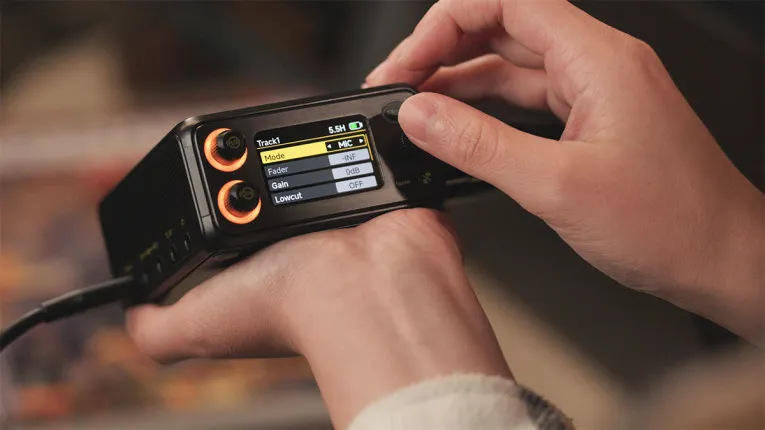
Deity PR-4 field recorder has been officially announced, entering the 32-bit recording market with a clear agenda: remove failure points from production audio rather than push sonic quality forward.
Deity Microphones is clearly targeting real-world production scenarios — interviews, documentary work, fast-paced shoots — where preventing mistakes matters more than shaving off a few dB of noise. The PR-4 is a six-track, four-input recorder with built-in automixing, dual media recording, and wireless timecode transmission, all priced aggressively at $449.
Context: the 32-bit recorder market is no longer about sound
32-bit float recording already solved clipping. That battle is over. What remains is workflow — reliability, redundancy, and speed under pressure.
Devices like Zoom F6 normalized 32-bit capture. Sound Devices MixPre-6 II refined it with better build, routing, and control. The PR-4 doesn’t compete on those terms.
It reframes the category: less control, more automation, fewer ways to fail.
Deity PR-4 field recorder features that actually matter
This isn’t about spec inflation. These are the elements that impact production:
- 32-bit float recording — eliminates gain staging errors in uncontrolled environments
- Dual ADC ReGain preamps — up to +60 dB with a stated EIN of -127 dBV
- Six tracks / four inputs — hybrid XLR/TRS and 3.5mm layout
- VoiceAware automix — prioritizes active dialogue in real time
- Dual media recording — simultaneous capture to internal SSD and SD card
- Wireless timecode master — positions the recorder as a sync hub
The spec sheet reads strong. The intent is stronger: remove risk from capture.
What’s actually new here
None of these features are new individually. The shift is in how they’re combined at this price point.
Dual recording is usually a higher-end feature. Native timecode transmission typically requires external boxes. Automix has existed, but not as a core workflow crutch in budget field recorders.
The PR-4 merges all three into a single device aimed at operators who don’t have time — or expertise — to manage audio manually.
Real-world impact on audio production workflows
In practical terms, the PR-4 changes what arrives at the mix stage, not how it sounds.
Interview production
Automix stabilizes dialogue capture. It won’t match a human mixer, but it prevents unusable takes.
Documentary recording
Dual media recording reduces catastrophic risk. Losing audio is more expensive than any sonic imperfection.
Content production
32-bit float removes constant gain monitoring — a measurable efficiency gain for solo operators.
For mixing and mastering engineers, this means fewer broken recordings — but not better ones. The quality ceiling is unchanged. The failure rate drops.
Critical limitations: where the PR-4 falls apart
The trade-offs are obvious once you step outside marketing:
- Two XLR inputs only — limits scalability in multi-mic setups
- 3.5mm connectors for outputs and timecode — weak point in professional rigs
- Automix ≠ mixing — no nuance, only approximation
- Compact interface — reduced tactile control under pressure
“This is a safety device, not a precision instrument.”
If you need control, this isn’t the tool.
Positioning: where it sits against competitors
Against Zoom F6, the PR-4 adds workflow redundancy and automation. Against Sound Devices MixPre-6 II, it loses in build quality, routing depth, and operational confidence.
This is not a MixPre competitor. It’s a replacement for lower-tier recorders used by operators who can’t afford mistakes.
Best fit: solo shooters, small crews, fast-turnaround production
Poor fit: dedicated production sound mixers, complex routing environments
Implications for mixing and mastering
From a post-production perspective, the PR-4 shifts consistency, not fidelity.
Fewer clipped takes, fewer missing recordings, fewer unusable files — that’s the gain. Tonal quality, depth, and spatial accuracy remain dependent on mic choice, placement, and environment.
That distinction matters. Because even clean capture requires controlled post-processing. In professional audio production, final results are still defined by balance, dynamics, and translation — not the recorder itself. That’s why serious workflows continue through structured finishing stages such as professional mastering refinement, regardless of capture format.
Pricing and release
- PR-4 field recorder: $449
- Cage: $59
- Field Audio Bag (Mini): $79
Pre-orders include a free bag, but pricing is the real lever. At $449, this undercuts much of the mid-tier while offering features typically reserved for higher brackets.
Verdict
The Deity PR-4 field recorder doesn’t raise the bar for sound — it lowers the risk of failure.
It replaces precision with automation, control with safeguards, and expertise with system design.
For the right user, that trade-off isn’t a compromise. It’s the entire value proposition.