Fracture Sounds Trails II Review: Is This Kontakt Library Worth It?
Fracture Sounds Trails II enters a crowded category: cinematic Kontakt libraries built around unusual instruments, processed textures, and sounds that seem production-ready before the arrangement has properly started. The question is not whether its resonant trumpet, bass clarinet, percussion, synths, and acoustic sources sound distinctive in a demo. It is whether they remain useful once a cue has to support dialogue, coexist with other instruments, survive a dense mix, and justify space in an established scoring setup.
Trails II is not trying to replace an orchestral section or provide conventional solo-instrument coverage. Its focus is narrower and more interesting. Acoustic performances are captured through resonating metal surfaces, contact microphones, and other physical interactions, then extended through granular processing and layered atmospheres. The processing is not simply placed around a clean sample after recording; it is embedded in the behavior of the source.
That gives Trails II its strongest advantage and its main limitation. A single patch can provide pitch, movement, decay, texture, and spatial character at once, which makes sparse cues develop quickly. The same complexity can become difficult to place when the arrangement is already full. Trails II works best as a source of sonic identity, not as another layer added to everything else.
Fracture Sounds Trails II at a Glance
| Developer | Fracture Sounds |
| Collaboration | Alexander Parsons |
| Format | Kontakt Player 7.6 or later |
| Core Content | 28 articulations from trumpet, bass clarinet, saxophone, synths, percussion, and resonating acoustic sources |
| Microphone Control | Four microphone mixes, including contact-mic perspectives |
| Additional Engines | Layer Blends with 19 Atmosphere Layers and granular processing with Rate control |
| NKS Support | Yes |
| Regular Price | $149 |
| Best For | Contemporary scoring, documentary, tension, experimental production, and sparse hybrid arrangements |
| Overall Rating | 8.7/10 |
Where Trails II Fits in the Modern Cinematic Library Market
 Composers no longer have a serious shortage of polished strings, brass, woodwinds, percussion, pulses, drones, or cinematic pads. The harder problem is making a score sound specific. Sample-library quality has improved across the market, but access to the same production-ready vocabulary has also made technically impressive cues easier to recognize by their ingredients.
That changes the value of a new library. Another well-recorded sustain patch may expand orchestral coverage; it rarely gives a production its own fingerprint. Trails II belongs to a different category, where composition and sound design are deliberately difficult to separate. Trumpet, bass clarinet, saxophone, synth material, and percussion are captured through physical interactions with resonating metal surfaces, including gong and thunder sheet. The resonance is part of the recorded event, not an effect wrapped around a clean sample afterward.
For contemporary scoring, that distinction is practical. A single sound may need to carry pitch, tension, movement, and environmental detail without requiring a separate stack for each function. Trails II can reach that point faster because much of the interaction between source and texture already exists inside the performance.
Rebuilding similar material from scratch is possible, but the process is rarely quick. It can involve recording or re-amping acoustic sources, finding useful resonant objects, controlling feedback and mechanical noise, then shaping the result with editing, convolution, granular processing, and automation. Trails II packages that chain into something playable. The value is not that any one technique is new; it is that the difficult part of the process has already been captured in a repeatable form.
The tradeoff is authorship. The more personality a library contributes, the more easily it can begin making aesthetic decisions for the composer. Reusing the same resonant articulations, atmosphere layers, and processing chains across several cues can create continuity, but it can also create a recognizable library fingerprint. Trails II offers enough control to push beyond its factory sound, though producers who rely on presets rather than reshaping the material will reach that limit much sooner.
How Trails II Behaves Inside a Real Arrangement
The real test of Fracture Sounds Trails II begins after the first compelling patch has been found. Many cinematic libraries are excellent at generating an opening idea; fewer remain useful when that idea has to develop into a complete cue without every new section requiring another layer.
Trails II is built around 28 articulations drawn from trumpet, bass clarinet, saxophone, synth material, and acoustic sources interacting with resonating metal surfaces. The Canna Sonora contributes a tuned percussive voice, while the dedicated percussion patch draws on waterphone, thunder sheet, gong, and cymbal interacting with a timpani head. Four microphone mixes, including contact-mic perspectives, change more than the apparent distance of the recording: they alter how much mechanical detail, resonance, and conventional instrument tone reaches the arrangement.
This is where the library separates itself from a collection of unusual samples. A trumpet-derived articulation can begin as a recognizable brass gesture, then continue as metallic decay after the note itself has stopped carrying the musical information. Bass clarinet can introduce low-mid movement without behaving like a conventional woodwind line. The percussion sources can mark a transition or increase tension without occupying the same transient space as orchestral hits or trailer drums.
Those behaviors make Trails II particularly effective when an arrangement needs motion without an obvious pulse. Instead of creating movement with another sequencer, arpeggiator, or modulation layer, the recorded source can evolve internally. Attacks give way to resonant tails, pitched material becomes less defined as it decays, and acoustic detail moves in and out of focus.
The practical advantage is arrangement economy. One well-chosen articulation can perform work that might otherwise require a playable instrument, a transition effect, and a separate atmospheric layer. That does not automatically make a cue better, but it can leave more space for dialogue, percussion, or orchestration later in the production.
Why Physical Resonance Matters More Than the Source Instruments
The unusual source list attracts attention, particularly the Canna Sonora, but Trails II is defined less by what was recorded than by what happened to the sound during recording. The recurring idea is physical excitation: an acoustic or electronic source sets another object into motion, and that resonating surface becomes part of the performance.
This behaves differently from placing delay, reverb, or saturation around a clean sample. A sympathetic object reinforces some frequencies while suppressing others, alters the apparent attack, and continues producing energy after the original gesture has begun to decay. The result has an envelope and spectral shape that would be difficult to reproduce with a single post-processing chain.
That physical behavior gives unfamiliar sounds a degree of coherence. The ear does not need to identify the instrument to recognize that something is vibrating, decaying, and interacting with a space. In contemporary scoring, that can be more useful than conventional realism: the sound remains abstract enough to avoid obvious orchestral associations while still behaving like a recorded event rather than a static synthetic layer.
The same mechanism creates the library’s most important mixing problem. Metallic resonance is spectrally selective. Narrow bands can remain active long after the initial note, upper-mid energy can become disproportionately forward, and several overlapping decays can accumulate in the low mids without producing obvious peak overload. A patch that sounds detailed in isolation may begin masking dialogue, strings, or other sustained material before the session appears technically dense.
That is primarily an arrangement problem, not an EQ problem. Cutting every resonant peak after several complex parts have been stacked can strip away the behavior that made the sounds useful in the first place. Trails II works better when one resonant element is given a clear function and enough spectral room to complete its decay, rather than being layered with several equally detailed patches and repaired later in the mix.
How Layer Blends and Granular Processing Change the Source Material
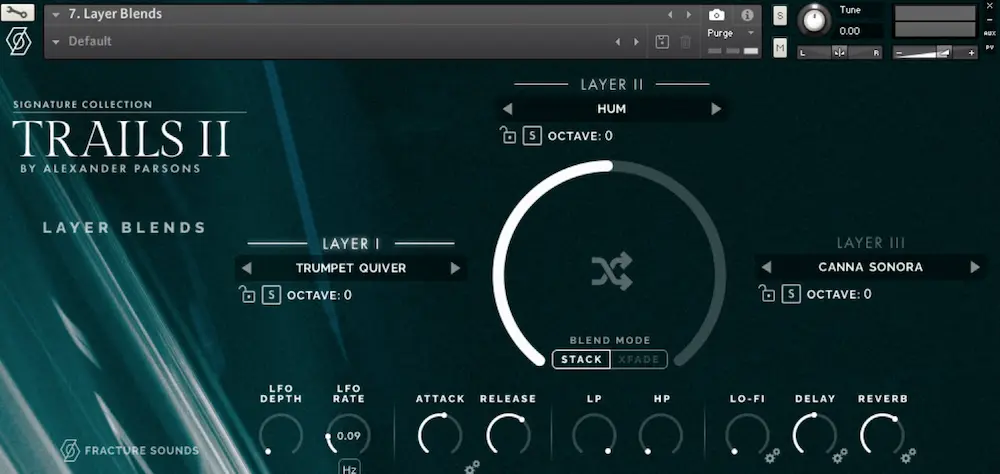
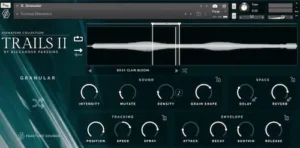
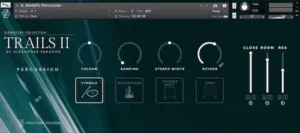 The recorded articulations are only the starting point. Trails II adds 19 Atmosphere Layers through the Layer Blends engine, while the granular section includes a Rate control for changing how quickly the underlying material is scanned and reorganized. Together, these tools determine whether the library remains a collection of recognizable performances or becomes usable as a broader source-design instrument.
That distinction affects the library’s long-term value. Characterful samples can become familiar quickly, especially when the same attack and decay profile appears across multiple cues. Layering and granular processing can obscure that fingerprint, but only when they change the function of the source rather than simply making it larger.
The granular engine is most useful for altering time scale and gesture. A short acoustic event can be stretched into sustained movement, a defined attack can be softened until the source sits behind the arrangement, or a recognizable articulation can be pushed toward texture without losing all connection to the original recording. Extreme processing is less consistently useful. Once the source becomes a diffuse granular cloud, much of the physical character that distinguishes Trails II from more conventional atmospheric libraries disappears.
The Atmosphere Layers create a different workflow problem. They can establish scale and continuity almost immediately, but a wide sustained bed beneath an already resonant articulation may occupy more of the arrangement than the session initially suggests. A similar problem appears with physics-based generative material: movement can keep producing new detail after the musical role is already complete. Add dialogue, strings, bass, percussion, or external reverb later, and the cue can run out of depth before it runs out of tracks.
The useful decision is functional: determine whether an Atmosphere Layer is part of the composition or part of the production. If it carries harmony, motion, or tension, the rest of the cue should be arranged around it. If it only adds size, it usually works better through selective automation, section changes, or printed edits than as a continuous layer running underneath the entire cue.
Where Trails II Creates Problems in Mixing and Mastering
Trails II can expose weak arrangement decisions long before there is an obvious technical fault in the mix. The difficult material is not necessarily loud or bright. It is persistent: narrow resonances continue after the note, atmospheric layers maintain average energy, and several microphone perspectives can occupy different depth cues at the same time.
Frequency buildup is usually the first consequence. A resonant articulation may contain a narrow band that seems harmless in solo because the peak is brief or musically related to the note. Once several decays overlap, the same region can remain active across an entire phrase. The cue develops hardness, nasality, or low-mid pressure even though no individual channel appears obviously excessive.
Static EQ can make this worse by removing character from the whole performance to solve a problem that exists only during certain notes or decay stages. The location of the buildup matters as well: a resonance concentrated on one side of the image is not the same problem as excess energy in the Mid or Side signal, a distinction that also shapes the stereo EQ workflow examined in our Curve Control review. Dynamic control is sometimes useful, but the cleaner fix may be earlier in the production chain: change the articulation, shorten the tail, automate the microphone balance, or remove the layer occupying the same region. Resonance is part of the sound design in Trails II; flattening it indiscriminately defeats the reason to use the library.
Depth can collapse just as easily. The four microphone mixes provide different amounts of direct tone, mechanical detail, resonance, and space. Once those perspectives are blended with Atmosphere Layers and external reverbs, a session can contain several competing ideas of distance. The result may not sound conventionally over-reverberated. Instead, the foreground loses definition because too many elements carry their own spatial information.
Mic balance is therefore an arrangement decision as much as a tonal one. Contact-heavy perspectives can bring mechanical detail forward without adding conventional brightness, while more ambient signals can push the source deeper into the cue. Leaving every perspective active because the soloed patch sounds larger usually spends depth that the full production may need later.
The final problem appears at the mix bus. Long decays and sustained atmospheres can hold substantial average energy without producing dramatic peaks. A cue may sound restrained while still feeding a dense, nearly continuous signal into compression or limiting. As peak-to-average relationships are reduced, low-level tails and background layers become more perceptually exposed, making an already crowded arrangement feel flatter and more forward.
Mastering does not create that density; it reveals how much of it was already built into the mix. The same principle applies when you prepare a mix for mastering: unresolved overlap, long tails, and unstable depth are production decisions, not problems to hand off downstream. Trails II can make a sparse sketch feel finished unusually quickly, but that apparent completeness is exactly why the arrangement needs to be checked before additional layers are added. If the cue already feels full with only a few parts, treating the remaining space as empty track count is usually the wrong decision.
Where Trails II Falls Short
The most obvious limitation is coverage. Trails II is not a substitute for a dedicated brass library, woodwind collection, percussion suite, or broad cinematic workstation. Its trumpet and bass clarinet material is valuable because of how the sources were transformed, not because the library offers deep conventional articulation sets. Producers looking to fill gaps in an orchestral template will still need other instruments.
The narrower problem is aesthetic lock-in. Metallic resonance, unstable decays, granular movement, and processed acoustic detail are not neutral colors. They naturally lean toward tension, ambiguity, fragility, isolation, and restrained forms of wonder. That range is useful, but it is still a range. A project that repeatedly needs direct melodic writing, conventional warmth, aggressive rhythmic energy, or transparent orchestration can quickly expose how specialized Trails II is.
The complexity of individual patches can also work against the arrangement. A single sound may already contain a pitched source, resonant tail, internal movement, ambience, and enough harmonic information to imply a background layer. Treating that patch like a conventional instrument and continuing to add parts around it can reduce the apparent scale of the cue. More tracks produce less depth because every element arrives with its own detail and spatial footprint.
Recognizability is another long-term concern. Strongly authored sample libraries are easiest to identify when users stop at preset selection. Trails II provides microphone control, Layer Blends, effects, and granular processing, but those options only matter if the source is actually reshaped. Repeatedly using the most immediately impressive factory articulations will make the library’s fingerprint more obvious across multiple cues.
Trails II also should not be confused with bespoke sound design. A composer with recording access, resonant objects, contact microphones, and a developed processing workflow can create material that is more specific to a project and less likely to appear in another score. What Trails II offers is different: difficult source capture made playable, repeatable, and immediately recallable inside a session. Its value is speed and consistency, not exclusivity.
Trails II vs Trails and Other Cinematic Scoring Libraries
Trails II does not have a clean one-to-one competitor. A traditional orchestral library solves a different problem, while a pure sound-design instrument usually gives up some of the playable acoustic behavior that makes Trails II useful. The relevant comparison is therefore not which library has the longest feature list, but where each one starts in the production process.
| Library | Core Approach | Best Fit | Main Tradeoff |
|---|---|---|---|
| Fracture Sounds Trails II | Acoustic and electronic sources shaped through physical metal resonance | Contemporary scoring, tension, documentary, hybrid acoustic textures | Specialized palette with a strong sonic fingerprint |
| Fracture Sounds Trails | Solo strings, Falkner Dulcichord, synth material, and granular transformation | Intimate drama, organic movement, restrained emotional scoring | Less emphasis on winds, brass, percussion, and metallic resonance |
| Native Instruments Ashlight | Granular processing built around sampled source material | Abstract textures, evolving sound design, experimental scoring | Less connection to playable acoustic performance |
| Heavyocity Mosaic Voices | Hybrid layering built around processed vocal sources | Emotional underscore, pulses, pads, and production-ready hybrid cues | More immediately tied to a vocal aesthetic |
| Spitfire Audio Albion Solstice | Large ensemble, organic instruments, and contemporary scoring textures | Building a broader score from one integrated collection | Far larger in scope, with less focus on detailed resonant-source manipulation |
The most useful direct comparison is Trails II vs Trails. The original library is centered more heavily on solo strings, the Falkner Dulcichord, synth sources, and granular transformation. Trails II moves the concept toward trumpet, bass clarinet, saxophone, percussion, and acoustic material shaped by resonating metal surfaces.
This is not a conventional sequel relationship. Trails II does not provide a newer version of the same core palette, and it does not make the original library obsolete. The first Trails remains the stronger choice for composers drawn to intimate string movement and organic melodic texture. Trails II is the more distinctive option when brass, woodwind, percussion, and metallic decay need to sit between instrumental writing and sound design.
Ashlight becomes more relevant when granular transformation itself is the priority. Mosaic Voices is a better fit when the production needs an immediately recognizable vocal center. Albion Solstice makes more sense for composers looking for a much broader scoring environment rather than a specialized source library.
Trails II is best suited to producers who are comfortable building a cue around a small number of highly authored sounds. It is a weaker purchase for anyone looking for neutral raw material, deep traditional articulation coverage, or a single Kontakt library capable of carrying an entire score. Its advantage is not breadth. It is the speed with which a specific acoustic identity can enter an arrangement.
How Trails II Translates Beyond the Studio Monitor Sweet Spot
 Sample-library demos are built to expose detail. Finished productions have to preserve hierarchy when the listener changes volume, speakers, codec, or playback environment. That translation problem is particularly important in film score mastering, where depth, low-level atmosphere, and foreground detail have to survive outside the controlled monitoring environment in which the cue was built. Trails II makes the issue more pronounced because much of its character lives in the relationship between the initial gesture and the resonance that follows it.
Playback level can change that relationship significantly. At a generous monitoring level, contact detail, metallic decay, and low-level atmosphere feel physically connected to the source. Turn the monitors down and some of that complexity recedes, leaving a smaller amount of midrange information to define the part. Low-level checks quickly reveal whether the cue still has a focal point or whether its impact depends on hearing every detail in the patch.
Small speakers expose a different imbalance. Extended low-level decays and broad atmospheric information may become less audible while persistent upper-mid resonance survives. A sound that feels deep on full-range monitors can become unexpectedly forward on a laptop, phone, or compact Bluetooth speaker. Aggressively removing that resonance is not automatically the right fix, because the same frequency information may be what keeps the part identifiable on limited playback systems.
Lossy encoding presents less of a tonal problem than a separation problem. Dense combinations of granular motion, diffuse ambience, and continuously changing high-frequency detail can lose definition when several low-level events compete for the same perceptual space. Mixing specifically for a codec is unnecessary; controlling how much information changes at once is more useful.
Streaming normalization is largely beside the point. In mastering for streaming platforms, the greater risk is often how final dynamics processing changes the relationship between foreground gestures and sustained background energy. If the mix already carries continuous atmosphere, controlling the peaks can make tails and low-level layers feel more exposed, reducing front-to-back contrast even when the master is not especially loud.
Outside cinematic scoring, Trails II is most useful when its sounds are treated as production sources rather than complete presets. Experimental electronic music can use a single resonant articulation where a conventional arrangement might stack a synth, texture, impact, and effect return. Ambient production is an obvious application, but also the easiest way to make the library sound predictable. Sparse electronic arrangements leave more room for its acoustic irregularities to remain identifiable.
Session efficiency depends on how much of the instrument is left active. Multiple microphone signals, Layer Blends, effects, and granular processing can make a patch more expensive than its apparent musical role suggests. In larger templates, unused mic perspectives should be disabled rather than merely turned down, and committed parts are often better printed once their internal movement is established. Trails II runs in Kontakt Player 7.6 or later, so the full version of Kontakt is not required; the more relevant limitation is how many fully loaded, continuously evolving patches a session actually needs to keep live.
Trails II Pros and Cons
| Pros | Cons |
|---|---|
| Physical resonance gives the source material a distinctive acoustic identity | Too specialized to replace a broader cinematic or orchestral library |
| Complex patches can replace several conventional production layers | Resonant tails and sustained textures can create mix density quickly |
| Four microphone mixes provide meaningful control over detail and depth | The strongest factory sounds may become recognizable across multiple cues |
| Layer Blends and granular processing extend the useful life of the recorded material | Its aesthetic range favors tension, ambiguity, and atmospheric scoring |
| Runs in the free Kontakt Player and supports NKS | Producers needing conventional articulation depth will still need other libraries |
Verdict: Is Fracture Sounds Trails II Worth It?
Trails II is a strong purchase for composers who need playable acoustic material with sound design already embedded in the performance. Physical resonance is the reason to buy it. The trumpet, bass clarinet, percussion, and other sources matter because of how they excite, interact with, and decay through resonating objects—not because the library offers broader instrument coverage than its competitors.
For documentary work, contemporary media scoring, experimental production, and sparse hybrid arrangements, that approach can remove several stages from the workflow. A useful part can arrive without building separate chains for re-amping, resonant processing, transitional effects, and atmospheric support. When deadlines are short, that compression of the production process has real value.
The case is weaker for composers who need conventional articulations, neutral source material, or a single library with enough range to carry an entire score. It is also less essential for producers who already record their own acoustic sources and have a mature custom sound-design workflow. In that environment, Trails II offers faster recall and consistent results, but not the project-specific identity of original recording.
The final decision comes down to how you arrange. If your cues are built from a few characterful elements with clearly defined roles, Trails II can contribute a sound that is difficult to reach quickly with standard sample libraries. If your workflow depends on stacking many production-ready patches until the arrangement feels large, its strongest qualities will turn into masking, reduced depth, and a recognizable library fingerprint. Trails II is not broad enough to be essential, but within the workflow it was designed for, it is unusually well focused.
Overall Rating
| Category | Rating |
|---|---|
| Sound Quality | 9.5/10 |
| Production Workflow | 9/10 |
| Mix Translation | 8.5/10 |
| Sound Design Flexibility | 8.5/10 |
| Scoring Versatility | 7.5/10 |
| Long-Term Value | 8.5/10 |
| Overall | 8.7/10 |
Trails II earns its highest score for sound quality because the resonance is part of the recorded performance rather than an effect placed around a conventional sample. The source material retains mechanical detail, irregular decay and a physical relationship between the instrument and the resonating object. That gives the library an acoustic coherence that is difficult to reproduce with a standard effects chain.
Production Workflow — 9/10. Trails II can replace several separate production stages with one playable source. A patch may already provide the instrumental gesture, internal movement, transition and atmospheric tail needed for a cue. The score stops short of 10 because that efficiency depends on restraint: the same production-ready complexity can make an arrangement dense before the track count suggests there is a problem.
Mix Translation — 8.5/10. The library can translate well when resonant parts are given defined roles, but it is not automatically easy to mix. Narrow spectral buildup, persistent upper-mid energy, long decays and multiple depth cues can become more obvious on small speakers or after final dynamics processing. These are manageable problems, but they require more attention than neutral source material.
Sound Design Flexibility — 8.5/10. Four microphone mixes, Layer Blends, 19 Atmosphere Layers and granular processing provide enough control to move beyond the factory articulations. The limitation is that extreme transformation can erase the physical resonance that makes Trails II distinctive in the first place. Its flexibility is strongest inside its own aesthetic rather than across every form of cinematic sound design.
Scoring Versatility — 7.5/10. This is the clearest compromise. Trails II is highly effective for tension, documentary, psychological drama, experimental production and restrained hybrid scoring, but its palette is too specific to function as a general-purpose cinematic library. It complements a broader template rather than replacing one.
Long-Term Value — 8.5/10. The library has more depth than a preset-driven texture collection, and producers who reshape mic balances, layers and granular behavior should get substantial use from it. The score is held back by the risk of a recognizable sonic fingerprint when the most immediate factory sounds are reused without modification.
Overall: 8.7/10. Trails II is not a broad scoring solution, and that is exactly why the rating should not be inflated. Its value comes from doing one difficult thing unusually well: turning physically resonant acoustic material into a playable production instrument. For composers who build cues from a few characterful elements, it is a focused and technically convincing library. For producers who need neutral coverage or rely on dense preset stacking, its limitations will appear much sooner.

Yurii Ariefiev is a mastering engineer and audio production editor whose work focuses on how complex source material behaves beyond the soloed track. His technical analysis covers resonant textures, arrangement density, spatial depth and the way production choices change during mixing, mastering and real-world playback.
This Trails II review evaluates the library as a working production instrument: how its acoustic resonance, microphone perspectives, granular processing and sustained layers affect arrangement decisions, mix translation and final dynamics processing.
Fracture Sounds Trails II FAQ
Does Trails II require the full version of Kontakt?
No. Trails II runs in the free Kontakt Player 7.6 or later, so the full version of Kontakt is not required. Installation and authorization are handled through Native Access.
What is the difference between Trails II and the original Trails?
The original Trails is centered more on solo strings, the Falkner Dulcichord, synth material, and granular textures. Trails II shifts toward trumpet, bass clarinet, saxophone, percussion, and acoustic sources interacting with resonating metal surfaces. They cover different palettes rather than serving as old and new versions of the same library.
Can Trails II replace a traditional brass or woodwind library?
No. Its brass and woodwind sources are designed for resonance, texture, and hybrid scoring rather than detailed orchestral performance. Producers who need conventional articulation coverage will still need dedicated instrument libraries.
Is Trails II NKS compatible?
Yes. Trails II supports NKS, which makes preset browsing and hardware integration more practical for users working inside compatible Native Instruments setups.
How demanding is Trails II on CPU and RAM?
Performance depends on the patch, active microphone signals, effects, Layer Blends, and granular processing. In large scoring templates, disabling unused mic perspectives and printing finished parts will reduce unnecessary session load.
Can Trails II be used without additional effects?
Yes. Many patches already contain substantial movement, resonance, spatial information, and processing. External effects are most useful when they give several elements a shared production context rather than simply making an individual patch larger.
Is Trails II useful outside film and television scoring?
Yes. Its source material fits experimental electronic music, ambient production, game audio, dark pop, and sparse hybrid arrangements. It is less useful when the production requires neutral or conventionally realistic instrument playback.
What are the closest alternatives to Trails II?
The original Trails is the closest choice for a related acoustic-granular concept with more emphasis on strings. Native Instruments Ashlight goes further into granular sound design, while broader scoring collections such as Spitfire Audio Albion Solstice provide much greater ensemble coverage but solve a different production problem.
Is Trails II worth buying if I already own several cinematic texture libraries?
Only if physical resonance and playable acoustic transformation fill a genuine gap in your setup. Producers who already own many drones, pads, and atmospheric presets should not buy Trails II simply for more texture; its value lies in the behavior of the recorded sources.
Does Trails II require special treatment during mixing and mastering?
No special process is required, but its long resonances and sustained layers make arrangement density more important. If too many complex patches overlap, compression and limiting can expose background energy and reduce depth. The better fix is usually in the arrangement or mix rather than the mastering chain.
How much does Fracture Sounds Trails II cost?
Trails II has a regular price of $149. Fracture Sounds may offer temporary launch discounts, bundle pricing, or personalized upgrade offers for existing customers, so the current checkout price can vary.