Reference tracks have become an essential part of modern mixing and mastering, but the workflow around them is often inefficient. Engineers still switch between media players, browser windows, metering software, and DAW sessions just to compare a mix against commercial releases. Every interruption breaks concentration and makes critical listening less objective.
Ninja AB is designed to eliminate that friction by keeping reference management, loudness-matched playback, and instant A/B comparison inside the DAW. The idea isn’t revolutionary—plugins like Magic AB, ADPTR Metric AB, and Mastering The Mix REFERENCE have served this role for years. The question is whether Ninja AB delivers a faster, cleaner workflow that justifies its place alongside established tools.
Rather than reviewing specifications in isolation, this article evaluates how Ninja AB performs during real mixing and mastering sessions, where reference management, critical listening, and translation have a measurable impact on production decisions. We’ll examine how Ninja AB fits into real-world production workflows, where it improves decision-making during mixing and mastering, where competing solutions still offer an advantage, and which type of engineer is most likely to benefit from adding it to their daily workflow.
Testing Methodology
This review evaluates Ninja AB from a production workflow perspective rather than a feature checklist. The plugin was assessed during real-world mixing and mastering sessions involving commercial pop, rock, electronic, and Hip-Hop productions, with particular attention paid to translation, critical listening, long-session usability, and comparison speed.
Contents
| Developer | The Him DSP |
|---|---|
| Plugin Type | Reference Track Management & A/B Comparison Plugin |
| Formats | VST3, AU, AAX, CLAP |
| Operating Systems | Windows & macOS |
| Primary Use | Reference Mixing, Mastering, Critical Listening, Mix Translation |
| Best For | Mix Engineers, Mastering Engineers, Producers |
| Trial | Available from the developer |
| CPU Load | Very Low |
| Current Version | Initial Release |
| License | Commercial |
| Activation | Developer Account |
| Category | Reference Plugin |
Review Summary
Bottom Line:
Ninja AB is one of the most workflow-focused reference plugins currently available. Instead of competing through feature count, it prioritizes rapid comparison, organized reference management, and uninterrupted critical listening.
Best For:
Professional mastering engineers, mixing engineers, producers and studios that reference commercial releases throughout every project.
Not Ideal For:
Users looking for an all-in-one analysis environment with integrated loudness, spectrum, stereo, and codec diagnostics.
Recommended If:
You compare commercial references throughout every mix or master and want a faster, more organized reference workflow without replacing your existing metering tools.
What Makes Ninja AB Different from Traditional Reference Plugins
Most reference plugins solve the same basic problem: playing commercial releases inside the DAW without constantly switching to an external media player. Ninja AB starts from that familiar concept but expands it into a workflow designed around decision-making rather than simple playback. Instead of treating references as static audio files, it organizes comparisons as part of an active production session, reducing the number of manual steps required to evaluate every significant processing move.
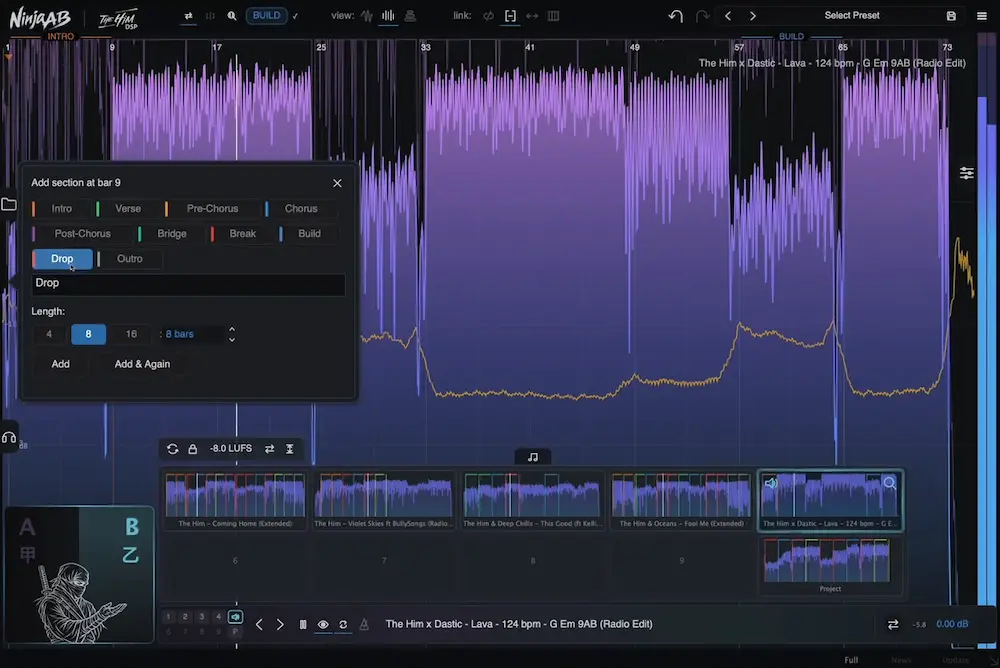
One of its most distinctive ideas is section-based synchronization. Traditional reference workflows often compare an entire commercial release against an entire mix, forcing engineers to manually locate matching verses, choruses, drops, or breakdowns every time they switch tracks. Ninja AB stores section markers as reference metadata, allowing comparable moments to remain synchronized throughout the session. That may sound like a small convenience, but it dramatically shortens repetitive navigation during long projects.
This approach also changes the quality of comparisons. Instead of evaluating unrelated musical passages, engineers can jump directly between equivalent sections where arrangement density, instrumentation, and energy are comparable. A chorus is evaluated against another chorus, a breakdown against another breakdown, making judgments about vocal balance, transient control, stereo image, or low-frequency energy considerably more reliable.
Another practical addition is live project capture. Rather than relying exclusively on imported commercial references, Ninja AB can capture snapshots of the current project while production is still in progress. That creates a useful timeline of mix development, making it easier to compare today’s decisions against earlier revisions without exporting multiple temporary files or maintaining a collection of offline bounce versions.
For engineers working through several client revisions, this becomes more valuable than it initially appears. It allows important milestones to remain accessible inside the same reference browser, reducing the need to manage dozens of exported mix versions scattered across project folders.
The plugin also introduces a structured reference timeline where saved comparison points remain attached to individual projects instead of existing as temporary playback positions. Combined with stored section metadata, this encourages referencing to become a continuous part of the production process rather than an occasional reality check before mastering.
Listening tools receive similar attention. Loudness matching removes much of the psychological bias that naturally favors louder material, while dedicated audition filters—including band-pass, high-pass, and low-pass modes—allow engineers to isolate specific frequency regions during comparison. Those filters are particularly useful when evaluating vocal intelligibility, low-frequency interaction, or high-frequency harshness without allowing the full mix to dominate perception.
Mid/Side and Mono monitoring further expand critical listening options. Instead of evaluating only the stereo master, engineers can quickly inspect center information, side energy, or mono compatibility while moving between references. This is especially useful when judging stereo width, ambience, and center stability during mastering, where small spatial changes often influence translation more than additional processing.
Visual feedback complements rather than replaces listening. Ninja AB includes waveform overview displays that simplify navigation without encouraging engineers to mix with their eyes. Peak, RMS, PSR, and LUFS matching provide objective context when needed, but the workflow consistently returns attention to listening instead of prolonged meter interpretation.
Compatibility is equally comprehensive. Native support for VST3, AU, AAX, and CLAP formats allows the plugin to integrate into virtually any modern production environment, whether the session is built around a traditional DAW, a hybrid mastering workstation, or a modular plugin ecosystem.
Taken together, these features position Ninja AB differently from earlier generations of reference plugins. Its strongest contribution isn’t a single headline feature but the way section synchronization, live capture, organized reference metadata, loudness matching, and streamlined navigation reduce the time between making a processing decision and verifying whether it actually improves the mix. That emphasis on continuous evaluation aligns well with modern mixing and mastering, where consistency and translation usually matter more than dramatic processing.
Why Fast Reference Comparison Has Become a Core Mixing and Mastering Tool
Reference listening has evolved from a final quality check into a routine part of modern production. Today’s sessions are larger, revision cycles are longer, and releases are expected to translate across studio monitors, headphones, smartphones, Bluetooth speakers, cars, and streaming platforms. Engineers are no longer judging a mix for a single playback environment—they’re optimizing it for dozens.
That shift makes objective listening harder than it was a decade ago. After several hours on the same session, auditory adaptation becomes unavoidable. Low-end balance starts to feel natural even after drifting by a decibel or two. A vocal that initially felt too aggressive gradually settles into the mix simply because the ear has adjusted. Switching to a well-chosen commercial reference interrupts that adaptation and immediately exposes decisions that no longer hold up.
The effect becomes even more pronounced during mastering, where changes are intentionally subtle. A broad EQ move of less than 1 dB or a small adjustment to the limiter can alter translation without sounding dramatic inside the control room. Comparing those changes against trusted references provides context that meters alone cannot offer.
AI-assisted production has added another layer to the equation. Many AI-generated mixes achieve respectable tonal balance while falling short in transient definition, front-to-back depth, stereo organization, or dynamic contrast. Those weaknesses are often easier to hear through immediate A/B comparison than through spectrum analysis or loudness measurements. That becomes even more relevant when working with locally generated AI productions, as discussed in our OBSIDIAN Neural Local Edition review.
Streaming has also changed the way engineers evaluate finished mixes. Loudness normalization has reduced the advantage of mastering purely for maximum level. Decisions now revolve around perceived punch, vocal intelligibility, low-frequency control, and how consistently a mix translates after platform processing. Fast, level-matched comparison is one of the quickest ways to validate those decisions before a release reaches listeners.
This is why reference plugins continue to gain relevance despite an already competitive market. Their value isn’t limited to playing commercial tracks inside a DAW. They shorten the feedback loop between processing and critical evaluation, allowing engineers to make faster, more confident decisions throughout the entire mixing and mastering process.
Beyond the Feature List: How Ninja AB Fits into a Professional Workflow
 Ninja AB isn’t trying to reinvent reference monitoring. Its purpose is far more practical: eliminate the interruptions that break critical listening. Instead of relying on external players or separate applications, engineers can switch between multiple commercial references and the active mix without leaving the DAW. That may sound like a minor convenience, but during long sessions it changes how often references are actually used.
Frequent comparison matters because critical listening degrades over time. Every interruption—opening another application, matching playback levels, searching for a reference track, or navigating playlists—creates just enough friction for engineers to postpone the next comparison. The longer that comparison is delayed, the greater the risk of making tonal or dynamic decisions in isolation.
Speed alone, however, has little value if comparisons aren’t level matched. Loudness bias remains one of the most persistent problems in audio production. A mix that’s even slightly louder will usually appear clearer, punchier, and more detailed regardless of whether it has actually improved. Any serious reference plugin succeeds or fails on its ability to remove that variable from the evaluation process.
That’s where Ninja AB delivers its greatest practical benefit. By making loudness-matched A/B comparison nearly instantaneous, it shifts attention away from playback level and back to the decisions that define a professional mix: tonal balance, transient control, stereo imaging, depth, and overall translation.
The questions become far more specific than simply asking whether the reference sounds better.
- Does the vocal sit at a comparable depth without relying on excessive compression?
- Is the low end controlled, or is the kick masking the bass guitar?
- Are cymbals adding clarity instead of fatigue?
- Does the stereo image remain stable as the arrangement becomes denser?
- Has limiting reduced punch compared to the reference?
Those comparisons produce actionable information. Experienced engineers rarely chase identical tonal curves; they compare relationships between elements. How far forward is the vocal? How much transient energy survives bus compression? Is ambience creating depth or simply filling empty space? Those questions are difficult to answer with analyzers alone, regardless of how sophisticated the metering becomes.
Reference management also becomes more effective when multiple tracks serve different purposes. One reference may define low-frequency control, another vocal presentation, another transient impact, while a fourth demonstrates how dense arrangements retain separation under heavy limiting. Treating every commercial release as a universal benchmark usually creates conflicting objectives instead of better mixes.
This reflects a broader shift in mastering. Modern mastering is increasingly focused on validation rather than correction. Well-balanced mixes often require only incremental EQ, dynamics, or limiting adjustments before release. If you’re interested in how those decisions fit into a complete professional workflow, see our guide to how professional mastering actually works. At that stage, reliable comparison is often more valuable than adding another processor to the signal chain because it confirms whether each adjustment genuinely improves translation. Once those decisions are validated, processors such as tube saturators can be used far more effectively, as explored in our UAD Black Box HG-2 review.
Ninja AB doesn’t improve audio quality on its own, and that’s worth emphasizing. It improves the quality of decisions. Better comparisons reduce second-guessing, shorten revision cycles, and help engineers identify problems earlier, when they’re still inexpensive to fix.
Whether it replaces an existing reference plugin depends less on specifications than on execution. Engineers don’t keep reference tools because they offer the longest feature list—they keep the ones that become invisible during a session. The less attention a plugin demands, the more often it’s used, and consistent referencing almost always leads to better long-term results than occasional, end-of-session reality checks.
Where Ninja AB Adds Real Value—and Where It Doesn’t
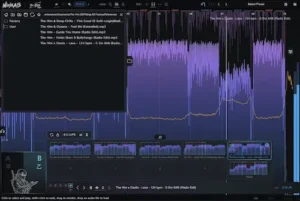 Reference plugins occupy an unusual place in a mixing or mastering chain because they never touch the audio itself. Unlike an EQ, compressor, or limiter, they don’t solve production problems directly. Their only job is to improve the quality of the decisions made around those processors. That distinction matters because it’s easy to mistake a smoother workflow for better results.
Ninja AB’s strength isn’t that it changes the sound—it’s that it encourages more frequent, more consistent referencing. Engineers who compare against commercial releases throughout a session are far less likely to drift into tonal imbalance, excessive limiting, or unnecessary processing than those who wait until the final export.
The benefit becomes obvious during long sessions. Auditory adaptation gradually resets expectations, making small tonal shifts feel normal. A vocal can creep forward, low-end energy can accumulate, or transient impact can soften without immediately drawing attention. A properly level-matched reference breaks that cycle and restores perspective within seconds.
None of this compensates for inaccurate monitoring. If the room exaggerates bass, speakers have uneven frequency response, or headphones don’t translate reliably, faster comparison simply reinforces incorrect decisions. Reference plugins improve judgment, but they can’t correct flaws in the monitoring environment.
Another mistake is treating commercial releases as templates instead of benchmarks. Reference tracks should provide context, not a destination. Copying another mix’s tonal balance without considering arrangement, instrumentation, or production style usually creates new problems rather than solving existing ones.
A sparse singer-songwriter production, for example, shouldn’t chase the density or loudness of a modern EDM master. Effective referencing focuses on transferable qualities—vocal intelligibility, low-frequency control, stereo stability, depth, and transient clarity—while allowing each production to retain its own identity.
The same discipline applies to reference selection. More tracks rarely produce better decisions. A small library of carefully chosen references, each representing a specific production characteristic, is generally more useful than scrolling through dozens of commercially successful releases with conflicting sonic signatures.
Ninja AB also takes a deliberately focused approach compared to reference plugins that combine playback with advanced metering, spectrum analysis, stereo visualization, loudness history, and codec simulation. Whether that’s a limitation or an advantage depends entirely on the engineer’s workflow.
Many experienced mix and mastering engineers prefer reference tools that stay out of the way. They already rely on dedicated metering suites and simply want instant, reliable comparison without adding another screen full of graphs. Others may prefer an all-in-one environment where playback, measurement, and diagnostics live inside a single plugin.
The most important point is also the easiest to overlook: no reference plugin improves a mix on its own. Better references don’t create better masters—better decisions do. Ninja AB shortens the distance between hearing a problem and recognizing it, but the engineering judgment still belongs to the person behind the monitors.
Ninja AB vs. the Competition: Which Reference Plugin Fits Your Workflow?
Choosing a reference plugin is no longer about finding software that can play commercial tracks inside a DAW. Every established product in this category handles that task well. The real differences come down to speed, listening workflow, analysis tools, and how much visual feedback an engineer wants during a session.
Ninja AB enters a market already shaped by products such as ADPTR Metric AB, Magic AB, and Mastering The Mix REFERENCE. Rather than competing on feature count alone, it takes a more focused approach by reducing the friction between making a processing decision and validating it against a trusted commercial reference.
| Plugin | Primary Strength | Best Fit | Trade-Off |
|---|---|---|---|
| Ninja AB | Fast, distraction-free A/B referencing | Mixing and mastering engineers focused on listening rather than visual analysis | Less comprehensive metering than dedicated analysis suites |
| ADPTR Metric AB | Advanced metering, loudness, spectrum, stereo, and dynamics analysis | Engineers who rely on extensive visual verification during mastering | More complex interface and a slower learning curve |
| Magic AB | Simple reference playback with minimal setup | Mix engineers looking for a lightweight comparison tool | Limited analytical functionality |
| Mastering The Mix REFERENCE | Translation analysis and guided mix diagnostics | Producers who want objective feedback throughout production | Less streamlined for rapid A/B comparison |
Ninja AB vs ADPTR Metric AB
ADPTR Metric AB remains one of the most comprehensive reference plugins available, combining reference playback with loudness analysis, spectrum comparison, stereo imaging, dynamics metering, and detailed visual feedback. It’s designed for engineers who want technical verification alongside critical listening.
Ninja AB follows a different philosophy. Rather than consolidating every analysis tool into a single interface, it focuses on reducing the time between making a processing decision and validating it against commercial references. Engineers who already work with dedicated metering plugins may find that separation more efficient because it keeps reference listening independent from technical analysis.
If your workflow revolves around visual confirmation, ADPTR Metric AB remains the stronger choice. If your priority is uninterrupted critical listening with minimal interface complexity, Ninja AB offers the faster workflow.
Ninja AB vs Magic AB
Magic AB established the idea that reference comparison should be simple, immediate, and integrated into the DAW. Ninja AB builds on that concept by expanding reference organization instead of fundamentally changing the listening process.
Section-based synchronization, reference metadata, project timelines, and live project capture reduce manual navigation during long sessions. Engineers who reference commercial material dozens of times while mixing are likely to notice those workflow improvements far more than occasional users.
For straightforward A/B playback, both plugins accomplish the task well. Ninja AB distinguishes itself by making reference management scale more naturally across larger projects and revision-heavy workflows.
Ninja AB vs Mastering The Mix REFERENCE
Mastering The Mix REFERENCE approaches the problem from a diagnostic perspective. In addition to playback comparison, it highlights translation issues, tonal balance, stereo width, dynamics, and frequency relationships through guided visual analysis.
Ninja AB is intentionally less prescriptive. Instead of identifying potential mix problems, it provides a faster environment for engineers to identify those issues through disciplined listening and comparison against trusted commercial releases.
Neither philosophy is inherently better. Engineers developing their critical listening skills may appreciate the additional guidance offered by REFERENCE, while experienced professionals often prefer a workflow that minimizes visual distractions and returns attention to the monitors as quickly as possible.
Choosing between these plugins is less about feature count than production style. Studios built around comprehensive analysis may naturally gravitate toward ADPTR Metric AB or REFERENCE. Engineers who already trust their monitoring chain and want faster reference comparison without unnecessary interface complexity are the audience Ninja AB is clearly designed for.
Who Is Ninja AB Actually For?
Not every engineer approaches reference listening the same way, which is why there’s no universally “best” reference plugin. Ninja AB is designed for users who already understand the value of commercial references and want to make that process faster, more consistent, and easier to integrate into every session. Whether it’s the right choice depends far more on your workflow than on your experience level.
Professional Mastering Engineers
Mastering engineers are likely to benefit the most. Their work often involves dozens of subtle decisions where translation matters more than dramatic processing. Rapid section-based comparison, loudness-matched playback, and organized reference management make it easier to verify tonal balance, transient integrity, stereo image, and dynamics throughout the session. Engineers already using dedicated metering suites will probably appreciate Ninja AB’s focused approach instead of expecting another all-in-one analysis environment.
Mix Engineers
For mix engineers, Ninja AB encourages a habit that’s often neglected until the final export: continuous referencing. Instead of checking commercial releases only after the mix feels finished, comparisons become part of the decision-making process itself. Vocal balance, kick-to-bass relationship, stereo width, ambience, and bus processing can all be evaluated before problems become expensive to fix.
Bedroom Producers
Home studios rarely provide perfect monitoring conditions. Room modes, untreated reflections, and headphones with exaggerated frequency response make objective listening difficult. Ninja AB doesn’t solve those acoustic limitations, but frequent comparison against trusted commercial releases helps reveal decisions influenced by the monitoring environment rather than by the mix itself.
EDM and Electronic Music Producers
Electronic productions place exceptional demands on low-end consistency, transient impact, stereo width, and loudness. Reference comparison becomes particularly valuable when balancing sub-bass, controlling limiting, or evaluating how dense arrangements maintain clarity at release level. Comparing equivalent drops and breakdowns instead of entire songs makes workflow considerably more efficient.
Hip-Hop and Trap Producers
Hip-Hop and Trap productions benefit from disciplined referencing because small changes in 808 balance, vocal presence, or transient control dramatically influence playback on phones, cars, and streaming platforms. Immediate A/B comparison helps prevent excessive sub-bass buildup, harsh upper mids, or vocal masking before mastering begins.
Post-Production and Film Audio
Ninja AB is less essential for traditional dialogue editing or film mixing, where references often serve different purposes than in music production. It can still be useful when comparing alternate versions, trailers, or music-driven content, but engineers working primarily with loudness compliance and broadcast specifications may place greater value on comprehensive metering platforms.
Podcast Production
Podcast editors generally have fewer reasons to invest in a dedicated reference plugin unless they regularly compare multiple production styles or maintain consistent sound across an entire series. For spoken-word content, loudness compliance and dialogue intelligibility typically remain higher priorities than detailed music referencing.
Ultimately, Ninja AB delivers the greatest value to engineers who already reference commercial releases throughout the creative process. If references are only opened once, immediately before exporting the final master, much of the plugin’s workflow advantage disappears. Its strength lies in making critical listening frequent enough that better decisions become part of the session rather than the final quality check.
Who May Not Need Ninja AB
If commercial reference tracks are only opened once, immediately before exporting the final mix, Ninja AB is unlikely to transform your workflow. Engineers who depend primarily on integrated metering, spectrum analysis, codec simulation, and loudness diagnostics may receive greater value from comprehensive analysis suites instead of a dedicated reference plugin.
Reference Listening in Practice: Why Translation Matters More Than Tonal Matching
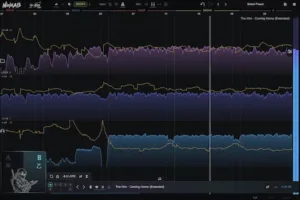 A common mistake is treating reference tracks as tonal templates. Experienced mix and mastering engineers use them for something far more valuable: verifying translation. A successful commercial release isn’t defined by its EQ curve or loudness—it proves that thousands of production decisions continue to hold up across different playback systems.
That changes the purpose of Ninja AB. The goal isn’t to decide whether a commercial release sounds better than your mix. It’s to understand why it translates consistently on studio monitors, headphones, car stereos, Bluetooth speakers, smartphones, and streaming services while your mix may not.
Low-frequency balance is often the first area where immediate A/B comparison exposes weaknesses. Sub-bass that feels controlled in a treated control room can disappear on consumer earbuds, while excessive energy around the kick and bass relationship may overwhelm smaller playback systems. Switching to a trusted reference quickly reveals whether those decisions translate outside the studio.
Vocal placement is another area where references outperform visual analysis. Commercial mixes rarely stand out because the vocal is simply louder. More often, the vocal remains intelligible because frequency balance, dynamics, ambience, and automation work together without excessive masking. Those relationships are easier to hear through direct comparison than to identify on a spectrum analyzer.
Stereo imaging deserves the same discipline. Chasing maximum width often weakens center focus, reduces mono compatibility, and creates an unstable phantom image. Referencing provides perspective on how much width the arrangement actually supports instead of encouraging increasingly aggressive stereo processing.
Mastering decisions benefit from the same approach. Limiting can create an immediate impression of greater impact, yet repeated comparison frequently reveals softened transients, reduced punch, or increased listener fatigue. Proper loudness matching removes much of that psychological bias, allowing dynamics to be evaluated on their own rather than through differences in playback level.
Streaming delivery has made this process even more relevant. With loudness normalization now standard across major platforms, competitive mastering is no longer defined by maximum level. Translation, clarity, transient integrity, and tonal balance consistently have a greater influence on listener experience than another decibel of loudness. We cover this in more detail in our mastering for streaming platforms guide.
Reference plugins cannot predict how every streaming platform or codec will affect a mix, but they make it easier to judge whether production choices remain convincing after normalization and data compression. Lossy codecs, for example, often expose brittle cymbals, exaggerated upper-midrange energy, unstable ambience, or blurred stereo information that may go unnoticed inside the DAW.
From a technical standpoint, Ninja AB is easy to leave active throughout an entire project. Unlike oversampled processors, convolution reverbs, or linear-phase mastering tools, reference management has minimal impact on CPU resources, allowing comparison to become part of the normal production process instead of a final quality-control step.
Its biggest contribution, however, is behavioral rather than technical. The easier it becomes to reference commercial material, the more often engineers actually do it. Short, frequent comparisons keep a mix anchored to an objective benchmark, reducing the gradual drift that naturally develops during long sessions. Over time, that habit has a greater impact on mix quality than any single feature inside the plugin.
Verdict
Ninja AB succeeds by focusing on a single task instead of trying to become another all-in-one mastering utility. It makes reference comparison faster, reduces interruptions, and encourages engineers to check their work more often—three small improvements that can have a measurable impact over the course of a long mixing or mastering session.
That focus also defines its limitations. Engineers who depend on detailed loudness analysis, spectrum overlays, stereo imaging, and advanced metering will still find more complete solutions elsewhere. Ninja AB works best as a dedicated reference tool, not as a replacement for a full mastering analysis suite.
For experienced engineers, that’s arguably the right design choice. Critical listening improves through repetition, not through adding more graphs to the screen. If your workflow already includes reliable monitoring and dedicated metering, Ninja AB integrates naturally by shortening the gap between making a processing decision and validating it against trusted commercial releases.
For engineers who already rely on commercial references as part of every session, Ninja AB is one of the strongest workflow-focused plugins released in recent years. It doesn’t replace mastering processors, analyzers, or experience—it simply makes objective listening fast enough that engineers are more likely to reference consistently throughout the production process. That behavioral change alone can have a greater impact on finished mixes than adding another processor to the mastering chain.
Overall Rating
| Category | Rating |
|---|---|
| Reference Workflow | 9.8/10 |
| Listening Efficiency | 9.7/10 |
| Mix Translation Support | 9.5/10 |
| CPU Efficiency | 10/10 |
| Analysis Features | 8.5/10 |
| Value for Money | 9.3/10 |
| Overall | 9.4/10 |
Reference Workflow — 9.8/10.
Ninja AB excels at reducing friction during critical listening. Fast switching, integrated reference management, and reliable loudness-matched comparison encourage engineers to reference more frequently instead of treating it as a final quality-control step.
Listening Efficiency — 9.7/10.
The plugin stays out of the way and keeps attention on listening rather than interface management. That simplicity becomes increasingly valuable during long mixing and mastering sessions, where uninterrupted decision-making often matters more than additional features.
Mix Translation Support — 9.5/10.
Ninja AB doesn’t improve translation directly, but it makes translation problems easier to identify before a project reaches release. Used consistently, it helps expose tonal imbalance, stereo issues, transient loss, and excessive limiting far earlier in the workflow.
CPU Efficiency — 10/10.
Resource usage is effectively negligible in modern production environments. The plugin can remain active throughout an entire session without influencing system performance, even alongside demanding mastering processors.
Feature Depth — 8.5/10.
The streamlined design is intentional rather than restrictive. Engineers looking for integrated spectrum analysis, loudness history, codec simulation, or advanced metering will still need dedicated analysis tools. Ninja AB focuses on one task and executes it well.
Value for Money — 9.3/10.
For engineers who reference commercial releases throughout every project, the workflow improvements can easily justify the investment. The value comes from better decisions, fewer revisions, and more consistent mixes—not from adding another processor to the signal chain.
Ninja AB is one of the strongest dedicated reference plugins currently available for engineers who prioritize fast decision-making over feature-heavy analysis. Rather than replacing mastering processors or metering suites, it strengthens the evaluation stage of mixing and mastering—the point where small decisions often determine whether a track translates successfully outside the studio.
Why 9.4/10?
Ninja AB earns its score by focusing on execution rather than feature count. While it deliberately avoids becoming a comprehensive mastering analysis suite, its combination of section-based synchronization, rapid loudness-matched comparison, negligible CPU usage, and efficient reference management makes it one of the most refined dedicated reference plugins currently available.
Pros & Cons
| Pros | Cons |
|---|---|
|
|
Most competing products attempt to combine reference playback with increasingly complex analysis environments. Ninja AB takes the opposite approach, prioritizing listening efficiency over interface density—a design choice that will appeal more to experienced engineers than to users seeking guided diagnostics.
FAQ
Is Ninja AB better suited for mixing or mastering?
It works well in both stages. During mixing, it helps evaluate tonal balance, stereo imaging, vocal placement, and low-end control against commercial references. During mastering, it becomes a fast validation tool for translation, dynamics, and final tonal decisions.
Is Ninja AB worth buying if you already own ADPTR Metric AB?
Not entirely. Ninja AB focuses on fast, distraction-free reference comparison, while ADPTR Metric AB combines referencing with advanced loudness, spectrum, stereo, and dynamics analysis. The better choice depends on whether your workflow prioritizes listening speed or technical diagnostics.
Does Ninja AB improve mix translation?
Indirectly. It doesn’t change the audio, but it makes translation problems easier to identify before a mix is finalized. Better decisions—not the plugin itself—lead to more consistent playback across different listening systems.
How many reference tracks should professionals use?
Most engineers rely on three to six carefully selected references. Each should represent a different production characteristic, such as vocal balance, low-frequency control, transient impact, stereo width, or overall depth.
Should reference tracks be loudness matched?
Absolutely. Even small level differences influence perception. Without loudness matching, a louder reference will usually appear clearer, punchier, and more detailed regardless of its actual mix quality.
Can Ninja AB replace dedicated metering plugins?
No. Reference comparison and technical metering solve different problems. Loudness compliance, phase correlation, stereo analysis, and broadcast specifications still require dedicated measurement tools.
Is Ninja AB useful in a home studio?
Yes. Home studios often have imperfect monitoring conditions, making objective comparison even more valuable. A consistent set of trusted reference tracks can reveal tonal imbalances that room acoustics may disguise.
Does Ninja AB use significant CPU resources?
No. Reference playback and A/B switching require relatively little processing power compared to oversampled dynamics processors, convolution reverbs, or linear-phase EQs, making the plugin practical to leave active throughout an entire session.
Can Ninja AB help optimize mixes for Spotify, Apple Music, or YouTube?
It can help evaluate whether a mix maintains balance and punch against commercially released material destined for those platforms. It does not replace loudness normalization checks or codec-specific testing, but it supports better production decisions before export. For a deeper look at platform-specific translation, see our Spotify mastering guide.
Is Ninja AB worth upgrading to if you already use another reference plugin?
That depends on your current workflow. If your existing reference plugin already integrates seamlessly into every session, the practical benefit may be limited. If referencing feels slow or disruptive, Ninja AB’s streamlined workflow may encourage more frequent comparison and, ultimately, more consistent engineering decisions.

Yurii Ariefiev is a mastering engineer and audio production editor specializing in mix translation, reference-based mastering workflows, and critical listening. His editorial work explores how monitoring decisions, commercial reference tracks, and mastering techniques influence consistency across streaming platforms and real-world playback systems.
This review evaluates Ninja AB from the perspective of day-to-day studio practice, focusing on reference management, translation accuracy, loudness perception, and the practical role of A/B comparison during professional mixing and mastering.