Realistic virtual guitars are no longer limited by sample quality. Today’s premium libraries capture detailed articulations, round robins, and dynamic layers with impressive accuracy. The weak point is usually the MIDI performance driving them. Rigid chord timing, identical downstrokes, static velocity, and repetitive phrasing still make many programmed guitar parts sound artificial, regardless of the instrument being used.
Release: July 2026
Platform: Windows, macOS
Format: VST3 (Windows/macOS), AU (macOS)
Price: Lite (Free), Pro ($39)
StepStrum addresses that problem without introducing another guitar library. Instead, it functions as a MIDI effect that converts live keyboard chords into programmable strumming performances. Because it generates MIDI rather than audio, the same performance can drive an acoustic guitar library, an electric guitar, a synth, a sampler, or any compatible virtual instrument. The workflow separates performance design from sound selection, making it easier to experiment with different instruments without rebuilding the MIDI from scratch.
That architecture makes StepStrum fundamentally different from the strumming engines bundled with many guitar libraries. Rather than being tied to a single instrument ecosystem, it sits upstream in the production chain and focuses exclusively on performance generation. Creating strumming patterns is the easy part. The real question is whether StepStrum improves production efficiency enough to justify adding another MIDI layer to an existing setup.
On this page
Why Performance Matters More Than Sample Quality
 Virtual guitar technology has matured dramatically over the past decade. Premium libraries now reproduce detailed articulations, multiple round robins, release behavior, slides, palm mutes, harmonics, and dynamic layers with impressive accuracy. As a result, the limiting factor is rarely the instrument itself. More often, it’s the MIDI performance driving it.
Even expensive guitar libraries sound programmed when every chord lands at exactly the same time, every downstroke follows the same velocity curve, and every four-bar phrase repeats without variation. Human players naturally change pick direction, timing, dynamics, and note emphasis. Those small inconsistencies create movement that listeners recognize immediately, even if they cannot explain why one performance feels more convincing than another.
That has shifted attention from sound generation toward performance generation. Instead of relying on prerecorded strumming phrases or library-specific pattern systems, many producers now prefer tools that generate reusable MIDI performances independent of the instrument itself. The goal is no longer to find another guitar library, but to create MIDI that remains musical regardless of which library eventually plays it.
Most commercial guitar instruments already include their own strumming engines, but those workflows are typically designed around a single ecosystem. They understand articulations, key switches, and fretboard logic specific to that instrument, yet the generated performance rarely transfers cleanly to another library. Replacing the sound often means rebuilding the performance.
A dedicated MIDI processor approaches the problem differently. It separates performance from sound generation, allowing producers to develop a strumming pattern once and audition it across multiple guitar libraries, synthesizers, samplers, or external MIDI hardware without rewriting the underlying performance. That flexibility has become increasingly valuable as modern production templates combine virtual instruments from multiple developers rather than relying on a single platform.
This is exactly where StepStrum positions itself. It doesn’t compete with guitar libraries—it sits before them in the signal chain. Its job is to generate expressive MIDI performances that can be reused regardless of the destination instrument. That reflects a broader shift in music production, where MIDI effects have evolved from simple utility processors into dedicated performance tools that influence the arrangement before a single audio sample is rendered.
From a mixing perspective, stronger MIDI performances usually produce stronger source material. Natural variations in timing and dynamics create more believable transient behavior, reduce repetitive rhythmic artifacts, and allow compression to respond more organically. Those characteristics are difficult to recreate later with EQ, saturation, or transient processing, making performance quality one of the earliest—and often most overlooked—contributors to a convincing final mix.
Who Is StepStrum Actually Competing With?
StepStrum isn’t competing with every virtual guitar plugin on the market. It occupies a narrower category built around MIDI performance rather than sound generation. That distinction matters because producers often compare products that solve entirely different production problems.
For example, Scaler 3 focuses on harmony, chord generation, and compositional assistance. It helps users decide what to play, whereas StepStrum concentrates on how those chords are performed after they’ve been written.
Products such as Ample Guitar, Native Instruments Session Guitarist, MusicLab RealGuitar, and AAS Strum GS combine sound generation with performance scripting inside a single instrument. They manage articulations, fretboard behavior, and instrument-specific playback, but their strumming systems rarely transfer cleanly outside their own ecosystems.
StepStrum approaches the problem from the opposite direction. Instead of becoming another virtual guitar, it functions as a dedicated MIDI performance layer that remains independent of the destination instrument. The same performance can drive multiple guitar libraries, synthesizers, samplers, or hardware without rebuilding the underlying MIDI.
The closest competition may actually come from DAW-native MIDI FX, piano-roll editing, and modern MIDI sequencers rather than guitar libraries themselves. Those tools can all generate rhythm, but StepStrum combines a dedicated MIDI strumming engine, guitar-oriented chord performance, and realistic guitar MIDI generation inside a workflow built specifically for rhythm guitar programming instead of general sequencing.
Inside the Workflow: Where StepStrum Adds Value
StepStrum is not another virtual guitar. StepStrum sits earlier in the production chain as a dedicated MIDI FX processor, acting as a guitar performance engine rather than a virtual instrument. The plugin outputs standard MIDI, allowing the same performance to control a guitar library, synthesizer, sampler, orchestral instrument, or external hardware without modification.
That architecture changes the benchmark. StepStrum shouldn’t be compared with premium guitar libraries because it solves a different problem. Its real competitors are manual piano-roll editing, library-specific strumming engines, and other MIDI performance tools. The question isn’t whether it sounds realistic—there is no sound engine—but whether it creates expressive MIDI quickly enough to replace repetitive editing.
The workflow starts with live chord input. Instead of triggering prerecorded phrases, users build their own rhythmic patterns inside a step sequencer, separating harmonic content from rhythmic behavior. Once a pattern is created, it can drive entirely different chord progressions without rebuilding the performance. For producers focused on MIDI guitar programming, this approach turns StepStrum into a reusable performance sequencer that can be applied across multiple arrangements instead of rebuilding every strumming pattern from scratch.
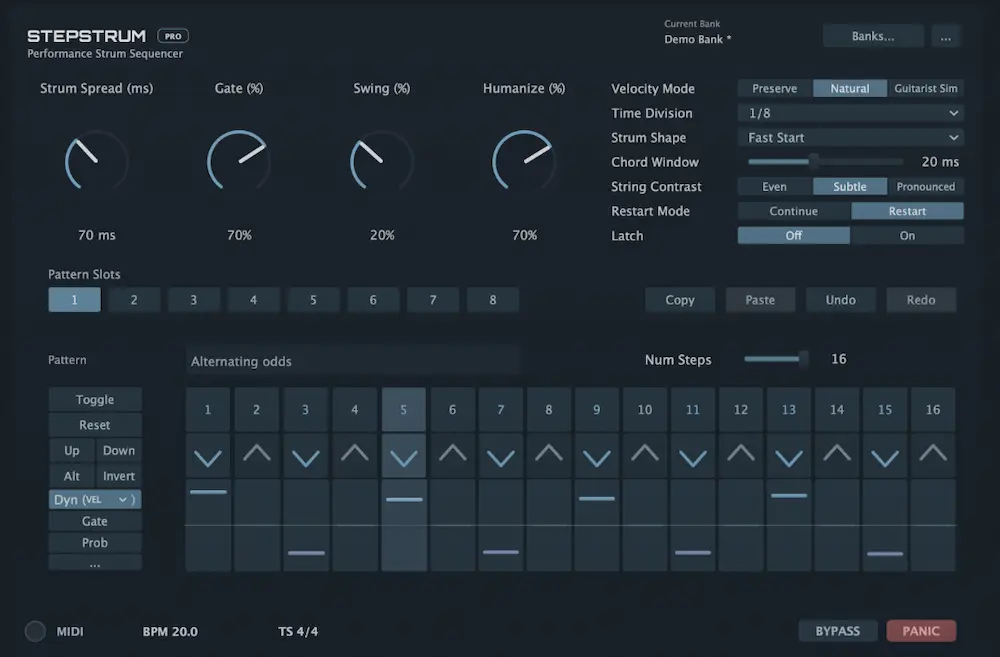
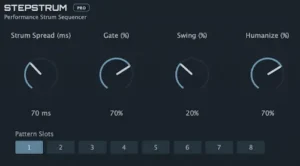
Most of StepStrum’s controls are familiar on paper: Strum Spread, Gate, Swing, Humanize, Velocity Mode, and selectable time divisions. None of them is particularly innovative in isolation. Their usefulness depends on how they interact to shape a believable performance rather than simply adding random variation.
Strum Spread controls how notes are distributed across time instead of triggering every note simultaneously. Used conservatively, it recreates the natural delay between strings during a pick stroke. Push it too far, however, and the result becomes exaggerated enough to draw attention to the effect itself.
Gate determines note duration and has a direct impact on groove. Short values create tighter rhythmic interplay with drums, while longer values can produce fuller harmonic movement at the expense of clarity in dense arrangements.
Swing adjusts feel rather than timing accuracy. Subtle settings often contribute more to a convincing performance than aggressive humanization, particularly in genres where guitars need to lock tightly with programmed drums.
Humanize is arguably the most difficult parameter to judge without extended use. Random timing offsets alone do not produce realistic performances. Skilled players repeat recognizable timing habits rather than introducing completely unpredictable variation. Whether StepStrum captures that distinction ultimately determines how natural repeated patterns feel over the course of an arrangement.
The Pro edition expands the workflow with editable lanes for velocity, gate, dynamics, probability, and pattern management. Those additions don’t fundamentally change the plugin’s purpose, but they make larger productions easier to maintain by reducing duplicated MIDI clips and simplifying variation between repeated sections.
Probability is particularly useful because it addresses one of MIDI programming’s oldest problems: repetition. Instead of manually creating several versions of the same pattern, selected notes or accents can appear only on certain passes. Used with restraint, this introduces subtle variation without making the performance unpredictable.
Instrument independence remains StepStrum’s strongest advantage. Since it generates standard MIDI instead of proprietary articulation data, a completed performance can be auditioned across multiple guitar libraries—or repurposed for entirely different instruments—without rebuilding the underlying pattern. Producers working with hybrid templates or regularly changing sounds late in production will appreciate that flexibility.
That flexibility has clear limits. StepStrum has no awareness of fretboard positions, string allocation, articulation switching, or physically playable voicings. Those responsibilities remain with the source instrument and the programmer. A convincing performance still depends on realistic chord choices and appropriate articulation management, not simply on better strumming patterns.
Viewed as a workflow tool rather than a realism engine, StepStrum occupies a practical niche. It won’t replace the instrument-specific intelligence built into premium guitar libraries, but it can reduce repetitive MIDI editing and make performance data considerably more portable between projects, libraries, and production templates.
Strengths, Trade-Offs, and Practical Limitations
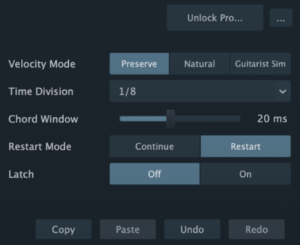 StepStrum’s biggest advantage is also the reason it won’t fit every production workflow. Because the plugin generates standard MIDI instead of controlling a specific instrument, it remains portable across guitar libraries, software instruments, and external hardware. That flexibility comes at the cost of instrument awareness. StepStrum has no understanding of string selection, fretboard position, articulation switching, or the physical constraints of an actual guitarist.
Premium guitar libraries approach the same problem differently. Their internal scripting often determines which string should play each note, manages articulation changes automatically, and avoids transitions that would be awkward—or impossible—for a real player. Those systems are tightly integrated with the instrument itself. StepStrum intentionally avoids that level of specialization in favor of a workflow that remains independent of any single library.
Whether that approach is an advantage depends entirely on the production setup. If a guitar library already provides an efficient strumming engine with intelligent articulation management, adding another MIDI performance layer may introduce unnecessary complexity. Producers using multiple libraries, on the other hand, gain the ability to keep performance data consistent while freely changing the sound source throughout a project.
StepStrum also highlights an important distinction between performance realism and musical realism. Timing variation, velocity shaping, and strumming direction can make MIDI feel less mechanical, but they cannot correct unrealistic chord voicings or impossible fingerings. Keyboard-oriented harmony remains keyboard-oriented harmony, regardless of how naturally the notes are distributed across time.
The same principle applies to humanization. Random variation is easy to generate but surprisingly difficult to make believable. Experienced guitarists develop consistent timing tendencies that become part of their playing style. If humanization behaves as uncontrolled randomness rather than repeatable musical behavior, realism can actually decrease instead of improve—particularly in productions where guitars must lock tightly with drums, bass, or sequenced percussion.
The difference between the Lite and Pro editions is best understood as workflow depth rather than feature count. Lite includes the core performance engine and is more than capable of evaluating the concept or building simple arrangements. Pro becomes valuable once projects require evolving patterns, organized banks, detailed velocity programming, and probability-based variation across longer song structures. Those additions streamline editing rather than fundamentally changing the generated MIDI.
That distinction is important because upgrading does not improve sound quality. StepStrum never processes audio. Every improvement comes from faster editing, greater control over performance data, and better management of complex arrangements.
The plugin also occupies a relatively specialized segment of the market. Producers heavily invested in a single guitar ecosystem may see little benefit over the tools they already use. Those working across multiple libraries, hybrid scoring templates, or mixed software and hardware environments are more likely to appreciate its modular approach.
Ultimately, StepStrum is best viewed as production infrastructure rather than a realism shortcut. It reduces repetitive MIDI editing, encourages reusable performance workflows, and simplifies instrument changes during production. It does not replace musical judgment, realistic arrangement choices, or the instrument-specific scripting that remains essential for highly convincing virtual guitar performances.
Can StepStrum Replace a Guitar Library?
Not by itself. StepStrum is a MIDI performance plugin, not a virtual instrument. It doesn’t include guitar samples, amplifier models, articulation switching, or physical modeling. Instead, it sits in front of another instrument and focuses entirely on generating expressive strumming performances.
That distinction is easy to overlook because many premium guitar libraries already include their own strumming engines. Those integrated systems combine sound generation, articulation management, and performance scripting inside a single product. StepStrum separates the performance layer from the instrument, making the resulting MIDI portable across different libraries and production templates.
Whether that approach is better depends on the workflow. Producers committed to a single guitar platform may gain little from introducing another MIDI processor. Those who regularly compare libraries, layer multiple instruments, or revise arrangements throughout production will often benefit from keeping performance independent of the sound source. StepStrum doesn’t replace a guitar library—it replaces part of the programming workflow that normally lives inside one.
How StepStrum Compares to Other MIDI Strumming Workflows
StepStrum isn’t competing with virtual guitars in the traditional sense. Most commercial guitar instruments combine three elements into a single ecosystem: sound generation, articulation management, and performance scripting. StepStrum removes the performance layer from that ecosystem, allowing it to remain independent of the instrument producing the audio.
That distinction changes the comparison entirely. The plugin competes less with guitar libraries themselves and more with the workflows producers use to create realistic strumming. Depending on the project, that may mean replacing manual MIDI editing, supplementing a built-in strumming engine, or becoming the primary performance tool across multiple libraries.
| Workflow | Primary Advantage | Primary Limitation | Best Fit |
|---|---|---|---|
| StepStrum Pro | Portable MIDI performance across different instruments and libraries | No awareness of articulations, fretboard logic, or playable fingerings | Hybrid production environments and multi-library workflows |
| Built-In Guitar Strumming Engines | Deep integration with articulations and instrument scripting | Performance is usually locked to a single library | Producers committed to one guitar platform |
| Manual Piano Roll Programming | Unlimited editing precision | Slow to create, difficult to revise consistently | Detailed editing and final performance refinement |
| General MIDI Sequencers | Flexible rhythmic programming | Rarely optimized for guitar-oriented phrasing | Electronic music and experimental sequencing |
StepStrum’s biggest competitive advantage is portability rather than realism. Because the generated performance remains independent of the destination instrument, producers can audition the same MIDI across multiple guitar libraries without rebuilding patterns every time the sound changes. That becomes increasingly valuable during mixing, where replacing an instrument after hearing it in context is a common part of the revision process.
The workflow also scales well to larger production templates. Film composers, trailer composers, and producers working with extensive orchestral or hybrid setups frequently separate composition from orchestration to keep sessions flexible. StepStrum follows the same philosophy by treating performance data as an independent layer that can survive library changes throughout a project’s lifecycle.
That modular approach also reflects a broader shift toward specialized production tools rather than all-in-one platforms. Instead of relying on a single application to generate, arrange, and process music, many producers now combine dedicated utilities for each stage of the workflow. Our OBSIDIAN Neural Local Edition review examines the same trend from the perspective of offline AI-assisted music production.
That flexibility isn’t universally beneficial. Producers who spend nearly all of their time inside a single premium guitar library may find its built-in performance engine faster and more tightly integrated. In those cases, StepStrum becomes another layer to manage rather than a meaningful workflow improvement.
Ultimately, the choice is less about which solution generates the most realistic guitar and more about how much value portability has within an individual production workflow. If projects regularly move between different libraries, templates, or instrument combinations, StepStrum offers a level of independence that integrated strumming systems generally cannot match.
Production Impact: Why Better MIDI Still Matters at the Mixing Stage
 StepStrum isn’t a mixing plugin, but the quality of MIDI performances affects every stage that follows. Its greatest strength is improving the virtual guitar workflow before audio reaches the mixing stage, where programming decisions become far more difficult to change. Many mix decisions compensate for problems introduced during programming rather than recording. Static dynamics, repetitive phrasing, and rigid timing often make virtual guitars feel disconnected from the rest of an arrangement long before EQ or compression enters the picture. Understanding where mixing ends and mastering begins makes it easier to recognize why performance issues should be solved before the final mastering stage.
More natural strumming patterns change how guitars interact with the rhythm section. Slight variations in timing and velocity produce less predictable transient relationships between guitars, drums, and percussion, allowing compressors and bus processing to respond to genuine musical movement instead of identical repeated events. The result isn’t a better mix because of the plugin itself—it is better source material entering the mix.
That distinction is important. StepStrum cannot improve tone, stereo width, or frequency balance. Those remain the responsibility of the instrument, the arrangement, and the mix engineer. What it can influence is how convincingly the performance occupies rhythmic space before audio processing begins.
Once the MIDI performance is finalized, tonal shaping becomes a separate stage of production. Tools focused on guitar processing solve a different problem entirely. For example, our Chainsaw Suite review explores how modular amp processing, Neural Amp Modeler integration, and parallel signal routing affect the recorded guitar tone after the performance itself has already been established.
This becomes particularly relevant in layered productions where multiple guitars share similar rhythmic roles. Small variations in attack, note duration, and strumming direction help reduce the mechanical phase-like repetition that often develops when identical MIDI patterns drive several instruments simultaneously. Those differences may appear subtle in isolation but become increasingly noticeable across an entire arrangement.
CPU efficiency is unlikely to be a deciding factor. Since StepStrum processes MIDI rather than audio, the additional processing overhead is minimal compared to modern guitar libraries or sample-based orchestral instruments. Even in larger production templates, the instrument generating the audio will remain the primary consumer of system resources.
The more practical advantage is workflow flexibility during revisions. Instrument choices often change after hearing a production develop, particularly once vocals, drums, and bass are fully integrated. Because StepStrum keeps the performance independent of the instrument, producers can audition different libraries without rebuilding the underlying MIDI—a workflow benefit that becomes increasingly valuable on commercial projects with multiple revision cycles.
For mixing and mastering engineers working with printed audio, StepStrum offers no direct benefit. Its contribution happens earlier in the production chain. Used during composition and arrangement, however, it can produce performances that require fewer corrective edits before a project reaches the mix. Once the arrangement is finalized, following a structured mix preparation workflow before mastering becomes far more important than trying to correct programming issues during the final stage.
Overall Rating
| Category | Rating |
|---|---|
| Performance Realism | 8.5/10 |
| Workflow Efficiency | 9.5/10 |
| Editing Flexibility | 9/10 |
| CPU Efficiency | 10/10 |
| Cross-Library Compatibility | 9.5/10 |
| Value for Money | 9/10 |
| Overall | 9.1/10 |
StepStrum doesn’t attempt to replace sophisticated virtual guitar libraries or simulate the behavior of a real guitarist. Instead, it improves one of the weakest points in modern MIDI production: performance programming. Its greatest strengths are workflow efficiency, portability between instruments, and the ability to build reusable MIDI performances without locking them to a single ecosystem. Producers expecting automatic realism may find dedicated guitar libraries more complete, but those working across multiple instruments and evolving production templates will likely see StepStrum as a practical long-term workflow investment.
Why These Ratings?
Performance Realism – 8.5/10
StepStrum produces noticeably more natural strumming than static MIDI programming, but realism still depends heavily on chord voicings, articulation management, and the receiving instrument. It improves performance expression without replacing instrument-specific guitar scripting.
Workflow Efficiency – 9.5/10
This is where the plugin stands out. Separating performance generation from sound generation makes arrangement revisions considerably faster and encourages reusable MIDI across multiple projects and instruments.
Editing Flexibility – 9/10
The Pro edition provides enough control over timing, velocity, probability, and pattern organization to handle complex productions efficiently without becoming unnecessarily complicated.
CPU Efficiency – 10/10
Since StepStrum processes MIDI rather than audio, resource consumption is effectively negligible. Even large production templates are unlikely to notice any measurable performance impact.
Cross-Library Compatibility – 9.5/10
One of StepStrum’s biggest advantages is that completed performances remain independent of the instrument. Moving the same MIDI between different guitar libraries—or even non-guitar instruments—is considerably easier than with most integrated strumming engines.
Value for Money – 9/10
At $39, the Pro version offers meaningful workflow improvements without trying to compete with premium guitar libraries. Producers who regularly build MIDI-based arrangements should recover the cost quickly through reduced editing time alone.
Verdict: StepStrum Solves a Workflow Problem, Not a Realism Problem
StepStrum fills a gap that many virtual guitar tools leave untouched. Viewed as a MIDI performance processor rather than another virtual instrument, its purpose becomes much easier to understand. Instead of generating another instrument or another collection of preset strumming patterns, it focuses on the performance layer—the part of MIDI programming that often determines whether a virtual guitar feels convincing inside a finished arrangement.
That approach comes with clear trade-offs. StepStrum has no understanding of fretboard positions, articulation switching, or physically accurate guitar technique. It won’t rescue unrealistic chord voicings or compensate for weak MIDI writing. Producers expecting automatic realism will find more comprehensive solutions inside dedicated guitar libraries.
Where StepStrum succeeds is portability. A performance remains independent of the instrument generating the sound, making it far easier to compare libraries, revise arrangements, or repurpose existing MIDI without rebuilding every strumming pattern. For producers who regularly move between different instruments during a project, that flexibility can save considerably more time than another collection of preset articulations.
The Lite edition is an easy recommendation because it demonstrates the core workflow without financial commitment. The Pro version becomes worthwhile once projects demand probability-based variation, reusable pattern banks, and more detailed performance editing. At $39, the upgrade is less about adding new capabilities than reducing friction during larger productions.
Rather than competing with premium guitar libraries, StepStrum complements them by separating performance generation from sound generation. Those invested in a single guitar ecosystem may see only marginal benefits. Producers working across multiple libraries, hybrid production templates, or evolving commercial sessions are far more likely to appreciate its modular approach.
The plugin ultimately solves a production workflow problem rather than a sound-quality problem. It cannot make unrealistic MIDI musical, but it can make well-written MIDI substantially easier to create, revise, and reuse. For many professional production environments, that distinction is more valuable than another incremental improvement in virtual guitar realism.
Frequently Asked Questions
Does StepStrum work with any VST instrument?
Yes. StepStrum outputs standard MIDI, allowing it to control guitar libraries, software instruments, samplers, drum machines, and compatible external MIDI hardware. Compatibility depends on the receiving instrument’s ability to accept MIDI input rather than on the instrument type itself.
Can StepStrum replace the built-in strumming engine in a guitar library?
Sometimes. If your guitar library already offers advanced articulation scripting and realistic strumming, StepStrum may be unnecessary. Its biggest advantage is portability, making it easier to reuse performances across different libraries instead of remaining tied to one ecosystem.
Is StepStrum Lite enough for professional work?
Lite includes the core strumming engine and is suitable for learning the workflow or building straightforward arrangements. Producers working on larger commercial projects will benefit from the Pro edition’s probability editing, performance lanes, and pattern management.
Does StepStrum create audio or only MIDI?
It generates MIDI only. Every sound comes from the virtual instrument or hardware receiving the MIDI output, making sound quality entirely dependent on the destination instrument.
Can StepStrum make programmed guitars sound realistic?
It can improve timing, dynamics, and rhythmic variation, but it cannot fix unrealistic chord voicings, impossible fingerings, or poor articulation choices. The realism of the final result still depends on both the MIDI programming and the instrument being played.
Is StepStrum compatible with all major DAWs?
StepStrum is available as a VST3 plugin for macOS and Windows, with AU support on macOS. Practical compatibility depends on whether your DAW supports MIDI effects and MIDI routing to virtual instruments.
Does StepStrum use much CPU?
No. Since it processes MIDI instead of audio, CPU usage is minimal. In most sessions, the receiving instrument will consume significantly more processing power than StepStrum itself.
Can StepStrum be used with synths and orchestral libraries?
Absolutely. Although it is designed around guitar-style strumming, its MIDI output can drive synthesizers, pianos, orchestral instruments, cinematic textures, and other sound sources where rhythmic note distribution is useful.
Is StepStrum worth buying if you already own premium guitar libraries?
That depends on your workflow. Producers using a single guitar ecosystem may find their library’s integrated strumming engine sufficient. Those switching between multiple libraries or regularly replacing instruments during production will gain far more from StepStrum’s independent MIDI workflow.
Who will benefit most from StepStrum?
StepStrum is best suited to producers, composers, and songwriters who build arrangements with multiple virtual instruments, maintain reusable production templates, or prefer separating MIDI performance from sound generation. It offers fewer advantages for users who stay inside a single integrated guitar platform.