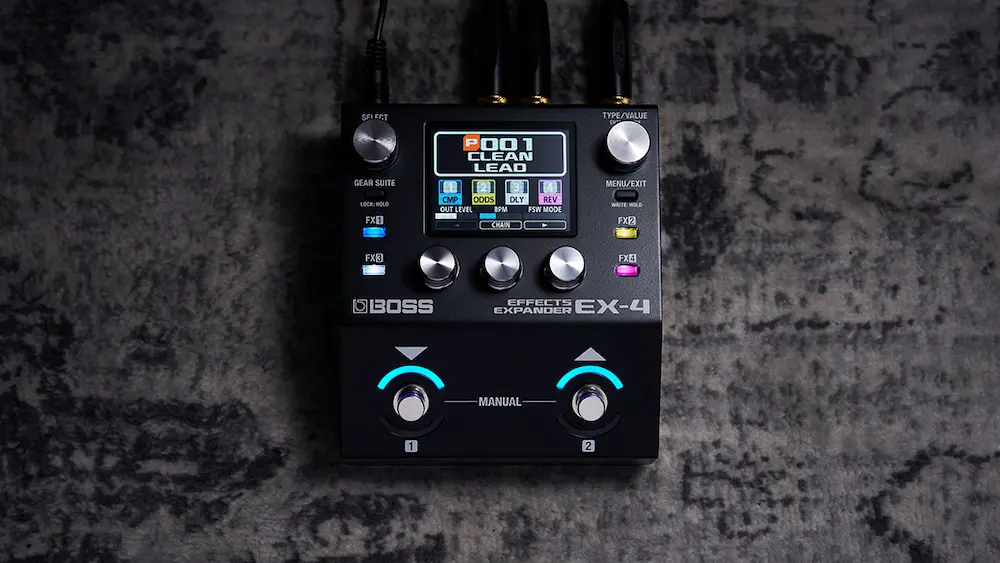
The BOSS EX-4 Effects Expander is easy to misread as another compact multi-effects pedal. Its specification sheet certainly points in that direction: 120 effects, four simultaneous effect blocks, stereo I/O, MIDI, an external effects loop and programmable signal routing. But the most important part of the EX-4 is not the size of its effect library. It is the way those effects can be arranged, controlled and integrated with the rest of a pedalboard.
The EX-4 works best as a programmable signal-flow layer for an existing rig. Instead of replacing a complete pedalboard, amp modeler or software effects chain, it adds multiple configurable processing stages that can be reordered, switched and recalled as complete setups. External pedals can be inserted into the chain, while different routing configurations can be stored for different songs or production requirements.
That distinction matters in real-world use. A guitarist can move modulation, delay or reverb to different positions without rewiring the board. A bassist can combine dedicated external pedals with digital processing. In a recording setup, the EX-4 can function as a compact piece of programmable outboard for tracking, reamping and sound design. The hardware becomes useful not because it contains 120 effects, but because it reduces the amount of physical signal-path management required around them.
There are equally important boundaries. The EX-4 does not provide amp modeling, supports four active effect blocks rather than an unlimited chain, and does not use an analog dry-through path. It is also not a replacement for a full multi-effects processor or a DAW-based effects system. Its strongest engineering decisions are instead concentrated in routing, control, external integration and preset recall.
This BOSS EX-4 review focuses on those decisions rather than treating the pedal as a catalogue of effects. The goal is to determine where its architecture actually improves a working guitar, bass or hybrid production setup—and where the compact format imposes practical limits.
Why the EX-4 Matters: When the Pedalboard Becomes a Signal-Flow Problem
 Modern pedalboards are increasingly less about collecting individual stompboxes and more about managing a complete signal path. A working rig may combine a few essential analog pedals with digital modulation, delay, reverb, pitch processing, filtering and utility functions. The difficulty is no longer finding another effect. It is keeping the entire chain practical, repeatable and easy to reconfigure.
Every additional pedal brings more than another sound. It adds cabling, power requirements, physical space and another point of failure. Once different songs require different effect orders or combinations, rebuilding the signal path becomes a workflow problem rather than a tone decision.
The EX-4 addresses that problem by providing four programmable effect blocks in a compact hardware unit. The blocks can be reordered and configured for different processing chains, while external pedals can be incorporated through the EX-4’s effects loop. That makes the unit fundamentally different from a group of four fixed stompboxes: the hardware is being used to manage signal flow as well as generate effects.
The advantage becomes more obvious once a configuration has been built and stored. The EX-4 provides 128 User memories plus 128 Preset memories, giving the recall-based workflow enough capacity for separate live, session and production configurations. A guitarist can recall a complete chain for a particular song without physically moving pedals, while a session player can maintain separate setups for different artists or tracking requirements.
This is where the EX-4 makes its strongest case. Its primary advantage is not the number of effects available; it is the reduction in physical signal-path management. The effects are the components, but the programmable routing and recall system is what makes the unit useful as a piece of working hardware.
What the BOSS EX-4 Actually Brings to Audio Production
The EX-4 provides 120 BOSS effects covering drive and distortion, modulation, delay, reverb, pitch, filtering and utility processing. That library is useful, but the more important specification is how those effects are organized inside the signal path.
The core architecture provides four simultaneously active FX blocks. Each block can host an effect, and multiple instances of the same effect can be used when supported. This makes the EX-4 fundamentally different from a compact processor designed around adding only one effect at a time.
A conventional chain might be as simple as compressor → overdrive → chorus → delay. The more useful applications come from changing the relationship between those stages. The EX-4 supports different serial and parallel structures, allowing the four FX blocks to operate as a configurable processing system rather than a fixed sequence.
Four FX Blocks Plus Six Utility Blocks
The four main FX slots are only part of the EX-4 architecture. BOSS also provides six dedicated utility blocks: Divider/Mixer, Send/Return, Foot Volume, two Noise Suppressors and Global EQ. These blocks should not be counted as four additional effect slots; they extend the signal-flow system around the four main FX processors.
This distinction is important when judging the EX-4’s processing capacity. The unit can place utility functions around the main effects instead of forcing every routing or control function to consume one of the four primary FX positions. A noise suppressor, external pedal loop or global EQ can therefore support the signal path without reducing the number of main FX blocks available for creative processing.
The Send/Return block is particularly important for hybrid pedalboards. An external pedal or pedal chain can become part of the programmable architecture while the EX-4 handles the digital effects around it. This allows a preferred analog pedal to remain in the rig without requiring the entire signal path to be rebuilt around it.
That makes the EX-4 less like four digital stompboxes in one enclosure and more like a compact programmable effects matrix. The practical value comes from controlling where processing occurs, which stages remain active, where external hardware enters the chain and how the complete configuration is recalled.
The External Effects Loop Is More Important Than the Effect Count
The EX-4’s Send/Return architecture allows an external pedal or pedal chain to be integrated into the programmable signal path. This is one of the unit’s most useful features for hybrid pedalboards because it allows existing hardware to remain part of the system rather than becoming redundant.
A preferred analog overdrive, compressor or other character device can remain in the chain while the EX-4 supplies additional modulation, pitch processing, delay, reverb, filtering or utility functions around it.
In that configuration, the external pedals provide the parts of the chain where the player already has a strong preference, while the EX-4 handles processing that benefits from digital recall and configurable routing. The result is a programmable expansion layer for an existing rig, rather than a conventional all-in-one multi-effects replacement.
Are Four Effect Blocks Enough?
Four active FX blocks can look restrictive next to larger floor processors, but the limitation makes more sense when the EX-4 is treated as an effects expander rather than a complete guitar system.
A tracking setup might use pitch → drive → delay → reverb. A live rig could dedicate the four positions to noise suppression, modulation, delay and ambience. For sound design, a chain such as filter → Slicer → pitch → reverb can turn the same hardware into a very different processing tool.
The additional utility blocks change the calculation. Send/Return, Foot Volume, Noise Suppression, Divider/Mixer and Global EQ can support the main four effects without occupying those four creative FX positions. That gives the EX-4 more useful signal-path capacity than a simple “four effects maximum” description suggests.
For a player who needs a complete amp-and-effects system, the four FX blocks will still be a limitation. For someone who already has the core of a rig and needs programmable processing around it, the architecture is considerably more capable than the raw number four implies.
BOSS EX-4 Interface and Gear Suite
The EX-4 is designed around a compact but unusually information-dense control system. A 2.4-inch color graphic display works with dedicated FX1–FX4 buttons, a SELECT control, a TYPE/VALUE control and three parameter knobs. The interface is built around editing the selected processing block without requiring a large touchscreen or extensive menu navigation.
The dedicated FX buttons are particularly important because they make the four processing stages visible as separate parts of the signal path. The user can select an individual block, change its effect type and adjust its parameters while keeping the overall chain structure accessible.
The Gear Suite adds another layer to this workflow. Instead of rebuilding commonly used effect settings each time a particular effect type is selected, stored Gear Suite configurations can provide quick starting points for frequently used sounds. This is especially relevant to players and session musicians who repeatedly use the same effect categories across different memories.
The interface therefore supports the EX-4’s central design goal: the unit is not simply a collection of effects, but a system for building, editing and recalling repeatable signal paths. That distinction becomes more important as the number of presets and external devices in the rig increases.
Make the Final Mix Translate Beyond the Studio
Effects, routing and stereo processing can shape the character of a production long before it reaches the master bus. If you want an independent engineering perspective on the finished mix, AREFYEV STUDIO offers a free mastering demo so you can hear how the track translates through a professional mastering chain. Upload up to 40 seconds of your mix and use the result to evaluate balance, dynamics, stereo image and overall translation before committing to a full master.
Upload your 40-second free mastering demo →
BOSS EX-4 Effects: What the 120-Effect Library Actually Means
 120 effects is a library size, not a measure of capability. The useful question is whether those effects cover the processing roles an existing pedalboard actually needs and whether they can be combined effectively within the four main FX blocks.
The library covers the major categories expected from a modern BOSS effects system, including overdrive and distortion, compression, modulation, delay, reverb, pitch, filtering and utility processing. It also includes distinctive BOSS effects such as Slow Gear and Slicer, which are more difficult to replace with generic software effects or a single-purpose stompbox.
There is an important caveat to the 120-effect headline: the EX-4 is not a complete catalogue of BOSS’s effects history. Some notable omissions remain, including the DC-2-style Dimension effect and Harmonic Tremolo, while parts of the broader BOSS effects ecosystem are not represented in the EX-4. The result is a broad working library rather than a definitive collection of every BOSS algorithm.
That distinction matters when comparing the EX-4 with processors such as the HX One or Fractal VP4. The question is not simply whether 120 effects sounds like a large number. It is whether the particular effects available cover the secondary processing roles a player actually needs. The EX-4 is strongest in the conventional BOSS vocabulary of drives, modulation, delay, reverb, pitch and utility processing, rather than in attempting to reproduce every specialist effect BOSS has released.
The practical strength is therefore breadth across several secondary processing roles rather than the expectation that every one of the 120 effects will be equally important. A guitarist may use only a small subset regularly, but the ability to recall different combinations of those effects is what gives the EX-4 its value as an expansion device.
Multiple instances of supported effects also make the four-block architecture more flexible. The system is not limited to four different effect categories; the available blocks can be configured according to the requirements of the actual signal path.
The equation changes for players who need a complete amp-and-cabinet system. The EX-4 does not attempt to provide that ecosystem, and comparing its effect count directly with a larger floor processor can therefore be misleading.
A GX-series processor, Helix-class system or high-end Fractal unit is designed to manage a much broader rig: amp modeling, cabinet or IR processing, multiple effects, extensive routing and a substantially larger control surface. The EX-4 intentionally stops short of that level of integration.
That limitation is also part of its appeal. The EX-4 is less capable as a complete rig precisely because it is more focused as an effects expansion system. It avoids the additional modeling and control layers when the player already has an amp, core pedals or another primary rig and simply needs flexible digital processing around them.
BOSS EX-4 vs HX One, Fractal VP4, H90 and GX-10
The most useful way to compare the EX-4 with competing processors is to look at signal-path architecture, not simply the number of effects or processing power.
| Product | Best Reason to Choose It | Main Trade-Off |
|---|---|---|
| BOSS EX-4 | Four configurable FX blocks, utility routing and external pedal integration around an existing rig | No amp/cab modeling and a more focused architecture than a complete floor processor |
| Line 6 HX One | Adding one sophisticated Helix effect to an existing chain | Only one active effect at a time |
| Fractal VP4 | Four high-end effects inside Fractal’s processing ecosystem | Larger and positioned in a different premium ecosystem |
| Eventide H90 | Premium dual-algorithm effects and deeper Eventide processing | Different two-algorithm architecture and higher-end positioning |
| BOSS GX-10 | Complete guitar system with amp and cabinet modeling | Larger system when the goal is only effects expansion |
| ZOOM MS-50G+ | Low-cost compact multi-effects expansion | Different control, routing and processing architecture |
The BOSS EX-4 is the strongest fit when the problem is not a lack of one particular effect, but a need for several configurable processing stages around an existing pedalboard or production rig.
The HX One makes more sense when only one additional effect is required. The Fractal VP4 is the closer alternative for users who specifically want four effects inside the Fractal ecosystem, while the Eventide H90 targets a different premium workflow built around two powerful algorithms.
The BOSS GX-10 should be considered when amp and cabinet modeling are part of the requirement. It solves a much broader problem than the EX-4. The ZOOM MS-50G+, meanwhile, is more relevant when low cost and compact multi-effects functionality matter more than the EX-4’s particular routing and integration architecture.
The important comparison is therefore not which unit has the longest effect list. It is which architecture solves the actual signal-flow problem.
BOSS EX-4 Workflow: Manual Mode, Memory Recall and Signal-Path Control
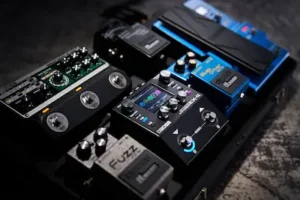 The EX-4’s workflow is defined as much by its control architecture as by its four FX blocks. The unit provides Manual and Memory modes, allowing the same hardware to behave either like a group of stompboxes or as a preset-based processor with complete signal-path recall.
In Manual mode, the footswitches can be used for effect control, while Memory mode is designed around recalling complete configurations. The footswitch assignments can also be customized for functions such as effect on/off, memory changes, bypass and tap tempo. This matters because the EX-4 is intended to sit inside an existing board rather than replace the board’s entire control philosophy.
Memory changes are another important part of the design. BOSS supports carryover of delay and reverb effects during memory changes under supported configurations, so changing from one stored setup to another does not necessarily mean an abrupt cut in ambience. For live rigs, this is a more meaningful feature than simply having a large preset count.
The control architecture also explains why the 2.4-inch display is important. The screen shows the effect chain and its parameters, while the dedicated FX1–FX4 buttons provide direct access to individual processing blocks. Holding an FX button exposes the broader parameter set, while the three parameter controls handle the values currently shown on screen. The result is a workflow built around the four-block architecture rather than a menu system designed for a much larger processor.
For external rigs, the same logic extends through the Send/Return block. The EX-4 can place external pedals inside the programmable chain, while TRS MIDI and the CTL/EXP connection allow the unit to participate in a larger control system. The pedal also includes a USB-C connection for computer-based system functions.
This is where the EX-4 separates itself from a simple four-effect pedal. Its value is the combination of effect blocks, routing, recall and control assignments. The individual effects are only one part of the product; the workflow determines how useful those effects become when the signal path has to change repeatedly.
Who Should Buy the BOSS EX-4?
The EX-4 makes the most sense for players who already have a core rig and need more processing flexibility without adding another large floor processor. It is an expansion device first, and that should determine who gets the most value from it.
Guitarists with established pedalboards are the clearest audience. If the essential character of the rig already comes from a few preferred pedals, the EX-4 can add modulation, delay, reverb, pitch and utility processing while leaving those core pedals in place.
Session players can benefit from the memory-based architecture when different songs or artists require different signal paths. The ability to recall configurations is more useful here than simply having access to a large effect library.
Home studios and producers have a strong use case when hardware reamping, printed effects or external sound design are part of the workflow. The EX-4 can sit between the instrument or interface and the rest of the production system as a configurable hardware effects stage.
Electronic producers can also exploit the stereo routing and less conventional effects, particularly when processing synthesizers, drum machines or other external sources. The workflow is still fundamentally pedal-oriented, however, so it is not the most natural choice for a studio built primarily around line-level hardware processing.
Mixing engineers should view the EX-4 as creative outboard rather than a conventional mixing processor. It can be useful for guitars, bass, reamping and effects design, but software remains more practical for precise corrective processing, automation and total recall.
Mastering engineers are a different case. There is little reason to buy the EX-4 specifically for mastering. Its strengths—effects, routing and creative signal processing—do not address the core requirements of a precision mastering chain.
Beginners may also get less value from it than the specification suggests. A large effects library and flexible routing are useful once a player understands what the signal path needs to accomplish. Before that point, the additional choices can add complexity without solving a real workflow problem.
The simplest buying rule is therefore straightforward: buy the EX-4 when you need a programmable expansion layer around an existing rig, not when you are looking for a complete guitar processor or a replacement for DAW mixing tools.
What the BOSS EX-4 Can Replace — and What It Cannot
The EX-4 is most useful when it replaces multiple low-frequency-use pedals rather than the core sound of an established board. A player may keep the preferred overdrive, compressor or character pedal while moving less frequently used modulation, delay, reverb, pitch or utility duties into the EX-4.
It can also replace repeated physical changes to the board. If different songs require different effect orders, external pedals or combinations of processing, those configurations can be stored instead of rebuilt manually.
It cannot replace the functions of a complete modeling processor, an amp-and-cabinet system or a DAW-based effects environment. That is not a missing feature so much as the boundary of the product’s design.
The EX-4 therefore makes the most sense as a consolidation and expansion tool: fewer dedicated secondary pedals, more recallable configurations, and more routing flexibility without turning the board into a full-size multi-effects system.
Overall Rating
| Category | Rating |
|---|---|
| Routing & Integration | 9.0/10 |
| Control & Preset Workflow | 8.7/10 |
| Effect Library | 8.0/10 |
| Processing Scope | 7.8/10 |
| Value at $299.99 MSRP | 8.5/10 |
| Overall | 8.4/10 |
The EX-4 scores highest where its architecture is most differentiated: routing, external integration and repeatable control. Its effect library is broad, but not comprehensive, while the absence of amp/cab modeling deliberately limits its scope compared with larger processors.
The value score reflects the product’s intended position. At the official $299.99 MSRP, the EX-4 is easier to justify when it replaces several secondary pedals or solves recurring signal-path changes than when it is purchased simply as another source of effects.
Overall: 8.4/10. The EX-4 is a strong effects-expansion platform, but its value depends heavily on whether the buyer actually needs four configurable processing stages and external routing.
Verdict: The BOSS EX-4 Makes Sense When Your Board Needs More Routing, Not More Pedals
The BOSS EX-4 is easier to justify as a piece of pedalboard infrastructure than as a conventional multi-effects purchase. Its strongest combination is four configurable FX blocks, utility routing, an assignable effects loop, preset recall and MIDI control in a compact enclosure.
That makes it particularly attractive for an established guitar or bass rig where the core pedals are already chosen but secondary effects keep changing from song to song. The EX-4 can absorb those less frequently used functions without forcing the player to build a larger all-in-one processor.
The compromises are equally clear. There is no amp or cabinet modeling, the effect library does not represent every BOSS algorithm, and the digital signal path means it is not the right choice for users who specifically require analog dry-through. A player who needs one occasional effect may also get better value from a dedicated pedal or a simpler single-effect processor.
At the $299.99 MSRP, the EX-4 is therefore a strong specialist purchase rather than a universal one. Its value comes from replacing repeated signal-path changes and several secondary effects—not from simply offering 120 effects in one box.
Before Adding More Processing, Hear What the Finished Mix Actually Needs
The EX-4 shows how much can be achieved by changing routing, processing order and effect combinations, but more processing is not automatically the answer to a mix that feels unbalanced, lacks depth or does not translate consistently. A professional mastering pass can provide a useful before-and-after reference for evaluating overall balance, dynamics, stereo image, punch and translation without guessing what the mix needs next. Upload up to 40 seconds of your mix and receive a free mastering demo prepared by a real mastering engineer, giving you a direct comparison between your current mix and a mastered reference.
Upload your 40-second mix for a free mastering demo →
BOSS EX-4 FAQ
Can the BOSS EX-4 run four effects at the same time?
Yes. The EX-4 supports up to four simultaneous effect blocks. Multiple instances of the same effect can also be used when supported by the selected configuration.
Does the BOSS EX-4 have amp modeling?
No. The EX-4 is an effects expander, not a complete amp-and-cabinet modeling system. Players who need amp modeling should look at a broader processor designed for that purpose.
Can external pedals be placed inside the BOSS EX-4 signal chain?
Yes. Two quarter-inch connections can be configured as an effects loop, allowing an external pedal or pedal chain to be integrated into the EX-4’s programmable signal path.
Is the BOSS EX-4 useful for recording and mixing?
Yes. Its strongest studio applications include guitar and bass processing, reamping, stereo effects and creative sound design. It should be treated as external effects hardware rather than a replacement for DAW mixing tools.
Can the BOSS EX-4 be used for mastering?
It can be used for creative processing earlier in the production chain, but it is not a mastering processor. It does not replace precision EQ, compression, limiting or metering.
Does the BOSS EX-4 have analog dry-through?
No. The signal passes through the unit’s digital conversion and processing path. This matters for users whose signal-chain design specifically requires analog dry-through.
How does the BOSS EX-4 compare with the Line 6 HX One?
The two units use different architectures. The HX One is built around one active effect at a time, while the EX-4 provides up to four simultaneous effect blocks with programmable routing. The better choice depends on whether the rig needs one additional effect or several stages of processing.
How does the BOSS EX-4 differ from the GX-10?
The GX-10 is a broader amp-and-effects processor with amp modeling and a more complete rig architecture. The EX-4 is designed primarily to expand an existing pedalboard with additional programmable effects.
Does the BOSS EX-4 support MIDI?
Yes. It provides TRS MIDI connectivity for integration with compatible MIDI controllers, switching systems and other hardware.
Is the BOSS EX-4 worth buying for a home studio?
It can make sense when guitar, bass, reamping or external hardware effects are part of the workflow. If nearly all processing happens inside the DAW, the EX-4 offers less practical benefit.
How many presets does the BOSS EX-4 have?
The EX-4 provides 128 User memories and 128 Preset memories, for 256 memories in total. The User memories are intended for storing custom configurations, while the Preset memories provide factory configurations.
Does the BOSS EX-4 have utility blocks in addition to its four effects?
Yes. The four main FX blocks are supported by six dedicated utility blocks: Divider/Mixer, Send/Return, Foot Volume, two Noise Suppressors and Global EQ. These utility functions extend the signal-flow architecture without being counted as the four main FX slots.

When evaluating an effects expander such as the BOSS EX-4, I focus less on the size of the effect library and more on how reliably its processing stages can be integrated into a real signal path. Four-block routing, external effects integration and repeatable configurations are the practical criteria that determine whether a unit like this adds useful flexibility without introducing unnecessary complexity.
Enjoyed this review?
If you found it useful, you can support independent audio research with a coffee.
☕ Buy me a coffee