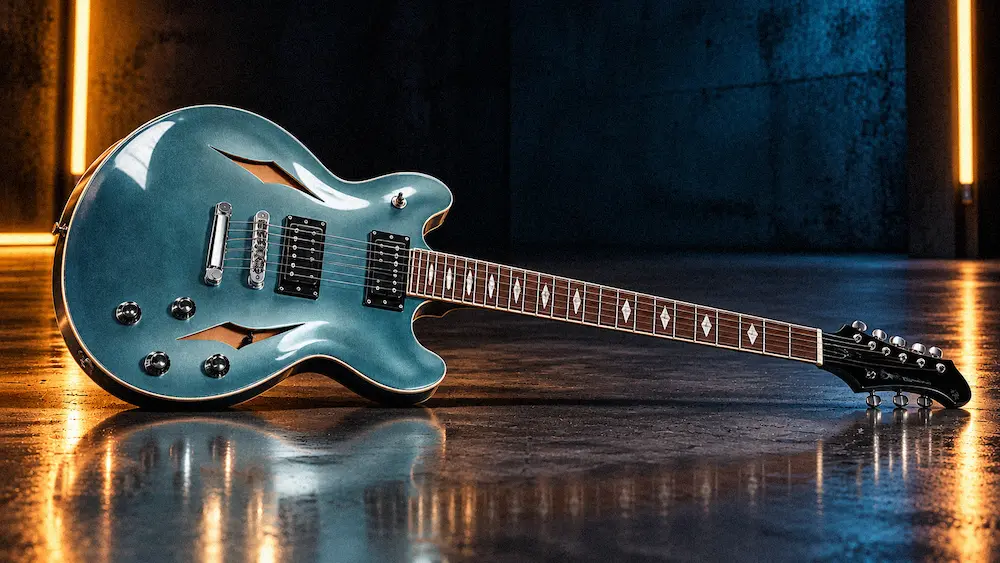
The Harley Benton HB-35TL Tesla is an affordable semi-hollow electric guitar that pairs a traditional double-cutaway design with a substantial hardware specification. Priced at approximately $330, it features a maple body, an Okoume center block, Tesla VR-60 Alnico 5 humbuckers, push/pull coil-splitting, a rosewood fingerboard, and locking tuners. On paper, that combination makes it an appealing option for guitarists looking for the character and versatility of a semi-hollow instrument without stepping up to more expensive models from established brands such as Epiphone or Gibson.
But a strong specification sheet does not necessarily translate into consistent build quality or convincing real-world performance. The more important question is whether the HB-35TL delivers enough in terms of construction, playability, and tonal flexibility to justify its place in the budget semi-hollow market. Its relationship with the less expensive HB-35Plus Rotary is also worth examining, particularly for buyers weighing different pickup configurations and tone-shaping options.
Harley Benton HB-35TL Tesla: Design and Construction
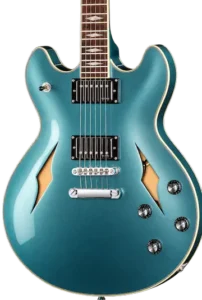 The HB-35TL is part of Harley Benton’s Tribute Series, introduced in September 2026. Its design follows the familiar double-cutaway semi-hollow format, with a body shape that recalls the styling of classic Gibson Trini Lopez models. The Pelham Blue Gloss finish gives this version a more distinctive look than the traditional sunburst finishes commonly associated with semi-hollow guitars.
The body combines an arched maple top, maple back and sides, and an Okoume center block. This construction distinguishes the HB-35TL from a fully hollow guitar. The center block provides a solid mounting structure for the bridge and tailpiece while leaving hollow sections within the body.
That distinction matters when playing through an amplifier. The interaction between the hollow body, center block, pickups, and amplification system influences how a semi-hollow guitar responds at higher volume levels. A center block can reduce the instrument’s tendency to feed back compared with a fully hollow design, but it cannot eliminate feedback. The result still depends on amplifier gain, speaker placement, room acoustics, pickup characteristics, and playing volume.
The maple neck uses a set-neck construction and has a C-shaped profile. The specified scale length is 24.75 inches, while the fingerboard has a 12-inch radius. The rosewood fingerboard is fitted with 22 medium-jumbo frets and rolled edges, a feature intended to make the fretboard feel more comfortable under the fretting hand.
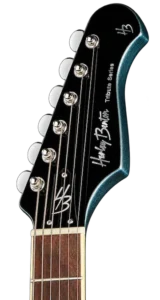
Hardware includes a 42 mm graphite nut, a Deluxe Tune-O-Matic bridge, and Sung-Il ML-55 locking tuners. These specifications are attractive at this price point, but they do not establish the consistency of the guitar’s overall manufacturing quality. Fretwork, nut finishing, neck relief, and factory setup remain important factors to check on the individual instrument.
Tesla VR-60 Alnico 5 Pickups and Coil-Splitting
One of the defining features of the HB-35TL is its pair of Tesla VR-60 Alnico 5 humbuckers. The dual-humbucker configuration gives the guitar a familiar foundation for clean passages, overdriven rhythm parts, and higher-gain playing.
Alnico 5 is a common magnet choice in electric guitar pickups, but magnet composition alone does not determine their tonal character. Coil geometry, winding specifications, pickup height, electrical loading, and the rest of the signal chain all influence the final response. Without controlled measurements or a detailed technical specification, assigning a precise output level or frequency-response profile to the VR-60 pickups would be speculative.
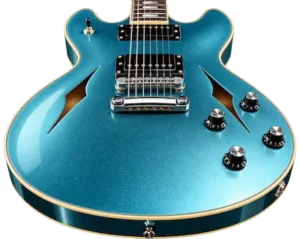
Both volume controls feature push/pull switching for coil-splitting. This allows the player to switch from the standard humbucker configuration to a split-coil mode directly from the guitar, without installing additional pickups or changing the instrument’s basic control layout.
For recording and general playing, this adds another option when shaping guitar parts. The neck position can be explored for fuller clean passages, while the bridge position offers an alternative for more focused or aggressive parts. The split mode provides a further variation in pickup response, potentially useful when a track needs a different tonal texture without changing instruments.
There are, however, limits to what coil-splitting can achieve. A split humbucker does not automatically reproduce the output, frequency response, or dynamic behavior of a purpose-built single-coil pickup. This is different from a multi-voice active system such as the three-voice Fishman Fluence Open Core Classic system, which includes a dedicated single-coil-style voice. Depending on the pickup design, splitting can also reduce signal level and make the guitar more susceptible to electrical interference. The actual usefulness of the HB-35TL’s split mode therefore depends on how it sounds and performs in practice, not simply on the presence of push/pull controls.
The electronics are completed by a three-way pickup selector and independent volume and tone controls. This is a conventional layout that keeps pickup selection and basic tonal adjustments straightforward, without adding unnecessary switching complexity.
Get More Clarity and Balance From Your Guitar Mixes
A semi-hollow guitar can bring a distinctive character to a recording, but its pickups, amplifier response, and arrangement all influence how the final mix translates. Professional mastering helps refine tonal balance, preserve dynamics, and improve clarity without losing the character of the original performance. Submit up to 40 seconds of your mix and get a free mastering demo to hear how your track translates through a dedicated mastering process.
Request Your Free Mastering Demo →
How Does the Harley Benton HB-35TL Sound?
One of the more useful independent demonstrations of the HB-35TL comes from Rich. Words. Music., whose review, published on October 10, 2026, features playing examples across a range of musical styles. The video covers clean passages, blues, funk, country, indie, classic rock, hard rock, punk, progressive music, and heavier distorted tones.
The reviewer also documents the recording setup, which includes a Hughes & Kettner Black Spirit 200 amplifier, several overdrive and distortion pedals, a Red Box DI, and a Zoom H6 recorder. According to the review, the recorded guitar examples were not post-processed.
These examples are useful because they demonstrate the instrument in several musical contexts rather than relying solely on promotional descriptions. They also provide an opportunity to hear how the guitar works within a signal chain ranging from relatively clean amplification to heavily processed tones.
However, the demonstration should not be treated as a controlled comparison with competing guitars. The amplifier, effects, recording equipment, DI configuration, and playing technique all influence the resulting sound. The examples show that the HB-35TL can be used across these styles, but they do not establish that its Tesla pickups outperform those in other semi-hollow guitars.
For guitarists considering the HB-35TL as a recording instrument, the more relevant question is whether its pickup configurations offer enough tonal variation for their production needs. The combination of dual humbuckers and coil-splitting provides several starting points, but the recorded result will still depend heavily on amplifier voicing, cabinet simulation, distortion, equalization, and the arrangement of the guitar parts. When using an amp modeler, the monitoring system also affects how the modeled tone is heard; the Positive Grid Spark CAB 2 FRFR cabinet is one example of a physical monitoring solution designed for this type of setup.
Recording and Playing Applications
The Harley Benton HB-35TL is best suited to guitarists looking for a versatile instrument for home recording, rehearsals, and general amplified playing. Its semi-hollow construction, dual humbuckers, and coil-splitting controls provide several tonal options, making it adaptable to different musical styles rather than specifically optimized for one genre.
- Blues and classic rock: The dual-humbucker configuration provides a conventional starting point for clean passages, edge-of-breakup tones, and more saturated rhythm parts. The semi-hollow construction also makes the HB-35TL relevant to players drawn to the traditional sound and appearance of this guitar category.
- Indie and alternative rock: Switching between humbucker and split-coil configurations offers additional tonal variation when recording layered rhythm and lead parts. This can help create contrasting textures without changing instruments.
- Pop and funk: Coil-splitting provides another pickup configuration to explore for cleaner arrangements and tightly articulated rhythmic parts. Its actual suitability for these applications depends on the output and response of the split pickups.
- Jazz: The semi-hollow format and neck humbucker make the guitar a reasonable candidate for clean jazz-oriented playing. However, its tonal response should be evaluated individually rather than assumed from the body construction alone.
- Hard rock and heavier styles: The independent demonstration includes higher-gain applications, showing that the instrument can be used in more aggressive musical contexts. Players primarily focused on modern metal, however, may find a dedicated solid-body guitar with an appropriate pickup configuration more practical.
In a home studio, the ability to switch between pickup configurations can be useful when recording multiple guitar parts. Using different settings for rhythm and lead performances, for example, creates opportunities to introduce tonal contrast before applying additional processing. How these layers are balanced and positioned is equally important, which is why understanding how to mix a song becomes relevant when building arrangements in which several guitar layers occupy similar frequency ranges.
Pickup switching should not, however, be confused with a solution to frequency masking. Differences in pickup response can contribute to separation between guitar parts, but arrangement, performance, amplifier voicing, and frequency balance in a mix have a much greater influence on how those parts fit together. The HB-35TL’s coil-splitting is best understood as an additional recording option, not a substitute for deliberate guitar arrangement or corrective processing.
HB-35TL vs HB-35Plus Rotary: Which Harley Benton Is More Interesting?
One of the most relevant comparisons for the Harley Benton HB-35TL is the HB-35Plus Rotary. Both models target guitarists looking for an affordable semi-hollow instrument, but they differ in their pickup systems, tonal controls, and hardware specifications.
The HB-35TL is equipped with Tesla VR-60 Alnico 5 humbuckers and push/pull coil-splitting controls. The HB-35Plus Rotary uses ISOLA VT60 Alnico 5 pickups and adds a six-position rotary midrange-cut control. This gives the two guitars different approaches to tonal flexibility: the HB-35TL offers access to split-coil configurations, while the HB-35Plus Rotary provides additional control over its midrange response.
Published US launch-period pricing placed the HB-35Plus Rotary at approximately $281, compared with around $328–333 for the HB-35TL. These figures provide a historical price comparison, not a guarantee of current availability or checkout prices.
| Feature | HB-35TL Tesla | HB-35Plus Rotary |
|---|---|---|
| Approximate US launch price | $328–333 | $281 |
| Body construction | Maple semi-hollow body | Okoume body with maple veneer |
| Center block | Okoume | Okoume |
| Neck | Maple | Mahogany |
| Pickups | Tesla VR-60 Alnico 5 | ISOLA VT60 Alnico 5 |
| Coil-splitting | Yes | Yes |
| Additional tonal control | Conventional tone controls | Six-position rotary midrange-cut control |
| Locking tuners | Sung-Il ML-55 | Not listed in the compared specifications |
The HB-35Plus Rotary may be the more appealing option for players who want an additional way to shape the midrange directly from the instrument. Its six-position rotary control is a defining feature that sets it apart from the HB-35TL. However, the practical effect of each position should be evaluated through a direct playing comparison rather than inferred from the control’s name alone.
The HB-35TL follows a different specification approach. Its maple body construction, Tesla pickups, rosewood fingerboard, and Sung-Il locking tuners may appeal to buyers who place greater value on those particular components and the guitar’s overall design.
Neither model can be declared the better-sounding instrument on specifications alone. Without a controlled comparison using the same amplifier, signal chain, playing conditions, and setup, claims of tonal superiority would be premature. The more practical choice depends on which pickup and control system the player prefers, the importance of the listed hardware features, and the difference in purchase price.
HB-35TL vs Epiphone ES-335
 The Epiphone ES-335 is another relevant alternative to the Harley Benton HB-35TL, although it occupies a higher price category. Its semi-hollow construction, maple center block, mahogany neck, and Alnico Classic PRO humbuckers follow the established ES-335 design approach. This makes it a useful comparison for buyers considering whether to spend more on a guitar from a long-established model family.
At an observed US retail price of approximately $599, the Epiphone ES-335 costs considerably more than the HB-35TL. The price difference is relevant, but it should not be treated as automatic evidence of superior sound, construction quality, or reliability. Those factors depend on the individual instrument, its setup, and the buyer’s requirements.
The Epiphone may appeal to players who specifically want the traditional ES-335 platform, its familiar construction approach, and its established position in the semi-hollow guitar market. The HB-35TL is aimed at buyers who want to spend substantially less while getting a semi-hollow guitar with a different combination of pickups, controls, and hardware.
It is important, however, not to treat the HB-35TL as a direct equivalent to the Epiphone ES-335 in every respect. The Harley Benton is a lower-priced alternative with its own specification priorities. Without comparative testing and long-term reliability data, there is no sound basis for claiming that the two models offer equivalent construction consistency, pickup performance, or durability.
Build Quality, Hardware, and Potential Limitations
On paper, the Harley Benton HB-35TL offers a competitive hardware specification for its price category. Features such as locking tuners, a graphite nut, a Tune-O-Matic bridge, a rosewood fingerboard, and rolled fingerboard edges contribute to its overall appeal. However, the presence of these components does not, by itself, establish the quality of their installation or the consistency of the finished instrument.
Locking tuners simplify string changes by securing each string at the tuning post and reducing the amount of winding required. They can make restringing more convenient, but they do not guarantee tuning stability. Nut friction, string installation, neck movement, bridge setup, string condition, and playing technique all remain relevant factors.
The published specifications also list a graphite nut and factory-fitted Elixir strings in .010–.046 gauge. These details help establish the guitar’s out-of-the-box configuration, although players may prefer a different string gauge or setup depending on their playing style and tuning requirements.
One Thomann customer review reports an uneven finish around the edge of an F-hole on the buyer’s individual guitar. Other early customer comments mention a comfortable neck, good body balance, and relatively little volume loss when using coil-splitting. These are individual observations from a small number of buyers, not evidence of consistent performance or a widespread manufacturing problem. They do, however, reinforce the value of inspecting the finish, fretwork, neck alignment, hardware installation, and overall setup before accepting the instrument.
According to the published product information, the guitar is supplied without a gig bag or hard case. Buyers planning to transport it regularly should factor the cost of suitable protection into their overall budget.
More broadly, the available information does not establish the HB-35TL’s long-term manufacturing consistency. Without extensive owner reports, repeated inspections, or controlled durability and tuning-stability tests, it would be premature to draw firm conclusions about the reliability of the entire model range. As with other budget instruments, the condition and setup of the individual guitar remain important considerations.
Harley Benton HB-35TL Tesla: Price and Value for Money
The observed US price for the standard Harley Benton HB-35TL Tesla Pelham Blue at Thomann was approximately $328–333 in October 2026. A left-handed version was listed at a similar price, while a B-stock example was advertised for approximately $268. These figures reflect specific listings at the time of observation, not guaranteed current prices.
For US buyers, the final cost may differ depending on product availability, shipping, import duties, taxes, and other checkout charges. International buyers should also check regional pricing and delivery conditions before comparing the HB-35TL with locally available alternatives.
At around $330, the HB-35TL presents an appealing specification package for players looking for an affordable semi-hollow guitar. Its listed features include a maple body and set neck, rosewood fingerboard, Tesla VR-60 Alnico 5 humbuckers, push/pull coil-splitting, locking tuners, and a Tune-O-Matic bridge.
However, the specification sheet only describes what the instrument is equipped with; it does not establish the quality of its construction or performance. Fret finishing, nut-slot accuracy, neck relief, action, electronics installation, and final quality control can all affect the playing experience. Buyers should therefore consider the condition and setup of the individual guitar, rather than judging its value solely by the number of features listed.
For guitarists specifically looking for a Pelham Blue semi-hollow instrument with coil-splitting and locking tuners, the HB-35TL is worth considering at this price level. Players who place greater importance on additional onboard tonal shaping should also compare the HB-35Plus Rotary, whose six-position midrange-cut control offers a different approach to versatility. The better value depends on which features are actually useful to the player.
Harley Benton HB-35TL Tesla: Pros and Cons
Pros
- Distinctive semi-hollow design with a Pelham Blue Gloss finish.
- Maple body construction with an Okoume center block.
- Set maple neck and rosewood fingerboard.
- Tesla VR-60 Alnico 5 dual-humbucker configuration.
- Push/pull coil-splitting controls for additional pickup configurations.
- Sung-Il ML-55 locking tuners and a graphite nut.
- Rolled fingerboard edges and a Tune-O-Matic bridge.
- Competitive specification package at an observed price of approximately $330.
Cons
- No gig bag or hard case included, according to the published product information.
- Coil-splitting does not necessarily reproduce the output or tonal response of dedicated single-coil pickups.
- This review does not include controlled measurements of the Tesla VR-60 pickups’ output or frequency response.
- Long-term manufacturing consistency and durability have not been established by sufficiently extensive testing.
- The less expensive HB-35Plus Rotary offers a different onboard tonal-control system that may be more useful to players who want additional midrange shaping.
- Fretwork, finish quality, nut slots, and factory setup may require inspection on the individual instrument.
Is the Harley Benton HB-35TL Tesla Worth Buying?
 The Harley Benton HB-35TL Tesla makes a compelling case as a budget semi-hollow guitar based on its documented construction and hardware specifications. Its combination of Tesla VR-60 pickups, push/pull coil-splitting, maple body construction, rosewood fingerboard, and locking tuners gives it a more substantial feature set than an instrument relying primarily on visual appeal.
An independent sound demonstration also shows the HB-35TL being used across a range of musical styles, from clean and lightly overdriven passages to higher-gain applications. However, a demonstration of this kind cannot replace controlled comparisons or long-term ownership testing. The available evidence does not establish the pickups’ measured performance, consistency of factory setup, or long-term durability.
For home-studio musicians, indie and alternative guitarists, blues players, and others looking for an affordable semi-hollow instrument, the HB-35TL is worth considering. Its pickup configurations provide additional options when recording different guitar parts, while its familiar control layout keeps operation relatively straightforward.
Before making a decision, buyers should also compare the HB-35Plus Rotary, particularly if onboard midrange shaping is more important than the HB-35TL’s particular hardware specification. Guitarists with a larger budget may also want to consider the Epiphone ES-335, although it occupies a different price category.
Final verdict: The Harley Benton HB-35TL Tesla Pelham Blue is a well-equipped budget semi-hollow guitar with a useful combination of familiar construction and flexible electronics. Its strongest selling point is the specification package offered at its price, rather than technological innovation or proven professional-grade performance. At an observed price of approximately $330, it deserves consideration by buyers looking for an affordable semi-hollow guitar. The important qualification is to inspect the individual instrument carefully and recognize that the available independent evidence does not establish long-term consistency or performance across every example.
Frequently Asked Questions
Is the Harley Benton HB-35TL a semi-hollow or fully hollow guitar?
The HB-35TL is a semi-hollow electric guitar. It features a hollow body with an Okoume center block running through the body, distinguishing it from a fully hollow instrument.
What pickups are installed in the Harley Benton HB-35TL Tesla?
The guitar comes with two Tesla VR-60 Alnico 5 humbuckers. Its volume controls feature push/pull functionality for coil-splitting.
Does the HB-35TL have locking tuners?
Yes. The HB-35TL is equipped with Sung-Il ML-55 locking tuners. They simplify string changes, but tuning stability also depends on factors such as nut friction, bridge setup, neck stability, string condition, and proper string installation.
Can the Harley Benton HB-35TL be used for rock and heavier music?
Yes. An independent demonstration includes classic rock, hard rock, punk, and higher-gain guitar sounds. Its suitability for heavier styles depends on the player’s preferred pickup response, amplifier, effects, tuning, and overall setup.
Is the HB-35TL better than the HB-35Plus Rotary?
Neither model is universally better. The HB-35TL features Tesla VR-60 pickups, maple body construction, and Sung-Il locking tuners. The HB-35Plus Rotary adds a six-position midrange-cut control. The better choice depends on which construction and tonal-control features are more important to the player.
Does coil-splitting make the HB-35TL sound like a single-coil guitar?
Not exactly. Coil-splitting disables one coil of a humbucker, changing its output and tonal response. However, the result does not necessarily reproduce the sound of a dedicated single-coil pickup. The differences depend on pickup design, output, frequency response, and noise characteristics.
How much does the Harley Benton HB-35TL Tesla cost?
Observed US Thomann listings in October 2026 placed the standard model at approximately $328–333. These are historical listing prices rather than guaranteed current prices. Shipping, taxes, and import costs may affect the final amount depending on the destination.
Does the Harley Benton HB-35TL come with a guitar case?
A gig bag or hard case is not listed as included in the published product specifications. Buyers who need one should budget for a separate purchase.
Hear What Your Guitar Mix Can Really Deliver
The Harley Benton HB-35TL offers useful tonal flexibility through its Tesla humbuckers and coil-splitting, but choosing the right pickup configuration is only one part of getting a guitar recording to work in a finished track. Even a well-recorded semi-hollow guitar can compete with other instruments in the mix, lose definition, or sound different when played through another system. More processing is not always the answer. Professional mastering provides an opportunity to evaluate the finished mix as a whole, with careful attention to tonal balance, clarity, dynamics, and translation. Upload up to 40 seconds of your mix and receive a free mastering demo prepared by a real mastering engineer. Compare the original with the mastered version and hear the difference for yourself before deciding on the next step.
Upload Your Mix and Get Your Free Mastering Demo →

As a mastering engineer, I pay particular attention to how electric guitar recordings translate beyond the instrument itself. Pickup selection, coil-splitting, amplifier voicing, cabinet simulation, and distortion all influence the recorded signal before it reaches the mix. Evaluating a semi-hollow guitar therefore requires looking beyond its hardware specifications to consider tonal consistency, noise behavior, and how effectively its different pickup configurations serve an arrangement.
Enjoyed this review?
If you found it useful, you can support independent audio research with a coffee. ☕
Buy me a coffee