Acustica Audio Ruby 3 Review — Tube EQ Modeling That Actually Behaves Like Hardware
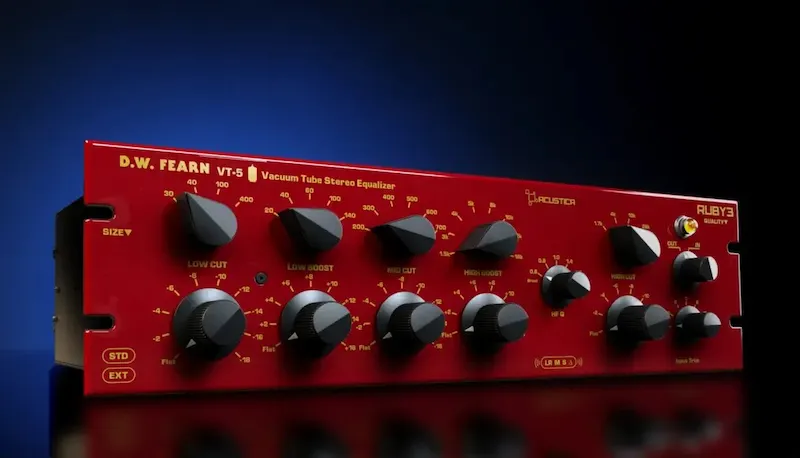
In a market saturated with “analog-style” plugins, very few tools genuinely replicate the behavior of real hardware. Acustica Audio’s Ruby 3 stands apart because it doesn’t just emulate frequency curves — it models the entire signal path of a tube equalizer, specifically the legendary D.W. Fearn VT-5.
This release is not a cosmetic update or incremental revision. Ruby 3 is built from one of the earliest VT-5 units ever produced — a personal reference device used by Doug Fearn himself. That distinction matters. Instead of averaging multiple units or approximating behavior, Acustica captured a specific piece of hardware with all its nuances, imperfections, and sonic identity intact.
Why Ruby 3 Is Fundamentally Different From Standard EQ Plugins
Most digital equalizers operate in a predictable, linear domain. You boost or cut frequencies, and the output responds accordingly. Ruby 3 operates on a completely different level. It models the interaction between passive EQ circuits and tube amplification stages — meaning every adjustment affects not just frequency balance, but harmonic content, phase response, and transient behavior.
- Passive EQ curves produce smooth, musical shaping
- Tube stages introduce harmonic saturation and density
- Signal response changes depending on input level
- Phase shifts occur naturally, not mathematically
This results in processing that feels integrated into the audio rather than layered on top of it. Instead of “fixing” frequencies, Ruby 3 reshapes tone in a way that mirrors high-end analog workflows.
NOVA Technology — The Core of the Sound
Ruby 3 runs on Acustica Audio’s NOVA (Neural Optimized Volterra Audio) engine. This hybrid modeling approach goes beyond static impulse responses and captures both linear and nonlinear behaviors across the entire dynamic range.
Traditional modeling often breaks down when signal levels change. Ruby 3 maintains consistency by modeling:
- Linear characteristics (frequency and phase response)
- Nonlinear behavior (harmonic distortion, saturation)
- Level-dependent variations in tone
This is critical in real-world mixing and mastering scenarios. The plugin reacts differently to quiet passages versus loud peaks, preserving the organic feel that engineers expect from analog gear.
Real-World Use Cases in Mixing and Mastering
Ruby 3 is not designed to replace your primary surgical EQ. It’s a tone-shaping tool intended for high-level decisions where musicality matters more than precision.
- Mix bus — adding cohesion, depth, and low-end weight
- Vocals — smoothing high frequencies without harshness
- Drums — enhancing punch while retaining natural dynamics
- Instrument groups — gluing elements together harmonically
A common mistake is trying to use it as a corrective EQ. That’s not its purpose. Ruby 3 excels at broad tonal moves and subtle enhancement rather than narrow cuts or problem-solving tasks.
In professional workflows, tools like this are used at the final stages of production. If the mix isn’t already balanced, no amount of analog-style processing will fix it. In those cases, it’s far more effective to rely on a structured approach through professional mixing and mastering services, where every stage is controlled and optimized.
Workflow Features and Monitoring Options
Ruby 3 includes a focused set of features designed to support critical listening and decision-making without cluttering the interface:
- Auto Gain for level compensation
- Monitoring modes: Left/Right, Mid/Side, Delta
- Real-time EQ visualization
- Factory presets for mixing and mastering chains
The Delta mode is particularly valuable. It allows engineers to hear only what the EQ is adding or removing, eliminating loudness bias and improving decision accuracy.
Performance and System Considerations
Ruby 3 is available in VST3, AU, and AAX formats, compatible with major DAWs on macOS and Windows. It supports sample rates up to 96 kHz and runs natively on Apple Silicon systems.
However, like most Acustica Audio plugins, it is CPU-intensive. This is not a tool you instantiate across dozens of tracks. It’s designed for targeted use — typically on buses or the master channel.
What’s New in Ruby 3
This version introduces meaningful improvements over previous iterations:
- More accurate modeling of the original VT-5 reference unit
- Improved coherence between clean and saturated signals
- Reduced high-frequency smearing
- Better dynamic response across varying input levels
These updates make Ruby 3 more predictable and reliable in critical mastering environments, where small changes have significant impact.
Final Assessment
Ruby 3 is a specialized tool with a clear purpose. It’s not a general-purpose EQ and won’t replace your entire processing chain. What it offers is character — depth, harmonic richness, and a sense of analog realism that standard digital tools struggle to achieve.
Used correctly, it enhances already well-balanced material and elevates it to a more competitive, polished level. Used incorrectly, it adds unnecessary complexity without meaningful improvement.
This is a finishing tool. And like any finishing tool, its value depends entirely on the quality of what comes before it.