LUX Orchestral Strings Essentials Review: A Practical Alternative to Oversized String Libraries?
LUX Orchestral Strings Essentials enters a market saturated with orchestral libraries that promise maximum realism through ever-expanding articulation counts, microphone options, and feature sets. The problem is that most professional scoring work rarely requires all of that complexity. Television cues, production music, documentary scores, trailer beds, and game soundtracks are often delivered under tight deadlines where speed, consistency, and predictability matter more than having access to every possible playing technique.
That is what makes LUX Orchestral Strings Essentials worth examining. Rather than competing for the title of the most comprehensive string library available, Sonuscore has positioned it as a streamlined version of its flagship LUX platform focused on the articulations composers use most frequently. The underlying question is not how many features have been removed. It is whether the remaining feature set covers the demands of real-world scoring work.
For working composers and producers, the value of a library is rarely determined by the length of its specification sheet. What matters is how quickly it moves from an initial sketch to a finished production, how easily it fits into a dense arrangement, and whether it continues to hold up once the music reaches the mixing and mastering stages.
Viewed through that lens, LUX Orchestral Strings Essentials is less a reduced version of a flagship product and more a test of whether modern orchestral workflows have become unnecessarily complicated. The answer depends on how much of a composer’s daily workload actually benefits from a larger library—and how much simply benefits from getting the job done faster.
- Why Streamlined Orchestral Libraries Matter in Modern Production
- What LUX Orchestral Strings Essentials Actually Includes
- LUX Orchestral Strings Essentials vs Full Version
- Kontakt Integration and Template Considerations
- The Real Workflow Question: What Is Missing?
- How the Library Fits Into Modern Mixing Workflows
- Critical Evaluation: Where the Marketing Meets Reality
- How LUX Orchestral Strings Essentials Compares to Major Alternatives
- Is LUX Orchestral Strings Essentials Worth It?
- Verdict
Why Streamlined Orchestral Libraries Matter in Modern Production
The orchestral sample market has reached a point where technical capability is no longer the primary limitation. Modern developers can capture hundreds of articulations, multiple microphone arrays, and enormous amounts of performance data. The result is a generation of orchestral libraries that are more detailed than ever, but not necessarily more efficient to use.
For many working composers, the bottleneck is no longer realism. It is workflow.
Television schedules, production music deadlines, game development cycles, and advertising projects rarely reward the composer who spends hours auditioning articulations. They reward the composer who can deliver convincing results quickly, make revisions without friction, and keep projects moving through the pipeline.
This reality has created growing demand for libraries that prioritize speed and usability over maximum depth. Rather than functioning as complete orchestral ecosystems, these products focus on the articulations and performance styles that appear most frequently in everyday scoring work.
The trend extends beyond a single developer. Across the industry, there has been increasing interest in smaller orchestral packages that reduce decision fatigue while retaining enough flexibility to produce professional results. The appeal is not simply lower cost. It is the ability to spend less time navigating the library and more time writing music.
LUX Orchestral Strings Essentials enters the market with that exact premise. Instead of competing with flagship collections on articulation count or feature density, it targets composers who need a dependable string section available immediately, without the overhead that often accompanies larger orchestral platforms.
Whether that approach succeeds depends less on what has been removed and more on whether the remaining tools cover the demands of real-world scoring sessions. For many composers working under deadlines, that distinction is far more important than the size of the library itself.
What LUX Orchestral Strings Essentials Actually Includes
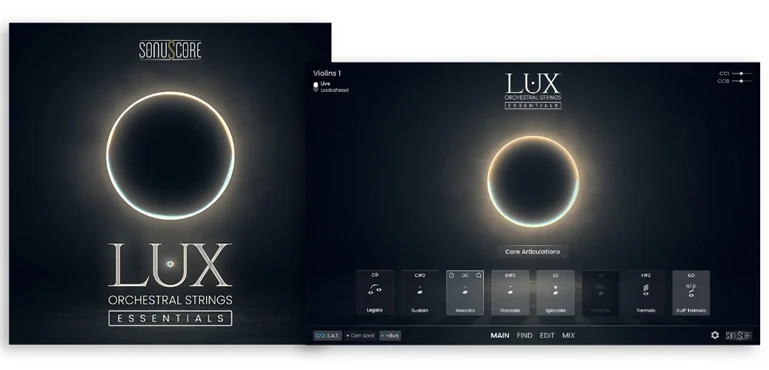
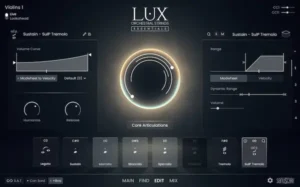
 LUX Orchestral Strings Essentials includes the five core sections of a traditional orchestral string ensemble: 1st Violins, 2nd Violins, Violas, Celli, and Basses. Each section is provided as an independent Kontakt instrument rather than being locked into pre-built ensemble patches.
That design choice has practical implications beyond orchestration. Separate sections allow composers to shape internal balances, build more convincing stereo depth, and make targeted adjustments during mixing without affecting the entire string arrangement. It also creates more flexibility when layering strings alongside synths, percussion, guitars, or modern production elements.
Many compact orchestral libraries prioritize speed by collapsing everything into ensemble-based workflows. While that approach can accelerate sketching, it often becomes limiting once a cue reaches the mix stage. Being able to independently control violins, violas, celli, and basses remains one of the most valuable advantages of a traditional orchestral structure.
Just as important is the character of the recordings themselves. Based on Sonuscore’s design philosophy and the relationship to the flagship LUX platform, Essentials appears to favor a modern cinematic sound rather than an aggressively processed trailer aesthetic. The ensemble tone sits in a versatile middle ground that can support traditional orchestral writing, contemporary media scoring, and hybrid productions without immediately pushing the composer toward a specific genre.
Legato behavior may ultimately prove more important than the articulation count. In real-world scoring, composers spend far more time writing connected melodic passages than triggering specialty articulations. If the legato transitions retain the smoothness and consistency associated with the full LUX platform, many users are likely to spend more time evaluating playability and phrasing than worrying about missing articulations.
From a tonal perspective, LUX Orchestral Strings Essentials appears positioned closer to modern media scoring than traditional concert-hall realism. The overall character favors clarity, control, and mix compatibility rather than oversized cinematic weight. That balance may prove particularly useful for television, production music, and hybrid orchestral work where strings must coexist with percussion, synthesizers, sound design, and dialogue rather than dominate the entire arrangement.
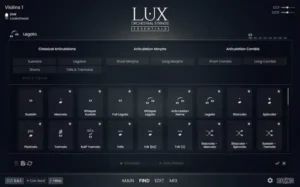
The articulation set reflects a similar philosophy. Rather than attempting to cover every possible playing technique, Essentials focuses on the articulations most commonly used across television, trailer, documentary, production music, and game scoring workflows.
Sustain options include standard sustains, stronger dynamic sustains, whisper sustains, and marcato variations. Legato performance is available in both standard and whisper versions, providing enough variation to move between exposed melodic writing and softer underscoring without constantly changing instruments.
Short articulations are limited to staccato, spiccato, and pizzicato. On paper, that may seem conservative. In practice, those three articulations account for a large percentage of modern media scoring, particularly in projects where efficiency matters more than exhaustive performance detail.
Tremolos, sul ponticello tremolos, and interval trills extend the library into more cinematic territory. These articulations are frequently used to create tension, movement, and harmonic instability in suspense cues, trailers, documentaries, and dramatic television scoring.
The most workflow-oriented feature is the collection of articulation combinations. Instead of forcing composers to build every layered texture manually, the library includes pre-configured combinations such as sustain with tremolo, sustain with sul ponticello tremolo, tremolo with marcato, whisper with tremolo, and various short-articulation blends.
For composers working against deadlines, these combinations may prove more valuable than an expanded articulation catalog. They allow movement and complexity to emerge quickly without relying on extensive key-switch programming, multiple layered tracks, or time-consuming articulation management. Whether they become a genuine productivity advantage depends on execution, but the concept is clearly aimed at reducing friction during everyday scoring sessions rather than maximizing feature count.
LUX Orchestral Strings Essentials vs Full Version
For many composers, the most important buying decision is not whether LUX Orchestral Strings Essentials sounds good. It is whether the reduced feature set removes anything that will affect day-to-day work.
The Essentials edition retains the same core orchestral concept, recording environment, and ensemble foundation as the full LUX Orchestral Strings library. The difference is not the underlying sound character but the amount of control and articulation depth available to the user.
For television scoring, production music, documentaries, game cues, and hybrid orchestral projects, the Essentials articulation set covers a large percentage of real-world writing scenarios. Most composers in these environments spend far more time working with sustains, legatos, shorts, tremolos, and dynamic layering than with highly specialized performance techniques.
The full version becomes more attractive when projects demand extensive articulation variety, advanced mockup realism, or highly exposed orchestral writing. In those situations, additional performance options can provide greater expressive control and more convincing musical detail.
Viewed practically, Essentials is aimed at composers who prioritize output speed and workflow efficiency. The full version is aimed at composers who regularly require the highest possible level of orchestral flexibility. Neither approach is inherently better; they simply solve different production problems.
Kontakt Integration and Template Considerations
For professional composers, compatibility is often just as important as the library itself. LUX Orchestral Strings Essentials runs within Kontakt, making it relatively easy to integrate into existing scoring templates without introducing an entirely new playback environment.
This matters because many media composers already manage large multi-library orchestral setups. A library that fits naturally into established Kontakt workflows typically creates less friction during project delivery, revisions, and template maintenance than a platform that requires separate ecosystem management.
Users should still verify current Kontakt requirements before purchasing, particularly if they rely on Kontakt Player compatibility or maintain legacy production systems. For composers already working inside Kontakt-based orchestral templates, Essentials also benefits from predictable session management. Existing routing structures, articulation workflows, and multi-library setups generally require fewer adjustments than migrating to an entirely separate playback ecosystem.
The Real Workflow Question: What Is Missing?
The value of any scaled-down orchestral library is determined less by what it includes than by what has been left out. That is where many “Essentials” products struggle. Some remove genuinely useful tools in order to create artificial separation from a flagship product. Others trim features that rarely affect real-world work.
LUX Orchestral Strings Essentials appears closer to the latter approach. Looking at the articulation list, most of the omissions are unlikely to impact composers working in production music, television, advertising, documentaries, or game audio. The core writing tools remain intact, and the library covers the articulations responsible for a large percentage of everyday scoring tasks.
The limitations become more apparent when projects demand a higher degree of orchestral realism. Detailed mockups often rely on subtle articulation changes, performance-specific bowing techniques, and extensive layering to create the illusion of a live ensemble. In those situations, articulation depth is not simply a luxury—it becomes part of the performance itself.
A sustained chord progression under dialogue places very different demands on a library than a fully exposed orchestral passage carrying the emotional weight of a scene. The former can succeed with a focused articulation set. The latter often requires a broader range of performance options to avoid sounding programmed.
That distinction matters because the phrase “professional results” can mean very different things depending on the production environment. For a production music composer delivering multiple cues per day, professional results are measured by speed, consistency, and reliability. For a film composer building a detailed orchestral mockup intended to compete with a live recording session, the requirements are significantly higher.
Viewed through that lens, LUX Orchestral Strings Essentials is not trying to replace a deep orchestral programming environment. It is trying to cover the work that occupies most composers most of the time. For deadline-driven scoring, that approach makes sense. For composers whose workflow revolves around highly exposed orchestral writing, the library is more likely to function as a fast sketching tool than a complete long-term solution.
How the Library Fits Into Modern Mixing Workflows
 One of the most important questions for any orchestral library is not how it sounds during composition, but how it behaves once a project reaches the mixing stage. This is where many string libraries reveal their strengths—and their weaknesses.
It is relatively easy for a string section to sound impressive in a solo demonstration. The challenge begins when those same strings must coexist with the rest of a modern production. Contemporary scoring projects rarely consist of orchestral instruments alone. Strings are routinely layered with synthesizers, hybrid percussion, low-frequency impacts, cinematic sound design, guitars, vocals, and electronic elements competing for the same space.
In that environment, articulation count becomes less important than arrangement efficiency. A library packed with options can encourage excessive layering, which often creates problems later in the mix. Dense orchestration may sound larger during production but frequently results in reduced separation, increased masking, and a loss of perceived depth once the entire arrangement is playing.
This is where a focused library can offer an unexpected advantage. By limiting the number of available choices, composers are often forced to make stronger orchestration decisions earlier in the process. Instead of solving musical problems by adding more layers, they are encouraged to create contrast through voicing, dynamics, and section placement.
Separate control of the five string sections also remains valuable throughout mixing. Violins, violas, celli, and basses occupy different spectral regions and perform different roles within an arrangement. Independent access to those sections makes it easier to manage low-mid buildup, maintain clarity through dense passages, and create a more believable sense of depth without relying heavily on corrective processing.
Those decisions also influence what happens later during mastering. Problems that seem minor inside a mix often become far more obvious during final evaluation, particularly in dense orchestral productions. Understanding the distinction between these stages is critical, as many issues attributed to mastering actually originate much earlier in the production process. Learn more in our guide to Mixing vs Mastering.
This becomes particularly important in production music, television, and trailer work, where cues are often judged within seconds. Music supervisors, editors, and clients are rarely evaluating articulation complexity. They are responding to impact, clarity, emotional communication, and how effectively the arrangement supports the visual content.
From a mixing perspective, that often favors disciplined orchestration over maximum orchestral detail. If LUX Orchestral Strings Essentials preserves the recording quality and ensemble character of the flagship library, its streamlined design may prove less restrictive than many composers initially assume. In practical production environments, fewer options can sometimes lead to cleaner mixes, faster decisions, and more effective results.
Why String Libraries Often Sound Different After Release
One of the least discussed aspects of orchestral sample libraries is playback translation. A string arrangement that feels wide, detailed, and emotionally engaging in the studio can behave very differently once it leaves the DAW and reaches real-world playback systems.
The library itself is rarely the problem. More often, issues emerge from the way sampled strings interact with the rest of a production.
Large orchestral arrangements naturally generate substantial energy across the low-midrange, particularly when multiple sections are layered through sustains, legato passages, and long harmonic movements. During composition, that density is often perceived as warmth, size, or cinematic weight. After release, the same density can reduce separation, narrow perceived depth, and make arrangements feel less defined on consumer playback systems.
The problem becomes more obvious when orchestral strings are combined with modern production elements. Hybrid percussion, synthesizers, impacts, sub-bass layers, and sound design all compete for space in frequency ranges already occupied by celli, violas, and lower violin registers. Without careful orchestration and mixing, the arrangement may sound impressive in isolation yet lose clarity once everything is playing simultaneously.
Streaming distribution introduces another variable. Platform normalization does not directly damage orchestral music, but it can expose balance issues that were less noticeable during production. Dense arrangements with limited contrast often feel smaller after normalization than composers expect, particularly on headphones, televisions, laptops, and Bluetooth speakers where low-mid congestion becomes more apparent.
This is one reason why orchestration discipline remains more important than library size. Additional articulations and layered performance options can increase realism, but they can also encourage arrangements that become unnecessarily crowded. A focused library often forces composers to rely on voicing, dynamics, and section writing rather than continuously adding layers to create perceived complexity.
That does not remove the need for proper mixing or mastering. It simply reduces the number of opportunities for arrangement decisions to create translation problems later in the production chain. In practice, the projects that survive distribution most effectively are rarely the most complex. They are the projects where every section has a clear purpose and enough space to remain intelligible across a wide range of playback environments.
Critical Evaluation: Where the Marketing Meets Reality
Sonuscore presents LUX Orchestral Strings Essentials as the version many composers will use most often. From a workflow perspective, that claim is difficult to dismiss. The majority of professional scoring work does not require a massive articulation catalog. Most deadlines are driven by delivery schedules, revision requests, and production demands rather than the need for highly specialized string techniques.
For television, production music, advertising, documentaries, and many game audio projects, speed frequently outweighs orchestral completeness. A cue that is finished, approved, and delivered on time has more value than a technically superior cue that misses its deadline. Viewed from that angle, reducing complexity can be a legitimate advantage rather than a compromise.
The challenge is determining whether the reduction has been made in the right places.
Many “Essentials” products are built around product segmentation rather than workflow optimization. Features are removed not because they are unnecessary, but because they help create distance between entry-level and flagship versions. The result is often a library that feels artificially constrained, forcing users toward an upgrade as projects become more demanding.
LUX Orchestral Strings Essentials avoids much of that problem. The articulation selection appears focused on commonly used scoring techniques rather than being restricted to the point of frustration. Most composers working in deadline-driven environments are unlikely to encounter major limitations during routine production work.
That does not mean the library is without boundaries. Composers creating highly exposed orchestral passages, detailed mockups, or productions where realism is the primary objective will eventually reach the limits of a streamlined articulation set. Advanced orchestral writing often depends on subtle performance variations, specialized bowing techniques, and articulation transitions that extend beyond the scope of an Essentials product.
The distinction is important because “professional results” can describe very different outcomes. A production music cue licensed for television, a documentary underscore, and a feature-film mockup can all be considered professional productions while placing completely different demands on a string library.
In practical terms, the strongest argument for LUX Orchestral Strings Essentials is not that it competes directly with flagship orchestral collections. It is that many composers spend far more time paying for articulation depth than actually using it. If a library covers the techniques required for the vast majority of scoring sessions while reducing friction inside the workflow, it may deliver more value than a larger collection that remains underutilized.
For composers who routinely work under deadlines, that may be the most relevant measure of success. The question is not whether a flagship library can do more. The question is whether those additional capabilities contribute meaningfully to the work being delivered every week.
How LUX Orchestral Strings Essentials Compares to Major Alternatives
Evaluating LUX Orchestral Strings Essentials in isolation only tells part of the story. The more important question is where it fits within a market already dominated by mature orchestral platforms. Most composers considering Essentials are not choosing their first string library. They are deciding whether its workflow advantages outweigh the additional depth offered by more established competitors.
| Library | Primary Focus | Workflow Speed | Articulation Depth | Best Fit |
|---|---|---|---|---|
| LUX Orchestral Strings Essentials | Fast professional scoring workflows | High | Moderate | Production music, TV, documentaries, game audio |
| Cinematic Studio Strings | Realistic orchestral performance | Medium | High | Film scoring, detailed mockups |
| Spitfire Symphonic Strings | Large-scale cinematic writing | Medium-Low | Very High | Epic orchestral productions |
| Berlin Strings | Advanced orchestral programming | Medium-Low | Very High | Professional orchestration and mockups |
| Hollywood Strings | Traditional Hollywood scoring sound | Medium | High | Film, television, trailer composition |
| Spitfire Originals Epic Strings | Quick sketching and entry-level scoring | Very High | Low | Beginners, lightweight workflows |
One of the most relevant comparisons may be against Spitfire Originals. While both product lines target composers seeking faster workflows, their priorities differ. Spitfire Originals typically emphasizes immediacy and lightweight sketching, whereas LUX Orchestral Strings Essentials retains greater section-level control and a broader articulation palette. For composers balancing speed with orchestration flexibility, that difference may prove more significant than raw library size.
The closest competitors are not necessarily the largest orchestral libraries on the market. In practice, Essentials sits between lightweight sketching tools and full-scale orchestral ecosystems. It offers considerably more control than entry-level products while avoiding much of the operational overhead associated with flagship collections.
Cinematic Studio Strings, Berlin Strings, and Spitfire Symphonic Strings remain stronger choices for composers whose work depends on maximum realism and deep articulation control. Those libraries were designed for users willing to invest significant time into programming, orchestration, and detailed performance shaping.
Essentials targets a different workflow. Its value proposition is not orchestral completeness. It is efficiency. The library focuses on the articulations that appear most frequently in commercial scoring environments, reducing the amount of time spent navigating large patch collections or building elaborate articulation templates.
That distinction becomes increasingly relevant as project deadlines shrink. Many composers spend far more time producing television cues, production music tracks, game assets, and commercial work than they do building feature-film mockups. In those environments, the ability to move from concept to finished cue quickly can be more valuable than having access to every possible performance variation.
This positioning ultimately places LUX Orchestral Strings Essentials in a category that is becoming increasingly important within the industry: professional libraries designed around output rather than maximum feature count. Composers looking for the deepest orchestral toolkit available will find more comprehensive options elsewhere. Composers looking for a library that stays out of the way and allows work to move forward may find Essentials occupies a far more practical middle ground.
Who Should Consider LUX Orchestral Strings Essentials?
 LUX Orchestral Strings Essentials is best suited to composers whose primary challenge is not achieving maximum realism, but delivering finished work efficiently. The library’s design aligns most closely with production environments where deadlines, revisions, and output volume have a greater impact on workflow than access to highly specialized articulations.
That includes production music composers, television scorers, documentary composers, trailer producers, game audio professionals, and hybrid orchestral writers. These workflows often demand cues that sound convincing immediately, integrate easily with modern production elements, and remain manageable across multiple revisions. In those situations, speed and consistency frequently provide more value than an extensive articulation catalog.
The library is also a logical option for producers expanding beyond synthetic strings and into more traditional orchestral writing. Because the individual string sections remain separated, users can build realistic arrangements, learn orchestral balance, and develop stronger scoring techniques without committing to the complexity and cost of a flagship orchestral platform.
Perhaps the strongest fit is the composer who spends more time finishing cues than building templates. Many modern scoring projects require dozens of deliverables rather than a single highly detailed orchestral mockup. For that type of work, a streamlined library often becomes a practical production tool rather than a compromise.
Ultimately, Essentials makes the most sense for users who view orchestral samples as part of a broader production workflow. If the goal is delivering music efficiently while maintaining a professional orchestral sound, its focused feature set may prove more useful than a significantly larger library that introduces additional complexity without improving day-to-day output.
Who May Outgrow the Library Quickly?
The strongest criticism of LUX Orchestral Strings Essentials is also the tradeoff that makes the library attractive in the first place. A streamlined workflow inevitably comes at the expense of orchestral depth.
For many commercial scoring applications, that compromise is unlikely to matter. For others, it may become apparent relatively quickly.
Composers working on highly exposed orchestral material typically require a greater level of performance control than a compact library can provide. When strings are carrying the emotional weight of a scene without support from percussion, sound design, synth layers, or dialogue, the realism of individual articulations becomes significantly more important. Small performance details that might be hidden inside a dense production become immediately audible.
This is particularly relevant for film composers building detailed mockups intended to approach the realism of a live orchestra. In that environment, articulation variety is not simply a feature list advantage. It directly affects phrasing, expression, transitions, and the perceived authenticity of the performance.
Professional orchestrators and composers working primarily with orchestral music may encounter similar limitations. As projects become more sophisticated, the ability to access specialized playing techniques, alternative performance styles, and nuanced articulation changes often becomes part of the creative process rather than an optional enhancement.
The same applies to users who treat sample libraries as substitutes for live recording sessions. The closer a production needs to resemble a real orchestra, the more valuable advanced articulation depth becomes. No streamlined library can fully eliminate the gap between efficient scoring workflows and highly detailed orchestral emulation.
That does not mean Essentials is underpowered. It simply means the library has a clearly defined scope. It is designed to accelerate common scoring tasks, not to serve as the final destination for every type of orchestral production.
For composers whose work revolves around broadcast cues, production music, trailers, documentaries, and hybrid scoring, that limitation may never become significant. For users pursuing maximum orchestral realism, a flagship platform remains the more appropriate long-term investment.
Real-World Production Perspective: Beyond the Demo Videos
Most sample library demos answer a relatively simple question: can the library sound impressive under ideal conditions? What they rarely demonstrate is how those sounds behave inside a finished production.
Commercial releases operate under very different constraints than promotional showcases. Strings must coexist with dialogue, sound design, percussion, synthesizers, vocals, and a wide range of competing elements. They must survive compression, encoding, streaming delivery, and playback on systems that bear little resemblance to the monitoring environments used during production.
This is where orchestration decisions become more important than the size of the library itself.
Many composers assume that realism problems originate from the samples. In practice, the more common issue is arrangement density. Layers accumulate, articulations overlap, and multiple sections compete for the same musical role. The result is a cue that sounds large in isolation but loses definition once placed against picture or combined with the rest of the production.
Libraries with extensive articulation catalogs can sometimes make this problem worse. More options create more opportunities to layer information that does not meaningfully contribute to the cue. Complexity increases while clarity decreases.
A focused library encourages a different workflow. Instead of continuously searching for additional articulations, the composer is forced to concentrate on orchestration, dynamics, and section interaction. Those decisions have a far greater impact on how a cue translates outside the studio than the presence of another variation of a sustain or short articulation.
This becomes particularly relevant in television, production music, and trailer work, where cues are often consumed through headphones, laptop speakers, mobile devices, televisions, and small Bluetooth systems. On those playback systems, clear musical roles and controlled orchestration tend to survive far better than dense arrangements built around articulation complexity.
Viewed from a production perspective, one of the more interesting aspects of LUX Orchestral Strings Essentials is not what it includes, but what it discourages. By reducing unnecessary decision points, the library naturally pushes users toward cleaner arrangements and faster creative decisions. In many commercial scoring environments, those qualities have a greater impact on the finished result than access to a larger collection of articulations.
Mixing Considerations for Modern Streaming Releases
Orchestral music is no longer confined to film soundtracks and concert recordings. Today, string-based productions are routinely distributed through the same streaming platforms that host pop, hip-hop, electronic, and cinematic hybrid releases. As a result, orchestral mixes face many of the same translation challenges as contemporary commercial music.
String arrangements are particularly vulnerable because they occupy a broad portion of the frequency spectrum while generating substantial harmonic density. What sounds rich and immersive inside a studio can quickly become congested when reproduced on headphones, soundbars, laptop speakers, televisions, or consumer Bluetooth systems.
Many composers mistakenly assume that streaming platforms alter orchestral music primarily through loudness reduction. In reality, playback normalization interacts with balance, dynamics, and arrangement choices already present in the mix. Understanding how loudness normalization works helps explain why some orchestral productions translate better than others. See our detailed LUFS Mastering Guide.
Several problems appear repeatedly in orchestral mixes regardless of which library was used. Low-mid accumulation between violas, celli, and supporting instruments can reduce clarity. Layered sustains often create masking that obscures important melodic movement. Excessive stereo width may sound impressive on studio monitors while becoming unstable on smaller playback systems. Dense legato passages can lose separation after lossy encoding, particularly when multiple sections occupy similar frequency ranges.
These issues are rarely caused by the sample library itself. More often, they are symptoms of orchestration and arrangement decisions made earlier in the production process. A larger library does not automatically solve them. In some cases, it can make them more difficult to identify because additional articulations encourage further layering rather than refinement.
This is where the philosophy behind LUX Orchestral Strings Essentials becomes relevant. A smaller, more focused articulation set naturally shifts attention away from feature exploration and toward balance, dynamics, voicing, and section interaction. Those factors play a far greater role in playback translation than the number of articulations available inside the library.
From a mixing perspective, successful orchestral productions are rarely defined by the complexity of their templates. They are defined by how effectively each section occupies its role within the arrangement. When strings remain intelligible across streaming platforms and playback systems, the underlying orchestration is usually doing more work than the sample library itself.
Mastering Perspective: Why String Libraries Reveal Problems Late
Orchestral string libraries often expose production problems later than almost any other instrument category. A cue can sound polished during composition, survive the mixing stage, and still reveal weaknesses once mastering begins.
The reason is largely spectral. Strings generate dense harmonic information across a wide frequency range, particularly when multiple sections are layered through sustains, legato passages, and stacked voicings. Small balance issues that seem insignificant during writing can become much more obvious when the entire production is evaluated as a finished master.
One of the most common problems is low-mid accumulation. As arrangements become denser, violas, celli, basses, piano, percussion, synth layers, and other supporting elements often begin competing for the same space. The mix may retain its apparent size while losing definition, separation, and perceived depth.
Mastering frequently exposes these issues because there are fewer places left to hide them. Once the arrangement, orchestration, and mix decisions are locked, the underlying structure of the production becomes easier to evaluate. Congestion between sections, unstable stereo imaging, flattened dynamics, and a lack of front-to-back depth often become more apparent than they were earlier in the process.
This is one reason why mastering sometimes appears to “cause” problems that were already present in the production. In reality, the process often reveals weaknesses that were masked during composition and mixing. We explore this phenomenon in greater detail in our guide to common mastering problems.
This is why experienced mastering engineers rarely view orchestral translation problems as a sample library issue. In most cases, the library simply reveals decisions that were made during composition and mixing. A larger articulation catalog cannot compensate for an arrangement where too many elements occupy the same musical role.
From that perspective, one of the practical advantages of LUX Orchestral Strings Essentials may be its restraint. A more focused workflow encourages composers to solve musical problems through orchestration, voicing, and dynamics rather than continuous layering. Those decisions tend to have a far greater impact on mastering outcomes than access to additional articulations.
For composers releasing soundtrack albums, production music catalogs, streaming singles, or commercial media cues, the ability to maintain clarity throughout the production chain is often more valuable than having the deepest feature set available. A string library that promotes cleaner arrangements can ultimately contribute more to a successful master than one that simply offers more options.
Is LUX Orchestral Strings Essentials Worth It?
The answer depends less on orchestral experience and more on workflow priorities.
Composers searching for the deepest possible string library will find more comprehensive options elsewhere. Libraries from Spitfire, Orchestral Tools, Cinematic Studio Series, and EastWest offer greater articulation depth and more extensive programming possibilities.
LUX Orchestral Strings Essentials becomes compelling when speed, efficiency, and reliability are more valuable than maximum feature count. For production music writers, television composers, documentary scorers, and game audio professionals, reducing friction inside the creative process can often produce a greater return than acquiring additional articulations that remain unused.
Its strongest value proposition is not affordability or simplicity. It is the possibility of reaching finished results faster while retaining enough orchestral control to produce professional work.
Perhaps the most important consideration is that Essentials is competing less against other libraries and more against unused complexity. Many composers already own orchestral collections capable of far more than their daily workload requires. The value of Essentials lies in reducing friction between an idea and a finished cue rather than maximizing the number of available features.
Verdict
LUX Orchestral Strings Essentials succeeds because it addresses a problem that many orchestral libraries ignore: most professional scoring work is constrained by time, not by a lack of articulations.
Rather than competing directly with flagship collections, Sonuscore has built a library around the techniques composers use most frequently. The result is a streamlined orchestral tool that prioritizes speed, usability, and day-to-day productivity over exhaustive depth.
That approach will not satisfy every user. Composers focused on detailed orchestral mockups, advanced performance programming, or achieving the highest possible level of realism will eventually reach the limits of the library. Larger platforms from Cinematic Studio Series, Orchestral Tools, Spitfire Audio, and EastWest still offer significantly greater flexibility for those workflows.
For production music, television scoring, documentaries, trailer cues, game audio, and hybrid orchestral productions, the equation looks different. In these environments, the ability to move quickly from an idea to a finished cue often matters more than access to dozens of additional articulations that may rarely be used.
What makes LUX Orchestral Strings Essentials compelling is not that it replaces flagship libraries. It is that many composers do not actually need flagship libraries for the majority of the work they deliver. The library covers the core techniques required for modern media scoring while maintaining enough orchestral control to remain useful beyond simple sketching.
As with any orchestral production tool, the final result depends far more on orchestration, mixing decisions, and preparation before mastering than on the library alone. Before sending a soundtrack, production music cue, or orchestral release for mastering, it is worth reviewing the key technical considerations outlined in our guide on how to prepare a mix for mastering.
Ultimately, LUX Orchestral Strings Essentials is best viewed as a production-focused string library rather than a reduced version of a larger product. Composers looking for maximum depth will find more comprehensive options elsewhere. Composers looking for a practical, efficient, and professional orchestral workflow may find that Essentials covers far more real-world work than its specification sheet suggests.

Yurii Ariefiev is a mastering engineer and audio production editor who regularly evaluates orchestral, cinematic, hybrid, and soundtrack productions before release. His work focuses on how complex arrangements translate across streaming platforms, consumer playback systems, and real-world listening environments.
This review examines LUX Orchestral Strings Essentials from a production and mastering perspective, focusing on workflow efficiency, arrangement density, mix translation, and the practical factors that determine whether orchestral libraries perform successfully beyond demo videos and marketing claims.
FAQ
How does LUX Orchestral Strings Essentials compare to the full LUX Orchestral Strings library?
The Essentials edition focuses on the articulations most composers use daily, while the full library offers greater articulation depth, expanded performance options, and increased programming flexibility. For television, production music, documentary scoring, and many game audio projects, Essentials may cover the majority of practical writing scenarios. The full version becomes more attractive when orchestral realism and mockup detail take priority over workflow efficiency.
Is LUX Orchestral Strings Essentials suitable for professional film scoring?
It depends on the type of film scoring. The library is well suited to documentaries, independent films, television work, trailers, and production music. Composers creating highly exposed orchestral mockups for major film productions may eventually require a deeper articulation set.
How does LUX Orchestral Strings Essentials compare to Cinematic Studio Strings?
Cinematic Studio Strings offers more detailed performance programming and a higher ceiling for orchestral realism. LUX Orchestral Strings Essentials prioritizes workflow efficiency, faster setup, and a smaller decision-making footprint during composition.
Can LUX Orchestral Strings Essentials handle trailer music production?
Yes. The inclusion of marcatos, tremolos, sul ponticello tremolos, trills, and layered articulations makes it capable of creating tension, movement, and dynamic builds commonly used in modern trailer scoring.
Does LUX Orchestral Strings Essentials require Kontakt?
Yes. Before purchasing, users should verify the current Kontakt version requirements and whether the library runs in Kontakt Player or requires the full version of Kontakt.
Is LUX Orchestral Strings Essentials a good choice for production music composers?
Production music is arguably one of its strongest applications. The library focuses on articulations that appear regularly in broadcast, licensing, advertising, and television cue production, making it well aligned with high-output workflows.
How demanding is the library on CPU and system resources?
Actual performance depends on template size, storage speed, RAM availability, and Kontakt configuration. However, a more focused articulation set generally results in lighter project management and lower resource demands than many flagship orchestral collections.
Can LUX Orchestral Strings Essentials replace Spitfire Originals?
Not necessarily. Spitfire Originals and LUX Orchestral Strings Essentials target similar workflow-oriented users but take different approaches. Originals focuses on simplicity and fast sketching, while Essentials provides greater section-level control and a broader articulation selection for more detailed scoring work.
Can LUX Orchestral Strings Essentials work alongside synths and hybrid scoring elements?
Yes. The library is particularly well suited to hybrid orchestral workflows where strings need to integrate with synthesizers, impacts, percussion, pulses, sound design layers, and modern cinematic production techniques.
Does the library include enough articulations for realistic orchestral writing?
For many professional scoring applications, yes. The included articulations cover a large percentage of day-to-day orchestral writing. Composers seeking highly specialized performance techniques may require a more comprehensive library.
Will a better string library improve mixing and mastering results?
Not necessarily. Most orchestral translation issues originate from orchestration, arrangement, and mix decisions rather than the library itself. Strong voicing, balance, and section management usually have a greater impact on the final result than additional articulations.
Is LUX Orchestral Strings Essentials a replacement for a flagship orchestral library?
For some composers, it may be. For others, it functions as a faster and more focused complement to a larger orchestral setup. The answer depends on whether your workflow prioritizes efficiency or maximum orchestral depth.
Who will get the most value from LUX Orchestral Strings Essentials?
Composers working under deadlines, production music writers, television and documentary scorers, game audio professionals, and hybrid producers are the most likely to benefit from its balance of speed, flexibility, and professional orchestral sound.