Forma Labs Filament Review: Real-Time MIDI Orchestration, Workflow, and Limitations
Forma Labs Filament tackles a specific problem in modern orchestral production: turning one MIDI performance into a controlled multi-instrument arrangement without building the routing architecture first. The plugin hosts instruments, redistributes incoming notes, reshapes voicings, and switches between orchestration setups from a single environment.
Filament is not a sample library or an automatic arranger. It sits between the performance and the instruments, controlling how musical information is divided across the setup. For composers working with large templates, that can shorten the distance between playing an idea and hearing it as an arrangement. The same architecture also applies to hybrid scoring, layered synth systems, and sound-design setups that would otherwise require multiple tracks and separate MIDI routing.
The important question is not whether Filament can send one chord to several instruments. Basic MIDI tools have done that for years. What matters is whether combining instrument hosting, voicing, switchable orchestration states, arpeggiation, and internal routing produces a faster working system than conventional DAW templates—and whether that advantage survives once the project moves from writing into detailed editing and mixing.
Quick Verdict
Forma Labs Filament is one of the more ambitious attempts to turn multi-instrument orchestration into a playable real-time workflow rather than a routing exercise. Its strongest advantage is the ability to host instruments, redistribute notes, reshape voicings, and switch ensemble behavior inside one environment. The main limitation appears later: detailed editing, troubleshooting, rendering, and session handoff remain more transparent in a conventional track-based DAW template.
Filament is most convincing for composers and hybrid producers who make arrangement decisions while performing. It is much less essential for users who already have a mature orchestral template or prefer to construct productions one track at a time.
Forma Labs Filament Pros and Cons
| Pros | Cons |
|---|---|
| Fast real-time control of complex multi-instrument setups | Less transparent than conventional DAW tracks during detailed editing |
| Hosts up to 64 AU or VST3 instruments in one environment | Large centralized setups can complicate troubleshooting |
| Chord revoicing goes beyond simple MIDI splitting and layering | Requires a deliberate render and stem strategy for professional handoff |
| Strong workflow for hybrid scoring, synth layers, and performance-driven composition | CPU and memory efficiency depend heavily on the hosted instruments |
| Keyswitchable configurations, arpeggiators, and MIDI clips support reusable performance systems | Less valuable for producers who already have a fast, mature orchestral template |
What Is Forma Labs Filament?
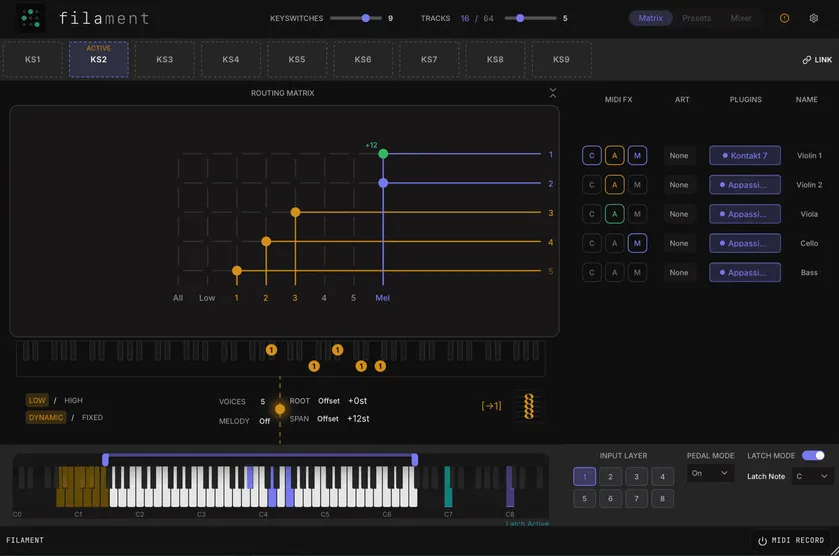
Forma Labs Filament is a real-time MIDI orchestration plugin and standalone application for Windows and macOS. It can host up to 64 AU or VST3 instruments inside one environment, then distribute, revoice, transpose, arpeggiate, sequence, and route incoming MIDI across those instruments while the user performs.
Unlike a sample library, Filament does not provide the orchestral sounds itself. It controls compatible virtual instruments and sample players that the producer already owns. Its main tools include a 64-output routing matrix, chord revoicing, per-instrument arpeggiators, MIDI clip launching, keyswitch-based orchestration changes, mixer configurations, and more than 100 presets.
The practical goal is to make a large collection of virtual instruments behave like one playable system without requiring the composer to build every relationship through separate DAW routing first.
Forma Labs Filament: Price, Formats, and Key Specifications
| Developer | Forma Labs Audio |
| Product Type | Real-time MIDI orchestration engine and instrument host |
| Plugin Formats | VST3 and AU |
| Standalone Version | Yes |
| Operating Systems | Windows and macOS |
| Maximum Hosted Instruments | Up to 64 AU or VST3 instruments |
| Core MIDI Tools | Routing, chord revoicing, transposition, arpeggiation, MIDI clips, and keyswitch-based configurations |
| Factory Presets | 100+ |
| Regular Price | £149 |
Why Large Templates Still Slow Down the Writing Process
 Modern composers do not lack sounds. They lack fast ways to control large collections of them without turning composition into session management.
A scoring template may contain dozens or hundreds of tracks, while even a modest hybrid production can combine orchestral sections, solo instruments, percussion, synth layers, and processed textures. A DAW can store that architecture efficiently, but storage is not the same as playability. One chord from a MIDI controller still has to be split, voiced, transposed, filtered, or routed according to what each instrument is supposed to contribute.
The conventional solution is to do the work in advance: build the template, assign MIDI channels, create routing, configure articulation maps, save track stacks, and preserve useful combinations as presets. A well-designed template can be extremely fast, but only after substantial preparation. As the instrument count grows, so does the cost of maintaining routing, track states, library changes, and project-specific variations.
Filament shifts that work closer to the performance itself. Instead of starting with destination tracks and deciding what each one should receive, it starts with the incoming MIDI and determines how that material should be distributed across the ensemble. A single gesture can produce several coordinated parts without forcing every hosted instrument to play the same notes in the same register.
That distinction matters under real production pressure. A media composer working to picture may need to test three orchestration ideas before one survives the scene. A hybrid producer may want to hear how strings, brass, synths, and rhythmic layers interact before committing them to separate tracks. Auditioning those relationships one part at a time interrupts the decision the producer is trying to make.
Real-time orchestration does not write the arrangement. Its practical value is narrower: it shortens the path between playing an idea and hearing how that idea behaves across multiple instruments.
This is where Filament differs from a conventional MIDI utility. It combines routing logic with instrument hosting and performance control inside the DAW. The result is effectively a production subsystem: one plugin instance can contain an ensemble, define how that ensemble responds to incoming MIDI, and preserve multiple orchestration behaviors without rebuilding the surrounding session.
How Forma Labs Filament Rebuilds the MIDI-to-Instrument Workflow
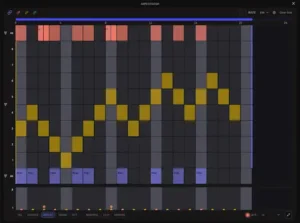
Filament’s workflow begins with an architectural choice: one instance can host up to 64 AU or VST3 instruments alongside the logic that controls them. MIDI distribution and sound generation therefore remain inside the same environment instead of being spread across an orchestration tool, destination tracks, and a separate routing layer.
External-routing systems offer a clear advantage: visibility. Each instrument can remain a conventional DAW track with its own MIDI regions, automation, mixer channel, processing, and edit history. Filament prioritizes something else. It treats the ensemble as a playable system rather than a collection of tracks that must be connected before they can respond as one instrument.
The difference becomes important when one performance needs to generate several musical roles. A hybrid cue might combine low strings, brass, a granular texture, a rhythmic pulse, and a high synth layer. Sending the same chord to all five destinations creates stacking, not orchestration. The low strings may need only the root and fifth; the brass a controlled middle register; the texture selected upper voices; the pulse an arpeggiated pattern; and the synth a transposed, range-limited version of the original input.
That is the core of Filament. It does not become useful because it sends MIDI to multiple plugins. It becomes useful when each destination can interpret the same performance differently.
Chord revoicing is central to that process. Simple note splitting can distribute a chord, but it does not necessarily produce a convincing vertical arrangement. Reorganizing the source harmony across different registers and destinations can expose weak spacing, unnecessary doubling, and overloaded frequency ranges while the idea is still being played. Those are arrangement decisions with direct consequences for the later mix.
Switchable orchestration states extend the concept beyond a fixed routing setup. Keyswitches can recall different ensemble behaviors rather than merely changing articulations inside one sample library. The same hosted setup can move between a reduced texture, a full ensemble, a rhythmic configuration, or an alternate voicing without rebuilding the routing between sections.
For performance-driven composers, this is one of Filament’s strongest ideas. The orchestration can change during the performance instead of being reconstructed after the MIDI has been recorded. That does not eliminate editing, but it allows larger structural decisions to happen while the musical gesture is still intact.
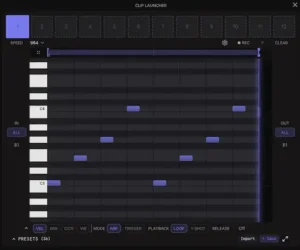
Per-instrument arpeggiation and MIDI clips widen the scope beyond orchestral scoring. Different destinations can derive separate rhythmic behaviors from the same source material, making the architecture relevant to trailer music, electronic production, ambient systems, and hybrid live setups. A layered synth rig, for example, can separate bass movement, sustained harmony, pulses, and high-frequency detail without requiring every role to originate from an independent MIDI performance. That approach becomes especially relevant with multi-layer instruments such as the Waldorf Microwave 1 Plugin v2, where expanded polyphony, multi-part behavior, and arpeggiation can generate substantial internal density before the sound is combined with the rest of the arrangement.
This broader application may be more important than the orchestration label suggests. Filament can function as a programmable macro-instrument built from otherwise unrelated plugins. A setup could combine a synthesizer, orchestral library, rhythmic instrument, and phrase-based source such as Audiomodern Voxmotive 2, then define how each element responds instead of treating the entire stack as one duplicated MIDI layer. For producers who repeatedly construct large hybrid systems, the practical advantage is not a larger sound. It is the ability to design relationships between layers before the session expands into dozens of separate tracks.
How Filament Can Prevent Mix Problems — or Build Them Into the Arrangement
Filament can speed up composition, but that speed has a production cost. When one performance can generate a large ensemble in seconds, it becomes easy to build arrangements that sound expansive during writing and turn into damage control at the mixing stage.
The most common failure is spectral duplication. Several hosted instruments may receive different notes yet still concentrate energy in the same register. Strings, pads, brass, and synthetic textures can sound complementary when auditioned separately while forming a wide, static block in context. EQ can create some space, but it cannot fully repair a conflict that began with voicing and register.
This is where Filament’s routing and revoicing have direct value for mixing. Low voices can be restricted to specific harmonic functions, upper extensions assigned selectively, and rhythmic parts kept out of the registers occupied by sustained layers. Used well, the plugin can reduce masking before the signal reaches an EQ. Used carelessly, it can generate more overlapping material faster than a mixer can untangle it.
Transient behavior is another risk. When several instruments respond to the same performance, their attacks can arrive almost simultaneously. Short strings, piano, plucks, percussion, and synth transients may combine into peaks that consume substantial headroom without producing an equivalent increase in perceived impact. The arrangement gets harder to limit, but not necessarily more powerful.
That relationship often becomes obvious only at mastering. A limiter may spend most of its effort controlling composite attacks while the sustained body of the track still feels restrained. Raising the level further then reduces depth and movement rather than increasing useful loudness. This is one reason loudness and clipping problems in mastering often begin upstream: too many sources are reaching peak energy at the same moment.
Small timing differences can help, but blanket humanization is a poor fix. Timing should follow musical function. A pulse or percussion layer may need tight alignment, while a supporting texture can enter more slowly. Brass, strings, and synthetic layers do not need identical onset behavior simply because they originate from the same keyboard gesture.
Velocity can create a similar form of correlation. If every destination follows the same performance curve, the ensemble may swell and recede as one oversized instrument. That can flatten the internal hierarchy of the arrangement: supporting layers become aggressive whenever the lead gesture is played harder, and sections that should remain stable begin competing for attention.
The useful discipline is to treat each destination as a role, not as another layer. Filament can make an arrangement more mixable when its routing separates register, timing, and dynamic behavior before audio processing begins. These decisions also determine whether the finished mix is actually ready for mastering, because masking, peak density, and unstable low-end relationships become far harder to correct once the arrangement has been printed to stereo.
Where Filament’s Self-Contained Workflow Starts to Cost You
 The same architecture that makes Filament fast during composition can become restrictive once a project moves into detailed editing, revision, and delivery.
A conventional DAW template exposes the arrangement as tracks. That can feel cumbersome while writing, but the structure becomes valuable later. MIDI parts are directly editable, automation is visible, processing can be inspected channel by channel, and individual instruments can be frozen, rendered, disabled, archived, or transferred without dismantling the rest of the session.
Filament trades some of that visibility for containment. An ensemble can remain compact and playable inside one environment, but professional projects eventually need a path out of that environment. The relevant question is not only how quickly the setup produces an arrangement, but how cleanly that arrangement can be separated into editable parts, audio outputs, and deliverable stems.
That transition matters in any workflow built around revisions or handoffs. Film, television, game, and production-music sessions may need to survive picture changes, alternate versions, library updates, computer migrations, and transfers between composers, editors, and mix engineers. A setup that is efficient for one operator on one machine can become less efficient when another person needs to reconstruct its logic.
This does not make internal hosting a liability by default. For a solo producer who writes, mixes, and archives the project on the same system, containment may be exactly the point. The tradeoff becomes more significant as the production chain gets longer and more people need access to individual parts.
Resource management is another practical limit. Support for up to 64 hosted instruments describes capacity, not a sensible target. A session built from multiple sample players, large libraries, high voice counts, oversampled synths, and effect-heavy patches can become demanding long before every slot is occupied. Disk streaming, memory use, buffer size, and the DAW’s processor scheduling may matter more than Filament’s own overhead.
Large centralized setups can also be slower to diagnose. On a conventional track-based session, a problem source can often be isolated by disabling channels, inserts, or instrument tracks in sequence. When many dependencies live inside one hosted system, crashes, missing plugins, broken library paths, or one unstable instrument may require troubleshooting inside the container before the surrounding DAW session tells you anything useful.
Factory presets have a different limitation. An orchestration preset is only as useful as the instruments behind it and the musical roles it assumes. Unlike a synth preset, it cannot guarantee a repeatable result across different sample libraries, articulations, dynamic responses, and user templates. The presets may be useful for learning Filament’s architecture, but the long-term value will come from building configurations around the instruments a producer actually uses.
Filament also lowers the technical barrier faster than it lowers the musical one. A large ensemble can be assembled quickly, but convincing results still depend on voicing, register, density, articulation, and dynamic hierarchy. Faster routing does not make unnecessary doubling useful, and a sophisticated performance system cannot decide which instrument should remain silent.
That is the real boundary of the product. Filament can remove setup friction and make complex ensembles easier to perform. It cannot remove the need to design an arrangement that remains editable, mixable, and intelligible after the initial performance is over.
Forma Labs Filament vs Divisimate vs a Conventional DAW Template
The obvious comparison is Forma Labs Filament vs Divisimate. Both address real-time control of multiple instruments, but treating Filament as a cheaper Divisimate alternative obscures the more important difference: where the orchestration system lives and how much of the session it controls.
Filament places hosted instruments and the MIDI logic controlling them inside the same plugin environment. Divisimate is built around distributing a performance across a larger multi-instrument setup. A conventional DAW template leaves the architecture exposed at track level. All three can produce complex arrangements; they differ in how quickly those arrangements become playable and how visible they remain once detailed editing begins.
| Workflow | Forma Labs Filament | Divisimate | Conventional DAW Template |
|---|---|---|---|
| Core architecture | Instrument hosting and orchestration logic inside one plugin environment | Real-time MIDI distribution across a multi-instrument setup | Tracks, instruments, MIDI routing, and processing remain directly exposed in the DAW |
| Main advantage | Fast construction of self-contained, playable ensembles | Dedicated real-time orchestration across established instrument setups | Maximum session visibility and direct control |
| Initial setup | Relatively compact once instruments and configurations are built | More dependent on the surrounding routing and template | Potentially time-consuming, especially at large track counts |
| Instrument location | AU and VST3 instruments hosted inside Filament | Instruments remain part of the wider production setup | Instruments loaded on native DAW tracks or existing host structures |
| Performance changes | Multiple orchestration behaviors can be recalled within the Filament setup | Designed for changing how live MIDI is distributed across instruments | Depends on track states, MIDI routing, macros, scripts, or DAW-specific tools |
| Detailed editing | Requires working within the hosted architecture or separating parts for later editing | Depends on how the receiving instruments and recording workflow are configured | Most direct for track-level MIDI, automation, and processing changes |
| Mix handoff | Benefits from an early output, render, and stem strategy | Depends on the structure of the receiving session | Usually the clearest architecture for another engineer to inspect |
| Best fit | Composers and producers who want the ensemble to behave like a playable instrument | Composers who want dedicated real-time distribution across a larger setup | Producers who prioritize explicit control, editing, and session portability |
Filament makes the strongest case when performance is part of the arrangement process. It suits composers who think in gestures, voicings, and changing ensemble states rather than building every destination part independently. The same logic works for hybrid producers combining orchestral libraries, synths, pulses, and textures inside one playable system.
Divisimate is the more established choice for composers whose main requirement is distributing live MIDI across a broader instrument setup. That distinction matters for users who already have a developed orchestral template and want to preserve it rather than move instruments into a self-contained plugin host.
A conventional DAW template remains difficult to beat once transparency matters more than immediacy. It may take longer to build, but MIDI, automation, processing, routing, and track states remain visible. Detailed editing is direct, troubleshooting is familiar, and another engineer can inspect the session without first understanding a separate orchestration layer.
Filament is therefore not an automatic upgrade for anyone with a large template. A composer who already has reliable routing, fast macros, stable articulation control, and a proven delivery workflow may gain little from inserting another layer between the keyboard and the instruments. The cost of changing a mature system can exceed the time Filament saves.
The same applies to producers who work sequentially: record one part, edit it, then build the next. Filament is designed around relationships between instruments happening during performance. If those relationships are normally created one track at a time, real-time orchestration solves the wrong bottleneck.
From Filament to the Final Mix: Where the Workflow Has to Change
 A Filament setup can behave like one instrument while it is being played. The mix cannot treat it that way by default.
Once the writing stage is over, the ensemble has to be evaluated as separate sources with different spectral, dynamic, transient, and spatial functions. A setup that feels coherent under the fingers may contain low-frequency conflicts, correlated attacks, excessive ambience, or layers that contribute scale without contributing definition.
That makes the output strategy part of the production workflow, not an administrative step at the end. Complex Filament arrangements should not arrive at the final mix as a single stereo file unless the entire setup is deliberately intended to function as one composite sound. Separate outputs or printed stems preserve control over low-end balance, transient shaping, reverb depth, automation, and revisions.
The limitation becomes obvious at mastering. If low strings, bass synths, percussion, and cinematic impacts are already competing in the same low-frequency region, a mastering engineer can reshape the combined spectrum but cannot restore independent control over the sources. The same applies to a midrange crowded by strings, brass, pads, and distorted textures. Once those relationships are printed into a stereo mix, professional mastering is working on the combined result rather than the individual arrangement decisions behind it.
Stereo width needs the same discipline. Sample-library ambience, stereo reverbs, chorusing, unison synthesis, and spatial effects can accumulate until the arrangement has substantial side energy but little center definition. The result may sound large on full-range monitors and noticeably weaker in mono or on playback systems with limited stereo separation. More width at the source level does not guarantee a wider or more stable final mix.
Dense arrangements also behave differently under loudness processing. Sustained layers can raise average energy before the track achieves much perceived impact, while synchronized attacks can trigger peak control ahead of the musical body. Pushing the master harder may then reduce depth and transient contrast without making the arrangement feel meaningfully larger.
Streaming delivery does not create these weaknesses, but it can expose them. Codec processing and reduced-bandwidth playback are less forgiving of arrangements that depend on dense high-frequency texture, diffuse stereo detail, or multiple reverberant layers for separation. This is one of the practical reasons mastering for streaming platforms has to account for translation rather than loudness alone. A mix with clear hierarchy usually remains clear after distribution; one whose definition depends on fine spatial detail has less margin.
Monitoring level is equally important. Large cinematic and hybrid stacks are easy to overestimate when played loud: low-end weight feels authoritative, reverberation creates scale, and masking is harder to judge. At lower levels, the hierarchy becomes more obvious. If the lead role disappears, the center weakens, or the arrangement turns into sustained midrange energy, the problem is usually structural rather than a mastering issue.
The strongest Filament configurations are therefore not the ones that activate the most instruments. They are the ones that preserve clear roles and a clean exit from the performance system into the mix. Each important source should have a reason to exist, enough separation to remain identifiable, and a practical path to individual control when the arrangement is no longer being treated as one playable object.
Verdict: Who Should Build a Workflow Around Forma Labs Filament?
Forma Labs Filament should not be judged by how many plugins one chord can trigger. Basic MIDI routing already solves that problem. Its value lies in turning a group of instruments into a programmable performance system before the arrangement is broken into individual tracks.
That makes Filament most useful for composers and producers who make orchestration decisions while playing. If voicing, instrument distribution, rhythmic behavior, and ensemble changes need to remain fluid during the writing stage, the plugin can remove a substantial amount of routing and template work. Hybrid scoring is an especially strong fit because orchestral libraries, synths, pulses, and textures can be treated as parts of the same playable structure.
The tradeoff is not subtle. Filament gains speed by containing instruments and orchestration logic inside its own environment. A conventional track-based session remains easier to inspect when the project reaches detailed MIDI editing, troubleshooting, revisions, archiving, or mix handoff. Serious users should decide how parts will be separated, rendered, and preserved before a large Filament setup becomes difficult to unwind.
At £149, the plugin does not need to replace an orchestral template to make financial sense. It needs to remove a recurring bottleneck. For a composer who repeatedly builds multi-instrument routing, playable ensemble states, or layered hybrid systems, the time savings can justify the cost. For a producer who records and edits one part at a time, or already has a fast and reliable template, Filament is more likely to add another control layer than eliminate one.
The decision is therefore straightforward. Filament is worth building around when performance and orchestration happen at the same time. If the arrangement is normally constructed track by track, the plugin solves a workflow problem you probably do not have.
Overall Rating
| Category | Rating |
|---|---|
| Real-Time Orchestration | 9.4/10 |
| Workflow | 9.2/10 |
| MIDI and Routing Flexibility | 9.1/10 |
| Mix Preparation | 8.6/10 |
| Editing and Session Handoff | 7.6/10 |
| Resource Management | 7.8/10 |
| Value for Money | 8.8/10 |
| Overall | 8.6/10 |
Real-Time Orchestration — 9.4/10. This is Filament’s strongest area. The ability to distribute one performance across multiple hosted instruments, reshape voicings, recall different ensemble behaviors, and give individual destinations separate rhythmic functions turns orchestration into something that can happen during performance rather than after recording. The score stops short of 10 because the quality of the result still depends heavily on the user’s own voicing and arrangement decisions.
Workflow — 9.2/10. Filament removes a substantial amount of setup friction for composers who repeatedly build multi-instrument systems. Hosting the instruments and their control logic in one environment can be considerably faster than rebuilding routing across a large DAW template. That advantage is workflow-dependent: producers who already have a mature template or work one track at a time will gain much less.
MIDI and Routing Flexibility — 9.1/10. Note distribution, revoicing, switchable orchestration states, per-instrument arpeggiation, and MIDI clips provide enough depth to move beyond simple keyboard splitting. The strongest results come from assigning different musical functions to each destination rather than using Filament as a way to duplicate the same performance across more instruments.
Mix Preparation — 8.6/10. Filament can improve a mix before processing begins by separating register, timing, and dynamic behavior at the arrangement stage. It can just as easily create masking, synchronized peak density, and excessive layering when every destination is allowed to compete. The score reflects the quality of the routing tools, not an assumption that the plugin automatically produces mix-ready arrangements.
Editing and Session Handoff — 7.6/10. The self-contained architecture becomes less convincing once a project requires detailed editing, revisions, archiving, or transfer to another engineer. Conventional DAW tracks remain easier to inspect and modify. Large Filament projects need a deliberate strategy for separate outputs, printed parts, and stems.
Resource Management — 7.8/10. Support for up to 64 hosted instruments is useful capacity, but it should not be confused with guaranteed efficiency. Real-world performance depends heavily on the hosted synths, sample players, library streaming, polyphony, oversampling, effects, buffer settings, and DAW scheduling. Large centralized setups can also take longer to troubleshoot than conventional track-based sessions.
Value for Money — 8.8/10. At £149, Filament offers strong value when it replaces a recurring production bottleneck. Composers who repeatedly build playable ensembles or hybrid multi-instrument systems can justify the price through time saved in routing and configuration. For users with an already optimized template, the return is less obvious.
Overall — 8.6/10. Forma Labs Filament is a strong specialist workflow tool rather than a universal production upgrade. Its real achievement is making complex multi-instrument relationships playable without reducing orchestration to simple MIDI duplication. The main compromise appears later in the production chain, where self-contained speed has to be converted into editable parts, controllable mix elements, and reliable deliverables.
Forma Labs Filament FAQ
Can Forma Labs Filament be used for synths and electronic music?
Yes. The same MIDI distribution and voicing logic can separate bass, chords, pulses, textures, and high-frequency layers across multiple synths. Filament is relevant to hybrid scoring, ambient production, trailer music, and complex electronic setups, not only orchestral libraries.
Does Filament replace a large orchestral template?
Not necessarily. It can replace some routing and performance logic, but conventional DAW tracks remain useful for detailed MIDI editing, automation, revisions, stem delivery, and long-term session management. Many professional users will treat Filament as part of a template rather than a complete replacement for one.
Can Forma Labs Filament host Kontakt and other sample players?
Filament can host compatible AU and VST3 instruments. Whether a specific sample player works efficiently depends on its plugin format, the libraries being loaded, disk streaming, memory use, and the overall session configuration.
What is the difference between Filament and a normal MIDI routing plugin?
Filament combines MIDI distribution with internal instrument hosting, chord revoicing, per-instrument arpeggiation, MIDI clip launching, keyswitchable orchestration states, and mixer configurations. A conventional MIDI routing plugin usually sends or transforms MIDI between existing DAW tracks; Filament is designed to make the complete multi-instrument setup behave as one reusable performance system.
How much CPU does a large Filament setup use?
There is no useful fixed figure. The hosted instruments usually determine the practical ceiling: sample streaming, polyphony, oversampling, effects, buffer size, and processor scheduling can become limiting factors long before every available instrument slot is used.
Does the 64-instrument capacity mean one Filament instance should host an entire template?
No. The 64-instrument figure describes capacity, not an ideal session design. Splitting a large production across smaller systems may simplify CPU management, troubleshooting, rendering, and revisions.
Is Filament better than Divisimate for real-time orchestration?
They solve related problems with different architectures. Filament combines instrument hosting and orchestration logic inside one plugin environment, while Divisimate is built around distributing live MIDI across a broader instrument setup. The better fit depends on whether you prioritize a self-contained playable system or integration with an established external template.
Can Filament be used for live performance?
Its real-time MIDI distribution, switchable configurations, and hosted instrument architecture make live use a logical application. Reliability still depends on the hosted plugins, audio buffer, controller setup, and the stability of the complete system under performance conditions.
Should a Filament arrangement be printed to audio before mixing?
For complex productions, usually yes. Printing important parts or separating them into controllable outputs reduces dependence on the original performance system and gives the mix engineer direct control over balance, processing, automation, and revisions.
Is Forma Labs Filament worth £149?
The price makes sense when the plugin removes a recurring workflow bottleneck. Composers who repeatedly build playable multi-instrument systems may recover the cost in setup time. Producers who work one track at a time or already have an efficient template are less likely to benefit.

Yurii Ariefiev is a mastering engineer and audio production editor whose work focuses on how arrangement, routing, transient structure, and spectral density affect the final mix and master. His technical coverage examines audio production tools from the point where creative workflow decisions become real problems of translation, headroom, and mix control.
This Forma Labs Filament review evaluates real-time orchestration from that production perspective: not by counting MIDI features, but by examining how multi-instrument routing, voicing, internal hosting, and complex layered arrangements hold up through editing, mixing, and mastering.