MOTU 16A, 848 and 10pre Receive Official Milan Certification
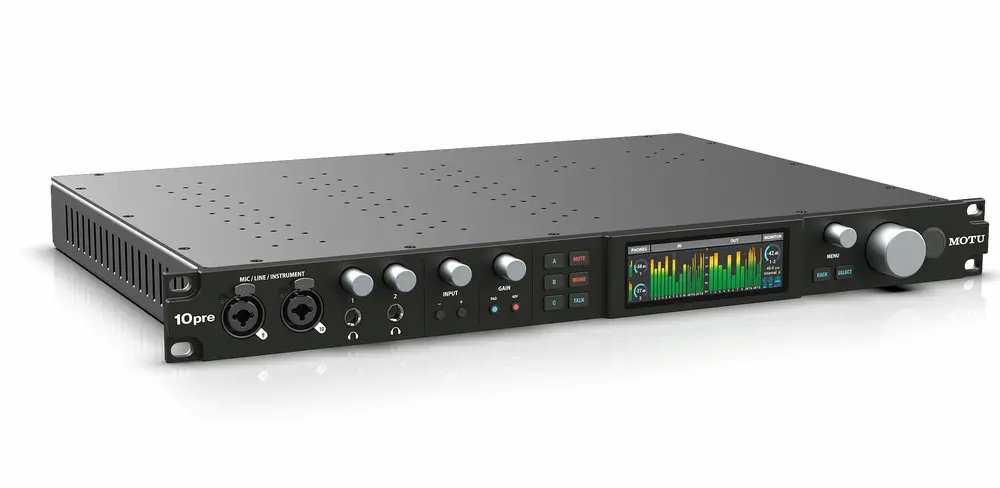
MOTU has received official Milan certification for the 16A, 848 and 10pre audio interfaces, allowing all three models to exchange and route hundreds of audio channels with other Milan-certified devices over an AVB network.
For a project studio running one interface from one computer, little changes. The certification matters in larger systems: multi-room facilities, live recording rigs and hardware-heavy studios where high channel counts must move between networked devices without relying on conventional point-to-point cabling.
The announcement is accompanied by firmware, driver and CueMix Pro updates that extend beyond Milan networking. New per-channel routing delays, one-click network synchronization, static IP support and clock freewheeling address practical problems in complex studio and production systems.
What Milan Certification Actually Changes
Milan is a certified implementation of AVB for professional media networks. That distinction is critical: an interface can support AVB without being certified to operate predictably in a multi-vendor Milan system.
The 16A, 848 and 10pre can now exchange audio and maintain network timing with Milan-certified hardware from other manufacturers. For facilities building beyond a single-brand AVB system, the practical gain is interoperability under a defined network specification rather than dependence on proprietary device behavior.
This is an infrastructure upgrade, not a change in sound quality. A producer running one interface from one computer gains little from the certification itself. The value appears when hundreds of channels must move between control rooms, converters, stage locations or other networked endpoints, where predictable routing and synchronization matter more than another bank of local I/O.
Each interface also includes a two-port Gigabit AVB switch, so multiple units can be daisy-chained without an external switch in a basic multi-device system. Larger installations can still expand through a broader network topology, but a small MOTU AVB setup does not require additional switching hardware just to connect a second unit.
How Milan Fits the 16A, 848 and 10pre
Milan adds the same network capability to three interfaces built around different I/O strategies.
The 16A is the clearest fit for studios centered on external analog hardware. Its line-level I/O suits systems where microphone preamps are handled elsewhere and the interface serves as a conversion and routing layer. In hybrid rooms, a mastering chain may already involve external processors, multiple conversion stages and dedicated monitoring paths; Milan becomes relevant when those resources need to be shared across devices or rooms.
The 848 is the more general-purpose studio hub. Its broader I/O configuration allows recording, monitoring and outboard routing to coexist in one system, making network expansion less dependent on a specialized line-level workflow.
The 10pre is built around input count. Ten microphone preamps make it better suited to tracking rooms, ensemble sessions, location recording and live production, where local microphone signals may need to enter a larger networked system.
Milan does not blur those roles. It gives each interface access to the same certified network architecture while leaving the choice between them where it belongs: I/O requirements and workflow.
CueMix Pro Adds 64 Channels of Routing Delay
CueMix Pro now provides 64 multi-purpose delay channels, each with up to 2 ms of adjustment. The useful application is not a delay effect, but time alignment inside complex routing systems.
External processing chains, converters, network paths and distributed monitoring feeds do not always return signals at identical times. The new delay channels allow those offsets to be corrected inside the routing matrix rather than adding another software stage solely for alignment.
The feature is particularly useful when parallel signal paths must remain phase-coherent. Small timing errors can alter the result when processed and unprocessed signals are recombined; larger offsets become more obvious across multi-speaker systems or audio distributed between locations.
Network Sync and Clock Freewheeling Improve System Resilience
MOTU has added unified synchronization for current-generation and legacy devices on the same network. A multi-interface system can now be synchronized in one operation instead of configuring clock settings device by device.
The benefit is operational, not sonic. Centralized synchronization reduces setup time and removes a common source of errors when networked systems are expanded, reconnected or reconfigured.
Clock freewheeling handles the failure case. If network clock is temporarily interrupted, MOTU devices can continue streaming audio while waiting to regain lock. The interruption still needs to be resolved, but a brief loss of synchronization no longer has to stop the audio stream immediately.
That behavior matters most in live, broadcast and continuous-production systems, where surviving a temporary clock disturbance is more useful than simply reporting one.
Static IP Support Adds More Predictable Network Access
MOTU interfaces normally receive IP addresses automatically, but the new firmware allows a static IPv4 address to be assigned from the front panel. Fixed addressing is useful in managed networks where devices need to remain reachable at known locations for administration and troubleshooting.
CueMix Pro can also connect to devices by searching for a specific IP address. This provides a direct alternative to multicast discovery on VPNs and other networks where automatic device discovery is unavailable or restricted.
Together, the two changes make device access less dependent on network discovery behavior—largely irrelevant in a single-interface studio, but useful once MOTU hardware becomes part of a managed or remotely accessed system.
Windows Adds ARM Support and 24-Channel WDM Streams
MOTU now supports ARM-based Windows systems across device firmware, drivers and the CueMix Pro application, extending the current software stack beyond conventional x86 Windows hardware.
The update also adds optional 24-channel WDM streams, configurable independently for inputs and outputs. This gives Windows applications outside an ASIO-based DAW access to more interface channels, which is useful in production systems that combine recording software with streaming, communication or multichannel playback applications.
Smaller Workflow Updates for Mac and Shared Systems
Mac users can optionally control the interface’s main output level from the computer keyboard—a minor convenience when the hardware is mounted away from the listening position.
A new front-panel lockout disables physical controls to prevent accidental changes. The feature has little relevance in a private room, but it is useful in shared studios, live rigs and installed systems where gain, routing or monitoring settings should not be altered from the hardware.
Three DAC Reconstruction Filters Are Now Available
The interfaces now offer three DAC reconstruction filters: Minimum Phase, Linear Phase Fast and Linear Phase Slow. Minimum Phase remains the default.
The settings allow users to choose between different time-domain and frequency-domain tradeoffs at the conversion stage. The differences are subtle and most relevant in controlled monitoring environments, where filter behavior can be evaluated without larger variables such as room response or monitoring level dominating the comparison.
There is no universally correct setting. In professional mastering and other critical-listening work, the useful change is simply that the DAC is no longer limited to one reconstruction filter.
The Larger Update Is About System Management
Milan certification is the headline, but the broader update moves the 16A, 848 and 10pre further from standalone computer interfaces toward managed audio infrastructure.
Certified Milan interoperability matters most in larger multi-vendor networks. The routing delays, unified synchronization, static addressing and clock freewheeling have wider practical reach because they address alignment, configuration and failure handling inside complex systems.
None of the updates changes the core role of each interface. What changes is the scale of the system around it. The same hardware can operate as a conventional studio interface or become part of a network spanning multiple devices, rooms and manufacturers.