The market for chord progression plugins has expanded rapidly over the past few years, but many tools still force producers to choose between rigid theory templates and unpredictable idea generators. The result is often the same: more time sorting through unusable progressions than writing music. The category now includes everything from theory assistants to AI-driven composition platforms, making workflow efficiency a more useful benchmark than feature count alone.
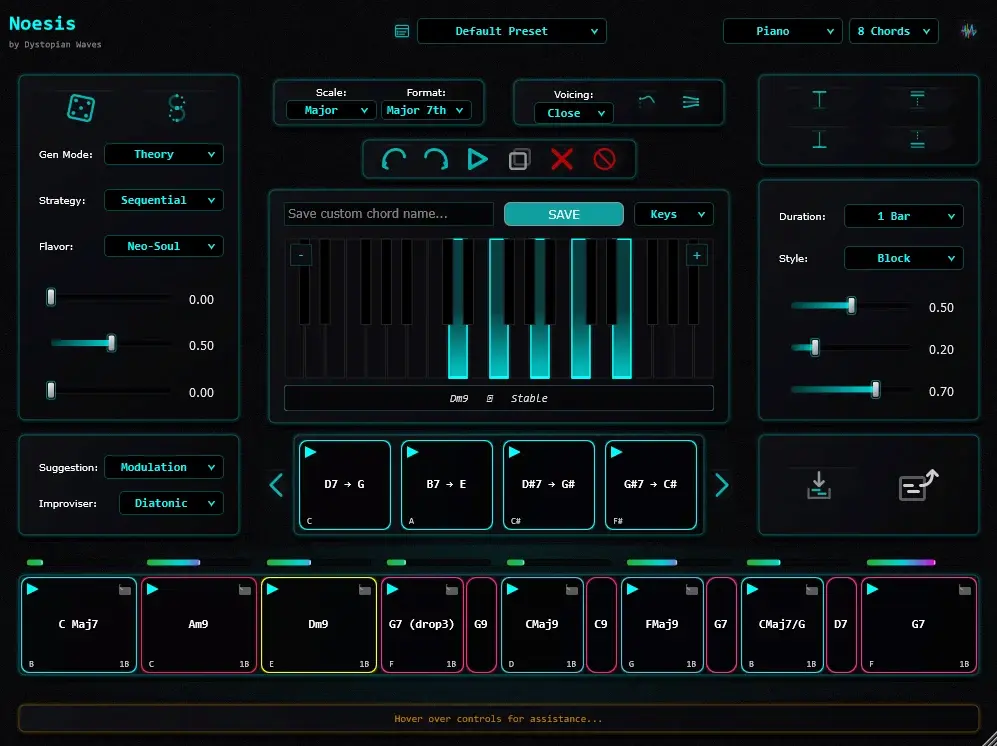
Dystopian Waves Noesis approaches the problem from a different angle. Rather than attempting to generate complete songs, it focuses on one production task—building and refining harmonic progressions. The plugin combines functional harmony, rule-based composition algorithms, and genre-specific generation models inside a MIDI workflow intended to accelerate songwriting without locking users into predefined musical patterns.
That design choice makes Noesis more relevant to working producers than many AI-branded composition tools. Instead of replacing musical decisions, it generates structured harmonic alternatives that remain fully editable after export. For composers working against deadlines, producers developing multiple song ideas, or beatmakers iterating through arrangements, reducing harmonic trial and error can save considerably more time than expanding another preset library.
This review evaluates Noesis from a production perspective rather than a marketing one. We’ll examine how the plugin performs in real-world composition workflows, where its design offers measurable advantages, where established competitors still hold the edge, and whether it earns a place alongside mature harmonic tools such as Scaler, Captain Chords, and InstaComposer.
Contents
Why Chord Generation Matters in Modern Music Production
 Chord generation software has evolved well beyond its original role as a teaching aid. In commercial production, film scoring, sync licensing, and high-volume songwriting, the bottleneck is rarely music theory—it’s iteration. Producers are expected to present multiple harmonic directions quickly, revise arrangements on demand, and keep sessions moving without sacrificing musical coherence.
That shift has changed how composition tools are evaluated. They are no longer judged by how many chords they can generate, but by how efficiently they help users reach stronger musical decisions. Like intelligent gain staging, dialogue restoration, or stem separation, harmonic generation has become another workflow optimization rather than a replacement for technical expertise.
The strongest platforms focus less on quantity and more on context. Generating dozens of random progressions has little practical value if they ignore voice leading, functional harmony, or stylistic consistency. Modern composition tools are expected to preserve harmonic relationships, produce musically believable transitions, and integrate naturally into an existing DAW workflow without creating additional editing work.
That expectation has intensified competition across the category. Established products such as Scaler, Captain Plugins, Hookpad, and InstaComposer each approach composition from a different angle, yet all pursue the same objective: reducing repetitive harmonic work while keeping creative control with the producer. Success is measured less by automation and more by how quickly usable ideas emerge inside a real production session.
Unlike many recent AI-branded composition tools, Noesis relies primarily on structured music theory and algorithmic harmony instead of machine learning.
Rule-based harmonic systems produce predictable results. Producers can understand why substitutions occur, how harmonic functions resolve, and what changes when scales, tensions, or voicings are modified. That level of transparency becomes increasingly valuable during client revisions, where repeatability often matters more than surprise.
Viewed from a production standpoint, Noesis is best understood as a chord progression plugin built to accelerate harmonic workflow rather than an automated songwriter. Its purpose is to shorten the distance between an initial musical idea and a production-ready progression while leaving composition decisions under complete user control.
How Noesis Builds Better Harmonic Workflows
Noesis deliberately avoids the “all-in-one AI composer” approach. It doesn’t attempt to generate melodies, drum patterns, basslines, or complete arrangements. Instead, the plugin concentrates on a single stage of production that often consumes more time than expected: developing harmonic ideas into usable progressions.
Its workflow is built around two independent generation engines. The Theory Engine follows traditional functional harmony, producing progressions that remain musically coherent and predictable while giving producers complete control over the exported MIDI. The Flavor Engine approaches the same task from a stylistic perspective, adapting harmonic language to genres including Neo-Soul, Cinematic, Lofi, Dark Trap, and Synthwave rather than simply loading different chord presets. That MIDI-first philosophy is similar to tools designed to improve instrumental realism, as explored in our StepStrum review.
That separation gives Noesis a more focused identity than many competing composition tools. Instead of generating entirely unrelated ideas, it encourages refinement. Similar progressions can evolve in different stylistic directions without abandoning their underlying harmonic structure, making iterative writing sessions feel more deliberate and less random.
The most practical feature is the Mutation Engine. Professional composers rarely throw away an entire progression because one section feels weak. More often, they need a stronger cadence, additional tension before a chorus, smoother voice leading, or a less predictable harmonic turn. The Mutation Engine generates alternative versions while preserving the musical intent of the original progression, reducing the need to rebuild ideas from scratch.
From an engineering standpoint, this is exactly the type of feature that determines whether a composition assistant remains part of a daily workflow or gets abandoned after the initial novelty wears off. The real advantage is not generating more progressions—it’s reducing the number of times a producer has to interrupt a writing session to rebuild an idea manually. Whether Noesis consistently achieves that across different genres will ultimately depend on how stable its harmonic decisions remain during extended real-world use.
That philosophy extends to the Snapshot System, which stores multiple progression variations inside a single project. In everyday DAW sessions, comparing harmonic ideas often leads to duplicated MIDI clips, additional tracks, and unnecessary project clutter. Keeping alternate versions organized within the plugin streamlines A/B evaluation and makes revision sessions considerably easier to manage.
The integrated keyboard editor reinforces the same workflow. Since voicing has as much influence on musical character as chord selection itself, adjusting inversions, spacing, and register before exporting MIDI reduces corrective editing later in the arrangement process. Combined with manual passing chord insertion and the editable Tension Curve, Noesis gives producers more control over harmonic movement without forcing them into fully automated composition.
In practical production, voicing adjustments often have a greater impact than replacing an entire progression. Small changes in spacing or inversion can alter how keyboards, guitars, strings, or layered synthesizers interact long before any mixing decisions become necessary.
None of these features replace musicianship. Their value comes from reducing repetitive exploration rather than making creative decisions on the user’s behalf. That’s an important distinction. Many composition tools promise automation; Noesis is generally more successful when viewed as a workflow accelerator.
Whether that approach is enough to justify adopting another composition plugin depends largely on existing workflows. Producers already invested in Scaler or similar platforms may find considerable feature overlap. Those looking for a faster environment dedicated to harmonic iteration, however, will likely appreciate Noesis’ narrower focus and more streamlined design.
Noesis Strengths, Weaknesses & Practical Limitations
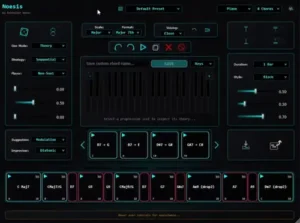 Feature counts rarely determine whether a composition plugin earns a permanent place in a production template. What matters is whether it removes repetitive decisions without introducing new friction. Noesis generally succeeds because its strongest features address problems that arise during everyday writing sessions rather than attempting to automate the entire songwriting process.
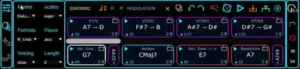
The suggestion engine is a good example. Instead of forcing producers to rebuild a progression when a section feels harmonically weak, it generates substitutions, extensions, voicing changes, and modulation options that preserve the overall direction of the piece. In practice, that means spending more time refining an idea and less time abandoning it.
The same philosophy applies to passing chords. Experienced composers already know how to write transitional harmony, but exploring several convincing alternatives manually interrupts creative momentum. Generating variations quickly is particularly useful in cinematic writing, where harmonic movement often drives emotional pacing long before the mix reaches the final film score mastering stage.
The integrated voicing editor is another feature with practical value beyond its specification sheet. Since Noesis generates MIDI rather than audio, the quality of the final result depends entirely on the instrument receiving the performance data. Even so, adjusting inversions, spacing, and register before exporting MIDI reduces corrective editing later in the arrangement. In larger orchestral or production templates, those small workflow improvements accumulate surprisingly quickly.
Equally important, Noesis remains independent of any instrument ecosystem. Standard MIDI export allows progressions to move freely between pianos, orchestral libraries, synthesizers, and hardware without proprietary formats or conversion utilities. That flexibility makes the plugin equally relevant for electronic producers, media composers, and hybrid scoring environments.
Performance is unlikely to be a deciding factor. Unlike spectral processors, physical-modeling instruments, or AI-based audio restoration tools, Noesis performs lightweight MIDI calculations rather than continuous audio processing. Independent benchmark data is still limited, but there is little reason to expect meaningful CPU or memory overhead in modern DAW sessions.
Its limitations are less technical than strategic.
Platform support is the most obvious. A Windows-only VST3 release immediately removes a significant portion of the professional market, particularly composers working in Logic Pro or mixed-platform studio environments. Cross-platform compatibility is no longer a premium feature—it is an expectation.
The surrounding ecosystem is another consideration. Established platforms such as Scaler benefit from years of tutorials, educational material, community presets, and proven production workflows. That accumulated knowledge often becomes part of the product itself, reducing the learning curve for new users. Noesis has yet to build that advantage.
Marketing language also deserves some perspective. Although Noesis is positioned as an intelligent composition tool, there is little evidence that machine learning drives its harmonic decisions. The software appears to rely primarily on structured music theory and algorithmic composition. For many producers, that’s not a drawback. Rule-based systems are predictable, repeatable, and easier to refine during client revisions than black-box AI models.
The broader limitation is scope. Noesis improves harmonic exploration, not composition as a whole. It won’t write convincing melodies, shape arrangements, orchestrate instruments, or solve structural problems within a song. Producers expecting complete songwriting automation will still find themselves making the same creative decisions—they’ll simply arrive at stronger chord progressions more efficiently.
Noesis vs Scaler, Captain Chords & Other Chord Progression Tools
Noesis enters a category that is already well established. The challenge isn’t offering another way to generate chord progressions—it’s providing a workflow that justifies replacing or complementing tools many producers already rely on. Each major platform approaches composition from a different perspective, making direct feature comparisons less useful than evaluating how they perform in real production environments.
| Product | Primary Focus | Best Fit | Key Trade-Off |
|---|---|---|---|
| Dystopian Waves Noesis | Fast harmonic iteration with structured variation | Producers and composers refining chord progressions | Windows-only platform with a developing ecosystem |
| Scaler 3 | Music theory, harmonic analysis, and advanced composition tools | Experienced composers requiring deep harmonic control | More complex workflow and longer learning curve |
| Captain Chords | Guided songwriting inside an integrated ecosystem | Pop, EDM, and fast-paced production workflows | Less flexible for advanced harmonic experimentation |
| InstaComposer | Automatic generation of multiple musical elements | Rapid sketching and idea generation | Output often requires significant editing |
| Hookpad | Songwriting, harmony planning, and theory education | Writers developing complete song structures | Less integrated with everyday DAW production |
Noesis occupies a narrower position than most of these competitors. Rather than attempting to become a complete songwriting environment, it concentrates on harmonic development and revision. That focus makes the plugin particularly effective during the stage where producers compare alternative progressions, refine cadences, and experiment with different harmonic directions before committing to an arrangement.
The Mutation Engine illustrates that philosophy well. Many chord generators excel at producing entirely new ideas but offer fewer tools for evolving an existing progression. In practice, professional writing sessions rarely start over from scratch. More often, producers adjust tension, substitute chords, or reshape a transition while preserving the overall musical identity. Noesis is designed around that iterative process.
Scaler remains the strongest option for users who want comprehensive harmonic analysis and advanced theory tools. Its educational depth, extensive chord database, and mature ecosystem continue to set the benchmark for analytical composition software.
Captain Chords takes a different approach by emphasizing guided songwriting and speed. Producers building commercial pop or EDM tracks may appreciate its tightly integrated workflow, although experienced users sometimes outgrow its more structured environment.
InstaComposer expands well beyond harmony by generating melodies, rhythms, basslines, and other musical elements. That broader scope makes it useful for rapid sketching, but the generated material typically demands more editing before it reaches production quality.
Noesis doesn’t outperform every competitor across every category, nor does it attempt to. Its strength lies in providing a focused environment for harmonic refinement rather than comprehensive song generation. Producers who already have an established writing process may find that specialization more valuable than another platform promising fully automated composition.
How Noesis Fits Into a Professional Production Workflow
 Noesis doesn’t improve audio quality directly, but it can influence the quality of the production long before mixing begins. Better harmonic decisions often lead to cleaner arrangements, stronger voice leading, and fewer competing musical elements. Those improvements reduce problems that engineers would otherwise spend time correcting later in the process.
Snapshot-based comparison also reflects how many commercial writing sessions actually evolve. Producers rarely evaluate a single progression in isolation—they compare several small harmonic variations before committing to an arrangement. Keeping those alternatives organized inside one interface has greater practical value than adding another large preset library.
Mix engineers regularly encounter sessions where harmonic density creates masking that cannot be solved with EQ alone. Instruments competing for similar registers, unnecessary chord extensions, and inconsistent voice leading often translate into crowded arrangements rather than mix problems. Noesis won’t fix those issues after the fact, but it can help producers avoid creating them in the first place by making harmonic experimentation faster and easier.
The plugin doesn’t make songs sound better—it increases the likelihood that stronger musical decisions are made before recording, sound design, and mixing begin. Comparing multiple progression ideas, refining cadences, and adjusting voicings early in the writing process usually produces cleaner source material for the rest of the production chain. That same principle applies when you prepare a mix for mastering: better decisions upstream usually require fewer corrective decisions downstream.
Once MIDI has been rendered to audio, Noesis leaves the signal path entirely. It has no influence on loudness, stereo imaging, dynamics, phase response, or mastering decisions. That distinction often causes confusion among newer producers who blur the line between arrangement, mixing, and mastering. If you’re unsure where those responsibilities actually begin and end, see our guide on Mixing vs Mastering. Any improvement to the final release comes from stronger composition rather than audio processing.
Resource usage is unlikely to become a concern. Since the plugin generates MIDI instead of processing audio, CPU and memory demands should remain negligible even in larger DAW sessions. Producers working with orchestral templates, hybrid scoring projects, or dense electronic arrangements are therefore unlikely to notice any measurable performance impact.
Viewed in context, Noesis is best understood as a pre-production tool. It shortens the path between an initial harmonic idea and a production-ready arrangement without attempting to replace the creative decisions that define a finished record. Once those ideas move into tracking and sound design, processing tools become far more important than composition assistants, a distinction illustrated in our Chainsaw Suite review.
Who Should Actually Consider Noesis?
Noesis is not designed for every type of music producer. Its value depends almost entirely on how often harmonic development becomes part of the daily workflow.
| Recommended For | Probably Not For |
|---|---|
| • Film composers • Media composers • Beatmakers • Pop producers • EDM producers • Songwriters working with MIDI | • Mix-only engineers • Mastering engineers who never compose • Producers looking for complete AI songwriting • Users requiring macOS support today |
Producers who regularly compare harmonic ideas before committing to an arrangement are likely to benefit the most. Engineers whose work begins after recording will rarely interact with the plugin beyond occasional songwriting sessions.
Verdict
Noesis doesn’t attempt to compete as a fully automated songwriting platform, and that’s arguably its biggest strength. Instead of generating complete musical ideas, it concentrates on one area where many writing sessions lose momentum: developing and refining harmonic progressions.
The Mutation Engine, Snapshot System, editable voicings, and theory-driven generation all support that objective without taking creative control away from the user. Rather than replacing composition skills, the plugin reduces repetitive experimentation and makes it easier to compare musical alternatives before committing to an arrangement.
Its limitations are equally clear. Windows-only support immediately narrows its potential audience, the surrounding ecosystem is still immature compared with Scaler, and there is currently little independent performance testing or long-term user feedback. Those factors make Noesis feel more like an emerging platform than an established industry standard.
For producers, composers, and beatmakers who spend hours developing chord progressions, the plugin offers a practical workflow improvement at a competitive price. Mix engineers and mastering engineers who rarely participate in composition, however, will find little reason to add it to their toolkit.
Noesis won’t write better songs than an experienced musician. What it can do is reduce the time spent searching for stronger harmonic ideas while keeping every creative decision in human hands. For many professional writing sessions, that’s a far more useful objective than another promise of AI-generated music.
Overall Rating
| Category | Rating |
|---|---|
| Harmonic Generation | 9.0/10 |
| Workflow Efficiency | 9.5/10 |
| Creative Flexibility | 8.8/10 |
| MIDI Editing & Integration | 9.2/10 |
| Platform & Ecosystem | 7.8/10 |
| Value for Money | 9.4/10 |
| Overall | 8.9/10 |
Harmonic Generation — 9.0/10
The Theory and Flavor Engines produce musically coherent progressions while maintaining predictable harmonic behavior. The emphasis on structured harmony is more useful in professional writing sessions than fully automated composition.
Workflow Efficiency — 9.5/10
The Mutation Engine, Snapshot System, and integrated voicing tools significantly reduce repetitive experimentation. Producers can evaluate more musical ideas without constantly rebuilding progressions from scratch.
Creative Flexibility — 8.8/10
Noesis offers meaningful control over harmonic development while keeping every decision editable. Its narrower focus on chords rather than complete arrangements limits creative scope but also avoids unnecessary complexity.
MIDI Editing & Integration — 9.2/10
Standard MIDI export, editable voicings, and compatibility with existing virtual instruments make the plugin easy to integrate into professional DAW workflows without disrupting established production templates.
Platform & Ecosystem — 7.8/10
This is currently the weakest area. Windows-only support and a relatively young user ecosystem make adoption more difficult than with mature alternatives such as Scaler.
Value for Money — 9.4/10
At its introductory price, Noesis delivers strong value for producers and composers who regularly develop chord progressions. Long-term value will ultimately depend on continued development and broader platform support.
Overall — 8.9/10
Noesis is not trying to automate songwriting. Instead, it improves one of the most time-consuming stages of music production—harmonic development. For producers who spend significant time refining chord progressions, its focused workflow is more valuable than many broader AI composition tools.
Ratings reflect our editorial assessment of workflow design, practical production value, feature maturity, and long-term usability rather than launch-day feature count alone.
Pros and Cons
| Pros | Cons |
|---|---|
| Focused harmonic iteration workflow Fast harmonic iteration DAW-independent MIDI workflow Editable voicings Organized Snapshot system Competitive introductory pricing | Windows only Limited educational ecosystem Limited independent testing Harmony-only scope Smaller community than Scaler |
FAQ: Dystopian Waves Noesis
Is Noesis an AI-powered composition plugin?
Not in the machine-learning sense. It relies on rule-based music theory, functional harmony, and algorithmic composition rather than neural-network models that learn from musical datasets.
Can Noesis generate complete songs?
No. The plugin focuses on harmonic development. It generates and refines chord progressions but does not create full arrangements, melodies, lyrics, or finished productions.
How does Noesis differ from Scaler 3?
Scaler is a broader music theory and harmonic analysis platform, while Noesis emphasizes fast progression development, variation, and iteration. The two tools solve related but different production tasks.
Does Noesis improve audio quality or mixing?
No. It generates MIDI rather than processing audio. Any improvement comes indirectly through stronger arrangements and more coherent harmonic decisions before the mix begins.
Which DAWs are best suited for Noesis?
Any Windows DAW with VST3 support can integrate the plugin into a standard MIDI workflow. Compatibility ultimately depends on the host application’s MIDI routing capabilities.
Can exported MIDI be edited manually?
Yes. Once exported, the MIDI behaves exactly like hand-programmed data, allowing producers to edit notes, timing, voicings, velocity, and articulations inside the DAW.
Who benefits most from using Noesis?
Producers, composers, beatmakers, and media composers who generate multiple harmonic ideas during a typical writing session will see the greatest workflow benefit. Engineers focused exclusively on mixing or mastering are unlikely to use it regularly.
Is Noesis suitable for professional film scoring?
It can be useful during the sketching stage, particularly when exploring alternate harmonic directions before orchestration begins. It is not intended to replace orchestration or scoring software.
Is the introductory price good value?
At its launch price, Noesis offers a competitive entry point compared with other dedicated harmony tools. Its long-term value depends more on continued development and platform support than on the initial purchase price.
Is Noesis likely to become an industry-standard composition tool?
The workflow shows promise, but long-term adoption will depend on cross-platform availability, ongoing development, independent validation, and growth of the surrounding user ecosystem.

Yurii Ariefiev is a mastering engineer and audio production editor who evaluates music software from the perspective of complete production workflows rather than feature lists. His reviews focus on how composition, arrangement, mixing, and mastering interact to determine the quality of the final release.
This review examines Noesis as a practical composition tool inside professional studio environments, emphasizing harmonic workflow, production efficiency, and the long-term impact of stronger source material on mixing and mastering.
Editorial Evaluation Scope
This editorial assessment focuses on workflow design, harmonic generation methodology, DAW integration, MIDI editing capabilities, platform compatibility, pricing, competitive positioning, and the practical production value of Noesis within modern music production workflows. The analysis emphasizes professional use cases over launch-day marketing claims.