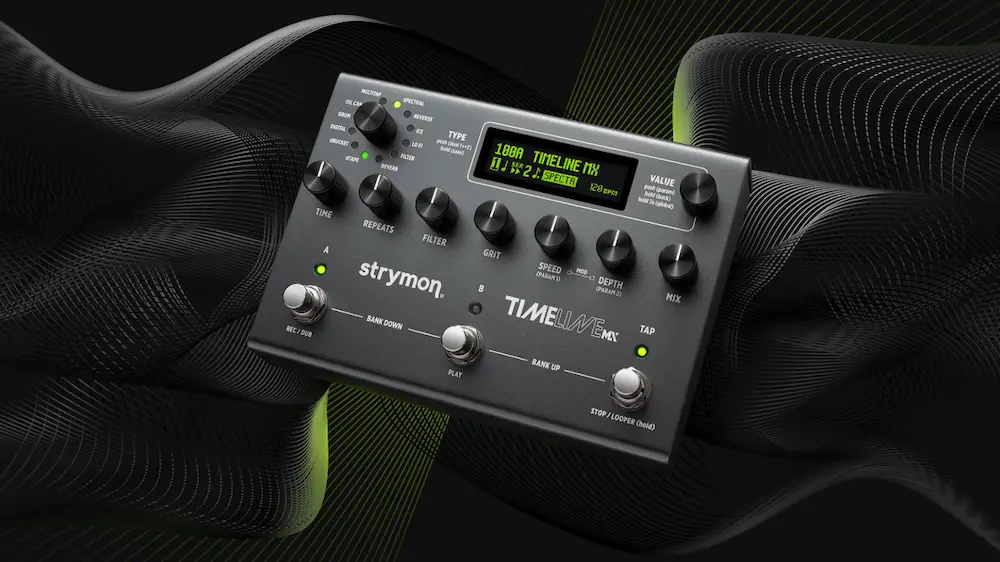
The Strymon TimeLine MX enters a very different market than the original TimeLine did more than a decade ago. High-end delay is no longer defined by the quality of a single algorithm. Engineers now compare routing flexibility, stereo architecture, MIDI implementation, hybrid studio integration, and how efficiently a processor fits into modern audio production, mixing, and even reamping workflows.
That shift raises a more meaningful question than whether the TimeLine MX sounds good—it almost certainly does. The real question is whether its redesigned architecture delivers practical advantages over today’s premium hardware processors and increasingly sophisticated delay plugins, or simply adds complexity to an already crowded workflow.
This review examines the TimeLine MX from a production perspective rather than a guitarist’s first impression. Instead of repeating the specification sheet, we’ll look at how its dual-engine design, routing options, insert loop, and stereo processing affect real recording sessions, hybrid studios, and mixes that still need to translate cleanly through mastering and modern streaming platforms.
Contents
TimeLine MX at a Glance
| Specification | Details |
|---|---|
| Delay Engines | 11 delay engines + 1 reverb engine; dual-engine operation |
| Signal Routing | Series, Parallel and Split Stereo |
| Integrated Reverb | Independent stereo reverb section |
| Looper | Up to 5 minutes of stereo recording |
| Audio Resolution | 24-bit / 96 kHz converters |
| Internal Processing | 32-bit floating-point DSP |
| Connectivity | USB-C MIDI, 5-pin MIDI, Stereo I/O, Insert Loop |
| Analog Dry Path | Yes |
| MSRP | $679 USD |
Key Takeaways
- Dual-engine routing is the biggest practical improvement over the original TimeLine.
- The MX is designed for hybrid production workflows as much as modern pedalboards.
- Existing TimeLine owners should upgrade only if they need more routing flexibility—not simply more delay sounds.
- Its strongest advantage is studio integration rather than another collection of vintage delay emulations.
Why Modern Stereo Delay Is Now About Signal Architecture, Not Tone
 The premium delay market has changed dramatically over the past decade. Buyers no longer choose processors based solely on tape emulation, analog coloration, or the character of repeated echoes. Professional users now evaluate stereo routing, signal architecture, MIDI implementation, preset management, external hardware integration, and how efficiently a processor fits into modern audio production workflows.
That shift has changed the competitive landscape. Products like the Eventide H90, Meris LVX, and advanced software delays have raised expectations well beyond traditional pedal design. High-end hardware is now expected to function as a configurable signal processor that integrates naturally with DAWs, outboard gear, and hybrid mixing environments—not simply as another source of delay textures.
The TimeLine MX is built around that philosophy. Its biggest changes are architectural rather than cosmetic: dual independent delay engines, flexible routing modes, an integrated reverb section, an assignable insert loop, modern MIDI implementation, and expanded stereo control. Those additions are less about producing entirely new sounds than reducing the compromises involved in building complex spatial effects.
That approach mirrors how many professional studios now use hardware. Delay processors increasingly handle vocals, synthesizers, drum buses, effects returns, and reamped stems instead of serving only as guitar pedals. Engineers expect external processors to integrate seamlessly with recallable hybrid sessions while offering routing options that remain difficult—or simply less intuitive—to recreate with multiple software plugins. The same shift toward scalable hybrid infrastructure is evident in modern studio interfaces, as discussed in our coverage of MOTU’s Milan-certified audio interfaces.
Workflow has become part of the purchasing decision. A premium delay may sound exceptional, but if it slows session recall, complicates routing, or duplicates what a DAW already accomplishes with a few plugins, its practical value drops quickly. Hardware now has to justify its place in the signal chain, not just impress during a solo demonstration.
Viewed through that lens, the TimeLine MX is less about replacing the original TimeLine and more about adapting the platform to the realities of contemporary studio production. Its success depends less on the quality of individual delay algorithms than on whether its redesigned architecture genuinely streamlines complex stereo processing.
Dual-Engine Processing: The Biggest Real-World Upgrade
Physically, the TimeLine MX feels familiar to anyone who has used the original TimeLine. The interface follows the same design philosophy, so existing users won’t need to relearn the platform. The meaningful changes are architectural, not cosmetic.
The biggest upgrade is the ability to run two completely independent delay engines within a single preset. That goes well beyond stacking two delay sounds together. Each engine maintains its own timing, feedback behavior, modulation, and routing, allowing engineers to construct spatial effects that previously required multiple processors or considerably more complex DAW sessions.
For production work, this changes how delay occupies a mix. Instead of asking one processor to balance rhythmic definition with ambience, each engine can perform a dedicated task. One delay may provide tempo-locked repeats that reinforce groove, while the second generates evolving textures that sit behind the source without competing for the same rhythmic space.
The advantage becomes obvious on lead vocals, synthesizers, and cinematic sound design. Separating rhythmic information from atmospheric content reduces masking, preserves transient definition, and gives engineers much finer control over stereo depth before the signal reaches bus processing or mastering.
Routing options make those engines substantially more useful than a simple dual-delay configuration.
Series routing builds progressively evolving textures by feeding one delay into another. This approach works particularly well for ambient production, post-production, and sound design where each regeneration adds movement instead of simply increasing repeat count.
Parallel routing keeps both delay structures independent, preventing unnecessary buildup inside the feedback path. Engineers can combine contrasting note divisions, tonal characters, or modulation styles while maintaining greater clarity than a conventional serial chain typically delivers.
Split stereo routing may prove to be the platform’s most valuable production feature. Assigning independent delay engines across the stereo image creates width through timing relationships rather than aggressive modulation or artificial stereo enhancement. That generally translates more naturally during mixing and remains more stable after bus compression and final limiting.
Viewed as a production tool instead of a guitar pedal, the dual-engine architecture is less about creating larger effects and more about giving engineers independent control over spatial density. That distinction becomes increasingly important in modern mixes where delays must support the arrangement without consuming valuable headroom or crowding the center image.
How the New Delay Machines Perform in Real Sessions
Vintage emulations remain popular, but they are no longer enough to differentiate a premium delay processor. Most experienced engineers already have access to convincing tape, analog, and bucket-brigade emulations in software. What matters today is whether new algorithms solve production problems that existing tools do not.
That’s where the TimeLine MX takes a different approach. Its new delay engines focus less on recreating familiar hardware and more on expanding what can be built inside a single processing chain.
Spectral Machine is the clearest example. Instead of generating conventional echoes, it applies granular processing to individual fragments of the incoming signal, producing evolving textures that sit somewhere between delay, ambience, and sound design. Used with restraint, it adds movement without burying the source beneath oversized reverb tails or stacked modulation effects.
That makes it particularly effective for ambient production, cinematic scoring, experimental electronic music, and modern synthesizer work. It also demands restraint. Granular processing spreads energy across both time and frequency, making it surprisingly easy to soften transients, reduce vocal intelligibility, or blur rhythmic precision if pushed too far.
MultiTap Machine addresses a completely different challenge. Independent tap shaping and stereo placement allow rhythmic patterns to be programmed inside a single processor instead of assembling multiple synchronized delays across several plugin instances. For engineers working with percussion, sequenced synthesizers, or intricate guitar arrangements, that simplifies both programming and session recall.
The Oil Can and Drum algorithms take a more traditional direction, but they avoid becoming simple EQ recreations of vintage hardware. Their physical modeling focuses on the mechanical instability, modulation artifacts, and nonlinear behavior that defined early electro-mechanical delay systems—characteristics that remain difficult to reproduce convincingly with basic saturation or filtering alone.
Individually, each algorithm expands the processor’s tonal range. The more significant advantage appears when they interact inside the TimeLine MX’s dual-engine architecture. Pairing a tightly controlled MultiTap pattern with a restrained Spectral texture produces far greater separation than relying on one increasingly complex delay. Likewise, combining a physically modeled engine with a cleaner digital delay preserves articulation while introducing movement that develops naturally over successive repeats.
Viewed from a mixing perspective, the new delay engines are less about offering more presets and more about distributing spatial responsibilities across independent processors. That approach generally produces cleaner stereo images, more predictable translation, and greater control over density than asking a single delay algorithm to perform every task at once.
Hybrid Studio Integration: Where the TimeLine MX Stands Out
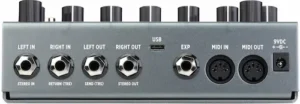 The most significant production feature on the TimeLine MX isn’t another delay algorithm—it’s the configurable hardware insert loop.
Most stereo delay processors operate as self-contained systems. Once audio enters the delay engine, the internal signal path is fixed. External hardware can only process the input or the final output. The TimeLine MX breaks that limitation by allowing outboard processors to become part of the delay path itself.
For hybrid studios, that changes far more than the specification sheet suggests.
The configurable FX loop allows external hardware to sit between the two delay engines. In this configuration, the signal path runs from the input through Delay 1, into the external loop, and then through Delay 2 before reaching the output. This makes it possible to place an external processor between two independent delay stages rather than simply before or after the entire TimeLine MX.
That architecture opens up several useful hybrid workflows. An external preamp, drive, modulation unit, or other processor can shape the signal between the two delay stages, while Delay 1 and Delay 2 handle different spatial roles. Strymon also supports mono and stereo FX Loop configurations, making the routing practical for both pedalboard and studio setups. Pairing the TimeLine MX with a dedicated analog channel strip can open even more creative routing options—we explored that workflow in our Heritage Audio TUBESTRIP review.
These routing techniques have long been available through modular systems, large-format consoles, and complex DAW routing. Bringing them into a dedicated stereo delay processor dramatically reduces setup time while making advanced signal paths practical for everyday production.
The analog dry path is equally relevant, although for a less obvious reason. During parallel processing, preserving an untouched dry signal helps maintain phase integrity while avoiding unnecessary conversion stages. That becomes particularly valuable when blending hardware effects into modern hybrid mixing sessions, where even small phase shifts can soften transient detail or destabilize the stereo image.
The remaining hardware specifications—24-bit/96 kHz conversion, 32-bit floating-point DSP, OLED display, USB-C connectivity, and comprehensive MIDI implementation—are exactly what professional users should expect from premium studio hardware. They don’t define the TimeLine MX, but they remove practical obstacles that often discourage engineers from integrating external processors into modern DAW-based workflows.
Viewed from an engineering perspective, the insert loop is less about adding another routing option and more about turning the TimeLine MX into an adaptable processing platform. Instead of treating delay as the final destination in the signal chain, it becomes the foundation for building far more sophisticated spatial processing without relying on increasingly elaborate plugin routing inside the DAW.
Real Limitations You Should Know Before Buying
The TimeLine MX solves several limitations of the original platform, but it also asks more of the user. Expanding a processor’s routing architecture inevitably increases the number of creative decisions that must be made before a preset becomes mix-ready.
Running two independent delay engines is significantly more demanding than programming a conventional stereo delay. Timing relationships, feedback structure, modulation, stereo placement, reverb interaction, and gain staging all influence one another. Small adjustments made to one engine often change how the entire spatial image behaves.
For experienced engineers, that additional complexity is usually an advantage because it allows spatial effects to be shaped with much greater precision. Less experienced users may find themselves building increasingly elaborate presets that sound impressive in isolation but become difficult to place inside a finished arrangement.
That distinction highlights one of the most common mistakes in modern effects processing: confusing complexity with depth. Layering multiple delay structures does not automatically create a larger mix. More often, it increases spectral density, masks transient detail, and competes with the very instruments the delay is supposed to support—issues that frequently become even more noticeable during mastering. We examine these translation problems in greater detail in our Mastering Problems guide.
The Spectral Machine illustrates that balance particularly well. Its granular processing can produce exceptionally rich movement, but excessive diffusion quickly softens rhythmic definition and reduces vocal intelligibility once compression, bus processing, and mastering begin reducing available dynamic contrast.
The integrated reverb presents a similar compromise. Keeping delay and ambience inside the same processor simplifies preset construction and live performance, yet many mix engineers still prefer independent reverbs for precise control over decay time, early reflections, automation, and front-to-back depth. The onboard reverb works best when it functions as an extension of the delay itself rather than replacing a dedicated spatial processor.
Price becomes part of the equation for the same reason. The TimeLine MX competes in a market where flagship hardware is measured against sophisticated software delays, modular processing environments, and premium multi-effects platforms. Sound quality alone is no longer enough to justify the investment because high-end alternatives already perform at an exceptionally high level.
The purchase decision ultimately comes down to workflow. Engineers who routinely build complex stereo effects, integrate outboard hardware, and depend on repeatable hybrid sessions are far more likely to benefit from the MX than producers whose work rarely extends beyond a single stereo delay plugin.
Existing TimeLine owners should approach the upgrade with the same perspective. The MX is not a mandatory replacement for the original hardware. Its value depends almost entirely on whether the expanded routing architecture removes real production bottlenecks. If your current workflow already delivers the results you need, the original TimeLine remains a highly capable processor.
TimeLine MX vs. Today’s Best Premium Delay Processors
The TimeLine MX doesn’t compete in an empty category. Engineers considering hardware at this price point are typically choosing between several mature platforms, each built around a different production philosophy rather than dramatically different sound quality.
The real comparison is no longer “Which delay sounds best?” Nearly every flagship processor delivers excellent audio quality. The more useful question is which platform integrates most naturally into the way you record, mix, and manage complex sessions.
| Processor | Production Focus | Strongest Advantage | Best Fit |
|---|---|---|---|
| Strymon TimeLine MX | Advanced stereo delay architecture | Dual-engine routing, insert loop, hybrid workflow | Hybrid studios, reamping, dedicated spatial processing |
| Eventide H90 | Comprehensive multi-effects platform | Broad algorithm library across multiple effect types | Studios wanting one processor for many production tasks |
| Meris LVX | Modular delay design | Deep signal customization and experimental sound design | Electronic producers and advanced sound designers |
| Boss DD-500 | Feature-rich digital delay | Professional flexibility at a lower cost | Users prioritizing value over advanced routing |
| High-end delay plugins | Complete DAW integration | Unlimited automation, instant recall, multiple instances | Fully in-the-box production workflows |
Among these platforms, the TimeLine MX occupies a clearly defined niche. It is neither the most experimental processor nor the broadest multi-effects system. Its primary advantage lies in combining sophisticated stereo routing with a workflow that remains approachable for engineers already familiar with dedicated hardware delays.
That distinction is important because workflow—not sound quality—is increasingly driving purchasing decisions. Engineers working in hybrid environments often prioritize tactile control, predictable routing, and external hardware integration over adding another software plugin to an already complex session.
For producers who spend most of their time entirely inside a DAW, the calculation is different. Modern delay plugins already provide exceptional sound quality, deep automation, and unlimited recall. The TimeLine MX becomes easier to justify only when dedicated hardware genuinely improves the creative or technical workflow rather than simply replacing software with another piece of equipment.
Who Is the TimeLine MX Really For?
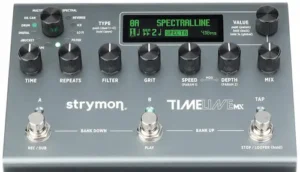 The TimeLine MX isn’t designed for every studio. Its strongest selling point isn’t a particular delay sound—it’s the ability to solve routing and workflow problems that become increasingly common in complex productions.
Engineers working in hybrid environments will see the greatest benefit, particularly if their sessions involve hardware reamping, external signal processing, sophisticated MIDI synchronization, or layered stereo effects that would otherwise require multiple plugins and elaborate routing inside the DAW. The same applies to composers and electronic producers building evolving spatial textures rather than relying on conventional tempo-synced delays.
It’s also a logical upgrade for long-time TimeLine users who have reached the limits of the original platform. If your existing presets frequently require additional hardware, parallel processing, or multiple delay instances to achieve the desired result, the MX’s expanded architecture addresses those limitations directly.
On the other hand, many producers simply don’t work that way.
- Studios operating entirely inside a DAW may gain little beyond the tactile experience of dedicated hardware.
- Players using a handful of traditional delay sounds are unlikely to exploit the MX’s routing capabilities.
- Users looking for an all-in-one multi-effects processor may find broader platforms such as the Eventide H90 better aligned with their workflow.
- Cost-conscious buyers should carefully consider whether their current sessions genuinely require dual-engine processing before investing in premium hardware.
The deciding factor is neither sound quality nor the number of available algorithms. It is whether your production workflow regularly pushes beyond the limits of a conventional stereo delay. For engineers who already encounter those limitations, the TimeLine MX offers meaningful architectural improvements. For everyone else, the original TimeLine—or a high-quality delay plugin—may remain the more practical solution.
Should You Buy the TimeLine MX?
The answer depends far more on your workflow than on the quality of the delay algorithms. The MX isn’t designed to replace every delay plugin or outperform every competing processor in isolation. It targets engineers and producers who routinely build complex stereo effects, integrate external hardware, and value repeatable signal routing over collecting more presets.
Buy the TimeLine MX if:
- your productions regularly involve hybrid hardware workflows;
- you build layered stereo delays instead of using basic tempo echoes;
- external routing and MIDI recall are part of your everyday sessions;
- you want one dedicated delay platform rather than a general-purpose multi-effects unit.
Skip it if:
- your work is entirely inside a DAW;
- one stereo delay plugin already covers your needs;
- you rarely build complex spatial effects;
- your budget would be better invested in monitoring, room treatment, or converters.
Is the $679 Price Actually Justified?
At approximately $679, the TimeLine MX sits firmly in the premium hardware category. Buyers at this level are no longer comparing individual delay pedals—they’re choosing between complete production ecosystems that include processors such as the Eventide H90, modular delay platforms like the Meris LVX, and increasingly sophisticated software solutions.
Viewed purely as a source of delay sounds, the price is difficult to justify. Modern plugins already deliver excellent audio quality, extensive automation, and unlimited instances for considerably less money.
The calculation changes when routing flexibility becomes part of the purchase. Dual-engine processing, an assignable insert loop, analog dry path, comprehensive MIDI implementation, and dedicated hardware operation offer production advantages that software cannot always replicate with the same speed or simplicity.
For hybrid studios where external processing is part of the daily workflow, the MX represents a long-term infrastructure investment rather than a simple effects purchase. Producers working entirely inside a DAW are likely to see less practical value from the additional hardware.
How the TimeLine MX Holds Up During Mixing and Mastering
Premium delay hardware shouldn’t be judged by how it sounds in solo. Almost every flagship processor can produce impressive echoes on an isolated guitar or synthesizer. The real test begins once those effects compete with vocals, drums, bass, and dense arrangements inside a finished mix.
That’s where the TimeLine MX’s routing architecture becomes more important than its individual delay algorithms. Independent stereo engines make it easier to distribute spatial information without relying on excessive modulation or artificial stereo widening. Instead of filling the entire stereo field with one increasingly complex delay, engineers can assign separate spatial roles to different processing paths while preserving a stable center image.
That approach generally survives mastering more predictably. As bus compression and limiting reduce dynamic range, densely layered delay structures often become more audible than intended, reducing clarity and masking important musical elements. Cleaner routing decisions made during mixing usually translate into more controlled spatial depth after mastering. If you’re interested in what actually happens during those final processing stages, see our Mastering Chain Explained guide.
Streaming codecs introduce another variable. AAC, Ogg, and similar perceptual codecs do not process highly decorrelated stereo information as transparently as simple, well-organized spatial effects. Excessive modulation, diffuse ambience, and heavily layered delay networks can become less stable after encoding, particularly on headphones. While no hardware processor can eliminate codec artifacts, disciplined stereo design typically translates more consistently across streaming platforms. We explore that process in greater detail in our guide to mastering for streaming platforms.
Monitoring remains equally important. Dual-delay presets that appear impressively wide on headphones can behave very differently on loudspeakers or under mono playback. Checking mono compatibility, phantom-center stability, and side-image balance should remain part of the programming process rather than an afterthought before mastering.
The hardware itself also contributes to workflow efficiency. Offloading sophisticated delay processing from the DAW has little impact on lightweight sessions, but larger hybrid productions built around orchestral templates, extensive virtual instruments, or external hardware often benefit from reducing plugin complexity while keeping sophisticated spatial processing immediately accessible.
Viewed from a professional production perspective, the TimeLine MX is not a shortcut to larger mixes. Its real advantage lies in helping engineers organize stereo space with greater precision before those creative decisions are locked in by mastering. That distinction ultimately matters far more than the number of delay algorithms available inside the processor.
Verdict: A Serious Upgrade for Hybrid Studios
The TimeLine MX doesn’t redefine what a delay processor can sound like. It redefines how a dedicated hardware delay fits into a modern production environment.
Its biggest improvements are architectural. Dual independent delay engines, flexible routing, an assignable insert loop, and stronger integration with hybrid studios make the platform considerably more capable than the original TimeLine. Those changes won’t always be obvious during a quick demonstration, but they become increasingly valuable in complex recording, mixing, and reamping workflows where routing flexibility often matters more than another variation of tape or analog delay.
That also explains why the TimeLine MX is not a universal recommendation. Engineers working primarily inside a DAW already have access to outstanding delay plugins with extensive automation, instant recall, and virtually unlimited processing power. If your existing software already supports the way you work, dedicated hardware may add expense without solving a meaningful production problem.
For hybrid studios, however, the equation changes. Engineers who routinely integrate outboard processors, build sophisticated stereo effects, or depend on repeatable hardware workflows will find considerably more value in the MX’s redesigned signal architecture than in its individual delay algorithms.
The TimeLine MX succeeds because it focuses on workflow instead of feature count. Rather than chasing more presets or more vintage emulations, it delivers a routing platform that gives experienced engineers greater control over stereo space, signal flow, and creative decision-making throughout the production process. That makes it one of the most thoughtfully engineered premium delay processors currently available—not because it attempts to replace software, but because it offers a compelling reason to keep dedicated hardware in the modern studio.
Pros & Cons
| Pros | Cons |
|---|---|
| Excellent dual-engine routing architecture | Premium purchase price |
| Outstanding stereo imaging control | Steeper learning curve than traditional delays |
| Powerful insert loop for hybrid studios | Many users won’t need all of its routing capabilities |
| Professional MIDI implementation and recall | Software may remain the better choice for fully in-the-box production |
Overall Rating
| Category | Rating |
|---|---|
| Sound Quality | 9.5/10 |
| Workflow & Routing | 9.8/10 |
| Mix Translation | 9.4/10 |
| Hardware Integration | 9.8/10 |
| Sound Design Flexibility | 9.6/10 |
| Value for Money | 8.6/10 |
| Overall | 9.4/10 |
The TimeLine MX isn’t simply a better-sounding version of the original TimeLine. Its greatest strength is the way it expands routing, stereo processing, and hybrid studio workflows without sacrificing the familiar operating philosophy that made the platform successful. While the asking price places it firmly in the premium category, few dedicated delay processors currently offer the same balance of signal-flow flexibility, production-oriented architecture, and long-term studio relevance.
Sound Quality — 9.5/10
The delay engines are exceptionally refined, maintaining clarity even in complex stereo configurations. Rather than chasing exaggerated character, the MX delivers repeat behavior that remains musical and predictable inside dense productions.
Workflow & Routing — 9.8/10
This is the processor’s defining strength. Dual independent engines, configurable routing, and the insert loop significantly reduce the compromises normally associated with advanced hardware delay setups.
Mix Translation — 9.4/10
Well-programmed presets retain depth without overwhelming the center image, making the processor particularly effective in professional mixing environments. Translation still depends on disciplined programming, but the routing architecture makes that easier to achieve.
Hardware Integration — 9.8/10
USB-C, comprehensive MIDI implementation, stereo routing, analog dry path, and external insert capabilities allow the TimeLine MX to integrate naturally into modern hybrid studios rather than functioning as an isolated effects pedal.
Sound Design Flexibility — 9.6/10
The new Spectral, MultiTap, Oil Can, and Drum engines dramatically expand the processor beyond conventional delay applications while remaining practical for everyday production instead of becoming experimental for its own sake.
Value for Money — 8.6/10
The premium price is justified only if the expanded architecture becomes part of your daily workflow. Producers relying primarily on software delays may struggle to realize enough additional value, while hybrid studios are far more likely to see a long-term return on the investment.
Frequently Asked Questions
Is the Strymon TimeLine MX worth upgrading from the original TimeLine?
Only if your current workflow has outgrown the original hardware. The MX is a substantial upgrade for engineers who need dual-engine processing, advanced stereo routing, or deeper integration with hybrid studios. If your projects rarely move beyond conventional delay presets, the original TimeLine remains highly competitive.
Can the TimeLine MX be used with synthesizers and line-level studio gear?
Yes. Although many players associate Strymon products with guitar rigs, the TimeLine MX integrates well with synthesizers, drum machines, studio interfaces, and reamping systems. Its stereo architecture makes it particularly useful for electronic music production and hybrid recording environments.
Does the TimeLine MX replace delay plugins?
No. High-end plugins still provide unmatched automation, instant recall, and unlimited instances inside a DAW. The TimeLine MX works best as a dedicated hardware processor that adds hands-on control, external routing, and creative signal-flow options that are often less intuitive in software.
How does the TimeLine MX compare with the Eventide H90?
The comparison comes down to specialization. The H90 is a versatile multi-effects platform covering a wide range of processing tasks, while the TimeLine MX focuses almost entirely on building sophisticated stereo delay environments with greater routing flexibility.
Can dual-delay routing create phase issues?
Not inherently. Problems usually appear when complex stereo effects are programmed without checking mono compatibility or center-image stability. As with any advanced spatial processor, monitoring across multiple playback systems remains essential.
Does the integrated reverb replace a dedicated reverb plugin?
For many productions, no. The onboard reverb is most effective as part of the delay engine itself. Dedicated reverbs still provide greater control over depth, early reflections, and independent automation during mixing.
Will the TimeLine MX affect mastering results?
Indirectly, yes. Well-organized stereo delays generally survive bus compression, limiting, and streaming normalization more gracefully than dense, heavily layered effects. The processor itself is not designed for mastering, but better spatial decisions during mixing often lead to cleaner masters.
Does hardware still offer advantages over modern delay plugins?
For hybrid studios, absolutely. Dedicated hardware simplifies external routing, reduces plugin management, and encourages faster creative decisions. Producers working entirely inside a DAW may find software remains the more practical solution.
Is the TimeLine MX suitable for live performance as well as studio production?
Yes. Preset recall, MIDI integration, stereo routing, and onboard processing make it equally capable on stage and in professional recording environments, especially for players who rely on complex synchronized effects.
How long is the TimeLine MX likely to remain relevant?
Probably longer than processors built around individual effects alone. Flexible routing architectures tend to age well because they adapt to changing production workflows instead of relying on a fixed collection of algorithms.

Yurii Ariefiev is a mastering engineer and audio production editor specializing in stereo image translation, hybrid mixing and mastering workflows, and real-world playback consistency. His editorial work focuses on how routing architecture, time-based processing, and spatial effects influence mix clarity before a track reaches the mastering stage.
This review evaluates the Strymon TimeLine MX from the perspective of practical studio production—not product marketing—with emphasis on delay routing, signal flow, hybrid hardware integration, and how professional production decisions translate from recording to mastering.