Spectral processing has evolved from a niche mastering technique into a practical mixing tool. As modern productions become denser, conventional broadband compression often struggles to control localized frequency buildup without affecting the rest of the signal. That’s why spectral compressors are gaining attention—not as replacements for traditional dynamics processors, but as a more targeted way to solve problems that static EQ, multiband compression, or dynamic EQ can’t always address efficiently.
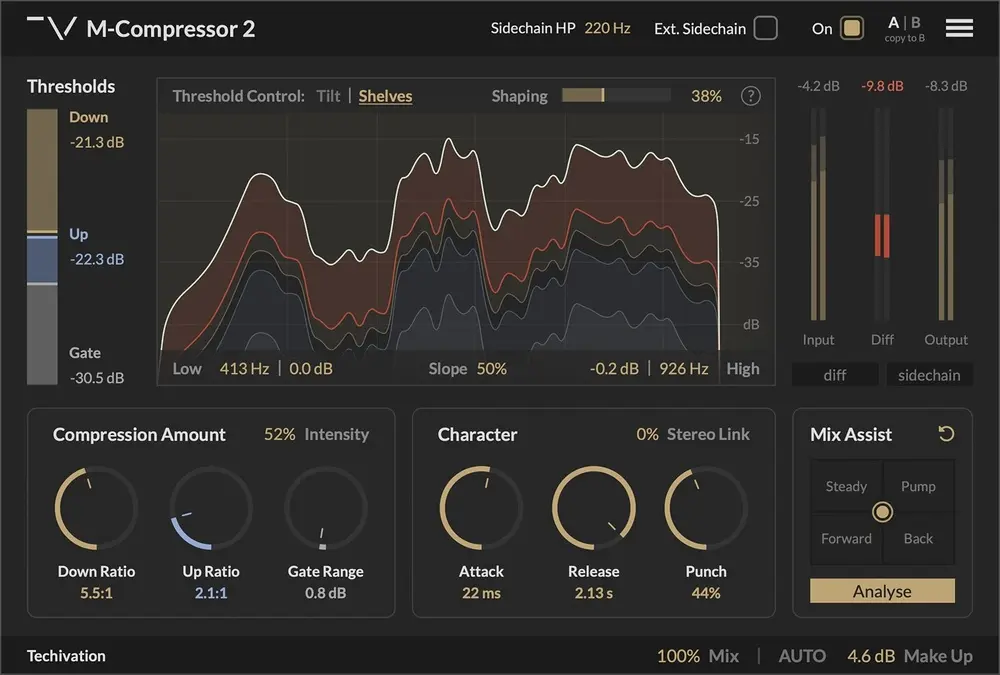
Techivation M-Compressor 2 is built around that idea. Rather than shaping the entire signal with a single detector, it continuously analyzes spectral energy and applies compression where excessive activity occurs. The concept isn’t new, but its implementation has become increasingly relevant as productions rely on layered instruments, heavily processed vocals, virtual orchestration, and AI-generated audio that often exhibit unstable spectral balance.
The real question isn’t whether M-Compressor 2 works. The more useful question for experienced engineers is whether spectral compression meaningfully improves a professional workflow, or simply adds another adaptive processor to an already crowded plugin chain. That’s the perspective this review takes.
Contents
What’s New in M-Compressor 2?
Although M-Compressor 2 builds on the same spectral processing philosophy as the original release, it introduces several workflow improvements aimed at reducing setup time and expanding practical use cases. Rather than redesigning the plugin from scratch, Techivation focused on refining how engineers interact with adaptive spectral compression inside modern mixing sessions.
- Updated spectral processing engine with improved frequency resolution.
- Mix Assistant for faster initial parameter setup.
- New Tilt Compression mode for broad tonal control.
- Shelves mode for low- and high-frequency spectral management.
- Integrated upward, downward and gate-style processing options.
- Improved stereo behavior for buses and full mixes.
- Refined interface with a faster corrective workflow.
None of these additions fundamentally change what the plugin is designed to do. Instead, they reduce the amount of manual adjustment required before spectral compression becomes useful in a real production environment.
Why Spectral Compression Is Moving Beyond Niche Processing
 Spectral processing is no longer limited to restoration software or occasional mastering repairs. As modern productions have become denser, engineers increasingly encounter problems that broadband compression was never designed to solve. Layered synthesizers, stacked vocals, distorted guitars, orchestral sample libraries, and AI-generated stems often create frequency buildups that change from note to note rather than remaining fixed throughout a performance.
Traditional compression treats the signal as a single dynamic event. While that approach remains essential for shaping groove, punch, and musical movement, it cannot distinguish between desirable dynamics and localized spectral peaks. As a result, reducing harshness or masking with broadband compression often affects parts of the signal that didn’t require correction in the first place.
Spectral compression approaches the problem differently. Instead of working across a handful of fixed bands, it continuously analyzes narrow frequency regions and applies gain reduction only where excess energy develops. A vocal, for example, can retain its overall dynamics while brief upper-mid resonances or shifting low-mid buildup are controlled independently from the rest of the performance.
That level of frequency resolution places spectral compression somewhere between dynamic EQ and conventional multiband compression rather than positioning it as a replacement for either. Each processor solves a different engineering problem. Dynamic EQ remains highly effective when problematic frequencies are predictable, while multiband compression offers broader tonal control. Spectral compression becomes most valuable when resonances move continuously and cannot be managed efficiently with a small number of dynamic bands.
This explains why developers such as Techivation, oeksound, sonible, and iZotope continue investing in adaptive spectral processing. The objective isn’t to automate mixing decisions—it’s to reduce the amount of corrective processing required before creative decisions can begin.
For experienced mixing and mastering engineers, that’s where the technology has the greatest practical value. A spectral compressor isn’t another character processor for the chain; it’s a precision tool that can reduce masking, preserve transient detail, and eliminate several corrective stages without forcing the mix through additional broadband compression.
Where M-Compressor 2 Belongs in a Professional Mixing Chain
M-Compressor 2 shouldn’t be evaluated like a traditional compressor because it isn’t solving the same problem. VCA, FET, optical, and vari-mu designs shape dynamics by controlling the signal envelope, whether the goal is adding punch, tightening a performance, or creating bus glue. Spectral compression works at a different level, targeting localized frequency buildup while leaving the overall dynamic contour largely intact.
That difference changes where the plugin belongs in a session. Instead of replacing a vocal compressor or a mix bus compressor, M-Compressor 2 fits naturally alongside corrective processors such as dynamic EQ, resonance suppressors, and surgical equalization. Its primary job is to reduce masking and unstable resonances before they force broader processing decisions later in the chain.
In practical terms, the plugin is most useful on material whose tonal balance changes continuously throughout a performance. Lead vocals, layered synthesizers, distorted guitars, orchestral libraries, and dense backing vocals rarely exhibit the same resonant behavior from one phrase to the next. Those moving spectral buildups are difficult to control with static EQ and often require multiple dynamic EQ bands to manage transparently.
By operating across a much finer spectral resolution, M-Compressor 2 can address those changes without forcing engineers to build increasingly complex corrective chains. The result isn’t necessarily a more processed mix, but often a simpler one—fewer overlapping processors, fewer automation passes, and fewer compromises between tonal balance and dynamics.
Techivation has also maintained its established design philosophy of simplifying advanced DSP behind a relatively restrained interface. Rather than exposing dozens of technical parameters, the plugin prioritizes workflow speed over deep algorithmic customization. For many engineers, particularly those moving quickly between projects, that approach reduces setup time and encourages decisions based on listening rather than visual analysis.
That philosophy won’t appeal to everyone. Engineers who prefer complete control over detector behavior and every stage of the processing path may find the streamlined interface restrictive. Others will see the limited control set as an advantage, especially when the processor consistently reaches transparent results without extensive tweaking.
Ultimately, M-Compressor 2 is less about replacing familiar compression techniques than reducing the amount of corrective work required before creative mixing decisions begin. That’s where it offers the greatest value in a modern production workflow.
Spectral Compression vs. Dynamic EQ: The Comparison That Actually Matters
Spectral compression is often marketed as the next step beyond conventional compression, but that comparison misses the point. From an engineering perspective, its closest relative is dynamic EQ. Both processors are designed to control frequency-dependent events without permanently altering tonal balance, and both aim to solve problems that static equalization handles less efficiently.
The distinction lies in how each processor detects and responds to those problems. A dynamic EQ operates through a limited number of user-defined bands, making it highly predictable and easy to fine-tune. Spectral compression analyzes a much higher number of narrow frequency regions simultaneously, allowing it to react to resonances that move continuously throughout a performance instead of remaining centered around fixed frequencies.
That difference becomes apparent on complex source material rather than isolated test signals. A lead vocal may shift its upper-mid resonance with every phrase as articulation, microphone distance, and vocal intensity change. Layered synthesizers can develop masking that evolves with modulation, while distorted guitars rarely produce identical harmonic content from one chord to the next. Building multiple dynamic EQ bands can certainly address those issues, but the process becomes increasingly manual as the number of moving resonances grows.
Because spectral compression operates with much finer frequency resolution, it can often control those changes without requiring engineers to predict where the next resonance will occur. The processor adapts to the material instead of relying on a predefined set of correction points.
That adaptability is also its greatest limitation.
Dynamic EQ remains easier to audit, automate, and revise because every processing decision originates from bands the engineer deliberately created. Spectral compression delegates more of those decisions to the algorithm itself. The trade-off is straightforward: greater automation in exchange for less direct control over exactly how each frequency region is being managed.
For many professional workflows, the two approaches complement rather than replace one another. Dynamic EQ remains the better choice when problematic frequencies are stable and repeatable. Spectral compression becomes considerably more effective when resonances, masking, and tonal imbalance shift constantly throughout the performance, making manual correction progressively less efficient.
Where Spectral Compression Delivers the Greatest Practical Benefit
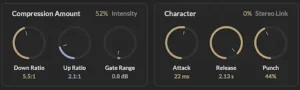 Spectral compression proves its value in complex sessions where corrective processing begins to dominate the plugin chain. Instead of replacing conventional compression, it reduces the number of processors required to manage constantly changing spectral problems before they accumulate into larger mix decisions.
Lead vocals are one of the clearest examples. Contemporary vocal chains often combine corrective EQ, dynamic EQ, de-essing, broadband compression, saturation, clip gain, and automation to maintain tonal consistency from phrase to phrase. When harsh upper mids, unstable low-mid buildup, or shifting resonances can be controlled by a single spectral processor, the entire chain becomes easier to manage and typically requires fewer corrective moves downstream.
Instrument groups also benefit from adaptive spectral control. Layered guitars, synthesizers, orchestral sections, and stacked backing vocals rarely generate static masking. Harmonic density changes with every chord, articulation, and arrangement change. Broadband bus compression treats those variations as overall dynamics, while spectral compression can respond only to the frequencies creating temporary congestion.
Mix bus processing, however, requires considerably more restraint. At this stage, engineers are no longer correcting individual sources—they’re protecting the balance of an entire production. Any processor that continuously reshapes spectral energy across the full mix deserves careful evaluation, particularly when translation, stereo stability, and long-term tonal consistency are priorities.
The same caution applies during mastering. A processor may solve localized harshness or low-mid buildup without introducing obvious artifacts, yet still produce subtle tonal movement that becomes apparent only after repeated listening across multiple monitoring systems. Where spectral compression belongs depends on the overall mastering chain, not on the processor alone. (See our Mastering Chain Explained guide for a detailed breakdown.)
Ultimately, M-Compressor 2 is most effective where spectral behavior is genuinely unpredictable. The more stable the source material, the stronger the case for conventional EQ, dynamic EQ, or broadband compression. The more the tonal balance shifts throughout a performance, the more compelling spectral compression becomes.
What M-Compressor 2 Says About the Future of Mixing Plugins
M-Compressor 2 is part of a broader shift in plugin design. Rather than building processors around fixed frequency bands or static thresholds, developers are increasingly focusing on adaptive analysis that responds to the signal in real time. The objective isn’t simply to create smarter plugins—it’s to reduce the amount of manual corrective work required before creative processing begins.
That philosophy is already visible across several areas of modern audio production. Dynamic resonance suppression, intelligent masking control, adaptive equalization, and spectral balancing all share a common goal: making highly localized corrections while preserving the overall musical balance of the source. Instead of applying larger processing moves across broad sections of the spectrum, these tools concentrate on the specific frequencies responsible for audible problems.
This doesn’t eliminate the need for engineering decisions. It changes where those decisions are made. Instead of spending time building increasingly complex corrective chains, engineers can devote more attention to balance, depth, dynamics, and musical intent—the choices that listeners actually notice.
Whether this approach becomes a long-term standard depends on one factor: consistency. Professional engineers rarely adopt a processor because it produces impressive demonstrations. They adopt it because it behaves predictably across dozens of different sessions, genres, monitoring environments, and client revisions.
That’s ultimately the benchmark M-Compressor 2 must meet. If its spectral processing consistently reduces corrective work without introducing unwanted tonal movement or making mastering decisions less predictable, it becomes more than another intelligent plugin. It becomes a workflow tool that earns a permanent place alongside conventional compression rather than attempting to replace it.
Where Spectral Compression Can Become Overly Corrective
The main advantage of spectral compression—its ability to react with extremely high frequency resolution—can also become its biggest limitation. Every adaptive decision slightly changes the relationship between frequencies, and while each correction may be inaudible on its own, thousands of continuous adjustments can gradually reshape the tonal character of a mix.
Traditional compressors are relatively predictable because their behavior is defined by parameters the engineer explicitly controls: threshold, ratio, attack, release, and detector response. Spectral processors operate differently. They continuously analyze the incoming signal and make localized gain adjustments across a large number of frequency regions, many of which change from one musical event to the next.
On individual tracks, that level of precision is often an advantage. During mastering, however, the same behavior deserves closer scrutiny. Small spectral corrections applied across an entire stereo mix can accumulate over time, subtly affecting tonal stability, stereo depth, or the perceived relationship between instruments—even when no obvious artifacts such as pumping or distortion are present.
For that reason, mastering engineers tend to evaluate spectral processors differently than they would a conventional compressor. Transparency is measured not only by what the processor removes, but also by what remains unchanged after repeated listening across multiple monitoring systems.
A useful practical test is surprisingly simple: bypass the processor after several uninterrupted playbacks and ask whether the mix has become objectively clearer or merely different. Dedicated reference tools can make those comparisons far more reliable, particularly during long sessions (our Ninja AB review explains why structured A/B evaluation often leads to better engineering decisions). If the improvement is difficult to distinguish from tonal movement, the processor may be making more corrective decisions than the material actually requires.
Where Spectral Compression Solves Real Problems—and Where It Doesn’t
Spectral compression is often presented as a smarter alternative to conventional dynamics processing, but its effectiveness depends entirely on the problem it’s being asked to solve. Demonstrating cleaner frequency balance in a controlled example is relatively easy. Maintaining that improvement across an entire production with changing performances, dense arrangements, and multiple processing stages is a far more demanding test.
Professional sessions rarely contain isolated problems. Vocal inconsistencies interact with room reflections, layered instruments compete for the same spectral space, saturation generates new harmonics, and limiting changes the way frequencies mask one another. No adaptive processor can resolve those issues on its own because many of them originate in the arrangement, recording, or monitoring environment rather than in the signal itself.
That’s why M-Compressor 2 should be viewed as a refinement tool instead of a corrective shortcut. It can reduce unstable resonances, improve spectral balance, and simplify downstream processing, but it cannot compensate for poor source material or replace engineering decisions made earlier in the production process. Many of the issues commonly blamed on mastering plugins actually originate much earlier in production (see Mastering Problems for a detailed explanation).
The same principle applies when comparing spectral compression with conventional EQ. If a problematic frequency remains in the same place throughout a song, a static EQ band is usually the faster and more predictable solution. Adaptive processing becomes worthwhile only when resonances, masking, or tonal imbalance change continuously enough that manual correction becomes inefficient.
The distinction is equally important for compression. Engineers looking for punch, groove, transient control, or bus glue will still achieve more consistent results with conventional compressor designs built specifically for those musical objectives. Spectral compression becomes the stronger option only when the problem is frequency-dependent rather than dynamic.
Used with that expectation, M-Compressor 2 complements an existing mixing workflow instead of competing with tools that were designed for entirely different jobs.
Which Workflows Benefit Most from M-Compressor 2?
M-Compressor 2 is best suited to engineers who spend more time solving tonal inconsistencies than creating compressor character. Its strengths become apparent in sessions where transparency, spectral balance, and mix translation take priority over audible dynamics processing.
That makes the plugin particularly useful for productions built around dense arrangements. Layered vocals, stacked synthesizers, orchestral templates, modern guitar productions, and AI-generated stems often develop moving resonances that are difficult to manage with static EQ or a handful of dynamic EQ bands. In these situations, adaptive spectral processing can reduce corrective work without fundamentally changing the musical dynamics of the performance.
For mastering engineers, the role is naturally more specialized. A stereo master occasionally contains localized harshness, unstable low-mid buildup, or frequency masking that broadband processing cannot address cleanly. Used selectively, spectral compression can resolve those issues while preserving the overall balance of the mix. Used indiscriminately, it can introduce unnecessary tonal movement into material that was already translating well.
The plugin is less convincing when compression itself is expected to become part of the sound. Engineers relying on FET aggression, optical leveling, vari-mu coloration, SSL-style bus glue, or heavily compressed parallel drums are shaping musical dynamics rather than correcting spectral behavior. Those workflows demand processors whose envelope characteristics are both intentional and immediately audible. Hardware-inspired channel strips remain a better fit for that role (see our Heritage Audio TUBESTRIP review for an example of a workflow centered on analog-style signal shaping).
That’s why M-Compressor 2 shouldn’t be viewed as an alternative to classic compressor designs. It belongs in sessions where corrective processing dominates the workflow, leaving traditional compressors to perform the musical tasks they were originally designed for.
Choosing the Right Tool for the Job
M-Compressor 2 isn’t competing with every dynamics processor on the market. Its closest alternatives are tools that address frequency-dependent problems through different processing philosophies. The choice depends less on brand preference than on the type of corrective work a session actually requires.
| Processor | Best Used For | Where It Excels | Where M-Compressor 2 Has an Advantage |
|---|---|---|---|
| Techivation M-Compressor 2 | Adaptive spectral compression | Moving resonances and spectral masking | Native workflow |
| oeksound Soothe2 | Dynamic resonance suppression | Removing harshness and resonant peaks | Broader dynamics control alongside spectral correction |
| FabFilter Pro-Q (Dynamic EQ) | Manual frequency correction | Predictable problem frequencies | Automatically follows moving resonances |
| FabFilter Pro-MB | Multiband compression | Broad tonal shaping | Higher spectral resolution |
| sonible smart:comp 2 | Intelligent broadband compression | Fast compressor setup | More detailed frequency-specific processing |
None of these processors directly replaces another because they operate at different levels of resolution. Dynamic EQ remains the most predictable solution when problematic frequencies are stable. Multiband compression offers broader tonal control across defined frequency ranges. Intelligent broadband compression simplifies traditional dynamics processing, while resonance suppressors focus on narrow spectral problems.
M-Compressor 2 occupies the space between those categories. Instead of asking the engineer to define every correction manually, it continuously adapts to changing spectral content while still behaving like a dynamics processor rather than a dedicated resonance remover.
For experienced engineers, the better question isn’t which plugin is objectively superior. It’s which processing model matches the behavior of the material in front of them. Selecting the right approach at the beginning of a session usually produces better results than forcing a familiar processor to solve a problem it wasn’t designed to address.
M-Compressor 2 vs. M-Clarity 2: Which Problem Are You Actually Solving?
Although both plugins come from Techivation and share a transparent processing philosophy, they address different engineering challenges. M-Compressor 2 focuses on controlling excessive spectral energy through adaptive compression, while M-Clarity 2 is designed to improve instrument separation by reducing masking between competing sources.
In practice, the choice depends less on genre and more on the underlying problem. If a vocal contains moving resonances or unstable tonal buildup, M-Compressor 2 is the more appropriate processor. If individual instruments remain difficult to distinguish despite an otherwise balanced mix, M-Clarity 2 targets that type of masking more directly.
Many professional engineers could reasonably use both processors within the same session, but rarely on the same track or for the same objective. They complement one another rather than compete directly.
Why Workflow Consistency Matters More Than Intelligent Processing
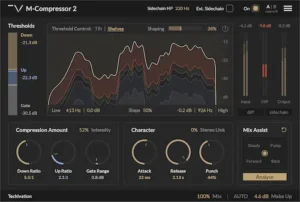 Modern mixing sessions already rely on multiple layers of adaptive processing. Dynamic EQ, resonance suppression, automatic gain compensation, intelligent limiting, and even AI-assisted source repair have become part of many production workflows. Each processor promises more accurate correction, but every additional stage also introduces another layer of analysis that engineers must evaluate.
CPU performance is rarely the limiting factor anymore. Current production systems can comfortably run sophisticated spectral processors, even in large sessions. The greater challenge is maintaining confidence in every processing decision. As more adaptive tools are inserted into the signal chain, it becomes increasingly difficult to determine which processor is responsible for a particular change in tonal balance or dynamics.
That shifts the bottleneck from computing power to workflow efficiency. A processor only saves time if its behavior remains predictable across different sessions, source material, and monitoring environments. Otherwise, engineers simply replace manual adjustments with repeated bypass comparisons, additional automation, and more time spent verifying results.
This is particularly relevant in commercial mixing and mastering, where consistency matters as much as sound quality. A plugin that performs exceptionally well on one project but requires constant second-guessing on the next rarely becomes part of a long-term template, regardless of how advanced its DSP may be.
Ultimately, that’s the standard M-Compressor 2 will be judged against. Its value isn’t determined by the sophistication of its spectral analysis, but by whether it consistently reduces corrective work without increasing uncertainty elsewhere in the production process.
Will Spectral Compression Improve Mix Translation?
Better mix translation is often cited as one of the practical advantages of spectral compression. By reducing localized masking before the final mastering stage, adaptive spectral processing can help individual instruments remain more intelligible on playback systems with limited frequency response, including earbuds, Bluetooth speakers, laptops, and automotive audio systems.
That benefit depends entirely on how the processor is used. Every spectral adjustment changes the balance between harmonics, even when those changes are too subtle to notice during a single listening pass. Excessive correction may produce a cleaner mix while gradually reducing the tonal relationships that allow a production to translate naturally across different playback environments.
This becomes particularly relevant during mastering, where even small spectral decisions affect the entire stereo image. Loudness normalization on streaming platforms does not compensate for tonal imbalance, and lossy codecs can exaggerate subtle changes in high-frequency content or masking that were barely noticeable in the studio.
For that reason, spectral compression works best after the largest problems have already been addressed through arrangement, editing, and conventional corrective processing. It should refine an already balanced mix rather than compensate for unresolved issues earlier in the production chain. The cleaner the mix is before mastering, the less corrective processing is typically required later. (Our Prepare Mix for Mastering guide explains which issues should be fixed before the mastering stage.)
Verification remains essential. If spectral compression improves clarity on studio monitors but produces inconsistent tonal balance across consumer playback systems, the processor is solving one problem while introducing another. The most reliable workflow is still to evaluate the result across multiple monitoring environments before committing to the final master.
Viewed from that perspective, M-Compressor 2 is most effective as a precision finishing processor. Used selectively, it can improve translation without changing the musical character of the mix. Used aggressively, it risks making technically cleaner mixes that feel less consistent once they leave the studio.
Verdict: A Specialized Tool That Earns Its Place Through Consistency
Evaluating M-Compressor 2 against conventional compressors misses the point. It isn’t designed to replace VCA, FET, optical, or vari-mu designs because it addresses a different engineering problem. Instead of shaping envelope and musical dynamics, it focuses on controlling localized spectral behavior that conventional compressors often leave untouched.
That makes it particularly relevant in modern production environments where dense arrangements, layered instruments, virtual orchestration, and AI-generated material create constantly shifting masking that static processing cannot always manage efficiently. In those situations, spectral compression can simplify an otherwise complex corrective chain while preserving the musical dynamics of the performance.
Its role becomes more selective during mastering. Adaptive spectral processing is capable of solving problems that broadband dynamics cannot, but consistency remains the deciding factor. Any processor placed across a finished mix must justify its presence not only through transparency, but through predictable behavior across different playback systems, monitoring environments, and client revisions.
Ultimately, M-Compressor 2 succeeds or fails for the same reason any professional tool does: repeatability. If it consistently reduces corrective work across a wide range of sessions without creating new verification steps, it deserves a permanent place in a mixing template. If engineers spend more time validating its decisions than benefiting from them, the workflow advantage quickly disappears.
M-Compressor 2 doesn’t redefine compression, nor does it try to. Its value lies in solving a category of spectral problems that conventional dynamics processors were never intended to address. For engineers who regularly encounter those challenges, it represents a practical addition to an existing workflow rather than a replacement for established mixing or mastering techniques.
Overall Rating
| Category | Rating |
|---|---|
| Spectral Processing Quality | 9.5/10 |
| Workflow Efficiency | 9.5/10 |
| Mix Translation Support | 9/10 |
| Transparency | 9/10 |
| CPU Efficiency | 8.5/10 |
| Value for Money | 9/10 |
| Overall | 9.1/10 |
Spectral Processing Quality — 9.5/10
M-Compressor 2 delivers excellent spectral control without relying on aggressive tonal reshaping. It consistently reduces moving resonances and masking while preserving the overall musical balance, making it one of the strongest implementations of adaptive spectral compression currently available.
Workflow Efficiency — 9.5/10
Its greatest strength is reducing the number of corrective processors required in complex sessions. On dense productions, the plugin can often replace multiple dynamic EQ moves and resonance-control stages, resulting in a cleaner and faster workflow.
Mix Translation Support — 9/10
Used conservatively, M-Compressor 2 improves clarity across headphones, speakers, and streaming playback by reducing localized masking before mastering. Translation benefits depend heavily on engineering decisions rather than the algorithm alone, which prevents a perfect score.
Transparency — 9/10
The processor generally remains unobtrusive, but extensive spectral correction across an entire mix can gradually influence tonal stability. On stereo buses and mastering chains, careful evaluation is still essential.
CPU Efficiency — 8.5/10
Real-time spectral analysis naturally requires more processing power than conventional compression. Modern production systems handle it comfortably, although large sessions with many instances will demand more resources than traditional dynamics processors.
Value for Money — 9/10
For engineers who routinely work with corrective mixing, layered arrangements, and spectral masking, the plugin offers meaningful workflow improvements. Users primarily seeking analog coloration or compressor character will find less value because those tasks fall outside its intended design.
Overall — 9.1/10
M-Compressor 2 isn’t trying to reinvent compression—it solves a different class of engineering problems. Its combination of transparent spectral processing, efficient workflow, and professional mix translation makes it a valuable addition for modern mixing and selective mastering, provided it’s used where adaptive processing genuinely offers an advantage.
Is M-Compressor 2 Worth Buying?
Worth buying if:
- you regularly mix dense modern productions;
- dynamic EQ no longer solves moving resonances efficiently;
- you want fewer corrective processors in large sessions;
- transparent processing matters more than analog character.
Probably not necessary if:
- most of your work relies on classic compressor coloration;
- you primarily use analog-style workflows;
- your current combination of dynamic EQ and resonance suppression already covers these tasks efficiently.
For engineers working on contemporary productions with layered arrangements and frequent spectral masking, M-Compressor 2 offers a meaningful workflow improvement. Those looking for audible compression character should continue viewing it as a complementary processor rather than a replacement for conventional compressor designs.
Pros & Cons
| Pros | Cons |
|---|---|
|
|
FAQ
Does M-Compressor 2 work better before or after a traditional compressor?
That depends on the objective. Placing spectral compression earlier in the chain allows it to reduce resonances before broadband compression reacts to them. Using it later can help clean up frequency buildup introduced by saturation or heavy dynamics processing. Both approaches are valid, but the processor should generally address spectral problems before final tonal shaping.
Can spectral compression replace a de-esser?
Not entirely. Spectral compression can reduce sibilance as part of broader frequency management, but dedicated de-essers usually provide more precise control over speech-related consonants. Many engineers use both when vocal recordings require different types of correction.
Is M-Compressor 2 more useful for mixing than mastering?
Generally, yes. Mixing provides greater flexibility because processors operate on individual tracks or buses. During mastering, any adaptive spectral adjustment affects the entire stereo mix, making conservative settings and careful monitoring significantly more important.
How is spectral compression different from dynamic EQ?
Dynamic EQ responds through a limited number of manually configured bands. Spectral compression continuously analyzes a much finer frequency resolution, allowing it to react to moving resonances without requiring engineers to predict where they will occur.
Can M-Compressor 2 improve poorly recorded tracks?
It can reduce unstable resonances, harshness, and localized masking, but it cannot correct microphone placement, room acoustics, excessive clipping, or poor performances. Source quality still determines the final result.
Does spectral compression affect stereo imaging?
It can if applied aggressively. Because spectral processing continuously changes frequency relationships, excessive correction may alter perceived width, depth, or image stability. This is one reason mastering engineers typically use spectral processors more conservatively than mixing engineers.
When is a traditional compressor still the better choice?
Whenever the goal is shaping musical dynamics rather than correcting spectral balance. Drum punch, vocal control, bus glue, transient shaping, and analog-style coloration remain the strengths of conventional compressor designs.
Is spectral compression suitable for AI-generated stems?
Often. AI-generated material frequently contains moving resonances and inconsistent masking that adaptive spectral processing can reduce effectively. It cannot, however, repair poor source separation or restore musical dynamics that were never present in the original generation.
Is M-Compressor 2 worth adding to an existing plugin collection?
For engineers who regularly deal with dense arrangements and corrective mixing, it fills a gap that traditional compressors and static EQs do not always cover efficiently. If your workflow already relies on resonance suppression and dynamic EQ, the decision depends on whether adaptive spectral compression solves recurring problems more quickly than your current toolset.

Yurii Ariefiev is a mastering engineer and audio production editor specializing in mix translation, spectral balance, and transparent mastering workflows. His editorial work focuses on evaluating modern DSP tools from a practical studio perspective, emphasizing real-world production efficiency over marketing claims or feature lists.
This review examines spectral compression as an engineering workflow rather than a standalone plugin feature, with particular attention to corrective processing, mastering reliability, and long-term consistency across professional mixing environments.