Dynamic resonance suppression has evolved from a niche corrective technique into a standard part of modern mixing. Static EQ still handles broad tonal shaping well, but it struggles with resonances that shift throughout a performance. Vocal harshness, cymbal buildup, distorted guitars, and dense synth arrangements rarely stay locked to fixed frequencies, making adaptive spectral processing a far more precise solution for many corrective tasks.
ToneVeil enters a market that is already defined by mature tools trusted in commercial studios. That immediately raises the bar. A new resonance suppressor isn’t judged by its feature count—it has to demonstrate transparent processing, predictable behavior, and a workflow that saves time without introducing new compromises. Those expectations are especially high in mastering, where even subtle artifacts can outweigh the benefits of additional control.
The real question isn’t whether adaptive resonance suppression belongs in a modern workflow. It already does. The question is whether ToneVeil contributes anything beyond another variation on an established idea. Can it compete with dedicated resonance suppressors that engineers already rely on, or does it simply offer a different interface around familiar processing?
This review examines ToneVeil from a production perspective rather than a marketing one. Instead of repeating the specification sheet, we’ll look at how the plugin fits into professional mixing and mastering workflows, where its design choices make practical sense, and where it still needs to prove itself against more established alternatives.
What Is the ToneVeil Plugin?
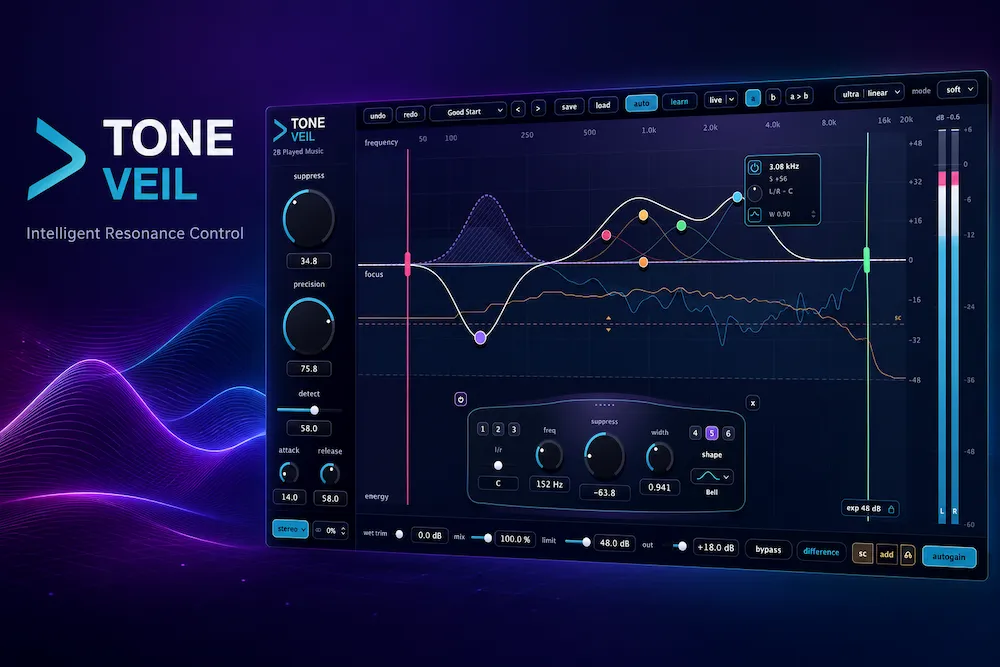
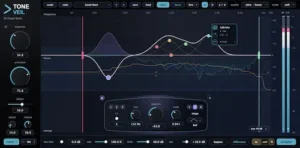
ToneVeil is a spectral resonance suppression plugin designed for professional mixing and mastering. Instead of relying on static EQ cuts, the ToneVeil plugin continuously analyzes incoming audio and applies dynamic resonance suppression only when excessive frequencies become audible.
Designed for vocals, electric guitars, drum overheads, synthesizers, mix buses, and stereo masters, ToneVeil combines adaptive spectral processing, Mid/Side operation, and multiple processing modes to reduce harshness while preserving transients, harmonic detail, and overall mix translation.
Contents
Resonance suppression plugins can solve specific problems, but they can’t replace experienced mastering decisions. Upload up to 35 seconds of your mix and receive a free mastering demo to hear how professional mastering improves clarity, balance, and translation across real-world playback systems.
Quick Verdict
| Best For | Professional mixing, mastering, vocals, guitars, mix buses, stereo mastering |
| Not Ideal For | Users expecting fully automatic mix repair or low-CPU utility processing |
| Strength | Transparent dynamic resonance suppression with flexible workflow |
| Editorial Rating | 9.1/10 |
Why Spectral Resonance Suppression Matters
 Resonance has always been one of the hardest mixing problems to solve cleanly. Traditional EQ works well when a troublesome frequency remains relatively constant, but many real-world sources don’t behave that way. Vocal harshness shifts with performance intensity, distorted guitars generate different resonances from note to note, and cymbals produce constantly changing overtone patterns. Static EQ inevitably becomes a compromise—either removing more tone than necessary or leaving intermittent resonances untouched.
That limitation explains the rise of adaptive spectral processing. Rather than applying permanent cuts, resonance suppressors monitor the incoming signal in real time and attenuate only the frequencies that become excessive. When the algorithm is well designed, harshness is reduced while transients, harmonic detail, and overall tonal balance remain largely intact.
For many mix engineers, this has changed corrective processing more than the introduction of another dynamic EQ. Tasks that once required multiple narrow EQ bands, automation passes, or carefully tuned multiband compression can often be handled by a single processor reacting continuously to the source material. The goal isn’t to replace traditional EQ, but to reduce the amount of manual intervention required when resonances refuse to stay in one place.
As the category has matured, feature lists have become far less important than processing quality. Engineers now evaluate resonance suppressors by different criteria: how transparent the algorithm remains under heavy gain reduction, whether transient detail survives aggressive settings, how predictable the detection behaves across different source material, and whether CPU usage remains practical in large sessions.
That context is important because ToneVeil is entering a market with very little room for gimmicks. Competing products have spent years earning trust in commercial studios, so a new release has to demonstrate more than intelligent frequency detection or a polished interface. It needs to solve familiar problems with equal or better transparency while integrating naturally into established mixing and mastering workflows.
Mastering places even greater demands on this type of processing. Streaming normalization, perceptual codecs, and modern playback systems expose upper-midrange harshness more readily than ever, making subtle resonance control an increasingly common finishing step. Used conservatively, spectral suppression can smooth isolated problem areas without altering the overall tonal balance of a finished mix. Used aggressively, however, it risks reducing depth, transient definition, and musical energy—regardless of which plugin is performing the processing.
That distinction ultimately defines the role of processors like ToneVeil. They are not replacements for good recording technique, balanced arrangements, or thoughtful EQ decisions. Their value lies in solving the moving resonances that conventional processing often struggles to control efficiently.
How the ToneVeil Plugin Performs in Mixing and Mastering
ToneVeil is built around a familiar idea: resonance removal only when resonances become problematic instead of applying permanent EQ cuts. That concept isn’t new, but execution is what separates a useful production tool from another spectral processor with an impressive feature list. The quality of the detection algorithm—not the interface—ultimately determines whether harshness disappears naturally or the source simply loses energy.
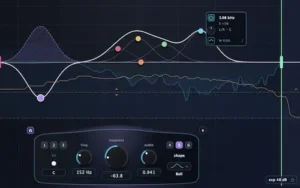
Its six-node architecture reflects that philosophy. Rather than applying broad spectral correction across the entire signal, ToneVeil allows individual resonance regions to be treated independently. In practice, this gives engineers more control over sources where several unrelated problems occur at once instead of forcing one global processing profile across the entire spectrum.
A modern vocal is a good example. Chest resonance, nasal emphasis, upper-mid harshness, and occasional sibilance rarely behave the same way throughout a performance. Static EQ often turns into a compromise, while broad spectral suppression risks dulling articulation. Independent suppression nodes make it easier to target each problem with different sensitivity and depth, producing more predictable results.
The same principle applies to drum overheads and distorted guitars. Cymbal overtones shift with every hit, while high-gain guitars generate resonances that change depending on note position, cabinet behavior, and playing dynamics. These are situations where dynamic spectral processing generally outperforms static notch filters because attenuation follows the resonance instead of assuming it remains fixed.
ToneVeil also separates its processing into different operating modes. Zero Latency mode targets tracking and live monitoring, where responsiveness matters more than absolute transparency. Linear Phase processing is intended for stereo buses and mastering, where preserving phase relationships often outweighs the additional latency. Offering dedicated processing paths for different production stages is a practical decision rather than a marketing feature. In a typical mastering workflow, processors of this type are normally placed after corrective EQ but before final limiting, as explained in our Mastering Chain Explained guide.
Mid/Side processing expands the plugin’s usefulness beyond individual tracks. Correcting excessive upper-mid energy in the center channel without disturbing ambience or stereo width can be particularly valuable on mix buses and full stereo mixes. Used carefully, this approach avoids the broad tonal changes that conventional stereo processing sometimes introduces.
Several workflow features deserve attention because they address everyday engineering tasks rather than adding visual complexity. Difference Monitoring lets engineers hear exactly what is being removed, making it easier to judge whether suppression is targeting resonances or beginning to strip away musical information. Node Listen serves a similar purpose by allowing each suppression band to be evaluated independently before committing to more aggressive settings.
Learn Mode should be viewed in the same practical context. Automatic analysis can accelerate initial setup, especially on unfamiliar material, but it doesn’t eliminate critical listening. Experienced engineers will still refine thresholds, bandwidth, and suppression depth manually. Like most intelligent assistants in audio production, its value comes from reducing setup time—not replacing engineering decisions.
Perhaps the most sensible aspect of ToneVeil’s design is what it doesn’t try to do. It isn’t presented as a substitute for dynamic EQ, broadband compression, de-essing, or transient shaping. Instead, it focuses on one corrective task that continues to consume a surprising amount of time in professional sessions: controlling moving resonances with as little collateral damage as possible.
Whether ToneVeil ultimately succeeds depends far less on its feature list than on the transparency of its DSP. If the detection remains natural under demanding conditions and multiple plugin instances continue to behave predictably in large sessions, it has the potential to become a practical corrective tool. If the algorithm proves overly aggressive or introduces audible artifacts under heavier processing, experienced engineers are unlikely to replace workflows that already rely on established resonance suppressors.
Best Use Cases
- Lead vocals with shifting upper-mid resonances
- Electric guitars containing aggressive harmonic buildup
- Drum overheads and cymbals
- Bright synthesizers and layered electronic productions
- Mix buses requiring transparent resonance reduction
- Stereo masters before final limiting
Beyond the Marketing: What Will Determine Whether the ToneVeil Plugin Succeeds?
 Launch features don’t determine whether a corrective plugin becomes part of a professional workflow. Engineers stop noticing interfaces surprisingly quickly. After a few weeks, the questions become much simpler: Does the plugin solve problems consistently? Can it be trusted across different source material? Does it save enough time to justify another insert in the session?
For a resonance suppressor, nearly everything comes down to the detection algorithm. Every processor in this category promises dynamic spectral control, but transparency depends on how accurately the software distinguishes genuine resonances from harmonics that give an instrument its character. The difference is immediately audible. An overly aggressive algorithm makes vocals smaller, softens transient attack, and gradually removes the sense of depth from a mix. An overly cautious one leaves the harshness you were trying to eliminate in the first place.
This balance between corrective processing and preserving useful harmonic content is equally important when working with analogue-style processors. Our The Asylum Analogue Review examines how tape and cassette emulation can enhance character without overwhelming a modern mix.
That is where ToneVeil still has to prove itself. Its architecture is well thought out, but there is currently very little independent evidence showing how the algorithm behaves under demanding production conditions. A sparse acoustic session tells you very little. Dense rock arrangements, modern pop vocals, high-gain guitars, layered EDM productions, or orchestral mixes expose weaknesses much faster than controlled demonstrations.
Another factor is cumulative processing. One carefully adjusted instance may sound completely transparent, but twenty or thirty instances distributed throughout a session tell a different story. Small changes to transient definition, stereo depth, and harmonic detail accumulate over an entire mix. The best resonance suppressors remain almost invisible even when used repeatedly. That level of consistency cannot be judged from launch videos or manufacturer audio examples.
Performance is another area where independent testing matters more than specifications. Spectral analysis is computationally intensive by design, and multiple real-time detection nodes inevitably consume more resources than conventional EQ processing. ToneVeil offers separate operating modes for low-latency tracking and higher-quality mastering, which is the right engineering approach, but meaningful CPU comparisons against established competitors have not yet been published.
The same applies to latency. Zero Latency mode is clearly intended for recording and live monitoring, while linear-phase processing targets stereo buses and mastering. On paper, that separation makes sense. In practice, engineers still need objective latency measurements before deciding where the plugin belongs in large commercial sessions.
Long-term adoption will depend on more than DSP quality alone. Professional studios expect consistent updates, compatibility with new operating systems and DAWs, reliable session recall, and predictable behavior over years of daily use. Established resonance suppressors earned their reputation through thousands of real projects—not because of their initial feature lists. ToneVeil is only beginning that process.
None of this diminishes its potential. In fact, the opposite is true. ToneVeil appears to avoid unnecessary complexity and focuses on solving a specific production problem efficiently. The remaining question isn’t whether the concept works—it already does. The real question is whether its DSP can deliver the level of transparency that experienced mixing and mastering engineers already expect from this category.
ToneVeil vs the Best Resonance Suppression Plugins
ToneVeil isn’t entering an empty market. Most engineers considering it already own—or have at least worked with—another resonance suppressor. That shifts the discussion away from feature lists and toward a more practical question: where does ToneVeil fit among the tools professionals already trust?
The reference point remains Soundtheory Soothe2. Its reputation wasn’t built on the idea of dynamic resonance suppression alone, but on how naturally the algorithm behaves under real-world conditions. Used conservatively, Soothe2 can remove harshness while preserving the tone, depth, and transient detail that often disappear with more aggressive corrective processing. That level of transparency has made it a common benchmark rather than simply another competing plugin.
TBProAudio DSEQ follows a different philosophy. It gives engineers extensive control over detection and processing behavior, making it attractive for users who prefer precision over automation. The trade-off is a steeper learning curve and more time spent configuring the processor for each source.
Baby Audio Smooth Operator Pro prioritizes workflow speed. Its simplified approach makes corrective processing accessible without requiring extensive tweaking, although experienced engineers may eventually reach its limits on more demanding material.
TEOTE occupies a slightly different category. While it can influence spectral balance dynamically, its primary goal is automatic tonal optimization rather than dedicated resonance suppression. Comparing it directly with ToneVeil is useful, but the two plugins are designed to solve different problems.
| Plugin | Transparency | Workflow | Learning Curve | Best Use Case |
|---|---|---|---|---|
| ToneVeil | Promising, but still awaiting long-term independent validation. | Balanced between automation and manual control. | Moderate. | General-purpose resonance control for mixing and mastering. |
| Soothe2 | Widely regarded as one of the most transparent processors in its category. | Fast once integrated into an existing workflow. | Moderate. | Professional mixing, mastering, and vocal production. |
| DSEQ | Highly configurable and capable of extremely precise correction. | Prioritizes control over speed. | High. | Detailed corrective mixing and mastering. |
| Smooth Operator Pro | Generally transparent at moderate settings. | Very fast. | Low. | Quick corrective processing during production. |
| TEOTE | Depends heavily on the source material. | Automatic tonal balancing. | Moderate. | Mix bus and mastering tonal optimization. |
From a workflow standpoint, ToneVeil sits between highly automated processors and deeply configurable engineering tools. It provides more manual control than simplified spectral balancers without becoming as parameter-heavy as processors aimed at technical users.
Pricing strengthens its position. At the introductory price, ToneVeil undercuts several established competitors, making it an attractive entry point for engineers who don’t yet own a dedicated resonance suppressor. At full retail, however, value depends less on specifications and more on whether its DSP ultimately proves competitive in long-term professional use.
For existing Soothe2 or DSEQ users, ToneVeil is unlikely to justify an immediate switch. Those plugins already occupy mature, well-tested workflows. The more realistic scenario is using ToneVeil alongside them to evaluate how its detection algorithm responds to different material. Engineers purchasing their first dedicated resonance suppressor, however, may find ToneVeil to be one of the more interesting recent alternatives—provided its long-term performance matches its initial promise.
Production Reality: How ToneVeil Affects Mix Translation Beyond the Studio
 A resonance suppressor shouldn’t be judged solely by what happens inside the DAW. The more meaningful test comes after export, when the mix is encoded, normalized, and played back through headphones, laptops, car speakers, smart speakers, and countless consumer playback systems. A processor that sounds transparent in the studio should remain equally unobtrusive once the music reaches its audience. These translation challenges are explored in greater detail in our guide to Mastering for Streaming Platforms.
This is where dynamic resonance control can provide a genuine advantage. Small buildups in the upper midrange often become more noticeable after lossy encoding or on playback systems with uneven frequency responses. Harsh vocal consonants, brittle cymbals, or aggressive guitar overtones that seem acceptable on studio monitors may become fatiguing during everyday listening. Subtle spectral suppression can reduce these localized problems without forcing broad EQ moves that alter the overall balance of the mix. If harshness continues to appear after mastering, the underlying causes often extend beyond resonance alone, as discussed in Fix Harsh Highs in Mastering.
Mastering engineers encounter this regularly. A gentle cut around 3–5 kHz may tame vocal harshness but also reduce snare attack, guitar presence, and overall mix energy. Dynamic resonance suppression offers a more selective solution by acting only when excessive energy appears instead of permanently reshaping the frequency response.
That doesn’t make processors like ToneVeil a substitute for solid engineering. Poor microphone choices, masking, excessive limiting, clipped transients, or unbalanced arrangements still need to be addressed earlier in production. Spectral suppression is most effective as a finishing process, refining an already well-balanced mix rather than repairing fundamental problems.
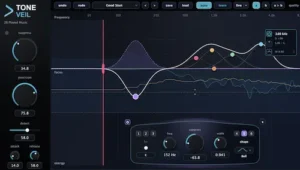
Reliable monitoring remains equally important. Modern resonance suppressors provide detailed spectral displays, but experienced engineers rarely trust visual feedback on its own. The most successful workflow combines accurate monitoring with listening tools such as Difference Monitoring and Node Listen, using visual analysis to confirm decisions that have already been made by ear rather than replacing them.
Perhaps the most important consideration is restraint. Even the best resonance suppressors can gradually reduce depth, transient impact, and harmonic complexity when inserted indiscriminately across an entire project. Used selectively on tracks that genuinely benefit from adaptive correction, ToneVeil has the potential to improve translation while preserving the character of the original mix. The same principle applies to spatial processing: preserving natural depth is often more important than removing every perceived imperfection. Our Blackbird Chamber D Review explores how realistic chamber reverbs can add dimension without compromising mix translation. That balance—not maximum suppression—is ultimately what separates transparent corrective processing from audible overprocessing.
ToneVeil Overall Rating
| Category | Rating |
|---|---|
| Transparency | 9.0/10 |
| Workflow | 9.5/10 |
| DSP Design | 9.0/10 |
| Mastering Suitability | 9.0/10 |
| CPU Efficiency | 8.5/10 |
| Value for Money | 9.5/10 |
| Overall | 9.1/10 |
ToneVeil enters one of the most competitive categories in modern audio production with a focused approach rather than an overloaded feature set. Its workflow is well designed, the processing architecture makes practical sense, and the feature selection reflects real production needs. While its long-term reputation will ultimately depend on extensive use in commercial sessions, the plugin already presents itself as a serious option for engineers looking for transparent resonance control in both mixing and mastering.
Why These Scores?
Transparency — 9.0/10.
For a resonance suppressor, transparency is the single most important criterion. ToneVeil appears capable of reducing harsh resonances while preserving musical balance, although broader real-world validation across demanding sessions is still needed before placing it alongside the longest-established tools.
Workflow — 9.5/10.
The interface is clean, easy to understand, and built around practical engineering decisions rather than visual complexity. Features such as Learn Mode, Difference Monitoring, Node Listen, and independent suppression nodes significantly reduce setup time during everyday work.
DSP Design — 9.0/10.
The combination of multi-node resonance control, Mid/Side processing, Zero Latency operation, and Linear Phase mode demonstrates a well-considered DSP architecture aimed at solving specific production problems instead of offering unnecessary processing options.
Mastering Suitability — 9.0/10.
Linear Phase processing and precise resonance control make ToneVeil suitable for mastering applications where subtle correction is required. As with any spectral processor, the best results come from conservative settings that preserve depth, transients, and overall musicality.
CPU Efficiency — 8.5/10.
Real-time spectral analysis is inherently demanding, and ToneVeil is no exception. Resource usage appears reasonable for this class of processor, but large-session benchmarking across different DAWs and systems remains limited.
Value for Money — 9.5/10.
Its introductory pricing makes ToneVeil particularly attractive for engineers who do not yet own a dedicated resonance suppressor. Assuming continued development and stable long-term support, it offers a strong balance between capability, workflow, and cost.
Pros & Cons
| Pros | Cons |
|---|---|
|
|
Who Should Buy the ToneVeil Plugin?
The ToneVeil plugin is best suited to mixing engineers, mastering engineers, electronic music producers, post-production editors, and anyone working with complex material where moving resonances are difficult to control using conventional EQ or dynamic EQ alone.
It is a particularly strong choice for engineers who want dedicated spectral resonance suppression without sacrificing workflow speed. Those expecting a one-click solution that automatically repairs poor recordings or replaces traditional mixing techniques should keep their expectations realistic.
Verdict: Is the ToneVeil Plugin Worth It?
ToneVeil enters a category where expectations are already well established. Engineers don’t need another plugin that can suppress resonances—they need one that does so transparently, predictably, and quickly enough to become part of an everyday workflow. In this market, DSP quality matters far more than the length of the feature list.
On paper, ToneVeil makes sensible design choices. Independent suppression nodes, Mid/Side processing, Difference Monitoring, Node Listen, Learn Mode, and dedicated processing modes for tracking and mastering address genuine production tasks instead of adding complexity for its own sake. The plugin presents itself as a specialized corrective tool rather than another all-in-one mixing solution, and that focused approach is one of its strongest qualities.
The remaining question is whether the detection algorithm performs as confidently as the interface suggests. At the time of writing, there is still limited independent evidence showing how ToneVeil behaves across demanding commercial sessions, where dozens of plugin instances, dense arrangements, and long production hours quickly expose weaknesses in transparency, stability, and resource efficiency.
That uncertainty is normal for a first-generation release. Every established resonance suppression plugin built its reputation through years of real projects, software updates, and feedback from professional engineers. ToneVeil now begins the same process.
For producers and engineers who don’t already own a dedicated resonance suppressor, ToneVeil is one of the more interesting recent entries into the category, particularly while introductory pricing remains available. Those already relying on mature tools such as Soothe2 or DSEQ are less likely to view it as a replacement today, but it is certainly a plugin worth evaluating alongside existing workflows.
Ultimately, ToneVeil doesn’t need to reinvent resonance suppression to justify its place in the market. It only needs to solve a familiar problem with enough transparency and consistency that engineers stop thinking about the plugin itself and simply trust the result. If its DSP proves capable of doing that over time, ToneVeil has every opportunity to establish itself as a credible professional tool rather than another short-lived product launch.

A resonance suppressor can reduce harsh frequencies, but it can’t decide how your entire mix should translate after mastering. Every production responds differently, and achieving clarity without sacrificing punch, depth, or musical energy still depends on careful engineering decisions.
If you’d like to hear how your mix sounds after professional mastering, upload up to 35 seconds and receive a free mastering demo. You’ll be able to compare your original mix with a professionally mastered version before making any commitment. Get your free demo →
FAQ
Is ToneVeil a replacement for a dynamic EQ?
No. Dynamic EQ is still the better tool for manually controlling specific frequencies. ToneVeil is designed to track moving resonances automatically, making it more efficient for corrective tasks where problem frequencies constantly change.
Can ToneVeil replace Soothe2?
Not yet. ToneVeil offers a similar workflow and feature set, but Soothe2 has years of proven performance in professional studios. At this stage, ToneVeil is better viewed as an alternative worth evaluating rather than a direct replacement.
Is ToneVeil suitable for mastering?
Yes. Its Mid/Side processing and linear-phase mode make it suitable for subtle mastering work, provided resonance suppression is applied conservatively to avoid unnecessary loss of transients or depth.
How CPU-intensive is ToneVeil?
Like most spectral processors, ToneVeil requires more processing power than a conventional EQ because it continuously analyzes the incoming signal. Independent large-session benchmark results are still limited.
Does ToneVeil add latency?
Yes, depending on the processing mode. Zero Latency mode is intended for recording and monitoring, while higher-quality modes are expected to introduce additional latency suitable for mixing or mastering.
What audio sources benefit most from ToneVeil?
Vocals, drum overheads, distorted guitars, bright synthesizers, acoustic instruments, mix buses, and stereo masters are among the strongest candidates. Sources with constantly shifting resonances typically benefit the most.
Can ToneVeil fix a bad mix?
No. It can reduce excessive resonant energy, but it cannot correct masking, poor arrangements, clipping, distortion, or an imbalanced mix. Those issues still require proper mixing decisions.
Is ToneVeil a good choice for electronic music?
Yes. Dense synthesizer layers, supersaws, distorted basses, and bright electronic percussion often generate moving resonances that are better controlled with adaptive spectral processing than static EQ.
Should resonance suppression be used on every track?
Usually not. Resonance suppressors work best when applied only where audible problems exist. Excessive use across an entire session can gradually reduce transient impact, harmonic detail, and overall mix depth.
Is ToneVeil worth buying?
If you don’t already own a dedicated resonance suppressor, ToneVeil is a compelling option—especially at its introductory price. Engineers who already rely on mature tools should evaluate it based on independent testing and how its DSP performs in their own workflow.
Is ToneVeil better than Soothe2?
Not necessarily. Soothe2 remains the reference for long-established professional workflows, while ToneVeil offers a promising alternative with a similar goal but a different implementation. The better choice depends on workflow preferences, DSP transparency, and long-term reliability.

Yurii Ariefiev reviews audio plugins from the perspective of real mastering sessions, focusing on transparency, mix translation, DSP behavior, and long-term workflow efficiency rather than marketing claims or feature lists.
This ToneVeil review evaluates how adaptive spectral resonance suppression performs in professional mixing and mastering, where preserving clarity, transients, and musical balance is often more important than removing every resonance.