Few guitar pedals have remained as relevant to modern recording as the Big Muff. Its compressed sustain and unmistakable fuzz character continue to define everything from classic rock to contemporary shoegaze, doom metal, stoner rock, alternative rock, and heavier productions. The downside has always been the same: what sounds enormous through an amp often demands significant corrective EQ once multiple guitars, bass, drums, and vocals compete for space in a finished mix.
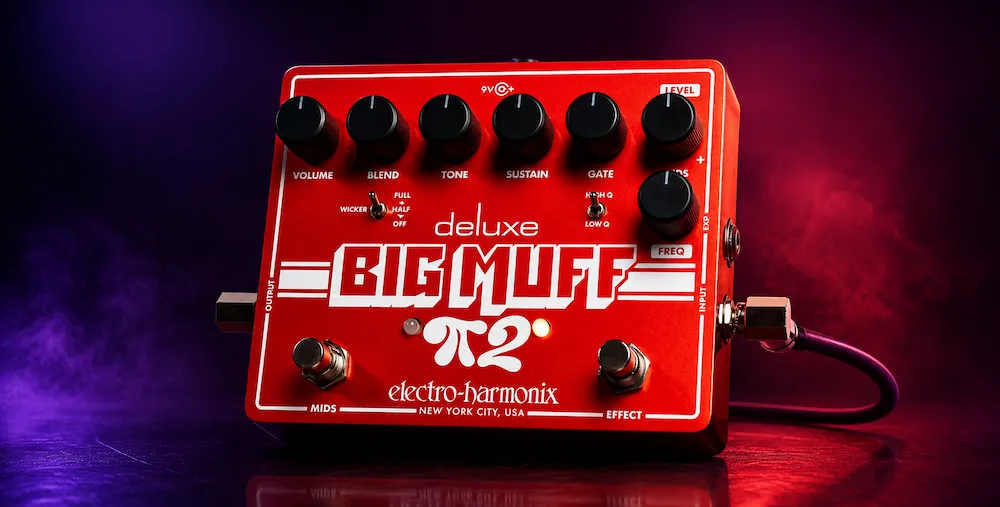
The Electro-Harmonix Deluxe Big Muff Pi 2 doesn’t attempt to reinvent that formula. Instead, it revisits the company’s lesser-known dual-op-amp Big Muff design and adds tools intended to solve long-standing production challenges rather than simply expand the feature list. Adjustable midrange shaping, parallel blend control, expression-controllable filtering, and an integrated noise gate all target decisions that engineers typically make after recording—not before it.
That shift is more significant than another variation on a familiar fuzz circuit. In modern audio production, the quality of the source often determines how much processing follows. A guitar tone that already occupies the right spectral space translates more consistently across dense arrangements, requires less corrective mixing, and reaches mastering with fewer compromises. Understanding where those responsibilities change is one of the key differences between mixing and mastering. The question isn’t whether the Deluxe Big Muff Pi 2 can generate massive sustain—virtually every Big Muff can. The real question is whether its expanded control set produces recordings that fit a mix with less work.
This review evaluates the Deluxe Big Muff Pi 2 from a production perspective rather than a guitarist’s first impression, focusing on recording workflow, mix translation, practical engineering benefits, and how it compares with both classic Big Muff variants and today’s most capable professional fuzz pedals.
Contents
A great guitar tone is only part of a professional production. If you’d like to hear how your finished mix translates after mastering, upload up to 35 seconds of your track and receive a free mastering demo. It’s an easy way to evaluate how balanced recordings carry through to the final master before committing to a full project.
Why Modern Recording Workflows Matter
 Classic Big Muff circuits were designed for a recording environment that looked very different from today’s hybrid studios. Guitarists committed to a tone before pressing Record, and engineers had relatively few options for reshaping heavily distorted tracks afterward. Modern production has reversed that workflow. DI recording, re-amping, impulse responses, amp modeling, and layered guitar arrangements have made source quality more important than ever because every weakness is magnified across multiple processing stages.
That change also highlights one of the Big Muff’s longest-standing compromises. Its compressed sustain and broad midrange scoop create an unmistakable signature, but they don’t always translate efficiently in dense productions. Multiple rhythm guitars, modern drum samples, wide stereo synths, and forward vocal mixes all compete for the same frequency range. A fuzz tone that dominates a solo performance can easily lose definition once the arrangement fills out, forcing engineers to rebuild presence with corrective EQ.
For that reason, today’s guitar hardware is increasingly influenced by studio workflow rather than vintage authenticity alone. Features such as parametric midrange control, parallel blending, onboard noise management, and more flexible filtering aren’t simply added conveniences—they reduce the amount of corrective processing required after tracking. The goal isn’t to replace mixing decisions but to produce a recording that arrives closer to its final position in the mix.
The Deluxe Big Muff Pi 2 follows that direction. Instead of chasing another variation of a familiar fuzz voice, Electro-Harmonix has focused on improving how that voice integrates into modern productions. Most of the new controls are less about expanding the tonal palette than giving engineers better control over how the pedal occupies the frequency spectrum before the signal reaches the DAW. That source-first philosophy is becoming increasingly common across professional recording hardware, from guitar pedals to modern channel strips such as the elysia channex|studio, where capturing a mix-ready signal is often more valuable than correcting it later.
That distinction becomes increasingly relevant in hybrid recording environments, where analog pedals are routinely combined with reactive load boxes, cabinet impulse responses, software amp simulators, and extensive post-processing. Every improvement made at the source reduces downstream correction while preserving the nonlinear response that still gives analog fuzz an edge over many software recreations.
How the Deluxe Big Muff Pi 2 Improves the Recording Workflow
The Deluxe Big Muff Pi 2 doesn’t redefine what a Big Muff sounds like. The familiar compression, long sustain, and dense harmonic structure are all intact. What Electro-Harmonix has changed is the amount of control available before the signal reaches the recording chain. That’s a more meaningful upgrade than chasing another variation of the circuit itself because source decisions generally have a greater impact than corrective processing later in the session.
The standout addition is the footswitchable parametric midrange section. Most fuzz pedals offer little more than a fixed mid boost or tone control, leaving engineers to compensate after tracking. Here, both center frequency and gain are adjustable, allowing the pedal to be matched to the guitar, amplifier, cabinet, and arrangement before the performance is recorded.
That matters because the traditional Big Muff mid scoop remains one of the circuit’s biggest production compromises. It creates an expansive sound on its own but often struggles once layered guitars, bass, cymbals, keyboards, and lead vocals compete for the same space. Rebuilding those frequencies with surgical EQ works, but it also means correcting harmonics that have already been generated by the distortion stage. Shaping the spectrum beforehand usually produces a more coherent result.
The selectable Q modes make the EQ section practical rather than simply more flexible. A wider bandwidth is useful for subtle tonal balancing across rhythm guitars, while the narrower setting allows specific frequencies to be pushed forward for lead parts without changing the overall character of the pedal. It’s a production tool, not just another tone-shaping gimmick.
Expression control over the mid-frequency parameter expands those possibilities further. Although it’s easy to view this as a creative effect, it also opens the door to controlled filter movement that feels more integrated than a traditional wah pedal. Engineers experimenting with evolving guitar textures or cinematic sound design will likely find more value here than players looking for conventional lead tones.
The Blend control addresses another long-standing limitation of high-gain fuzz circuits. Parallel processing has become standard practice because it preserves transient definition and low-frequency stability while introducing harmonic saturation where it’s actually beneficial. Integrating that concept into the pedal simplifies tracking, particularly for bass guitar, baritone instruments, and heavily layered productions where maintaining note definition is often more important than generating additional distortion.
While achieving the same result inside a DAW is straightforward, committing a balanced source during recording usually speeds up the rest of the production. Fewer duplicate tracks, fewer parallel buses, and less corrective routing mean fewer technical decisions competing with creative ones later in the mix.
The three-position Wicker switch is a more subtle addition than the EQ section but still addresses a familiar limitation. Earlier Big Muff designs often lean toward darker voicings, leaving engineers to recover presence with shelving EQ or brighter cabinet choices. Here, the additional top-end options don’t simply make the pedal brighter—they allow harmonic content to interact differently with speaker impulse responses, microphones, and subsequent equalization.
The integrated noise gate follows the same practical philosophy. Analog fuzz inevitably raises the noise floor, especially when paired with high-output pickups, boosted front ends, or modern recording interfaces with wide dynamic range. Stopping that noise before it reaches delays, reverbs, modulation, or stereo processors reduces cleanup work later, even if the gate itself isn’t sophisticated enough to replace dedicated studio expanders or restoration software.
Perhaps the biggest workflow improvement isn’t any single feature but the shift in where decisions are made. The Deluxe Big Muff Pi 2 encourages committing to a finished guitar tone during tracking instead of relying on plug-ins to solve predictable problems afterward. That approach tends to produce more consistent sessions, particularly when dozens of rhythm layers need to fit together without excessive corrective EQ.
None of these additions fundamentally change the mastering stage. Loudness, stereo imaging, and overall tonal balance remain mix decisions. Their contribution is earlier in the production chain: a better-controlled source usually survives compression, equalization, and limiting with fewer compromises throughout the mastering chain. That’s a subtle improvement, but one that experienced engineers tend to appreciate more than another variation on a familiar fuzz circuit.
Key Features & Technical Specifications
The Deluxe Big Muff Pi 2 is built around Electro-Harmonix’s dual op-amp Big Muff circuit while expanding the original design with modern studio-oriented controls. Alongside the familiar Sustain and Tone controls, it adds a fully adjustable parametric mids section with selectable Q, Blend control for parallel processing, a three-position Wicker switch, an onboard noise gate, and an expression pedal input that controls the mid-frequency parameter.
The pedal features true bypass switching, standard mono input and output, support for external expression control, and operation from a standard 9V DC power supply. Although physically larger than traditional Big Muff models, the additional controls are intended to reduce corrective EQ during guitar recording rather than simply increase tonal variety.
| Feature | Included |
|---|---|
| Dual Op-Amp Big Muff Circuit | Yes |
| Parametric Mids EQ | Yes |
| Blend Control | Yes |
| Noise Gate | Yes |
| Expression Input | Yes |
| True Bypass | Yes |
| 9V DC Power | Yes |
Separating Genuine Workflow Improvements from Marketing Claims
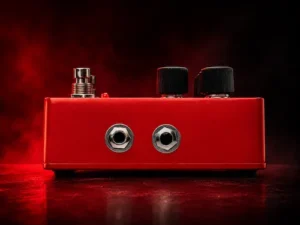 Electro-Harmonix positions the Deluxe Big Muff Pi 2 as the next step in the evolution of the Big Muff platform. That’s only partially true. The pedal doesn’t introduce a fundamentally new fuzz architecture, nor does it redefine the familiar compression, sustain, or harmonic character that players associate with the circuit. Anyone expecting a completely different voice will likely come away disappointed.
Where the Deluxe model genuinely improves the design is usability. Instead of changing the distortion itself, Electro-Harmonix has addressed several production problems that engineers routinely solve after recording. That’s a more meaningful upgrade than adding another clipping mode or a handful of preset voicings.
The parametric midrange section is the clearest example. Classic Big Muff pedals often require corrective EQ simply to remain present in a dense arrangement. Being able to adjust both center frequency and gain before the distortion reaches the recording chain produces a source that’s easier to place alongside modern drums, layered guitars, and vocal-heavy mixes. It doesn’t eliminate EQ during mixing, but it reduces the amount of corrective work required later.
The Blend control follows the same philosophy. Parallel distortion has been part of professional recording workflows for years because it preserves low-frequency definition while retaining the harmonic density that makes fuzz musically interesting. Integrating that capability into the pedal simplifies tracking, particularly for bass guitar and extended-range instruments, even if the same routing can be recreated inside any DAW.
The Wicker switch is a more incremental improvement. Additional high-frequency extension offers greater flexibility, but it shouldn’t be mistaken for a universal solution to mix translation. Brighter isn’t automatically better. Depending on the amplifier, cabinet, impulse response, and microphone combination, additional upper harmonics can become abrasive long before they become useful.
The built-in noise gate deserves similar perspective. It reduces cleanup during tracking by preventing idle noise from feeding downstream effects, but it isn’t sophisticated enough to replace dedicated expanders or restoration tools in demanding studio environments. Engineers working with high-gain productions will still rely on more precise noise management during post-production.
The biggest limitation remains the circuit itself. Even with significantly expanded tonal control, the Deluxe Big Muff Pi 2 is still unmistakably a Big Muff. Players looking for dynamic edge-of-breakup tones, transparent overdrive, or amplifier-like touch sensitivity won’t find those characteristics here because they aren’t part of the underlying design.
There is also a practical trade-off between flexibility and speed. Earlier Big Muff pedals earned their reputation partly because useful sounds were available within seconds. The Deluxe version offers substantially greater control, but every additional parameter introduces another decision during tracking. In experienced hands that’s an advantage. Less experienced users may spend more time chasing settings than capturing performances.
Ultimately, the strongest argument for the Deluxe Big Muff Pi 2 isn’t that it produces dramatically better fuzz. It produces fuzz that’s easier to record, easier to layer, and easier to integrate into a finished mix. That’s a meaningful distinction—and one that’s considerably more valuable in professional production than marketing language about a “new generation” of distortion.
Competitive Position: Where the Deluxe Big Muff Pi 2 Fits in Today’s Fuzz Market
The Deluxe Big Muff Pi 2 enters a crowded category where simply recreating a vintage circuit is no longer enough. Most established manufacturers—and countless boutique builders—already offer their own interpretation of the Big Muff formula. The question isn’t whether this pedal produces convincing fuzz. It’s whether its expanded feature set solves enough real production problems to justify choosing it over existing alternatives.
Electro-Harmonix has deliberately avoided chasing the “multiple pedals in one box” approach adopted by several competitors. Instead, the Deluxe Big Muff Pi 2 focuses on improving a single circuit through better signal control. That makes it less of a collector’s pedal and more of a recording tool designed to reduce corrective work after tracking.
| Pedal | Production Advantage | Main Limitation | Best Fit |
|---|---|---|---|
| Electro-Harmonix Deluxe Big Muff Pi 2 | Parametric mids, blend control, onboard gate, expression-controlled filtering | Still retains the classic Big Muff compression and voicing | Recording, layered guitars, hybrid analog/digital workflows |
| Electro-Harmonix Op-Amp Big Muff | Immediate, recognizable ’90s alternative character | Minimal tonal flexibility once recorded | Straightforward rock sessions, grunge, alternative |
| EarthQuaker Devices Hoof | More balanced mids and greater note definition | Fewer workflow-oriented controls | Indie, alternative, dynamic rhythm work |
| Walrus Audio Eons | Extensive clipping options and broader tonal range | Requires more setup and experimentation | Sound design, modern heavy production, experimental textures |
| JHS Muffuletta | Multiple historical Big Muff circuits in a single enclosure | Prioritizes variety over production workflow | Players comparing classic Muff revisions |
Viewed from an engineering perspective, the Deluxe Big Muff Pi 2 occupies a fairly specific position. It isn’t the most versatile fuzz available, nor is it intended to reproduce every historical Big Muff revision. Its strength lies in making one familiar circuit easier to integrate into modern recording sessions.
That’s particularly relevant for engineers who routinely spend time restoring midrange presence or managing low-frequency buildup after tracking. The onboard EQ and blend section won’t replace careful mix decisions, but they often reduce the amount of corrective processing required once guitars are layered into a dense arrangement.
Live players may reach a different conclusion. If the goal is simply to access a reliable Big Muff sound on stage, the additional controls, larger enclosure, and deeper editing options may offer limited practical benefit. Simpler Big Muff variants remain faster to dial in and occupy less pedalboard space.
The same applies to fully digital guitar rigs. Platforms such as Kemper, Quad Cortex, Fractal Audio, Helix, and Neural DSP already provide extensive EQ, routing, and parallel processing. In those environments, the Deluxe Big Muff Pi 2 offers a more immediate analog workflow rather than capabilities that software cannot reproduce. The same workflow philosophy can also be seen in compact studio hardware designed to simplify routing and performance, such as the Korg NTS-4, where reducing setup complexity is just as important as expanding processing options.
Ultimately, this pedal competes less with other Big Muff variants than with the amount of corrective work engineers are willing to perform after recording. Studios that prefer committing to a finished guitar tone at the source will likely appreciate its expanded control set. Engineers who routinely reshape every guitar track inside the DAW may find the workflow advantages less compelling.
How the Deluxe Big Muff Pi 2 Holds Up in a Real Production Environment
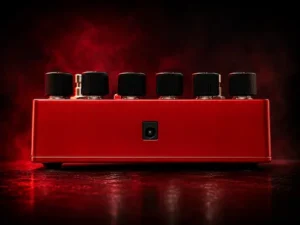 A fuzz pedal shouldn’t be judged by how it sounds in isolation. Nearly any high-gain circuit can deliver an impressive solo tone through a guitar cabinet. The real test begins after double-tracked rhythm guitars, bass, drums, keyboards, and vocals occupy the same mix. That’s where many classic Big Muff recordings end up requiring far more corrective EQ than players expect.
The Deluxe Big Muff Pi 2 is designed to reduce that gap between an inspiring tracking tone and a workable mix tone. Its expanded EQ section allows engineers to shape the signal before distortion reaches the recording chain, making it easier to retain note definition and midrange presence once additional instruments are introduced. The result isn’t necessarily a better guitar sound—it is often a guitar sound that requires less intervention later.
That distinction becomes increasingly important in productions built around layered rhythm guitars. Traditional Big Muff voicings can sound enormous on a single track yet gradually disappear as more instruments compete for the same spectral space. Having direct control over the pedal’s midrange allows those conflicts to be addressed at the source instead of relying entirely on corrective equalization after recording.
From a mixing standpoint, this often leads to smaller EQ moves and fewer compromises elsewhere in the arrangement. Engineers are less likely to overemphasize upper mids simply to recover articulation, reducing the risk of creating harshness that later affects vocals, cymbals, or snare presence.
The same philosophy extends to mastering, although indirectly. The pedal itself has no influence on loudness normalization, dynamic range targets, or streaming delivery specifications. What it can influence is the quality of the source entering the mix. Recordings that arrive with a more balanced spectral profile generally require fewer corrective adjustments before final limiting, preserving both tonal consistency and headroom. The same principle applies when you prepare a mix for mastering, where solving tonal issues before the final stage almost always produces better long-term results.
Another practical advantage is commitment. Modern productions often encourage endless revisions because nearly every processing decision can be postponed until mixdown. Hardware such as the Deluxe Big Muff Pi 2 pushes some of those decisions back into the recording stage, where experienced engineers have traditionally preferred to make them. Committing to a stronger source usually shortens the overall production process and leads to more consistent guitar tones across an entire project.
None of this suggests the pedal replaces careful engineering. Cabinet selection, microphone placement, amplifier choice, and player dynamics continue to have a greater influence on the finished recording than any onboard EQ section. What the Deluxe Big Muff Pi 2 offers is a broader range of useful starting points before those variables enter the equation.
Ultimately, its biggest contribution isn’t a radically different fuzz sound. It’s the ability to deliver tracks that integrate into a finished production with less corrective work. For engineers balancing dozens of channels in a modern rock mix, that kind of efficiency is often more valuable than another variation on an already familiar distortion circuit.
Verdict: Built for Recording, Not Reinvention
The Deluxe Big Muff Pi 2 dual op-amp design succeeds because it focuses on the part of the Big Muff formula that actually needed improvement. Electro-Harmonix hasn’t reinvented the circuit or attempted to compete with the growing number of multi-mode fuzz pedals. Instead, the company has addressed the production compromises that have accompanied classic Big Muff recordings for decades, giving engineers more control before those tracks ever reach the DAW.
The parametric midrange section is the most compelling reason to choose this version over earlier Big Muff models. Combined with the Blend control and integrated noise gate, it makes the pedal considerably easier to record, layer, and fit into modern mixes without relying as heavily on corrective EQ. Those are practical workflow improvements rather than marketing features.
None of that changes the pedal’s identity. It still delivers the compressed sustain, dense harmonic structure, and unmistakable voicing that define the Big Muff family. Players looking for transparent overdrive, highly dynamic breakup, or a completely different distortion architecture should look elsewhere, because this pedal was never intended to fill those roles.
The biggest beneficiaries are engineers and producers who prefer solving tonal problems at the source instead of after recording. In sessions built around layered guitars, hybrid analog/digital workflows, or frequent re-amping, the Deluxe Big Muff Pi 2 can remove several routine corrective steps without sacrificing the character that made the original circuit famous.
It’s not a revolutionary fuzz pedal, and it doesn’t need to be. Its value comes from making an established design more practical for contemporary recording. For studios that regularly track guitars, it’s arguably the most production-focused Big Muff Electro-Harmonix has released to date. For everyone else, it’s best viewed as a refinement of a classic—not a replacement for it.
Overall Rating
| Category | Rating |
|---|---|
| Sound Quality | 9.5/10 |
| Workflow | 10/10 |
| Mix Translation | 9.5/10 |
| Noise Management | 8.5/10 |
| Tonal Flexibility | 9.5/10 |
| Value for Money | 9/10 |
| Overall | 9.3/10 |
The Deluxe Big Muff Pi 2 isn’t trying to reinvent one of the industry’s most recognizable fuzz circuits. Instead, it refines it for modern recording by improving tone shaping before the signal reaches the DAW. For engineers and producers working with layered guitars, hybrid recording setups, and mix-focused productions, those workflow improvements are often more valuable than introducing an entirely new distortion character.
Why These Scores?
Sound Quality — 9.5/10. The pedal delivers the unmistakable Big Muff sustain and harmonic density while offering significantly greater tonal precision than earlier versions. The core sound remains authentic without sacrificing recording practicality.
Workflow — 10/10. This is where the Deluxe version stands out. Parametric mids, Blend control, onboard gate, and expression-controlled filtering allow important tonal decisions to be made before tracking, reducing corrective work throughout the rest of the production process.
Mix Translation — 9.5/10. Traditional Big Muff pedals often require substantial EQ once multiple instruments enter the arrangement. The expanded midrange control greatly improves how guitars retain definition inside dense mixes while preserving the classic fuzz character.
Noise Management — 8.5/10. The integrated gate effectively controls typical analog fuzz noise during recording. While dedicated studio expanders still provide greater precision, the built-in solution noticeably reduces cleanup during everyday sessions.
Tonal Flexibility — 9.5/10. Adjustable mids, selectable Q, Blend, Wicker voicing, and expression control provide a much wider range of usable recording tones than previous Big Muff designs without making the pedal unnecessarily complex.
Value for Money — 9/10. Players seeking a traditional Big Muff for live performance may not need the additional controls. For studio musicians, producers, and engineers, however, the improved workflow and reduced reliance on corrective EQ make the Deluxe version a worthwhile investment.
Who Should Buy the Deluxe Big Muff Pi 2?
| Best For | Not Ideal For |
|---|---|
| ✔ Recording engineers ✔ Hybrid analog/digital studios ✔ Layered rhythm guitars ✔ Shoegaze and alternative rock ✔ Doom and stoner rock productions | ✖ Transparent overdrive tones ✖ Vintage one-knob simplicity ✖ Compact pedalboards ✖ Players wanting edge-of-breakup dynamics |

Recording a better guitar tone always makes mastering easier, but even well-balanced mixes can reveal hidden issues once final processing begins. Harsh upper mids, low-end buildup, or masking between layered guitars often become much more obvious at the mastering stage than they did during mixing.
Upload up to 35 seconds of your mix and receive a free mastering demo. You’ll hear how your production translates after professional mastering before deciding on a full project.
Get your free demo →
FAQ
How does the Deluxe Big Muff Pi 2 dual op-amp version differ from a standard Big Muff Pi?
The core fuzz character remains unmistakably Big Muff, but the Deluxe version adds a fully adjustable parametric mids section, Blend control, integrated noise gate, Wicker switch, and expression control for the mid-frequency circuit. Those additions focus on improving usability rather than changing the underlying distortion voice.
Can the Deluxe Big Muff Pi 2 replace post-EQ during mixing?
No. It simply allows more tonal shaping before recording. Engineers will still apply EQ where the arrangement demands it, but starting with a better-balanced source generally reduces the amount of corrective processing required later.
Is the Deluxe Big Muff Pi 2 a good choice for bass guitar?
Yes. The Blend control makes it particularly useful for bass by preserving clean low-frequency fundamentals while introducing saturated harmonics. That approach helps maintain note definition without sacrificing weight.
What does the Wicker switch actually change?
Rather than adding more gain, the Wicker switch extends the upper-frequency response. Depending on the amplifier, cabinet, or impulse response in use, it can improve articulation or introduce additional brightness that may require careful balancing in dense mixes.
Can the expression input be used for more than wah-style effects?
Yes. Because it controls the center frequency of the parametric mids section, gradual sweeps can create evolving filter movement that works well for ambient textures, experimental guitar parts, and cinematic sound design without relying on a traditional wah pedal.
Is the built-in noise gate enough for high-gain studio recordings?
It helps reduce idle noise before the signal reaches downstream effects, but it shouldn’t be considered a replacement for dedicated studio gates or restoration software when working with demanding high-gain sessions.
Does it work well with amp modelers and impulse responses?
Yes. The additional EQ flexibility makes it easier to tailor the pedal to different cabinet impulse responses, reactive load boxes, and software amp simulations without relying entirely on post-processing inside the DAW.
Is the Deluxe Big Muff Pi 2 better suited to recording or live performance?
It performs well in both environments, but its expanded controls provide the greatest advantage during recording, where shaping the source before tracking can reduce editing and corrective EQ later in the production process.
Who should upgrade from an older Big Muff?
Players who regularly record guitars, layer multiple rhythm tracks, or struggle with the traditional Big Muff midrange scoop will benefit the most. Those who primarily use the pedal live and are satisfied with its existing tone may see less practical value in upgrading.
Is the Deluxe Big Muff Pi 2 likely to remain relevant as recording technology evolves?
Probably. It improves the workflow around one of the industry’s best-known fuzz circuits rather than following a short-term trend. As long as producers continue recording Big Muff-style tones, the added control should remain useful regardless of changes in DAWs or amplifier modeling technology.

Yurii Ariefiev is a mastering engineer and audio production editor specializing in recording, mixing, and mastering workflows. His hardware reviews examine how studio equipment performs inside real productions, with particular attention to source quality, mix translation, and the practical decisions that shape a finished master.
This review explores the Electro-Harmonix Deluxe Big Muff Pi 2 dual op-amp fuzz pedal from an engineering perspective, evaluating how its tone-shaping tools influence guitar recording, layered arrangements, corrective EQ, and overall mastering readiness rather than focusing solely on standalone sound.