Passive tube equalizers remain a fixture in professional mastering rooms despite the dominance of ultra-precise digital EQs. Modern engineers can correct individual resonances, automate dynamic frequency control, and visualize every adjustment in real time, yet many final tonal decisions are still made with broad, musical EQ curves rooted in decades-old analog designs.
That is the context behind Softube’s Reference 1998 Equalizer and Reference 1956 Equalizer. These plugins are not trying to compete with surgical processors such as FabFilter Pro-Q or Kirchhoff EQ. They target a different stage of the workflow: the final tonal shaping decisions that determine how a mix feels rather than how it measures.
The real question is not whether Softube can recreate vintage hardware behavior. The company has established itself as one of the more credible names in analog circuit modeling. What matters is whether these new EQs offer enough practical value to justify a place alongside the passive equalizers, mastering processors, and mix bus tools that many engineers already own. In a market crowded with analog emulations, workflow efficiency and sonic character matter far more than another vintage-inspired front panel.
Why Mastering Engineers Still Reach for Passive EQs
 Mastering EQ design has largely split into two camps. One focuses on precision: dynamic bands, surgical corrections, linear-phase processing, and detailed visual feedback. The other focuses on tonal shaping, where the goal is not to fix isolated problems but to improve the overall balance and presentation of a mix.
Passive tube equalizers remain relevant because mastering decisions are rarely made by frequency response alone. Engineers react to depth, density, stereo presentation, transient behavior, and the way tonal changes affect emotional impact. Two EQs can produce a similar curve on an analyzer while delivering noticeably different results through monitors.
This is where passive designs continue to earn their place. Their broad curves naturally push engineers toward larger tonal decisions instead of endless micro-adjustments. In practice, that often leads to more cohesive masters and fewer situations where a mix becomes technically cleaner but musically less engaging.
The current streaming landscape has only reinforced that role. As loudness normalization reduces the advantage of excessive level, tonal balance becomes a more important differentiator. Engineers are increasingly focused on creating mixes that feel larger, deeper, and more open across earbuds, consumer speakers, cars, and full-range monitoring systems. Passive EQs have long been valued for exactly that type of enhancement.
Viewed through that lens, the Reference 1998 and Reference 1956 are not competing with corrective EQs. They are aimed at the final stage of decision-making, where broad tonal shaping, subtle coloration, and overall presentation matter more than analytical precision.
Part of the interest surrounding this release comes from the hardware lineage behind the designs. Softube has positioned both plugins as recreations of respected passive tube equalizers that earned their reputation in professional mastering environments. While the exact hardware is not the primary reason to consider the plugins today, the association matters because engineers are ultimately evaluating decades of mastering philosophy as much as a piece of software.
Analog EQs Shape Tone. Mastering Shapes the Release.
Even the best passive EQ cannot fix translation issues, inconsistent low-end, unstable stereo imaging, or loudness decisions that fall apart after distribution. Professional mastering is about evaluating the entire record as a finished product, not just applying processing. Upload up to 35 seconds of your mix and receive a free mastering demo to hear how your track responds to real-world mastering decisions before committing to a full project.
Request your free mastering demo →
How the Reference 1998 and 1956 Fit Into a Modern Mastering Chain
The most important thing to understand about Softube’s Reference series is that these are finishing EQs, not problem-solving EQs. They are designed for the stage where major balance issues have already been addressed and the focus shifts toward presentation, depth, and tonal refinement.
In practical terms, both plugins occupy a position that mastering engineers traditionally reserve for tonal enhancement stages within a larger processing sequence. Understanding where that stage sits relative to compression, limiting, stereo processing, and quality control is often more important than the EQ itself. In many contemporary mastering chains, tonal shaping decisions made with passive EQs directly influence how the final limiter responds, affecting perceived loudness, punch, and transient behavior. We recently examined this relationship from the limiting side in our TBProAudio LAxLimit V review.
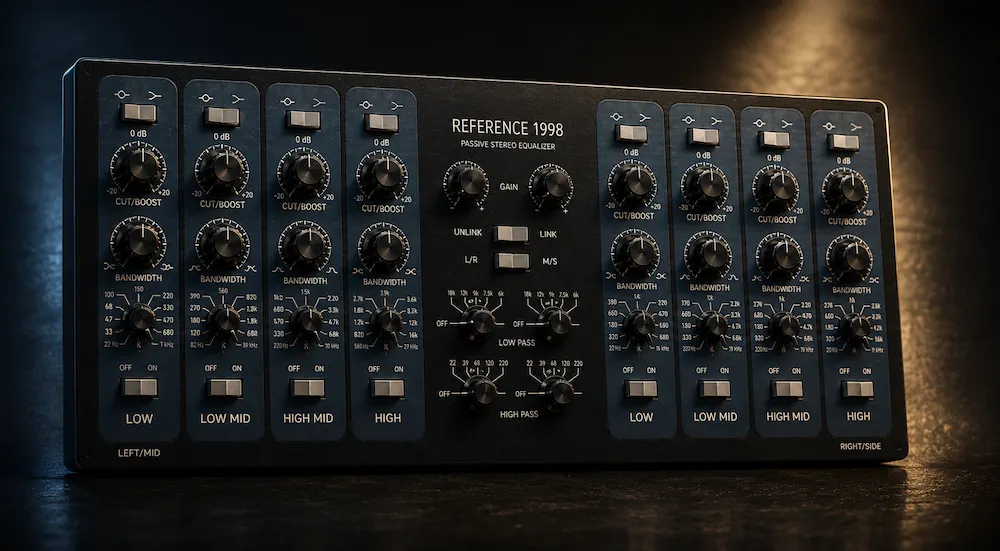
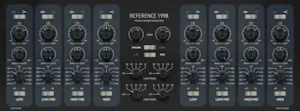
The Reference 1998 Equalizer is particularly suited to broad-spectrum shaping. Rather than chasing individual resonances or corrective cuts, it encourages the kind of wide tonal moves commonly found in mastering workflows. In practical terms, that means adding low-end authority without making the mix feel heavier, opening the top end without introducing brittle highs, or improving overall tonal cohesion before final limiting.
That distinction matters because many engineers already own highly capable corrective tools. The value of a passive EQ is rarely its ability to solve problems. Its value comes from how quickly it helps an engineer reach a desirable tonal balance once those problems have been solved.
The Reference 1956 Equalizer extends that concept into a workflow that reflects current mastering practice more accurately. Its integrated Mid/Side processing allows tonal decisions to be made independently in the center and side channels without introducing additional routing, utility plugins, or parallel processing chains.
In a real mastering session, that can be useful for tightening low-frequency information in the center while preserving width in the sides, adding presence to vocals without pushing cymbals forward, or introducing high-frequency air into the stereo image without altering the core impact of the mix. These are common mastering moves, but they often require multiple processors when Mid/Side functionality is not built directly into the EQ.
Mid/Side processing itself is not innovative. What matters is that Softube has integrated it into a passive EQ workflow that encourages tonal decisions rather than technical manipulation. The practical benefit is fewer plugin stages, less routing complexity, and a faster path to evaluating whether a change genuinely improves translation.
That does not guarantee a better master. What it does provide is a more efficient environment for making the kinds of subtle tonal decisions that often separate a finished master from a merely loud one.
What These EQs Actually Bring to the Table — and What They Don’t
 One of the easiest ways to misjudge an analog-modeled EQ is to mistake character for innovation. The audio industry has spent the last decade releasing increasingly sophisticated recreations of classic hardware, but accurate modeling alone is no longer enough to justify a new processor.
That is the challenge facing the Reference 1998 and Reference 1956. Neither plugin introduces a new EQ architecture, a new DSP concept, or a fundamentally different approach to mastering. They are not attempting to reinvent equalization. Their value comes from how effectively they package familiar analog behavior into a workflow that fits modern production environments.
In practical use, the advantages are fairly clear. Broad tonal adjustments can be made quickly, Mid/Side processing is available without additional routing, and engineers can apply analog-style coloration without adding multiple stages of saturation, EQ, and stereo processing. Those benefits are not revolutionary, but they are relevant in sessions where speed and decision-making efficiency matter. That emphasis on faster, more confident tonal decisions mirrors a broader trend in modern production workflows, including systems designed around EQ decision support rather than additional processing power, such as the concepts explored in our Mastering The Mix MIXVAULT review.
The distinction becomes important when separating marketing expectations from real-world results. These plugins will not uncover details that other high-end mastering EQs cannot reach. They will not automatically improve translation, increase perceived depth, or outperform established processors simply because they are newer. The quality of the outcome still depends on the engineer, the monitoring environment, and the source material.
That reality also exposes the primary limitation of the release. Most experienced mastering engineers already own several excellent tonal-shaping tools. Whether the Reference series becomes a meaningful addition depends less on sound quality and more on workflow preference. Engineers who already rely on processors such as Pulsar Massive, high-end Pultec-style emulations, Acustica mastering suites, or dedicated hardware equalizers may find the improvement relatively subtle.
Viewed realistically, the strongest argument for the Reference 1998 and 1956 is not that they replace existing tools. It is that they offer another high-quality path to the same destination, with a workflow that some engineers may ultimately prefer over the alternatives already available.
Competitive Analysis: Where the Reference Series Fits in the Mastering EQ Market
The biggest challenge facing the Reference 1998 and Reference 1956 is not sound quality. It is market saturation. Engineers shopping for a premium mastering EQ already have access to some of the strongest analog-modeled processors ever released, which means Softube is competing in a category where “good” is no longer enough.
One reason the mastering EQ category remains highly competitive is that engineers are rarely shopping for frequency curves alone. A modern mastering EQ plugin is expected to influence tonal balance, stereo presentation, depth perception, and mix translation while remaining fast enough for daily production work. The most successful designs are often the ones that encourage confident decisions rather than endless adjustment.
Viewed from that perspective, the Reference series sits firmly within the analog mastering EQ tradition. These are not corrective processors competing with surgical digital tools. They are finishing EQs intended for mix bus and mastering applications where broad tonal shaping has a greater impact than narrow frequency correction.
| Plugin | Core Strength | Best Application | Main Limitation |
|---|---|---|---|
| Softube Reference 1998 | Broad tonal enhancement | Mix bus and mastering | Not designed for corrective work |
| Softube Reference 1956 | Passive EQ with integrated Mid/Side processing | Modern mastering workflows | Focused rather than all-purpose |
| FabFilter Pro-Q | Precision, flexibility, dynamic processing | Corrective and surgical EQ | Less analog coloration |
| Kirchhoff EQ | Advanced mastering precision | Corrective and hybrid mastering | Minimal analog coloration |
| Pulsar Massive | Mastering-oriented tonal shaping | Final stereo bus processing | Higher complexity |
| UAD Pultec Collection | Classic passive EQ character | Mix bus enhancement | Less workflow flexibility |
| Acustica Purple | Deep hardware-style modeling | High-end mastering chains | Higher CPU demands |
Pulsar Massive is arguably the closest competitor because it targets the same type of engineer: someone looking for a finishing EQ rather than a corrective tool. Both products are designed to shape presentation, depth, and tonal balance during the final stages of production. The difference is that Pulsar Massive offers a broader mastering feature set, while Softube appears focused on a more streamlined workflow.
Against FabFilter Pro-Q, the comparison becomes less meaningful because the products solve different problems. Pro-Q remains one of the industry’s most capable corrective EQs, while the Reference series is aimed at tonal enhancement. Most professionals would use them together rather than choose one over the other.
The comparison becomes more interesting against traditional passive EQ emulations. Here, the Reference 1956 gains a practical advantage from its integrated Mid/Side workflow. Many mastering engineers routinely separate center and side information, and eliminating extra routing can simplify session management without changing the underlying processing philosophy.
The strongest competition may ultimately come from engineers’ existing plugin folders. Anyone who already owns several premium passive EQs, particularly mastering-focused designs, is unlikely to discover an entirely new category of sound here. The decision becomes less about capability and more about whether Softube’s workflow, control layout, and tonal character fit a preferred way of working.
For mastering engineers, mix bus specialists, and producers who regularly finish commercial releases, the Reference series represents a legitimate option in the premium EQ category. For users primarily focused on corrective processing, detailed frequency repair, or dynamic control, other tools will remain far more essential.
Do These EQ Decisions Hold Up Outside the Studio?
 A mastering EQ is ultimately judged by translation, not by how impressive it sounds during a solo listening session. The real test comes after export, when a track moves from a controlled monitoring environment to streaming platforms, wireless earbuds, car stereos, smart speakers, laptops, and countless playback systems the engineer will never hear firsthand.
This is one reason passive EQs remain popular in mastering despite the availability of far more precise tools. Broad tonal adjustments tend to influence the overall presentation of a mix rather than isolated frequency details. When a track passes through AAC, Ogg Vorbis, or other lossy codecs, those larger tonal relationships are often preserved more effectively than extremely narrow corrective moves.
The Reference 1998 and Reference 1956 encourage exactly this type of decision-making. They are not designed for chasing individual resonances or endlessly refining analyzer readings. Their strength lies in shaping overall tonal balance, depth, weight, and perceived openness — qualities that remain relevant regardless of playback system.
That approach aligns well with modern streaming workflows. Loudness normalization has largely shifted mastering priorities away from maximum level and toward consistency, balance, and translation. Engineers evaluating passive EQ moves in modern releases should also understand how normalization affects playback behavior across platforms, a topic explored in our Mastering for Streaming Platforms guide.
The Reference 1956’s Mid/Side implementation is particularly relevant here. Used conservatively, it allows engineers to introduce width and air without sacrificing center-channel focus. That can help preserve vocal intelligibility, kick impact, and bass stability while still creating a wider stereo presentation. The key word is “conservatively.” Excessive side-channel processing remains one of the fastest ways to create translation issues outside a controlled monitoring environment.
From a workflow perspective, there is little reason to expect performance-related limitations. Softube’s processing has historically been far more efficient than many hardware-focused emulations that rely on heavy sampling or convolution techniques. For engineers running multiple meters, analyzers, references, limiters, and mastering processors simultaneously, predictable CPU behavior is often more valuable than another layer of analog realism.
That may sound like a minor consideration, but it directly affects daily use. A processor that sounds excellent but slows session navigation, increases project load times, or discourages experimentation rarely becomes a permanent part of a professional mastering chain.
What Is Missing From Softube’s Approach?
The biggest limitation of the Reference series is not sound quality. It is specialization. These plugins are designed to excel at broad tonal shaping, which means engineers still need separate tools for corrective equalization, dynamic frequency control, resonance management, and detailed problem solving.
In practical mastering work, that usually means pairing the Reference Equalizers with a transparent parametric EQ, dynamic processor, or dedicated mastering suite. They are not intended to function as all-in-one solutions.
This is where products such as FabFilter Pro-Q, Kirchhoff EQ, Weiss EQ1-inspired processors, and modern dynamic EQs retain a significant advantage. They provide a level of precision that passive designs intentionally avoid.
For some engineers, that limitation is actually the appeal. Restricting available options often leads to faster decisions and fewer unnecessary adjustments. For others, especially those working across multiple genres and mastering styles, the Reference series may feel too narrowly focused to become a primary EQ platform.
Overall Rating
| Category | Rating |
|---|---|
| Sound Quality | 9/10 |
| Mastering Workflow | 9.5/10 |
| Mix Translation Potential | 9/10 |
| CPU Efficiency | 9/10 |
| Feature Innovation | 7/10 |
| Value for Money | 8.5/10 |
| Overall | 8.7/10 |
Sound Quality — 9/10
The strongest aspect of the Reference series is its musical behavior. Both equalizers appear designed around broad tonal shaping rather than corrective work, making them well suited to mix bus and mastering applications where depth, balance, and overall presentation matter more than precision editing.
Mastering Workflow — 9.5/10
The integrated Mid/Side implementation in the Reference 1956 and the streamlined control philosophy of both plugins make them unusually efficient for final-stage mastering decisions. The workflow encourages listening and decision-making instead of constant visual analysis.
Mix Translation Potential — 9/10
Passive EQ curves often survive streaming codecs and consumer playback systems better than aggressive corrective processing. While no EQ guarantees translation, the tonal approach behind these plugins aligns well with modern release workflows.
CPU Efficiency — 9/10
Softube’s modeling has historically balanced realism with usability. Based on the company’s track record and design philosophy, these plugins should fit comfortably into large mastering sessions without becoming resource-heavy bottlenecks.
Feature Innovation — 7/10
There is little evidence of fundamentally new DSP technology. No dynamic EQ, spectral processing, machine learning, or novel equalization architecture is present. The innovation lies in workflow integration and execution rather than new processing concepts.
Value for Money — 8.5/10
At the introductory pricing, the bundle presents a stronger value proposition than purchasing either plugin individually. For engineers without an established passive EQ collection, the value is compelling. For professionals already invested in premium mastering EQ ecosystems, the benefit is more incremental.
Overall — 8.7/10
The Softube Reference 1998 and Reference 1956 Equalizers are not category-disrupting releases, but they are serious mastering tools. Their strength comes from musical tonal shaping, efficient workflow design, and practical integration into modern mastering chains. Engineers looking for a finishing EQ may find them highly useful; engineers expecting revolutionary processing technology will not.
Who Should Actually Consider the Reference Series?
The strongest audience for the Reference 1998 and 1956 is not beginners looking for their first EQ. These plugins make the most sense for engineers who already own corrective tools and want a dedicated finishing equalizer for mix bus and mastering work.
Mastering engineers, mix bus specialists, and producers who regularly deliver commercial releases are likely to benefit the most. The workflow encourages broad tonal decisions and minimizes unnecessary tweaking.
Users primarily focused on resonance removal, dynamic equalization, dialogue cleanup, or surgical repair will generally get more value from modern parametric and dynamic EQ platforms.
Final Verdict: A Serious Mastering Tool, Not a Category Disruptor
The Reference 1998 and Reference 1956 enter one of the most competitive segments of the audio software market. Nearly every major developer already offers some version of a passive mastering EQ, and many of them sound excellent. That makes differentiation far more difficult than simply delivering another convincing analog emulation.
Softube’s strongest achievement is not technological innovation but product positioning. Rather than chasing increasingly complex feature sets, the company has focused on a workflow that encourages broad tonal decisions, efficient mastering moves, and a more streamlined path from evaluation to execution.
The Reference 1998 is likely to appeal most to engineers who prefer shaping the overall presentation of a mix rather than dissecting individual frequency problems. That distinction mirrors a broader reality in professional mastering: successful results rarely come from a single processor and are more often the product of cumulative decisions made throughout the mastering process, from tonal balance and dynamics to translation and final delivery.
For readers interested in how those decisions are made in commercial mastering environments, our guide on How Professional Mastering Works provides additional context.
Neither plugin changes what is possible in mastering. Experienced engineers can achieve comparable results with existing premium tools. The difference lies in how quickly those results can be reached and whether the workflow encourages better decision-making under real session conditions.
For engineers building a mastering chain from scratch, the Reference series represents a strong entry into the passive EQ category. For professionals who already own multiple high-end mastering equalizers, the decision becomes more personal. The question is not whether these plugins are capable, but whether their particular combination of tonal character, control layout, and workflow philosophy fits the way you prefer to work.
The Reference series is best viewed as a refinement of a proven mastering approach rather than a reinvention of it. That may sound less exciting than the marketing language often surrounding new releases, but in professional audio, refinement is usually what survives long after the launch cycle ends.
A Great Master Is Built on Decisions, Not Presets
Plugins like the Softube Reference Equalizers can add polish, depth, and tonal character, but they cannot determine what your track actually needs. Professional mastering is the process of making critical decisions about balance, dynamics, stereo presentation, and translation across real-world playback systems.
Before spending more money on processing, find out how far your mix can go with expert mastering. Upload up to 35 seconds of your track and receive a free mastering demo prepared by a real mastering engineer. Hear the difference before making any commitment.
Request your free mastering demo →
FAQ
Can the Softube Reference Equalizers be used as the primary EQ in a mastering chain?
They can, but most mastering engineers will likely pair them with a more surgical processor. The Reference series excels at broad tonal shaping, while detailed corrective work is usually handled by a transparent parametric EQ earlier in the chain.
Which is more useful for mastering: Reference 1998 or Reference 1956?
That depends on workflow. The Reference 1998 is better suited to overall tonal balance and mix bus enhancement, while the Reference 1956 becomes more attractive when Mid/Side processing plays a significant role in the mastering process.
Do these EQs work well before or after a mastering compressor?
Both approaches can be effective. Before compression, they can influence how the compressor responds to low-end and high-frequency content. After compression, they function more as finishing tools for final tonal adjustments.
How do the Reference Equalizers compare to hardware passive EQs?
They deliver the workflow convenience, recallability, and session integration expected from software while attempting to capture the tonal behavior associated with passive analog designs. Whether they fully replace hardware remains a matter of personal preference and monitoring environment.
Are these plugins useful for stem mastering?
Yes. Their broad curves can be particularly effective on drum, instrumental, and vocal stems where subtle tonal shifts often have a greater impact than aggressive corrective processing.
Do the Reference Equalizers make sense for hybrid analog-digital studios?
They may. Engineers working with analog compressors, converters, or summing systems often use passive EQ plugins as flexible tonal-shaping stages that do not require additional hardware routing.
How do they compare to mastering-focused EQs such as Pulsar Massive?
Pulsar Massive offers a wider range of mastering-specific controls, while the Softube approach appears more streamlined. The choice is less about capability and more about preferred workflow and tonal character.
Are the Reference Equalizers suitable for modern genres such as EDM, pop, and hip-hop?
Yes. Broad low-frequency enhancement, top-end shaping, and Mid/Side tonal control remain relevant across contemporary genres, particularly during mix bus and mastering stages.
Can these plugins help improve translation across streaming platforms?
Indirectly. No EQ guarantees better translation, but broad tonal adjustments often survive codec conversion and playback-system variation more consistently than highly aggressive corrective processing.
Can the Reference 1998 and 1956 Equalizers replace hardware mastering EQs?
For recall, automation, and workflow convenience, yes. For engineers who rely on the specific interaction of transformers, tubes, and analog gain staging, software still behaves differently. Most studios should view these plugins as high-end mastering tools rather than direct hardware replacements.
Do experienced engineers need another passive EQ plugin?
Not necessarily. The strongest reason to add the Reference series is workflow preference rather than capability. Most professionals already own tools that can achieve similar results, making usability and tonal taste the deciding factors.

Yurii Ariefiev is a mastering engineer and audio production editor who analyzes EQ plugins through the lens of real-world mastering decisions, translation, and release preparation. His work focuses on how tonal balance, stereo presentation, dynamics, and playback consistency interact across modern streaming platforms.
This article evaluates the Softube Reference 1998 and Reference 1956 Equalizers as practical mastering tools rather than vintage recreations, examining where passive EQ workflows improve results, where they fall short, and how they compare with other mastering-focused processors used in professional production environments.
☕ Buy me a coffee