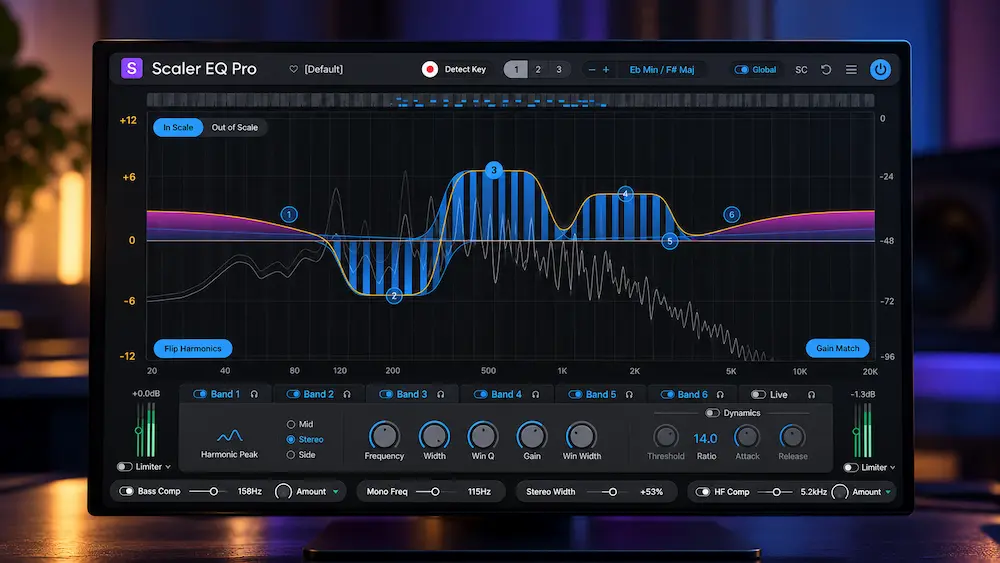
Most modern EQs are built around the same fundamental workflow: identify a frequency, determine how much to change it, and control how that change responds to the signal. Scaler EQ Pro adds another layer to that process by relating EQ decisions to the musical key and scale of the material. Instead of treating frequency as an isolated parameter, its Harmonic Peak filters can target frequencies that belong to the selected scale and treat out-of-key content differently. That makes the processor particularly relevant to tonal shaping and sound design, although it does not make it a universal replacement for a conventional precision EQ.
Scaler EQ Pro is the successor to Scaler EQ, but the update goes well beyond a cosmetic revision. The new version adds a rebuilt Harmonic Peak architecture, low- and high-frequency compressors, continuously variable filter slopes, Continuous Gain Match, dynamic EQ behavior and a MIDI-controlled Live Mode. The feature set is considerably broader than the original, while the central concept remains the same: frequency processing that responds to musical context.
For mixing and mastering engineers, that distinction is important. Conventional precision EQs remain the more direct choice for surgical resonance removal, detailed spectral balancing, EQ matching, or linear-phase processing. Scaler EQ Pro becomes more interesting when the task involves shaping harmonics in relation to the key of the material—for example, emphasizing useful tonal components while reducing frequencies that fall outside the musical context.
Why Key-Aware EQ Is More Than Another Parametric EQ
 The original Scaler EQ introduced the core idea in 2024: its Harmonic Peak filters could place multiple narrow EQ bands around a frequency region according to the notes contained in a selected key or scale. This is not pitch correction, tuning, or harmonic generation. The source remains unchanged in pitch; the processor changes the level of selected frequency components according to their relationship with the musical scale.
That is the key distinction between Scaler EQ Pro and a conventional parametric or dynamic EQ. A standard EQ works from frequency, gain, bandwidth, and, in the case of dynamic EQ, signal level. Scaler adds musical context to that process. The selected scale becomes another variable that determines which frequency components the EQ should emphasize or attenuate.
Consider a sustained vocal with dense upper-midrange harmonic content. A conventional bell affects everything within its bandwidth, so useful harmonic structure and unwanted energy are treated together. Harmonic Peak processing can instead concentrate the boost on frequencies that correspond to notes within the selected scale. Depending on the selected mode, the relationship can also be reversed to reduce components that fall outside the scale.
The distinction is subtle but useful: Scaler EQ Pro does not decide which frequencies are musically desirable. It does not evaluate the arrangement or understand the role of an individual track. The engineer still chooses the key, scale, frequency region, gain and processing direction. The musical scale simply adds another layer of control between the source material and the EQ curve.
What Scaler EQ Pro Actually Adds to the Production Workflow
Scaler EQ Pro is a substantial expansion of the original Scaler EQ rather than a cosmetic update. The Harmonic Peak system has been rebuilt, while the new version adds conventional EQ filtering, dedicated Bass and High-Frequency Compression, Live Mode, continuously variable filter slopes and Continuous Gain Match. Magic Shelves, dynamic processing and Mid/Side operation remain part of the broader architecture.
The practical change is that Scaler EQ Pro no longer confines the note-aware concept to a specialist EQ mode. Traditional filters, dynamic processing, dedicated low- and high-frequency compression, stereo control and MIDI input now sit around the Harmonic Peak system, so the same plugin can move between corrective EQ, scale-dependent shaping and MIDI-driven processing without changing its underlying workflow.
Scaler EQ vs. Scaler EQ Pro: What Actually Changed
The Pro version keeps the original Scaler EQ concept intact, so the upgrade is less about replacing the musical EQ idea and more about removing some of the limitations around it. The rebuilt Harmonic Peak engine remains the defining feature, while the expanded filtering, dynamics and MIDI control make the processor considerably broader in scope.
| Area | Scaler EQ | Scaler EQ Pro |
|---|---|---|
| Harmonic Peak | Original note-aware architecture | Rebuilt Harmonic Peak processing |
| Filter control | Core EQ filter set | Expanded filtering with continuously variable slopes |
| Dynamics | Dynamic EQ bands | Dynamic bands plus dedicated Bass and High-Frequency Compression |
| Gain matching | Manual level comparison | Continuous Gain Match |
| MIDI control | No Live Mode | MIDI-controlled Live Mode with polyphonic operation |
| Platform position | Original musical EQ | Expanded musical EQ and processing platform |
The upgrade therefore makes the most sense for users who already like the note-aware approach but want more control around it. The underlying concept has not been replaced; the surrounding toolset has been substantially expanded.
Harmonic Peak Processing
Scaler EQ Pro can detect the key automatically, but the workflow is not limited to a single detected scale. The plugin provides three scale slots, which is useful when a project changes key or when different sections of the arrangement require different harmonic references. That makes manual verification of the detected key part of the process rather than an optional technical detail.
Harmonic Peak remains the primary reason to reach for Scaler EQ Pro instead of a conventional parametric EQ. Once a key or scale is selected, the filter can distribute its processing across the corresponding musical notes rather than applying the same gain continuously across a conventional bell curve. Boosts can emphasize in-key frequencies, while cuts can target frequencies outside the selected scale, with the relationship reversible.
At moderate settings, this is best understood as scale-aware tonal shaping rather than pitch processing. On a vocal, for example, a controlled boost can reinforce frequency components associated with the selected scale without applying identical gain across a broad band. On layered guitars, the same approach can emphasize selected harmonic regions while leaving unrelated spectral energy comparatively untouched. The important limitation is that the processor changes amplitude at those frequencies; it does not retune notes or correct an out-of-key performance.
The processing can also be pushed well beyond conventional corrective EQ. Because the filter follows specific pitch relationships, it can impose a stronger sense of tonal organization on material that contains ambiguous or relatively unpitched frequency content. That can be effective for percussion and sound design, although aggressive settings can become audible as an effect rather than transparent EQ.
Dynamic Harmonic EQ
Dynamic operation makes the Harmonic Peak concept considerably more practical for mixing. Any EQ band can be made dynamic, including Harmonic Peak bands, with threshold, ratio, attack and release controls available to shape the response. Positive or negative gain can therefore be used for both dynamic emphasis and attenuation.
This matters when the problematic or desirable harmonic content changes with the performance. A vocal may produce excessive energy around particular notes only at certain moments. A synth can shift its strongest partials as chords change. A guitar may generate resonant components that become prominent only on specific fretted notes.
A conventional dynamic EQ can already solve many of these problems. The difference is that Scaler allows the engineer to constrain that tonal movement according to a musical scale. The scale does not replace threshold or dynamics processing; it determines which frequency relationships the EQ is allowed to favor.
Live Mode and MIDI Control
Live Mode is the most unconventional addition to Scaler EQ Pro. MIDI notes can trigger harmonic EQ bands, while velocity and ADSR controls influence their behavior. Polyphonic MIDI input allows several note-related bands to operate simultaneously.
That changes the plugin from a processor controlled exclusively by audio and automation into something that can respond directly to a musical performance. For corrective mixing, that distinction may have little practical value. For electronic production, evolving pads, transitions, cinematic sound design and performance-based processing, it opens a substantially different workflow.
A producer can use MIDI to emphasize different harmonic regions as a chord progression develops instead of drawing separate automation curves for each tonal change. The advantage is not simply faster automation. The control source itself becomes musical: the notes being played determine which harmonic regions the processor emphasizes.
Magic Shelves and Stereo Processing
Magic Shelves carry over from the original Scaler EQ and provide separate Mid/Side behavior across the low and high frequency ranges. This allows broad tonal changes to affect the center and sides differently rather than applying an identical shelf to the entire stereo signal.
In practical mixing, that can be useful for managing low-frequency width, opening the upper end of the stereo field, or reshaping the tonal balance between center information and ambience or side content. The underlying Mid/Side technique is well established; the useful part is having it inside the same processor as Scaler’s scale-aware filtering.
Magic Shelves are therefore complementary rather than the main reason to choose Scaler EQ Pro. The more significant distinction is the combination of conventional stereo processing with Harmonic Peak and dynamic scale-aware operation.
Hear What Your Mix Can Translate Like
Key-aware processing can shape individual harmonic relationships, but the finished mix still has to hold together as a complete record—with clear tonal balance, controlled dynamics, depth, stereo image and reliable translation across playback systems. If you want to evaluate how your own mix responds to professional mastering decisions, you can submit a free mastering demo with up to 40 seconds of your track. Upload up to 40 seconds for a free mastering demo →
Where Scaler EQ Pro Earns Its Place in a Mix
 Scaler EQ Pro makes the most sense on sources whose spectral content has a clear relationship with musical pitch. The more closely the harmonic structure follows the composition, the more useful its scale-aware processing becomes.
Vocals are one of the clearest applications. A vocal’s fundamental and harmonic structure moves continuously as the melody changes, while a conventional EQ remains tied to fixed frequency regions. Harmonic Peak processing can follow the pitch relationships within the selected scale, allowing the engineer to emphasize specific musical components without applying the same gain across an entire upper-midrange band. That kind of tonal control also matters later in the chain, where vocal mastering has to preserve intelligibility and harmonic presence without making the vocal sound disconnected from the mix. It is not a replacement for conventional vocal EQ, but it can provide a more selective way of shaping harmonic presence.
Electric guitars are another strong candidate, particularly with distorted or heavily layered parts. Distortion produces dense harmonic content, and broad EQ moves can remove desirable components along with the buildup being targeted. Scale-aware filtering provides another degree of control over which harmonic regions receive emphasis or attenuation, which can be useful when several guitars are competing in the same spectral range.
Synths and pads are especially well suited when the arrangement has a strong tonal center. Their harmonic content can change substantially as the chord progression moves, and a fixed EQ curve may not always address those changes efficiently. Scaler can keep the tonal shaping tied to the selected scale, reducing the need to treat every chord change as an unrelated spectral problem.
Bass and 808s can benefit when the issue involves inconsistent harmonic emphasis between notes rather than simply excessive sub-bass. This is also an area where Scaler EQ Pro’s dedicated Bass Compression can complement the harmonic processing, giving the engineer separate control over low-frequency dynamics and scale-dependent tonal shaping.
Drums are more situational. Tuned kicks, toms and resonant percussion can provide enough pitch information for Harmonic Peak to make sense, while broadband sources such as cymbals and some snare material offer less predictable targets. The distinction is simple: the clearer the musical pitch relationship, the more defensible the scale-aware processing becomes.
The practical lesson is that Scaler EQ Pro should not be judged by how many channels it can replace a conventional EQ on. Its value appears when the source has a meaningful pitch relationship and the engineer wants that relationship to influence the EQ decision.
Scaler EQ Pro in Mastering: A Specialist Tool, Not a Mastering Workhorse
Scaler EQ Pro has a legitimate place in a mastering chain, but its strengths are different from those of a dedicated precision mastering EQ.
Mastering work often demands highly predictable frequency shaping, precise gain control, selectable phase behavior, reliable metering and fine control over both broad tonal balance and narrow corrective moves. Established mastering EQs such as FabFilter Pro-Q 4 are designed around that workflow, with features including multiple phase modes, dynamic and spectral processing, EQ Match and extensive band control.
Scaler EQ Pro approaches the problem from another direction. Its strongest mastering applications are situations where the musical key and harmonic structure are relevant to the tonal decision. A mastering engineer could use Harmonic Peak processing for restrained harmonic emphasis or selective tonal shaping where a conventional bell or shelf would affect a wider range of frequency content. Where it sits in the broader signal path matters just as much as the processor itself, since EQ decisions interact with compression, limiting and other stages of the mastering chain.
The limitation is equally important. A mastering engineer cannot assume that every tonal correction should follow the musical scale. Some problems are purely spectral: resonances, excessive low-end buildup, harshness, or an overall tonal imbalance may require a conventional EQ curve with no musical constraint at all. In those situations, a precision mastering EQ remains the more direct tool, while an integrated processor such as Rast Sound Redwood takes a broader approach to tonal shaping by combining EQ with other forms of processing.
For mastering, then, Scaler EQ Pro is best viewed as a specialist processor that complements a precision EQ. Its broader appeal is in mixing, where scale-aware processing can be applied to individual pitched sources and used as part of a more creative tonal workflow.
Where the Marketing Stops and the Engineering Starts
Scaler Music describes the Harmonic Peak architecture as rebuilt from the ground up and says the new filters produce smoother, more natural results. That is a relevant technical claim, but it remains a manufacturer claim. At the time of writing, there is not enough independent measurement data to establish that the new architecture is objectively superior to competing EQ algorithms in areas such as transparency, distortion, phase response or transient behavior.
The more important distinction concerns what Scaler EQ Pro actually knows about the material. The processor can use a selected or detected key and scale to determine which frequency components receive EQ treatment. That is useful musical information, but it is not the same as understanding the arrangement, performance or artistic intent.
Scaler EQ Pro does not correct an out-of-tune performance. It does not determine whether a particular harmonic is desirable simply because that harmonic belongs to the selected scale. And it does not replace the engineer’s judgment about whether a frequency should be emphasized, attenuated or left untouched.
There is also a practical limit to how far Harmonic Peak processing should be pushed. The original Scaler EQ had documented use cases where stronger harmonic processing became an audible part of the effect rather than transparent corrective EQ. Scaler EQ Pro’s redesigned filter architecture is intended to improve that behavior, but there is not yet enough independent testing to establish how far the new implementation can be pushed before coloration becomes obvious. For that reason, aggressive settings should still be evaluated by ear and against a level-matched bypass.
For that reason, Harmonic Peak is most convincing when treated as a precision musical tool. Used with restraint, it can add a dimension that conventional EQ does not provide. Used indiscriminately, it can become another form of spectral coloration that still requires careful listening and level-matched evaluation.
Scaler EQ Pro vs. Conventional EQ Alternatives
| Plugin | Primary Approach | Key-Aware Processing | Dynamic EQ | MIDI EQ Processing | Typical Applications |
|---|---|---|---|---|---|
| Scaler EQ Pro | Scale-aware EQ, harmonic processing and MIDI control | Yes | Yes | Yes — Live Mode | Harmonic shaping, tonal mixing, creative processing and sound design |
| FabFilter Pro-Q 4 | Precision EQ, dynamic processing and spectral control | No | Yes | Parameter control via MIDI Learn | Mixing, mastering, corrective and surgical EQ |
| Kirchhoff-EQ | Detailed conventional EQ and dynamic processing | No | Yes | No dedicated MIDI EQ mode | Mixing, mastering and detailed tonal shaping |
| TDR Nova | Dynamic EQ and conventional parametric filtering | No | Yes | No dedicated MIDI EQ mode | Corrective EQ, resonance control and dynamic tonal shaping |
The distinction is primarily about the processing model rather than a simple feature hierarchy. Pro-Q 4, Kirchhoff-EQ and TDR Nova are fundamentally conventional frequency-domain tools: the engineer identifies a frequency region and determines how its level should change, either statically or dynamically. Scaler EQ Pro can do that as well, but its defining filters use musical notes and scale relationships to determine where multiple frequency changes occur within the selected range.
That distinction matters when the problem is harmonic rather than purely spectral. A conventional EQ can place a band at a musical fundamental or resonance, but Scaler’s Harmonic Peak approach can distribute processing across note-related frequency components according to the selected scale. Live Mode takes the same idea further by allowing incoming MIDI notes to determine which harmonic regions are addressed.
That does not make Scaler a replacement for a precision EQ. An engineer who already owns several capable EQs can still have a reason to add it when the workflow calls for scale-dependent harmonic shaping or MIDI-driven EQ.
The more useful question is therefore not which EQ has the largest feature set, but whether musical context should be part of the EQ decision. That is the specific territory Scaler EQ Pro is designed to occupy.
Scaler EQ Pro Price, Upgrade Value and Who Needs It
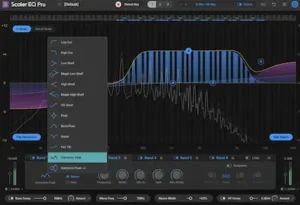 Scaler EQ Pro has a standard price of $99, while existing Scaler EQ owners receive a separate upgrade offer. The launch upgrade price is $29, and Scaler Music provides a 14-day trial. Because the upgrade discount is promotional rather than the plugin’s permanent retail price, the current offer should be checked before purchase.
At $99, the value proposition depends largely on the type of EQ workflow the engineer needs. If the requirement is simply another high-quality parametric EQ, Scaler EQ Pro enters a crowded category with several mature alternatives. Its justification becomes much clearer when key-aware harmonic processing, dynamic Harmonic Peak operation or MIDI-controlled EQ are part of the intended workflow.
Existing Scaler EQ users have a different calculation. The Pro version extends the same harmonic-EQ concept with a substantially larger processing toolkit, so the learning curve is lower than switching to an unrelated processor. The $29 launch upgrade therefore represents a considerably smaller commitment than buying the plugin at full price, although the value still depends on whether the new functions will actually enter regular use.
For mixing engineers, the most relevant applications are likely to involve vocals, guitars, synths, bass, electronic production and other sources with a strong harmonic relationship to the arrangement. Mastering engineers can also find uses for it, but the case is narrower because many mastering tasks are better served by highly predictable conventional EQ processing.
The practical buying question is therefore straightforward: do you need an EQ that incorporates musical scale into the processing decision? If the answer is no, Scaler EQ Pro is competing for space with established precision EQs. If the answer is yes, its additional processing model is the feature that justifies the purchase—not the number of conventional EQ controls it contains.
Overall Rating
| Category | Rating |
|---|---|
| Harmonic Processing | 9.2/10 |
| Tonal Precision | 8.2/10 |
| Dynamic EQ Control | 8.5/10 |
| Musical Context Control | 9.1/10 |
| Stereo Processing | 8.0/10 |
| Processing Transparency | 7.5/10 |
| Overall | 8.4/10 |
Harmonic processing earns 9.2/10 because the scale-aware Harmonic Peak approach gives Scaler EQ Pro a genuinely distinct method of distributing EQ treatment across musical relationships rather than fixed frequency regions.
Tonal precision receives 8.2/10 because the plugin combines conventional EQ control with more selective harmonic shaping, although purely surgical corrective work remains better suited to dedicated precision EQs.
Dynamic EQ control scores 8.5/10 because any EQ band can operate dynamically, including Harmonic Peak bands, with threshold, ratio, attack and release providing useful control over changing harmonic content.
Musical context control rates 9.1/10 because key and scale can directly influence which frequency relationships receive emphasis or attenuation, with detected or manually defined scales extending that concept beyond conventional EQ decisions.
Stereo processing receives 8.0/10 because Mid/Side operation and Magic Shelves provide useful control over center and side information, although this is complementary to the plugin’s more distinctive harmonic processing rather than its defining strength.
Processing transparency scores 7.5/10 because the page identifies audible artifacts at aggressive settings, while independent measurement data is still insufficient to establish a clear advantage in distortion, phase behavior or transparency over mature precision EQ designs.
Scaler EQ Pro’s strongest value lies in making musical key and harmonic relationships part of the EQ decision. The main compromise is specialization: conventional precision EQ remains more predictable for purely spectral correction, while Scaler becomes more compelling when the source has a clear pitched or harmonic structure.
The Bottom Line for Professional Audio Production
Scaler EQ Pro earns its place by treating musical scale as an active part of frequency processing rather than simply displaying notes alongside a conventional EQ curve. That gives Harmonic Peak a distinct purpose on pitched and harmonic material, while the expanded dynamics, filtering and MIDI control make the concept considerably broader than the original Scaler EQ.
The trade-off is specialization. When the problem is purely spectral—a resonance, fixed tonal imbalance, reference match or surgical corrective move—a conventional precision EQ remains the more direct choice. Scaler EQ Pro makes more sense when the musical relationship between frequency and pitch is itself part of the problem being solved.
For an engineer already interested in note-aware EQ, the Pro version is a substantial expansion of the original concept. For someone looking only for another general-purpose precision EQ, its distinctive processing model is less relevant than the maturity and predictability of established alternatives.
Put the Processing in Perspective
Not every mix problem is solved by adding another EQ or refining another processing chain. Scaler EQ Pro can give you more control over harmonic relationships, but the final test is how the complete mix holds together: tonal balance, dynamics, depth, stereo image and translation. A real mastering comparison can reveal what those decisions actually contribute at the finished-mix stage. Upload up to 40 seconds and receive a free mastering demo prepared by a real mastering engineer. Upload your mix and request the free mastering demo →
Scaler EQ Pro FAQ
Is Scaler EQ Pro a dynamic EQ?
Yes. Any EQ band can operate dynamically, including Harmonic Peak bands, with threshold, ratio, attack and release controls. The difference is that Harmonic Peak can combine dynamic processing with the plugin’s key- and scale-aware frequency relationships.
Can Scaler EQ Pro replace FabFilter Pro-Q 4?
Not as a general-purpose replacement. Pro-Q 4 is designed around comprehensive precision EQ, dynamic and spectral processing, EQ Match and multiple phase modes. Scaler EQ Pro serves a different purpose, with its main distinction being scale-aware harmonic processing and MIDI-controlled EQ.
Does Scaler EQ Pro correct out-of-key notes?
No. Scaler EQ Pro is not a pitch-correction or tuning processor. Harmonic Peak changes the level of selected frequency components according to their relationship with the chosen key or scale; it does not change the pitch of the source.
Is Scaler EQ Pro suitable for mastering?
Yes, but its role in mastering is specialized. It can be useful for restrained harmonic emphasis and scale-aware tonal shaping, while a conventional mastering EQ remains the more direct choice for surgical correction, reference matching and other precision EQ tasks.
Does Scaler EQ Pro support MIDI control?
Yes. Live Mode accepts MIDI input and can use incoming notes to trigger harmonic EQ bands. Velocity and ADSR controls can influence the response, while polyphonic MIDI allows multiple note-related bands to operate at the same time.
What plugin formats does Scaler EQ Pro support?
Scaler EQ Pro is available as VST3, AU and AAX on supported systems, with a standalone application included. macOS support starts at macOS 12, while Windows support starts at Windows 10; both platforms require a 64-bit host. Windows uses VST3 and AAX, while macOS also supports AU. There is no VST2 build listed by Scaler Music, so older VST2-only hosts are not supported.
Does Scaler EQ Pro have zero latency?
Scaler Music specifies minimum-phase, zero-latency EQ processing. That makes the plugin suitable for low-latency tracking and monitoring applications, although the complete processing configuration and DAW session should still be evaluated in practice.
Is Scaler EQ Pro CPU intensive?
There is not yet enough independent benchmark data to establish a reliable CPU profile across different DAWs and session sizes. For a newly released processor, repeatable testing in realistic sessions is more useful than isolated CPU readings.
Is Scaler EQ Pro worth upgrading to from Scaler EQ?
The upgrade adds substantially more than a new interface. The rebuilt Harmonic Peak system is joined by Live Mode, dedicated Bass and High-Frequency Compression, continuously variable slopes, dynamic processing and Continuous Gain Match. Existing Scaler EQ users should base the upgrade decision on whether those additions fit their workflow. Any launch-specific upgrade price should be checked against Scaler Music’s current offer.
What is the main reason to use Scaler EQ Pro instead of a conventional EQ?
The main reason is to make musical key and scale part of the EQ decision. If the task is simply to remove a resonance, shape a fixed frequency range or perform a surgical mastering correction, a conventional precision EQ will generally provide the more direct workflow.

Yurii Ariefiev approaches EQ evaluation from the perspective of frequency balance, tonal shaping and resonance control, with particular attention to how an EQ’s processing model affects musical material. For a key-aware processor such as Scaler EQ Pro, the important question is how reliably musical scale can become part of the frequency-processing decision without obscuring the underlying spectral relationships.
Enjoyed this review?
If you found it useful, you can support independent audio research with a coffee.
☕ Buy me a coffee