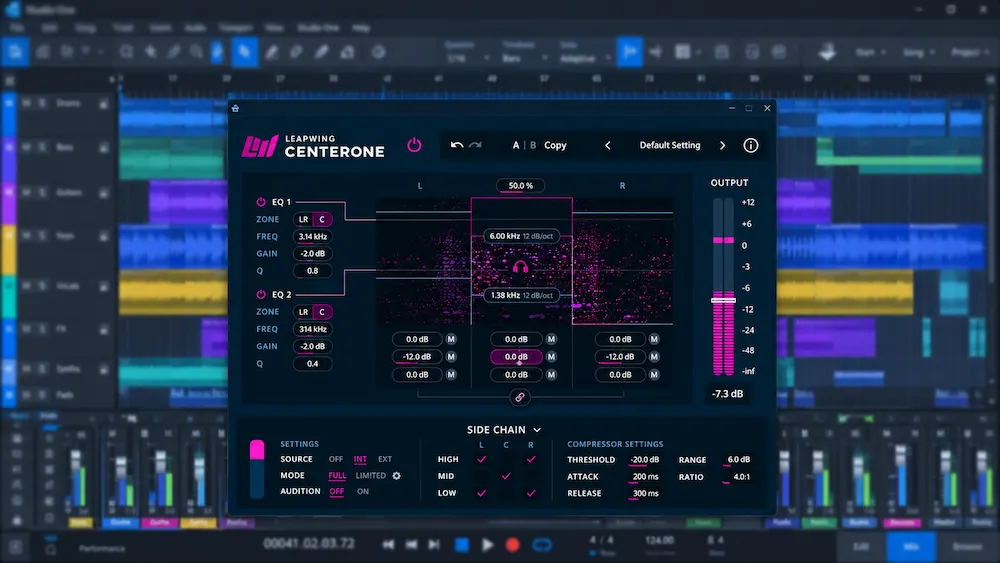
Leapwing CenterOne 3 is a specialist stereo processor built around one specific problem: changing the apparent prominence of material perceived in the phantom center without treating the entire Mid channel as though it were a discrete center stem. That distinction matters when a vocal, kick, bass, snare, or other center-weighted element needs adjustment inside a finished stereo mix.
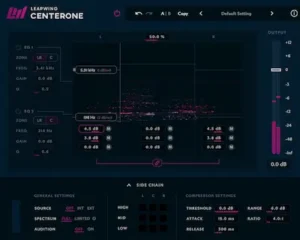
Version 3 keeps the original Center Prominence approach but adds three new dimensions to the correction: frequency-dependent L/C/R control, spatially assignable EQ, and dynamic sidechain processing. The practical difference is less about having more controls and more about being able to limit a center correction to a particular frequency range or make it respond only when another signal creates competition.
This review looks at CenterOne 3 from a practical mixing and mastering perspective, with particular attention to the problem it solves, how its spatial target differs from conventional Mid/Side processing, where the new version 3 features matter, and where the processor’s limitations become important.
The key question is straightforward: does CenterOne 3 provide useful phantom-center control that conventional M/S processing cannot achieve without affecting other material in the stereo field? That is the distinction that determines whether its specialized architecture justifies a place in a professional stereo-processing workflow.
Leapwing CenterOne 3 at a Glance
| Processor type | Phantom-center stereo processor |
| Primary use | Selective stereo correction in mixing, mastering and stereo stem workflows |
| Key version 3 additions | Multiband L/C/R processing, zone-assignable EQ and internal/external sidechain processing |
| Best suited to | Stereo mixes, stems, samples, loops and masters where conventional M/S processing is too broad |
| Not designed for | Clean source separation or reconstruction of individual instrument stems |
| Current price | $249 / €249 |
| Introductory price | $174 / €174 through October 22, 2026 |
| Capability rating | 8.7/10 |
Why Phantom-Center Processing Matters More Than Another Stereo Widener
 Most stereo processors work in one of two familiar domains: Left/Right or Mid/Side. Both are fundamental techniques, but neither gives you a dedicated control for the material perceived at the center of a stereo image.
Consider a vocal that needs to come forward. With conventional M/S processing, increasing the Mid channel also affects everything else contributing to Mid: kick, bass, snare, centered guitars, keyboards, and other material that happens to be correlated between the left and right channels. The processor cannot inherently distinguish the lead vocal from those other center-weighted elements.
That is the specific problem CenterOne is designed to address.
Leapwing’s Center Prominence processing analyzes the stereo signal to derive a controllable phantom-center component alongside information localized toward the left and right sides. The result is not simply an M/S encode with another set of controls. The processing target is different: the goal is to manipulate what is perceived as the center of the stereo image without automatically applying the same change to all Mid information.
This becomes particularly useful once the original multitrack balance is no longer available. In mastering, there is no vocal fader to pull forward. With a stereo stem, the individual sources may already be printed together. A stereo sample or loop may contain exactly the same problem, with no separate tracks available for correction.
In those situations, the ability to target the phantom center can turn a broad stereo adjustment into a more localized intervention. That does not make CenterOne a replacement for M/S processing; it gives the engineer another way to approach problems where conventional Mid/Side control is too blunt.
CenterOne 3 vs CenterOne 2: What Actually Changed?
CenterOne 3 keeps the original Center Prominence concept but expands the amount of control that can be applied to the extracted spatial information. The important question for existing users is therefore not whether the underlying idea has changed, but whether the new processing options solve problems that previously required additional routing, automation, or separate processors.
| Capability | CenterOne 2 | CenterOne 3 |
|---|---|---|
| Center Prominence processing | Yes | Yes |
| Multiband L/C/R processing | No | Yes |
| Zone-assignable parametric EQ | No | Yes |
| Internal and external sidechain | No | Yes |
| Spatially targeted dynamics | More limited | Yes |
| Practical workflow impact | Primarily center-focused correction | Frequency- and dynamics-dependent spatial correction |
The difference matters most when the problem is not simply “too much center,” but too much center in a particular frequency range or under particular dynamic conditions. That is where CenterOne 3 moves beyond the original concept and becomes a more flexible corrective processor.
For existing CenterOne 2 users, the upgrade is therefore most relevant when multiband spatial control, zone-specific EQ, or sidechain-driven processing would otherwise require additional processors and routing. If the existing workflow only requires occasional broadband center adjustment, the practical difference may be smaller.
Technically, the new workflow is more specific than a simple three-band center control. Each Low, Mid and High region can address the Left, Center and Right components independently, while the two parametric EQ sections can be assigned to either the Center or the LR processing zone. The sidechain can use an internal or external source and applies threshold, ratio, attack, release and range controls to the selected spatial and frequency targets.
CenterOne 3 vs Mid/Side: The Important Technical Difference
Mid/Side processing starts with a mathematical transformation of the stereo signal. The Mid component is derived from information shared by the Left and Right channels, while the Side component represents their difference. This makes M/S processing extremely useful for controlling broad aspects of stereo balance, but Mid is not synonymous with the phantom center.
A sound can contribute strongly to the Mid channel without being perceived as a single point source directly between the speakers. Conversely, a source that appears centered can contain substantial Side information through stereo ambience, modulation, delay, reverberation, or other spatial components.
CenterOne takes a different processing approach. Rather than treating all mathematically common Left/Right information as one Mid signal, its Center Prominence processing is designed to derive a controllable representation of the material perceived toward the center of the stereo image.
That distinction is what makes CenterOne 3 complementary to M/S rather than a replacement for it. M/S remains the more direct tool when the goal is to change the overall tonal or level relationship between Mid and Side. CenterOne becomes useful when the problem is more specifically related to the apparent prominence of center-positioned material.
If the task is to brighten or attenuate the entire Mid component, an M/S EQ is usually the more straightforward solution. If the goal is to increase overall stereo width, an imaging processor is more appropriate. But when a finished stereo signal contains a center-heavy element that needs to be brought forward, pushed back, or dynamically controlled without applying the same treatment indiscriminately to the rest of the Mid content, CenterOne 3 offers a more targeted approach.
This also places CenterOne 3 in a different category from broader integrated stereo-processing tools. A conventional channel-strip or mastering processor may provide M/S EQ, compression and stereo shaping in one chain, but CenterOne’s defining feature is that its processing target is the perceived center rather than the complete mathematical Mid signal.
Need More Control Over Stereo Balance?
Center-focused problems are only one part of the final stereo picture. Professional mastering also has to preserve the right balance between clarity, depth, punch, dynamics and stereo image while keeping the mix consistent across different playback systems. Our free mastering demo lets you hear how your own material translates through a professional mastering workflow. Upload up to 40 seconds of your mix and hear what can be achieved before committing to the full master. Upload your mix for a free mastering demo →
Multiband L/C/R Processing Is the Real Version 3 Upgrade
The most consequential addition in CenterOne 3 is multiband processing across the Left, Center and Right components. It changes the processor from a broad spatial-balance tool into something that can make frequency-dependent decisions about where the stereo energy is concentrated.
That matters because stereo problems are often localized in frequency rather than spread across the entire spectrum.
Consider a master with excessive center energy in the sub and low-bass region while the upper-midrange stereo image is already balanced. Reducing the center across the full bandwidth would also affect vocals, snare, guitars, keyboards, and other material that does not need correction. A frequency-dependent approach allows the intervention to stay closer to the actual problem.
The same principle works in the opposite direction. A vocal may need greater apparent center presence through the critical midrange while the existing high-frequency width should remain largely unchanged. An electronic mix may benefit from reducing center concentration in the low end while preserving the wide synths, delays, and effects that establish its spatial character.
This is where CenterOne 3 moves beyond a conventional stereo-width control. Width processors primarily change the relationship between the sides of the image; multiband L/C/R processing adds frequency as another axis of spatial control. In practical terms, the engineer can decide where the center is being emphasized or reduced, and in which part of the spectrum.
The Sidechain Turns CenterOne 3 Into a Dynamic Mixing Tool
The sidechain implementation is one of the more consequential additions to CenterOne 3, particularly for mixing engineers working with stereo buses and consolidated stems.
Consider a lead vocal competing with a dense stereo instrumental. The conventional solutions are familiar: automate the instrumental level, carve space with EQ, or use sidechain compression to duck the entire bus. Each can work, but each treats the problem broadly. If the masking is concentrated in the center of the stereo image, reducing the whole instrumental can unnecessarily pull down wide material that was not competing with the vocal in the first place.
CenterOne 3 allows the sidechain signal to drive processing with both frequency and spatial position taken into account. A vocal can therefore act as the trigger while the processor is focused on the part of the stereo field where the competition is actually occurring.
In practice, this can mean feeding the vocal into the sidechain of CenterOne on a stereo instrumental bus, then targeting center-weighted material in the relevant frequency range. As the vocal becomes active, competing center content can be reduced dynamically while material concentrated toward the sides is affected less.
The advantage is not that CenterOne replaces conventional sidechain compression. It is that the ducking decision can be more selective. Instead of asking, “How much of this stereo bus should I turn down?”, the engineer can work toward a more specific question: “Which part of this stereo image is competing with the vocal, and only how much of it needs to move?”
That becomes particularly useful when the source has already been consolidated into stereo. There may be no individual synth, guitar, pad, or backing-vocal fader available to automate. Spatially targeted dynamics can provide another way to create separation without rebuilding the arrangement or covering the entire bus with broadband ducking.
CenterOne 3 for Mixing
CenterOne 3 is most useful in a mix when the individual source that needs adjustment is no longer isolated on its own channel. Stereo buses, stems, samples, loops, and partially consolidated sessions can all create situations where conventional level or EQ moves are too broad.
Vocals
When a vocal disappears in a dense chorus, adding level is not always the best first move. The problem may be competition from other center-weighted material occupying the same frequency and spatial region.
CenterOne 3 can instead be used to reduce competing center content, including dynamically via its sidechain, while leaving more of the wider stereo material outside the main intervention. This can create additional apparent space for the vocal without simply making the entire backing track quieter.
Bass and Low End
Modern productions frequently combine a centered kick or sub with wide bass harmonics, synths, effects, and other low-mid information. A conventional width control does not distinguish between those components; it changes the stereo relationship of the signal as a whole.
CenterOne 3 provides a more selective way to examine and adjust center concentration within specific frequency regions. That can be useful when the low end needs to remain controlled and centered while the wider character of the production is preserved.
The approach is particularly relevant to electronic, hip-hop, and pop productions where stereo width is often deliberately designed into the arrangement rather than added as a finishing effect.
Stereo Samples and Synths
A stereo loop or synth patch can have an apparently wide image while still carrying substantial center energy. Simply widening it further may increase the sides without addressing the reason the center feels crowded.
CenterOne 3 offers a different approach: adjust the relationship between center and side content directly, potentially reducing center density without relying on additional artificial width.
Guitars and Dense Midrange
Dense guitar arrangements, layered keyboards, and other midrange-heavy parts can compete with a centered vocal even when they are not strictly mono. In these cases, the Center Prominence processing and extraction-width controls become useful for defining how broadly the center region should be treated.
That distinction matters in a crowded mix. The goal is not necessarily to remove everything near the center, but to make a narrower spatial intervention than a conventional Mid-channel adjustment would allow.
CenterOne 3 for Mastering: Where the Concept Makes the Most Sense
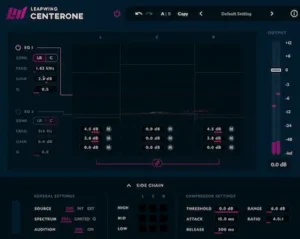 Mastering is one of the workflows where CenterOne 3’s spatial approach becomes particularly relevant. The mastering engineer is usually working from a stereo master or stem rather than the original multitrack session, so many corrective decisions have to be made without access to the individual sources that created the problem. This is also why identifying the actual mastering problem before processing matters: a stereo imbalance, masking issue, or tonal problem can easily be treated too broadly if the cause is not isolated first.
Conventional EQ, compression, and M/S processing cover a large part of that work. The more difficult cases are often spatially specific: the problem exists in a particular region of the stereo field, but a conventional broadband or Mid/Side adjustment also affects material that is already working correctly.
Typical situations can include:
- a vocal or lead element that is disproportionately prominent in the center;
- excessive center concentration in the low-frequency range;
- a master whose balance feels overly center-focused;
- center-weighted material masking useful information toward the sides;
- a stereo stem that needs corrective spatial processing rather than additional width;
- a problem where conventional M/S processing produces too much collateral change elsewhere in the mix.
CenterOne 3 does not identify the musical source responsible for these problems, nor does it replace the decisions made during mixing. Its value is more specific: it gives the mastering engineer another spatial domain in which to make a controlled correction when conventional stereo processing is too broad. This distinction becomes especially relevant when working with stereo stems and stem-based mastering workflows, where some control is available but the original multitrack balance is still not fully accessible.
That makes CenterOne 3 a problem-solving tool rather than a substitute for a balanced mix. Used carefully, its main advantage is not that it can make a master wider, narrower, louder, or more centered, but that it can make those changes with a different degree of spatial selectivity.
CenterOne 3 EQ: Useful Because of Where It Works
The two parametric EQ sections are useful, but the EQ itself is not the technical reason to choose CenterOne 3. Their importance comes from being integrated into the processor’s spatial architecture.
The EQ sections can be assigned to the Center or LR processing zones, allowing frequency correction to follow the same spatial structure used by the rest of the processor. This can be useful when a tonal problem is concentrated in center-positioned material and a conventional stereo or M/S EQ would affect more of the program than intended.
For example, excessive low-mid energy concentrated toward the center can be addressed without applying the same tonal correction to the side information. The distinction is subtle but important: CenterOne 3 is not valuable because it contains another parametric EQ; it is valuable because the EQ can operate within a different spatial processing target.
What CenterOne 3 Cannot Do
CenterOne 3 is a spatial processor, not a source-separation system. It should not be evaluated as a way to extract clean instrument stems from a finished stereo recording.
Feed it a master containing vocals, guitars, piano, drums, bass, effects, and ambience, and the extracted center will still contain overlapping material. A phantom center is a property of the stereo image, not a discrete track waiting to be recovered. Multiple sources can occupy the same spatial region, while a single source can contain information extending well beyond the center.
This also places a practical limit on how aggressively the processing can be used. As the extraction and spatial manipulation become more extreme, residual material and processing artifacts can become increasingly noticeable. The exact behavior depends on the source, stereo balance, frequency content, and amount of processing.
That limitation is not specific to CenterOne. Once individual sources have been combined into a stereo signal, there is no original track-level information available to recover. Spatial processing can exploit the information that remains in the stereo image, but it cannot reconstruct the original mix decisions.
For that reason, the useful test is not whether the extracted center sounds perfectly isolated in solo mode. The more relevant question is whether the processing produces a better result when the complete stereo mix is monitored at matched levels.
In practice, this makes CenterOne 3 better suited to controlled mix correction and subtle mastering work than to extreme pseudo-separation. Its strength is selective intervention, not perfect isolation.
CenterOne 3 Alternatives: Which Tool Fits the Job?
CenterOne 3 is not a universal replacement for conventional stereo processors. The appropriate alternative depends on what actually needs to change: tonal balance, stereo width, dynamic control, center prominence, or individual source separation.
| Alternative | Better Fit When | How It Differs From CenterOne 3 |
|---|---|---|
| Waves Center | When basic center/side level and tonal control are sufficient | Provides conventional center-and-sides processing, but does not offer CenterOne 3’s multiband L/C/R workflow and spatially targeted sidechain architecture. |
| A.O.M. Stereo Imager D | When the goal is straightforward center/side gain control with minimal processing complexity | Offers a simpler center/side approach, while CenterOne 3 adds frequency-dependent L/C/R control, zone-specific EQ and dynamic spatial processing. |
| Mid/Side EQ or Dynamics | When the problem is fundamentally a broad Mid/Side tonal or dynamics adjustment | Usually provides a faster solution, but Mid is not equivalent to CenterOne’s phantom-center processing target. |
The distinction is ultimately about the problem being solved. If a mix simply needs a tonal adjustment to the Mid channel, an M/S EQ is usually the more direct tool. If the goal is greater stereo width, a dedicated widener addresses that job more directly. If individual sources need to be recovered, stem separation is the appropriate category.
CenterOne 3 becomes relevant when the material is already stereo and the problem is specifically related to the prominence or balance of center-positioned content. Its value comes from combining that spatial target with frequency-dependent and dynamic processing rather than from replacing the other approaches.
Who Actually Benefits From CenterOne 3?
CenterOne 3 makes the most sense for engineers who regularly have to solve spatial problems after the original track-level balance is no longer available. It is a specialist processor, so its usefulness depends more on the type of material you work with than on the size of the studio.
Mixing engineers are a natural fit when the workflow involves stereo buses, consolidated stems, stereo samples, or masking between a centered vocal and dense instrumental material. The sidechain and multiband L/C/R processing become particularly relevant when a conventional bus-level EQ or compressor is too broad.
Mastering engineers have a similarly practical use case. Working from a stereo master means there is often no individual source fader available when a spatial imbalance needs correction. CenterOne 3 provides another option when conventional stereo or M/S processing affects more of the program than intended.
Electronic producers may find it useful when a production combines a tightly centered low end with deliberately wide synths, effects, and upper-frequency layers. Stereo samples and loops can present similar problems, particularly when their internal balance cannot be changed at the source.
For a professional studio, CenterOne 3 makes more sense as a specialist processor that solves specific jobs than as a default insert for every session. The same applies to experienced bedroom producers who regularly work with stereo stems, samples, and complex stereo arrangements. For those users, it can be valuable once the underlying need is recurring rather than occasional.
CenterOne 3 is less relevant when the problem is fundamentally different. If the task is simply to widen a stereo signal, change the overall Mid/Side balance, perform conventional tonal shaping, or recover individual instrument stems, a dedicated widener, M/S processor, EQ or stem-separation system is a more direct solution.
For beginners, the priority is different. A solid understanding of gain staging, EQ, dynamics, frequency masking, M/S processing, and stereo monitoring will generally have a larger impact on the quality of their mixes than another specialized spatial processor.
Content creators are unlikely to need CenterOne 3 unless their work involves detailed stereo post-production. For straightforward voice, music, and video workflows, its specialized center-processing capabilities are usually more than the job requires.
CenterOne 3 Pricing and Upgrade Value
 CenterOne 3 is listed at $249/€249, with an introductory price of $174/€174 through October 22, 2026. Existing CenterOne 2 users can upgrade for $30/€30 during the promotion.
For a new buyer, the relevant comparison is not simply CenterOne 3 versus cheaper stereo plugins. Basic M/S EQ, stereo widening and conventional dynamics are widely available at lower prices. The more useful question is whether phantom-center correction solves problems that occur often enough in your work to justify a dedicated processor.
For existing CenterOne 2 users, the calculation is different. The main reason to upgrade is not the presence of additional controls by itself, but the ability to apply center-focused processing across frequency regions and dynamic conditions that previously required more manual routing or separate processors.
Bottom line: CenterOne 3 makes the strongest commercial case for engineers who regularly work with consolidated stereo material. If center-specific correction is an occasional problem, conventional M/S and stereo-processing tools may already cover the job.
Leapwing CenterOne 3 Capability Rating
This rating evaluates CenterOne 3 by the capabilities and workflow described in this review rather than by synthetic benchmarks or unverified listening claims. The scores reflect how effectively each part of the architecture addresses the specific stereo-processing problems discussed above.
| Category | Rating |
|---|---|
| Phantom-Center Targeting | 9.0/10 |
| Spatial Selectivity | 9.0/10 |
| Frequency-Dependent Control | 8.8/10 |
| Spatial Dynamics | 8.6/10 |
| Stereo Correction Utility | 8.5/10 |
| Source-Material Applicability | 8.4/10 |
| Overall | 8.7/10 |
The dedicated phantom-center architecture gives CenterOne 3 a clear advantage when the perceived center needs adjustment without treating the entire mathematical Mid signal in the same way.
The spatial model is unusually selective for a stereo processor, although the phantom center remains an overlapping representation rather than an isolated source, which limits how aggressively it can be pushed.
Three-band L/C/R processing makes the correction more precise because spatial decisions can follow different frequency regions instead of forcing one broadband adjustment across the program.
Frequency- and position-aware sidechain processing adds useful dynamic control for masking between center-focused material, particularly on stereo buses and consolidated stems, but it remains dependent on the quality of the source material.
Its strongest practical role is corrective stereo work where conventional M/S processing is too broad; it is less relevant when the task is simply tonal shaping, overall width enhancement, or actual source separation.
The processor applies well to stereo masters, stems, samples, loops, and consolidated material, but it cannot recover original track-level information and increasingly aggressive extraction can expose residual material or artifacts.
Overall Comment: CenterOne 3 has a clearly defined professional role: selective correction of center-positioned material inside stereo signals where conventional M/S processing becomes too broad. Its main compromise is equally clear—the spatial representation cannot provide true source isolation. It is therefore most relevant to engineers who repeatedly encounter center-specific problems in already-consolidated material.
Verdict: A Specialist Tool for Center-Specific Stereo Correction
CenterOne 3 succeeds because it addresses a narrower problem than conventional stereo processors: changing the prominence of center-positioned material without automatically treating the entire Mid signal in the same way.
Version 3 makes that concept substantially more useful by adding multiband L/C/R processing, spatially targeted dynamics and sidechain control. Those additions matter most when a stereo mix, stem or master contains a localized problem that would require too much collateral change with conventional M/S processing.
Its limitations are equally important. CenterOne 3 does not provide true source separation, cannot reconstruct missing track-level information, and becomes less convincing as processing is pushed toward extreme extraction. It is therefore best approached as a precision stereo-correction tool, not as a replacement for mixing, M/S processing or stem separation.
For engineers who repeatedly encounter center-specific problems in already-consolidated stereo material, that specialization is the reason to consider CenterOne 3. For workflows that rarely require this type of correction, its dedicated architecture may offer little practical advantage over more general stereo-processing tools.
Before Adding Another Processor, Check the Master
Center-specific processing can be useful when a stereo mix needs a more selective correction, but not every balance, masking or stereo-image problem should be solved with another plugin. Once the mix is finished, the more useful question is how the complete master holds together: whether the center and sides remain balanced, whether the low end stays controlled, and whether clarity, depth, punch and dynamics translate outside your studio. Our free mastering demo gives you a direct before-and-after comparison prepared by a real mastering engineer. Upload up to 40 seconds of your mix and evaluate the mastered version against your current mix before deciding on the full master. Upload up to 40 seconds and get your free mastering demo →
CenterOne 3 FAQ
Is CenterOne 3 better than Mid/Side processing?
Not universally. M/S remains a faster and more general solution for many stereo-processing tasks. CenterOne 3 becomes relevant when the target is the perceived phantom center rather than the conventional Mid component.
Can CenterOne 3 isolate vocals from a stereo mix?
No. It can process center-weighted information, which may include much of a centered vocal, but it is not a source-separation system. The result should be treated as spatially selective processing, not a clean vocal stem.
Is CenterOne 3 useful for mastering?
Yes. Its mastering applications include controlled changes to center prominence, low-frequency center concentration, stereo balance, and center-focused masking when only a stereo master or stem is available.
Does CenterOne 3 work with mono audio?
CenterOne 3 is intended for stereo spatial processing. A mono signal does not contain the Left/Right spatial information required for its center-versus-side processing concept.
Is CenterOne 3 compatible with Apple Silicon Macs?
Yes. Current compatibility information lists Apple Silicon support on macOS, with AU, VST3, and AAX formats. Windows support includes VST3 and AAX.
What is the difference between CenterOne 2 and CenterOne 3?
CenterOne 3 expands the original center-processing concept with multiband L/C/R control, spatially assignable EQ sections, internal and external sidechain processing, and additional visualization and workflow functions.
Is CenterOne 3 worth upgrading from CenterOne 2?
The upgrade is most relevant to existing users who need the new multiband, EQ, or sidechain capabilities. If CenterOne 2 already covers occasional broadband center adjustments, the additional functionality may have less practical impact.
What are the main alternatives to CenterOne 3?
The closest alternatives depend on the problem being solved. M/S EQ is more direct for broad Mid/Side tonal correction, a stereo widener is more appropriate when the goal is increased width, conventional center/side processing can handle simpler center-level adjustments, and stem separation is the appropriate category when individual sources need to be recovered. CenterOne 3 occupies the narrower space between those approaches by targeting center-positioned material with frequency-dependent and dynamic spatial control.
Who should buy CenterOne 3?
CenterOne 3 is most relevant to mixing and mastering engineers who regularly work with stereo masters, stems, samples, loops or consolidated mixes where a center-specific problem cannot be corrected cleanly at the source. It is less relevant when the task is conventional EQ, broad Mid/Side processing, stereo widening or source separation.

Yurii Ariefiev evaluates stereo processors from the perspective of spatial balance, phantom-center behavior, and how selectively a tool can address problems within a finished stereo signal. For CenterOne 3, the key consideration is the distinction between conventional Mid/Side processing and more targeted control of center-positioned material, particularly when frequency and stereo image interact.
Enjoyed this review? If you found it useful, you can support independent audio research with a coffee.
☕ Buy me a coffee