
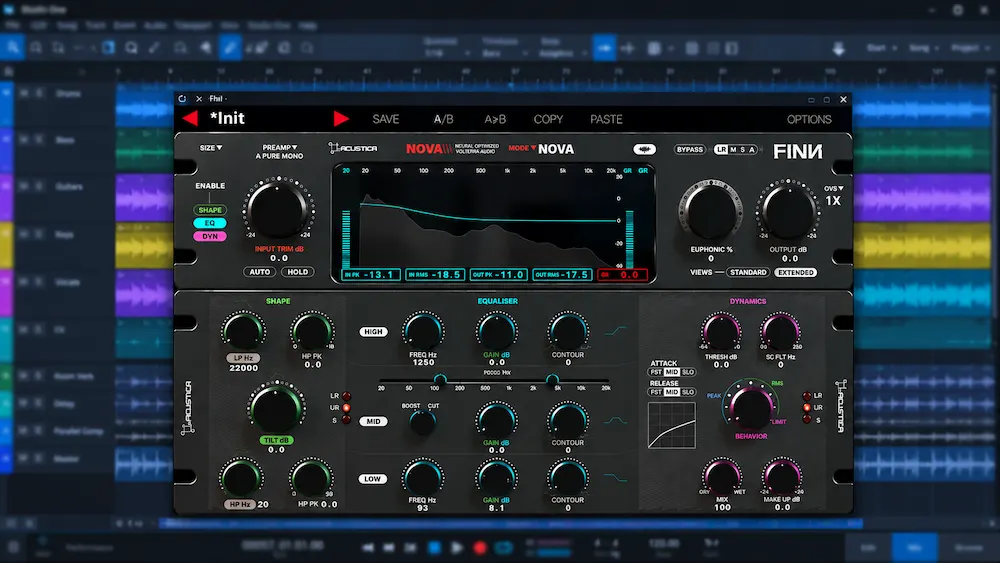
Acustica Audio FINN is an all-in-one processor built around a simple production idea: several stages of analog-style processing can live in one signal path without forcing the engineer to assemble another chain of separate plugins. It combines coloration, filtering, EQ, dynamics and stereo processing for use on individual tracks, groups, stems and mix buses.
That makes FINN less interesting as a collection of familiar processing functions than as a workflow tool. EQ, compression, saturation and stereo control are hardly scarce in a modern DAW. The practical question is whether combining them into one processor makes routine mix decisions faster while retaining enough control to remain useful in a professional session.
FINN is powered by Acustica Audio’s latest-generation NOVA modeling technology, but it is not presented as an emulation of a single console channel or piece of vintage hardware. Its signal path is deliberately broader: analog-inspired tone shaping and dynamics are combined with modern filtering and stereo processing in a single environment.
That distinction matters in practice. FINN is not a replacement for every specialized EQ, compressor or saturation processor. Its appeal is the ability to handle several common stages of track and bus processing without turning each channel into a stack of unrelated plugins. For sessions where that kind of consolidation saves time without compromising the required tonal decisions, the approach is considerably more useful than the usual “all-in-one channel strip” pitch suggests.
Quick Verdict: Is Acustica Audio FINN Worth It?
Acustica Audio FINN is most compelling as a compact analog-style processing environment for engineers who repeatedly combine coloration, broad EQ, dynamics and stereo shaping. Its main advantage is not replacing every specialized plugin, but reducing routine chain-building while keeping enough control for track, bus and stem processing. The main compromise is equally clear: dedicated EQ, dynamics and stereo processors remain preferable when highly specific control matters more than consolidation.
Acustica Audio FINN: Quick Specs
| Plugin Type | Analog-style all-in-one processor with a channel-strip-style signal path |
| Core Processing | Analog color, Shape filtering, 3-band EQ, 9 dynamic behaviours and EUPHONIC stereo processing |
| Modeling Technology | NOVA nonlinear modeling |
| Processing Modes | L/R, Mid/Side and Delta monitoring |
| Oversampling | Up to 4x |
| Formats | VST3, AU and AAX |
| Launch Price | €79 until October 29, 2026; regular price €159 |
Why Integrated Analog Processing Makes Sense in Modern Mixing
 Analog-style processing in a modern DAW is usually modular. An engineer may start with saturation or console color, follow it with filtering, use a dedicated EQ for tonal shaping, add compression for dynamics, and finish with some form of stereo processing. That modularity is valuable because each stage can be replaced when the mix calls for a different response.
The weakness appears when the same basic chain has to be assembled repeatedly across a session.
Vocals, bass, drum buses, synths and backing tracks frequently need some variation of the same treatment: remove unwanted energy, establish the tonal balance, add harmonic density, control dynamics and, where appropriate, refine the stereo image. None of those decisions is particularly unusual. The cumulative workflow can be.
A processor such as Acustica Audio FINN approaches that problem by putting several of those stages into a single signal path. The advantage is not that saturation, EQ or compression suddenly become more capable. It is that the engineer can make related tonal, dynamic and spatial decisions without building and maintaining a separate chain for every channel.
That distinction is important. A dedicated EQ will usually remain the better choice when a mix requires a very specific filter topology or surgical control. The same applies to specialized compressors, saturators and stereo processors. FINN is more compelling when the goal is integrated shaping: getting a track or bus into the right general tonal, dynamic and spatial territory with fewer processing stages and less interface overhead.
The practical gain is workflow continuity: FINN keeps coloration, tonal shaping and dynamics inside the same signal path, so the engineer can hear those decisions as a combined process rather than managing them as unrelated plugin stages.
What FINN Actually Brings to the Signal Path
FINN brings several processing stages into a single signal path: analog-style preamplification, Shape filtering, a three-band EQ, dynamics processing and EUPHONIC stereo treatment. The important point is not the number of modules, but their position within one processing environment. FINN is designed less as a collection of isolated effects and more as a compact channel-processing path where coloration, tonal shaping, dynamics and stereo decisions can be evaluated together.
The preamp section provides different coloration approaches, including solid-state and tube-oriented behavior. The gain control therefore affects more than level. Driving the stage changes the amount and character of harmonic coloration entering the rest of the chain. Used conservatively, this can add density and presence; pushed harder, it becomes a more obvious tone-shaping stage.
Shape handles filtering and broad tonal adjustment before the main EQ. That positioning is useful in a channel-oriented workflow because unwanted low or high-frequency energy can be dealt with early, leaving the three-band EQ to perform broader musical shaping rather than forcing it to solve every problem in the signal.
The three-band EQ is intentionally less surgical than a modern digital equalizer. Its strength is broad tonal movement rather than narrow corrective work. That makes it appropriate for decisions such as adding weight, reducing excess energy or bringing a source forward in a mix. When a track needs a precise notch, steep filtering or detailed resonance control, a dedicated digital EQ remains the more appropriate tool.
The dynamics section extends FINN beyond tone shaping into compression and limiting. Keeping dynamics within the same processing environment has a practical advantage: changes in harmonic coloration, EQ and compression can be evaluated together instead of being spread across several plugin interfaces. That can make gain-staging decisions easier, particularly on tracks and buses where the processing is relatively straightforward.
The most distinctive part of the architecture is EUPHONIC, which works with the left and right channels to introduce controlled differences in the stereo presentation. This is fundamentally different from simply turning up a conventional width parameter. Because the process alters the relationship between the two channels, it should be judged against the original signal in mono as well as stereo, and checked on more than one monitoring system. Stereo enhancement that sounds impressive in isolation can become less useful once the full mix, mono compatibility and playback environment are taken into account.
Taken together, these sections make FINN useful as a compact shaping chain rather than as a substitute for every specialized processor in a modern mix. Its value depends on how much of the processing a particular source actually needs.
Bring More Control to the Final Mix
Integrated processing can simplify a mix, but the final result still depends on how well tonal balance, dynamics, stereo image and translation hold together outside the studio. Our free mastering demo lets you hear how your mix translates through a dedicated mastering process before making a decision. Upload up to 40 seconds of your mix and get a professional mastering demo for direct comparison. Upload up to 40 seconds for a free mastering demo →
NOVA Modeling: The Technical Detail That Actually Matters
Acustica Audio’s NOVA technology is relevant because FINN is intended to model nonlinear behavior rather than reproduce only a static frequency response. Acustica describes the architecture as a combination of Vectorial Volterra Kernels and neural processing, with the aim of representing signal-dependent behavior associated with analog circuits.
That distinction matters because analog processing is level-dependent. A transformer, tube stage, transistor circuit or amplifier does not necessarily produce the same response at every input level. As the signal changes, so can harmonic content, saturation behavior, compression characteristics and intermodulation. Those interactions are part of what engineers perceive as analog coloration.
A modeling system that attempts to represent those nonlinear relationships is therefore doing considerably more than applying a fixed EQ curve followed by a generic saturation algorithm. The architecture is relevant because it is intended to reproduce behavior that changes with the signal rather than treating coloration as a single static effect. That distinction also matters when comparing analog-style processing with conventional digital approaches, particularly in mastering, where the practical question is what the processing contributes rather than whether the signal path is inherently analog or digital. For a broader look at that distinction, see our analog mastering vs. digital mastering guide.
There is, however, an important distinction between modeling methodology and audible superiority. A sophisticated DSP architecture does not automatically make a processor sound more accurate, more musical or better than competing designs.
NOVA is technically relevant to FINN’s design, but the modeling method itself is not evidence of superior audible performance. Establishing a meaningful advantage would require controlled measurements, level-matched comparisons and properly designed listening tests. Until independent FINN-specific evidence is available, the sensible conclusion is that NOVA explains part of the processor’s architecture, not that it guarantees a better result.
The relevant engineering questions are therefore practical: how much the coloration changes with input level, how controllable the added harmonic density remains, and whether the nonlinear response stays useful when FINN is driven across different sources and gain structures.
Those are the tests that ultimately determine whether NOVA is merely an interesting modeling architecture or a meaningful part of FINN’s sound.
Where Acustica Audio FINN Works Best in a Mix
Vocals: Fast Tone and Dynamics Control
Vocals are a natural fit for FINN because the processing requirements are often broad rather than highly specialized. After vocal tuning and pitch correction, a typical chain may need low-end cleanup, harmonic density, tonal shaping and compression before the vocal sits correctly in the arrangement. FINN is useful here when those stages need to remain closely related rather than split across a long chain.
FINN can cover those stages without turning the vocal chain into a collection of separate processors. The preamp can establish harmonic density, Shape can control unwanted low-frequency energy, the EQ can address body or presence, and the dynamics section can stabilize level changes.
The advantage is workflow rather than exclusive processing capability. When the vocal needs several relatively straightforward moves, having them in one signal path makes it faster to judge the combined result and adjust the balance between tone, density and dynamics.
Bass: Harmonic Density Instead of More Sub-Bass
Bass is a particularly useful application for nonlinear processing because perceived weight does not always come from adding more energy below the fundamental. Generating controlled upper harmonics can make a bass line easier to identify on systems that reproduce the lowest octaves poorly.
That makes the preamp stage potentially more useful than a simple low-frequency boost. Once harmonic content has been established, the EQ can shape the relationship between the fundamental and upper harmonics, while compression keeps the level and density reasonably consistent.
The goal should be translation rather than sheer size. In a dense arrangement, a bass sound with more audible harmonic information can remain intelligible without requiring excessive sub-bass energy or occupying more low-end headroom than the mix can support.
Drum Bus: Density Without Flattening the Transients
Drum buses benefit from the combination of nonlinear coloration and moderate dynamics control, which makes FINN a logical candidate for this role. A small amount of preamp drive can increase density, followed by broad EQ shaping and compression to bring the kit into a more cohesive range.
The main risk is cumulative density. Saturation can make drums feel louder and thicker before the compressor even reacts, while compression further reduces level variation and increases perceived consistency. Pushing both stages too far can turn punch into a flatter, more congested presentation.
For that reason, FINN makes more sense on a drum bus when the processing is judged against the bypassed signal at matched levels. The question is not whether the processed version sounds bigger. It is whether the kick, snare and room information retain the transient contrast the arrangement needs.
Synths and Electronic Sources: Controlled Color and Movement
Synthesizers can expose a different side of FINN. Many modern virtual instruments are already clean, stable and harmonically predictable. Nonlinear processing can make that material denser and more complex without requiring obvious distortion.
This is also where EUPHONIC becomes more relevant. Controlled differences between the left and right channels can add movement to pads, synth layers, electronic percussion and effects that would otherwise occupy the stereo field in a very static way.
The technique is most useful when the stereo treatment remains subordinate to the arrangement. Excessive channel differentiation can make a sound impressive in solo while weakening its position in the full mix or creating problems when the stereo signal is summed toward mono.
Mix Bus: Useful, but Only When the Mix Actually Needs It
The mix bus is where FINN’s integrated design becomes both useful and easy to misuse. Putting coloration, EQ, compression and stereo processing in the same plugin creates an obvious temptation to use every section simply because it is available.
That is rarely a sound engineering decision. A mix bus processor should solve a specific problem or provide a deliberate sonic character, not accumulate processing for its own sake.
FINN works best here as a compact analog-style shaping stage. A small amount of nonlinear density, broad tonal adjustment and restrained dynamics can be useful when the mix needs those changes as a group. If the existing bus chain already provides the required tone and dynamics, adding FINN simply because it combines several functions is unlikely to improve the result.
On a mix bus, restraint is therefore part of the processor’s usefulness. The fact that several controls are available in one window does not make all of them necessary.
FINN for Mastering: A Tone-Shaping Stage, Not a Mastering Chain
 FINN can be useful in mastering, but its role is more selective than in mixing. In a mastering context, the appeal is the ability to introduce a small amount of nonlinear color, make broad tonal adjustments, apply restrained dynamics and, when appropriate, alter the stereo presentation without assembling several separate processors.
That makes FINN most relevant when the master needs a deliberate change in character or density rather than detailed corrective work. A conservative amount of coloration before or alongside broad EQ and dynamics can be useful when the source feels too sterile, slightly disconnected or lacking cohesion. The processing has to remain subordinate to the mix, however; mastering leaves considerably less room for cumulative coloration than individual track processing.
The limitations become clearer when precision is the priority. A dedicated mastering EQ will generally provide more control over narrow tonal problems and filter behavior. Specialized mastering compressors offer more detailed control over detection, timing and gain reduction. Final peak management still belongs to dedicated limiters or clippers, while accurate metering and true-peak monitoring remain separate technical requirements.
Stereo processing also deserves particular caution at the mastering stage. A change that sounds attractive on the full mix can affect mono compatibility, center stability or the perceived position of important elements. EUPHONIC can therefore be useful as a subtle finishing option, but it should be evaluated against the unprocessed master rather than treated as an automatic enhancement.
In practical mastering work, FINN makes the most sense as one intentional processing stage within a larger chain. Its value is the combination of broad tone, nonlinear character and dynamics in a compact environment. How that stage fits alongside EQ, dynamics, saturation and final peak control depends on the source and the mastering objective; the broader signal-path logic is covered in our mastering chain guide. FINN does not eliminate the need for specialized mastering processors, metering or final peak management.
The Real Workflow Advantage: Less Chain Management, Faster Decisions
The workflow advantage becomes most obvious when the same combination of processing has to be repeated across a session. A drum bus, for example, may need harmonic density, low-end cleanup, broad EQ, moderate compression and controlled stereo shaping. With separate processors, those decisions are distributed across several instances; FINN keeps them in one processing environment.
The benefit is operational rather than inherently sonic: fewer plugin instances to manage, fewer gain-staging points and a shorter recall path. That matters most when the same broad treatment is applied repeatedly across tracks, buses and stems.
That becomes more valuable during recall and revisions. A session reopened months later does not require the engineer to reconstruct which processor was providing the coloration, which EQ was responsible for the tonal shift and where the dynamics were being controlled. The relevant processing state is contained within one plugin instance.
The same principle applies during client revisions. If a vocal needs less density, less compression or a different tonal balance, the engineer can return to the corresponding stage without navigating through a long chain of unrelated processors. That does not make the mix decision itself easier, but it reduces the friction involved in implementing it.
The result is best viewed as chain consolidation, not plugin replacement. FINN can reduce the number of separate processing stages required for routine work while leaving specialized processors available for situations where a more specific tool is justified.
Where FINN Starts to Lose Its Advantage
The same integration that makes FINN efficient also defines its limits. The point at which FINN stops being the efficient choice is not a lack of processing stages, but a requirement for deeper control within one of them. When the task becomes highly specific, a dedicated processor can provide more useful control than an integrated signal path.
A specialized EQ will normally provide more detailed frequency control than FINN’s three-band design, including narrower corrective moves and more precise filter behavior. A dedicated compressor may offer more extensive sidechain filtering, detector options and timing controls. Likewise, a purpose-built stereo processor can provide deeper control over width, correlation and frequency-dependent imaging.
That is why FINN should not be judged as a replacement for a professional plugin collection. Its more realistic role is as a replacement for routine processing chains where the required decisions are broad enough to fit within its architecture.
If an engineer already has a highly refined chain that consistently produces the required result, moving those processors into FINN does not automatically improve the workflow. Consolidation only has value when it reduces complexity without removing control that the mix actually needs.
There is also a less obvious risk. Integrated processing makes over-processing easier to justify. When coloration, EQ, compression and stereo enhancement are all available in the same interface, it becomes tempting to touch each stage simply because it is there.
The more disciplined approach is the opposite: start with the smallest intervention that solves the problem, then leave unused sections bypassed. FINN’s efficiency comes from having several useful stages available in one environment, not from using all of them on every source.
EUPHONIC and the Stereo-Image Trade-Off
EUPHONIC is one of the more consequential parts of FINN because stereo processing is easy to overestimate in solo and difficult to judge correctly without translation checks.
Rather than treating stereo width as a single control, EUPHONIC introduces controlled differences between the left and right channels. That departure from perfect channel symmetry can change the perceived size, movement and spatial character of a source without relying solely on a conventional width increase.
The same mechanism creates the main engineering risk. Any deliberate change to the relationship between the left and right channels can alter the way a signal behaves when summed to mono, played through different speaker layouts or reproduced on headphones. A wider image is not automatically a more useful image, particularly when important low-frequency or center information is involved.
For that reason, EUPHONIC should be judged by translation rather than impression. Compare the processed signal with bypass at matched levels, monitor the stereo correlation, check the signal in mono and listen on more than one playback system. The goal is to establish whether the spatial change survives outside the monitoring environment in which it was created.
The margin for error becomes smaller on the mix bus and especially in mastering. At those stages, even a subtle change in stereo relationships can affect center stability, mono compatibility and the apparent position of important mix elements. EUPHONIC can be useful as a finishing tool, but its contribution should remain clearly audible in context without becoming dependent on exaggerated stereo width.
FINN vs. Other Mixing Approaches
| Approach | Primary Advantage | Trade-Off | Typical Role |
|---|---|---|---|
| Acustica Audio FINN | Integrated analog-style tone, dynamics and stereo processing | Less specialized control than dedicated processors | Track, bus, stem and mix-bus shaping |
| Acustica Gold 6 | Broader console-oriented processing environment | Larger processing concept and more extensive workflow | Console-style channel and mix processing |
| Acustica Mystic 2 | Distinctive tube-oriented coloration and dynamics | More focused around a specific tonal character | Sources where tube-style coloration is part of the objective |
| Dedicated EQ + compressor + saturation chain | Maximum specialization and parameter control | More separate processors to configure and recall | Detailed track and bus processing |
| Traditional channel-strip emulation | Consistent hardware-inspired signal path | Usually built around a specific console or circuit concept | Console-style channel processing |
The useful distinction is not simply how many controls each approach provides. It is where the workflow places the boundary between integration and specialization.
FINN sits toward the integrated end of that spectrum. It can cover several common stages of track and bus processing without requiring the engineer to assemble a separate chain for each source. A dedicated processing chain sits at the opposite end: each stage can be selected and fine-tuned independently, which becomes more valuable as the technical requirements become more specific.
That makes FINN less of a universal replacement than a different way of organizing routine processing. Its practical advantage appears when an engineer can achieve the required tonal, dynamic and spatial result without needing the deeper controls of several specialized processors.
Who Actually Benefits From FINN?
 Mixing engineers are the most obvious fit. If a session repeatedly calls for some combination of coloration, broad EQ, dynamics and stereo shaping, FINN can reduce the amount of chain management without forcing the engineer to give up dedicated processors when a more specialized approach is required.
Experienced producers working in the box can benefit for much the same reason. FINN covers several common stages of track and bus processing, making it practical for sessions where speed, recall and a consistent processing workflow matter more than having a separate specialist plugin for every task.
Electronic producers have another reason to consider it. Nonlinear processing can add harmonic complexity to clean sources, while EUPHONIC provides a different way of shaping stereo character. That combination is potentially useful on synths, electronic percussion, pads and effects where controlled coloration is part of the sound-design process.
Mastering engineers have a narrower use case. FINN can function as a color and broad-shaping stage, but mastering still demands specialized EQ, dynamics, peak management and metering tools when precision and delivery control are required.
Beginners can certainly use an integrated processor, but the convenience can hide the relationship between individual processing stages. FINN is more useful as part of a learning workflow when the engineer understands what the preamp, EQ, dynamics and stereo sections are changing independently before relying on the combined result.
In practical terms, FINN is best suited to engineers who value integrated track and bus processing and regularly perform broad tonal and dynamic shaping. It becomes less compelling when the job depends on highly specialized processing or tightly measured real-time performance.
CPU, Latency and the Professional Session Question
Performance is one area where FINN should be evaluated with measurements rather than assumptions.
Acustica Audio’s modeled processors have traditionally placed a meaningful load on the computer, while newer generations of the company’s technology are designed for modern systems. FINN is available in VST3, AU and AAX formats and supports native Apple Silicon, but those specifications do not tell an engineer how the plugin will behave inside a large session.
There is not enough independent, FINN-specific benchmark data to assign a meaningful universal CPU figure. The same instance can behave differently depending on sample rate, oversampling, host, buffer configuration, processor architecture and the number of active instances.
More importantly, CPU per plugin instance is not the most useful measurement for an integrated processor. The relevant question is CPU cost per completed processing task.
If one FINN instance replaces a saturation stage, EQ and compressor and uses resources comparable to the combined chain, its consolidation has a measurable performance advantage as well as a workflow advantage. If FINN consumes substantially more resources than the processors it replaces, the benefit may still be organizational, but the efficiency argument becomes weaker.
Latency needs to be considered separately. A plugin can be efficient in CPU terms and still introduce enough processing delay to matter in a live or tracking workflow. For mixing and mastering, that may be largely irrelevant; for real-time monitoring, it can become a practical constraint.
Engineers working at 96 kHz, high oversampling settings or with many FINN instances should therefore test the plugin in the actual session environment. The useful benchmark is not an isolated number from a test system, but whether FINN remains practical at the processing density required by the session.
Translation, Streaming and Final Delivery
FINN does not change the fundamentals of mix translation. Analog-style coloration cannot compensate for an unbalanced mix, stereo enhancement cannot correct poor monitoring, and compression cannot solve problems that originate in the arrangement or balance.
The opposite can be true: nonlinear processing and stereo manipulation make critical monitoring more important because they can change both the spectral content and the spatial relationships of the signal. Harmonic coloration may improve audibility or density, while excessive processing can introduce congestion that was not present in the original source.
That makes level-matched bypass comparisons particularly useful. Listen to FINN-processed material on the main monitors and headphones, at lower monitoring levels, and in mono whenever stereo processing is involved. The question is whether the processing improves the source across listening conditions rather than simply making it appear larger or louder in the primary monitoring setup.
The same principle applies to streaming delivery. FINN should be treated as a shaping tool, not a loudness strategy. Its value is established before encoding: tonal balance, controlled dynamics, harmonic density and stereo presentation should already work as intended before the file reaches the distribution codec. The wider implications of mastering for different streaming services are covered in our guide to mastering for streaming platforms.
Nonlinear processing can also alter the high-frequency and harmonic content presented to a lossy codec, so excessive coloration is not automatically harmless simply because the master meets its nominal loudness target. The practical solution is not to avoid harmonic processing, but to judge it at the final level and in the context of the complete master.
If a mix is already balanced and dynamically controlled, FINN can provide a useful final layer of tone or density. If the underlying mix is fundamentally wrong, increasing drive, compression or stereo processing only moves the problem around. No amount of integrated processing turns a balance problem into a mastering solution.
Is FINN Worth the Price?
At the introductory price of €79, FINN is positioned as a relatively accessible way to add an integrated analog-style processing environment to a modern DAW. The relevant question is not how many individual processors are included, but how often their combined workflow can replace routine chains in actual sessions.
At the regular €159 price, the value calculation becomes more demanding. Engineers who already own specialized saturation, EQ, compression and stereo-processing tools may have little practical need for another integrated processor unless FINN’s particular workflow or tonal behavior solves a recurring problem more efficiently.
The strongest case for FINN is therefore not based on the number of features. It comes from repeated use. If the same combination of coloration, broad EQ, dynamics and stereo shaping appears across multiple tracks and buses, consolidating those stages can save time during production, recall and revisions.
For an established workflow built around highly specialized processors, the equation is different. Replacing familiar tools only makes sense if FINN provides a result or workflow that is materially more efficient without sacrificing control that the session requires.
Price, in other words, should be judged against workflow frequency and processing requirements, not against the nominal number of functions in the plugin. At €79, the lower entry cost makes experimentation easier; at €159, FINN needs to earn its place through regular practical use.
Overall Assessment
FINN’s strongest attribute is integration. It brings analog-style coloration, filtering, EQ, dynamics and stereo processing into one signal path, making it particularly relevant for repeatable track, bus and stem processing.
The main limitation is specialization. Its three-band EQ, integrated dynamics and stereo section do not remove the need for dedicated processors when a task demands deeper corrective, sidechain or imaging control.
Overall assessment: FINN is best understood as a workflow-focused analog-style processor rather than a universal replacement for specialized mixing or mastering tools.
The Bottom Line on Acustica Audio FINN
Acustica Audio FINN makes the strongest case when several routine processing decisions need to remain connected within one signal path. Its value is less about replacing individual specialist plugins than about reducing the number of separate decisions, interfaces and processing stages required to shape a source or bus.
Its technically interesting component is NOVA’s approach to nonlinear modeling. Its more immediate practical value comes from combining that processing with filtering, EQ, dynamics and stereo control inside a single signal path.
That makes FINN particularly well suited to mixing workflows built around repeatable track and bus processing. When the same broad combination of coloration, tonal shaping and dynamics is needed across vocals, bass, drums, synths or buses, consolidation can reduce chain management and simplify recall without eliminating the option of reaching for a specialized processor when necessary.
The limitations are equally straightforward. Dedicated processors still have an advantage when detailed control is required. EUPHONIC demands careful stereo and mono evaluation. FINN’s real-world CPU and latency behavior should be judged on the engineer’s own system rather than assumed from the plugin’s architecture. And NOVA’s technical sophistication should not be treated as evidence of universally superior sound without controlled comparison.
For mixing engineers, this makes FINN a practical option for repeatable track and bus processing. For mastering engineers, it is a more selective tool for color and broad shaping. For engineers with an established collection of specialized processors, FINN is better viewed as an alternative workflow than an essential replacement.
At €79, the introductory price makes FINN easier to evaluate as a workflow addition. At the regular €159 price, the justification becomes more dependent on repeated use: the plugin needs to earn its place by consolidating processing that would otherwise require several specialized stages without sacrificing control that the session actually needs.
Find Out What Your Mix Still Needs
Not every mix problem is solved by adding another processor. Once the tonal balance, dynamics and stereo image have been shaped, the more useful question is how the finished mix actually translates beyond your own monitoring environment. A real before-and-after mastering comparison can reveal whether the balance, punch, depth and detail hold together when the mix is treated as a finished record. Upload up to 40 seconds of your mix and receive a free mastering demo prepared by a real mastering engineer, so you can judge the difference directly rather than relying on another plugin or another set of settings. Upload your mix for a free 40-second mastering demo →
Acustica Audio FINN FAQ
Is Acustica Audio FINN a channel strip?
FINN works like a modern channel-strip processor, but it is not an emulation of one specific console channel. It combines analog-style coloration, filtering, EQ, dynamics and stereo processing in a single signal path.
Can FINN replace separate EQ and compressor plugins?
For routine track and bus processing, it can consolidate several common processing stages into one plugin. Dedicated EQs and compressors remain preferable when detailed filtering, advanced sidechain control or highly specialized dynamics processing is required.
Is FINN suitable for mastering?
Yes, but its most useful mastering applications are selective. FINN can provide subtle coloration, broad tonal shaping and restrained dynamics, while specialized mastering processors remain more appropriate for precision EQ, detailed dynamics, peak management and metering.
Does FINN use AI?
Acustica Audio describes its NOVA technology as combining Vectorial Volterra Kernels with neural processing for nonlinear modeling. This involves neural processing, but FINN is not an AI assistant that analyzes a mix and makes processing decisions automatically.
Is Acustica FINN CPU heavy?
There is not enough independent FINN-specific benchmark data to provide a reliable universal CPU figure. Actual resource use depends on the DAW, sample rate, oversampling, buffer settings, processor architecture and number of instances. Engineers working in large sessions should benchmark FINN on their own systems.
Is FINN better than using separate saturation, EQ and compression plugins?
There is no universal advantage. Separate plugins provide greater specialization and parameter control, while FINN’s main benefit is integrating several routine processing stages into one workflow. The more specific the processing requirement, the more valuable dedicated processors become.
Can FINN be used on a mix bus?
Yes. Its combination of coloration, EQ and dynamics can work well for restrained mix-bus shaping. EUPHONIC stereo processing requires additional care, particularly with mono compatibility, center stability and translation across different playback systems.
What is EUPHONIC in FINN?
EUPHONIC is FINN’s stereo-processing section. It introduces controlled differences between the left and right channels to alter the perceived spatial character of a source. It is better understood as a stereo-coloration tool than as a conventional width control.
Is FINN worth buying?
Its value depends primarily on workflow rather than the number of processing features. FINN makes the most sense for engineers who regularly need some combination of analog-style coloration, broad EQ, dynamics and stereo shaping and want those stages available within one repeatable processing environment.

Yurii Ariefiev is a mastering engineer and audio production editor focused on how processing decisions affect tonal balance, dynamics, stereo presentation and translation. His FINN analysis examines the practical trade-off between integrated analog-style processing and dedicated specialist tools.
Enjoyed this review? If you found it useful, you can support independent audio research with a coffee.
☕ Buy me a coffee