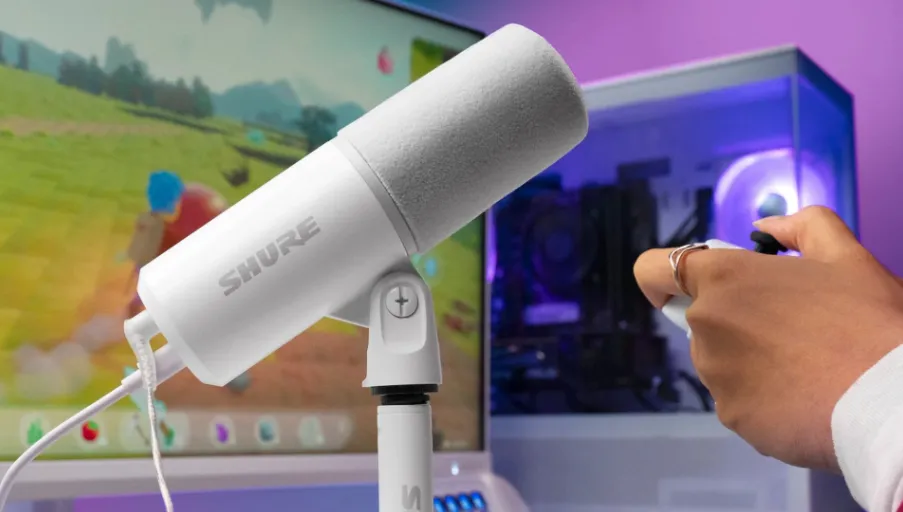
The Shure MV6 Gen 2 is a USB dynamic gaming microphone designed for streaming, podcasting, voice work, and creator recording without the conventional interface-and-plugin chain. The second-generation model does not introduce a radically different microphone architecture. Its main advance is greater control over the DSP that shapes the signal before it reaches the computer.
That matters more than the new finish or longer cable. Adjustable Auto Level, variable real-time denoising, a five-band EQ, and high-pass filtering can remove several routine processing steps from a spoken-word workflow. The same processing can become a limitation in music production, however, where dynamics, noise, and tonal decisions are often better left under the mix engineer’s control.
At $169, the MV6 Gen 2 is best judged as a DSP-driven recording workflow rather than simply another USB microphone. The real question is whether its processing produces a more useful source, saves enough time to justify the trade-offs, and still makes sense once that recording enters a conventional mixing workflow.
Shure MV6 Gen 2 at a Glance
| Feature | MV6 Gen 2 |
|---|---|
| Type | Dynamic USB microphone |
| Polar Pattern | Cardioid |
| Connection | USB-C |
| Recording Resolution | 16/24-bit, 44.1/48 kHz |
| Frequency Response | 50 Hz–15 kHz |
| Headphone Output | 3.5 mm, latency-free monitoring |
| Main DSP | Auto Level, Real-time Denoiser, 5-band EQ, High-Pass Filter, Digital Popper Stopper |
| Software | Shure MOTIV Mix |
| Price | $169 |
The specifications explain the hardware, but they do not fully explain the Gen 2 upgrade. The important difference is how much control the microphone gives the user over the processing that sits between the capsule and the recorded USB signal.
When the Microphone Starts Doing the Mixer’s Job
 USB microphones have increasingly moved parts of the recording chain into the microphone itself. Instead of delivering a relatively raw signal and leaving gain control, EQ, dynamics, and noise reduction to the DAW, these systems can process the voice before it ever reaches the recording software.
The MV6 Gen 2 takes that approach further without changing the basic architecture of the microphone. It remains a dynamic cardioid USB microphone, but its onboard processing is designed to produce a more controlled voice signal in environments where the user may not have the time, equipment, or acoustic conditions for a conventional recording setup.
For streaming, podcasting, and other spoken-word work, that can be a genuine advantage. Consistent level, controlled background noise, and basic tonal shaping can eliminate several routine processing decisions before the session even starts.
For music production, the trade-off is more important. Every decision made before the signal reaches the DAW is a decision the mixing engineer no longer gets to make later. Auto gain and denoising can solve problems at the source, but they can also alter dynamics or remove information that would have been useful during mixing.
That makes the MV6 Gen 2 less interesting as a collection of features and more interesting as a change in where the signal chain is controlled. Its value depends on whether that control belongs in the microphone or should remain in the hands of the engineer.
The MV6 Gen 2 Is Primarily a DSP Upgrade
The second-generation MV6 keeps the same basic concept: a dynamic cardioid USB microphone designed to deliver a controlled voice signal without requiring a conventional interface and external processing chain. The meaningful Gen 2 changes are concentrated in the control available over that signal path.
The new generation adds adjustable Auto Level behavior, adjustable Real-time Denoiser, a five-band EQ, Speech, Singing, and Instrument presets, a High-Pass Filter, and greater control through Shure MOTIV Mix. The result is not a radically different microphone; it is a more configurable recording system built around the same basic capture philosophy.
That distinction matters when evaluating the upgrade. The Gen 2’s value is primarily in how much control the user gains over the processing, not in evidence of a fundamentally redesigned transducer.
Shure MV6 vs. MV6 Gen 2: What Actually Changed?
The Gen 2 is best understood as a refinement of the original MV6 rather than a replacement built around a completely different microphone architecture. The most relevant changes are concentrated in DSP control, workflow flexibility, and the physical package.
| Area | Original MV6 | MV6 Gen 2 |
|---|---|---|
| Core microphone concept | Dynamic cardioid USB microphone | Dynamic cardioid USB microphone |
| Auto Level | Automatic level control | Adjustable behavior with greater control over level management |
| Noise processing | Real-time Denoiser | Adjustable Real-time Denoiser |
| EQ and tone shaping | Basic tone controls | 5-band EQ plus Dark, Natural, and Bright tone options |
| Presets | More limited workflow configuration | Speech, Singing, and Instrument modes |
| Physical package | Original MV6 package | Black or white finish, color-matched stand, and 2 m USB-C cable |
The upgrade case is therefore strongest for users who want more control over the microphone’s built-in processing. For an existing MV6 owner who is already satisfied with the original workflow, the Gen 2 is harder to justify unless those additional controls solve a specific limitation.
Adjustable Auto Level
Automatic level control makes sense when the priority is consistent speech level rather than preserving the natural dynamics of a performance. The difficulty is that one response characteristic cannot suit every source. A conversational podcast, a gaming stream, and an animated voice performance can produce very different level changes.
The MV6 Gen 2 lets the user adjust how quickly Auto Level responds to those changes. A slower response is better suited to relatively controlled speech, while a faster response can react more quickly to abrupt changes in level.
That is a meaningful improvement because the user can now choose how much intervention the level-control stage applies instead of accepting a single fixed behavior.
For music recording, the calculation is different. Vocal dynamics are information, not simply level variation to be corrected. A singer moving from an intimate phrase into a louder section, or a rapper changing intensity between verses and hooks, may be delivering exactly the performance the mix needs.
For that reason, I would normally leave Auto Level out of the printed recording chain when using the MV6 Gen 2 for serious music production. It is useful when the objective is a stable creator feed; it is less useful when the objective is to preserve maximum control over the source.
Real-Time Denoiser
The adjustable Real-Time Denoiser is arguably the most consequential addition for the microphone’s intended environment. Background noise is one of the main problems that makes untreated rooms difficult to use for spoken-word recording, particularly with computers, fans, HVAC systems, and other continuous sources nearby.
Noise reduction is inherently a trade-off. Increasing suppression can lower the apparent background level, but increasingly aggressive processing can also affect the character of the voice through modulation, spectral artifacts, or loss of low-level detail. An adjustable control is therefore more useful than a simple processing switch because the user can decide how much intervention the recording requires.
The important point is that the denoiser should not replace good recording technique. Microphone distance, positioning, the cardioid pickup pattern, and the acoustic environment still determine how much unwanted information reaches the capsule in the first place.
A close-positioned dynamic microphone can already reduce the contribution of a room compared with a more distant setup. The denoiser can then address residual environmental noise. It cannot turn a poor acoustic environment into a controlled recording space, and it should not be treated as a substitute for microphone placement or room control.
Five-Band EQ
The five-band EQ gives the MV6 Gen 2 another layer of control over the signal before it reaches the DAW. For spoken-word recording, that can be useful for reducing excessive low-frequency weight, controlling lower-mid buildup, shaping presence, or adding enough upper-frequency definition to improve intelligibility.
The EQ should still be treated as source shaping rather than a substitute for a full mix-stage equalizer. Its value is speed and repeatability: the user can establish a consistent tonal starting point before recording instead of building the same basic correction in software every time.
The limitation is equally important: an onboard five-band EQ is not a replacement for the flexibility of a proper DAW-based processing chain. Once the EQ is printed into the recording, those tonal decisions become part of the source rather than a reversible mix-stage adjustment.
That is intentional. The MV6 Gen 2 is designed to produce a usable signal quickly, not to replicate an entire studio processing chain. For streaming or podcasting, that distinction is largely an advantage. For music production, it determines how conservatively the processing should be used.
Hear What Your Mix Can Become
Once the recording stage is finished, the final master still has to translate with the right balance of clarity, depth, punch, dynamics, stereo image, and detail across real playback systems. If you want to hear how your mix responds to professional mastering, you can upload up to 40 seconds for a free mastering demo.
Upload your mix for a free mastering demo →
MOTIV Mix: Where the Gen 2 Controls Actually Live
The hardware features are only part of the MV6 Gen 2 workflow. Shure’s MOTIV Mix software provides the control layer that makes the second-generation microphone more configurable than a fixed-function USB microphone.
For the MV6 Gen 2, MOTIV Mix provides access to Auto Level or Manual gain control, Monitor Mix, tone selection, Real-time Denoiser, Digital Popper Stopper, the High-Pass Filter, and microphone-specific processing settings. MOTIV Mix also lets users save and recall settings, which makes the software more useful as a configuration tool than something that has to remain open for every recording session.
The practical advantage is that the user can establish a recording configuration once and then use the microphone as a more self-contained source. That matters for streaming, podcasting, and repeatable voice work, where the same signal path may be used for hours at a time.
There is also an important limitation. MOTIV Mix gives the MV6 Gen 2 more control, but it does not turn the microphone into a conventional modular studio chain. The processing still occurs before the signal reaches the DAW, so the additional configuration does not eliminate the underlying trade-off between convenience and reversibility.
For music tracking, that distinction makes the software particularly important. The ability to switch to Manual operation and disable processing that is optimized for speech provides a more conservative starting point than simply leaving every DSP feature active.
What the MV6 Gen 2 Changes in a Real Recording Workflow
 The practical benefit of the MV6 Gen 2 becomes clearer once the signal leaves the microphone and enters the recording workflow. Several tasks that would normally be handled as separate processing stages can be performed before the signal reaches the DAW.
For spoken-word production, that can mean less time spent setting gain, applying corrective EQ, controlling background noise, and preparing a consistent monitoring signal. The difference is not necessarily a better raw recording; it is a more finished signal with fewer setup decisions required between the microphone and the recording software.
That distinction becomes valuable for creators who record frequently. If the same microphone is used for several hours of streaming, podcasting, narration, voice-over, online teaching, or remote communication each week, reducing repetitive setup work can have more practical value than a small change in frequency response.
The workflow advantage is strongest when the objective is consistent speech with minimal intervention. It is less significant when recording music, where the producer or engineer may deliberately want the source to remain as untouched as possible.
Once a vocal enters a DAW, control over dynamics, noise, EQ, saturation, and spatial processing can become part of the creative and technical mixing process. Processing those elements inside the microphone moves some of those decisions earlier in the chain and can make them less flexible later.
That is the fundamental trade-off of the MV6 Gen 2: less work before recording, but potentially less control after recording. For spoken-word creators, that exchange is often favorable. For music production, it needs to be considered on a case-by-case basis.
The Music Production Question: Should You Print the Processing?
This is where the MV6 Gen 2 becomes more relevant to producers than its creator-focused positioning might suggest. The microphone can capture vocals, acoustic instruments, demos, and other musical sources, but its onboard processing should not automatically be treated as part of the recording chain.
For music tracking, I would generally start with the least invasive configuration that produces a clean and usable source. The microphone’s dynamic capsule and cardioid pickup pattern already determine much of the capture behavior; additional DSP should have a specific reason to be active.
Auto Level and aggressive denoising are therefore better understood as situational tools rather than universal recording defaults. They can be useful when the recording environment or performance makes level consistency and noise control more important than preserving maximum source flexibility.
The critical issue is what happens after tracking. If automatic level control changes the gain structure or denoising alters the source, those decisions are effectively printed into the recording. A mixing engineer can compensate for the result, but cannot fully reconstruct the original signal simply by bypassing a plugin.
That is fundamentally different from applying EQ, compression, or noise reduction inside the DAW. Processing on a channel can normally be bypassed, adjusted, automated, or replaced as the mix develops. Processing performed before the signal reaches the DAW becomes part of the recorded source.
There are situations where printing processing is completely reasonable. If the DSP solves a known problem and the resulting signal is already appropriate for the intended production, committing that processing can simplify the session. The mistake is treating every available processor as something that should be enabled simply because it is available.
For professional music production, reversibility remains valuable. The MV6 Gen 2 gives you the option to commit more processing at the microphone, but that option is most useful when it is applied deliberately rather than by default.
Design, Setup, and Monitoring
The MV6 Gen 2 is designed to remove as much hardware complexity from the recording setup as possible. The microphone uses USB-C rather than XLR, includes a desktop stand and isolation base, and provides a 3.5 mm headphone output for direct monitoring.
The physical controls are deliberately simple. The touch-to-mute control handles immediate muting, while deeper configuration is handled through MOTIV Mix. This division makes sense for a creator workflow: actions that need to happen during a stream or recording session stay accessible on the microphone, while less frequent DSP adjustments remain in software.
The headphone output is also more important than it may initially appear. MOTIV Mix allows the user to balance microphone and computer playback in the monitor mix, which makes the MV6 Gen 2 a more self-contained monitoring solution rather than simply a USB input device.
The trade-off is the same one found throughout the microphone’s design. A compact USB system is easier to deploy, but it is not designed for the routing flexibility of an interface-based studio setup with multiple inputs, external hardware, or interchangeable preamps.
Audio Quality: Strong Voice Capture, Limited Studio Flexibility
The MV6 Gen 2 uses a dynamic cardioid design with a specified frequency range of 50 Hz to 15 kHz and 24-bit operation at 44.1 or 48 kHz. Those specifications are well aligned with its primary use case: close-miked speech where intelligibility, off-axis rejection, and consistent voice level matter more than extended bandwidth.
Its main strength is the combination of a close-working dynamic capsule and processing designed to produce a controlled voice signal with relatively little setup. In the right position, that can result in a focused vocal recording with limited room contribution and enough tonal consistency for spoken-word production.
That should not be confused with the performance profile of a large-diaphragm condenser or a professional XLR broadcast microphone connected to a dedicated preamp. Those systems can offer different transient behavior, frequency extension, gain staging, and considerably more control over the signal path. They are solving a different recording problem.
For the intended close-mic use case, the more relevant question is not whether the MV6 Gen 2 provides the widest possible frequency response, but whether its processing can produce a consistent and usable voice signal without creating problems that have to be corrected later. That is where the microphone’s DSP architecture becomes more important than the headline specification.
The MV6 Gen 2 instead prioritizes usable capture with minimal external equipment. For speech, that can be more important than absolute bandwidth or maximum signal-path flexibility.
There is also not enough independent laboratory data to justify claiming a major improvement over the original MV6 in parameters such as THD, phase response, aliasing, noise floor, or frequency-response accuracy. Without controlled measurements, those would be assumptions rather than demonstrated differences.
The defensible conclusion is therefore narrower: the Gen 2’s meaningful advancement is primarily in the control and integration of the processing surrounding the microphone, rather than evidence of a transformational change in the underlying transducer.
MV6 Gen 2 vs. the Alternatives
| Option | Main Advantage | Main Limitation | Best Use |
|---|---|---|---|
| Shure MV6 Gen 2 | Integrated DSP, USB simplicity, adjustable voice processing | Less routing and source flexibility than a modular setup | Streaming, podcasting, voice-over, creator recording |
| Shure MV6 | Similar core USB dynamic workflow at a lower upgrade cost | Less configurable DSP workflow | Existing MV6 owners and buyers who do not need the Gen 2 controls |
| Shure MV7 / MV7+ | Broader studio-oriented workflow and XLR connectivity | Higher cost and more involved setup | Creators who want a path toward a conventional studio chain |
| Razer Seiren V3 Chroma | Gaming-focused software and visual features | Less focused on a conventional broadcast-style workflow | Gaming and live streaming |
| HyperX QuadCast 2 S | Multiple pickup patterns and creator-oriented controls | Different capture philosophy from a close-positioned dynamic microphone | Gaming, streaming, and general content creation |
| XLR microphone + interface | Maximum routing, gain-staging, and processing flexibility | Additional equipment and setup required | Professional music production and expandable studio workflows |
The central buying decision is therefore not simply which microphone sounds best. It is whether the user benefits more from an integrated, configurable USB workflow or from the greater flexibility of a modular recording chain.
Streaming, Gaming, and Monitoring
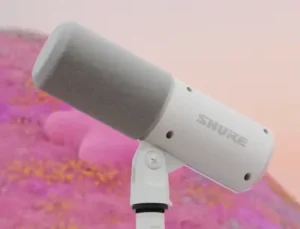 This is where the MV6 Gen 2’s design makes the most practical sense. Gaming and live-streaming can produce abrupt changes in vocal level, continuous background noise, and the need to monitor both the microphone and computer audio from the same setup.
Adjustable Auto Level is designed for those level changes, while the Real-time Denoiser controls how aggressively background sound is reduced. MOTIV Mix also provides Monitor Mix for balancing microphone and computer audio in the headphones, and the 3.5 mm output provides latency-free monitoring.
The High-Pass Filter offers 75 Hz and 150 Hz settings for low-frequency rumble, while the physical tap-to-mute control provides immediate muting without reaching for the streaming software. These are small features individually, but together they explain why the MV6 Gen 2 is more compelling as a self-contained streaming microphone than as a conventional studio microphone.
The limitation is equally clear: the microphone remains USB-only, and the deeper controls live in the MOTIV ecosystem rather than on the hardware itself. That is a reasonable trade for a creator setup, but it is not the same workflow as an XLR microphone connected to a modular interface.
Where the MV6 Gen 2 Falls Short
The biggest structural limitation is the USB-only architecture. It makes the microphone easy to connect and use, but it also prevents the MV6 Gen 2 from fitting into a conventional XLR-based signal chain with an external preamp, interface routing, outboard processing, or a larger studio patching system.
The onboard DSP introduces a second limitation: processing is not inherently an advantage simply because it happens before the signal reaches the computer. Automatic level control and denoising can make a difficult recording more usable, but they can also change dynamics or remove information that an engineer might prefer to preserve and process later.
The same trade-off applies to the onboard EQ. It is useful for fast tonal shaping, but it does not provide the depth or reversibility of a full software-based processing chain.
There are also practical boundaries to the microphone’s architecture. The MV6 Gen 2 is designed primarily around a single close-positioned speaker. It is not intended to replace a multi-microphone recording system, a stereo capture setup, a detailed acoustic-instrument chain, or a conventional live-sound microphone workflow.
For existing MV6 owners, the most important point is that the Gen 2 designation should not be interpreted as proof of a dramatically improved raw acoustic performance. The available evidence does not establish a transformational change in the underlying microphone. The more substantial upgrade is the amount of control over the processing and the resulting recording workflow.
Is the Shure MV6 Gen 2 Worth $169?
At $169, the MV6 Gen 2 makes the strongest case when the buyer is paying for workflow simplicity rather than simply for a microphone capsule. The integrated DSP, USB connectivity, headphone monitoring, and MOTIV Mix controls can replace several separate setup decisions.
For a first serious USB microphone: the price is reasonable if the main goal is streaming, podcasting, voice-over, remote work, or other spoken-word recording where consistent output matters more than a fully modular signal path.
For music production: the value is more conditional. A buyer who expects to record demos, scratch vocals, or occasional performances can benefit from the simple setup, but an XLR microphone and interface may offer more long-term flexibility for the same overall investment.
For an existing MV6 owner: the upgrade is harder to justify. The Gen 2 becomes more compelling when adjustable DSP and the additional workflow controls solve a limitation that the original microphone cannot address.
The $169 price therefore makes sense when the buyer is purchasing a complete recording workflow, not simply chasing a generational improvement in raw microphone performance.
Who Should Buy the Shure MV6 Gen 2?
Streamers and content creators: This is the clearest use case. The integrated DSP can reduce repetitive gain, noise, and tonal-processing work, making it easier to maintain a consistent voice signal during live production.
Podcasters: A strong match for users who need controlled speech without building a conventional interface-and-plugin chain. The combination of close-positioned dynamic capture and onboard processing is particularly practical when the recording environment cannot be fully treated.
Voice-over users: The MV6 Gen 2 can provide a straightforward recording path for narration and other spoken-word work. Professionals who need extensive control over the unprocessed source may still prefer an XLR microphone and conventional studio chain.
Bedroom producers: Useful for demos, scratch vocals, narration, and occasional recording. If music production is the primary purpose, however, the same budget may be better allocated toward a more flexible microphone and interface combination that can remain useful as the studio develops. That becomes particularly relevant when the goal is to retain enough control for later mixing and production decisions rather than solving every problem at the recording stage.
Mixing engineers: Its strongest role is as a dedicated communication, streaming, or voice-over microphone rather than as a replacement for a conventional studio vocal microphone. The integrated DSP is useful when speed matters more than maximum source flexibility.
Professional studios: The microphone can make sense as a convenient utility tool for quick voice work, talkback, streaming, or client communication. It is less compelling as a replacement for an established tracking chain with interchangeable microphones, external routing, and greater control over the recorded source.
Overall, the MV6 Gen 2 makes the most sense when speed, consistency, and a self-contained workflow are more important than maximum recording flexibility.
Shure MV6 Gen 2 Overall Rating
The rating reflects the MV6 Gen 2 against its intended use as a self-contained USB microphone for spoken-word recording, streaming, podcasting, and creator workflows. It is an editorial assessment rather than a laboratory measurement of microphone performance.
| Category | Rating |
|---|---|
| Voice Capture & Intelligibility | 8.5/10 |
| DSP Control | 8.7/10 |
| Noise Management | 8.4/10 |
| Source Flexibility | 6.8/10 |
| Signal-Path Integration | 8.8/10 |
| Recording Versatility | 7.2/10 |
| Overall | 8.1/10 |
Its close-positioned dynamic design and integrated processing make it well suited to controlled spoken-word capture, where consistent level and intelligibility are more important than extended bandwidth.
Adjustable Auto Level, denoising, EQ, and filtering give the user meaningful control over how much processing is committed before the USB signal reaches the computer.
The denoiser is useful for residual environmental noise, but its effectiveness remains dependent on microphone placement and room conditions, with aggressive suppression carrying the risk of audible artifacts.
The main compromise is source flexibility: USB-only connectivity and printed DSP leave less room for external routing, interchangeable processing, and later reconstruction of the unprocessed signal.
The integrated architecture is particularly effective for streaming, podcasting, voice-over, and other situations where reducing external equipment and repetitive setup has greater value than maintaining a fully modular signal chain.
For music recording, its versatility is more limited because the same processing that simplifies spoken-word capture can reduce control over dynamics, noise, and tonal decisions once the source has been recorded.
The MV6 Gen 2 is most compelling when the recording objective is a controlled voice signal with minimal external equipment. Its integrated DSP solves a real practical problem, but the convenience comes at the cost of the reversibility and routing flexibility expected from a conventional studio recording chain.
Verdict: A Better Workflow, Not a New Recording Paradigm
The Shure MV6 Gen 2 succeeds by making a USB microphone behave more like a configurable recording system. Its dynamic cardioid capture, integrated DSP, MOTIV Mix control, headphone monitoring, and simple USB workflow address the practical problems that matter most in streaming, podcasting, voice-over, and creator recording.
The most important improvement is not a dramatic change in the underlying microphone architecture. It is the amount of control Shure now gives the user over the processing that happens before the signal reaches the computer. That makes the Gen 2 more useful than the original MV6 for buyers who specifically need adjustable DSP rather than simply another USB microphone.
The trade-off remains fundamental. Processing committed at the microphone can simplify recording, but it also reduces the flexibility available later in the DAW. For spoken-word production that is often a sensible exchange. For serious music tracking, preserving the cleanest and most reversible source remains the stronger engineering approach.
At $169, the MV6 Gen 2 is therefore easiest to recommend when the buyer values a complete, configurable USB recording workflow. Existing MV6 owners should upgrade for the additional control rather than expecting a transformational change in raw microphone performance.
The MV6 Gen 2 is not a new benchmark for microphone acoustics. It is a more configurable voice-production system designed to make good spoken-word recording easier to achieve with less external equipment.
Find Out What Your Mix Still Needs
The MV6 Gen 2 review highlights an important production principle: processing can make a source more controlled, but it can also reduce the flexibility available later in the mix. The same applies to the finished mix itself. Instead of adding more processing without knowing what the mix actually needs, a professional mastering pass can provide a useful before-and-after reference for balance, dynamics, depth, stereo image, and translation. Upload up to 40 seconds of your mix and receive a free mastering demo prepared by a real mastering engineer.
Upload up to 40 seconds and get your free mastering demo →
FAQ
Is the Shure MV6 Gen 2 good for recording vocals?
Yes. It can work well for demos, songwriting, content production, and casual vocal recording. For a finished music vocal, a conservative setup is usually preferable so that dynamics, noise reduction, and tonal processing remain under the mix engineer’s control during mixing.
Can the Shure MV6 Gen 2 replace an audio interface?
It can eliminate the need for a separate interface when using the MV6 Gen 2 as a single USB microphone with headphones. It does not replace an interface for multiple inputs, XLR microphones, external hardware, studio routing, or a conventional multi-source recording setup.
Does the MV6 Gen 2 reduce the need for audio plugins?
For spoken-word recording, it can reduce the need for some basic host-side processing. Auto Level, Real-time Denoiser, tone shaping, EQ, high-pass filtering, and Digital Popper Stopper can handle tasks that would otherwise be built as part of a software chain. That does not make DAW processing unnecessary, especially for music production where detailed and reversible control remains important.
Should Auto Level be used when recording music?
Usually not as a default. Auto Level is designed to maintain more consistent signal levels, while musical dynamics are often part of the performance. Leaving more control for the DAW generally gives the engineer greater flexibility during mixing.
Is the MV6 Gen 2 better than the original MV6?
It is more configurable, particularly in its adjustable Auto Level, denoising, and EQ controls. The available evidence does not establish a dramatic improvement in the underlying acoustic performance, so the upgrade is better understood as a processing and workflow improvement.
Is the Shure MV6 Gen 2 suitable for professional music production?
It can be useful for demos, scratch vocals, communication, and specific recording situations. For primary studio tracking, an XLR microphone and interface provide a more flexible signal path and greater control over the recorded source.
Is the MV6 Gen 2 worth $169?
For streaming, podcasting, voice-over, and creator workflows, the integrated processing and USB setup can justify the price. For someone who already owns a good XLR microphone and interface, the additional value is much more limited.
What is the difference between the Shure MV6 and MV6 Gen 2?
The Gen 2 keeps the same basic dynamic cardioid USB microphone concept but adds substantially more control over the processing around it. The most important changes are adjustable Auto Level behavior, adjustable Real-time Denoiser, expanded tone and EQ control, additional recording presets, and a more configurable workflow through MOTIV Mix. The upgrade is therefore more about DSP control and workflow than a fundamental change in microphone architecture.

As an audio production editor, Yurii Ariefiev evaluates USB dynamic microphones by looking beyond headline features and considering how their DSP, cardioid capture, and signal-path decisions affect practical recording. With creator microphones such as the Shure MV6 Gen 2, the important question is how much control is gained through integrated processing and how much source flexibility remains for the actual recording task.
Enjoyed this review?
If you found it useful, you can support independent audio research with a coffee.
☕ Buy me a coffee