Symphonic Destruction Redux release: Heavyocity’s fastest hybrid orchestral plugin for Kontakt Player
Symphonic Destruction Redux has been released by Heavyocity as a stripped-down, speed-focused hybrid orchestral plugin for Kontakt Player. Instead of expanding the original Symphonic Destruction, this version reduces it—prioritizing fast scoring, immediate usability, and pre-shaped cinematic sound over deep sound design.
This release targets a clear shift in audio production workflows: less time building sounds, more time delivering finished cues.
Quick facts: Symphonic Destruction Redux
- Type: hybrid orchestral plugin
- Platform: Kontakt Player (no full version required)
- Presets: 212
- Sources: 132
- Samples: 2,808 processed sounds
- Engines: Redux Designer, Redux Menu
- Intro price: $99 (until May 4, 2026)
- Regular price: $119
At a glance, symphonic destruction redux is positioned as a production-ready tool rather than a deep programming environment.
Why this release matters in 2026
The hybrid orchestral plugin space has shifted toward speed. Trailer composers, TV scoring teams, and content producers are working under tighter deadlines than ever, and libraries that require extensive setup are increasingly impractical.
Symphonic Destruction Redux is a response to that pressure. It removes complexity and replaces it with curated, pre-processed material that can be deployed instantly in a mix.
This puts it in direct contrast with more traditional libraries that emphasize articulation depth and realism. Here, the priority is workflow efficiency.
What actually changed from the original Symphonic Destruction
This is not an expansion. It’s a reduction.
- Content has been aggressively curated
- Preset count is limited but focused
- Sound design depth is reduced
- Workflow is significantly faster
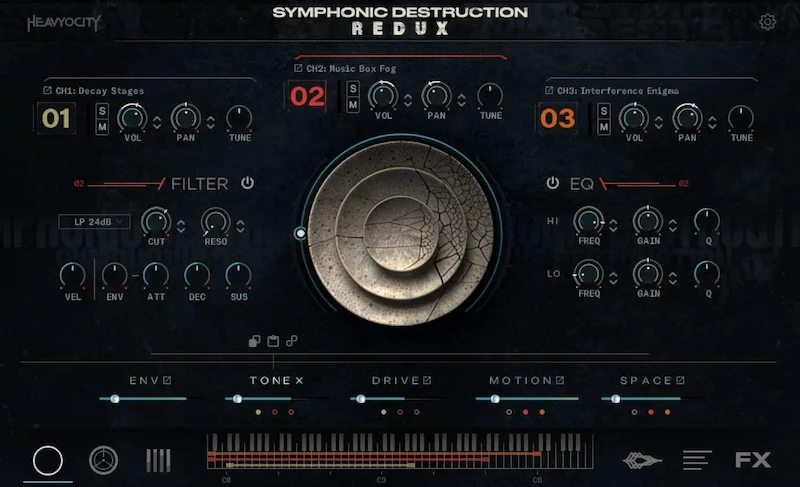
Redux Designer offers a three-layer structure with macro sequencing and per-channel effects. It allows shaping, but within defined boundaries.
Redux Menu maps 36 sounds across the keyboard for immediate access—no patch browsing, no deep navigation.
The emphasis is clear: eliminate friction, even if it means limiting control.
How Symphonic Destruction Redux affects mixing and mastering
From a mixing perspective, symphonic destruction redux behaves differently from raw orchestral libraries.
- Sounds are already compressed and saturated
- Low-end and low-mid energy are pre-enhanced
- High-frequency content is pushed for perceived impact
This makes placement fast—but reduces flexibility.
In practice:
- Layering multiple presets quickly creates density issues
- EQ adjustments become corrective rather than creative
- Transient control is limited due to baked-in processing
At the mastering stage, these characteristics can lead to instability under limiting. Pre-shaped cinematic content often collapses or becomes harsh when pushed to competitive loudness.
If you’re working with this type of material regularly, understanding how it translates through final processing is critical. A detailed breakdown of these issues and how to handle them is covered here: professional track mastering workflow.
Real-world use cases
Where it works:
- Trailer music production under tight deadlines
- TV scoring and streaming content
- Pre-production demos and client previews
- Layering for impact enhancement
Where it struggles:
- Detailed orchestral arrangements
- Projects requiring sonic uniqueness
- Dense mixes with multiple competing elements
symphonic destruction redux excels when speed matters more than originality.
Comparison: Redux vs competitors
- Damage 2 — stronger for percussion, less versatile
- Albion One — deeper orchestral control, slower workflow
- Jaeger — more musical, less processed
- Rise & Hit — more complex transition design
Symphonic Destruction Redux is not the most flexible or the most detailed. It is the fastest to deploy.
Limitations and trade-offs
- Limited sound design depth
- High risk of repetitive results
- Heavy reliance on presets
- Reduced control in mixing stage
“It sounds finished immediately. That’s useful—but also restrictive.”
The core trade-off is clear: speed versus uniqueness.
FAQ: Symphonic Destruction Redux
Do you need full Kontakt?
No. It runs in Kontakt Player.
Is this an upgrade to the original?
No. It’s a simplified alternative, not a replacement.
Is it worth it?
Yes, if speed is your priority. No, if you need deep customization.
Is it suitable for professional mixing?
Yes, but it requires corrective processing due to pre-shaped sound.
Verdict
Symphonic Destruction Redux is a production-first plugin designed for modern scoring workflows.
It trades depth for speed, flexibility for immediacy, and uniqueness for consistency.
Verdict:
For deadline-driven production, it’s efficient.
For sound design and originality, it’s limiting.
This is not a tool for exploration. It’s a tool for delivery.