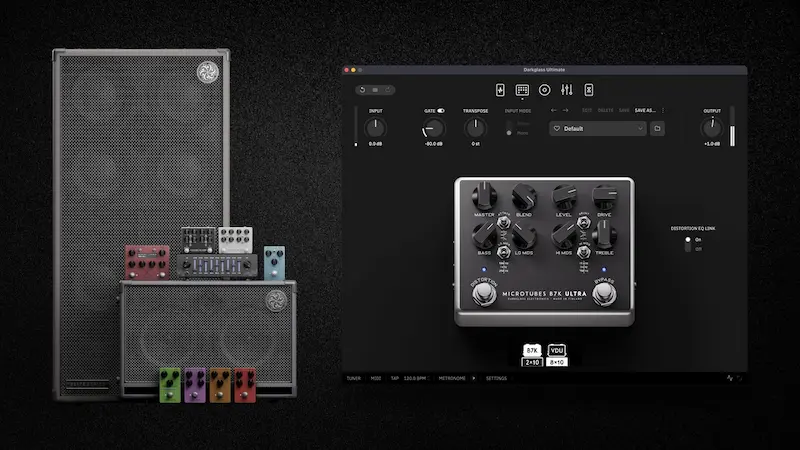
Neural DSP Darkglass Ultimate plugin released: a full bass signal chain built for modern mixing
Neural DSP Darkglass Ultimate plugin has been released in April 2026, expanding the company’s Darkglass line from a preamp model into a complete bass processing chain for in-the-box audio production. The update is free for existing Darkglass Ultra users and priced at €119, with a 14-day trial and a 50% launch discount.
This is not a new amp model. It’s a workflow shift: Neural DSP is collapsing the bass signal chain into a single plugin designed to move from DI input to mix-ready tone without leaving one interface.
Context: why this release matters in 2026
The amp sim category has matured. Most plugins already deliver acceptable tone. The bottleneck is no longer sound quality—it’s decision speed and consistency inside sessions.
That’s where the Neural DSP Darkglass Ultimate plugin positions itself. Instead of competing on realism or variety, it competes on consolidation. One plugin replaces a typical chain of compressor, saturation, amp, cab, and EQ.
That puts it closer to integrated environments like Line 6 Helix Native than to traditional single-purpose bass plugins.
Neural DSP Darkglass Ultimate plugin: key features and structure
At its core, the plugin still runs on two established circuits:
- B7K Ultra — tight low-end, aggressive midrange, controlled distortion
- Vintage Ultra — softer transient response, tube-like harmonic spread
The difference is everything around them:
- Pre-processing: compression, octaver, auto-wah, fuzz
- Post-processing: chorus, delay
- Cab section: 2×10 and 8×10 with adjustable mic positioning
- 9-band graphic EQ for tonal shaping
- Integrated tools: tuner, transpose, metronome
- Preset system tuned for production contexts
No new modeling engine was introduced. The sonic identity remains unchanged. The update is structural: a closed, linear signal path optimized for speed.
What actually changes in a mixing workflow
In practical sessions, the Neural DSP Darkglass Ultimate plugin reduces setup time rather than improving raw tone.
Case 1: rapid tone commit
Instead of assembling a chain, engineers can dial a usable bass tone within seconds. This matters in high-turnover production environments.
Case 2: dense arrangement clarity
The B7K voicing emphasizes upper harmonics, allowing bass to cut through multi-layered guitars without excessive level.
Case 3: in-the-box re-amping
For producers working without hardware, the plugin provides a consistent baseline across projects.
However, the trade-off becomes clear under scrutiny: the plugin tends to overbuild harmonic density in the low-mid region.
In isolation, that reads as “full.” In a mix, it often translates into masking—particularly against distorted guitars and kick fundamentals. In mastering, that energy accumulates, reducing headroom and destabilizing translation.
This is where a single-plugin approach starts to show its limits. Even when the bass sounds “finished,” it often requires corrective processing downstream. If you’re evaluating how that low-end behaves across playback systems, running a controlled mastering pass will expose inconsistencies immediately.
Critical analysis: where the plugin is oversold
The marketing angle suggests a complete solution. In practice, it’s a convenience layer, not a replacement for detailed processing.
Limitations:
- No parallel routing or advanced signal splitting
- Graphic EQ limits precision in problem-solving
- Cab section lacks third-party IR loading
- Built-in effects are functional but not class-leading
More importantly, the fixed signal flow forces decisions early. That’s efficient, but it reduces flexibility later in the mix.
Translation risk: what works inside the plugin doesn’t always survive full-range playback without additional control.
Positioning: where it fits against competitors
The Neural DSP Darkglass Ultimate plugin doesn’t compete on depth—it competes on speed.
- Line 6 Helix Native
Full routing flexibility and modular chains. Slower, but far more adaptable. - IK Multimedia AmpliTube
Large ecosystem with broader tonal range. Requires more setup time. - Ampeg SVT Suite
Focused on classic bass tones. Less suited for modern aggressive mixes.
Darkglass Ultimate’s lane:
- fastest path to a modern bass tone
- predictable results across sessions
- limited adaptability outside its intended sound
Pricing and launch timing
- €119 standard price
- Free upgrade for Ultra users
- 14-day trial
- 50% discount during Neural DSP Birthday Sale (through May 6, 2026)
At €59 during the sale, the plugin becomes competitive against mid-tier amp sims, especially considering the bundled signal chain.
Verdict
The Neural DSP Darkglass Ultimate plugin is not a breakthrough in sound design. It’s a consolidation tool.
It reduces friction, speeds up decision-making, and delivers consistent results in modern genres. But it trades flexibility for that efficiency.
Use it if your priority is speed and repeatability.
Avoid relying on it as a complete solution if your priority is control and translation accuracy.
This is a workflow product—not a sonic upgrade.