Arturia MiniFreak 49 Review: Sound Design, Workflow, and Value
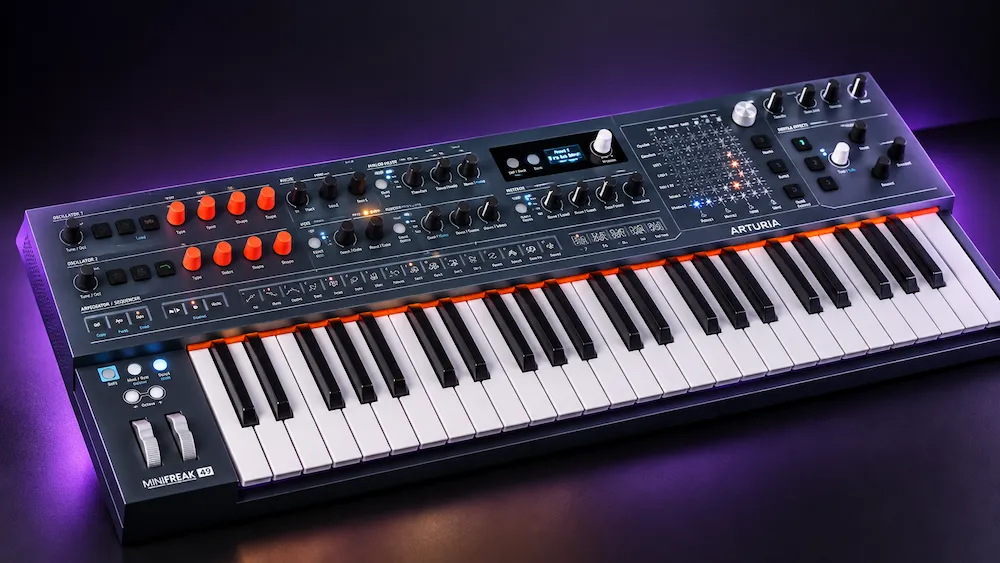
The Arturia MiniFreak 49 retains the original MiniFreak’s six-voice hybrid synthesis architecture but changes how players interact with it. A 49-key full-size keyboard, dedicated controls for both digital engines, a pressure-sensitive XYZ touch matrix, audio-rate filter FM, and voice panning make it a more performance-focused instrument. For new buyers, the key question is whether this combination suits their playing and sound-design workflow; for existing owners, the decision comes down to whether the revised interface and hardware-specific features justify the upgrade.
Arturia MiniFreak 49: Where Hands-On Sound Design Makes a Difference
 Software synthesizers already provide extensive modulation, deep preset libraries, and flexible routing. Performance-oriented instruments such as the Arturia AstroLab 2.0 take a different approach, prioritizing access to a broad sound library and selected on-device adjustments. The MiniFreak 49 puts more emphasis on hands-on interaction with its synthesis engines, making the distinction less about the number of available sounds than how directly a producer can shape them while playing.
Compared with the original MiniFreak’s 37 slim keys and shared oscillator controls, the 49-key model offers full-size semi-weighted keys, dedicated controls for both digital engines, physical pitch and modulation wheels, and a pressure-sensitive XYZ touch matrix. This layout makes it easier to adjust interacting sound sources while playing, without repeatedly switching between engine-editing modes.
The XYZ matrix also adds a performance layer beyond conventional parameter editing. Its Freak Control functions provide access to macros and performance-oriented behaviors such as Gate and Spice, while the surface can also handle modulation assignment and preset browsing. This matters most when a patch needs to change during a phrase: the matrix can make several assigned behaviors accessible through a physical gesture rather than requiring separate knob movements or later DAW automation. The benefit depends on how a patch is configured, so the matrix should be judged as a way to perform and organize sound changes—not as an automatic improvement to every preset.
The underlying instrument remains a six-voice hybrid synthesizer with two digital engines, an analog filter and VCA per voice, onboard effects, an arpeggiator, and a sequencer. The 49-key version builds on that architecture rather than replacing it. Its main advances are a more accessible playing interface and additional sound-design options, not a wholesale change in synthesis technology.
MiniFreak 49 Synthesis Architecture: Two Digital Engines, Six Analog Voices
The MiniFreak 49 combines two digital sound engines with an analog filter and VCA on each of its six voices. The digital engines provide the raw material; the analog stages shape its tonal character and dynamics. This arrangement supports a wider range of sounds than conventional virtual-analog synthesis alone, from stable oscillator-based tones to granular, sampled, metallic, and heavily modulated textures.
The two engines are more significant than a simple oscillator count suggests. Depending on the selected engine modes and routing, one engine can process or interact with the other, creating timbres that would otherwise require additional synthesis stages or external processing. Dedicated controls on the 49-key model make these relationships easier to explore without repeatedly switching between editing sections.
The keyboard and performance controls also affect how the instrument fits into a studio. Forty-nine full-size semi-weighted keys provide more room for two-handed parts and wider voicings than the original MiniFreak’s 37 slim keys. Physical pitch and modulation wheels replace the original touch strips, offering a more familiar control method for keyboard players. The practical advantage depends on playing style rather than an objective superiority of one interface.
The pressure-sensitive XYZ touch matrix adds direct access to modulation and performance functions, along with visual feedback and preset navigation. Its contribution is control rather than a new synthesis method: it makes existing parameters easier to manipulate while a sound is being played.
Arturia specifies 256 MB of sample and wavetable memory, compared with 32 MB in the original hardware. The larger allocation provides more room for custom content, but capacity alone says nothing about playback fidelity or signal quality. Its practical value depends on how extensively a producer uses user samples and wavetables.
Check How Your Synth Mix Translates Beyond the Studio
Complex synth textures, aggressive harmonics, and wide stereo layers can make it harder to judge balance in a finished arrangement. Professional mastering helps assess how the complete mix holds together in terms of tonal balance, dynamics, stereo image, and detail across playback systems. Submit up to 40 seconds of your mix for a free mastering demo to hear an independent perspective on its current balance and translation. Request Your Free Mastering Demo — Upload Up to 40 Seconds →
MiniFreak 49 vs. MiniFreak: Key Differences
The MiniFreak 49 keeps the original instrument’s six-voice hybrid architecture but changes how players access and shape it. The differences that matter most are the keyboard, direct engine control, performance interface, and additional sound-shaping capabilities—not an increase in polyphony.
| Feature | MiniFreak 49 | Original MiniFreak |
|---|---|---|
| Keyboard | 49 full-size semi-weighted keys with velocity and mono aftertouch | 37 slim keys |
| Engine control | Dedicated Type, Wave, Timbre, and Shape controls for both engines | Shared oscillator controls |
| Performance controls | Pressure-sensitive XYZ touch matrix and physical pitch/modulation wheels | Original touch-strip interface |
| Audio-rate Filter FM | Dedicated bipolar control for modulation from either engine | Not listed as a standard feature of the original hardware |
| Voice Panning | Selectable algorithms for positioning voices across the stereo field | No equivalent dedicated voice-spread control |
| Sample and wavetable memory | 256 MB | 32 MB |
| Polyphony | 6 voices | 6 voices |
| US list price | $849 | $649 |
The upgrade is easiest to justify for players who need full-size keys, more direct access to both engines, and the new performance controls. Existing owners should compare those benefits with the cost of replacing a working instrument. The six-voice limit remains unchanged, so the MiniFreak 49 is not an upgrade for producers whose main requirement is greater polyphony.
These are the listed US prices, not a guarantee of current retailer pricing. Check the current price and firmware documentation before making a purchase decision.
Audio-Rate Filter FM: The MiniFreak 49’s Most Significant Sound-Design Addition
The MiniFreak 49 adds a dedicated control for audio-rate filter frequency modulation, allowing either digital engine to modulate the analog filter cutoff at audio frequencies. For producers who build patches from the oscillator level, this is more consequential than the revised keyboard or control layout: it introduces another way to generate harmonic complexity within the instrument itself.
Unlike envelope sweeps or slower filter modulation, audio-rate FM drives the cutoff rapidly enough to alter the signal’s spectral structure. The interaction between the modulating waveform, cutoff frequency, resonance, and modulation depth can produce additional sidebands, metallic resonances, and inharmonic overtones. The result ranges from subtle tonal complexity to abrasive, unstable textures, depending on the source and settings.
This makes the filter part of the sound-generation process rather than simply a means of removing frequencies. A basic oscillator tone can develop a more complex identity without adding another oscillator or building an external effects chain. The technique is particularly useful for metallic basses, aggressive leads, synthetic percussion, and transitions that need movement beyond a conventional filter sweep.
The added complexity comes with a mixing trade-off. Strong modulation can create dense upper-midrange content that competes with vocals, guitars, and transient-rich percussion. Understanding frequency balance in a mix can help identify whether the conflict comes from the synthesizer’s tone, the arrangement, or overlapping parts. A patch that sounds compelling in isolation may need a different register, less modulation, or a narrower role in the arrangement.
Audio-rate filter FM is a meaningful expansion of the MiniFreak’s sound-design range, not evidence that its analog filter is more accurate or that the instrument has lower noise or better overall fidelity. Its value lies in producing timbres that would otherwise require a different synthesis approach or additional processing.
Voice Panning: Stereo Width and Mix Compatibility
The MiniFreak 49 introduces a dedicated Voice Panning control with selectable spread algorithms that position its six voices across the stereo field. This differs from creating width solely through chorus, delay, or reverb: the distribution of individual voices becomes part of the patch itself. The practical benefit is most apparent in sustained chords, evolving pads, and polyphonic sequences, where note placement can contribute to the arrangement before additional stereo effects are applied.
The effect depends on how notes are distributed across the six voices. Sustained chords can create a broad stereo image, while arpeggios and single-note sequences may produce changing positions as voices are reassigned. The selected spread algorithm and patch determine how noticeable that movement becomes, so evaluate it across a complete phrase rather than from one chord. Voice Panning creates spatial variation at the voice level; it does not guarantee greater clarity or reliable mono compatibility.
For mixing engineers, stereo width is only useful if the sound remains stable in the context of the arrangement. Check the part alongside vocals, guitars, percussion, and other stereo instruments. A deeper understanding of stereo width in mixing can help distinguish useful separation from excessive width that weakens the part’s role in the arrangement. Then audition it in mono and listen for changes in level, tone, or perceived presence.
MiniFreak 49 Workflow: From Patch Design to DAW Production
 The MiniFreak 49 fits into a production workflow at the sound-design and arrangement stages. Its sequencer and arpeggiator can help develop rhythmic ideas, bass patterns, and melodic figures before they are recorded or refined in a DAW. Modulation adds movement to a part without requiring every change to be programmed as separate host automation.
For example, a producer might build a layered pad from two contrasting digital engines, then use modulation and performance controls to introduce movement across a chord progression. Recording the result as audio captures the performance as played, while retaining MIDI makes it possible to revise notes, timing, or voicings later. The most useful approach depends on whether the part’s character comes primarily from the sound itself or from the performance.
In a hybrid studio, recording both MIDI and audio can preserve flexibility without making the session dependent on a hardware patch remaining unchanged. Once the sound is approved, a printed audio track provides a stable reference for editing, arrangement, and mixing. When the production is ready for its final stage, reviewing how to prepare a mix for mastering helps ensure that the delivered stereo file reflects the intended balance and dynamics. Keep the MIDI when alternate performances or note-level revisions are likely; otherwise, the recorded audio may be all the session needs.
The included MiniFreak V software brings the MiniFreak synthesis architecture into a DAW, allowing producers to create additional parts without assigning a separate hardware unit to every layer. Arturia also provides a dedicated MiniFreak 49 mode in MiniFreak V, unlocked by registering the MiniFreak 49 hardware license. This mode supports the model’s newer features while preserving integration between hardware and software. Before relying on a specific preset or project transfer, check Arturia’s current compatibility documentation and software version requirements.
The main trade-off is between hands-on interaction and session efficiency. A hardware instrument can encourage exploration and produce performance-driven results, but detailed patch refinement may take longer than working with an established software-instrument workflow. The MiniFreak 49 is most useful when its sound character or physical interaction contributes something meaningful to the arrangement—not simply because hardware is involved.
MiniFreak 49 Limitations: When the Upgrade Makes Less Sense
The MiniFreak 49 retains the original instrument’s six-voice polyphony and core dual-engine architecture. The larger keyboard improves playability, but it does not provide more simultaneous voices. Dense chords, long release tails, and layered parts can still push the instrument’s available polyphony, requiring shorter releases, simpler voicings, or additional instruments.
Feature availability can differ between the MiniFreak 49, the original MiniFreak hardware, and MiniFreak V. If a particular feature is important to your purchase decision, check Arturia’s current documentation to confirm which models and software versions support it.
The larger chassis and higher purchase price are practical considerations, too. A compact studio may benefit more from the original’s smaller footprint, while producers who work almost entirely with software instruments may not use the dedicated hardware controls often enough to justify the extra cost, cabling, and audio routing. The value depends on how frequently the instrument will be played and programmed.
Finally, specifications and early reviews alone do not establish lower noise, reduced aliasing, improved conversion, or superior audio fidelity compared with the original. Those conclusions require appropriate measurements and controlled comparisons. The strongest case for the MiniFreak 49 is therefore specific: its keyboard, performance controls, and sound-design workflow may justify the purchase for musicians who will make practical use of them.
MiniFreak 49 vs. the Main Alternatives
The best alternative depends on what you want to change: keyboard feel, synthesis options, modulation depth, or integration with a DAW. These instruments overlap in their intended uses, but their architectures and workflows differ enough that specifications alone will not determine the best fit.
| Instrument | Key strength | Reason to choose it | Best fit |
|---|---|---|---|
| Arturia MiniFreak 49 | Hybrid synthesis, hands-on controls, and 49 full-size keys | Combines the MiniFreak sound-design approach with a larger performance interface | Producers who build patches and play parts on hardware |
| Arturia MiniFreak | Compact version of the same core hybrid concept | Preserves the established synthesis architecture in a smaller format | Compact studios and owners who do not need the expanded interface |
| ASM Hydrasynth Explorer | Digital synthesis with extensive modulation and expressive performance control | Offers a different approach to shaping complex digital timbres | Sound designers and producers who prioritize deep synthesis control |
| Korg modwave | Wavetable synthesis and extensive modulation options | Provides a different toolkit for evolving textures and layered electronic sounds | Electronic producers and composers working with animated timbres |
| Arturia MiniFreak V | Software-based operation inside a DAW | Supports software instances and automation without requiring another hardware unit | In-the-box production and arrangements with multiple synthesizer layers |
The original MiniFreak is the closest alternative because it shares the same core instrument concept. The 49-key model makes more sense when full-size keys and its revised physical interface will improve regular playing or patch design. If you primarily sequence notes, automate parameters, and work inside a DAW, the software version may be a more practical choice, depending on the features and licensing available in the current release.
The Hydrasynth Explorer and Korg modwave are alternatives for producers seeking a different synthesis workflow, not direct substitutes with identical capabilities. Compare their modulation systems, performance controls, sound-generation methods, and keyboard requirements against the kinds of parts you actually make. The most useful instrument is the one whose workflow helps you reach the intended sound without adding unnecessary complexity.
MiniFreak 49 Price and Value: Who Benefits Most?
Arturia lists the MiniFreak 49 at a US price of $849, compared with $649 for the original MiniFreak in its current product comparison. That difference makes the buying decision less about gaining more polyphony and more about the value of the larger keyboard, dedicated engine controls, XYZ touch matrix, expanded sample and wavetable memory, and additional sound-design features. The package also includes MiniFreak V, making it relevant to producers who combine hardware performance with DAW-based arrangement. Check current authorized retailers for street pricing before comparing the two models.
For existing MiniFreak owners, the decision is less straightforward. The 49-key model retains the six-voice architecture, so the upgrade is not a way to gain greater polyphony. Its value depends on whether the revised interface, keyboard, additional memory, and relevant sound-design capabilities address limitations in the original instrument. If they do not, investing in monitoring, room treatment, a better controller, or another tool that addresses a clear production bottleneck may deliver a more noticeable improvement to the overall workflow.
Producers who work primarily in software should weigh the cost against the convenience of virtual instruments, including multiple instances, DAW automation, and project recall. The MiniFreak 49 offers a dedicated physical interface and a hands-on performance experience; it is not inherently more capable or cost-effective than software for every task.
The best return comes from regular use. Buyers who want a playable hardware instrument and will explore its sound-design features have a clearer reason to choose the MiniFreak 49 than users who mainly need another synthesizer plug-in or an upgrade that promises better mixes without addressing a specific problem.
Overall Rating
| Category | Rating |
|---|---|
| Synthesis Architecture & Timbre Range | 8.8/10 |
| Harmonic Shaping & Filter FM | 8.7/10 |
| Performance Interface & Playability | 8.9/10 |
| Modulation & Real-Time Expression | 8.5/10 |
| Stereo Voice Positioning | 8.2/10 |
| Upgrade Value & Polyphonic Capacity | 7.4/10 |
| Overall | 8.4/10 |
What earns the MiniFreak 49 its rating: the dedicated controls for both digital engines, audio-rate Filter FM, and the expanded performance interface address specific limitations of the original hardware. Voice Panning adds another way to shape the stereo presentation before relying on conventional widening effects.
What holds it back: six-voice polyphony is unchanged, and the higher price is difficult to justify if the full-size keyboard and new hardware controls will rarely be used. These scores reflect the instrument’s feature set and intended workflow, not measured sound-quality superiority over the original MiniFreak.
The MiniFreak 49 is strongest as a performance-oriented hybrid synthesizer that combines hands-on control with a broad sound-design palette. Its revised interface and filter-FM capabilities offer meaningful creative benefits, but they do not increase polyphony or automatically improve audio fidelity over the original. It is particularly suitable for producers who regularly play hardware parts, design evolving electronic timbres, and record them into a DAW; software-focused users may find the upgrade less compelling.
Verdict: A Better Playing Instrument, Not an Essential Upgrade
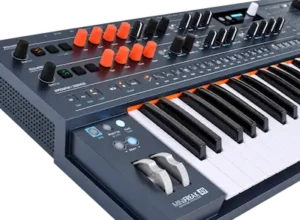 The Arturia MiniFreak 49 is a considered evolution of the original rather than a fundamental change to its synthesis architecture. Its full-size keyboard and revised control layout make it a more compelling option for producers who want to play, shape, and record sounds directly from hardware. Audio-rate filter FM and Voice Panning also expand the available sound-design options, although their practical value depends on the parts you need to create.
For existing MiniFreak owners, the decision is more specific. The six-voice architecture remains unchanged, while the 49-key model adds a larger keyboard, dedicated engine controls, an XYZ touch matrix, audio-rate Filter FM, and Voice Panning. The upgrade makes sense when these changes address a recurring limitation in your workflow—not simply because the 49-key model is newer.
Bottom line: Choose the MiniFreak 49 for its playing experience and hands-on sound design. Upgrade from the original only when its specific changes justify the cost. If your workflow is almost entirely software-based and your existing instruments already meet your needs, it is an optional creative tool rather than an essential studio purchase.
From Complex Synth Textures to a Mix That Holds Together
The MiniFreak 49 can produce dense harmonics through audio-rate Filter FM and expansive stereo textures with Voice Panning, but a sound that feels impressive on its own may compete with other elements or behave differently across playback systems. Adding another processor is not always the answer. The more useful next step is to hear how your actual mix responds to professional mastering. Upload up to 40 seconds and a real mastering engineer at AREFYEV STUDIO will prepare a free mastering demo, giving you a direct before-and-after comparison of your track’s tonal balance, dynamics, stereo presentation, and overall translation. Hear the difference on your own material and decide whether the result serves your production goals. Upload 40 Seconds and Get Your Free Mastering Demo →
Frequently Asked Questions
Does the Arturia MiniFreak 49 work as a MIDI controller for other synthesizers?
It provides MIDI connectivity for integration with external hardware and DAW-based setups. However, control mapping depends on the receiving instrument, MIDI configuration, and software support. Check the current manual before assuming that every physical control will map automatically to third-party plugins.
Can the MiniFreak 49 replace a collection of software synthesizers?
Not universally. Its dual-engine architecture, analog filters, modulation, and effects cover a broad range of sound-design tasks, but they do not reproduce every synthesis method or workflow available in a large software collection. Its main distinction is the combination of sound generation and hands-on physical control.
Is the MiniFreak 49 suitable for recording bass sounds?
Yes. Its digital engines and analog filters can produce bass tones ranging from relatively conventional sounds to heavily modulated textures. Evaluate each patch in the full mix, paying attention to low-frequency definition, upper-harmonic masking, and stereo behavior.
Does the MiniFreak 49 require a powerful computer?
The hardware synthesizer generates sound onboard, so its synthesis does not rely on the host computer’s CPU in the same way as a software instrument. MiniFreak V runs inside a DAW and uses host resources. CPU demand depends on the computer, software version, patch, and number of active instances.
Can MiniFreak V open patches created with the hardware MiniFreak?
The hardware and software are designed to work within the same MiniFreak ecosystem, but exact compatibility can depend on the patch, software version, and supported features. Check Arturia’s current documentation before relying on complete parameter or project interchange.
Is audio-rate filter FM useful for conventional pop and rock production?
Yes. It can add distinctive harmonics, a metallic edge, or a more complex attack to a sound. Subtle settings can work in conventional arrangements, while more aggressive modulation may be better suited to experimental layers, transitions, and effects.
Does Voice Panning make a MiniFreak 49 patch automatically mix-ready?
No. Voice Panning distributes voices across the stereo field, but the resulting image still needs to be evaluated in context. Check the patch in mono and alongside the other instruments to identify potential changes in tonal balance, masking, or stereo compatibility.
Is the MiniFreak 49 worth buying if I already own the original MiniFreak?
It may be worthwhile if the full-size keys, dedicated engine controls, XYZ touch matrix, Filter FM, or Voice Panning would improve your regular workflow. If the original already meets your needs, the upgrade is optional. Check Arturia’s current compatibility documentation to distinguish features available on the original hardware from those requiring MiniFreak 49 or its dedicated MiniFreak V mode.

Yurii Ariefiev approaches synthesizer reviews from an audio production perspective, considering how synthesis architecture and performance controls affect the character and practical use of an instrument. In evaluating the Arturia MiniFreak 49, the key considerations are the interaction between its digital engines and analog filter, the harmonic complexity of audio-rate filter FM, and how per-voice stereo positioning behaves in a musical context.
Enjoyed this review?
If you found it useful, you can support independent audio research with a coffee.
☕ Buy me a coffee