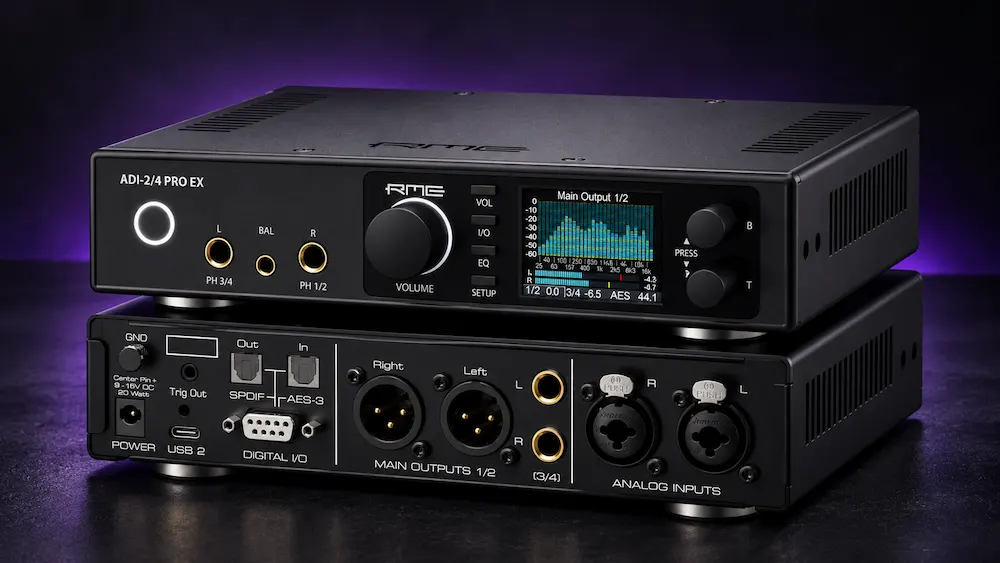
The RME ADI-2/4 Pro EX is a high-end A/D and D/A converter with dual headphone amplification, digital connectivity, and onboard monitoring DSP. At a listed US price of $2,999, its value depends on whether those functions solve specific monitoring, conversion, or routing requirements in your studio.
This is a specification-led review of the EX, not a report of hands-on listening tests or independent laboratory measurements. The documented hardware changes relative to the ADI-2/4 Pro SE can be assessed, but their audible significance cannot be established from component changes or manufacturer specifications alone.
The focus is on what the EX adds to a real studio signal path, which workflows benefit from those additions, and when keeping an existing converter or choosing a more specialized device is the more rational decision. Check current dealer availability before purchasing, as launch timing may vary by market.
Why Reference Conversion Still Matters in Modern Audio Production
 Modern DAWs can process audio with extremely low noise and distortion, even across complex chains of EQs, compressors, limiters, and other digital processors. The analog conversion and monitoring stages remain important, however, because engineers make decisions based on what they hear—not on the signal displayed inside the DAW. A monitoring chain that introduces frequency-response deviations, distortion, or other audible limitations can make it harder to judge the mix accurately.
A dedicated converter makes sense when an existing interface falls short in a specific area: analog I/O performance, digital connectivity, headphone amplification, or routing flexibility. In a mastering room, it can also provide the connection between the DAW, external analog processors, and reference monitors without requiring a separate device for every function.
The RME ADI-2/4 Pro EX is designed for this specialized role rather than conventional multichannel recording. It does not offer a bank of microphone preamps or a high input count. Instead, it combines stereo A/D and D/A conversion, multiple monitoring outputs, dual headphone amplification, digital connectivity, and onboard DSP in a single unit.
That range of functions is central to evaluating its $2,999 price. If the only requirement is clean stereo playback through powered monitors, a capable existing interface may already do the job. The EX becomes a more compelling proposition when its monitoring controls, headphone outputs, digital connections, and analog integration can replace separate hardware or simplify a demanding studio setup. Its value is therefore less about conversion specifications in isolation and more about how much of the monitoring and signal-routing system it can consolidate.
RME ADI-2/4 Pro EX: Core Hardware and Technical Changes
The RME ADI-2/4 Pro EX refines the architecture of the ADI-2/4 Pro SE rather than introducing a fundamentally different product. Its revised converter implementation uses the ESS ES9823Pro for analog-to-digital conversion and the ESS ES9039Q2M for digital-to-analog conversion. RME also specifies SteadyClock EX, clock adjustment in 0.1 ppm increments, and clock accuracy of ±1 ppm.
PCM playback and conversion are supported at sample rates up to 768 kHz. Digital connections include USB, AES, S/PDIF, and optical I/O with ADAT support. The analog section provides two inputs and four outputs, alongside two independent headphone amplifier paths. Headphone connections include a Pentaconn jack and dual 1/4-inch TRS sockets, supporting RME’s True Balanced Mode with compatible balanced headphones and the appropriate cable configuration.
The analog input section also matters when integrating external equipment. RME specifies input sensitivity extending down to -35 dBu and supported input-impedance options, while RIAA equalization is available in Line mode. These capabilities can be relevant when matching the converter to particular analog sources or supported vinyl-transfer workflows. The correct configuration still depends on the source level and signal path; these features should not be interpreted as evidence of inherently better audible performance.
The onboard DSP is a substantial part of the unit’s functionality. Features include independent five-band EQ for the left and right channels, crossfeed, Mid-Side processing, loudness compensation, stereo-width adjustment, selectable D/A filters, and RIAA equalization in Line mode. These tools are intended for monitoring and signal management rather than creative synthesis. Their practical value lies in allowing engineers to tailor monitoring conditions without adding separate processors to the signal path.
RME has also revised several hardware details. The EX features a lockable USB-C connection, DC protection for the headphone outputs, reverse-polarity and overvoltage protection, and a dedicated grounding terminal. These changes address connection security, electrical protection, and installation flexibility. They are useful engineering refinements, but they do not, by themselves, establish an audible improvement over the SE.
The distinction between revised conversion hardware and a new processing architecture matters when assessing the upgrade. The ADI-2/4 Pro EX retains the established platform’s core workflow while updating selected components and protection features. Whether it offers a meaningful advantage over the SE depends on measured performance, the specific requirements of the studio, and how much use an engineer makes of the integrated monitoring tools—not simply on the converter chip designations.
Make More Confident Mastering Decisions With a Clearer Reference
Accurate monitoring is only part of the equation. The final master also depends on tonal balance, controlled dynamics, stereo integrity, and how the mix translates across different playback systems. A professional mastering review can help assess these elements in your track without assuming that new hardware alone will solve them. Submit up to 40 seconds of your mix for a free mastering demo and hear how your material translates through our mastering process. Request Your Free Mastering Demo →
RME ADI-2/4 Pro EX vs. ADI-2/4 Pro SE: What Actually Changes?
The ADI-2/4 Pro EX is an evolution of the SE platform rather than a completely different type of converter. The most useful way to compare the two is to separate documented hardware changes from improvements that would require direct testing to verify.
| Area | ADI-2/4 Pro EX | Practical significance | Upgrade value |
|---|---|---|---|
| Converter implementation | ESS ES9823Pro A/D and ES9039Q2M D/A converters | Revised conversion hardware and analog implementation | Relevant on paper, but the magnitude of any performance improvement requires comparable independent measurements. |
| Clocking | SteadyClock EX with fine clock adjustment | Useful where precise digital clock configuration is part of the workflow | Most valuable when it addresses a specific synchronization requirement; it is not an automatic sound-quality upgrade. |
| USB connection | Lockable USB-C connection | Helps secure the physical connection in a fixed studio installation | A practical installation improvement rather than proof of better conversion quality. |
| Hardware protection | Revised headphone-output protection and additional electrical protection features | Addresses practical equipment and installation concerns | Potentially important for the intended setup, but not evidence of an audible improvement. |
| Analog input flexibility | Digital gain extends input sensitivity down to -35 dBu; selectable balanced input impedance of 94 kΩ or 47 kΩ; RIAA equalization available in Line mode | Provides more options for matching supported analog sources and configuring the input path | Relevant when these specific input options solve a source-matching or connection requirement; not proof of better sound by themselves. |
| Headphone source routing | ADAT channels 3/4 can be selected directly as the headphone source | Adds a digital monitoring option without requiring the same routing to be built around an external device | Potentially useful in studios that already use ADAT routing; less important in a simple USB stereo-monitoring setup. |
| Rack installation | Compatible with the RM19-III rackmount adapter | Provides an installation option for a fixed rack-based setup | A practical consideration for studios planning a rack installation, rather than an audio-performance upgrade. |
Upgrade verdict: The EX is easiest to justify when its revised hardware, connectivity, or protection features address a specific requirement. Owners of a well-functioning ADI-2/4 Pro SE should not assume that the newer converter implementation alone will produce an audible improvement. Without comparable independent measurements, the practical case for upgrading rests primarily on the features the studio will actually use.
A/D and D/A Performance: What the Specifications Actually Tell Us
RME specifies an A/D signal-to-noise ratio of 125 dB under AES17 measurement conditions at a +24 dBu reference level, rising to 127 dBA with A-weighting. The manufacturer’s published D/A signal-to-noise figure reaches 126 dBA under its specified reference conditions. RME also specifies output THD below -127 dB and THD+N of -119 dB at -1 dBFS. These are manufacturer specifications, and the stated measurement conditions matter when interpreting them.
The figures describe a conversion system engineered for very low noise and distortion. That performance is relevant when capturing signals from external analog processors, monitoring quiet details, and preserving signal integrity through a mastering chain. However, excellent specifications do not establish that the ADI-2/4 Pro EX sounds better than every competing converter, particularly when competing devices already operate at similarly low levels of noise and distortion.
Comparisons require consistent measurement conditions. Signal-to-noise ratio, total harmonic distortion, and THD+N can change with reference level, frequency, measurement bandwidth, weighting, analog gain setting, and load. A headline figure taken from one manufacturer’s specification sheet may therefore be unsuitable for direct comparison with a number measured under different conditions.
What Has—and Has Not—Been Independently Verified
Manufacturer data: RME publishes conversion and clocking specifications for the ADI-2/4 Pro EX. These establish the manufacturer’s stated performance, not an independent verification of it.
Independent measurements: The A/D and D/A figures cited from Sound On Sound were measured on the ADI-2/4 Pro SE, not the EX. Until comparable measurements of both models are available under the same conditions, the size of any performance improvement remains unverified.
For an existing SE owner, this limits the technical case for upgrading on conversion performance alone. The more defensible reasons to consider the EX are its documented hardware and routing features, provided they solve a requirement in the studio’s actual signal path.
SteadyClock EX: Accuracy Is Not the Same as Audible Improvement
RME specifies factory-calibrated internal clock accuracy of ±1 ppm. The internal sampling rate can also be fine-tuned across a ±50 ppm range in 0.1 ppm increments. This adjustment can help synchronize compatible digital equipment in setups where precise clock matching is required.
Clock accuracy and jitter are related to timing, but they are not interchangeable specifications. Accuracy describes how closely a clock’s average frequency matches its intended value. Jitter describes variations in the timing of individual clock edges. A low ppm figure alone does not establish low jitter, and neither specification proves that a converter will produce a wider stereo image, tighter bass, or sharper transients.
In a modern DAW-based studio, clocking is primarily a matter of reliable synchronization, correct digital configuration, and conversion performance under the conditions in which the equipment operates. When digital devices are synchronized properly, changing clock settings is not inherently a route to better-sounding mixes or masters. The relevant question is whether the system has a synchronization problem or a measurable performance limitation that clocking adjustments can address.
The EX’s fine clock adjustment is therefore best understood as a specialized calibration feature rather than a routine mastering control. It may be useful in specific digital setups, but for a typical stereo mastering room, synchronization reliability and the unit’s broader monitoring and connectivity features are likely to matter more than sub-ppm adjustment itself.
Onboard DSP: The Most Immediate Workflow Advantage
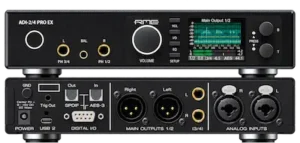 For many studios, the ADI-2/4 Pro EX’s onboard monitoring DSP offers a more tangible day-to-day benefit than incremental improvements in converter specifications. It provides several monitoring adjustments directly in the hardware, making it easier to switch listening conditions without building and maintaining separate DAW processing chains.
Independent left/right EQ allows engineers to adjust the two monitoring channels separately, compensate for known response differences, or investigate channel-dependent tonal issues. It is not a substitute for properly measured loudspeaker and room correction. Engineers should also keep track of the active EQ settings: otherwise, a tonal change introduced by the monitoring path can be mistaken for a problem in the mix itself.
Crossfeed sends a controlled, filtered portion of each stereo channel to the opposite headphone channel. This reduces the extreme left-right separation of conventional headphone playback and provides an alternative perspective on stereo placement. It can be useful during extended headphone sessions, but it does not reproduce the full acoustic behavior of loudspeakers in a calibrated room.
Mid-Side processing and stereo-width adjustment help engineers examine the relationship between center and side information. These functions provide another way to assess stereo balance and the consequences of changes to the stereo field. Engineers evaluating how width affects a mix can also explore the principles behind stereo width in mixing. The important distinction is between changing the monitoring perspective and applying processing that becomes part of the exported audio.
Loudness compensation can help maintain perceived tonal balance when listening at lower levels. This is useful for quiet monitoring, when bass and treble may seem less prominent than they do at higher playback levels. For critical judgments about the unmodified program signal, engineers need to understand when compensation is active and account for its effect.
Selectable D/A filters provide different digital reconstruction-filter responses. Their behavior depends on the selected filter and operating sample rate; they are not interchangeable with broad tonal-shaping controls, nor does selecting a different filter automatically improve sound quality. Any preference should be evaluated under controlled, repeatable listening conditions rather than assumed from the filter label.
RIAA equalization is useful for vinyl playback and transfer workflows where the supported Line-mode configuration is appropriate. It can reduce the need for a separate RIAA equalization stage, but it does not eliminate the importance of cartridge loading, turntable setup, grounding, gain structure, or the condition of the source record.
The broader advantage is operational: several monitoring functions are available in one device, making alternate listening checks easier to access and repeat. The DSP does not identify mix problems automatically, correct an unbalanced arrangement, or guarantee a better master. Its value lies in giving the engineer more controlled ways to evaluate the material before making a decision.
Using the ADI-2/4 Pro EX for Mixing and Mastering
In a mastering studio, the ADI-2/4 Pro EX makes the most sense as a combined conversion and monitoring hub. A DAW can route a stereo mix through external analog EQ or compression, capture the processed return, and feed the monitoring system through the same hardware. The two analog inputs and four analog outputs provide options for integrating compatible processors into a hybrid setup, although the exact routing depends on the studio’s signal-flow requirements.
The advantage is workflow consistency, not an automatic improvement in sound quality. External inserts still require careful gain staging, send-and-return level calibration, and accurate level matching when comparing processed and unprocessed signals. Latency and routing also need to be managed across the complete system, particularly when parallel paths or time-sensitive comparisons are involved. These checks are part of a broader workflow for preparing a mix for mastering, where the goal is to preserve the intended balance and avoid preventable technical problems before the final processing stage.
For mixing engineers, the dual headphone amplifier paths and onboard monitoring DSP make it easier to check a mix under different listening conditions. Engineers can compare headphone outputs, adjust monitoring EQ, and use crossfeed without relying exclusively on DAW-based monitoring plugins. This can make alternate checks more convenient, although the usefulness of each feature depends on the headphones, monitoring routine, and decisions being evaluated.
For producers working entirely in the box, the case is less compelling. A competent audio interface can already provide the conversion needed to monitor software instruments, buses, and finished mixes. If the existing system has no meaningful limitation in noise, distortion, headphone drive, or connectivity, the EX may offer little practical improvement. In that situation, investment in room acoustics, loudspeaker positioning, or monitoring equipment may address more consequential weaknesses in the production environment.
The EX should also not be mistaken for a conventional multichannel recording interface. Its two analog inputs do not replace a bank of microphone preamps for recording a full drum kit or a large ensemble. Studios that need numerous simultaneous microphone inputs, integrated preamps, and flexible multichannel recording should compare dedicated options such as the MOTU OctaLite, a compact eight-preamp recording interface.
Limitations: Where the ADI-2/4 Pro EX Can Be Overkill
The ADI-2/4 Pro EX’s biggest limitation for many buyers is not a clear technical deficiency but the diminishing return of upgrading a signal path that already performs well. High-end conversion can be valuable, but its price is harder to justify when the existing system is not imposing a meaningful constraint on the work.
In a mastering room built around a competent modern converter, room acoustics, loudspeaker placement, headphone response, and analog gain staging may have a greater influence on monitoring decisions than a further reduction in converter noise or distortion. Spending nearly $3,000 without identifying a specific shortcoming in the current setup risks paying for capabilities that will rarely be used. The case is stronger when the EX also replaces separate monitoring or headphone hardware, or solves a genuine connectivity or routing problem.
The maximum PCM sample rate of 768 kHz is another specification that deserves perspective. Most music production and mastering sessions operate at substantially lower sample rates, and support for an unusually high rate does not, by itself, establish superior conversion quality or improve a finished mix. More relevant considerations include measured performance at the rates actually used, compatibility with the rest of the system, and reliable operation in the intended workflow.
There is also a usability trade-off. The ADI-2 family offers extensive configuration and monitoring options, but a feature-rich, menu-driven interface can take longer to learn than a dedicated monitor controller with a small set of physical controls. Engineers who need only speaker-volume adjustment and a straightforward headphone output may find that much of the EX’s functionality adds complexity rather than value.
Finally, independent testing specific to the EX remains an important consideration when assessing claims of improved performance. The ADI-2/4 Pro SE’s strong published independent measurements provide useful context, but they are not a substitute for equivalent tests of the EX. Claims of lower distortion, better audible performance, reduced latency, or improved long-term reliability should be supported by direct evidence rather than inferred from revised components or manufacturer specifications alone.
RME ADI-2/4 Pro EX vs. the Alternatives
Choosing an alternative to the RME ADI-2/4 Pro EX starts with identifying the job the hardware needs to do. A mastering converter, a headphone monitoring system, and a multichannel recording interface solve overlapping but different problems. Converter specifications alone are not enough to establish which product offers the better fit; connectivity, monitoring controls, routing, and the existing studio setup matter just as much.
| Product | Main Strength | Best Fit | Why Choose It Instead? |
|---|---|---|---|
| RME ADI-2/4 Pro EX | Stereo conversion, dual headphone amplification, monitoring DSP, and digital connectivity | Mastering and hybrid studios | Choose it when its integrated monitoring and routing features can replace several separate devices. |
| RME ADI-2/4 Pro SE | Extensive monitoring functions and high-performance conversion | Studios comparing the previous generation with the EX | Consider it when a lower purchase price matters more than the EX’s revised hardware and additional protection features. |
| Lynx Hilo 2 | High-end conversion and a measurement-oriented monitoring workflow | Conversion-focused studios | Evaluate it if its metering, interface, and available I/O better match the studio’s requirements. |
| RME ADI-2 Pro FS R Black Edition | RME conversion and headphone monitoring in an earlier product generation | Engineers who do not require the EX’s specific hardware updates | It may offer better value if available at a substantial discount and its feature set meets the studio’s needs. |
| Universal Audio Apollo x16 | Multichannel analog I/O and an interface-centered recording workflow | Recording facilities and larger production studios | Choose it when multichannel connectivity and recording infrastructure are more important than a compact stereo monitoring hub. |
The Lynx Hilo 2 is worth evaluating when conversion performance, metering, and the monitoring workflow are central to the purchase. The ADI-2/4 Pro EX takes a different approach by combining conversion with dual headphone amplification, configurable DSP, and extensive digital connectivity. Which is the better choice depends on the required connections and functions; a meaningful performance comparison also requires measurements taken under comparable conditions.
The ADI-2/4 Pro SE is the most direct alternative because it already provides much of the same core functionality. If the SE is available at a significant discount, the savings may be more valuable than the EX’s hardware refinements for a studio that does not need its specific updates. The key question is whether the EX’s changes address an actual requirement. Without matched independent measurements of both models, the size of any conversion-performance improvement should remain an open question.
The Universal Audio Apollo x16 belongs in the comparison for a different reason. It is designed around a broader multichannel studio workflow, not simply as a substitute for the EX’s combination of stereo conversion and monitoring controls. Studios choosing between them should first establish how many analog inputs and outputs they need, whether microphone preamps are required, and how the device will integrate with their existing recording system.
Ultimately, the most sensible alternative is the one that meets the studio’s actual requirements without charging for unused capabilities. The EX is strongest when its conversion, monitoring DSP, headphone system, and connectivity are all useful parts of the same workflow. For studios integrating external analog processors, the wider distinction between analog and digital mastering also helps frame the role of hardware in the production chain. If only one of the EX’s functions matters, a more specialized or less expensive device may be the better investment.
Price and Value: Who Gets the Best Return?
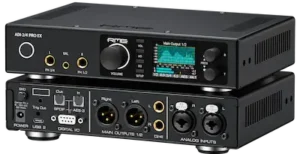 At an approximate US list price of $2,999, the RME ADI-2/4 Pro EX is a significant investment. Its value depends less on the number of features listed on the specification sheet than on how many of them solve real problems in the studio’s existing signal path.
For a mastering facility that needs high-performance conversion, two headphone amplification paths, broad digital connectivity, and integrated monitoring DSP, the EX can consolidate functions that might otherwise require several devices. That integration may justify the price when it simplifies routing and reduces equipment requirements. For a home studio with a reliable interface, suitable headphones, and a well-calibrated monitoring system, the additional expenditure is more difficult to defend.
The previous ADI-2/4 Pro SE may offer better value if it is available at a meaningful discount and its condition, warranty, and support arrangements are acceptable. Another option is to retain a capable interface and add a dedicated headphone amplifier, particularly if headphone output capability is the only real limitation. The more specialized solution is not necessarily the more expensive one.
Before buying, identify the problem the EX is expected to solve. If the issue is analog connectivity, map the required inputs, outputs, and signal routing. If it is headphone performance, compare the amplifier’s capabilities with the impedance, sensitivity, and connection requirements of the actual headphones. If conversion quality is the concern, look for independent measurements of the relevant models under comparable conditions. And if the goal is to make more reliable mastering decisions, assess room acoustics, loudspeaker placement, and monitoring calibration before assuming that a converter upgrade will deliver the greatest improvement.
Buying decision: the EX is easiest to justify when its conversion, headphone amplification, monitoring DSP, and digital connectivity solve several requirements in the same setup. If the only need is transparent stereo playback, basic monitor control, or a headphone output, compare the cost of a more focused solution before committing to the full feature set.
Who Should Buy the RME ADI-2/4 Pro EX?
Mastering and hybrid studios: the EX makes the strongest case when a studio needs high-performance stereo conversion, multiple monitoring functions, dual headphone amplification, and digital connectivity in one unit. It is especially worth evaluating when those capabilities can simplify an existing analog-digital signal path.
Mixing engineers: consider it if your current system has a defined limitation in headphone monitoring, analog integration, or digital routing. If your interface already meets those needs, the EX may offer convenience rather than a material improvement in results.
Existing ADI-2/4 Pro SE owners: upgrade only if the EX’s documented hardware changes or supported configurations address a specific requirement. The available SE measurements do not establish the size of any conversion-performance improvement in the EX.
In-the-box producers and smaller studios: if you mainly need clean stereo monitoring, first evaluate your existing interface, room acoustics, loudspeaker setup, and headphones. The EX is difficult to justify when most of its monitoring and connectivity features would remain unused.
Multichannel recording facilities: the EX is not a substitute for an interface with numerous microphone preamps and simultaneous recording inputs. If that is the primary requirement, choose a device designed around multichannel recording rather than treating the EX as a general-purpose interface.
Editorial Assessment
This assessment is based on the manufacturer’s published specifications, available documentation, and the ADI-2/4 Pro EX’s intended studio applications. It is not a hands-on sound-quality rating or a substitute for independent measurements.
| Category | Assessment | Reason |
|---|---|---|
| Conversion performance | Strong specifications | Published figures indicate a high-performance design, but independent measurements of the EX are needed for direct verification. |
| Monitoring DSP | Major strength | Channel EQ, crossfeed, loudness compensation, and other monitoring functions provide substantial flexibility in one unit. |
| Connectivity and analog integration | Highly capable for stereo workflows | Digital connectivity and multiple analog outputs suit hybrid setups, while the limited analog input count restricts multichannel recording applications. |
| Headphone monitoring | Strong feature set | Dual headphone amplification and supported balanced operation offer useful options for reference monitoring. |
| Hardware refinements | Practical benefits | Connection security and electrical protection address installation and equipment concerns, rather than establishing an audible advantage. |
| Value for money | Setup-dependent | The price is easier to justify when several integrated functions replace separate devices or solve specific workflow requirements. |
Overall assessment: The ADI-2/4 Pro EX is a feature-rich reference converter and monitoring hub for studios that can make practical use of its conversion, headphone, DSP, and digital connectivity options. Its strongest case is functional integration, not a proven audible improvement over the ADI-2/4 Pro SE. Buyers should weigh its documented capabilities against their existing setup and the features they will actually use.
Verdict: A Strong Reference Platform, Not an Automatic Upgrade
The RME ADI-2/4 Pro EX combines stereo A/D and D/A conversion, dual headphone amplification, monitoring DSP, and extensive digital connectivity in one compact unit. Its strongest argument is the integration of these functions, particularly for mastering and hybrid studios that would otherwise need separate monitoring or routing hardware.
The ADI-2/4 Pro EX is easiest to justify when its monitoring DSP, headphone outputs, analog inputs, and digital routing address several requirements in the same studio. Its specifications support a strong feature-based case, but they do not establish an audible improvement over the ADI-2/4 Pro SE.
Bottom line: choose the EX for the functions your workflow will actually use, not for the assumption that newer converter chips automatically produce better masters. If your existing converter already meets your needs, identify a specific limitation before spending $2,999 on an upgrade.
Your Converter Is Only One Part of the Mastering Chain
As this review shows, even a high-end converter and an advanced monitoring system cannot guarantee that a mix will translate well across playback systems. Reliable mastering decisions still depend on tonal balance, dynamics, stereo integrity, and how the finished track holds up beyond your own studio. Instead of assuming that another hardware upgrade or processing stage is the answer, hear what a dedicated mastering approach can change in your own material. Upload up to 40 seconds of your mix for a free mastering demo prepared by a real mastering engineer, then compare the original with the mastered version to evaluate the differences for yourself. Upload Your Mix and Get Your Free Mastering Demo →
Frequently Asked Questions
Does the RME ADI-2/4 Pro EX work with Pro Tools, Logic Pro, and Ableton Live?
It can be used with DAWs that support the device through the relevant operating-system audio interface and driver configuration. Compatibility depends on the computer, operating system, and connection method, so check RME’s current driver documentation before purchasing, especially if the studio relies on a specific system configuration.
Can the ADI-2/4 Pro EX replace a full recording interface?
Not for most multichannel recording workflows. The unit provides two analog input channels and four analog output channels, but it is not designed to replace an interface with multiple microphone preamps and numerous simultaneous recording inputs.
Does the ADI-2/4 Pro EX improve audio quality when mastering?
It offers high specified conversion performance and a flexible monitoring system. Whether it produces a meaningful improvement depends on the existing converter, monitoring environment, and workflow. Replacing a competent converter does not automatically result in a better master.
Is the ADI-2/4 Pro EX better than the ADI-2/4 Pro SE?
The EX introduces revised converter hardware, SteadyClock EX, and additional hardware refinements. The SE already has strong independently measured performance, however, and the magnitude of any improvement in the EX cannot be established without comparable independent measurements of both models.
Can the ADI-2/4 Pro EX drive balanced headphones?
It supports RME’s True Balanced Mode with compatible four-conductor headphones using the Pentaconn connection or the specified dual 1/4-inch TRS arrangement. Check the headphone’s wiring and the required cable configuration before connecting it; a connector’s shape alone does not establish compatibility.
Should an existing mastering studio upgrade to the EX?
Consider upgrading if its revised hardware, protection features, digital connectivity, or monitoring functions address a specific need. If the existing converter already performs reliably and the EX would not materially change the workflow, the published specifications alone are not a strong reason to spend the money.

Yurii Ariefiev evaluates reference converters such as the RME ADI-2/4 Pro EX through the perspective of signal integrity, monitoring accuracy, and practical studio integration. For high-end A/D and D/A hardware, meaningful assessment requires distinguishing published specifications from independently verified performance and considering whether conversion, headphone monitoring, and digital connectivity address genuine technical needs in a professional setup.
Enjoyed this review?
If you found it useful, you can support independent audio research with a coffee.
☕ Buy me a coffee