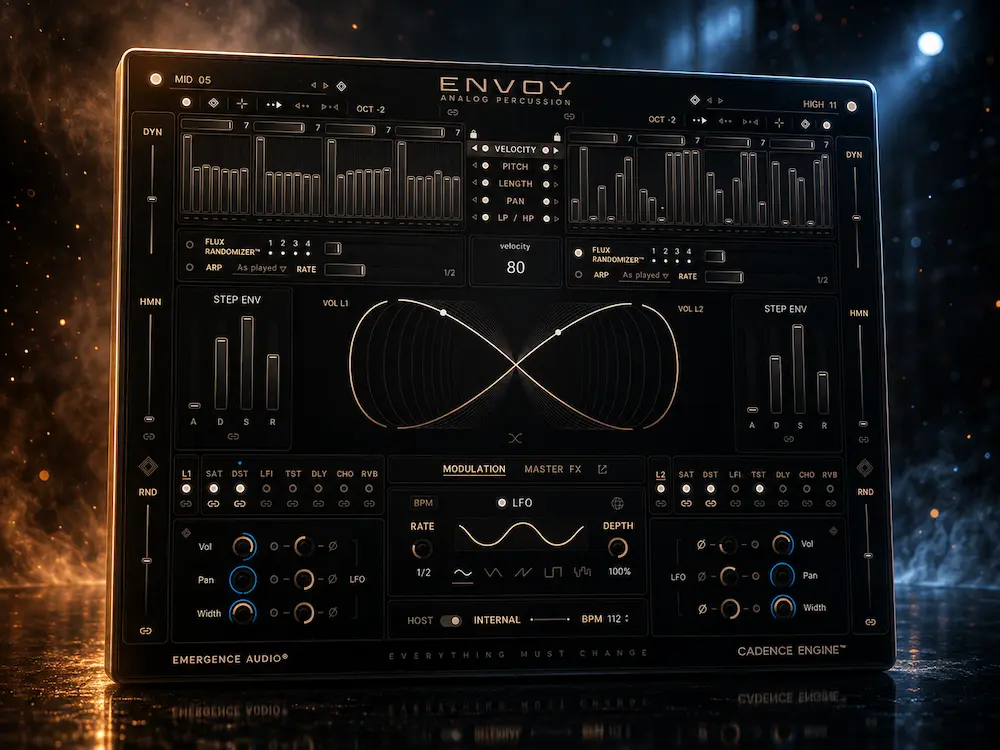
Programmed percussion often becomes predictable long before the arrangement does. A fixed sample, velocity pattern, note length, and subdivision can work for a few bars, then start revealing the loop underneath the music. Emergence Audio Envoy tackles that problem at the instrument level, combining two independently sequenced layers with per-step control and Flux Randomizer so variation does not have to be built entirely into the MIDI.
Envoy is the first instrument built on Emergence Audio’s Cadence Engine and runs in the free Kontakt Player 8.1 or later. Its architecture combines 600 analog percussion sources, 6,000 samples, ten round robins per source, 273 presets, independent layer sequencing, and separate effects processing for each layer. The more useful question is not how much content is included, but how much repetitive programming the engine can realistically remove from a production workflow.
That puts Envoy in a very specific category. It is not a general-purpose percussion library or a substitute for a realistic acoustic drum instrument. Its strength is synthetic, evolving percussion: rhythmic material that can shift in velocity, pitch, length, filtering, and pattern behavior while retaining a deliberate musical structure. For electronic production, sound design, and hybrid scoring, that makes the instrument considerably more interesting than another collection of static Kontakt one-shots.
Emergence Audio Envoy at a Glance
| Feature | Envoy |
|---|---|
| Instrument Type | Analog synthetic percussion and rhythmic sound-design instrument |
| Engine | Cadence Engine |
| Kontakt Requirement | Free Kontakt Player 8.1 or later |
| Source Material | 600 analog percussion sources |
| Total Samples | 6,000 |
| Round Robins | 10 per source |
| Presets | 273 |
| Sequencing | Two independent 32-step layers |
| Variation | Flux Randomizer |
| Per-Step Controls | Velocity, pitch, pan, length and filtering |
| Timing | Independent layer clocks plus Master LFO |
| Keyboard Workflows | Omni, Zoned, Split Omni and Split Zoned |
| Formats | VST3, AU and AAX via Kontakt |
| NKS | Yes |
| Library Size | Approximately 2.48 GB |
| Introductory Price | $149 |
| Regular Price | $199 |
In this Envoy review:
Why Envoy is different ·
Cadence Engine ·
Dual-layer workflow ·
Flux Randomizer ·
Sound quality ·
Mixing and mastering ·
Alternatives ·
Price and value ·
Verdict ·
FAQ
Why Programmed Percussion Gets Stale — and Where Envoy Fits
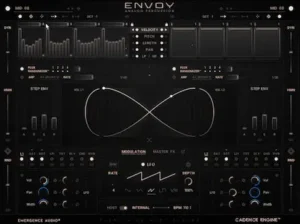
 Emergence Audio Envoy is a specialized analog percussion instrument for Kontakt Player built around Emergence Audio’s new Cadence Engine. It combines 600 analog percussion sources, 6,000 samples, two independently sequenced layers, Flux Randomizer, per-step control, and four keyboard workflows to create percussion that can evolve instead of repeating as a fixed loop.
In practical production terms, Envoy is not a replacement for an acoustic drum library or a conventional percussion sampler. Its strongest use case is evolving synthetic percussion, cinematic rhythm, electronic sound design, and hybrid scoring where static MIDI patterns become repetitive and manual variation takes too much time.
Our verdict: Envoy is a strong specialist instrument rather than a general-purpose percussion solution. The Cadence Engine and Flux Randomizer are genuinely useful for creating controlled rhythmic variation, while the analog source material gives the instrument a distinctive dark, textural character. The main limitations are its specialized sound palette, learning curve, lack of user-sample import, and the fact that its value depends heavily on how often you actually need evolving percussion.
For producers and composers who regularly work with cinematic, electronic, experimental, or hybrid percussion, Envoy is one of the more distinctive Kontakt instruments released in 2026. For conventional acoustic drums or straightforward one-shot percussion, it is much harder to justify.
Cadence Engine: A Workflow Architecture, Not a New DSP Paradigm
Cadence Engine is the defining idea behind Envoy, but its significance is architectural rather than algorithmic. The system does not introduce a new form of synthesis or physical modeling. Its value comes from combining sequencing, parameter variation, layered playback, independent timing, and per-layer processing into a single percussion instrument.
None of the underlying techniques is new. Step sequencing, round-robin sampling, parameter randomization, and layered effects have been standard production tools for years. What Envoy does differently is make them interact at the instrument level. Each of its two layers can run a different sequence and rate, respond to its own step parameters, and use its own effects chain before the layers are combined.
That integration matters in practice. Reproducing the same behavior with conventional tools would typically mean managing multiple sampler layers, separate MIDI data, automation, and additional processing. Envoy puts those relationships inside one patch, so rhythmic variation can be designed as part of the sound rather than assembled later in the DAW.
Cadence Engine is not a new synthesis paradigm. Its value is much simpler: it puts sequencing, variation, timing, layering, and processing into one percussion instrument. The interesting part is not any individual technique, but how those controls interact without requiring the producer to build the same structure from several sampler instances and automation lanes.
Once the percussion is doing its job at the source, the next question is how that additional rhythmic density behaves inside the finished mix. That is where the difference between an interesting production element and a mix-ready arrangement becomes audible.
Dual-Layer Architecture: Where Envoy Becomes Useful in a Mix
The two-layer architecture is more consequential than Envoy’s raw sample count. It lets the producer separate the transient and tonal roles of a percussion sound without building the same structure from multiple instruments in the DAW.
One layer can handle a short, sharply filtered attack while the other carries a longer body, resonance, or texture. Because each layer has its own sequence and effects chain, they do not have to share the same rhythm, envelope behavior, or processing. A transient can remain tightly defined while the longer component moves at a slower rate or follows a different pattern.
That separation has a direct mixing benefit. Instead of adding another static percussion loop to an already dense arrangement, the producer can build a part whose attack supplies rhythmic definition while its tonal component occupies a different rhythmic and spectral role. This can reduce the need for corrective EQ, gating, or automation simply to keep a layered percussion sound from masking the kick, bass, or other transient-heavy elements.
The advantage is therefore upstream of mixing. Envoy gives the producer more control over the source arrangement, which is usually a better solution than trying to repair a static or overly dense percussion part after it has already reached the mix.
Four Envoy Keyboard Workflows: Omni, Zoned, Split Omni and Split Zoned
Envoy includes four keyboard workflows that change how its two layers and source ranges are accessed from a MIDI keyboard. The underlying Cadence Engine remains the same, but the mapping changes the way the instrument can be performed and controlled.
| Workflow | How It Works | Best Use |
|---|---|---|
| Omni | Both layers can be played across the keyboard. | Fast layered sound creation and composite percussion parts. |
| Zoned | Source ranges are distributed across different keyboard zones. | Kit-style performance and direct access to different source ranges. |
| Split Omni | The two layers are assigned to separate keyboard regions. | Playing or controlling each layer independently. |
| Split Zoned | Both layers are split, with their source ranges organized across the keyboard. | Detailed performance control and complex rhythmic layering. |
The practical advantage is that Envoy is not locked into a single performance model. Omni is the fastest route to a composite sound, while the split layouts make more sense when the two layers need to behave as separate musical elements. Zoned workflows are useful when source selection needs to happen from the keyboard rather than by repeatedly returning to the interface.
For production, this makes Envoy more flexible than a simple step sequencer. The same engine can function as a playable percussion instrument, a layered sound-design tool, or a more granular source-selection system depending on the chosen mapping.
Workflow friction: Envoy’s flexibility comes with a real learning cost. The four keyboard layouts, two independent layers, multiple timing relationships, per-step controls, Flux blocks, modulation, and per-layer effects create a large number of possible states. That is powerful, but it also means the instrument is less immediate than a conventional one-shot percussion library. The first few sessions are better spent learning how the engine is organized than trying to exploit every control at once.
Flux Randomizer: Controlled Variation, Not Humanization
Flux Randomizer is arguably Envoy’s most useful production feature because it addresses the point where programmed percussion usually starts to sound repetitive: after the basic pattern already works. Instead of replacing the sequence with an entirely different pattern, Flux can introduce bounded variation at different amounts, sections, and parameter levels while preserving the underlying rhythmic idea.
That distinction is important. A producer can keep the main pattern stable while allowing selected blocks to change in velocity, pitch, note length, or filtering. A relatively controlled first section can therefore lead into a more active variation later in the phrase without requiring a second MIDI performance to be programmed manually.
This is more practical than unrestricted randomization because the musical structure remains under the producer’s control. The randomization is applied within defined parameters rather than turning the entire performance into an unpredictable sequence of unrelated events.
Flux should not, however, be described as humanization. A real percussionist does not vary every hit independently according to random values; timing, dynamics, accents, and articulation respond to phrasing and the surrounding performance. Envoy does not model those relationships. It creates controlled instability inside a programmed pattern.
For electronic production and sound design, that distinction is largely irrelevant in a good way. The objective is often not to imitate a drummer. It is to prevent a synthetic percussion part from behaving like the same four-bar loop every time it comes around.
Meter, Poly and Three Independent Clocks
One of Envoy’s more significant production features is the ability to let its two sequenced layers move at different rates. Each layer has its own sequencer timing, while the Master LFO provides a third independent timing source. Rates can range from four bars down to 1/128, creating rhythmic relationships that go well beyond a conventional 32-step loop.
One practical detail is easy to miss: some Envoy presets can use the instrument’s internal clock rather than immediately following the DAW’s host tempo. If a preset does not appear to sit correctly against the project grid, the clock source should be checked before assuming that the sequencer timing itself is wrong.
Meter keeps the two layers within a shared rhythmic relationship, while Poly allows them to move through different cycle lengths and create longer rhythmic relationships before the pattern repeats.
This matters more musically than simply having two sequencers. A fast transient pattern can continue underneath a slower tonal layer, while the third modulation clock changes the broader movement of the sound. The result can produce evolving polyrhythmic material without requiring separate MIDI clips, multiple instruments, or manually constructed automation.
For producers working with tempo-synced percussion, this timing architecture is one of Envoy’s strongest reasons to exist. The instrument is not simply generating different sounds from the same loop; it can change the temporal relationship between the layers while keeping the underlying production structure intact.
How Emergence Audio Envoy Actually Sounds
Envoy has a deliberately recognizable sonic profile rather than a neutral percussion-library character. The sources tend toward dark synthetic tones, gritty transients, resonant bodies, noise components, and pitched electronic material. The result is closer to cinematic sound design and electronic rhythm than to conventional drum programming.
What makes the library more useful than a collection of isolated one-shots is the amount of information inside some of the sources. A short attack can contain a longer resonant tail, pitch movement, noise, or internal modulation that becomes audible as the step length opens. This means the same source can behave like a tight percussion hit in one context and a more sustained rhythmic texture in another.
The low end deserves particular attention. Some sources have enough pitch and body to function as low-frequency musical material rather than merely supporting a kick or percussion layer. That expands Envoy’s role into territory normally associated with cinematic bass textures and pitched electronic rhythm.
The main mixing advantage is density control. Envoy can produce sounds that feel substantial without necessarily requiring a large amount of corrective processing. The two-layer structure also makes it possible to keep a short transient element separate from a longer tonal component, which gives the producer more control over what actually occupies the mix.
The limitation is equally clear: Envoy has a strong personality. If the production requires neutral percussion that can disappear into almost any arrangement, this is not the instrument’s natural territory.
Does Envoy Replace a Drum Sampler?
No. Envoy occupies a narrower but more distinctive role.
A conventional drum sampler is built around playable instruments, articulations, realistic performances, or large collections of individual drum sounds. Envoy is built around evolving synthetic percussion and the ability to reshape rhythmic behavior inside the instrument.
That makes the comparison less about which library has more sounds and more about what the production needs. If the track needs a realistic snare, acoustic toms, hand percussion, or a conventional drum kit, Envoy is the wrong tool. If the track needs a synthetic percussion part that can change its rhythmic and tonal behavior across an arrangement, Envoy offers a workflow that a conventional drum sampler does not prioritize.
For producers who already own extensive Kontakt percussion libraries, this distinction is the main reason to consider Envoy: it adds a different production method rather than simply another set of samples.
Hands-On Testing: What Matters After the Feature List
After working with Envoy beyond the specification sheet, the most important difference is how quickly the instrument moves from “percussion library” to “rhythmic sound-design tool.” The useful results do not come from simply loading a source and triggering it repeatedly. They appear when the two layers are given different rhythmic roles and Flux is used selectively rather than pushed to maximum variation.
One practical observation is that Envoy rewards restraint. With both layers moving aggressively, the result can become interesting very quickly but can also lose a clear rhythmic hierarchy. Keeping one layer comparatively stable while allowing the other to move produces a more usable relationship in a dense arrangement.
The same applies to the filter and Length controls. Shorter settings emphasize the transient information and make the instrument behave more like percussion, while longer values expose more of the internal texture contained in the analog source. That makes the same source capable of occupying very different roles without replacing it with another sample.
The three-clock architecture is also more useful in a musical context than the specification suggests. A fast layer can establish the rhythmic grid while a slower layer introduces movement over a longer cycle. The effect is most convincing when the layers are not both competing for the same frequency and rhythmic space.
The main friction point is the amount of information available at once. Envoy is not difficult because any individual control is particularly obscure; it is difficult because the relationship between layers, blocks, timing, modulation, source selection, and effects takes some time to internalize. Presets are therefore useful not only as starting points but as examples of how the engine expects to be used.
From an engineering perspective, that is the distinction that matters: Envoy does not simply provide more percussion sounds. It changes how variation can be designed before the signal ever reaches the mix.
Envoy’s Sound Palette: Synthetic Percussion, Not Acoustic Realism
Envoy’s source material makes its intended role clear. The library contains 600 percussion sources created from analog percussion synthesizers and Eurorack hardware, with ten round robins per source and 6,000 samples in total.
This is not a conventional acoustic percussion collection. The useful range is synthetic hits, metallic transients, resonant textures, noise-based percussion, unstable analog tones, and longer decays that can function as both rhythmic material and sound-design elements.
That makes Envoy a better fit for electronic production, hybrid scoring, experimental arrangements, and cinematic sound design than for realistic shaker, conga, tambourine, or hand-percussion performances. It can provide a percussion part with enough tonal and rhythmic movement to remain interesting as the arrangement develops, but it is not intended to reproduce the behavior of a recorded percussionist.
The analog provenance also needs to be separated from analog modeling. Envoy uses recordings of analog hardware as its source material; it is not a virtual circuit model of those instruments. The character comes from the captured hardware, sampling, round-robin playback, sequencing, and subsequent processing rather than from a new analog-emulation algorithm.
Where Envoy Actually Saves Production Time
 Envoy’s clearest workflow advantage appears when a percussion pattern already works but becomes stale after repeated sections. The conventional fix is to create alternate MIDI, vary velocities and note lengths, move individual hits, automate filters, layer additional sources, and build different fills for later phrases. None of that is difficult; doing it consistently across a full arrangement is where the time goes.
Envoy lets the producer establish the core pattern once and generate controlled changes from the instrument itself. The musical decisions still come from the user, but fewer variations have to be written into separate MIDI clips or automation lanes.
That is a genuine workflow improvement, not simply a convenience feature. The value is proportional to how often a project needs evolving synthetic percussion. For a conventional drum part, the time savings are negligible; for rhythmic sound design, they can be substantial. The same production-first principle applies beyond percussion: our VG Oboe review examines how real-time layer control and expressive MIDI performance can reduce the amount of manual editing required to make a sampled instrument behave musically.
There is also a consolidation benefit. A sound built from two independently sequenced layers can otherwise require multiple sampler instances, separate MIDI data, and additional processing. Envoy keeps those relationships inside one patch and provides independent effects for each layer, along with a master effects section that includes saturation, compression, EQ, reverb, and limiting.
That internal processing is useful for building and auditioning sounds quickly, but it should not be confused with a replacement for a professional mixing chain. Once the part needs precise EQ, dynamics, automation, or routing in a finished mix, moving the layers into the DAW remains the more flexible approach.
Envoy in Mixing and Mastering: Useful Upstream, Limited Downstream
Envoy has a meaningful role in music production and mixing, but almost none in mastering. From an engineering perspective, its value comes from shaping the source material before it reaches the mix: controlling transient density, rhythmic repetition, tonal movement, and the relationship between short attacks and longer textures.
For a mixing engineer, the consequence is straightforward. A static percussion loop can create problems downstream because the engineer then has to use level automation, filtering, muting, or additional processing to create movement that ideally should exist in the source arrangement. Envoy can move some of that decision-making upstream, where it is easier to control musically.
For a producer who also mixes, controlled variation can reduce the need for corrective automation later. A percussion part that changes subtly between sections is less likely to behave like a static loop that has to be manually opened up with level, filter, or mute automation. The benefit is not that Envoy produces a better mix automatically; it gives the mix a more useful source to work with.
The two-layer architecture is particularly relevant in dense arrangements. A short transient layer can establish rhythmic definition while a longer tonal layer follows a different pattern and occupies a different part of the arrangement. That separation gives the producer more control over temporal density and can help keep percussion from competing unnecessarily with vocals, kick, bass, or other transient-heavy elements. In electronic production, that upstream control becomes especially important when the finished track has to retain punch and momentum after release-level processing, which is one reason EDM mastering requires more than simply making the mix louder.
For mastering, the equation changes completely. Envoy does not address loudness, dynamics, tonal balance, stereo control, translation, or any other mastering-specific problem. Its only contribution to the final master is indirect: better-controlled percussion at the production stage can make the mix easier to balance before mastering begins.
For studio professionals, the buying decision is therefore straightforward. Envoy is a music production and sound-design instrument with secondary value for mixing, not a mixing or mastering utility. A mastering engineer who does not produce has little practical reason to own it.
Envoy CPU, RAM, and Session Performance
Envoy requires Kontakt or the free Kontakt Player 8.1 or later and is available through Kontakt as VST3, AU, and AAX. Emergence Audio lists an installed library size of approximately 2.48 GB and recommends 8–16 GB of system RAM. The instrument is supported on 64-bit macOS and Windows systems that meet the current Kontakt requirements.
Those specifications establish compatibility, not actual session performance. There is currently no reliable independent benchmark showing Envoy’s CPU load at a defined voice count, average RAM consumption per instance, loading time, render performance, or practical maximum instance count.
That makes it premature to label Envoy either lightweight or resource-heavy. KVR currently lists the instrument as version 1.0 with no user reviews, so there is not yet enough real-world data to establish a meaningful performance profile across different DAWs and hardware configurations.
For a Kontakt instrument, the more useful variables in a large session are polyphony, simultaneous instances, sample preload behavior, internal effects, and the number of active voices. A 2.48 GB library does not translate directly into 2.48 GB of RAM usage, and the actual footprint will depend on Kontakt’s memory management and the way the instrument is used in the project.
For now, Envoy’s system requirements look reasonable, but any precise claim about CPU efficiency or large-session performance should wait for controlled testing rather than being inferred from the library size or manufacturer’s specifications.
Where Envoy Fits in a Professional Production Workflow
Envoy is highly specialized, so its usefulness depends more on the production brief than on the user’s job title. It is strongest when percussion needs to function as an evolving sound-design element rather than as a realistic performance.
| Application | Production Fit | Practical Use |
|---|---|---|
| Electronic music | Excellent | Build evolving percussion layers, fills, transitions, and rhythmic textures without programming every variation manually. |
| Sound design | Excellent | Combine independent layers, parameter modulation, and controlled variation to create complex rhythmic textures. |
| Film and TV scoring | Excellent | Useful for hybrid percussion, tension cues, transitions, pulses, and rhythmic motifs that need to develop over time. |
| Game audio | Very good | Useful for generating source material and evolving rhythmic beds, although Envoy itself is not a game-audio middleware instrument. |
| EDM | Very good | Well suited to fills, transitions, secondary percussion, and layered rhythmic elements that need movement across sections. That matters particularly in EDM, where percussion has to retain impact and momentum as the arrangement builds. |
| Hip-hop | Good | Most useful as a secondary percussion or texture layer rather than as the foundation of a conventional drum kit. |
| Pop | Moderate | Can add unusual texture and movement, but its synthetic character makes it a specialized rather than general-purpose percussion choice. |
| Rock | Limited | Little advantage for conventional rock arrangements where realistic acoustic drums and percussion are the primary requirement. |
| Mixing and production | Good | Useful for engineers who also create or edit percussion, particularly when source-level variation is preferable to corrective mix automation. |
Emergence Audio Envoy vs. Other Kontakt Percussion Instruments
Emergence Audio Envoy is easier to evaluate against other Kontakt percussion instruments when the comparison is based on workflow rather than sample count. Envoy is designed around evolving synthetic percussion and controlled rhythmic variation, while conventional Kontakt percussion libraries generally prioritize realistic performances, playable articulations, or pre-programmed patterns.
| Instrument | Core Approach | Variation | Best Fit |
|---|---|---|---|
| Emergence Audio Envoy | Synthetic percussion and rhythmic sound design | Independent sequenced layers, per-step parameters, Flux Randomizer | Electronic, cinematic, experimental, and hybrid production |
| Native Instruments Session Percussionist | Performed percussion and pattern-based production | Pre-programmed performance patterns and editable sequences | Fast, realistic percussion arrangements |
| Big Fish Audio Street Percussion | Sampled percussion and rhythmic phrases | Phrase and step-based sequencing | Cinematic and rhythmic production |
| Traditional Kontakt percussion libraries | Playable sampled instruments | Articulations, velocity layers, round robins and MIDI editing | Realistic or conventional percussion parts |
The choice comes down to the production task. If the goal is realistic percussion or a library of immediately playable performances, a conventional Kontakt instrument is usually the better choice. If the goal is to create a rhythmic part that can change its behavior across an arrangement without building every variation manually, Envoy has a more specialized advantage.
That also explains why Envoy should not be judged by sample count alone. Its value lies in the sequencing architecture: two independent layers, separate timing relationships, per-step control, and controlled variation. The buyer is paying for a different production workflow, not simply for another collection of percussion samples.
Is Emergence Audio Envoy Worth the Price?
Envoy is currently priced at $149 during its introductory period, with a regular price of $199. The price is reasonable for the instrument’s target user, but its value depends heavily on whether the Cadence Engine workflow solves a problem that existing tools do not.
At $149, the combination of 600 source sounds, 6,000 samples, independent sequenced layers, per-step control, Flux Randomizer, and integrated effects makes a strong case for producers who regularly build evolving electronic or cinematic percussion. The purchase is not justified by sample quantity alone; it is justified by having those sounds and variation tools in one dedicated environment.
At the regular $199 price, the decision becomes more selective. Producers who already own several Kontakt percussion libraries, drum samplers, sequencers, and MIDI-generation tools may already have most of the individual capabilities Envoy combines. In that situation, the question is whether its integrated workflow is faster or more inspiring than assembling the same result from existing tools.
For composers, sound designers, and electronic producers who frequently create evolving percussion, Envoy has a clearer return on investment. For producers who primarily need realistic drums or conventional one-shot percussion, the additional workflow does not justify the premium.
Bottom line: Envoy offers good value at $149 and defensible value at $199, but it is a specialist purchase. Its ROI comes from the Cadence Engine workflow, not from replacing an entire percussion library collection.
Marketing Claims vs. What Envoy’s Engine Actually Delivers
Envoy’s feature set is substantial, but some of its larger promotional numbers need to be read as specifications rather than measures of musical value.
The instrument can generate different results from the same basic pattern through source selection, round robins, per-step parameters, independent layer sequencing, and Flux Randomizer. That makes repeated performances less mechanically identical, but it does not mean the engine generates unlimited musical variation. The range of outcomes is still defined by the sources, sequence settings, and variation controls selected by the user.
The same distinction applies to the advertised 4,501,500 combinations. That figure is a combinatorial calculation based on the available sources and octave relationships across Envoy’s two layers. It does not represent 4.5 million individually designed sounds, and it is not a useful proxy for the size or quality of the library.
For production, the more relevant question is how many useful variations the engine can produce before the results become repetitive, musically awkward, or require manual correction. That is something a combination count cannot answer.
The broader evidence base is also still limited. Envoy is a version 1.0 instrument, and there is not yet enough long-term user feedback or independent benchmark data to make firm claims about large-session performance, CPU efficiency, or detailed DSP behavior such as aliasing and phase response. KVR’s current product listing does not yet contain a substantial body of user reviews.
That does not weaken the core concept. It sets the appropriate level of confidence: Envoy has a well-defined and useful production architecture, but it is too new to be treated as an established studio standard or to support performance claims that have not been independently measured.
Early Reviews and User Feedback
Envoy is still new enough that long-term user consensus has not formed. The early reviews are more useful for identifying workflow strengths and friction points than for treating the instrument as an established studio standard.
Independent coverage has consistently highlighted the same core strengths: the dual-layer architecture, independent sequencing, Flux Randomizer, analog source material, and the ability to build evolving percussion without relying on fixed loops. The more useful differences appear in the details. Early hands-on coverage has also pointed to a learning curve, preset-navigation considerations, host-sync behavior, and limitations around user-sample import and some accessibility workflows.
At this stage, the useful evidence is still mostly about workflow rather than long-term reliability. Envoy already has a clear production identity, but claims about long-term reliability, large-session performance, and broad user adoption should remain provisional until more independent users have worked with it.
Who Should Buy Envoy — and Who Should Skip It?
 Envoy makes the most sense for producers whose percussion needs to evolve across an arrangement rather than simply reproduce a fixed performance. The strongest buyers are therefore electronic producers, sound designers, and composers working in hybrid or cinematic formats. They can take advantage of the independent layers, rhythmic sequencing, and controlled variation as part of the composition itself.
For electronic and experimental producers, Envoy can function as a dedicated rhythmic sound-design instrument: build a pattern, establish the boundaries, and let selected parameters change as the arrangement develops. Film, TV, and game composers have a similar use case when percussion needs to create movement, tension, transitions, or atmospheric rhythmic beds without sounding like a conventional loop.
Serious home-studio producers can also get good value from it, particularly because the instrument runs in the free Kontakt Player. The main requirement is that they actually need synthetic, evolving percussion. If most of their projects use conventional drum kits, acoustic percussion, or sampled performances, Envoy’s specialized architecture will see less use.
For mixing engineers, the purchase makes sense primarily when production is part of the job. Envoy can help create better-controlled source material before the mix, but it does not replace any core mixing tool. For mastering engineers who work only on supplied mixes, there is essentially no direct ROI.
Traditional drum producers should also look elsewhere if realistic acoustic percussion is the priority. Envoy is not trying to compete with those libraries. Its value comes from turning percussion into an evolving sound-design element, and the farther a workflow moves away from that requirement, the harder the $149–$199 price is to justify.
Is Emergence Audio Envoy Worth Buying?
Envoy makes sense if repetitive electronic percussion is a problem you actually run into. Its main advantage is not the 600 sources or the headline number of possible combinations. It is the way the two layers, independent timing, per-step controls and Flux Randomizer work together to keep a programmed part from behaving like the same loop every time.
What makes the instrument worthwhile is the way its existing technologies are integrated. Independent layers, separate timing, per-step control, layer-specific processing, and Flux Randomizer form a coherent workflow for building synthetic percussion that can change across an arrangement without losing its underlying structure.
The trade-off is specialization. Producers who need evolving electronic or cinematic percussion can get substantial value from that architecture. Producers who mainly need realistic drums, acoustic percussion, or conventional one-shots will find less justification for another Kontakt instrument, particularly at the regular $199 price.
For electronic producers, composers, and sound designers, Envoy is a strong specialist tool rather than a studio essential. Its long-term value will depend partly on how Emergence Audio develops the Cadence Engine platform, but the first implementation is already useful enough to justify serious consideration.
For mixing engineers: Envoy has value when production is also part of the workflow. It can help create more controlled source material and reduce some manual arrangement and automation work. For mastering engineers working exclusively on finished mixes: there is little direct reason to buy it.
Bottom line: Envoy is worth buying when the problem you are trying to solve is repetitive synthetic percussion. If that is not a recurring problem in your work, the instrument’s specialized workflow is unlikely to justify the price.
Overall Rating
| Category | Rating |
|---|---|
| Sound Quality | 9/10 |
| Workflow | 9.5/10 |
| Rhythmic Variation | 9.5/10 |
| Mix Integration | 8.5/10 |
| Sound Design Range | 8/10 |
| Value for Money | 8.5/10 |
| Overall | 8.8/10 |
Sound Quality — 9/10: Envoy has a distinctive synthetic and analog character, with enough transient detail, tonal movement, and textural depth to work beyond simple electronic drum-hit duties. The score is high because the library has a clear sonic identity, although that same character makes it less universal than a neutral percussion collection.
Workflow — 9.5/10: This is Envoy’s strongest area. Independent sequencing, per-step parameter control, separate timing relationships, multiple keyboard workflows, and integrated processing solve a substantial amount of repetitive MIDI and automation work inside one instrument.
Rhythmic Variation — 9.5/10: The combination of two independent layers, different timing relationships, and Flux Randomizer gives Envoy a convincing advantage when programmed percussion needs to evolve without losing its underlying rhythmic identity. The variation remains controllable rather than becoming unrestricted randomization.
Mix Integration — 8.5/10: Envoy can create clearer transient and tonal roles before the signal reaches the mix, which is particularly useful in dense electronic arrangements. The score is not higher because it remains a production instrument; precise EQ, dynamics, routing, and automation are still better handled in the DAW.
Sound Design Range — 8/10: Envoy can cover synthetic percussion, rhythmic textures, transitions, pulses, pitched electronic material, and hybrid scoring. The limitation is intentional: it is not designed to replace realistic acoustic percussion or function as a general-purpose drum instrument.
Value for Money — 8.5/10: At the introductory price, Envoy offers a strong combination of source material and workflow functionality. At $199, the purchase becomes more dependent on how frequently the producer actually needs evolving synthetic percussion rather than conventional drum sounds.
Bottom line: Envoy is not valuable because it contains thousands of samples or claims millions of combinations. Its real value is the production architecture that turns controlled rhythmic variation into part of the instrument itself. For electronic producers, composers, and sound designers who repeatedly build evolving percussion, that makes Envoy a strong specialist tool rather than simply another Kontakt library.
Your Production Decisions Still Have to Survive the Master
Good sound design and a well-balanced mix are only part of the job. Once the track leaves the studio, the master has to preserve transient impact, low-end control, tonal balance, and depth across different playback systems and streaming codecs without flattening the character you built into the production.
If you’re unsure how much your finished mix can still gain, compare it before committing to a full session. Upload up to 35 seconds and hear what a professional mastering engineer can do with the track through a free mastering demo.
Get your free mastering demo →
Emergence Audio Envoy FAQ: Compatibility, Workflow, CPU, and Value
Can Envoy run without the full version of Kontakt?
Yes. Envoy runs in the free Kontakt Player 8.1 or later, so the full retail version of Kontakt is not required. It is hosted through Kontakt in VST3, AU, and AAX formats and supports NKS-compatible workflows.
Can Envoy use my own percussion samples?
No. Envoy is based on its supplied source library and does not currently provide user-sample import. That limits its usefulness if you want to build the Cadence Engine workflow around your own recordings or one-shot collection.
Does Envoy work well for live MIDI performance?
It can be played from a MIDI keyboard using its different keyboard-mapping modes, but its strongest use case is programmed production and sound design. The internal sequencer and controlled variation are more important to the instrument than conventional live percussion performance.
Does Envoy replace a drum sampler such as Kontakt-based kit instruments?
No. Envoy is specialized for synthetic, evolving percussion. It does not provide the acoustic realism, broad articulation systems, or conventional kit workflow expected from a dedicated drum sampler.
Is Envoy useful if I already own several Kontakt percussion libraries?
It can be, but only if those libraries do not already cover evolving rhythmic sound design. Envoy’s reason to exist in an established Kontakt collection is its sequencing architecture and controlled variation, not simply additional percussion samples.
How much RAM should a system have for Envoy?
Emergence Audio recommends 8–16 GB of system RAM and lists the installed library at approximately 2.48 GB. Actual memory usage depends on Kontakt’s preload behavior, the project, and the number of active instruments and voices.
Does Envoy have high CPU usage?
There is not enough independent benchmark data to give a reliable CPU figure. Actual load will depend on polyphony, simultaneous instances, internal effects, Kontakt settings, and the host system, so precise performance claims should be treated cautiously until controlled tests are available.
Can Envoy be useful in a mixing workflow?
Yes, when the engineer is also involved in production. Its independent layers can help create percussion with different transient and tonal roles before the mix is built. It is not a substitute for dedicated mixing processors.
Does Envoy have any direct mastering application?
No. Envoy generates percussion rather than processing finished mixes. Its relevance to mastering is entirely upstream: better-controlled production can make the eventual mix easier to balance, but the instrument itself has no meaningful mastering function.
Does Envoy support different rhythmic rates for each layer?
Yes. Each of the two sequenced layers has its own timing control, while the Master LFO provides a separate modulation clock. This allows fast and slow rhythmic elements to evolve independently within the same instrument.
What are the four Envoy keyboard modes?
Envoy includes Omni, Zoned, Split Omni, and Split Zoned workflows. They use the same Cadence Engine but organize the two layers and their source ranges differently across the keyboard.
Is Envoy good for cinematic percussion?
Yes. Cinematic and hybrid scoring are among Envoy’s strongest use cases because its analog source material combines rhythmic transients with darker, textural and sometimes pitched elements. It is particularly useful when the production needs movement without relying on conventional acoustic percussion.
Can Envoy be used without its sequencer?
Yes. Envoy can be used in a more conventional playable mode, allowing its source material to function as percussion and sound-design material without relying entirely on the internal sequencer.
Does Envoy include acoustic percussion?
No. Envoy is built around analog synthetic percussion sources rather than acoustic drum or percussion recordings. Its sound palette is therefore closer to electronic percussion and cinematic sound design than to realistic shaker, conga, tambourine, or orchestral percussion libraries.
Is Envoy worth $199?
It is reasonably priced for producers and composers who regularly need evolving electronic or cinematic percussion. If the requirement is simply more drum sounds or realistic acoustic percussion, the regular price is harder to justify because less specialized alternatives may provide better value.

Yurii Ariefiev evaluates virtual instruments from an audio-engineering perspective, focusing on how their architecture affects source selection, arrangement, transient density, tonal balance, mix placement, and the amount of corrective processing required later in the production chain.
At AREFYEV STUDIO, instrument reviews connect production decisions with their downstream impact on mixing and mastering. The goal is to distinguish useful workflow improvements from feature lists, marketing claims, and specifications that have little effect on the finished record.
☕ Buy me a coffee