RME TotalMix FX 2.0: Why the New Scalable Mixing Engine Actually Matters in Professional Audio
RME TotalMix FX 2.0 is the company’s first meaningful redesign of its routing and monitoring environment in years. This is not a feature-pack update aimed at casual users. It is a rebuild of the graphical and scaling architecture behind one of the most widely trusted low-latency mixer systems in professional audio production.
For engineers working inside hybrid mixing chains, mastering rooms, broadcast setups or large-format tracking sessions, the update addresses a long-standing problem: TotalMix remained operationally excellent while increasingly feeling tied to an older generation of studio hardware. The routing depth, driver stability and DSP performance were still industry benchmarks, but the fixed bitmap interface had become increasingly inefficient on modern high-DPI displays and multi-monitor systems.
That mismatch mattered more than aesthetics. As production environments shifted toward ultrawide displays, mobile rigs and scalable workstation layouts, the original interface forced engineers to work around visibility limitations instead of through them.
TotalMix FX 2.0 is RME’s attempt to modernize that workflow layer without disrupting the routing logic professional users already depend on. The important question is not whether the software looks newer. It is whether the redesign improves session speed, navigation and monitoring control in real production environments.
- Why Routing Software Matters More in Modern Studio Workflows
- The Real Technical Change Behind TotalMix FX 2.0
- The Workflow Changes That Matter in Real Sessions
- Why TotalMix FX 2.0 Matters in Mixing and Mastering Workflows
- Why ARM Compatibility Matters More Than RME’s Marketing Suggests
- The Limitations TotalMix FX 2.0 Does Not Solve
- How TotalMix FX 2.0 Compares to Competing Routing Ecosystems
- Where TotalMix FX 2.0 Immediately Improves Daily Workflow
- Why Stability Still Matters More Than Feature Density
- Who Should Actually Upgrade to TotalMix FX 2.0
- Verdict
- FAQ
Why Routing Software Matters More in Modern Studio Workflows
Routing software used to sit quietly behind the DAW. Most engineers barely thought about it unless a driver crashed, a cue mix failed or clocking became unstable during a session. That changed once modern production workflows stopped living inside a single fixed studio environment.
A typical professional setup now moves between multiple operational contexts:
- hybrid mixing chains with external analog processing
- mastering rooms with calibrated monitoring paths
- portable editing rigs running high-DPI displays
- Dolby Atmos and multi-speaker playback systems
- live streaming and broadcast routing
- remote tracking sessions
- content production optimized for Spotify, YouTube and Apple Music delivery
Once sessions started spanning multiple monitoring formats, playback systems and hardware configurations, routing infrastructure stopped being passive background software. It became part of the production workflow itself.
That shift heavily favors companies like RME. While much of the audio interface market focuses on converter branding, vintage emulation DSP or creator-oriented features, RME built its reputation around infrastructure stability: low-latency drivers, predictable clocking behavior and systems that survive long sessions without operational drift.
TotalMix is central to that ecosystem. In many professional rooms, it functions less like bundled interface software and more like a dedicated monitoring environment sitting between the DAW, hardware chain and speaker management system.
TotalMix FX 2.0 reflects a larger transition happening across pro audio software. Legacy utility applications designed around fixed-resolution displays are increasingly colliding with modern production realities: Retina panels, ultrawide monitors, scalable workspaces, ARM-based systems and dense multi-window sessions.
That is why the redesign matters. Engineers working daily on 4K or multi-display systems are no longer willing to tolerate infrastructure software that slows navigation, wastes screen space or forces microscopic routing views simply because “it still works.”
The Real Technical Change Behind TotalMix FX 2.0
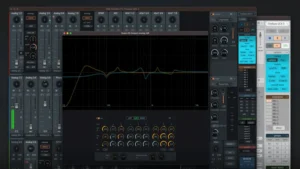 The most important upgrade in TotalMix FX 2.0 is not cosmetic. It is architectural.
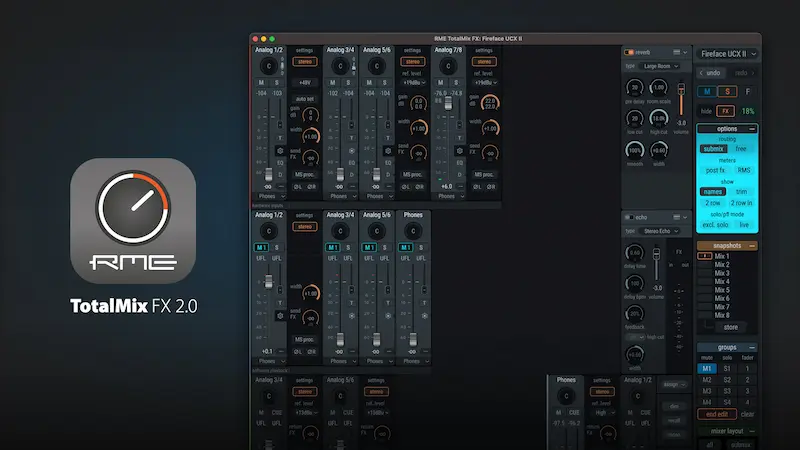
RME replaced the old bitmap-based rendering system with a hardware-accelerated graphics engine built for scalable modern displays. That sounds like a backend engineering detail until you work daily inside large routing environments on contemporary studio systems.
The original TotalMix interface was designed around fixed-resolution graphical assets. It remained functional, but scaling behavior was increasingly restrictive on modern production displays. On 1440p, 4K and ultrawide monitors, the interface often became either visually cramped or inefficiently spaced depending on system scaling.
TotalMix FX 2.0 removes those constraints entirely. The interface now scales dynamically across different resolutions, DPI environments and multi-monitor layouts without relying on pre-rendered graphical sizing.
That directly affects workflow speed in professional sessions.
The new scaling engine allows engineers to move from compact laptop monitoring setups to full-screen routing environments without destroying channel readability or navigation density. More importantly, zoom behavior is now fluid rather than locked into rigid scaling increments. Mixer and Matrix views can be resized in real time using trackpad gestures or mouse-wheel zooming, which substantially improves navigation in high-channel-count sessions.
The benefit becomes obvious in production environments involving:
- large-format recording sessions
- MADI-based routing systems
- immersive speaker configurations
- multi-headphone cue mixes
- hybrid analog mastering chains
- broadcast and streaming infrastructure
- parallel monitoring paths
In previous versions, large routing layouts often became visually exhausting over long sessions. Engineers compensated through muscle memory rather than actual visibility. The software remained powerful, but operational clarity degraded as session complexity increased.
TotalMix FX 2.0 reduces that friction significantly.
The redesigned Matrix view may be the most important improvement in the entire release. Matrix routing has always been one of TotalMix’s strongest features, particularly in complex RME and MADI ecosystems, but it could become difficult to manage visually once channel counts expanded. The new scalable rendering engine finally makes dense routing grids usable at professional scale instead of forcing engineers to navigate what effectively felt like microscopic patchbay spreadsheets.
The Workflow Changes That Matter in Real Sessions
Most audio software updates claim to improve workflow. In practice, that usually means reorganized menus, cosmetic UI cleanup or features that look useful in marketing screenshots but rarely change day-to-day production speed.
TotalMix FX 2.0 includes several changes that actually affect how engineers operate inside complex sessions.
Independent Snapshot Recall
The expanded Snapshot system is one of the strongest functional upgrades in the release, particularly for mastering engineers and hybrid studios.
Version 2.0 allows independent loading of:
- Room EQ settings
- Groups
- Record and playback states
That sounds subtle until you work in environments where monitoring infrastructure changes independently from routing or playback configuration.
In mastering rooms, engineers often maintain multiple calibrated monitoring states for different speakers, subwoofer integration paths or client playback references. Previous TotalMix behavior could force unnecessary full-state recalls simply to restore monitoring EQ or delay alignment.
TotalMix FX 2.0 reduces that overhead substantially. Monitoring calibration can now operate more independently from broader session routing.
That level of monitoring consistency matters because routing and playback inaccuracies often create problems engineers incorrectly attribute to mastering itself. Low-end imbalance, unstable stereo imaging or harsh limiter behavior can originate from monitoring infrastructure rather than processing decisions. In many cases, the issue is not the master, but the monitoring environment surrounding it — a problem explored further in this guide to common mastering problems.
The improvement is even more relevant in hybrid analog workflows. Modern production setups are increasingly modular. Engineers routinely preserve monitor infrastructure while changing insert chains, analog capture paths or external processing configurations between sessions.
Partial recall is more useful than total recall in those environments, and TotalMix finally reflects that operational reality.
Undo and Redo Support
The addition of Undo and Redo support is overdue, but still extremely important.
Large routing environments inevitably produce mistakes. Accidental reassignments, monitor path changes or incorrect submix edits become more common as session complexity increases. In previous versions, reversing those errors could become unnecessarily disruptive during active tracking or client-attended sessions.
Undo support changes the psychology of routing management.
Engineers become more willing to experiment with alternate monitoring paths, parallel cue mixes or temporary signal routing when infrastructure mistakes are reversible immediately. That reduces the tendency to freeze complex setups out of fear of destabilizing the session.
In practical terms, Ctrl-Z functionality makes TotalMix feel less like fixed infrastructure and more like modern production software.
Proper Multi-Monitor and DPI Scaling
This is one of the least glamorous upgrades in TotalMix FX 2.0 and one of the most important for long-session usability.
Modern studios rarely operate on a single display anymore. A typical setup may combine:
- Retina MacBook panels
- 4K editing displays
- ultrawide production monitors
- older secondary utility screens
Legacy audio software often behaves poorly in mixed-DPI environments. Interfaces become blurry, scaling breaks between monitors or windows reopen with inconsistent sizing behavior.
TotalMix FX 2.0 finally behaves like software designed for current workstation environments instead of software permanently locked to the display assumptions of the early 2010s.
Why TotalMix FX 2.0 Matters in Mixing and Mastering Workflows
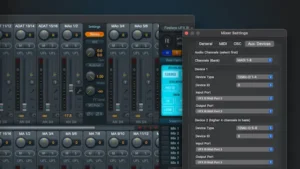 TotalMix has always operated beyond the role of standard interface control software. In many professional studios, it functions as a dedicated monitoring and routing layer sitting independently from the DAW itself.
That becomes particularly obvious in larger RME ecosystems built around interfaces such as the Fireface UFX III, MADIface XT or multi-device MADI environments connected to external converters from companies like Ferrofish and DirectOut. In those setups, TotalMix is no longer functioning as a simple interface utility. It effectively becomes the routing backbone of the entire monitoring and playback infrastructure.
That separation becomes increasingly important in mastering environments, where monitoring infrastructure often matters as much as the processing chain.
That becomes especially relevant in hybrid mastering environments where engineers constantly move between analog inserts, digital limiting stages and monitor correction paths. In many modern rooms, routing infrastructure directly affects how the mastering chain behaves operationally, particularly when hardware recall and parallel processing are involved. Engineers building complex analog-digital workflows should understand how monitoring and signal flow interact inside a real-world mastering chain rather than treating routing as a secondary utility layer.
DAWs are not particularly efficient for handling:
- multi-speaker calibration management
- reference monitoring recall
- parallel monitor feeds
- hardware insert monitoring
- broadcast and streaming source routing
- client playback switching
- subwoofer delay alignment
As monitoring systems become more complex, engineers increasingly rely on external routing environments rather than forcing every monitoring task through the DAW mixer.
That is where TotalMix becomes operationally important. In many hybrid studios, it effectively replaces portions of what used to require dedicated monitor controllers, patchbay systems or console-based routing infrastructure.
The Room EQ and Snapshot improvements in TotalMix FX 2.0 strengthen that role considerably.
Volume calibration, delay compensation and Room EQ integration inside Snapshot recall improve consistency between monitoring states. That matters in mastering rooms where engineers move constantly between nearfields, mains, sub-integrated systems and alternate playback references.
Monitoring consistency directly affects translation decisions. If speaker calibration, level matching or routing recall becomes unreliable, engineers compensate psychologically instead of acoustically. Over time, that introduces decision fatigue and inconsistent playback judgment.
Monitoring consistency directly affects translation decisions, especially when engineers are making loudness and tonal balance judgments for streaming delivery. Small monitoring inconsistencies can distort perceived dynamics, low-end balance and limiter behavior, particularly when working toward modern platform normalization targets. That becomes increasingly important in workflows built around Spotify, Apple Music and YouTube delivery standards, where engineers are already balancing translation against perceived loudness and platform normalization behavior discussed in this LUFS mastering guide.
TotalMix FX 2.0 reduces that friction by making monitoring states faster to manage and easier to verify visually.
The update also reflects a larger industry shift. As more studios move away from large-format analog consoles, software-based monitoring ecosystems are becoming central production infrastructure rather than secondary utilities.
TotalMix increasingly occupies territory that once belonged to dedicated monitor management hardware — particularly in hybrid mastering rooms, Atmos-capable environments and modern production studios built around flexible routing rather than fixed console architecture.
Why ARM Compatibility Matters More Than RME’s Marketing Suggests
ARM compatibility in TotalMix FX 2.0 is not just a checkbox feature for future hardware support. It reflects a broader transition already happening underneath professional audio production.
Apple Silicon accelerated that shift, but Windows-based ARM systems are starting to enter the conversation as well — particularly in mobile production environments where thermal efficiency, silent operation and battery life directly affect workflow reliability.
For audio engineers, architecture transitions have historically been painful.
The professional audio industry tends to move slower than general computing because low-latency stability matters more than raw performance benchmarks. During major platform shifts, driver support often breaks first. Plugin ecosystems fragment, synchronization becomes inconsistent and real-time playback reliability can collapse for months or years.
That is why early ARM optimization from companies like RME carries more weight than it would in most software categories.
TotalMix sits directly inside the real-time monitoring path. If routing software becomes unstable under new architectures, the entire production environment becomes unreliable regardless of DAW performance.
Supporting ARM systems early positions RME more favorably for the next generation of portable production workflows, particularly for engineers running:
- mobile editing and mixing rigs
- Nuendo-based immersive production systems
- portable Dolby Renderer environments
- Pro Tools HDX satellite editing rigs
- remote recording systems
- broadcast and livestream production setups
- travel mastering environments
- location-based tracking sessions
That matters because modern audio production is becoming increasingly decentralized. Engineers are no longer tied exclusively to fixed studio infrastructure. Sessions move between home studios, remote locations, hotel editing setups, livestream control rooms and client-attended mobile rigs.
ARM-based systems are well suited to those environments because they prioritize thermal efficiency and sustained performance over short-duration peak power behavior.
RME’s approach here is consistent with the company’s broader reputation. Rather than chasing trend-driven feature cycles, RME typically focuses on long-term infrastructure stability. Early ARM support is less about marketing future-proofing and more about maintaining continuity as production hardware evolves beyond traditional x86 workstation assumptions.
The Limitations TotalMix FX 2.0 Does Not Solve
TotalMix FX 2.0 modernizes the software substantially, but it does not fundamentally change what the platform is — or who it is built for.
The Learning Curve Is Still Steep
RME continues to design TotalMix around engineering logic rather than simplified creator workflows. That remains one of the platform’s biggest strengths and one of its biggest barriers.
Engineers familiar with signal flow, hardware routing and monitor infrastructure will understand the system quickly. Users coming from simplified software mixers or content-creator ecosystems may find TotalMix unnecessarily technical.
The Matrix environment is still dense, highly functional and unapologetically infrastructure-oriented. The new scaling engine improves readability, but it does not reduce conceptual complexity.
That distinction matters because many modern audio platforms prioritize abstraction over transparency. TotalMix does the opposite. It exposes routing structure directly instead of hiding it behind simplified workflow layers.
For experienced engineers, that level of control is valuable. For less technical users, it can still feel intimidating despite the redesigned interface.
Hardware Acceleration Introduces New Compatibility Variables
The move to a hardware-accelerated graphics engine improves scalability and responsiveness, but it also introduces dependencies older versions largely avoided.
RME has already warned that some legacy Intel graphics hardware may not be fully compatible with the new rendering system. That warning is more significant than it sounds.
Professional audio studios often operate on intentionally conservative upgrade cycles. Many engineers continue using older but stable workstation configurations specifically to avoid introducing unpredictable variables into production environments.
In those rooms, software modernization can become a liability if graphics compatibility introduces instability, rendering glitches or inconsistent UI behavior.
RME’s decision to continue maintaining version 1.991 alongside TotalMix FX 2.0 is effectively an acknowledgment of that reality. Parts of the professional audio industry still depend on long-life infrastructure rather than rapid hardware turnover.
TotalMix Is Still Deeply Tied to the RME Ecosystem
TotalMix remains one of the strongest routing and monitoring environments in professional audio, but its value is inseparable from RME hardware.
Unlike standalone software routing platforms or cross-platform monitor management systems, TotalMix is not designed as a universal infrastructure layer. Its real strength comes from deep integration with RME drivers, DSP architecture and hardware-level routing behavior.
For existing RME users, that integration is a major advantage. For engineers outside the ecosystem, TotalMix itself is unlikely to justify a platform migration unless low-latency stability and routing depth are already high-priority operational concerns.
How TotalMix FX 2.0 Compares to Competing Routing Ecosystems
TotalMix does not compete with DAWs directly. It competes with monitoring infrastructure, hardware control environments and low-latency routing ecosystems.
That distinction is important because most competing platforms prioritize completely different parts of the production workflow.
Compared to Universal Audio Console
Universal Audio Console is fundamentally built around DSP-assisted recording workflows. Its strength is real-time plugin tracking, analog emulation and tightly integrated front-end processing during recording sessions.
TotalMix approaches the problem from the opposite direction.
RME prioritizes routing depth, monitoring control, deterministic low-latency behavior and infrastructure stability rather than DSP coloration or tracking aesthetics. In large studios, broadcast environments or mastering rooms, that difference becomes immediately obvious.
Console feels like a recording-focused production environment. TotalMix feels like studio infrastructure.
For engineers heavily invested in real-time analog emulation tracking, UAD remains more attractive. For users managing complex monitor paths, hybrid routing systems or large I/O environments, TotalMix is substantially more flexible.
Compared to MOTU CueMix
MOTU CueMix has improved considerably in recent years, particularly regarding interface design and usability. For smaller studios, podcast environments or moderate I/O setups, the gap between CueMix and TotalMix is narrower than it was a decade ago.
Once session complexity increases, the differences become harder to ignore.
TotalMix still operates at a higher level in several critical areas:
- large-scale routing visibility
- Matrix workflow efficiency
- multi-room monitor management
- MADI integration
- driver consistency under heavy load
- long-session operational stability
That distinction matters less in small creator-oriented production rooms and far more in professional facilities where reliability is operationally critical rather than merely convenient.
Compared to Software Routing Platforms
Applications such as Loopback, virtual patching systems and software-based audio routers solve a different category of problem entirely.
Those platforms prioritize software-level signal flexibility, application routing and virtual device management. They are extremely useful for livestreaming, podcast production, browser-based audio capture and non-linear software routing tasks.
TotalMix is designed around hardware-level monitoring infrastructure.
Its priorities are deterministic latency behavior, direct hardware communication, monitor reliability and predictable signal flow under professional session load. That makes it significantly better suited to mastering rooms, hybrid analog setups and high-channel-count recording environments where monitoring stability matters more than routing experimentation.
In practical terms, software routers behave like flexible utility layers. TotalMix behaves like part of the studio’s physical infrastructure.
| Platform | Primary Strength | Best For | Weak Point |
|---|---|---|---|
| RME TotalMix FX 2.0 | Low-latency routing stability, monitoring infrastructure and scalable Matrix workflow | Hybrid mastering rooms, large routing systems, professional monitoring environments | Steep learning curve and dependence on RME hardware ecosystem |
| UAD Console | Real-time DSP plugin tracking and analog-style recording workflows | Tracking engineers, vocal production and low-latency plugin recording | Less flexible for large-scale routing and monitor infrastructure management |
| MOTU CueMix | Accessible routing workflow with improving interface usability | Mid-size studios, podcast setups and moderate I/O environments | Less scalable in large routing and multi-room production environments |
| Software Routing Platforms | Flexible virtual audio routing and application-level signal management | Livestreaming, browser capture, podcasting and virtual audio workflows | Less deterministic for mission-critical monitoring and hardware-integrated workflows |
Where TotalMix FX 2.0 Immediately Improves Daily Workflow
Most of the improvements in TotalMix FX 2.0 are not dramatic in isolation. The difference appears during long sessions where routing visibility, monitor management and navigation speed directly affect production efficiency.
| Workflow Area | Previous Limitation | TotalMix FX 2.0 Improvement |
|---|---|---|
| Large monitor routing | Dense Matrix layouts became visually exhausting during long sessions | Scalable Matrix zoom and fluid navigation improve routing visibility |
| Hybrid analog recall | Full Snapshot reloads disrupted monitoring continuity | Partial Snapshot loading separates monitoring and routing recall |
| Multi-monitor workstation setups | Mixed-DPI scaling caused inconsistent window behavior | Adaptive scaling improves usability across Retina and 4K displays |
| Complex cue mix management | Routing changes carried higher operational risk | Undo/Redo support encourages faster routing adjustments |
Why Stability Still Matters More Than Feature Density
Professional engineers rarely change monitoring or routing infrastructure because a company releases a visually cleaner interface. Infrastructure software gets replaced when operational friction becomes expensive enough to slow sessions, interrupt recall workflows or introduce uncertainty into production environments.
That is why TotalMix FX 2.0 works.
RME modernized the software without disrupting the routing behavior engineers already trust. In professional audio, that balance is far more difficult to execute than most software companies admit.
That alone separates TotalMix FX 2.0 from many modern audio software redesigns, where visual modernization often comes at the expense of operational speed.
Many audio platforms redesign interfaces aggressively in pursuit of visual modernization, only to damage workflow speed for long-term users in the process. Engineers who rely on muscle memory, fast navigation and repeatable monitor behavior often end up working slower after major redesigns.
RME avoided most of that disruption by preserving the underlying operational structure of TotalMix while rebuilding the rendering and scaling architecture around it.
The decision to retain the legacy interface mode is especially revealing. It acknowledges a reality many software companies ignore: professional studios operate conservatively because downtime directly affects revenue, scheduling and client confidence.
Engineers do not prioritize novelty inside core infrastructure tools. They prioritize predictability.
That predictability becomes critical long before the mastering stage itself. Engineers preparing mixes for mastering rely on stable monitoring translation and repeatable playback behavior to identify problems before files ever leave the studio. Routing inconsistencies, level mismatches and unreliable monitor management can compromise decisions during mix preparation just as easily as during mastering processing. That broader preparation stage is covered in more detail in this guide on how to prepare a mix for mastering.
That is particularly true in mastering rooms, broadcast environments and hybrid analog studios where routing systems effectively become part of the physical signal chain.
The graphics overhaul, scalable UI system and workflow refinements in TotalMix FX 2.0 matter because they reduce visual fatigue, improve navigation speed and simplify monitor management without forcing engineers to relearn the platform itself.
That is the correct way to modernize infrastructure software: improve operational efficiency without destabilizing the environment professionals already depend on.
Who Should Actually Upgrade to TotalMix FX 2.0
TotalMix FX 2.0 will not affect every studio workflow equally. The benefits become more significant as routing complexity, monitor management and display scaling demands increase.
- Existing RME users with 4K or ultrawide displays will notice the biggest immediate usability improvement. The scalable Matrix environment alone reduces navigation fatigue substantially in large sessions.
- Hybrid mastering studios benefit from improved Snapshot handling, partial recall behavior and better monitor-management flexibility across analog and digital chains.
- Dolby Atmos and immersive production rooms gain operational advantages from improved multi-monitor scaling and more manageable high-channel-count routing visibility.
- Mobile production systems running Apple Silicon or ARM-based hardware benefit from the updated graphics architecture and improved modern platform support.
- Legacy studio systems running older Intel graphics hardware may want to remain on version 1.991 until compatibility is fully verified in stable production conditions.
For engineers already comfortable with TotalMix, version 2.0 feels less like a feature expansion and more like overdue infrastructure modernization.
Verdict
TotalMix FX 2.0 is not a radical reinvention of RME’s routing ecosystem. It is a long-overdue modernization of the interface layer surrounding one of the most stable monitoring and routing platforms in professional audio.
The update succeeds because it focuses on operational friction instead of feature inflation. The new graphics engine, scalable Matrix workflow, improved Snapshot handling and proper DPI-aware behavior solve real problems affecting engineers working on modern studio systems.
Large routing sessions are easier to navigate. Multi-monitor environments behave properly. Monitoring recall becomes faster and more flexible. The software finally feels designed for current production hardware rather than adapted from an earlier workstation era.
At the same time, TotalMix remains unapologetically technical. Engineers expecting simplified creator-oriented workflows or heavily abstracted routing environments will still find the platform infrastructure-heavy compared to more consumer-facing ecosystems.
That is unlikely to matter to the audience RME actually serves.
For professional mixing rooms, mastering studios, broadcast facilities and hybrid analog environments, TotalMix FX 2.0 reinforces RME’s position as one of the most reliable low-latency routing systems currently available.
The most impressive part of the update is not the redesign itself. It is that RME managed to modernize a deeply established workflow platform without compromising the stability and predictability that made engineers trust it in the first place.

Yurii Ariefiev is a mastering engineer and audio production editor specializing in hybrid mastering workflows, monitoring translation and real-world playback optimization. His editorial work focuses on mastering infrastructure, loudness behavior, streaming delivery standards and the technical realities behind modern audio production systems.
This article was written from a professional studio workflow perspective rather than a press-release summary, with emphasis on routing architecture, monitoring consistency and operational reliability inside modern mixing and mastering environments.
FAQ
Does TotalMix FX 2.0 improve sound quality?
No. TotalMix FX 2.0 does not change converter performance, analog circuitry or clocking quality. The update focuses on routing workflow, monitoring management and interface scalability. Audio quality still depends primarily on the underlying RME hardware.
Is TotalMix FX 2.0 more demanding on system resources?
Slightly, yes. The new interface relies on hardware-accelerated graphics rendering instead of the older bitmap-based system. On modern GPUs the impact is minimal, but older graphics hardware may experience reduced responsiveness or compatibility issues.
Can TotalMix FX 2.0 run reliably on older studio computers?
That depends mostly on GPU support rather than CPU performance. Older Intel integrated graphics systems may struggle with the new rendering engine, which is why RME continues maintaining the legacy 1.991 version alongside 2.0.
Is the classic TotalMix interface still available?
Yes. Users can switch between the legacy and redesigned interface layouts through the Window menu. That option is particularly valuable for engineers working on older displays or deeply established studio workflows.
Does TotalMix FX 2.0 benefit mastering workflows specifically?
Yes. The Snapshot improvements, scalable Matrix view and enhanced Room EQ integration are especially useful in mastering environments involving multiple monitor paths, calibrated speaker systems and hybrid analog processing chains.
How does TotalMix compare to UAD Console in real studio use?
UAD Console is more recording-focused and centered around real-time DSP plugin workflows. TotalMix is stronger as a routing and monitoring infrastructure platform, particularly in large I/O systems and complex studio environments.
Is TotalMix FX 2.0 useful for hybrid analog studios?
Very much so. Studios running external compressors, EQs, summing chains or multiple capture paths benefit from faster routing visibility, scalable Matrix management and more flexible monitoring recall behavior.
Does TotalMix FX 2.0 support Apple Silicon and Windows ARM systems?
Yes. The software supports Apple Silicon natively and now adds broader ARM compatibility for Snapdragon-based Windows platforms, positioning RME more favorably for future mobile production systems.
Can TotalMix FX 2.0 handle Dolby Atmos or immersive monitoring setups?
Yes, particularly for speaker routing, monitor management and playback infrastructure. However, immersive production workflows still depend heavily on the DAW, renderer configuration and overall hardware ecosystem surrounding TotalMix.
Should existing RME users upgrade immediately?
Most modern studio systems should benefit from the upgrade without major issues. Engineers running older GPUs or highly conservative workstation setups may want to test compatibility carefully before replacing stable legacy environments.
Does TotalMix FX 2.0 reduce latency?
No. The update does not fundamentally change RME’s driver latency performance. The improvements are focused on routing workflow, graphics rendering and monitoring usability rather than audio buffer behavior.
Can TotalMix FX 2.0 replace a hardware monitor controller?
In some hybrid studios, yes. TotalMix already handles speaker switching, monitor calibration, subwoofer integration and routing management well enough to reduce dependence on external monitor-control hardware.
Is TotalMix FX 2.0 good for Dolby Atmos mixing?
Yes, particularly in larger immersive environments where scalable Matrix routing and multi-speaker monitor management become operationally important.
Does TotalMix FX 2.0 work without RME hardware?
No. TotalMix is tightly integrated with RME interfaces and DSP architecture. The software does not function as a standalone routing platform outside the RME ecosystem.