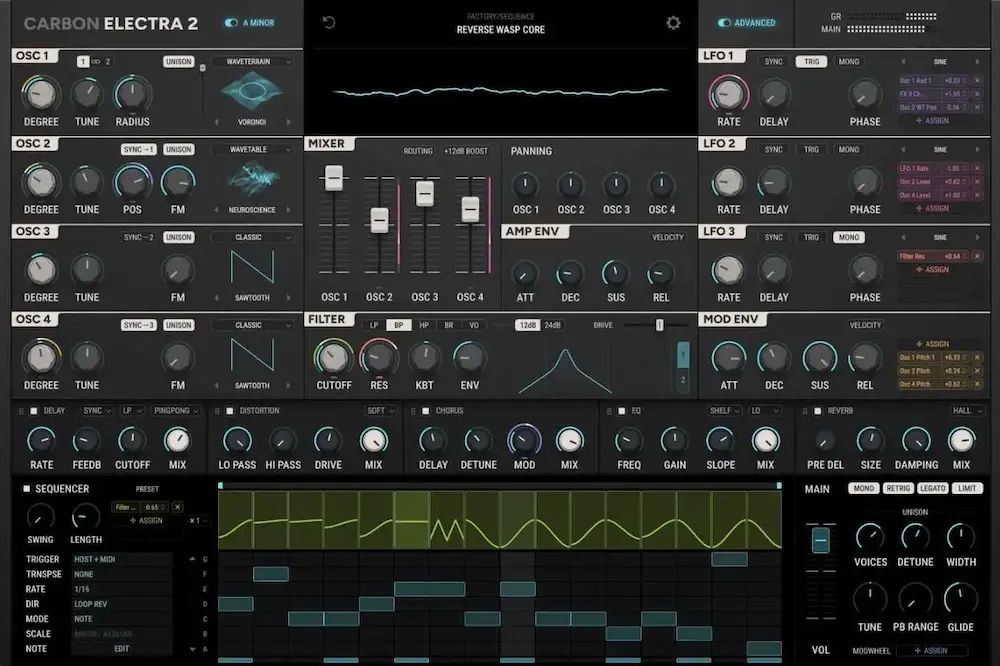
Carbon Electra 2 Review: Can Scaler Music Compete With Serum, Vital and Pigments?
The software synthesizer market is more competitive than ever. Producers today can choose from industry giants such as Serum, Vital, Pigments, Massive X, Phase Plant and dozens of other instruments capable of creating modern electronic sounds. Enter Carbon Electra 2, the latest synthesizer from Scaler Music, a company best known for its chord and music theory tools rather than virtual instruments.
Originally developed years ago and later acquired by the team behind Scaler, Carbon Electra has now been rebuilt and reintroduced as Carbon Electra 2. The question is simple: can this new synth realistically compete with modern favorites like Serum, Vital and Pigments, or is it primarily designed as a complementary instrument for existing Scaler users?
After examining its workflow, sound design philosophy, feature set and potential audience, the answer is more nuanced than many producers might expect.
What Is Carbon Electra 2?
 Carbon Electra 2 is a virtual synthesizer designed to deliver modern electronic sounds while maintaining a streamlined workflow. Rather than overwhelming users with endless modulation possibilities and deep synthesis architecture, the instrument focuses on speed, accessibility and immediate musical results.
This design philosophy aligns closely with Scaler Music’s broader ecosystem. While many synth developers compete by adding increasingly advanced routing systems and experimental synthesis methods, Carbon Electra 2 appears focused on helping producers reach usable sounds quickly.
For songwriters, beatmakers and producers who value efficiency over endless tweaking, this approach may be attractive.
The challenge, however, is that Carbon Electra 2 enters a market dominated by instruments that have spent years building loyal user bases and extensive preset ecosystems.
Why Carbon Electra 2 Exists
The release of Carbon Electra 2 is not simply another synthesizer launch. It represents Scaler Music’s expansion beyond music theory assistance and into sound generation.
Scaler has become widely recognized among producers who want help with:
- Chord progressions
- Songwriting ideas
- Music theory workflows
- Melody generation
- Composition assistance
Moving into the synthesizer market allows the company to create a more complete production ecosystem. Instead of helping users create harmonic content and then requiring third-party instruments, Scaler can now provide both the compositional framework and the sounds themselves.
This strategy mirrors what many software companies have attempted in recent years: keeping users inside a single creative environment for as much of the production process as possible.
Carbon Electra 2 vs Serum
Any modern synth release inevitably faces comparisons with Serum.
Despite being released years ago, Serum remains one of the most influential software synthesizers ever created. Its reputation comes from several factors:
- Extensive wavetable capabilities
- Visual workflow
- Deep modulation options
- Massive preset ecosystem
- Industry-wide adoption
Carbon Electra 2 does not appear to target the same audience directly.
Serum appeals heavily to sound designers who enjoy building patches from scratch and exploring complex modulation structures. Carbon Electra 2 focuses more on immediacy and usability.
For producers who spend hours designing sounds, Serum remains significantly more powerful.
For producers who simply need a strong lead, bass, pluck or pad without diving into advanced programming, Carbon Electra 2 may provide a faster workflow.
In other words, Carbon Electra 2 is not necessarily trying to beat Serum on complexity. It may be attempting to win on accessibility.
Carbon Electra 2 vs Vital
 Vital changed the software synthesizer market by offering advanced wavetable synthesis at little or no cost for many users.
This created a difficult environment for new synthesizer releases.
Today, producers comparing Carbon Electra 2 and Vital will likely focus on three questions:
- Which synth sounds better?
- Which synth is easier to learn?
- Which synth offers greater value?
Vital continues to dominate when it comes to modulation flexibility and visual feedback. Its interface makes complex routing relatively easy to understand, even for less experienced producers.
Carbon Electra 2 appears positioned differently. Rather than competing feature-for-feature, it attempts to reduce decision fatigue and provide a streamlined creative process.
For beginners, this may actually be an advantage.
Many producers never fully utilize the capabilities of advanced wavetable synthesizers. A simpler instrument can sometimes accelerate creative output.
Carbon Electra 2 vs Pigments
Pigments occupies a different category altogether.
Arturia’s flagship synthesizer combines multiple synthesis methods, extensive modulation, visual feedback and sophisticated sound design tools inside a single environment.
Pigments is often viewed as a sound designer’s playground.
Compared to Pigments, Carbon Electra 2 feels intentionally focused.
Rather than offering every possible synthesis approach, it concentrates on delivering modern production sounds with minimal friction.
For composers working on cinematic projects, experimental electronic music or highly technical sound design, Pigments remains the more capable platform.
For producers creating mainstream electronic music, pop, house, future bass, EDM or modern beat-based genres, Carbon Electra 2 may provide a more direct route from idea to finished sound.
How Does Carbon Electra 2 Actually Sound?
Sound quality ultimately determines whether a synthesizer survives beyond its launch period.
Marketing claims, feature lists and interface design can attract initial attention, but producers continue using instruments that consistently deliver results inside real projects.
Carbon Electra 2 appears designed around modern electronic production requirements. Its core sound is polished, immediate and commercially oriented rather than experimental.
This philosophy differs significantly from instruments focused on cinematic textures and organic atmospheres. Producers interested in hybrid sound design may also want to explore our Evolve Nest Acoustics review, where the emphasis shifts from electronic synthesis toward field recordings, natural environments and evolving acoustic textures.
This distinction matters.
Many synthesizers excel at creating unusual textures but require significant processing before fitting into a finished mix. Carbon Electra 2 seems optimized for sounds that are already close to release-ready.
Producers working in genres such as:
- EDM
- House
- Future Bass
- Pop
- Dance Pop
- Trap
- Electronic Hip-Hop
are likely to find usable presets and sound categories immediately.
The instrument focuses less on experimentation and more on practical production scenarios.
That approach will appeal to some users while disappointing others.
Is Carbon Electra 2 Good for Beginners?
One of Carbon Electra 2’s strongest selling points may be its accessibility.
Modern synthesizers often suffer from feature overload. New users open the interface and immediately face hundreds of parameters, modulation destinations and routing possibilities.
While advanced producers appreciate that flexibility, beginners frequently become overwhelmed.
Carbon Electra 2 takes a different approach.
The interface encourages exploration without requiring extensive synthesis knowledge. This creates a shorter learning curve and allows newer producers to focus on writing music instead of studying synthesis architecture.
For users already familiar with Scaler’s philosophy, this design direction feels consistent with the company’s existing products.
The goal is not maximum complexity. The goal is productive creativity.
Preset Library and Production Workflow
Preset quality often influences purchasing decisions more than many producers admit.
Even experienced sound designers regularly begin with presets and modify them rather than creating every sound from scratch.
Carbon Electra 2 benefits from launching into an environment where modern producers expect immediate inspiration.
A strong preset library can dramatically reduce production time by providing:
- Starting points for songs
- Genre-specific sounds
- Mix-ready patches
- Arrangement ideas
- Layering opportunities
The synth appears particularly attractive for producers who value speed and efficiency.
Rather than spending thirty minutes designing a pluck, users can focus on composition, arrangement and production decisions.
This workflow advantage should not be underestimated.
Many successful commercial records rely more on strong songwriting and execution than on highly complex sound design.
Can Carbon Electra 2 Replace Serum?
Probably not.
At least not for producers who depend heavily on advanced wavetable design and deep modulation systems.
Serum’s ecosystem has been growing for years. Thousands of tutorials, preset packs, courses and community resources exist around the instrument.
That level of market dominance cannot be replaced overnight.
However, replacing Serum may not be the correct question.
A more useful question is whether Carbon Electra 2 can become a valuable secondary synthesizer inside a producer’s workflow.
For many users, the answer could be yes.
Producers frequently own multiple synthesizers because different tools encourage different creative outcomes.
Carbon Electra 2 may ultimately succeed not by replacing industry leaders but by offering a faster route to usable sounds.
Can Carbon Electra 2 Replace Vital?
This comparison is more difficult.
Vital’s free availability created enormous adoption across the producer community.
For budget-conscious users, any paid synthesizer must justify its existence against a capable free alternative.
Carbon Electra 2 can compete if producers prioritize workflow, preset quality and ease of use over raw feature count.
If the primary goal is maximum synthesis flexibility per dollar spent, Vital remains one of the strongest options available.
If the goal is writing tracks faster and spending less time inside modulation matrices, Carbon Electra 2 becomes more compelling.
Who Should Consider Carbon Electra 2?
The synthesizer appears particularly well suited for:
- Bedroom producers
- EDM creators
- Pop producers
- Songwriters
- Beatmakers
- Scaler users
- Beginner and intermediate producers
It may be less appealing for:
- Hardcore sound designers
- Experimental electronic musicians
- Advanced wavetable specialists
- Users seeking extremely deep modulation systems
Understanding this distinction is critical.
Many negative reviews occur when producers evaluate a product against goals it was never intended to achieve.
Carbon Electra 2 appears designed primarily for music creation rather than technical synthesis exploration.
Mixing Considerations for Carbon Electra 2 Sounds
One interesting aspect of modern synthesizers is how they interact with the mixing process.
Highly processed presets can sound impressive in isolation but create challenges inside dense arrangements.
Producers should remember that no synthesizer automatically guarantees a professional result.
Even strong presets often require:
- EQ adjustments
- Dynamic control
- Stereo management
- Arrangement decisions
- Professional mixing
- Mastering optimization
A polished synth patch can still disappear inside a crowded mix or create frequency conflicts that reduce clarity.
The same principle applies to guitar tones, amp modeling and virtual instruments in general. A sound that feels impressive in solo mode does not automatically translate into a finished production. We observed similar behavior while testing hardware modeling workflows in our TONEX ONE+ review, where mix translation proved more important than isolated tone quality.
The quality of the production process remains more important than the specific synthesizer used.
Pros and Cons
Pros
- Fast workflow
- Beginner-friendly interface
- Modern electronic sound character
- Strong integration potential with the Scaler ecosystem
- Less overwhelming than many advanced synthesizers
- Useful for rapid idea generation
Cons
- Limited market recognition compared to Serum or Vital
- Smaller preset ecosystem
- Less advanced modulation capabilities
- Not aimed at deep sound design workflows
- Must compete against established industry standards
Final Verdict: Is Carbon Electra 2 Worth It?
Carbon Electra 2 is unlikely to dethrone Serum, Vital or Pigments in the near future.
Those instruments have spent years establishing themselves as industry standards with enormous communities and educational resources behind them.
That does not mean Carbon Electra 2 lacks value.
Its strength lies in a different area: simplicity, speed and musical productivity.
For producers who prioritize writing songs rather than endlessly tweaking synthesizer parameters, Carbon Electra 2 may become a surprisingly useful addition to the studio.
The synth appears most attractive to existing Scaler users, beginner producers and musicians who want modern sounds without navigating highly complex synthesis environments.
Whether it becomes a long-term success will depend largely on community adoption, preset ecosystem growth and continued development from Scaler Music.
For now, Carbon Electra 2 looks less like a Serum killer and more like a practical creative tool designed to help producers move from idea to finished track faster.
FAQ
What is Carbon Electra 2?
Carbon Electra 2 is a software synthesizer developed by Scaler Music, designed for modern music production with an emphasis on workflow efficiency and accessible sound design.
Is Carbon Electra 2 better than Serum?
Not necessarily. Serum offers significantly deeper wavetable synthesis and modulation capabilities. Carbon Electra 2 focuses more on speed and ease of use.
Is Carbon Electra 2 better than Vital?
The answer depends on workflow preferences. Vital provides greater flexibility, while Carbon Electra 2 emphasizes streamlined production and fast results.
What genres is Carbon Electra 2 good for?
Carbon Electra 2 appears well suited for EDM, House, Pop, Future Bass, Dance Music, Trap and other modern electronic genres.
Is Carbon Electra 2 good for beginners?
Yes. Its simplified workflow and accessible interface make it easier to learn than many advanced software synthesizers.