The Heritage Audio TUBESTRIP is built for engineers willing to commit tone and dynamics before a signal reaches the DAW. Unlike a plugin that can be bypassed, automated, or recalled instantly, a premium analog channel strip changes the recording itself. The real question is not how many processors fit inside the chassis, but whether the complete signal path helps an engineer make better decisions earlier.
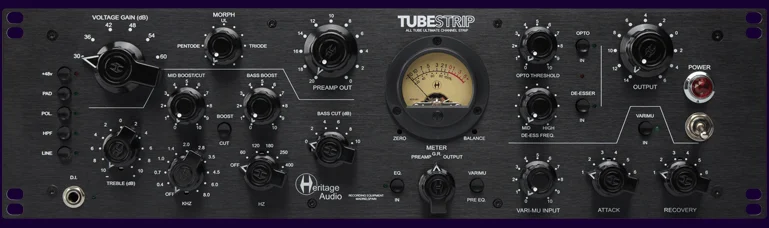
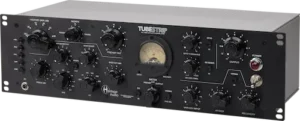
The TUBESTRIP combines a morphing tube preamp, inductor EQ, Vari-Mu compression, optical compression, and de-essing in a single 3U unit. That is a substantial amount of analog processing for one channel, but the feature count is not the point. What matters is how those stages interact during tracking and whether the integrated workflow offers a practical advantage over separate hardware or a flexible in-the-box chain.
For vocals, bass, room microphones, acoustic instruments, and selected mono mixing duties, the architecture has a clear purpose. The case is weaker for transparent capture, fast recall, and stereo mastering. This review analyzes where the TUBESTRIP fits in a modern production workflow, how its dual-compressor architecture changes the available signal path, and where an expensive all-tube channel strip becomes more commitment than advantage. The evaluation focuses on circuit architecture, routing, recording applications, mixing integration, and ownership tradeoffs rather than unverified claims about sound quality.
In This Review
Heritage Audio TUBESTRIP Specifications
| Specification | Details |
|---|---|
| Format | Single-channel all-tube analog channel strip |
| Rack Size | 3U |
| Preamp Gain | Up to 60 dB |
| Preamp Modes | Triode, UL, and Pentode via the Morph control |
| Equalizer | Inductor-based analog EQ |
| Dynamics | Vari-Mu compressor and optical tube compressor |
| De-Essing | Available through the optical dynamics section |
| Inputs | Microphone, line, and instrument-level sources |
| Transformers | Four custom transformers |
| Output Control | -14 dB to +6 dB |
| Weight | 7.6 kg / 16.8 lb |
Why a Premium Analog Channel Strip Still Matters
 Modern audio production does not lack processing power. A DAW can provide more EQ bands, compressor types, automation, recall, and routing flexibility than any single hardware channel strip. That changes the case for a unit such as the Heritage Audio TUBESTRIP: its value is not access to processing, but the ability to shape a signal before conversion and commit those decisions at the recording stage.
A well-chosen front-end chain can reduce the number of problems carried into the mix. A vocal may reach the DAW with its broad tonal balance established and major level swings already controlled. A bass can be recorded with a more stable envelope. A room microphone can be printed as a finished production layer rather than captured neutrally and rebuilt later with a long plugin chain.
The TUBESTRIP concentrates that workflow into one signal path. Its preamp, EQ, Vari-Mu compressor, and optical dynamics stage are not simply four processors sharing a chassis; each stage changes the signal presented to the next. Preamp drive affects how the compressors respond, EQ changes detector behavior, and serial gain reduction can divide dynamic control between two different circuits. That interaction is the practical argument for an integrated channel strip over a collection of unrelated processors.
The tradeoff is permanence. Hardware processing printed on the way in cannot be reopened, automated, or removed after the session. That makes the TUBESTRIP most useful in studios with monitoring accurate enough to judge compression, spectral balance, and saturation while tracking. Without that confidence, a sophisticated analog front end does not create better decisions. It simply records uncertain ones permanently.
How the Heritage Audio TUBESTRIP Signal Path Works as a System
The defining feature of the Heritage Audio TUBESTRIP is not any single circuit. It is the order in which the source can be shaped before conversion. Preamp character, EQ, Vari-Mu compression, and optical dynamics are available within one analog path, so each decision affects the signal reaching the next stage.
The front end is a transformer-coupled tube preamp for microphone, line, and instrument-level sources, with up to 60 dB of gain. Its key control is Morph, which moves between triode and pentode operation through an intermediate UL position. Rather than offering a simple two-state color switch, the control allows the engineer to alter the preamp’s operating character before EQ or compression enters the chain.
That matters because front-end coloration is not an isolated effect. Changes in harmonic structure, level, and transient shape affect how downstream processors respond. A source driven into a denser operating range will not present the same envelope to the compressors as a cleaner signal. The TUBESTRIP therefore makes more sense as an interactive signal path than as four separate processors sharing a chassis.
The Morph Control Sets the Direction of the Chain
On vocals, the preamp should be treated as part of the production decision rather than a generic upgrade in sound quality. A dense singer competing with guitars and drums may need a different front-end character from an exposed vocal in a sparse arrangement. More harmonic density can increase apparent presence, but it also leaves less room for later saturation, clipping, and limiting. That becomes especially important when the mix will also use processors such as the UAD Black Box HG-2, where additional tube-style harmonic buildup is applied after the signal is already inside the DAW.
Bass and DI instruments present a different opportunity. Additional upper-harmonic content can make a low-frequency source easier to follow on smaller playback systems, where the fundamental may be poorly reproduced. The important distinction is that the hardware is not fixing translation by itself. It is changing the spectral information available to the mix.
For percussion and room microphones, the preamp can be used less conservatively. A driven tube-and-transformer path can turn a clean capture into a deliberately colored layer before it reaches the DAW. That is one of the stronger arguments for committing hardware during tracking: the texture becomes part of the production rather than another decision deferred to the mix.
The Inductor EQ Is Built for Direction, Not Repair
The inductor EQ fits the same commitment-based workflow. Its job is not to compete with a surgical digital equalizer. It is to establish broad tonal direction while the source is being recorded or passed through the hardware.
That can mean reducing excess low-frequency weight, moving a source forward, opening the upper range, or changing the balance presented to the dynamics stages. The last point matters: EQ and compression do not operate independently when they share a signal path. A tonal move made before dynamics processing can change which parts of the source drive gain reduction most strongly.
The limitation is equally clear. Broad analog EQ cannot compensate for poor microphone placement, room resonance, or narrow-band harshness with the precision of modern digital tools. If the capture is fundamentally wrong, printing more tone into it is not a solution. The TUBESTRIP is better used to shape a recording that already works than to rescue one that does not.
The Dual-Compression Architecture Is the Real Differentiator
The dynamics section is where the TUBESTRIP separates itself from a conventional all-in-one channel strip. It combines a Vari-Mu stage based on the full Lang P.LANE circuit, including Heritage Audio’s Seawell mode, with a separate optical tube dynamics stage that can also handle de-essing.
Two compressors in series are not automatically better than one. The advantage is workload distribution. Instead of asking a single circuit to control the entire performance, an engineer can divide the job between two stages with different operating behavior.
On a vocal, the Vari-Mu section might handle broader level movement while the optical stage controls what remains. Used conservatively, that can be less conspicuous than demanding heavy gain reduction from one processor. The same principle applies to bass, where large dynamic movement and shorter inconsistencies do not always respond best to the same compression stage.
The useful principle is simple: distributed gain reduction can sound less processed than forcing one compressor to do all the work. That does not require both stages to be active on every source. If the first compressor already produces the required envelope, adding another stage only because it is available increases complexity without improving the recording.
Serial dynamics also raises the importance of gain staging. Each processor changes the signal entering the next, and small level differences can distort judgment during comparison. The chain needs to be evaluated at matched output level; expensive tubes and transformers do not make louder A/B tests any more reliable.
Why the Optical Stage’s De-Essing Role Matters
De-essing may look secondary beside the tube preamp and Vari-Mu compressor, but it addresses a predictable problem when vocal dynamics are controlled during tracking. As the body of a performance becomes more stable and forward, short sibilant events can become proportionally more exposed.
A compressor may reduce large level swings without adequately controlling those high-frequency events. The result can be a vocal that appears finished dynamically but becomes aggressive once additional mix compression, saturation, or high-frequency lift is applied.
Handling some of that behavior before conversion can be useful, but this is the stage that demands the most restraint. Mild residual sibilance can still be treated during mixing. Articulation removed by excessive de-essing cannot be restored by mastering.
Where the Heritage Audio TUBESTRIP Earns Its Place in a Session
 Lead vocals are the obvious application, but the Heritage Audio TUBESTRIP makes the most sense on any source important enough to justify decisions before the mix. The question is not whether the unit can process vocals, bass, drums, or acoustic instruments. It is whether committing its tone and dynamics will reduce the amount of work required later.
On a lead vocal, the full signal path allows several small decisions to replace one aggressive processing move. The preamp establishes the front-end character, the EQ sets broad tonal direction, and the two dynamics stages can divide level control when one compressor would otherwise be working too hard. De-essing remains optional. The wrong approach is to activate every section because the hardware provides it; four available processors do not create an obligation to use four processors.
Bass is a particularly logical fit because inconsistent note level, sustain, and playing intensity often create more work than the basic tone itself. A controlled capture can reduce later automation and keep downstream compression from reacting too differently between sections. The goal is not to flatten the performance on the way in, but to narrow the range of problems the mix has to solve.
Room microphones justify a more aggressive approach. Here, accuracy is often less important than whether the track contributes useful size, movement, or density when blended with the close microphones. Driving the preamp and dividing compression across multiple stages can turn the room capture into a deliberate production layer rather than a neutral document waiting to be redesigned in the DAW.
Acoustic instruments demand the opposite discipline. Sources already rich in transients and harmonic detail can become crowded when every stage adds more density or control. Starting with the shortest useful path is the safer approach: establish the preamp character first, then add EQ or dynamics only when each stage solves a specific problem.
As a mixing insert, the TUBESTRIP is best reserved for a small number of priority tracks. Vocals, bass, drums, synths, and parallel chains can all justify a mono analog pass, but the economics and workflow deteriorate quickly when the session requires broad multichannel processing. One high-value hardware channel is useful when it materially changes a decisive source. It is inefficient when treated as a substitute for an entire plugin-based mix architecture.
Where the Heritage Audio TUBESTRIP Becomes the Wrong Tool
An all-tube signal path is not an automatic upgrade. The Heritage Audio TUBESTRIP makes sense only when its character and commitment-based workflow serve the source. Engineers looking for a neutral front end, exact recall, or broad stereo processing are paying for strengths they may spend most of the session trying not to use.
The clearest limitation is the single-channel format. One unit fits vocal tracking, bass, individual instruments, and selected mono hardware inserts. Stereo processing changes the equation: it requires additional hardware, reliable channel matching, more converter I/O, and a stricter recall process. That makes the TUBESTRIP difficult to justify as a primary mastering processor, where stereo consistency and repeatability usually matter more than having several character stages in one path.
Recall is the larger problem for commercial mixing. A plugin chain returns exactly with the session; analog hardware does not. Settings can be photographed and documented, but revisions still require the unit to be reset, the routing rebuilt, and the signal printed again. That overhead is acceptable for one decisive vocal or bass track. Across multiple projects and repeated client revisions, it becomes part of the cost of using the hardware.
Tracking introduces a different risk. Committing EQ and compression can remove work from the mix, but only when the production direction is already clear. Sessions built around changing arrangements, late overdubs, or remote approvals may benefit more from a conservative capture. Once a vocal has been over-compressed or over-shaped on the way in, flexibility is not recovered by inserting a cleaner plugin later.
Existing hardware ownership also changes the value proposition. A studio with a preferred tube preamp, a versatile analog EQ, and several complementary compressors may gain more from choosing those processors independently. The TUBESTRIP is strongest for engineers who want one integrated front end with a consistent operating logic, not for studios already built around modular analog chains.
The broader mistake is to confuse analog complexity with better production. Expensive tubes, transformers, and multiple dynamics stages do not correct poor microphone placement, weak monitoring, or the wrong processing decision. The TUBESTRIP can make a strong recording more deliberate and reduce work later in the mix. It can also commit the wrong decision with exceptional hardware.
Heritage Audio TUBESTRIP vs Manley VOXBOX
The Manley VOXBOX is the obvious reference point because both units combine a tube front end, EQ, dynamics, and de-essing in a premium single-channel format. The overlap is real, but the comparison becomes less useful if it stops at the feature list. The TUBESTRIP is distinguished by its variable preamp architecture and two separate dynamics stages, making serial compression a central part of the workflow rather than an external routing choice.
That difference matters more than whether both units can record a lead vocal. The TUBESTRIP is built for engineers who want to distribute tone and level control across several stages before conversion. The VOXBOX remains the more established reference in the dedicated high-end voice-channel category. Choosing between them is ultimately a choice between complete signal paths, not individual specifications: how much control is needed at the preamp stage, how the engineer prefers to divide gain reduction, and whether the channel will be used mainly for vocals or across a wider range of sources.
TUBESTRIP vs Heritage Audio BritStrip
The Heritage Audio BritStrip presents a clearer alternative. Its 73-style preamp, expanded inductor EQ, and diode-bridge compressor follow a British console-derived approach rather than the TUBESTRIP’s all-tube, dual-dynamics concept. The BritStrip is the more logical choice for engineers seeking a familiar preamp/EQ/compressor workflow with transformer-driven character. The TUBESTRIP makes a stronger case when variable tube behavior and serial dynamics are the reasons for buying the hardware in the first place.
TUBESTRIP vs a Modular 500 Series Chain
A modular 500 Series chain solves a different problem. It allows the preamp, EQ, and compressor to be selected independently, replaced separately, and rearranged as the studio evolves. That flexibility is valuable when one fixed signal path cannot cover every source. The tradeoff is integration: more purchasing decisions, more gain-staging variables, additional rack infrastructure, and no guarantee that a collection of individually strong modules will feel as immediate as a channel strip designed to operate as one system.
TUBESTRIP vs a Plugin Chain
A plugin chain remains the practical benchmark for mixing rather than the direct sonic equivalent. Software offers instant recall, automation, multiple instances, and no external routing or printing pass. What it cannot do is process the microphone or instrument signal before conversion. The relevant question is therefore not whether plugins are more flexible—they are—but whether the studio gains enough from committing an analog front end to justify giving up that flexibility.
| Option | Signal-Path Concept | Best Fit | Why Choose It | Primary Tradeoff |
|---|---|---|---|---|
| Heritage Audio TUBESTRIP | All-tube channel with variable preamp character and two dynamics stages | Vocals, bass, instruments, and selected mono mix inserts | Integrated front-end shaping and distributed gain reduction | Single-channel workflow, manual recall, limited value for stereo processing |
| Manley VOXBOX | Premium tube voice channel with integrated dynamics, EQ, and de-essing | Studios centered on high-end vocal and instrument tracking | Established dedicated recording-channel workflow | High investment in a fixed single-channel architecture |
| Heritage Audio BritStrip | 73-style preamp and EQ with diode-bridge compression | Tracking that calls for British console-derived character | More conventional preamp/EQ/compressor operating logic | Lacks the TUBESTRIP’s variable tube front end and dual-dynamics architecture |
| Modular 500 Series Chain | Independently selected preamp, EQ, and dynamics modules | Studios that need configurable or evolving analog signal paths | Component choice, replacement flexibility, and modular expansion | More infrastructure and less certainty that the chain will behave as one system |
| Plugin-Based Chain | Software EQ, dynamics, saturation, and preamp emulation | Mixing, revision-heavy projects, and high channel counts | Instant recall, automation, multiple instances, and routing flexibility | No processing of the source before A/D conversion |
The TUBESTRIP makes the strongest case in a studio that wants one premium analog path used repeatedly on priority sources. It is harder to justify when the real requirement is multiple matching input channels, rapid recall across client revisions, or stereo processing. In those situations, the integrated design stops being an advantage and becomes the constraint.
How the TUBESTRIP Changes Mixing, Translation, and Mastering
 The value of a recording chain is easier to judge after the signal reaches the DAW. An impressive soloed sound proves very little. The more useful question is whether the recorded track requires fewer corrective decisions once it is placed inside the mix. That distinction matters because mixing and mastering solve different stages of the production: front-end hardware can shape the source, but it cannot replace the balance and system-level decisions made later.
A vocal with its largest level swings already controlled may need less serial compression later. A bass recorded with a more consistent envelope can require less automation. A room microphone printed with a clear tonal and dynamic role may reach the mix without another chain of saturation, transient shaping, and compression. None of those outcomes is guaranteed by analog hardware, but they are the practical reasons to commit processing before conversion.
Translation remains the harder test. Added harmonic content can improve the audibility of bass and other low-frequency sources on playback systems that reproduce their fundamentals poorly. The same added density can also crowd the low mids once guitars, synths, and vocals are present. A softened transient can make one track easier to place while removing the attack the arrangement needs. Processing that works in solo can still create a worse mix.
That is why monitoring becomes more important when tone and dynamics are printed. The engineer must distinguish an actual improvement in balance from the short-term appeal of higher level, stronger harmonics, or reduced peak movement. Once the signal is recorded, those decisions become part of the source rather than settings that can be bypassed during the mix.
Using the TUBESTRIP after tracking introduces a different cost. There is no CPU load, but a hardware insert requires converter I/O, round-trip latency compensation, real-time playback, and a new print whenever the settings change. In hardware-heavy rooms, interfaces such as the MOTU 16A, 848, and 10pre show how conversion and routing infrastructure becomes part of the outboard workflow rather than a separate technical concern. That overhead can be reasonable for a lead vocal, bass, or another priority source. It becomes inefficient when the same process is spread across a large number of secondary tracks.
Streaming codecs do not reward analog processing. They encode the spectrum and dynamics presented by the finished master regardless of whether the source was shaped with tubes, transformers, or plugins. Heavy saturation can increase spectral complexity, while excessive density can leave less room for later lossy encoding. The relevant test is the finished mix and master, not the pedigree of the recording chain.
The TUBESTRIP also has no direct relationship with final loudness. Better-controlled source tracks can reduce the amount of corrective compression and peak management required downstream, but they do not create a louder master by themselves. If the recording chain helps prepare the mix for mastering with fewer unstable peaks and less accumulated processing, that is a workflow advantage—not a shortcut to higher LUFS.
For mastering engineers, the distinction is straightforward. A single-channel processor built around source shaping is not a substitute for matched stereo hardware, precise recall, or the broader decision-making involved in professional mastering. The TUBESTRIP’s most useful contribution happens before the mastering session begins: better-controlled recordings can produce mixes that need less repair at the final stage.
Heritage Audio TUBESTRIP Price and Value
The Heritage Audio TUBESTRIP enters the US market at approximately $3,499, placing it firmly in the premium single-channel hardware category. At that price, the relevant comparison is not with a conventional microphone preamp or a plugin bundle. The real question is whether one integrated recording path can replace the need to assemble separate preamp, EQ, compression, and de-essing stages for priority sources.
The economics make the most sense for studios that repeatedly record lead vocals, bass, acoustic instruments, and other important mono sources. Engineers who mainly mix existing sessions, require multiple matching channels, or already own equivalent specialist hardware will have a harder time extracting the same value.
That makes the TUBESTRIP expensive, but not automatically overpriced. Its value depends on utilization. A premium front end used on nearly every recording session can justify a fixed architecture more easily than hardware purchased primarily for occasional analog processing.
Heritage Audio TUBESTRIP Review Verdict: Is It Worth It?
The Heritage Audio TUBESTRIP is worth considering for studios that need one premium analog recording path and are prepared to commit tone and dynamics before conversion. Its value comes from the complete signal path: variable tube behavior at the input, broad EQ, and two different dynamics stages that can divide the work instead of forcing one processor to control the entire source.
That architecture is most relevant to engineers who regularly record vocals, bass, acoustic instruments, and other priority sources through one high-value channel. It is much less convincing for studios built around transparent capture, rapid recall, high channel counts, or stereo processing. Existing collections of specialist analog hardware also weaken the argument for another fixed signal path.
The TUBESTRIP is therefore not the obvious choice for every studio with a premium hardware budget. It is the right kind of tool for engineers who know what they want to print before the signal reaches the DAW and have the monitoring to judge those decisions accurately. For that workflow, integration is the advantage. For everyone else, the same integration is the limitation.
Heritage Audio TUBESTRIP Overall Rating
| Category | Rating |
|---|---|
| Signal-Path Design | 9.5/10 |
| Tracking Workflow | 9/10 |
| Dynamics Architecture | 9.5/10 |
| Mixing Integration | 8/10 |
| Recall and Flexibility | 6.5/10 |
| Source Versatility | 8.5/10 |
| Value for Money | 8/10 |
| Overall | 8.4/10 |
Signal-Path Design — 9.5/10: The TUBESTRIP’s strongest argument is the way its stages are organized. Variable tube behavior, broad EQ, Vari-Mu compression, and optical dynamics form a coherent front end rather than a collection of unrelated processors. The design encourages small decisions across several stages instead of relying on one aggressive processing move.
Tracking Workflow — 9/10: For vocals, bass, acoustic instruments, and other priority sources, the integrated format can reduce routing complexity and move useful decisions earlier in the production. The score stops short of perfect because that advantage depends on accurate monitoring and an engineer willing to commit processing before the signal reaches the DAW.
Dynamics Architecture — 9.5/10: The combination of Vari-Mu and optical dynamics is the most distinctive part of the design. Distributing gain reduction between two stages creates more control over how a performance is shaped than a conventional single-compressor channel strip. The value lies in having different dynamics behaviors available within one path, not in running both stages by default.
Mixing Integration — 8/10: The TUBESTRIP can serve as a high-value mono hardware insert for vocals, bass, drums, synths, and parallel processing. Converter I/O, round-trip latency, real-time printing, and manual recall make it far less efficient when the same workflow is extended across a large session.
Recall and Flexibility — 6.5/10: This is the unavoidable weakness of the format. Settings must be documented and rebuilt, revisions require another hardware pass, and a single unit does not provide a practical stereo workflow. Engineers working across frequent client revisions will feel this limitation more than tracking-focused studios.
Source Versatility — 8.5/10: The combination of microphone, line, and instrument-level operation gives the TUBESTRIP a legitimate role beyond lead vocals. Bass, room microphones, acoustic instruments, DI sources, and selected mix inserts all fit the architecture, although engineers seeking transparent capture may find the concept less relevant.
Value for Money — 8/10: The value is strongest for a studio building one premium analog recording path and using it repeatedly on important sources. The case becomes weaker for engineers who already own equivalent specialist hardware, need multiple matching channels, or spend most of their time mixing recordings made elsewhere.
Overall — 8.4/10: The Heritage Audio TUBESTRIP is a highly focused analog front end with an unusually strong signal-path concept and one of the more interesting dual-dynamics architectures in the premium channel-strip category. Its score is held back by the same factors that define serious outboard hardware: mono operation, manual recall, and a workflow that rewards commitment rather than flexibility.
Heritage Audio TUBESTRIP FAQ
Can the Heritage Audio TUBESTRIP record microphones, line-level sources, and instruments?
Yes. The TUBESTRIP accepts microphone, line, and instrument-level signals, allowing it to work as a recording front end or as an outboard processor for tracks sent from a DAW. The required routing depends on whether the source is being recorded directly or processed through converter I/O.
Can two TUBESTRIP units be used for stereo processing?
Yes, but stereo use requires two units, careful level matching, sufficient converter I/O, and manual recall of both channels. Engineers buying primarily for stereo bus or mastering work should compare that cost and workflow with purpose-built stereo hardware.
Where should the TUBESTRIP sit in a recording chain?
For direct recording, it functions as the front end between the microphone or instrument and the audio interface or converter. External processing can change the routing, but the main reason to use the TUBESTRIP is to shape the source before A/D conversion.
Can the TUBESTRIP be used with an external microphone preamp?
Yes. A line-level source can be sent through the unit when another preamp provides the initial gain. Whether that makes sense depends on the desired signal path, since bypassing the TUBESTRIP’s own preamp removes one of its defining stages from the workflow.
Is the TUBESTRIP a better choice than a 500 Series recording chain?
It depends on whether integration or modularity matters more. The TUBESTRIP provides one fixed signal path with several interacting stages. A 500 Series system allows individual preamps, EQs, and compressors to be selected, replaced, and expanded separately.
How is the TUBESTRIP different from the Heritage Audio BritStrip?
The TUBESTRIP uses an all-tube concept with a variable preamp and two dynamics stages. The BritStrip follows a British console-derived architecture built around a 73-style front end, inductor EQ, and diode-bridge compression. The choice is primarily about signal-path design and workflow rather than feature count.
Is the Heritage Audio TUBESTRIP a direct alternative to the Manley VOXBOX?
It competes in the same premium single-channel market, but it is not a function-for-function substitute. The TUBESTRIP places more emphasis on variable preamp behavior and serial dynamics, so the decision should be based on the complete recording workflow rather than the shared presence of tubes, EQ, compression, and de-essing.
Does the TUBESTRIP add latency when used with a DAW?
Not during direct analog tracking. When used as a hardware insert during mixing, latency comes from the round trip through the D/A and A/D converters. The DAW must compensate for that delay, and the processed signal usually needs to be printed back into the session.
Is the Heritage Audio TUBESTRIP practical for a home studio?
It can be, but the rest of the recording chain should justify the investment. Monitoring accuracy, microphone choice, room quality, converter I/O, and the frequency of recording all matter. A premium front end has limited value if the studio cannot reliably judge the processing being committed.
How much does the Heritage Audio TUBESTRIP cost?
The Heritage Audio TUBESTRIP launched in the US premium hardware market at approximately $3,499. Pricing and availability can vary by retailer and region.
Is the Heritage Audio TUBESTRIP worth the price?
It offers the strongest value to studios that will use one premium analog channel repeatedly for important sources. The case is weaker for engineers who mainly mix existing recordings, need multiple matching inputs, or already own equivalent preamp, EQ, and dynamics hardware.

Yurii Ariefiev is a mastering engineer and audio production editor working with analog and digital signal chains, gain staging, mix translation, and hybrid studio workflows. His technical coverage examines how recording and mixing decisions affect the signal that ultimately reaches mastering.
This article evaluates the Heritage Audio TUBESTRIP through its signal-path architecture, serial dynamics workflow, tracking applications, and practical limitations rather than repeating manufacturer specifications.