Toontrack Classic Rock EBX Review: Is This Still the Most Useful EZbass Expansion for Rock Production?
A bass library can sound convincing in a product demo and still fall apart when placed inside a finished mix. The real test is not solo playback. It is how the instrument survives dense guitars, vocal stacks, mix bus compression, limiting, and the compromises introduced by streaming delivery.
That is where many virtual bass instruments reveal their weaknesses. Some occupy too much low-end space. Others require extensive EQ and saturation before they sit naturally against live drums and distorted guitars. What initially sounds impressive often becomes another problem to solve during mixing.
Toontrack Classic Rock EBX has remained relevant because it approaches the problem differently. Rather than chasing modern bass aesthetics built around aggressive processing, it focuses on the characteristics that made traditional rock bass recordings effective in the first place: note definition, midrange presence, and a tonal balance that integrates into a mix without demanding excessive corrective work.
The important question is not whether Classic Rock EBX sounds good. Most professional bass libraries do. The question is whether it still offers a meaningful advantage in today’s production environment, where engineers are expected to deliver mixes that translate across streaming platforms, consumer playback systems, and increasingly compressed production schedules.
- What Classic Rock EBX Brings to EZbass
- How Classic Rock EBX Performs in Real Mixes
- How Classic Rock EBX Improves Mixing Workflow
- Best Genres for Classic Rock EBX
- Classic Rock EBX vs Competing Bass Solutions
- Bass Translation and Streaming Performance
- Classic Rock EBX vs Other EZbass Expansions
- Is Classic Rock EBX Worth It?
- Overall Rating
Why Classic Rock Bass Sounds Matter More Than Ever
Modern rock production is increasingly shaped by translation rather than pure sound quality. A bass tone that feels massive on studio monitors still has to survive streaming normalization, lossy codecs, car stereos, earbuds, smart speakers, and countless playback environments the producer cannot control.
Many productions respond to that challenge by adding more processing. Bass tracks are compressed harder, saturated more aggressively, and pushed toward louder, denser low-end profiles. The approach can create immediate impact, but it often reduces the dynamic relationship between the bass, drums, and the rest of the arrangement.
One of the recurring problems in modern rock mixes is that bass remains audible without remaining musical. The instrument occupies space, contributes low-frequency energy, and helps achieve competitive loudness targets, yet much of the movement created by the performance itself disappears. The bass becomes a static layer rather than an active part of the groove.
As a result, many engineers have shifted attention back to source sounds that require less correction later in the production process. Instead of relying on extensive processing chains to create character, they are looking for bass instruments that already contain the articulation, note definition, and tonal balance needed to work inside a finished mix.
That production reality helps explain the continued relevance of Classic Rock EBX. Its value is not tied to nostalgia or vintage branding. The library is built around bass tones that prioritize mix integration, allowing producers to spend less time fixing low-end problems and more time refining the musical relationship between the rhythm section and the song.
What Toontrack Classic Rock EBX Actually Brings to EZbass
 Classic Rock EBX was not built to compete with modern metal bass libraries or heavily processed production tools aimed at contemporary radio rock. Its foundation is much closer to the bass sounds that defined countless rock records from the analog era, where the instrument was expected to support the arrangement rather than dominate it.
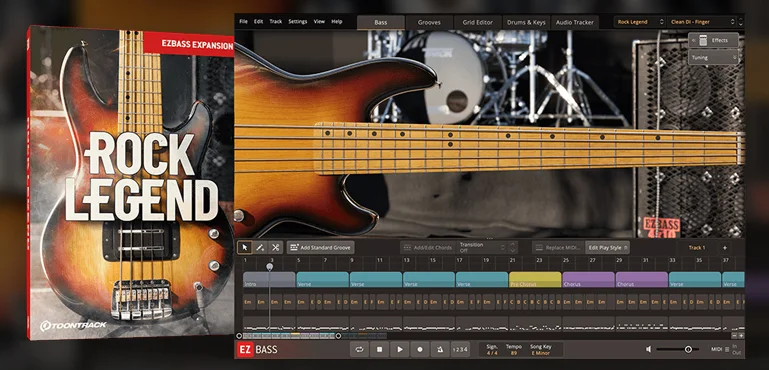
Unlike many modern bass expansions that attempt to cover multiple genres, Classic Rock EBX is intentionally focused. The library is built around vintage-inspired electric bass tones captured for traditional rock production, with articulations and performance options designed to support realistic bass programming rather than exaggerated modern processing.
For EZbass users, the practical value comes from the combination of playable bass tones, MIDI workflow integration, articulations, performance control, and mix-friendly source recordings that can be adapted to a wide range of rock-oriented productions without extensive corrective processing.
That design choice affects more than tone. It influences how the instrument behaves throughout the entire production process.
Many virtual bass instruments are designed to impress during the first thirty seconds of playback. They arrive with aggressive compression, enhanced low-end, and a level of polish that can feel finished before a mix even begins. While those characteristics can speed up songwriting and demo production, they often reduce flexibility once multiple instruments start competing for space.
Classic Rock EBX takes a different approach. The recordings contain enough character to avoid sounding sterile, but they leave substantial room for engineering decisions. The bass retains natural dynamics, usable midrange information, and a frequency balance that can be shaped according to the needs of the production rather than forcing the production to adapt to the instrument.
That distinction becomes particularly valuable during mixing. Instead of spending time undoing excessive processing baked into the source material, engineers can focus on relationships that actually matter: how the bass interacts with the kick drum, how it supports guitar layers, and how it contributes to overall low-end translation.
For EZbass users, Classic Rock EBX is less about adding another collection of presets and more about expanding the platform with a set of bass recordings that remain adaptable from arrangement through mastering. In an environment where many virtual instruments are optimized for immediate impact, that flexibility is arguably its most important feature.
What Is Included in Toontrack Classic Rock EBX?
Classic Rock EBX expands EZbass with a collection of vintage-inspired bass tones, performance articulations, MIDI integration tools, and mix-oriented source recordings designed for traditional rock production workflows.
How Classic Rock EBX Performs Inside Real Mixes
A bass library should not be judged by how it sounds in solo mode. It should be judged by how quickly it finds its place once the entire arrangement is playing.
In a finished rock mix, bass is constantly competing for space. It has to work alongside the kick drum, survive dense guitar arrangements, support vocal intelligibility, and remain stable under bus compression and final limiting. A bass tone that sounds impressive on its own can become difficult to manage once those variables are introduced.
This is where Classic Rock EBX performs better than many modern bass libraries built around oversized low-end and aggressive processing. The instrument naturally occupies the low-midrange areas that contribute to note definition and perceived weight, rather than relying primarily on sub-bass extension to create impact.
That distinction becomes apparent as a mix approaches completion. Instead of fighting excessive energy below the fundamental range of most playback systems, engineers can focus on balancing the relationship between bass and drums. The result is often a low end that feels more connected to the groove and less dependent on corrective processing.
From a mixing perspective, one of the strongest characteristics of Classic Rock EBX is that individual notes tend to remain identifiable even in dense arrangements. Bass lines retain articulation behind layered guitars instead of dissolving into a generic low-frequency foundation. This becomes particularly important in productions where bass movement contributes to the feel of the song rather than simply reinforcing root notes.
The benefit extends into mastering. Bass sources built around audible harmonic information generally translate more predictably through limiting, streaming normalization, codec conversion, and consumer playback systems. Much of that behavior is tied to how low-frequency information interacts with processing further down the chain, a topic explored in our guide on how a mastering chain actually works in real-world releases. Engineers spend less time restoring clarity that was lost in the production stage because much of the perceived weight already exists in frequency ranges listeners can actually hear on everyday devices.
Classic Rock EBX is not the deepest-sounding bass library available, nor is it designed to be. Its strength lies in producing bass tracks that remain intelligible, controllable, and musically connected to the arrangement long after the excitement of solo playback becomes irrelevant.
How Classic Rock EBX Improves Mixing Workflow
Most plugin reviews focus on sound. Far fewer discuss how a virtual instrument affects the speed and efficiency of the mixing process.
For working engineers, that distinction matters. The difference between a bass track that immediately fits into a production and one that requires extensive corrective processing can easily translate into hours of additional work across a project.
Every adjustment has consequences. Corrective EQ alters the relationship between bass and kick drum. Saturation changes harmonic balance and transient behavior. Compression affects note consistency and dynamic interaction. A bass source that arrives with fundamental tonal problems often triggers a chain reaction of decisions throughout the rest of the mix.
Classic Rock EBX generally avoids that scenario. The bass tones are balanced enough to establish a workable relationship with drums, guitars, and vocals without extensive repair work. Instead of spending the first stage of mixing solving low-end conflicts, engineers can move directly into shaping the musical interaction between instruments.
This may sound like a minor advantage, but it becomes increasingly important in professional workflows where revision cycles, deadlines, and project volume matter as much as sonic quality. A bass library that consistently reaches a usable starting point in less time delivers value long after the novelty of its presets wears off.
That may be the most overlooked aspect of Classic Rock EBX. Its strongest contribution is not a specific tone or feature set. It is the ability to reduce friction during the mixing process and allow engineers to focus on production decisions that actually influence the final record.
Best Genres for Toontrack Classic Rock EBX
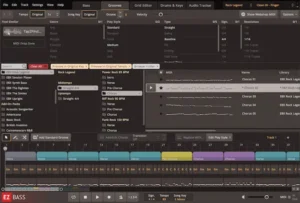 Classic Rock EBX delivers its strongest results in productions where bass is expected to support the arrangement rather than compete for attention. That distinction sounds obvious, but it separates a large portion of traditional rock-oriented music from many contemporary genres built around heavily featured low-end.
The expansion is particularly well suited to classic rock, blues rock, Americana, Southern rock, roots-oriented country rock, and vintage-inspired indie productions. It also fits naturally into singer-songwriter arrangements where the bass is responsible for reinforcing groove, harmony, and momentum without drawing focus away from vocals.
Across these styles, bass rarely functions as a standalone event. Its primary job is to connect the rhythm section to the harmonic structure of the song while maintaining forward motion through verse, chorus, and transitional sections. Excessive low-end hype often works against that objective because it shifts attention toward the sound of the instrument instead of its musical contribution.
Classic Rock EBX succeeds because its tonal character supports arrangement-level balance. The bass remains present without becoming intrusive, and it retains enough note definition to stay intelligible even when guitars, keyboards, and vocals begin competing for space.
That makes the library particularly useful for productions where the goal is not to showcase the bass itself, but to create a rhythm section that feels cohesive, controlled, and musically connected from the first mix pass through final mastering.
Where the Marketing Narrative Becomes Less Convincing
One of the recurring problems in the virtual instrument market is the assumption that a genre label automatically translates into genre suitability. A bass library marketed around classic rock aesthetics is not necessarily the right choice for every guitar-based production.
Classic Rock EBX has clear strengths, but it also has a defined operating range. Producers working in modern hard rock, active rock, progressive metal, metalcore, djent, or heavily processed streaming-oriented productions will often find themselves adding substantial compression, saturation, transient shaping, and low-end enhancement to reach contemporary expectations.
That does not mean the library fails in those environments. It means the production workflow begins moving away from the characteristics that made the expansion appealing in the first place. The more aggressively the bass must be reshaped, the less relevant its original tonal identity becomes.
There is another misconception worth addressing. The plugin industry frequently treats vintage tone as a shortcut to authenticity. In practice, authenticity is rarely determined by the source sound alone.
Convincing bass tracks are usually the result of arrangement choices, note placement, articulation, dynamics, and interaction with the rhythm section. Those factors have a far greater impact on realism than whether a library was captured through vintage equipment or modeled after a specific era.
Classic Rock EBX can provide an excellent foundation, but it cannot compensate for weak programming or poor musical decisions. A static MIDI performance will still sound artificial regardless of how detailed the samples are. Likewise, no bass library can create groove where none exists in the arrangement.
That limitation is not unique to Classic Rock EBX. It is simply a reminder that sample quality and production quality are not the same thing.
Classic Rock EBX vs Competing Bass Solutions
Comparing bass instruments purely by sound quality rarely produces useful conclusions. Most professional libraries are capable of delivering release-ready results. The more relevant question is how each platform approaches workflow, tonal flexibility, and genre specialization.
| Product | Core Philosophy | Strongest Applications | Potential Drawback |
|---|---|---|---|
| Toontrack Classic Rock EBX | Mix-ready traditional rock bass | Classic rock, blues rock, Americana, roots-oriented productions | Less optimized for heavily processed modern genres |
| IK Multimedia MODO Bass | Physical modeling and deep customization | Producers who need extensive control over instrument behavior | Requires more programming and tone development |
| Spectrasonics Trilian | Maximum sonic breadth | Multi-genre studios and composers working across diverse projects | Can slow decision-making due to library size |
| Submission Audio Bass Libraries | Genre-specific production focus | Modern metal, djent, progressive heavy music | Less natural outside specialized genres |
| Native Instruments Session Bassist Series | Fast songwriting workflow | Songwriters and producers prioritizing speed | Less detailed performance control |
What separates Classic Rock EBX from many competing solutions is not the number of sounds it offers. It is the consistency of its intended use case. The expansion was built around a specific production philosophy: bass should integrate into the arrangement naturally and require minimal corrective work once the mix begins.
That makes it a different proposition from products such as Trilian or MODO Bass. Those platforms provide significantly broader sonic territory, but they often ask users to spend more time searching, shaping, and refining sounds before reaching a final result.
By contrast, Classic Rock EBX is less concerned with tonal variety and more concerned with producing believable bass tracks inside traditional rock-oriented mixes. Producers looking for extreme flexibility may view that focus as a limitation. Engineers working under deadlines will often see it as an advantage.
Real-World Production Perspective: What Happens After the Mix Is Finished?
 Most plugin evaluations stop at the mixing stage. Real releases do not.
Once a track leaves the DAW, the bass is subjected to a series of processes that can dramatically alter how listeners perceive it. Many of those changes occur after upload, when streaming services apply their own playback rules, loudness management, and encoding processes. Understanding that stage is essential for anyone concerned with long-term translation and release quality. Mastering, loudness normalization, lossy encoding, streaming delivery, and consumer playback systems all place different demands on low-frequency content. A bass sound that feels powerful during production can quickly lose definition once those stages are introduced.
One of the more practical strengths of Classic Rock EBX is that its bass tones are built around information listeners can actually hear. Rather than relying heavily on extreme sub-frequency extension, much of the perceived weight comes from harmonic content, note articulation, and low-midrange presence.
That distinction has consequences beyond simple tone.
Bass lines remain easier to follow on earbuds, laptops, televisions, Bluetooth speakers, and other playback systems that struggle to reproduce deep low frequencies. Instead of hearing a vague sense of low-end energy, listeners can often distinguish individual notes and rhythmic movement within the performance.
Streaming platforms introduce another challenge. Lossy codecs and normalization algorithms can reduce the impact of bass information that exists primarily in the lowest octave. While no virtual instrument is immune to these limitations, bass sounds built around audible harmonics tend to retain more of their musical identity after encoding and playback conversion.
None of these advantages are exclusive to Classic Rock EBX. What makes the expansion noteworthy is how consistently these characteristics appear across its sound set. The library rarely produces bass tracks that feel oversized during production but disappear once they leave the studio environment.
That consistency becomes increasingly valuable in professional workflows. Engineers can make decisions with greater confidence because the bass they hear during production is more likely to resemble what listeners will hear after release.
Monitoring Considerations and Low-End Translation
Low-end decisions are only as reliable as the monitoring environment used to make them. Unfortunately, bass is also the frequency range most affected by room acoustics, speaker limitations, and monitoring inconsistencies.
This creates a common problem in project studios. Producers hear too much bass, compensate by removing low-end energy, and end up with thin mixes. Others hear too little bass, push low frequencies too aggressively, and create mixes that collapse outside the studio. In both cases, the issue is not necessarily the engineer’s judgment. It is the monitoring environment.
Virtual instruments can either expose that problem or amplify it. Bass libraries built around exaggerated sub-frequency content often encourage decisions that only work inside a specific room. What sounds massive on one monitoring system may become muddy, undefined, or overpowering everywhere else.
Classic Rock EBX generally avoids this trap because much of its perceived weight comes from note definition, harmonic structure, and low-midrange information rather than extreme sub-bass extension. The bass remains easier to evaluate even when monitoring conditions are less than ideal.
That does not eliminate the need for proper acoustic treatment or accurate monitoring, but it reduces the likelihood of chasing low-end that may not actually exist outside the studio. Engineers can make decisions based on musical balance and performance detail rather than reacting to room-induced frequency anomalies.
This becomes particularly important when mixes move between playback systems. Bass tones that derive their presence primarily from audible harmonic content tend to maintain their identity more consistently across headphones, earbuds, laptops, consumer speakers, and automotive systems.
Translation failures remain one of the most common reasons otherwise well-produced tracks struggle after release. In many cases, what appears to be a mastering issue actually originates much earlier in the production process through monitoring decisions, arrangement choices, and low-end balance problems.
Why Classic Rock EBX Speeds Up Rock Production Workflows
Audio production is often discussed in terms of sound quality, but professional workflows are shaped just as much by efficiency. The ability to reach a reliable result quickly can be as valuable as the result itself, particularly for engineers managing multiple projects, revision rounds, and client deadlines.
This is where many virtual instruments create hidden costs. A bass library may offer hundreds of presets and extensive tonal flexibility, yet require significant time to evaluate, modify, and fit into a mix. The additional hours spent auditioning sounds, correcting frequency conflicts, and refining processing chains rarely appear in product comparisons, but they directly affect production efficiency.
Classic Rock EBX takes a narrower approach. Rather than attempting to cover every possible bass sound, it focuses on a specific range of tones that already align with traditional rock-oriented productions. As a result, engineers can often reach a workable starting point faster and spend less time searching for solutions that should have existed at the source stage.
That advantage extends beyond tone selection. Because the expansion is built within the EZbass ecosystem, existing users can move immediately into performance editing, MIDI refinement, arrangement development, and songwriting without adapting to a new workflow. The platform remains familiar, which reduces friction throughout the production process.
There is a broader lesson here. More options do not always create better outcomes. In many cases, they simply create more decisions. For engineers focused on finishing records rather than collecting sounds, a curated set of usable bass tones can be more valuable than unlimited flexibility.
That principle extends well beyond virtual instruments. Our review of Effectrix 2 reached a similar conclusion: the most valuable production tools are often the ones that accelerate decision-making without introducing unnecessary complexity into the creative process.
Classic Rock EBX is a good example of that philosophy. Its strength is not that it offers more choices than competing products. Its strength is that it often requires fewer decisions before meaningful work can begin.
Classic Rock EBX vs Other EZbass Expansions
One of the more practical buying questions is not whether Classic Rock EBX sounds good, but how it fits within the broader EZbass ecosystem. Many EZbass users already own multiple expansions and are deciding where Classic Rock EBX fits within their existing workflow.
Compared to modern rock-oriented expansions, Classic Rock EBX places greater emphasis on note definition, organic dynamics, and traditional rhythm-section balance. It generally requires less corrective processing but offers less built-in aggression. Compared to genre-neutral expansions, it provides a more focused tonal identity and often reaches a usable mix position faster.
For producers working primarily with classic rock, blues rock, Americana, roots music, and vintage-inspired guitar productions, it remains one of the most purpose-built expansions currently available for EZbass.
Is Classic Rock EBX Worth It for Modern Producers?
Classic Rock EBX is best suited to producers who value mix-ready bass tracks over heavily stylized tones designed to impress in isolation. Its strengths become most apparent in genres where bass is expected to support the arrangement, reinforce groove, and maintain clarity without dominating the low end.
That makes the expansion particularly relevant for classic rock, blues rock, Southern rock, Americana, country rock, vintage-inspired indie productions, and songwriter-driven projects built around live instrumentation. In these styles, the bass is rarely the focal point of the record. Its role is to create stability, movement, and connection between the rhythm section and the harmonic structure of the song.
The library is also a practical choice for producers working with real guitars, acoustic instruments, and live-feeling arrangements. The tonal balance tends to integrate naturally alongside organic instrumentation without requiring extensive reshaping to avoid masking or low-end congestion.
Mix engineers may appreciate the expansion for a different reason. The bass tracks often arrive with fewer built-in processing decisions, making it easier to adapt them to the needs of a specific production rather than spending time undoing aggressive EQ, compression, or saturation choices embedded in the source sound.
Even from a mastering perspective, the library generally avoids some of the low-end excesses that can complicate final level optimization and translation. While mastering engineers are unlikely to choose a bass library themselves, they often benefit when production decisions upstream create fewer problems downstream.
Ultimately, Classic Rock EBX is not aimed at users searching for the biggest bass sound available. It is aimed at producers and engineers who care more about how the bass functions inside a record than how it sounds in solo playback.
Who Should Look Elsewhere?
Classic Rock EBX is not intended to be a universal solution, and treating it as one would ignore the realities of modern production. Its strengths are closely tied to traditional rock-oriented workflows, which means some producers will be better served by tools designed around different priorities.
Engineers working in modern metal, metalcore, djent, progressive metal, or contemporary active rock often require bass sounds with greater density, tighter transient control, more aggressive midrange shaping, and deeper integration with heavily processed guitar arrangements. While Classic Rock EBX can be pushed in that direction, doing so typically requires enough additional processing that its original character becomes less relevant.
The same production priorities appear throughout modern drum programming. In our analysis of Toontrack Progressive Metal ADpak, we found a similar emphasis on precision, transient control, and mix-ready aggression—qualities that often push productions away from the more organic workflow Classic Rock EBX was designed to support.
The same applies to productions built around modern streaming aesthetics, where bass is frequently expected to carry more low-end authority, sustain, and perceived loudness than traditional rock recordings. In these situations, genre-specific bass libraries may reach the desired result more efficiently.
Users seeking maximum tonal flexibility should also evaluate alternatives carefully. Platforms such as Trilian or MODO Bass provide broader sound-design possibilities, deeper customization, and a wider range of instrument models. Those capabilities come at the cost of additional complexity, but they may be preferable for producers who regularly move between multiple genres.
Classic Rock EBX performs best when its strengths align with the production goals of the project. Producers searching for extreme versatility or aggressively modern bass tones may find themselves working against the library rather than benefiting from it.
That is not a weakness so much as a consequence of specialization. Every focused tool solves certain problems exceptionally well while leaving others to products built for different applications.
Classic Rock EBX Pros and Cons
| Pros | Cons |
|---|---|
| Excellent mix integration | Less suitable for modern metal production |
| Fast workflow inside EZbass | Limited tonal range compared to Trilian |
| Strong low-end translation | Not designed for extreme bass processing |
| Natural note definition | Focused primarily on traditional rock styles |
| Requires less corrective EQ | May feel conservative for modern radio productions |
Overall Rating
| Category | Rating |
|---|---|
| Sound Quality | 9/10 |
| Workflow Efficiency | 9.5/10 |
| Mix Integration | 9.5/10 |
| Low-End Translation | 9.5/10 |
| CPU Efficiency | 9/10 |
| Genre Flexibility | 7.5/10 |
| Value for Money | 9/10 |
| Overall | 9.0/10 |
Classic Rock EBX is not the most versatile bass instrument available, nor was it designed to be. Its strength lies in delivering bass sounds that integrate naturally into finished productions, require minimal corrective processing, and remain reliable throughout mixing, mastering, and streaming delivery. For producers working in classic rock, blues rock, Americana, country rock, and other arrangement-driven genres, it remains one of the most practical and mix-friendly expansions in the EZbass ecosystem.
Verdict: One of the Most Useful EZbass Expansions for Mix-Focused Producers
Classic Rock EBX remains relevant because it addresses a problem that many virtual instruments still struggle to solve: creating bass tracks that work inside a finished record rather than simply sounding impressive during auditioning.
That also explains why source quality matters long before a project reaches the final release stage. A strong mix foundation typically creates fewer problems during mastering than any amount of corrective processing applied later. If you’re interested in what happens between the completed mix and the finished release, our guide on how professional mastering works in practice provides a detailed breakdown. The expansion succeeds because it consistently delivers bass sounds that integrate naturally with guitars, support the rhythm section, and remain manageable throughout mixing, mastering, and distribution.
That focus inevitably narrows its audience. Producers working in modern metal, active rock, or heavily processed contemporary genres will likely find more specialized tools better aligned with their needs. Likewise, users searching for maximum tonal variety may prefer broader platforms designed around customization rather than workflow efficiency.
For traditional rock-oriented productions, however, Classic Rock EBX occupies a valuable position within the EZbass ecosystem. It provides a collection of bass sounds that prioritize arrangement support, note definition, and low-end translation over sheer sonic spectacle.
Perhaps the most telling observation is that much of its value becomes apparent after the initial excitement of browsing presets has passed. The expansion tends to reveal its strengths during mixing, revision rounds, mastering preparation, and playback translation—stages where production decisions ultimately matter more than product demonstrations.
Viewed through that lens, Classic Rock EBX is less a collection of bass sounds and more a practical production tool. For engineers and producers working in classic rock, blues rock, Americana, country rock, and related genres, that may be a more useful distinction than any individual feature listed on a product page.

Yurii Ariefiev is a mastering engineer and audio production editor specializing in playback translation, low-end management, and release-ready audio for streaming platforms. His work focuses on how production decisions made during recording, programming, mixing, and mastering affect real-world listener experience after release.
This analysis examines Classic Rock EBX from a production and mastering perspective rather than a product-marketing perspective, with particular attention to bass translation, mix integration, monitoring reliability, and how virtual bass instruments behave in finished commercial releases.
FAQ
Is Classic Rock EBX suitable for professional releases?
Yes. The library is fully capable of commercial-quality results when paired with strong programming, arrangement decisions, and competent mixing. The limiting factor is rarely the source material itself.
Can Classic Rock EBX work in modern rock productions?
Yes, but the answer depends on the target sound. Modern rock often demands more compression, saturation, transient shaping, and low-end density than the library provides by default. Additional processing may be required to meet current production expectations.
How does Classic Rock EBX compare to a real bass recording?
A skilled bass player still offers advantages in timing, dynamics, articulation, and musical interaction. However, for many productions, a well-programmed Classic Rock EBX performance can deliver results that are difficult for listeners to distinguish within a full mix.
Is Classic Rock EBX CPU-intensive?
No. CPU usage is relatively modest compared to many modern virtual instruments. Most contemporary production systems can run the expansion without significant performance concerns.
Does Classic Rock EBX require extensive post-processing?
Generally less than many heavily stylized bass libraries. The sounds are balanced enough to fit naturally into rock-oriented productions while still leaving room for project-specific processing decisions.
Is Trilian a better choice than Classic Rock EBX?
Not necessarily. Trilian offers a much broader range of instruments and tonal possibilities. Classic Rock EBX focuses on a narrower workflow centered around traditional rock bass production. The better choice depends on whether flexibility or specialization is the priority.
How well does Classic Rock EBX translate to streaming platforms?
The library generally translates well because much of its perceived weight comes from harmonic information and note definition rather than excessive sub-frequency content. This helps preserve bass clarity across a wide range of playback systems.
Which genres benefit most from Classic Rock EBX?
Classic rock, blues rock, Americana, Southern rock, country rock, roots-oriented productions, and singer-songwriter material are among its strongest applications. These styles benefit from bass tones that support the arrangement without overwhelming it.
Can Classic Rock EBX be used in mastering-ready productions?
No instrument is inherently mastering-ready. However, the bass tones tend to require fewer corrective low-end adjustments than many aggressively processed alternatives, which can simplify later stages of production.
Is Classic Rock EBX worth buying if you already own EZbass?
If a significant portion of your work involves traditional rock-oriented music, the expansion offers a distinct tonal approach that can reduce sound-selection time and accelerate the mixing process. For producers focused primarily on modern metal or highly processed genres, other expansions may offer greater value.
Is Classic Rock EBX worth buying if you already own other EZbass expansions?
If most of your projects involve classic rock, blues rock, Americana, country rock, or vintage-inspired guitar productions, the expansion offers a noticeably different workflow advantage. The value comes less from adding new sounds and more from reducing the amount of processing required to reach a mix-ready result.