Creating believable distance has always been one of the more time-consuming parts of audio production. Traditional room simulation relies on a combination of EQ, level automation, stereo imaging, and reverb to convince the listener that a sound is coming from another room, behind a wall, or farther down a hallway. The result can be convincing, but building that illusion often means managing several processors and multiple automation lanes at once.
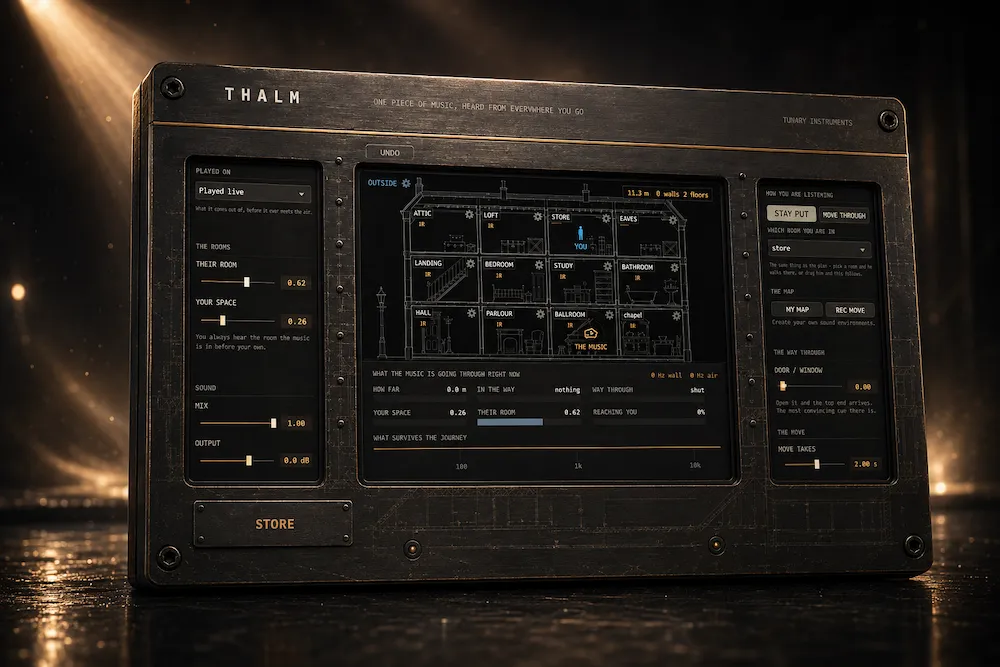
Thalm approaches the problem from a different angle. Instead of exposing acoustic parameters, it asks the engineer to work with physical space. Rooms, walls, doors, and listener position become the primary controls, while filtering, attenuation, and environmental perspective are generated by the plugin. The focus shifts from programming individual processing stages to defining where the sound exists within a virtual building.
That design immediately targets post-production, game audio, and cinematic sound design, where perspective changes are part of the narrative rather than occasional effects. For music production, however, the question is more nuanced. Does this approach genuinely reduce editing time, or does it simply replace familiar controls with a more attractive interface?
The answer depends less on the quality of the reverb engine than on the efficiency of the workflow. Thalm is not competing with traditional room processors on realism alone—it proposes a different way of building environmental perspective. That makes it one of the more interesting spatial audio releases of the year, but also one that deserves to be evaluated beyond its marketing language.
Priced at $89 during its introductory launch ($129 regular), Thalm targets post-production editors, game audio designers, and sound professionals who spend more time managing perspective changes than dialing in traditional reverb parameters.
Specifications at a Glance
| Developer | Tunary Instruments |
| Plugin Type | Environmental Perspective Processor |
| Formats | AU, VST3 |
| Operating Systems | macOS 11+, Windows 10+ |
| AAX | No |
| Custom IR Support | Yes |
| Launch Price | $89 |
| Regular Price | $129 |
Why Environmental Perspective Remains One of Audio Production’s Hardest Problems
 Creating believable acoustic distance has never been as simple as adding more reverb. When a sound needs to feel as though it originates behind a wall, down a hallway, or outside a building, engineers are balancing several psychoacoustic cues at once. Frequency balance changes as high frequencies are absorbed by walls and air. Direct sound loses level while early reflections become more prominent. Stereo width, transient definition, and perceived depth all shift together. If any one of those elements behaves unnaturally, the illusion falls apart.
That is why environmental perspective has traditionally been built from multiple processors rather than a single plugin. EQ shapes wall absorption, volume automation establishes distance, convolution or algorithmic reverbs recreate reflections, while additional automation keeps every parameter synchronized as the listener or sound source moves. The workflow is reliable, but it is also slow, especially when scenes change continuously.
Film and game audio expose this limitation more than music production. A camera moving from a street into a building—or from one room to another—requires the acoustic perspective to evolve naturally with the picture. Managing those transitions manually often means editing several automation lanes for what is ultimately one creative decision: where the listener is.
That is the production problem Thalm attempts to solve. Instead of asking engineers to automate individual DSP processes, it treats perspective as a physical relationship inside a virtual space. The engineer places a source, defines the listener’s position, and lets the plugin calculate how the environment changes as movement occurs. Whether the underlying acoustics outperform established room simulation tools remains open to independent evaluation, but the workflow itself addresses a genuine bottleneck in modern post-production.
That philosophy also explains why Thalm feels different from conventional spatial processors. It is less concerned with giving engineers finer control over reverb parameters and more focused on eliminating repetitive editing. For productions where movement drives the narrative, reducing five automation passes to a single editable path can save considerably more time than marginal improvements in reverb realism ever could.
Don’t Let Your Spatial Mix Fall Apart After Mastering
Creative spatial effects only work if they survive the final delivery stage. If you’ve built depth, movement, and realistic perspective into your mix, upload up to 35 seconds and receive a free mastering demo. You’ll hear how professional mastering preserves translation, clarity, and impact across real-world playback systems before committing to a full master.
Request your free mastering demo →
How Thalm Changes Real-World Production Workflows
Evaluating Thalm as another reverb misses its intended role. It is better viewed as a perspective processor designed to manage how a listener moves through an acoustic environment. That places it somewhere between room simulation, environmental sound design, and timeline-based post-production rather than alongside traditional ambience plugins.
The workflow is built around two operating modes. Stay Put keeps the sound source fixed while the listener moves through a virtual floor plan. Move Through records that movement directly on the timeline, allowing perspective changes to follow picture edits without manually writing multiple automation lanes.
That approach becomes valuable whenever acoustic perspective changes continuously. Consider a scene where music plays inside a café before following a character onto the street. A conventional workflow often combines EQ automation, level rides, reverb send adjustments, stereo image changes, and impulse response switching. All of those processes must remain synchronized to preserve a convincing sense of distance. Thalm replaces much of that manual coordination with a single editable movement path.
This is less about creating a more realistic reverb than reducing repetitive editing. For long-form productions with frequent location changes, saving even a minute or two per scene can translate into hours across an entire project.
The plugin is considerably less transformative for conventional music mixing. Most commercial records benefit from stable spatial placement rather than continuously shifting listener perspective. In those situations, dedicated reverbs still provide greater control over decay characteristics, early reflections, tonal balance, and mix integration. Thalm becomes relevant when movement itself is part of the production rather than simply supporting it.
That does not mean music producers should dismiss it. Cinematic intros, ambient transitions, concept albums, experimental electronic music, and narrative productions can all benefit from believable environmental movement without requiring complex automation. Used selectively, Thalm can create spatial transitions that would otherwise involve several processors working together.
Its support for custom floor plans and user-defined impulse responses further extends its usefulness in post-production. Studios working on recurring locations can build reusable acoustic layouts instead of recreating the same environmental perspective from scratch for every project. That capability is far more valuable than it first appears, particularly in television or episodic productions where consistency matters as much as realism.
One of the more intelligent design choices is the way Thalm handles movement between spaces. Conventional convolution reverbs typically jump from one impulse response to another, making transitions difficult to disguise without additional automation. Thalm instead treats movement as a continuous journey through connected rooms, producing perspective changes that feel more natural because they evolve rather than switch.
Mastering engineers, however, are unlikely to find a direct use case. By the time a project reaches mastering, spatial storytelling has already been established in the mix. Environmental perspective belongs to the production stage, not the final delivery stage.
The same principle applies to spoken-word productions, where subtle spatial processing can easily become distracting after final delivery. Our guide to podcast mastering explains why translation is often more important than the effect itself.
Ultimately, Thalm’s value is measured less by its acoustic algorithms than by the amount of editing it removes from complex sessions. It will not replace established reverbs, but it addresses a workflow that most spatial processors still leave almost entirely manual.
Best Use Cases
| Best Suited For | Less Suitable For |
|---|---|
| Film & TV post-production | Traditional stereo mastering |
| Game audio | Conventional pop and rock mixing |
| Trailer music production | Broadcast loudness processing |
| Sound design | General-purpose room reverb duties |
| Narrative podcasts | Daily mix-bus processing |
| Cinematic intros and transitions | Standard room reverb duties |
Thalm delivers its greatest value when listener perspective is part of the production itself. Projects involving movement through different acoustic environments benefit far more from its workflow than conventional music sessions built around a stable stereo image. Rather than replacing everyday reverbs, it fills a specialized role that many existing spatial processors leave largely untouched.
Separating Genuine Innovation from Product Positioning
 Every new spatial audio plugin promises to simplify complex production tasks. The important question is whether that simplification comes from better signal processing or simply a different interface. In Thalm’s case, the answer appears to be somewhere in between.
Its defining concept—treating rooms, walls, and listener position as the primary controls instead of exposing conventional reverb parameters—is genuinely different. Rather than automating EQ, level, reflections, and ambience independently, the engineer edits the physical relationship between the source and the listener. That is a meaningful shift in how environmental perspective is constructed.
That philosophy reflects a broader shift in modern audio software, where developers increasingly replace parameter-heavy interfaces with interaction models built around creative intent. We discussed a similar design direction in our Mastering The Mix MIXVAULT review, where EQ is controlled through a spatial workflow rather than a conventional frequency graph.
What remains unproven is whether the underlying acoustic simulation itself represents a technical breakthrough. Tunary Instruments has not published detailed information about its propagation model, diffraction handling, reflection engine, or frequency-dependent transmission algorithms. Without independent measurements or technical documentation, there is no basis for concluding that Thalm produces more accurate room simulation than mature convolution or hybrid reverberation platforms.
That distinction is important because interface innovation and DSP innovation are not the same thing. A faster editing process can be extremely valuable even if the underlying processing is relatively conventional. Professional engineers evaluate those categories separately, and Thalm currently earns more credit for the former than the latter.
This distinction also highlights why spatial plugins should be evaluated on different criteria. Some products compete by advancing reverb algorithms, while others rethink how engineers interact with space itself. We explored the DSP-first approach in our DEVPROAUDIO REVERSIDE review, which examines whether improvements in algorithmic reverberation alone are enough to change professional workflows.
The same perspective applies to replacement claims. Thalm can simplify environmental perspective, but it does not eliminate the rest of the production chain. A dialogue scene moving from a vehicle to an open street will still require dedicated dialogue processing, dynamics control, cleanup, ambience management, and often additional creative reverbs. The plugin reduces coordination between those processes—it does not replace them.
Several practical considerations also remain. There is currently no native AAX version for Pro Tools-based facilities, no published latency data, no independent CPU benchmarks under heavy session loads, and no blind listening tests comparing its acoustic realism against established alternatives. None of those issues are unusual for a first-generation release, but they do leave important questions unanswered for engineers working in demanding commercial environments.
Ironically, Thalm’s biggest challenge may be market perception rather than technical capability. Producers looking for another cinematic reverb could dismiss it because it does not behave like one, while engineers expecting a physically accurate acoustic simulator may discover that its primary strength lies in editing efficiency. Viewed as a perspective editor rather than a traditional room processor, the plugin makes considerably more sense.
Competitive Landscape: Where Thalm Fits in the Spatial Audio Market
Comparing Thalm directly with traditional reverbs oversimplifies what the plugin is designed to do. Its closest competitors are not stereo room processors, but specialized tools that address spatial perception, environmental realism, and post-production editing. Even within that category, however, each product solves a different problem.
| Product | Core Technology | Primary Application | Where It Excels | Where Thalm Differs |
|---|---|---|---|---|
| Audio Ease Altiverb | Convolution reverb | Film, post-production, scoring | Highly realistic room reproduction using extensive impulse response libraries | Focuses on recreating spaces rather than editing movement between them |
| dearVR Pro | Object-based 3D positioning | Immersive audio and VR | Precise binaural and multichannel localization | Designed for spatial placement rather than architectural perspective |
| Sound Particles | Particle-based spatial engine | Film and game audio | Large-scale cinematic environments with advanced object management | Far broader in scope, but significantly more complex |
| Fiedler Audio Spacelab | Immersive mixing platform | Dolby Atmos production | Professional object-based immersive workflows | Optimized for multichannel delivery instead of environmental storytelling |
| Tunary Thalm | Architectural perspective processing | Environmental movement and scene transitions | Fast timeline-based editing of listener perspective | Smaller ecosystem and limited long-term validation |
Altiverb remains the reference point whenever the objective is reproducing a real acoustic environment with maximum authenticity. Its extensive impulse response library and long history in commercial post-production make it difficult to challenge as a traditional room simulation platform. Engineers choosing Altiverb are typically searching for a specific space rather than a faster editing workflow.
Thalm addresses a different stage of the production process. Instead of recreating the acoustics of a single room, it focuses on how perspective changes as a listener moves between spaces. That distinction becomes particularly relevant when editing scenes that transition through multiple environments, where maintaining believable continuity often requires substantial automation.
The comparison with immersive audio platforms is equally important. Products such as dearVR Pro and Spacelab solve localization problems inside three-dimensional playback systems, whether binaural, surround, or Dolby Atmos. Thalm is not competing for the same role. It is concerned with how sound behaves as architecture changes around the listener, not where audio objects are positioned within an immersive mix.
That difference means many professional studios could justify owning both categories of tools. One manages object placement; the other manages environmental perspective. Those responsibilities overlap occasionally but rarely replace one another.
Pricing also works in Thalm’s favor. Its introductory cost places it well below many established post-production platforms, making it an accessible addition for independent editors, composers, and smaller facilities. The lower investment also reduces the risk of adopting a specialized processor for occasional projects.
The larger question is long-term maturity. Established competitors benefit from years of compatibility updates, documented workflows, educational resources, and widespread commercial adoption. Thalm has yet to demonstrate that same level of reliability across demanding productions. Early adopters are investing primarily in an innovative editing concept rather than a fully established production ecosystem.
Viewed in that context, Thalm is unlikely to replace the spatial tools already found in professional studios. Instead, it fills a gap that many existing processors leave largely untouched: building believable environmental movement without relying on extensive manual automation.
What We’d Like to See in Future Versions
Thalm already introduces one of the more original workflow concepts in recent spatial audio software, but several additions could make it significantly more attractive for professional facilities.
- Native AAX support for seamless integration into Pro Tools-based post-production environments.
- Independent CPU and latency benchmarks to help engineers evaluate performance in large commercial sessions.
- Expanded multichannel support for more complex immersive and surround production workflows.
- Additional architectural templates covering common production environments such as apartments, offices, public venues, and transportation spaces.
- Advanced movement editing tools for refining complex listener paths without relying on manual redraws.
- Long-term workflow validation through broader adoption across film, television, and game audio production.
None of these areas diminish the originality of the current release. Instead, they represent the next logical steps that could move Thalm from an innovative specialist tool toward wider adoption in professional production environments.
How Thalm Performs in Real Production Scenarios
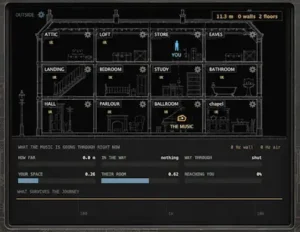 The value of a spatial processor is rarely determined by how it sounds in isolation. What matters is whether it integrates naturally into an existing production workflow without creating additional editing or mixing problems. That is where Thalm deserves closer examination.
For conventional music mixing, its role is intentionally narrow. Most commercial productions rely on stable stereo imaging and consistent spatial depth throughout the song. Constantly shifting listener perspective quickly becomes distracting unless it supports the arrangement. In practice, Thalm is better suited to intros, transitions, cinematic interludes, ambient productions, and concept-driven records than everyday mix processing.
Its strengths become much more apparent in post-production. Perspective changes occur constantly as scenes move between rooms, buildings, vehicles, or outdoor environments. Recreating those transitions manually often requires coordinated automation across EQ, level, ambience, stereo image, and multiple reverbs. Thalm reduces much of that work by treating environmental movement as a single editable event instead of several independent processes.
Many of the same challenges appear in interactive media, where perspective changes must remain convincing across unpredictable gameplay. Our article on video game mastering explores how those production decisions translate through the final delivery stage.
Monitoring also influences how convincing the effect feels. Full-range studio monitors reveal subtle changes in spectral balance, reflections, and perceived distance that are easily masked by laptop speakers or mobile devices. Fortunately, the larger spatial cues created by movement tend to remain perceptible even when playback systems compress dynamic range or limit frequency extension.
Mastering engineers are unlikely to interact with Thalm directly, but they should still evaluate mixes containing heavy environmental processing on multiple monitoring systems. Perspective effects that feel convincing in a treated control room can become exaggerated—or nearly disappear—once translated to consumer playback. That is not a limitation of Thalm itself, but of any processor built around spatial perception.
The largest unknown remains performance under production-scale workloads. At the time of writing, there are no independent CPU benchmarks, latency measurements, or stress tests showing how large numbers of simultaneous instances behave in feature-length sessions. Fortunately, most projects are unlikely to require environmental simulation across dozens of tracks, making overall processor demand less critical than it would be for EQs, compressors, or reverbs used throughout an entire mix.
Ultimately, Thalm succeeds or fails based on editing efficiency rather than raw DSP specifications. If it consistently replaces several automation passes with a single movement path, it offers measurable value regardless of whether its underlying algorithms prove to be more sophisticated than existing room simulation technologies.
Verdict: An Original Idea That Solves the Right Problem
Most spatial processors compete by offering another flavor of room simulation. Thalm takes a different approach. Instead of improving how a room sounds, it improves how engineers build acoustic perspective in the first place. That shift is more significant than it initially appears because it targets one of the most repetitive tasks in post-production: keeping multiple automation processes synchronized as perspective changes throughout a scene.
That does not automatically make Thalm a better reverb, nor does it position the plugin as a replacement for established convolution processors or immersive production platforms. Engineers looking for the most accurate room reproduction will still find more mature solutions elsewhere. Thalm’s strength lies in production efficiency, not in replacing the existing spatial toolkit.
For post-production, game audio, cinematic sound design, and narrative content, the concept has clear practical value. Reducing complex perspective changes to a single editable path can save meaningful production time while making revisions considerably easier. That advantage becomes more important as projects grow in length and complexity.
Once those spatial decisions are finalized, the remaining challenge is ensuring they survive the mastering stage without losing depth or translation across playback systems. We cover that process in more detail in our Film Score Mastering guide.
Its role in music production is narrower. Most commercial mixes benefit from stable imaging rather than continuously changing listener perspective, making Thalm better suited to transitional effects, atmospheric arrangements, and productions where environmental movement contributes directly to the composition.
Mastering engineers, on the other hand, have little reason to incorporate Thalm into their own process. By the mastering stage, spatial decisions should already be finalized, leaving environmental simulation firmly within the domain of production and mixing.
There are still unanswered questions. Independent CPU benchmarks, latency measurements, blind listening tests, and long-term reliability data are not yet available. Those omissions do not diminish the originality of the concept, but they do make it difficult to judge how well the plugin will hold up under demanding commercial workloads.
Ultimately, Thalm succeeds because it addresses a genuine production bottleneck instead of inventing a new category in search of users. It will not replace the spatial processors already established in professional studios, but it offers a faster and more intuitive way to build environmental perspective when movement is central to the story.
Final assessment: Thalm is not an essential purchase for every engineer, nor is it trying to be. For professionals working in film, television, game audio, or other narrative formats, it represents one of the more original workflow concepts to appear in recent years. For conventional music production, it is best viewed as a specialized creative processor—valuable when the project demands it, unnecessary when it does not.
Overall Rating
| Category | Rating |
|---|---|
| Workflow Innovation | 9.6/10 |
| Spatial Processing Concept | 9.2/10 |
| Professional Workflow Integration | 8.8/10 |
| Production Efficiency | 9.4/10 |
| Platform Maturity | 7.6/10 |
| Value for Money | 9.1/10 |
| Overall | 8.9/10 |
Workflow Innovation — 9.6/10
This is where Thalm clearly stands out. Replacing multiple automation lanes with a single movement-based editing model addresses a genuine post-production bottleneck instead of introducing another variation of a familiar effect.
Spatial Processing Concept — 9.2/10
The architectural approach is genuinely original and encourages engineers to think in terms of physical perspective rather than individual DSP parameters. Whether it also delivers more accurate acoustics than established room processors remains unverified.
Professional Workflow Integration — 8.8/10
Thalm integrates naturally into film, television, game audio, and narrative production. Its practical value is considerably lower for conventional stereo mixing, where stable imaging usually takes priority over continuous perspective changes.
Production Efficiency — 9.4/10
For sessions involving frequent location changes, the plugin has the potential to reduce repetitive editing significantly. Faster revisions may prove to be a greater advantage than any improvement in the underlying room simulation itself.
Platform Maturity — 7.6/10
As a first-generation product, Thalm still lacks independent CPU benchmarks, latency measurements, long-term commercial validation, and native AAX support. Those factors prevent it from receiving a higher engineering score despite its strong concept.
Value for Money — 9.1/10
At its introductory price, Thalm offers an unusually fresh production workflow at a cost well below many established post-production tools. For engineers working with environmental storytelling, the potential return on investment is compelling.
Overall — 8.9/10
Thalm is not attempting to become the next universal reverb plugin. Its value comes from simplifying one of the most time-consuming aspects of spatial editing. For post-production, game audio, and cinematic workflows, it introduces one of the most interesting interface concepts seen in recent years, even if its long-term technical standing is still developing.
Don’t Lose the Depth You Worked So Hard to Create
Building convincing space, movement, and depth takes careful production decisions. A poor final master can flatten those details, reduce separation, and make complex spatial effects translate unpredictably across streaming platforms, headphones, cars, and consumer speakers. Professional mastering isn’t about adding more processing—it’s about protecting the work that’s already in your mix.
Before you release your track, hear what experienced mastering can preserve. Upload up to 35 seconds of your mix and receive a free mastering demo prepared by a real mastering engineer. Compare the results on your own monitors and decide based on what you hear.
Request your free mastering demo →
Frequently Asked Questions
Is Thalm a reverb plugin or a room simulation tool?
Neither description is entirely accurate. Thalm is better viewed as a perspective processor that models how a listener experiences sound while moving through connected spaces. Reverb is only one component of that larger acoustic simulation.
How is Thalm different from Altiverb?
Altiverb is designed to reproduce the acoustic signature of real spaces using impulse responses. Thalm focuses on transitions between spaces, allowing engineers to edit listener movement instead of manually automating multiple processing stages.
Can Thalm replace traditional reverbs in a mix?
No. It is a specialized processor rather than a general-purpose room reverb. Most productions will continue to rely on conventional reverbs for ambience while using Thalm only where environmental movement is part of the creative intent.
Is Thalm worth buying for music producers?
That depends on the type of projects you produce. Cinematic music, ambient compositions, game soundtracks, and experimental productions can benefit from its perspective-based workflow. For standard pop, rock, or hip-hop mixing, it is likely to remain an occasional creative tool rather than an everyday processor.
Does Thalm improve mixing or mastering quality?
Not directly. The plugin is designed to simplify environmental perspective rather than improve tonal balance, dynamics, or loudness. Its value comes from faster editing and more believable spatial transitions.
How CPU-intensive is Thalm?
There are currently no independent benchmark results measuring CPU load, latency, or large-session performance. Until objective testing becomes available, engineers should treat processor efficiency as an open question rather than relying on assumptions.
Does Thalm work with Pro Tools?
Thalm currently supports AU and VST3 formats. An AAX version has not been announced, which may limit its adoption in Pro Tools-based post-production environments.
Is Thalm useful for Dolby Atmos or immersive audio?
It can complement immersive productions by creating convincing environmental perspective before object placement, but it is not a substitute for Dolby Atmos authoring or object-based spatial mixing software.
Who benefits most from Thalm?
Film editors, post-production mixers, game audio designers, trailer composers, and sound designers are likely to see the greatest return. Those workflows involve frequent perspective changes that traditionally require extensive automation.
Can Thalm replace a convolution reverb?
No. Thalm is designed to complement convolution reverbs rather than replace them. Its strength lies in editing environmental perspective and movement between spaces, whereas convolution reverbs remain the reference for reproducing the acoustic signature of real environments. Long-term adoption will depend on continued development, broader format support, and independent validation.

Yurii Ariefiev reviews audio software from the perspective of real production workflows, evaluating how new tools perform inside professional mixing, post-production, and mastering environments rather than relying on feature lists or marketing claims. His editorial focus is practical usability, long-term studio value, and reliable translation across real-world playback systems.
This analysis examines Thalm as a production tool for creating believable acoustic perspective, efficient scene transitions, and spatial storytelling, with particular attention to where it fits into modern studio workflows—and where traditional production techniques still outperform automation-driven workflows.