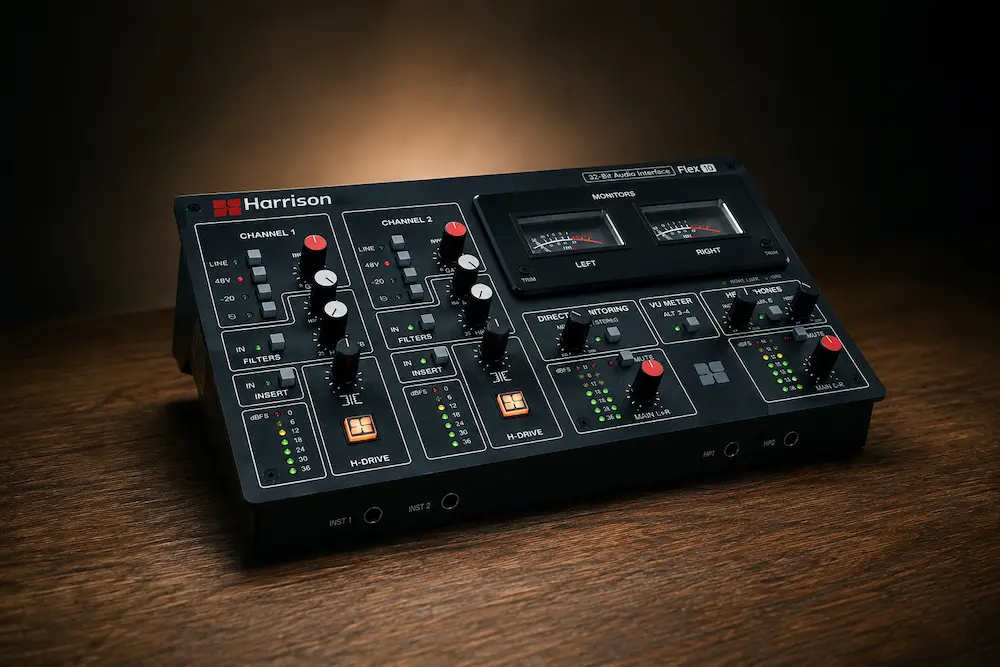
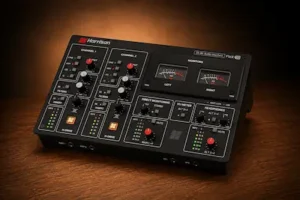
The Harrison Flex-10 is built around a workflow that many modern interfaces largely leave to plugins: shaping the source before it reaches the DAW. Its two main channels combine Harrison mic preamps with H-Drive transformer saturation, high- and low-pass filtering, and balanced inserts, while USB-C, ADAT, MIDI, dual monitor outputs, and two headphone outputs handle the digital studio side.
That makes the Flex-10 more interesting as an analog front end for recording and hybrid mixing than as another 10-in/12-out USB interface. The real question is whether committing some tone and filtering before conversion provides enough practical benefit to justify the Harrison over cleaner, more I/O-heavy alternatives.
For a hybrid studio, there is a credible argument. For an engineer who records clean and does everything else in the box, much of the Flex-10’s appeal disappears. There is also a limit to what can be concluded from the launch specifications alone: independent measurements of converter performance, latency, noise, and H-Drive’s harmonic behavior are not yet available. Until those tests exist, the Flex-10 should be judged primarily on its signal-path design and workflow, not on unverified claims of superior sound quality.
Review basis: This review evaluates the Flex-10 from an engineering and workflow perspective, with particular attention to its analog signal path, hybrid integration, recording decisions, and the limits of the specifications currently available. It does not treat manufacturer claims as independent measurements.
Harrison Flex-10 Pros and Cons
Pros: Harrison H-Drive transformer saturation on two mic preamps; analog high-pass and low-pass filters; balanced inserts on both main channels; ADAT expansion; flexible monitoring; dual headphone outputs; MIDI I/O; tactile VU metering; Harrison Mixbus 12 and Creator Pack included.
Cons: only two channels receive the distinctive Harrison analog processing; committing saturation and filtering during recording is not reversible; independent converter and latency measurements are still unavailable; the interface is less compelling for completely in-the-box producers; the value proposition depends heavily on actually using the analog front end.
Our verdict: The Flex-10 is most convincing as a compact hybrid recording interface rather than a universal replacement for a clean multi-channel interface. Its strongest advantage is the combination of H-Drive, analog filtering and balanced inserts before A/D conversion.
Harrison Flex-10 Specifications
| Specification | Harrison Flex-10 |
|---|---|
| Computer Connection | USB-C |
| USB I/O | 10 inputs / 12 outputs |
| Maximum Resolution | 32-bit / 192 kHz |
| Microphone Preamps | 2 Harrison mic preamps |
| H-Drive | 2 transformer saturation circuits |
| Analog Filters | High-pass and low-pass filters on both main channels |
| Hi-Z Inputs | 2 front-panel inputs |
| Line Inputs | 2 |
| Analog Inserts | 2 balanced inserts |
| ADAT | 8-channel I/O |
| MIDI | MIDI In/Out via 3.5 mm TRS |
| Monitor Outputs | 2 independent stereo outputs |
| Headphone Outputs | 2 |
| VU Meters | 2 front-panel meters |
| Operating Systems | macOS Class Compliant; Windows via supplied ASIO driver |
| Included Software | Harrison Mixbus 12 + Harrison Creator Pack |
Harrison Flex-10 Review: Quick Navigation
What Makes the Harrison Flex-10 Different?
 The interface market has largely standardized the basics: clean conversion, low-latency monitoring, ADAT expansion, multiple headphone outputs, and software-controlled routing. SSL, Audient, Focusrite, MOTU, and others already cover those requirements well. The Flex-10 therefore needs to justify itself somewhere other than its 10-in/12-out specification.
That justification is the analog signal path.
Its two main input channels combine Harrison mic preamps with H-Drive transformer-based saturation, a -20 dB pad, polarity reversal, and switchable phantom power. Each channel also has Harrison’s high- and low-pass filters and a balanced insert. Additional line and Hi-Z inputs, eight channels of ADAT I/O, MIDI, and the monitoring section turn it into a conventional interface when needed, but those features are not what distinguish it.
In practical use, the signal path can be understood as:
Microphone → Harrison preamp → H-Drive → analog filtering → hardware insert → A/D → DAW
That sequence moves several mix decisions to the recording stage. A software saturation plugin can add comparable coloration after the fact, but it cannot shape the signal before conversion or before an external compressor or EQ in the analog path. The trade-off is permanence: once you record substantial transformer coloration or aggressive filtering, that processing is part of the source.
That is not inherently better than staying clean. It is simply a different engineering decision. The Flex-10 makes the most sense for engineers who deliberately want to commit some character and processing at the front end rather than treating the interface as a transparent gateway into the DAW.
Harrison Flex-10 H-Drive: What Does It Actually Do?
H-Drive is the Flex-10’s most consequential feature because it puts transformer-based saturation directly in the recording path. Harrison describes it as a circuit that takes the input stage from clean operation toward a more colored response. In practical terms, the relevant question is not whether it sounds “vintage,” but how much useful harmonic density it can add before the signal reaches the DAW.
That can be effective on sources that need more weight or midrange information without relying entirely on post-recording saturation. A vocal can gain density, a bass DI can develop more harmonics that remain audible on smaller playback systems, and a clean guitar or synth can acquire additional texture before mixing begins.
The limitation is equally important: H-Drive is a recording decision, not a mix-stage effect. If the saturation is printed, it cannot be bypassed later. A vocal that sounded better during tracking may prove too dense once layered with the rest of the production; a bass that benefited from extra harmonics may become difficult to control; a mix that later needs more high-frequency openness cannot remove the recorded transformer character with a plugin.
That makes H-Drive most useful when the engineer already understands the source and wants to commit a controlled amount of coloration. Used that way, it is a legitimate front-end workflow tool. Used simply because “analog” is supposed to sound better, it is easy to turn a useful recording stage into a problem the mix engineer has to repair.
Harrison Flex-10 Mic Preamps: Can They Replace a Dedicated Preamp?
For many compact hybrid studios, the Flex-10 can reduce the need for a separate character preamp because its two main channels already combine Harrison microphone preamps with H-Drive transformer saturation, analog filtering and balanced inserts. That creates a usable front-end chain without adding another piece of hardware between the microphone and converter.
It does not make a dedicated premium preamp obsolete. A separate unit may still offer a different transformer topology, more gain, additional tonal controls, more channels, or a specific sound that an engineer already knows. The Flex-10’s advantage is integration rather than unlimited front-end choice.
If you need one or two character-equipped input channels, the Flex-10 can cover that role without a separate preamp. Once the studio needs four or more comparable channels, the advantage becomes much less clear.
Harrison Flex-10 Analog Filters: What Do They Actually Do?
The Flex-10’s high-pass and low-pass filters are less marketable than H-Drive, but they may be more useful in day-to-day recording. They address a basic console task: controlling the bandwidth of a source before unnecessary energy reaches the converter.
Used appropriately, a recording-stage filter can remove subsonic rumble, handling noise, excessive proximity buildup, or unwanted high-frequency content before the track enters the DAW. On a vocal, for example, a sensible high-pass setting can keep low-frequency junk out of every take rather than forcing the mix engineer to clean it up later.
There is nothing technically revolutionary here. The advantage is consistency and commitment. An engineer can establish a repeatable input path for vocals, guitars, bass or other sources and know that the same basic bandwidth control is being applied before recording.
But this is also where the Flex-10’s analog approach needs to be judged realistically. A DAW can perform the same filtering after recording, with no additional hardware cost and complete reversibility. There is little reason to print an analog filter merely to remove a problem that could have been handled later. The stronger use case is when the filter is part of the intended source tone or when removing unwanted energy before conversion simplifies the rest of the signal chain.
That distinction also applies to console-style processing inside the DAW. Harrison’s software approach takes a similar view of filtering, EQ, dynamics, and gain control as part of a repeatable channel workflow rather than as isolated effects; our Harrison 32Classic Channel Strip V2 review examines how that philosophy translates into modern mixing sessions.
Harrison Flex-10 vs. 32Classic: Hardware or Plugin?
The Flex-10 and Harrison 32Classic share a clear design philosophy: both bring Harrison’s console approach into a modern production workflow, but they operate at different stages of the signal chain. The Flex-10 shapes the source before A/D conversion, while the 32Classic works inside the DAW after the audio has already been recorded.
A plugin remains editable throughout the mix. H-Drive, analog filtering and hardware processing through the Flex-10 do not: once printed, they are part of the recorded source. The hardware is therefore better suited to engineers who want to make tonal decisions during tracking, while the 32Classic is the more flexible option when those decisions need to remain reversible.
Our Harrison 32Classic Channel Strip V2 review looks at the same console-inspired philosophy from the software side. The two products are therefore better understood as complementary tools than as direct substitutes.
Harrison Flex-10 Balanced Inserts: How the Hybrid Workflow Works
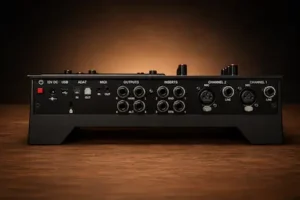 The balanced inserts may be the Flex-10’s most useful feature for a studio that already owns outboard gear. Each of the two main input channels can place external processing directly in the analog signal path:
Mic preamp → external compressor or EQ → A/D converter → DAW
That makes the Flex-10 more than an interface sitting between microphones and a computer. A hardware compressor, 500-series module, EQ, or saturation processor can remain permanently integrated into the recording chain without relying on DAW routing or an additional patching system. The same principle becomes relevant later in the production chain when engineers build a hardware-based mastering chain, where the order and role of each processor can matter as much as the individual hardware itself.
For an established hybrid studio, that can be a meaningful workflow advantage. The engineer can build a repeatable front end around two critical sources — typically vocals, bass, guitars, or other mono inputs that benefit from dedicated hardware — while leaving the rest of the production inside the DAW.
It also exposes one of the Flex-10’s limitations: only two channels get this Harrison-style analog treatment. A studio that needs four or more hardware-integrated recording channels may get more practical value from an interface with more analog inputs or a more extensive patching architecture.
That is why raw I/O count is a poor way to evaluate this interface. Ten inputs do not automatically make the Flex-10 more useful than an interface with fewer or more channels. Its value depends on whether those two processed analog channels fit the way the studio actually records and mixes.
Harrison Flex-10 Converter Performance: What Does 32-Bit/192kHz Actually Mean?
The Flex-10’s 32-bit/192kHz specification is a capability, not a performance verdict. It does not by itself establish that the interface has better conversion than an Audient, SSL, MOTU, or another modern studio interface.
Converter performance is determined by a much broader set of measurements: dynamic range, noise floor, THD+N, linearity, analog headroom, channel matching, clocking behavior, and output performance. None of those can be inferred reliably from bit depth and maximum sample rate alone.
The problem is that several established competitors publish substantially more technical data. Audient, for example, specifies up to 120 dB A-weighted ADC dynamic range, 126 dB A-weighted DAC dynamic range, -126 dBu microphone EIN, and sub-0.0003% ADC THD+N for the iD44 MKII under its stated test conditions. SSL publishes -130.5 dBu A-weighted microphone EIN and more than 120 dB of monitor-output dynamic range for the SSL 12.
Comparable independent measurements for the Flex-10 were not available when this review was prepared. That leaves an important question open: how good is the converter section when measured rather than specified? Until proper loopback, noise, distortion, and latency tests are available, there is no technical basis for calling the Flex-10 a superior converter.
And it does not need to be one. The stronger case for the Harrison is its front-end architecture: H-Drive saturation, analog filtering, balanced inserts, and a workflow designed to let the engineer make tonal decisions before the signal enters the DAW.
Harrison Flex-10 vs. Audient, SSL and MOTU: Which Should You Buy?
The Harrison Flex-10 is best compared with the Audient iD44 MKII, SSL 12 and MOTU UltraLite-mk5 by workflow rather than raw I/O count. Each takes a different approach to recording, hardware integration and expansion. Its closest alternatives overlap in features, but they prioritize different things: Harrison emphasizes analog source shaping, Audient emphasizes flexible recording I/O, SSL combines conventional connectivity with its own 4K coloration, and MOTU puts far more emphasis on routing and digital control.
| Interface | Core Strength | Analog Character | Hardware Integration | Digital Expansion | Best Fit |
|---|---|---|---|---|---|
| Harrison Flex-10 | Analog front-end workflow | H-Drive + Harrison filters | Two balanced inserts | ADAT | Hybrid recording and mixing |
| Audient iD44 MKII | Multi-channel recording I/O | Primarily clean | Two balanced inserts | ADAT + S/PDIF | Recording and hybrid studios |
| SSL 12 | Four-preamp desktop interface | Legacy 4K coloration | Less focused on inserts | ADAT | Tracking and project studios |
| MOTU UltraLite-mk5 | Routing and I/O density | Primarily DSP-based processing | Extensive digital routing | ADAT + S/PDIF + extensive I/O | Complex hybrid rigs |
The Audient iD44 MKII is one of the most direct alternatives for a hybrid studio. It provides four mic preamps, two balanced inserts, ADAT expansion, dual headphone outputs, and extensive monitor control. Its published technical measurements also give buyers a clearer picture of converter and preamp performance than is currently possible with the newly introduced Harrison.
The SSL 12 takes a different route. It provides four mic inputs, two Hi-Z inputs, ADAT, MIDI, and SSL’s Legacy 4K coloration. That gives it more simultaneous mic inputs than the Flex-10 and makes it a strong choice for tracking-heavy setups. SSL also publishes detailed performance specifications, which is useful when technical transparency and latency matter as much as analog character.
The MOTU UltraLite-mk5 is the outlier. Its appeal is not a Harrison-style analog front end but a much deeper routing and DSP architecture with substantially more I/O flexibility. For a studio running several hardware synthesizers, processors, monitor feeds, or complex DAW routing, that can outweigh the Flex-10’s two character-focused input channels.
The decision is therefore straightforward: choose the Flex-10 when its analog input path is the reason you are buying the interface. Choose Audient or SSL when you need more conventional recording I/O, and look at MOTU when routing flexibility and system expansion are more important than transformer coloration at the front end.
Who Is the Harrison Flex-10 For?
The Harrison Flex-10 is aimed primarily at producers, recording engineers and hybrid studios that want analog source shaping before the DAW without moving to a full-size console or large-format patching system.
Buy it if: you want two Harrison preamps with H-Drive, you regularly record vocals, bass, guitars or synths through hardware, you use external compressors or EQs, or you are building a compact hybrid studio around ADAT expansion.
Think twice if: you record everything clean, work almost entirely in the box, need four or more character-equipped microphone channels, or are buying primarily for the claimed converter performance. The Flex-10’s strongest justification is its analog workflow, not its 32-bit/192 kHz specification.
For mastering engineers: the use case is narrower. H-Drive and the analog inputs may be useful for intentional coloration, but the Flex-10 should not be treated as a mastering reference interface until independent measurements establish its conversion, noise, channel matching and latency performance.
Using the Harrison Flex-10 for Recording, Mixing and Mastering
The Flex-10 is most convincing as a recording and hybrid-mixing interface. Its case for mastering is much narrower, because the priorities change once the job moves from shaping individual sources to evaluating the finished mix. That distinction is fundamental to mixing vs. mastering, and it explains why the Flex-10’s analog front-end features are more immediately useful during recording and mix preparation than as a primary mastering conversion stage.
For tracking, the architecture is straightforward. A vocal can be recorded through the Harrison preamp with controlled bandwidth and a chosen amount of H-Drive. A bass DI can be given additional harmonic content before it reaches the DAW, while guitars, synths, and other sources can pass through external hardware via the balanced inserts. The advantage is not that these processes are impossible in software; it is that they can become part of a repeatable analog input chain before recording.
During mixing, the inserts become more useful than the preamps themselves. A favorite compressor, EQ, or other processor can remain connected to one of the two insert paths, turning the Flex-10 into a fixed hardware I/O point rather than forcing the engineer to rebuild the routing for every session.
Mastering is a different proposition. The priorities here are usually low noise, predictable gain structure, channel matching, stable conversion, and repeatability. That distinction is central to the broader question of analog mastering vs. digital mastering: analog coloration can be useful when it is an intentional part of the process, but it should not be confused with better conversion or greater technical accuracy. H-Drive can therefore be useful as a creative option rather than a reason to treat the Flex-10 as a dedicated mastering reference interface.
For a mastering room, the Flex-10 is better viewed as an additional analog processing option than as a primary reference interface. Its strongest professional use remains at the front end of recording and hybrid mixing, where the analog processing is part of the workflow rather than an optional afterthought.
For vocal recording: the main advantage is the ability to establish a repeatable preamp, H-Drive and filtering chain before the first take is recorded. That can be useful when the desired vocal character is part of the production rather than something intended to be added later.
For bass and guitars: H-Drive can provide additional harmonic information before conversion, while the Hi-Z inputs and balanced inserts make it practical to integrate instruments, pedals and external processors into the recording chain.
For hybrid mixing: the balanced inserts are more important than the microphone preamps. They allow selected external processors to remain connected to the interface without turning every hardware pass into a routing exercise.
For mastering: the Flex-10 has a much narrower role. Its analog coloration can be useful as a creative option, but mastering decisions depend heavily on transparent monitoring, predictable gain structure, channel matching and reliable conversion. Without independent measurements, there is no reason to treat the Flex-10 as a mastering reference converter.
Harrison Flex-10 Monitoring and VU Meters
The Flex-10’s monitoring section is one of the more practical parts of the design. It provides dedicated level and mute control for the Main and Alt stereo outputs, two headphone outputs, and a direct-monitoring blend between the input signal and DAW return.
For tracking, that allows performers to monitor the input path without depending on the DAW’s software monitoring path and its associated buffer latency. The dual headphone outputs are equally useful in a recording session where both the performer and engineer need headphone monitoring, while the Main/Alt outputs accommodate two monitoring destinations without repatching the interface.
The VU meters serve a different purpose. They provide immediate visual feedback on level and can make gain-staging decisions easier, particularly in a workflow modeled after a traditional console. But they do not improve conversion, reduce latency, lower noise, or change the audio signal. Their value is operational: they make the interface easier to read and work with, not technically better sounding.
The same principle applies to dedicated studio control hardware: tactile controls can improve access to a DAW without processing the audio itself. Our Asparion D700 Rack review looks at this distinction in detail, particularly how physical control, automation, and DAW integration affect real mixing workflows.
Harrison Flex-10 ADAT Expansion: How Many Channels Can You Add?
 The eight-channel ADAT I/O is important because it keeps the Flex-10 from being limited to its local analog inputs. An external eight-channel preamp or converter can expand the system for larger recording sessions without replacing the interface itself.
That gives the Flex-10 a sensible growth path: two Harrison channels for sources that benefit from H-Drive, analog filtering, or the built-in inserts, with additional channels supplied by external hardware when the session requires more inputs. For overdub-heavy production this may be more than enough; for drum tracking or larger ensembles, ADAT provides the necessary expansion.
There is an important distinction, however. ADAT expansion does not extend Harrison’s analog front end. The additional channels bypass the Flex-10’s local H-Drive, filters, and inserts. They add I/O capacity, not eight more Harrison-colored recording channels.
That makes the Flex-10’s headline I/O count slightly misleading if interpreted as ten equivalent analog inputs. Its distinctive processing is concentrated in the two local channels, while the remaining capacity depends on external digital expansion. For a purchasing decision, that architecture matters more than the simple “10-in/12-out” label.
Harrison Flex-10 Latency, Drivers and Performance
CPU usage is not a meaningful selling point for the Flex-10 because its defining processing happens in the analog signal path rather than on the host computer. The relevant performance questions are driver stability, round-trip latency, USB behavior, monitoring reliability, and performance across different sample rates and buffer sizes.
Those figures matter most when the interface is used for software monitoring, overdubbing, or large sessions where a driver problem can become a workflow problem. They also determine how comfortably the Flex-10 fits into a low-latency recording setup.
At launch, however, there is not enough independent test data to make a defensible claim about its round-trip latency or long-session stability. Published competitor specifications provide useful benchmarks: Audient reports sub-1 ms mixer latency under its stated conditions, while SSL publishes low-latency monitoring figures and round-trip measurements at specific sample rates and buffer settings.
The important distinction is between manufacturer specifications and measured system performance. Until the Flex-10 is tested with loopback measurements across representative sample rates and buffer sizes, it is premature to call it faster, more stable, or better suited to large sessions than established alternatives.
Harrison Flex-10 Limitations: What You Need to Know
The Flex-10 is not the obvious choice if your priority is a completely neutral recording path. Its defining features — H-Drive saturation, analog filtering, and hardware inserts — are there to encourage decisions at the input stage. If you prefer to capture everything clean and make those decisions later in the DAW, much of what you are paying for remains unused.
That trade-off becomes more significant when the studio needs more than two dedicated analog channels. The SSL 12 provides four mic inputs and its own 4K coloration, while the Audient iD44 MKII provides four mic preamps, two balanced inserts, and extensive digital expansion. Both are more straightforward choices for a tracking setup where multiple microphones need to be recorded simultaneously.
Harrison Flex-10 Price: Is It Worth the Money?
The Harrison Flex-10 launched at roughly £550 in the UK, with European pricing around the mid-€600 range depending on the market and tax treatment. Current retailer pricing should therefore be checked before purchase rather than treated as a fixed global price.
At roughly this price level, the Flex-10 is not competing simply on input count. Its value depends on whether the two Harrison channels replace functions that would otherwise require a dedicated character preamp, analog filtering, hardware inserts or additional studio routing.
If you work entirely in the box, the calculation is different. A conventional interface can provide clean conversion, monitoring, ADAT and computer connectivity without charging for an analog front-end workflow you may rarely use.
For a hybrid studio, however, the Flex-10 can be easier to justify because several pieces of the recording chain are consolidated into one desktop unit. The included Harrison Mixbus 12 license and Creator Pack further increase the package value, particularly for producers who do not already have an established DAW and software ecosystem.
Harrison Flex-10 Rating
Our rating reflects the Flex-10 as a professional studio tool, not simply as a list of features. Because independent converter, noise and latency measurements were not available at the time of review, those areas are scored conservatively.
| Category | Rating |
|---|---|
| Analog Signal Path | 9.2/10 |
| Hybrid Workflow | 9.3/10 |
| Conversion Confidence | 7.5/10 |
| Connectivity & Expansion | 8.8/10 |
| Monitoring & Ergonomics | 8.6/10 |
| Practical Value | 8.3/10 |
| Overall | 8.7/10 |
Analog Signal Path — 9.2/10: The Flex-10’s strongest asset is its front-end architecture. H-Drive, analog filtering, and balanced inserts give the engineer meaningful control before A/D conversion rather than simply adding another transparent I/O box to the studio.
Hybrid Workflow — 9.3/10: The interface is particularly well suited to recording and hybrid production where hardware processing is part of the workflow. The ability to build a repeatable input chain around two Harrison channels is more valuable than the headline I/O count for the right studio.
Conversion Confidence — 7.5/10: This is deliberately the lowest technical score. The 32-bit/192kHz specification does not establish converter quality, and independent measurements of noise, distortion, dynamic range, channel matching, and latency were not available for this assessment. The architecture is convincing; the measured performance still needs to be proven.
Connectivity & Expansion — 8.8/10: USB-C, ADAT, MIDI, additional analog I/O, dual monitor outputs, and two headphone outputs give the Flex-10 a useful expansion path. The main limitation is that the distinctive Harrison processing remains concentrated in only two channels.
Monitoring & Ergonomics — 8.6/10: Direct monitoring, Main and Alt outputs, dual headphone feeds, dedicated controls, and VU meters make the interface practical during recording and hybrid work. These features improve operational efficiency rather than audio quality, which is exactly how they should be evaluated.
Practical Value — 8.3/10: The Flex-10 offers good value when its analog front end replaces separate preamp, filtering, and hardware-integration requirements. For an entirely in-the-box producer, however, much of what makes the interface distinctive remains unused, making simpler alternatives more economical.
Harrison Flex-10 Verdict: Is It Worth Buying?
The Harrison Flex-10 makes sense for a specific kind of studio. It is not the obvious choice if the priority is maximum I/O, the cleanest possible signal path, or the best measured performance per dollar. Its value comes from putting analog source shaping directly in front of the converter.
H-Drive provides transformer-based coloration at the input stage. The Harrison filters allow bandwidth decisions before recording. Balanced inserts integrate outboard processors without building a separate hardware-routing system, while ADAT provides a path to additional inputs as the studio grows. The dual monitor outputs, two headphone feeds, direct monitoring, and VU meters complete a workflow that feels closer to a compact hybrid console than a conventional USB interface.
Those are meaningful engineering advantages. They can make a recording chain more deliberate and repeatable, particularly when the same preamp, filter, and outboard processing combination is used repeatedly on important sources.
The case becomes weaker when the discussion shifts to claims about superior conversion or a complete “70s console” sound. There is not yet enough independent measurement data to establish that the Flex-10 outperforms established interfaces in noise, distortion, latency, channel matching, or converter transparency. Its analog architecture is the defensible reason to buy it; the vintage narrative is secondary.
That also defines who should skip it. An ITB producer who records clean and handles saturation, filtering, and dynamics entirely with plugins will get little benefit from paying for analog features that remain unused. An engineer who needs four or more fully equipped mic channels may also find a different interface more practical.
For a hybrid recording or mixing studio, however, the Flex-10 has a clear rationale. It puts preamp coloration, filtering, and hardware integration into one repeatable front-end workflow without requiring a full-size console.
Bottom line: The Harrison Flex-10 is a specialist professional interface with a credible engineering purpose, not a universal upgrade or a new technical reference. Its strongest selling point is the workflow it creates around the two Harrison input channels. Whether it also deserves a reputation for exceptional conversion or unusually distinctive H-Drive behavior will require independent measurements and extended real-world testing.
The Right Mastering Starts With Better Decisions
A strong mix does not need to be made louder, brighter, or more processed just because it is being mastered. The real job is to identify what the mix is already doing well, correct what limits its translation, and make controlled decisions that hold up across headphones, monitors, cars, and streaming playback.
You can hear that difference before committing to a full project. Upload up to 35 seconds of your mix and receive a free mastering demo prepared by a professional mastering engineer. Compare it directly with your original and decide whether the improvement is worth taking further.
Request your free mastering demo →
Harrison Flex-10 FAQ: Compatibility, Workflow, Alternatives and Buying Advice
Is the Harrison Flex-10 good for mixing?
Yes, particularly for hybrid mixing. The balanced inserts let you keep external compressors, EQs, and other processors in the analog signal path. For an entirely in-the-box mix workflow, the Flex-10 offers fewer advantages over a conventional interface.
Can the Harrison Flex-10 be used for mastering?
Yes, but it is better suited to creative analog processing than to serving as a dedicated mastering reference interface. H-Drive can provide deliberate coloration, while critical mastering work also requires confidence in converter performance, noise, channel matching, and gain accuracy.
Does the Harrison Flex-10 have built-in DSP effects?
The Flex-10’s defining processing is analog rather than a DSP plugin platform. H-Drive and the high- and low-pass filters operate in the input signal path. That makes the interface fundamentally different from products whose main attraction is onboard DSP processing.
How many mic preamps does the Harrison Flex-10 have?
The Flex-10 has two Harrison mic preamps. These are the two channels that provide H-Drive, analog high- and low-pass filtering, and balanced inserts. The remaining I/O comes from additional analog connectivity and eight channels of ADAT expansion.
Does the Harrison Flex-10 work with Windows and Mac?
Yes. Harrison specifies class-compliant operation on macOS and Windows support through its supplied ASIO driver. The interface also uses USB-C connectivity.
Can I connect an external compressor to the Harrison Flex-10?
Yes. Each of the two main analog channels has a balanced insert, allowing an external compressor, EQ, or other processor to sit between the input stage and the converter.
Is H-Drive the same as using a saturation plugin?
No. The important difference is where the processing occurs. H-Drive operates in the analog input path before A/D conversion, so its effect can become part of the recorded source. A software saturation plugin can normally be changed or bypassed later.
Is the Harrison Flex-10 better than the SSL 12?
Neither is universally better. The SSL 12 offers four mic inputs, two Hi-Z inputs, ADAT, MIDI, and SSL’s Legacy 4K coloration. The Flex-10 is the more interesting choice when H-Drive, analog filtering, and balanced input inserts are central to the recording workflow.
Is the Harrison Flex-10 better than the Audient iD44 MKII?
They prioritize different workflows. The iD44 MKII provides four mic preamps, two balanced inserts, ADAT expansion, and extensive published technical measurements. The Flex-10 provides two character-focused Harrison channels with H-Drive and analog filtering. Choose based on whether you need more conventional recording I/O or Harrison’s analog front end.
Is the Harrison Flex-10 better than the MOTU UltraLite-mk5?
Not for every studio. The UltraLite-mk5 is the stronger choice when extensive routing, DSP and I/O flexibility are priorities. The Flex-10 is more specialized, with two Harrison input channels offering H-Drive, analog filtering and balanced inserts before conversion.
Is the Harrison Flex-10 worth buying for an in-the-box producer?
Usually not. If saturation, filtering, compression, and EQ are all handled after recording with plugins, the Flex-10’s main differentiators will see little use. Its strongest value is for a studio that intends to make analog processing part of the recording or hybrid-mixing chain.
How many channels of H-Drive does the Harrison Flex-10 have?
The Harrison Flex-10 has two H-Drive-equipped microphone input channels. Its eight-channel ADAT connection expands digital I/O, but those additional channels do not receive the Flex-10’s H-Drive, analog filters or built-in balanced inserts.

Yurii Ariefiev evaluates audio interfaces and studio hardware from a working-engineer’s perspective, focusing on signal-path design, analog processing, conversion, monitoring, latency, and hybrid studio workflow rather than specification-sheet marketing.
At AREFYEV STUDIO, hardware is assessed by what it changes in an actual production chain: where processing happens, what can be committed before recording, how reliably the system integrates with a DAW, and whether those decisions ultimately help a mix translate into mastering and real-world playback.
☕ Buy me a coffee