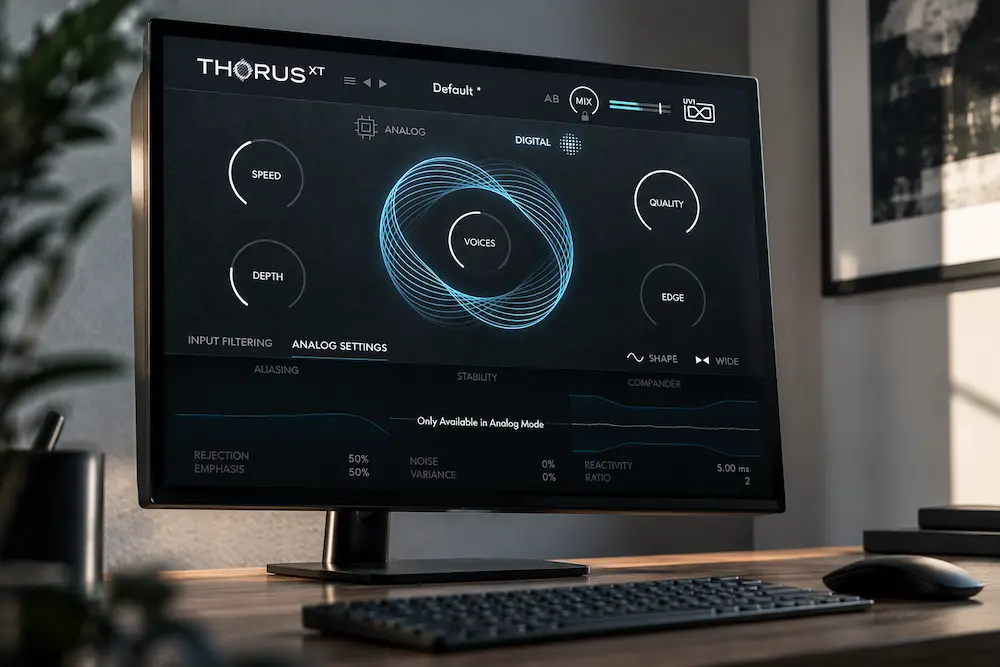
Thorus XT expands the original Thorus with a second processing engine built around modeled bucket-brigade behavior. The result is a chorus plugin that covers two distinctly different jobs: clean, tightly controlled digital modulation and the darker, less predictable character associated with analog BBD circuits. The important question for a working engineer is whether that extra range translates into a better mixing tool, or simply adds another chorus to an already crowded category.
The stronger argument is not simply that Thorus XT offers two chorus sounds. Both engines use the same morphable 2–8 voice architecture and core modulation controls, so the same movement can be compared through a clean Digital path or a BBD-based Analog path without rebuilding the effect. That makes the plugin more interesting as a working chorus tool than as a collection of vintage-style presets.
The Real Challenge: Adding Movement Without Losing Focus
 In a mix, the difficult part of chorus is not generating modulation. It is adding width and movement without weakening the center, destabilizing the low end, or smearing transients. The more modulation you introduce, the more the effect becomes part of the arrangement rather than a simple insert effect.
That tradeoff is obvious on common sources. A vocal can gain width while losing some center definition. A synth can become larger while its pitch and transient detail become less precise. A guitar can gain thickness but add yet another layer of moving energy to an already dense upper midrange. On bass, full-band stereo modulation can make the fundamental less stable and expose problems when the mix is collapsed toward mono.
For that reason, a useful chorus is defined less by how dramatic it sounds in isolation than by how precisely the engineer can control its contribution to the mix. Voice density, modulation depth, stereo behavior, frequency range and harmonic coloration all determine whether the effect creates useful separation or simply adds another layer of congestion.
Thorus XT addresses that tradeoff with two fundamentally different processing paths. The Digital engine is aimed at controlled, detailed modulation, while the Analog engine introduces the nonlinear behavior associated with BBD circuitry, including filtering, companding, instability and variation between voices. Because both engines use the same core modulation architecture, they can be compared within the same mix rather than treated as completely separate effects.
What Actually Changed in Thorus XT
Thorus XT is a substantive expansion of the original Thorus rather than a cosmetic revision. The central addition is a separate Analog engine built around modeled bucket-brigade behavior, while the chorus architecture now allows voice density to move continuously instead of jumping between fixed voice counts.
That change matters most when the plugin is being automated or auditioned against different mix contexts. Speed, Depth, Shape, Edge, Stereo Mode and voice density remain part of the same modulation framework, so an engineer can establish the movement first and then decide whether the source needs a clean digital presentation or more circuit coloration. The two engines therefore function as different tonal treatments of the same basic modulation setup rather than two unrelated chorus effects.
The Digital engine carries forward the original Thorus approach, with multiple modulation voices reading from a shared delay structure at interpolated positions. Its Quality control can also move the processing away from pristine digital behavior toward deliberate sample-rate reduction, making the Digital side more than a strictly clean chorus.
The Analog engine is the more significant addition. Instead of presenting a fixed emulation of one vintage unit, UVI exposes several behaviors associated with BBD-based chorus circuits, including clock-dependent filtering, aliasing, companding, noise and per-voice variation. Quality sets the base BBD clock rate, while the dedicated Analog controls allow the filtering, noise, component variation and compander behavior to be shaped independently.
Hear What Your Mix Can Become
A chorus can change width, movement and stereo balance, but the final master still determines how clearly those elements translate as a complete mix. If you want to evaluate your track beyond plugin processing, you can upload up to 35 seconds of your mix for a free mastering demo and hear how clarity, depth, punch and stereo balance respond to mastering treatment. Upload your mix for a free mastering demo →
Why the Digital Engine Still Matters
The Digital engine is arguably the more useful side of Thorus XT for day-to-day mixing. Its job is not to sound vintage; it is to add width and movement while keeping the source relatively clean and defined.
That makes it well suited to sources that already carry a lot of harmonic information. A vocal double can sit wider without becoming obviously chorused. A synth layer can occupy more stereo space without turning its pitch movement into the main event. Keys and backing parts can gain motion while retaining enough definition to coexist with a dense arrangement.
The more significant change from the original Thorus is the continuous voice control. Voice density is not limited to a few discrete states such as two, four or eight voices. The transition between voice counts is smooth, with the additional voice fading in or out rather than switching abruptly.
That distinction is mostly irrelevant on a static insert setting. It becomes useful when the parameter is automated. Increasing voice density can function as an arrangement move: a relatively focused sound can gradually open into a denser stereo texture without the audible steps that occur when a chorus switches between fixed voice configurations.
For an engineer, that makes the control more than a convenience feature. It provides another way to shape density over time without adding another processor or building a separate automation scheme around multiple chorus instances.
The Analog Engine Adds a Different Kind of Chorus
The Analog engine is the part of Thorus XT that materially expands the original plugin’s range. It does not simply add saturation after the chorus: each voice runs through a modeled bucket-brigade path with its own circuit behavior, including companding, anti-aliasing and reconstruction filtering, optional analog hiss and per-voice component variation.
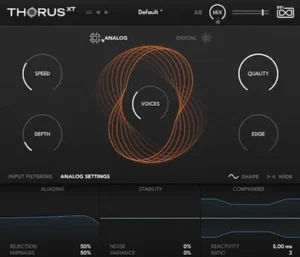
The important difference is that several of those behaviors are exposed as dedicated controls. The Aliasing section shapes the anti-aliasing and reconstruction filters through Rejection and Emphasis, Compander controls the compression and expansion stage through Ratio and Reactivity, while Stability controls analog hiss and per-voice component variation through Noise and Variance. This gives the engineer direct control over several characteristics that would normally be fixed inside an analog chorus circuit.
The Analog engine’s Quality control also changes role compared with the Digital engine. In Analog mode it determines the base clock rate around which the individual voices operate, so lowering it can push the chorus toward darker, rougher and more degraded textures. Combined with the circuit controls, this makes the Analog path a variable BBD-style processor rather than a fixed vintage-color switch.
That distinction is more useful in production than the label “analog” itself. A restrained setting can add thickness and soften the presentation of a vocal, guitar or electric piano, while more aggressive clocking, instability and filtering can turn the chorus into an intentionally degraded texture. The practical advantage is that these characteristics can be shaped rather than accepted as fixed properties of a single hardware emulation.
Best Mixing Applications for Thorus XT
Vocals and Background Vocals
Thorus XT is most useful on vocals when the objective is to create width or movement without making the chorus itself the focal point. On doubles and background vocals, the Digital engine can spread modulation around the center while keeping the source relatively clean. The Analog engine is better suited to parts that need more obvious texture or a less polished character.
On a lead vocal, moderation is critical. A heavily modulated stereo signal can weaken the perceived center and make the vocal less stable as the listener moves between playback systems. Low-mix or parallel processing is usually the more practical approach: let the dry vocal carry the intelligibility while the chorus supplies a controlled stereo layer around it.
Synths and Pads
Sustained synths and pads are among the easiest sources to push with chorus because their continuous harmonic content masks the individual delay modulation. Increasing voice density can turn a relatively narrow part into a broader stereo field, while the Analog engine adds additional movement and degradation when a cleaner digital texture feels too static.
The Digital engine is particularly useful when the synth has to remain wide but still leave room for vocals, drums and bass. The Analog path makes more sense when the synth is functioning as a texture rather than a sharply defined melodic element.
Electric Guitar
Electric guitar is a strong use case for the Analog engine because the source already contains enough harmonic complexity to make BBD-style coloration musically useful. Instead of committing to the fixed voicing of a Juno- or Dimension-style chorus, Thorus XT allows the modulation to remain familiar while the amount of circuit coloration and instability is adjusted independently.
That makes it useful for both restrained widening and deliberately aged guitar textures. The distinction is important in a mix: the former should support the guitar’s position, while the latter becomes part of its tone.
Bass
On bass, the crossover behavior is more important than the vintage character. Modulating the entire signal can make the fundamental feel unstable and create unwanted movement in the stereo field. Keeping the lower frequencies comparatively anchored while allowing the upper harmonics to move gives the effect somewhere to create width without sacrificing as much low-end definition. This becomes particularly relevant when the bass itself already needs careful low-end shaping, harmonic control or sub management, as discussed in this dedicated low-end processing approach.
This approach is also easier to translate. A bass part can retain a relatively stable center when summed to mono while its harmonics provide the perceived stereo spread. The result should still be checked in mono, particularly when the chorus depth and stereo width are pushed.
Keys and Piano
Keys, electric piano and other sustained keyboard parts respond well to the same two approaches. The Digital engine can widen a static part without imposing a strong vintage signature, while the Analog engine can add enough degradation and movement to make an otherwise sterile keyboard sound feel more dimensional.
As with synths, the useful setting is rarely the one that sounds largest in isolation. In a dense arrangement, excessive chorus can occupy the same upper-mid and high-frequency space as guitars, vocals and other stereo layers. The better result is often the setting that becomes less obvious when the full mix is playing.
Where Thorus XT Has Clear Limits
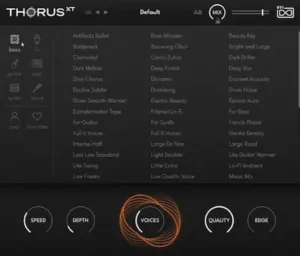 Thorus XT is a modulation processor, not a corrective mixing tool. It can create width, movement and coloration, but it cannot fix an overcrowded arrangement, an unstable stereo image or poor monitoring decisions. If the source already lacks definition, adding more modulation usually makes the problem harder to diagnose rather than solving it.
Stereo chorus also needs to be treated with some discipline. Wide modulation can sound impressive in headphones while becoming less stable when the mix is collapsed to mono or reproduced on a narrower playback system. This is particularly important on bass, lead vocals and other elements whose center position carries musical weight. Thorus XT provides the controls needed to manage that behavior, but it does not make an aggressive stereo effect inherently translation-safe.
The Analog engine introduces another trade-off. BBD-style processing can add character through bandwidth limitation, nonlinear behavior, clock-related artifacts and instability, but those same characteristics can reduce clarity in a dense arrangement. What sounds like useful coloration on a soloed guitar or synth can become masking once the full mix is restored. The more convincing the degradation sounds, the more carefully its role in the arrangement needs to be judged.
There is also a practical limitation in how much of the Analog architecture is useful on every source. The additional circuit controls are valuable when the character of the chorus is part of the sound, but they can become unnecessary on parts that only need controlled stereo movement. In those situations, the Digital engine is the more efficient choice because it avoids introducing BBD-specific coloration simply for the sake of having it.
How Thorus XT Compares With Other Chorus Plugins
| Plugin | Primary strength | Better choice when… | How it differs from Thorus XT |
|---|---|---|---|
| UVI Thorus XT | Digital chorus plus adjustable BBD-style processing | You want clean and colored chorus in the same workflow | Two distinct processing engines with a shared modulation architecture |
| UAD Studio D Chorus | Dimension D-style chorus | You want a focused classic hardware character with minimal setup | More focused on a specific Dimension D-style character |
| Arturia Chorus JUN-6 | Juno-inspired chorus | You specifically want the familiar Roland-style chorus behavior | Broader range beyond a single vintage-inspired character |
| D16 Syntorus 2 | Deep BBD-oriented modulation | You want a dedicated analog-style modulation processor | Combines BBD-style processing with a separate clean Digital engine |
| Valhalla ÜberMod | Complex delay-based modulation | You want extensive experimental modulation and multitap effects | More direct workflow when the goal is specifically chorus |
The right alternative depends on the sound you are trying to reach. UAD Studio D is the more focused choice when the target is a Dimension D-style chorus. Arturia Chorus JUN-6 makes more sense when the Juno approach is the point rather than simply one option among several. D16 Syntorus 2 is worth considering when BBD-style modulation is the primary requirement, while Valhalla ÜberMod moves into a much broader delay-and-modulation design space.
Thorus XT occupies the middle ground. It is not the obvious choice when a specific piece of vintage hardware is the target, and it is not as open-ended as a dedicated experimental modulation environment. Its advantage is that one plugin covers both a relatively clean modern chorus workflow and a much more colored BBD-style approach without requiring separate processing architectures.
That makes range within a focused chorus workflow the more defensible selling point—not a claim that Thorus XT is universally better than its competitors.
Thorus XT Workflow: Compare Chorus Character Without Rebuilding the Effect
Thorus XT is designed around a useful A/B decision: establish the modulation first, then decide whether the source works better through the Digital or Analog engine. Because both engines share the main Speed, Depth, Shape, Edge, Voices and stereo controls, the comparison does not require rebuilding the effect from scratch.
The Voices control is particularly useful when shaping density. Instead of switching between fixed voice counts, Thorus XT continuously fades the additional voices in and out. Fewer voices keep the modulation more identifiable; higher settings produce a denser, more diffuse chorus field.
The Input Filtering section provides another important part of the workflow. It can keep unwanted low-frequency material from entering the modulation stage, which is useful when the objective is to widen a source without making its low end move unnecessarily.
For bass and other sources where low-frequency stability matters, the Crossover control goes further: frequencies below the crossover point can bypass the modulation and be re-blended with the processed upper range. This makes the low end less dependent on the stereo movement while leaving the harmonically useful portion of the signal available for chorus.
The Standard and Wide stereo modes then provide two different spatial behaviors. Standard keeps the stereo presentation closer to the input material, while Wide redistributes the voice modulator phases for a more expanded image. The practical workflow is therefore straightforward: set the amount of movement, choose the voice density, decide how much of the spectrum should be modulated, and only then choose between a conventional or deliberately colored spatial treatment.
Thorus XT Price, Upgrade Value and ROI
Thorus XT is currently priced at $79. UVI also provides a three-day trial through UVI Portal. For a chorus processor whose value depends heavily on how its Digital and Analog engines fit an existing plugin collection, the trial is more useful than a feature comparison alone.
At its regular $79 price, Thorus XT is reasonably priced for a processor that combines two substantially different chorus approaches. But its value is determined less by the number of features than by how much overlap it has with the tools already installed in the studio.
If you already own a strong Juno-style chorus, a Dimension D emulation, a BBD processor and a flexible modulation effect, Thorus XT may add convenience and another sonic option without solving a genuine problem. Buying it simply to accumulate another chorus is difficult to justify.
The calculation changes if one plugin can replace several specialized choices in your working template. Having a clean digital chorus and an adjustable BBD-style engine available within the same interface can reduce plugin switching and make it faster to compare treatments during a mix. That is a workflow benefit, not just a larger feature count.
Overall Rating
| Category | Rating |
|---|---|
| Modulation Control | 9.0/10 |
| Dual-Engine Versatility | 8.8/10 |
| Analog Character Control | 8.4/10 |
| Voice Density & Stereo Management | 8.6/10 |
| Production Usability | 8.5/10 |
| Overall | 8.6/10 |
Why 8.6/10: Thorus XT combines a clean digital chorus with a much more configurable BBD-style engine, while the continuous voice architecture, filtering and crossover controls give it useful control over modulation density and frequency range. Its main limitation is not lack of capability, but overlap: studios that already own several strong chorus and modulation processors may gain more workflow convenience than genuinely new functionality.
Final Verdict: A Strong Specialist Chorus, Not a Studio Essential
Thorus XT justifies the upgrade by expanding the original Thorus into a substantially broader modulation processor. The Analog engine is a genuine functional addition, while continuous voice control and the shared modulation architecture make it faster to compare clean and colored treatments without rebuilding the effect.
Its strongest professional use is on individual mix elements rather than full-program processing. Vocals, synths, electric guitars, keys and other layered sources can benefit from controlled width and movement, while the crossover approach gives the engineer more control over what happens to the low end. The Analog engine adds another useful dimension when the chorus needs to contribute tone and texture rather than simply stereo spread.
The limitation is redundancy. A studio that already has strong Juno, Dimension D, BBD and general-purpose modulation processors may not gain much beyond workflow consolidation and another sonic option. There is also not enough independent measurement to support claims that Thorus XT is a more accurate emulation of specific hardware circuits than its established competitors.
For existing Thorus owners, the upgrade is easy to justify if BBD-style chorus has a regular place in the workflow. For new buyers, Thorus XT is worth a demo when the goal is to combine clean modern chorus with adjustable BBD-style coloration in one processor. It is not a must-have, and it does not replace a mature modulation toolkit. Its value comes from having two useful approaches available under one coherent interface.
Check What Your Mix Does Before You Add More Processing
A chorus can change the stereo image, density and perceived depth of a mix, but those changes do not automatically translate into a more balanced master. Once modulation, width and tonal coloration are part of the production, the useful question is no longer whether the effect sounds impressive on its own, but whether the finished mix still has the clarity, low-end stability and stereo translation needed beyond the studio.
Instead of solving every remaining issue with another processor, compare your mix with a real mastering pass. Upload up to 35 seconds and get a free mastering demo prepared by a real mastering engineer, so you can judge the difference directly in your own material. Upload your mix for a free mastering demo →
UVI Thorus XT FAQ
Is UVI Thorus XT worth upgrading from the original Thorus?
For active Thorus users, the upgrade makes the most sense if BBD-style chorus or deeper circuit control is useful in your work. The original already covers clean digital chorus, so users who never need analog-style coloration will see a smaller practical benefit.
Is Thorus XT a good chorus plugin for mixing vocals?
Yes, particularly for doubles, backing vocals and subtle stereo layers. The Digital engine can add movement without imposing a strong vintage character, while the Analog engine is better when the effect itself needs to contribute texture. On a lead vocal, conservative depth and mix levels are usually easier to translate.
Can Thorus XT be used on bass without destabilizing the low end?
Yes, provided the modulation is kept away from the lowest frequencies where appropriate. Its crossover approach allows the upper portion of a bass signal to carry more movement while the fundamental remains comparatively anchored. Always check the result in mono before committing to an aggressive setting.
Does Thorus XT accurately emulate a Dimension D or Juno-6?
UVI describes the Analog engine as a modeled bucket-brigade circuit designed to reproduce the behavior associated with classic analog chorus processing. However, Thorus XT is better understood as a configurable BBD-style chorus rather than a dedicated one-to-one emulation of a single hardware unit. Its main advantage is the ability to shape the underlying circuit behavior rather than reproduce one fixed hardware response.
How much CPU does UVI Thorus XT use?
There is not currently enough independent benchmark data to give a meaningful CPU figure against competing chorus plugins under matched DAW conditions. UVI’s published system requirements indicate supported operating systems and 4 GB of RAM, but that is not a measurement of the plugin’s actual memory or CPU footprint.
What does the continuous Voices control do in Thorus XT?
Voices continuously changes the number of active chorus voices from a lower-density modulation to a denser multi-voice texture. The additional voice fades in or out rather than switching abruptly, so the parameter can also be automated as a gradual change in modulation density.
Is Thorus XT compatible with Pro Tools and Logic Pro?
Yes. UVI provides AAX, AU and VST3 versions for common DAW workflows, along with standalone operation. The plugin is available for both macOS and Windows.
What are the best alternatives to Thorus XT?
The best alternative depends on the required behavior. UAD Studio D is more focused on Dimension D-style chorus, Arturia Chorus JUN-6 targets the Juno approach, D16 Syntorus 2 is a strong BBD-oriented option, and Valhalla ÜberMod is better suited to broader experimental delay and modulation work.
Is Thorus XT better than a stock DAW chorus?
It offers substantially more control, but that does not make it necessary for every production. The meaningful advantages are continuous voice control, the separate Digital and Analog engines, and adjustable BBD-style behavior. If a stock chorus already covers the required sound, those additional controls may have little practical value.
Is Thorus XT good value at its regular $79 price?
It is good value if you need both clean digital chorus and adjustable BBD-style processing in one plugin. The ROI is weaker for studios that already own several high-quality chorus and modulation processors with overlapping capabilities.

Yurii Ariefiev focuses on the practical behavior of audio processors in mixing and production workflows. For chorus processors, the relevant criteria are not simply the number of modulation controls, but how voice density, stereo placement, frequency range and tonal coloration affect the role of the processed signal in a mix.
☕ Buy me a coffee