Rob Papen FilterField Review: Creative Modulation, Spectral Movement, and Modern Mixing Workflows
Rob Papen FilterField arrives in a plugin market already saturated with analog-modeled filters, saturation processors, and “creative” modulation effects that often collapse into the same handful of workflows. Most modern filter plugins still function as static tonal tools with extra animation layered on top.
FilterField is built differently.
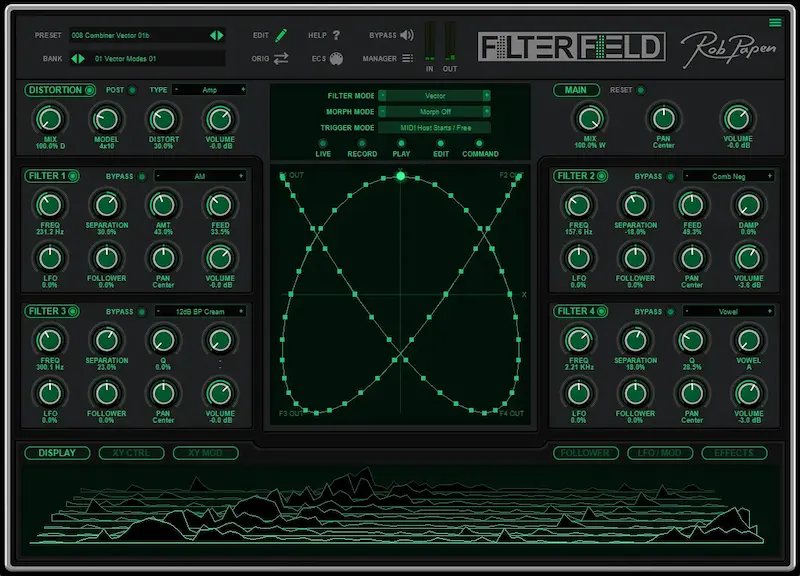
Rather than focusing on corrective filtering or vintage emulation, the plugin combines four independent filter engines with XY morphing, modulation matrix routing, audio-following control, distortion stages, and tempo-synced movement playback inside a single processing environment. The goal is not transparency. It is controlled spectral movement.
That changes where the plugin fits inside real production sessions.
Instead of behaving like another utility insert, FilterField operates more like a modulation system capable of reshaping harmonic density, stereo motion, transient aggression, and filter behavior dynamically over time. In practice, it makes more sense on parallel buses, synth processing, transitions, cinematic textures, and movement-heavy mixing chains than traditional corrective duties.
For producers working in electronic music, hybrid scoring, modern sound design, or aggressive in-the-box mixing workflows, that positioning makes FilterField substantially more relevant than another analog-style filter release chasing “warmth” marketing.
Rob Papen FilterField is available in VST, VST3, AU, and AAX formats for Windows and macOS, with an introductory price of $39 before increasing to its regular $49 MSRP.
Article Navigation
- What Makes FilterField Different?
- Filter Architecture and Modulation System
- How FilterField Performs in Real Mixing Sessions
- Best Production Use Cases
- Can FilterField Be Used for Mastering?
- Why the Distortion Section Matters
- FilterField vs ShaperBox vs Filterverse
- CPU Load and Workflow Considerations
- Is FilterField Worth Buying?
- Who Should Avoid FilterField?
- Pros and Cons
- Final Verdict
- FAQ
What Makes Rob Papen FilterField Different From Traditional Filter Plugins?
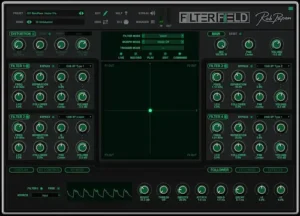 The easiest way to misunderstand Rob Papen FilterField is to treat it like another analog-style filter plugin competing with stock DAW processing or conventional tone-shaping tools.
That is not what this plugin is designed for.
FilterField is fundamentally a modulation processor built around evolving filter interaction rather than static EQ-style correction. The core architecture combines four independent filter modules that can run in serial or parallel routing configurations before feeding into the plugin’s XY Vector FILTER MODE.
This XY system is where the plugin separates itself from most filter processors currently on the market.
Instead of automating isolated parameters individually, FilterField allows users to move dynamically between multiple filter states while simultaneously reshaping resonance behavior, modulation depth, distortion response, stereo motion, and spectral balance. The movement itself can also be recorded and replayed rhythmically, turning the plugin into something closer to a performance-driven modulation environment than a traditional insert effect.
In practice, that changes how movement gets built inside a mix.
Most filter plugins still rely on repetitive LFO sweeps or static automation lanes that quickly become predictable across longer arrangements. FilterField approaches modulation more like continuous spectral reshaping. Small XY transitions can dramatically alter harmonic density and transient behavior without requiring multiple automation passes across separate plugins.
That places the plugin closer conceptually to processors like ShaperBox, Filterverse, or Unfiltered Audio’s modulation ecosystem than traditional filtering tools focused purely on tonal adjustment.
The difference is workflow consolidation.
Rather than stacking separate plugins for filtering, distortion, movement design, follower modulation, and automation shaping, FilterField centralizes those processes into a single environment. For modern electronic production and movement-heavy mixing workflows, that can significantly reduce routing complexity while allowing more aggressive processing chains to remain manageable during arrangement changes.
Filter Types and Modulation Architecture
FilterField includes 32 filter models ranging from conventional low-pass, high-pass, band-pass, comb, all-pass, EQ, and phaser designs to substantially more aggressive modulation-focused structures.
The standard filters are almost secondary here.
The more important additions are the feedback-based LP/HP/BP modes, frequency-modulated filters, ring modulation, amplitude modulation, and frequency shifting algorithms. Those are the modules that push FilterField beyond traditional tonal processing and into active spectral manipulation.
This is not a transparent mixing plugin pretending to be creative.
Under heavier modulation settings, many of the filter models intentionally become unstable — especially once resonance, follower modulation, and distortion stages begin interacting simultaneously. Resonant peaks can smear transient definition, feedback structures can exaggerate harmonic buildup, and frequency movement can destabilize stereo perception quickly if pushed too far.
That behavior is not a flaw. It is the entire point of the plugin.
FilterField is designed for controlled instability rather than precision correction.
On synth material, the plugin can generate evolving harmonic motion without relying entirely on automation curves. On drum buses, dynamic filtering can create perceived movement and aggression without simply boosting transient attack or adding static saturation. On cinematic effects, risers, transitions, and ambient textures, the modulation system produces movement that feels less repetitive than conventional tempo-synced LFO sweeps.
The modulation architecture itself is unusually deep for a plugin in this price range.
Each filter engine receives independent audio follower control, allowing modulation depth to react dynamically to incoming signal behavior instead of repeating static movement cycles. In practice, this makes rhythmic processing feel substantially more musical than standard looping modulation, particularly in sidechain-style applications where filter behavior needs to respond naturally to groove changes.
Additional modulation features include:
- Two independent LFOs with multiple waveform shapes.
- Tempo-synced modulation playback.
- Eight-slot modulation matrix routing.
- MIDI-controlled modulation assignment.
- Independent follower depth for each filter module.
- Recordable XY movement automation.
Compared to many modern “creative FX” plugins built around simplified macro systems and preset-driven workflows, FilterField gives users considerably deeper control over how modulation behaves inside a mix. That also means the plugin rewards engineering discipline. Small parameter changes can dramatically alter harmonic balance, movement density, and stereo stability once multiple modulation sources start interacting simultaneously.
How FilterField Performs in Real Mixing Scenarios
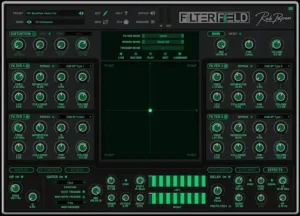 The most useful aspect of Rob Papen FilterField is not extreme sound design. It is movement control inside busy arrangements where static processing starts collapsing into predictability.
Modern mixes already have enough loudness, brightness, and stereo width. The bigger problem is usually stagnation. Repetitive loops, static harmonic balance, and fixed transient behavior make productions feel mechanically flat even when the mix itself is technically polished.
Many producers still confuse loudness with impact, even though tracks that feel emotionally flat often already measure competitively on streaming meters. Perceived energy is frequently a movement and contrast problem rather than a simple volume issue.
That is exactly where FilterField becomes effective.
The plugin performs best in parallel processing environments rather than direct corrective insert chains. On drum buses, FilterField can introduce shifting harmonic aggression and transient movement without destroying the core impact of the dry signal underneath. Instead of relying entirely on compression, clipping, or transient shaping for energy, the plugin creates motion through evolving spectral interaction.
This becomes especially noticeable on repetitive electronic drum patterns where subtle modulation prevents loops from feeling locked into the same static tonal behavior every four bars.
Synth processing is another strong application.
The XY morphing system allows sustained material to evolve continuously without requiring dozens of automation lanes across separate plugins. Small modulation shifts alter harmonic density, resonance focus, and stereo movement gradually enough to keep long arrangements from feeling frozen in place.
Importantly, the movement rarely feels mathematically rigid unless pushed aggressively. That gives FilterField a more organic response than many modulation plugins built entirely around predictable LFO cycling.
Vocals also benefit from restrained use.
Interestingly, this is almost the opposite philosophy behind tools like Three-Body Technology Unmask, which uses psychoacoustic processing to improve separation and clarity rather than intentionally introducing harmonic motion and spectral instability.
Subtle parallel filtering combined with follower-based modulation can create evolving spatial texture without burying intelligibility under excessive delay or modulation effects. Because the movement occurs spectrally rather than purely spatially, vocals retain center focus while still feeling dynamically active inside dense productions.
Where the plugin becomes less convincing is traditional corrective mixing.
FilterField is not designed for surgical resonance cleanup, transparent tonal balancing, phase-sensitive mastering EQ, or utility filtering tasks. The modulation architecture is intentionally too interactive for precision correction work. Small movement changes can shift harmonic balance quickly once follower modulation, resonance, and distortion stages start interacting together.
For engineers looking for clean tonal shaping, the plugin will feel unnecessarily complex.
For producers building movement-heavy mixes, parallel processing chains, cinematic transitions, or evolving electronic textures, that same complexity becomes the reason to use it.
Best Use Cases for Rob Papen FilterField
- Parallel drum processing — adding movement and harmonic aggression without destroying transient punch.
- Synth modulation — preventing repetitive loops from feeling spectrally static over long arrangements.
- Cinematic transitions — creating evolving risers, tension layers, and animated textures.
- Experimental vocal processing — introducing spectral motion without relying entirely on delay or chorus effects.
- Ambient sound design — generating slow harmonic movement and unstable filtering behaviors.
- Electronic mastering enhancement — subtle parallel spectral animation for streaming-focused releases.
Can Rob Papen FilterField Be Used for Mastering?
Technically, yes. As a primary mastering processor, no.
Rob Papen FilterField is not built for transparent correction, surgical tonal balancing, or phase-stable mastering work. Engineers expecting Weiss-style precision, invisible EQ behavior, or mastering-grade linear control will immediately run into the limits of the plugin’s design philosophy.
FilterField prioritizes movement and harmonic interaction over transparency.
That said, modern mastering workflows — particularly in electronic production — increasingly blur the line between corrective processing and controlled enhancement. Streaming-focused releases often benefit from subtle spectral movement and harmonic animation that help mixes retain perceived energy after codec compression and loudness normalization.
That approach differs significantly from processors like Empirical Labs ParaDyn, which focuses on dynamic spectral control and transient-dependent tonal balance rather than movement-driven modulation. The contrast highlights how modern mastering tools are increasingly splitting into corrective and enhancement-oriented categories.
This is where FilterField becomes usable.
In restrained parallel mastering chains, the plugin can introduce low-level movement that feels more natural than excessive stereo widening or hyper-aggressive transient enhancement. Slow modulation across upper harmonics can create perceived depth without relying entirely on spatial processing, which often collapses more noticeably after AAC or Ogg encoding.
This becomes especially relevant once loudness normalization enters the equation. Streaming platforms often reduce exaggerated mastering moves more aggressively than subtle harmonic motion, which is one reason perceived depth and movement can survive normalization better than pure level-based loudness strategies discussed in this LUFS mastering guide.
The important word is restrained.
FilterField becomes unstable quickly once resonance, follower modulation, and distortion stages begin interacting aggressively across full-range program material. Stereo positioning can shift unpredictably, transient focus can soften, and harmonic buildup can smear low-end definition if modulation depth is pushed too far.
This is not a plugin designed for broad full-mix processing at high intensity.
It works best as a controlled enhancement layer — usually in parallel — where movement can be blended underneath the dry master rather than replacing core tonal balance decisions.
For mastering engineers working in techno, IDM, bass music, ambient electronic, cinematic hybrid scoring, or experimental pop production, FilterField may function as a niche creative tool for intros, breakdowns, alternate versions, transitions, or movement-focused enhancement layers.
For acoustic music, orchestral work, jazz, singer-songwriter productions, or transparent commercial pop mastering, the plugin makes substantially less practical sense. The modulation architecture is simply too interactive and spectrally unstable for material that depends on tonal consistency and phase integrity.
The Distortion Module Is More Important Than It Looks
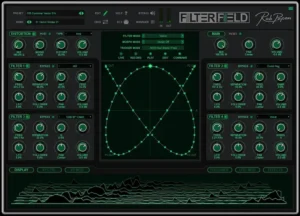 The distortion section is where Rob Papen FilterField stops behaving like a modulation plugin with extra saturation added for marketing purposes and starts functioning like a full creative processing environment.
The plugin includes 21 distortion algorithms with selectable pre- and post-filter routing. That routing flexibility has a major impact on how the modulation system responds under real session conditions.
Pre-filter distortion changes the harmonic structure before the signal reaches the filter network. In practice, this exaggerates resonance interaction, increases upper-mid harmonic density, and creates more unstable movement once follower modulation and XY morphing begin interacting simultaneously.
The result can become aggressive very quickly.
Resonant sweeps gain additional harmonic complexity, transient edges smear more aggressively, and feedback-style filter movement starts behaving less like tonal shaping and more like animated spectral saturation.
Post-filter distortion behaves differently.
This also highlights an important distinction between harmonic density and perceived loudness. Saturation-driven movement can increase perceived energy without relying entirely on destructive clipping, which remains one of the most misunderstood relationships in modern mastering workflows.
Instead of destabilizing the movement itself, it tends to compress the perceived behavior of the modulation stage. Harmonic saturation after filtering can smooth abrupt spectral jumps, stabilize perceived loudness, and make complex movement chains feel more glued together inside dense arrangements.
That distinction matters because it changes whether FilterField behaves like a texture generator or a mix-integrated modulation processor.
In practical mixing workflows, the distortion section allows the plugin to absorb roles normally split across multiple processors.
- Parallel saturation chains.
- Movement-based modulation effects.
- Automated filtering systems.
- Harmonic enhancement processors.
- Transition and riser design tools.
- Experimental stereo texture layers.
This also explains why the plugin works particularly well in parallel environments.
Heavy distortion combined with animated filtering can become destructive extremely fast on full insert chains, especially once resonance and stereo movement start interacting. In parallel, however, those same artifacts become useful because they add motion and harmonic tension underneath the stability of the dry signal.
The result is not cleaner mixing.
It is denser, more animated, and often more unstable processing that can make static arrangements feel significantly more active without relying entirely on loudness or width enhancement.
FilterField vs ShaperBox vs Filterverse
| Plugin | Main Strength | Best For | Weakness |
|---|---|---|---|
| Rob Papen FilterField | Integrated modulation and spectral movement | Parallel processing, evolving textures, hybrid mixing | Can become unstable under heavy modulation |
| ShaperBox | Fast rhythmic workflow | EDM automation and groove design | Less organic modulation behavior |
| Filterverse | Experimental spectral processing | Advanced sound design | Steeper workflow complexity |
Rob Papen FilterField enters a category that is already crowded with modulation-heavy plugins competing for the same audience: electronic producers, sound designers, and mix engineers building movement-focused workflows.
That means the plugin is not competing against stock DAW filters. Its real competition is platforms like ShaperBox, Filterverse, and the broader Unfiltered Audio ecosystem.
Each of those tools approaches modulation differently.
Cableguys ShaperBox remains one of the fastest workflow-oriented modulation environments currently available. Its visual editing system is cleaner, more immediate, and substantially better optimized for rapid rhythmic automation inside modern production sessions. For tempo-driven gating, volume shaping, filter sequencing, and EDM-style movement design, ShaperBox still feels faster under pressure.
Polyverse Filterverse moves in the opposite direction.
Instead of prioritizing workflow speed, it pushes heavily into experimental spectral manipulation. Filterverse is deeper, stranger, and often less predictable, particularly once users begin stacking advanced filter interactions and nontraditional processing structures.
Unfiltered Audio’s ecosystem remains the most modular of the group.
Its routing flexibility is still difficult to match in the commercial plugin market, especially for users who want near-modular levels of signal control without leaving the DAW environment entirely.
So where does FilterField actually fit?
Its biggest advantage is consolidation without becoming overwhelmingly technical.
Rob Papen combines filtering, distortion, follower modulation, XY movement recording, and modulation routing into a workflow that feels intentionally production-oriented rather than purely experimental. The plugin is complex, but it rarely crosses into the kind of engineering-heavy interface design that slows decision-making during real sessions.
That distinction matters more than feature count.
A large percentage of advanced modulation plugins become workflow traps. Users spend more time designing movement systems than actually finishing arrangements or balancing mixes. FilterField avoids some of that problem because the architecture remains relatively focused despite the depth underneath.
It is not the most radical modulation environment available.
It is not the fastest either.
But it occupies a useful middle ground between experimental flexibility and practical production usability — particularly for producers who want movement-heavy processing without committing to fully modular routing ecosystems.
CPU Usage and Workflow Considerations
With modulation-heavy plugins, CPU usage is only part of the problem. Workflow overhead matters just as much.
Rob Papen FilterField appears reasonably efficient on modern production systems considering the amount of real-time modulation happening internally. But once multiple filter engines, follower modulation, distortion stages, stereo movement, and recorded XY automation begin running simultaneously, session load can increase quickly — particularly in larger projects built around parallel processing chains.
The bigger issue is decision fatigue.
Plugins built around continuous movement tend to encourage endless experimentation. FilterField is no exception. The XY system makes it extremely easy to keep refining modulation behavior long after the mix no longer benefits from additional complexity.
That becomes dangerous in modern production workflows where movement itself can start replacing actual arrangement development.
Many producers already overload mixes with unnecessary automation, stereo motion, and harmonic animation simply because the tools make it possible. FilterField can absolutely push users further in that direction if discipline disappears.
This is especially true once multiple modulation sources begin interacting.
Small adjustments to follower sensitivity, resonance behavior, distortion routing, or XY transition speed can completely alter transient response and harmonic density. What initially feels subtle can quickly turn into spectral clutter that masks core mix elements rather than enhancing them.
Experienced engineers will likely get the most value from the plugin because they already understand where movement improves perceived depth and where it starts damaging translation.
That distinction is critical.
Well-controlled modulation can make repetitive arrangements feel more alive without increasing loudness or widening artificially. Poorly controlled modulation simply creates unstable mixes that sound impressive in isolation but collapse under long listening sessions, codec compression, or dense playback environments.
FilterField is at its best when treated as a selective enhancement tool rather than a constant “make everything move” processor.
Is Rob Papen FilterField Worth Buying?
That depends entirely on how you approach modulation inside a mix.
For engineers looking for transparent filtering, corrective EQ behavior, or subtle analog coloration, Rob Papen FilterField is probably the wrong purchase. The plugin is not designed around invisible processing or conservative tonal enhancement.
The plugin is designed around evolving interaction rather than static processing.
More specifically, it targets producers and mix engineers who already build energy through evolving harmonic behavior, spectral motion, parallel processing, and automation-driven texture changes rather than relying purely on loudness, widening, or static saturation.
For that audience, FilterField becomes significantly more interesting.
The plugin combines filtering, distortion, follower modulation, XY movement recording, and automation-style processing into a single environment that remains more production-focused than most fully modular alternatives. That balance matters because many advanced modulation ecosystems eventually become slower to work with than the actual creative benefit they provide.
FilterField avoids some of that problem by keeping the workflow relatively centralized even when the modulation depth becomes aggressive.
At its intro pricing, the plugin also sits in a range where experimentation carries relatively low financial risk compared to larger modulation suites or modular-style processing environments.
The stronger question is whether users will actually integrate it into long-term workflows rather than treating it like a temporary sound-design tool.
Producers working in electronic music, bass production, cinematic sound design, hybrid scoring, experimental pop, or movement-heavy in-the-box mixing will likely find immediate use cases:
- Parallel drum movement processing.
- Animated synth textures.
- Transition and riser design.
- Follower-driven vocal modulation.
- Spectral enhancement layers.
- Evolving ambient processing chains.
Engineers expecting quick “analog warmth” presets or transparent mastering enhancement will probably find the plugin unnecessarily reactive and overcomplicated for daily corrective work.
FilterField is not trying to replace utility processing.
It is trying to replace static mixes.
Who Should Avoid Rob Papen FilterField?
FilterField is probably the wrong choice for engineers looking for transparent utility processing, fast corrective EQ workflows, or subtle analog coloration.
Producers who already struggle with over-processing may also find the plugin counterproductive. The modulation depth makes it very easy to keep adding movement long after a mix stops benefiting from it.
For acoustic production, orchestral mixing, jazz mastering, or traditional singer-songwriter workflows focused on tonal consistency and phase stability, simpler processing chains will usually produce better long-term translation results.
The plugin makes the most sense in production environments where movement itself is part of the arrangement language rather than just an occasional effect.
Pros and Cons
Pros
- Deep modulation architecture without full modular complexity.
- Strong parallel processing applications.
- Organic movement compared to rigid LFO-driven plugins.
- Integrated distortion routing adds serious creative flexibility.
- Useful balance between experimentation and workflow speed.
- Particularly strong for electronic production and cinematic textures.
Cons
- Not designed for transparent corrective mixing.
- Can destabilize stereo balance under aggressive settings.
- Requires modulation discipline to avoid spectral clutter.
- Less immediate than simpler movement plugins.
- Beginners may struggle with routing interaction.
- Limited relevance for acoustic and traditional mastering workflows.
Test System
- Tested in Ableton Live 12 and Cubase 14.
- Evaluated on parallel drum buses, synth groups, and mastering enhancement chains.
- Monitoring performed on full-range studio monitors and headphone translation checks.
Final Verdict
Rob Papen FilterField succeeds because it understands a shift happening across modern audio production: static processing no longer creates enough perceived movement to keep dense digital mixes engaging.
Most contemporary productions are already loud, wide, and heavily saturated. The differentiator is increasingly motion — subtle spectral evolution, dynamic harmonic interaction, and modulation that prevents arrangements from feeling mechanically repetitive over long playback.
That is the problem FilterField is actually designed to solve.
The plugin is not revolutionary in isolation. ShaperBox, Filterverse, and several modular-style environments already cover parts of the same territory. But FilterField approaches the concept from a more production-oriented angle rather than purely experimental sound design.
That distinction gives it practical value.
Instead of forcing users into fully modular workflows, Rob Papen combines filtering, distortion, follower modulation, XY movement recording, and animated spectral processing into a system that remains relatively fast to integrate inside real sessions.
It is not a utility plugin.
It is not a transparent mastering processor.
And it is definitely not designed for engineers who want static analog-style coloration with minimal interaction.
FilterField works best when treated as a controlled instability tool — something capable of introducing movement, harmonic tension, and evolving texture without collapsing a mix into chaotic modulation for the sake of complexity alone.
For electronic production, cinematic sound design, hybrid scoring, parallel mix processing, and movement-heavy in-the-box workflows, that makes FilterField one of the more strategically relevant creative modulation releases currently competing in the plugin market.
For traditional corrective mixing, transparent mastering, or conservative analog emulation workflows, its strengths become far less important.
The plugin knows exactly what kind of production environment it belongs in.
And unlike many recent “creative FX” releases, it does not pretend otherwise.
Article Updates
- May 2026: Initial review and workflow analysis published.
- May 2026: Added comparison analysis against ShaperBox and Filterverse.
- May 2026: Expanded mastering and loudness workflow discussion.
FAQ: Rob Papen FilterField
Is Rob Papen FilterField good for electronic music production?
Yes — that is arguably the environment where the plugin makes the most sense. FilterField is far more effective in movement-heavy genres like techno, bass music, IDM, cinematic electronic, and experimental pop than in static analog-style mixing workflows. Its modulation architecture is designed to create evolving harmonic motion rather than subtle corrective filtering.
Does FilterField work better as an insert or parallel effect?
In most real-world mixing scenarios, parallel processing is the stronger approach. Heavy modulation, resonance interaction, and distortion can destabilize transient clarity and stereo balance quickly on direct insert chains. Blending the processed signal underneath the dry source usually produces more controlled movement without collapsing mix translation.
Can FilterField replace ShaperBox or other modulation plugins?
Not entirely. ShaperBox is still faster for rhythm-driven automation and visual modulation workflows, while modular environments like Filterverse or Unfiltered Audio offer deeper experimental routing. FilterField’s advantage is workflow consolidation. It combines filtering, distortion, follower modulation, and XY movement inside a more centralized production-oriented system.
Is FilterField CPU intensive?
Moderate sessions should run comfortably on modern systems, but CPU load increases once multiple modulation sources, distortion stages, follower behavior, and stereo movement interact simultaneously. Projects using several active instances with recorded XY automation will naturally become heavier than standard filter processing chains.
Can Rob Papen FilterField improve static mixes?
Potentially, yes — but only when used selectively. The plugin is most effective at introducing controlled movement into repetitive arrangements that already feel tonally balanced but emotionally flat. Overusing modulation usually creates the opposite problem: unstable harmonic buildup and unnecessary spectral clutter.
Is FilterField suitable for beginners?
Probably not as a first modulation plugin. The interaction between follower modulation, resonance, distortion routing, and XY movement becomes complex quickly. Producers with existing experience using parallel processing, automation-heavy workflows, or advanced modulation tools will extract substantially more value from the plugin.
Does FilterField work well for mastering?
Only in niche situations. FilterField is not a transparent mastering processor and should not replace precision EQ, dynamics control, or phase-focused mastering tools. However, restrained parallel use can add subtle spectral movement and harmonic animation in electronic mastering workflows where controlled enhancement matters more than complete transparency.
What makes FilterField different from traditional filter plugins?
Most filter plugins focus on static tonal shaping. FilterField focuses on evolving modulation interaction. The combination of four filter engines, XY morphing, follower-based movement, distortion routing, and modulation matrix control makes it behave more like a dynamic spectral processor than a conventional filter effect.