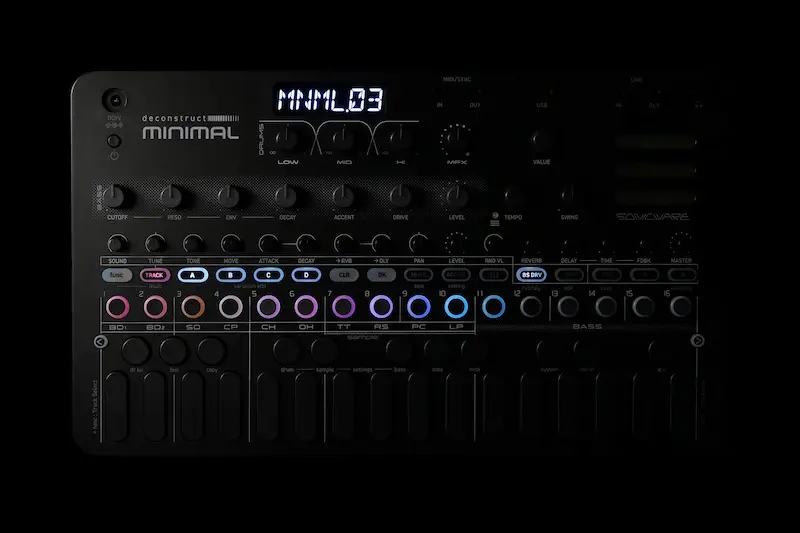
Sonicware Deconstruct Minimal Review: A Focused Groovebox for Modern Techno Production
Most modern grooveboxes fail for the same reason: they either reduce sequencing to toy-level simplicity or bury fast pattern programming under workstation-style complexity. That becomes a problem in minimal techno and house, where groove evolution matters more than feature count. Once the workflow slows down, the music usually does too.
Sonicware’s Deconstruct Minimal takes a different approach. Instead of positioning itself as another portable DAW replacement, it targets a narrower production workflow built around repetitive drum programming, bass sequencing, live mutation, and fast loop manipulation. The design philosophy is obvious immediately: less emphasis on broad sound design, more emphasis on movement, timing behavior, and pattern interaction.
The TR-808 and TR-909 references are mostly irrelevant by themselves. Every hardware manufacturer references those machines. What matters is whether the sequencer captures the behavioral side of classic rhythm programming — timing drift, unstable groove interaction, velocity inconsistency, and rapid pattern variation without breaking momentum. Those characteristics shaped decades of techno production far more than the raw drum sounds ever did.
That is where Deconstruct Minimal becomes more interesting than its price suggests.
At $299 during the introductory release window, Sonicware is targeting an unusually crowded part of the hardware market: producers who want hands-on sequencing without committing to larger Elektron-style ecosystems or laptop-centered live rigs. The challenge is not affordability. Cheap hardware already exists. The challenge is whether the workflow survives long-term use after the novelty disappears.
Quick Navigation
- Why Grooveboxes Are Returning to Modern Techno Workflows
- The Sequencer Is the Entire Product
- Dedicated Kick and Snare Synthesis Engines
- The Bass Synth Is Narrow by Design
- Battery Power and Live Workflow
- Where the Marketing Starts to Overreach
- How It Compares to Competing Grooveboxes
- Real-World Mixing and Mastering Implications
- What It Will Probably Sound Like in Real Mixes
- Who Will Probably Hate This Groovebox
- Verdict
- FAQ
Why Grooveboxes Are Returning to Modern Techno Workflows
Modern DAWs solved precision years ago. They did not solve creative fatigue.
A growing number of techno producers now separate composition from finishing because those stages reward completely different workflows. Hardware is increasingly used for loop generation, rhythmic mutation, and performance interaction. The computer handles editing, arrangement refinement, mixing, mastering, codec testing, and release delivery afterward.
That division explains why compact grooveboxes have regained relevance in underground electronic production.
Minimal techno and stripped-back house are unusually sensitive to timing behavior. In dense commercial EDM, microscopic sequencing inconsistencies disappear under layered arrangements and aggressive processing. In minimal production, those same inconsistencies become part of the groove architecture itself. Small velocity shifts, unstable swing interaction, and imperfect repetition create movement inside arrangements that intentionally avoid harmonic density.
Most DAW environments still push producers toward rigid quantization because the interface is visually tied to the grid. The workflow encourages correction. Hardware sequencers tend to encourage mutation instead — repeating patterns while gradually destabilizing timing, accents, note placement, or velocity behavior over time.
That distinction is psychological as much as technical.
Sonicware appears to understand this better than many companies building modern portable hardware. Deconstruct Minimal is not trying to compete directly with deep workstation ecosystems like the Elektron Digitakt line or larger hybrid production hardware from Roland. Its architecture is intentionally constrained around repetitive groove construction, bassline sequencing, live pattern variation, and fast rhythmic manipulation.
That narrower design focus may ultimately become the product’s biggest advantage. Many modern grooveboxes collapse under feature accumulation. Minimal electronic workflows usually benefit from fewer decisions, not more.
The Sequencer Is the Entire Product
 The drum library is secondary here. The sequencer determines whether Deconstruct Minimal becomes a serious production tool or another short-lived hardware novelty.
On paper, the architecture looks familiar: parameter locks, per-track accents, sub-steps, randomized velocity, swing, and phrase rotation. None of those features are new individually. The important part is how they behave together during repetitive loop programming, because minimal techno sequencing is less about writing arrangements and more about destabilizing repetition without destroying groove continuity.
That distinction matters.
Most grooveboxes can generate a usable four-bar loop. Far fewer can keep that loop evolving for six or seven minutes without sounding mechanically static. Minimal electronic music depends heavily on micro-variation because there is nowhere for weak sequencing to hide. Sparse arrangements expose timing rigidity immediately.
In practice, groove-driven sequencing usually depends on three things:
- small timing inconsistencies between hits
- velocity movement that prevents transient repetition
- rapid pattern mutation without interrupting flow
Phrase rotation is probably the most important feature in the entire sequencer because it shifts rhythmic emphasis without forcing manual rewrites. Combined with sub-steps and velocity randomization, the machine can generate longer-feeling rhythmic cycles from relatively short patterns. That is fundamental to minimal techno production, where tracks often rely on subtle loop evolution instead of major structural changes.
This also affects live usability directly.
That immediacy becomes critical in real hardware workflows because sequencing momentum disappears fast once producers start fighting interface friction. Grooveboxes live or die on how quickly accents, probability shifts, sub-steps, and pattern mutations can be reached without interrupting playback. If Deconstruct Minimal keeps those operations close to the surface instead of burying them behind layered menus, it will feel significantly faster than many portable competitors even with a smaller feature set.
Loop-based genres collapse fast when patterns become predictable. DAWs can technically achieve the same mutations through automation and MIDI editing, but the workflow is slower and psychologically different. Hardware sequencers encourage interaction in real time. Producers tend to experiment more aggressively because the process feels immediate instead of corrective.
The TR-808 and TR-909 comparisons only become relevant in this context. Classic Roland machines were never perfectly stable from a timing perspective. Their groove came partly from behavioral inconsistency — slight drift, imperfect swing response, transient interaction, and sequencing feel that modern DAWs often flatten into grid precision.
Sonicware appears to be chasing that sequencing behavior rather than simply copying vintage drum sounds. That is a much smarter design target.
Accurate TR-909 samples are everywhere. Sequencers that reproduce the movement producers actually associate with classic hardware are far less common.
The Dedicated Kick and Snare Synthesis Engines Matter More Than the Sample Library
Deconstruct Minimal includes 16 drum kits and 130 sounds, but the more important decision is the dedicated synthesis architecture for the kick and snare tracks. That changes the workflow far more than expanding the sample count ever would.
Most low-cost grooveboxes rely heavily on static samples. That approach works for sketching ideas, but it creates long-term production problems quickly. First, transient behavior becomes difficult to reshape during mixing without introducing artifacts or phase issues. Second, repetitive use of fixed one-shots accelerates sonic fatigue across multiple projects.
Sonicware avoids part of that problem by giving the kick and snare their own synthesis engines instead of treating them like ordinary playback channels.
That matters because modern techno production is heavily dependent on transient management. The way a kick envelope behaves affects nearly every downstream stage of the production chain:
- headroom during mastering
- low-end translation on club systems
- AAC and OGG codec stability
- limiter response at competitive loudness levels
- parallel saturation behavior
- vinyl pre-master compatibility
Static samples force producers to solve those issues later using EQ, clipping, multiband compression, transient shaping, or saturation plugins. Synthesized drum engines move part of that control earlier into the sound-design stage, where the source itself can be adjusted before mix processing starts.
If the kick engine offers enough envelope and pitch modulation depth, producers can shape low-end behavior directly instead of compensating after the fact. That usually leads to cleaner master bus behavior and more predictable limiting response, especially in stripped-back arrangements where the kick occupies a large percentage of the available spectrum.
The same logic applies to the snare engine. In performance-oriented sequencing, snares rarely function as realistic acoustic elements. They operate more like rhythmic punctuation and midrange texture. Fixed samples become repetitive fast because the arrangement intentionally exposes every transient. Having synthesis control over attack shape, body tone, and decay behavior increases the lifespan of the instrument substantially.
This is one of the smarter engineering decisions inside Deconstruct Minimal. Sonicware appears to understand that techno producers do not necessarily need massive sound libraries. They need a smaller set of core sounds that remain flexible enough to survive repeated use without forcing identical mixes every time.
The Bass Synth Is Narrow by Design — and That Is Probably Correct
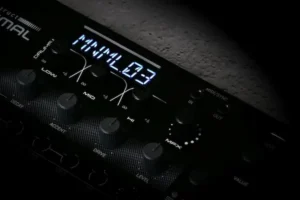 Deconstruct Minimal uses a relatively simple analog-modeling bass architecture: four modeled waveforms, a sine-wave sub oscillator, and a resonant 4-pole low-pass filter. On paper, that looks limited compared to modern desktop synths or modular-oriented hardware. In practice, it may be exactly the right design choice for the type of music this groovebox targets.
Minimal techno rarely depends on harmonic complexity. Most basslines operate inside extremely small melodic ranges — often a single repeating note or short interval pattern. The movement comes from filter automation, transient interaction, saturation, timing instability, and low-end modulation against percussion elements.
That changes what actually matters inside a bass engine.
For groove-focused production, the synth does not need massive wavetable libraries or cinematic modulation systems. It needs predictable low-frequency behavior under real mix conditions:
- stable sub extension
- tight envelope response
- controlled resonance behavior
- consistent mono translation
- manageable low-mid density
The sine-wave sub oscillator is arguably more important than the primary waveform section because it determines whether the bass survives downstream mastering without collapsing into distortion or undefined low-end smear. Many portable grooveboxes exaggerate sub frequencies to sound impressive in headphones, then fall apart once the track hits limiting, codec conversion, or large club systems.
That is where restrained tuning becomes more valuable than aggressive sound design.
If Sonicware calibrated the bass engine for controlled low-frequency stability rather than oversized “demo room” bass, Deconstruct Minimal becomes significantly more useful in professional workflows. Predictable low-end is easier to mix, easier to master, and far more reliable across streaming platforms where codec behavior punishes unstable sub information aggressively.
The resonant 4-pole filter also makes sense in this context. Minimal techno bass rarely needs hyper-complex harmonic movement. It needs smooth filter behavior that can evolve gradually across repetitive sequences without introducing harsh upper-mid buildup or unstable resonance spikes.
There are obvious limitations, though.
Producers expecting deep modulation matrices, layered oscillator routing, wavetable scanning, or modular-style experimentation will reach the ceiling quickly. This is not competing with dedicated mono synths or advanced hybrid instruments. The architecture is intentionally constrained around repetitive bass sequencing and low-end support inside loop-driven music.
That constraint is probably a strength rather than a weakness.
Too many sonic options often damage groove-focused production because producers start designing sounds instead of designing movement. Deconstruct Minimal appears engineered around the opposite philosophy: fewer variables, faster decisions, tighter rhythmic interaction.
Battery Power Changes the Live Workflow More Than Most Producers Realize
Running on six AA batteries sounds like a minor specification until you spend enough time around real live electronic setups. Power management is one of the least glamorous but most common failure points in hardware performance rigs.
Small venues, unstable power distribution, overloaded extension chains, noisy grounding, and limited booth space routinely create problems for live performers. Portable hardware usually solves portability by sacrificing sequencing depth, audio quality, or interface usability. Deconstruct Minimal appears to be trying to avoid that tradeoff.
Battery operation changes several practical parts of live workflow immediately:
- faster setup and teardown
- reduced ground-loop and hum issues
- less dependence on questionable venue power
- portable writing sessions without external routing
- simpler secondary rigs alongside CDJs or mixers
That matters more now because underground electronic performance culture has shifted away from purely laptop-based sets. More producers are combining hardware sequencers, compact synths, samplers, drum machines, analog front-end processing, and DJ systems instead of performing entirely inside Ableton Live. That broader shift toward hybrid production environments is also influencing studio hardware design well beyond grooveboxes, particularly in systems built around analog summing and integrated console workflows, as discussed in our API Vision+ Console review.
The reason is partly visual, but mostly behavioral.
Hardware changes how performers interact with repetition. Physical sequencing encourages faster rhythmic experimentation because controls remain directly accessible instead of hidden behind pages, plugins, or automation lanes. Audiences also respond differently to visible interaction than to screen-based performance, especially in genres built around gradual loop manipulation.
Battery-powered hardware becomes particularly valuable in hybrid setups where reliability matters more than unlimited flexibility. A compact groovebox that boots quickly, runs independently from external power, and handles sequencing without laptop dependency can function as a backup rig, transitional performance tool, or dedicated live percussion brain.
That does not mean laptops are disappearing from electronic music production. They still dominate arrangement, mixing, mastering, and playback management. But live workflow priorities have shifted noticeably over the last few years. Producers increasingly want hardware that reduces technical friction instead of expanding system complexity.
Deconstruct Minimal makes the most sense inside that environment: compact, self-contained, rhythm-focused, and intentionally limited in scope.
Where the Marketing Starts to Overreach
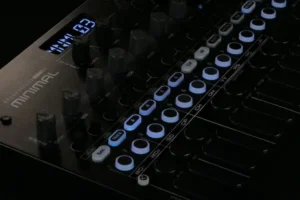 The TR-808 and TR-909 comparisons are effective marketing, but they also create expectations that are difficult for modern hardware to meet.
Classic Roland machines became influential partly because of their timing behavior, sequencing response, limitations, and long-term integration into club culture. Recreating that psychology is far more difficult than borrowing visual references or adding swing controls to a sequencer.
Deconstruct Minimal may successfully capture aspects of that workflow philosophy, but producers expecting genuine vintage-machine behavior should probably lower expectations early. The groove characteristics associated with classic hardware came from an entire production ecosystem — converters, clock instability, analog circuitry interaction, monitoring environments, and decades of musical context — not just sequencer features.
The more immediate limitation is sonic scope.
The included sound library is relatively compact by modern standards. The dedicated synthesis engines help extend usability, but producers building complete EPs entirely inside the device will likely encounter repetition faster than they would with larger ecosystems. That is especially true in minimal genres where the arrangement exposes every transient and tonal decision.
Deconstruct Minimal makes more sense as a composition and sequencing platform than a fully self-contained production environment.
Arrangement depth is another potential weakness.
Pattern-focused hardware is excellent at generating hypnotic loops. It is often less effective at maintaining long-form structural tension. Streaming-era listeners fatigue faster than club audiences because tracks are consumed in uncontrolled listening environments — earbuds, cars, phones, playlists, background playback. Repetitive sequencing that works inside a warehouse system can become static quickly on consumer playback systems.
That usually forces additional arrangement work later inside a DAW, particularly for producers targeting Spotify, Apple Music, or streaming-first releases rather than DJ tools.
There are also unanswered questions about mix translation.
Portable grooveboxes frequently prioritize immediate impact over spectral balance. Hyped low-end, exaggerated transients, and oversized stereo effects can sound impressive during sketching sessions while creating problems later during mastering. Small hardware speakers and headphone-oriented tuning often disguise those issues until the material reaches full-range monitoring systems — the same type of translation problems discussed in our Mastering Problems guide.
Until producers test exported audio through professional mixing and mastering workflows, it remains unclear how well the internal synthesis engines behave under aggressive limiting, codec conversion, and loudness normalization.
None of this means the product is flawed. It means the marketing language should be interpreted carefully.
There are still several unanswered workflow questions that only real-world use will expose: pattern chaining speed, menu depth during live editing, MIDI sync stability, project management friction, and how quickly the interface can be navigated under performance pressure.
Deconstruct Minimal is not escaping the modern production pipeline. Serious release preparation still requires external editing, mix processing, stereo management, codec auditioning, phase correction, and mastering control. That remains DAW territory regardless of how capable modern grooveboxes become.
The hardware appears optimized for generating movement and rhythmic interaction quickly. That is a much narrower — and probably more realistic — objective than replacing a full production environment.
How Deconstruct Minimal Compares to Competing Grooveboxes
| Groovebox | Main Strength | Weak Point | Best For | Workflow Style |
|---|---|---|---|---|
| Sonicware Deconstruct Minimal | Fast techno groove sequencing | Limited arrangement depth | Minimal techno and loop-driven electronic music | Pattern mutation and live groove manipulation |
| Elektron Model:Cycles | Deep sequencing flexibility | Steeper learning curve | Experimental rhythm design | Performance-oriented FM sequencing |
| Novation Circuit Tracks | Strong hybrid studio integration | Less focused for minimal techno | Multi-genre electronic production | DAW-assisted composition workflow |
| Roland AIRA Compact | Portable immediacy | Shallower sequencing depth | Mobile jam sessions and casual live use | Fast sketchpad-style programming |
Deconstruct Minimal enters one of the most saturated hardware categories in electronic music production. The challenge is not feature count. Nearly every modern groovebox already offers sequencing, sample playback, onboard effects, and portable workflow integration. The real difference is how each device approaches pattern development and long-term usability.
Compared to the Elektron Model:Cycles, Sonicware takes a far narrower approach. Elektron’s sequencing ecosystem is deeper, more mature, and significantly more flexible for experimental rhythmic programming. Model:Cycles also benefits from years of workflow refinement and a stronger performance-oriented architecture overall. Deconstruct Minimal appears less interested in broad experimentation and more focused on immediate techno groove construction. Producers working in stripped-back house or minimal loops may actually prefer that limitation because it reduces friction during pattern building.
The comparison with Roland’s AIRA Compact line is more interesting because both products target portability-first workflows. Roland emphasizes immediacy and accessibility, but the sequencing depth remains relatively constrained compared to larger hardware ecosystems. Sonicware appears more focused on pattern mutation, rhythmic instability, and low-end sequencing behavior instead of casual sketchpad functionality. The dedicated kick and snare synthesis engines also push it closer to a production-oriented instrument rather than a portable jam device.
Against Teenage Engineering Pocket Operators, the distinction becomes even clearer. Pocket Operators are extremely effective idea generators, but they operate closer to creative sketch tools than serious long-term production hardware. Their limitations become obvious quickly inside professional workflows involving multitrack arrangement, mixing, mastering, and release preparation. Deconstruct Minimal appears designed for producers who want compact hardware without sacrificing sequencing control entirely.
Novation Circuit Tracks probably represents the strongest competition from a workflow perspective. Circuit Tracks integrates more comfortably into hybrid studio environments and provides broader arrangement flexibility overall. It is also better suited for producers working across multiple genres rather than staying inside minimal electronic structures.
Where Sonicware may separate itself is focus.
Most modern grooveboxes try to satisfy too many production styles simultaneously. Deconstruct Minimal appears intentionally optimized for repetitive rhythm programming, bassline interaction, and fast loop mutation instead of broad genre versatility. That makes the device less flexible overall, but potentially more effective for producers specifically building groove-driven techno and stripped-back house music.
Whether that specialization becomes a strength or limitation depends entirely on the user. Producers looking for one central hardware workstation will probably outgrow it quickly. Producers wanting a dedicated sequencing environment for rhythm-focused composition may find the narrower architecture far more efficient.
Real-World Mixing and Mastering Implications
Many grooveboxes sound impressive during standalone demos and significantly less impressive once the audio enters a professional mixing or mastering chain. The important question is not whether Deconstruct Minimal sounds good in isolation. The real question is whether the generated material survives modern loudness workflows without falling apart spectrally.
Stripped-down club production is particularly unforgiving in this area because the arrangement leaves very little space to hide technical problems. Weak transient balance, unstable low-end, harsh upper mids, or phase inconsistency become obvious quickly once the track is pushed toward release-level loudness.
Several factors make groove-focused electronic music difficult to master cleanly:
- the kick and bass occupy a large percentage of the spectrum
- sparse arrangements expose frequency imbalance immediately
- repetition magnifies harsh resonances over time
- streaming codecs exaggerate unstable low-end information
If the kick engine produces uncontrolled sub harmonics below usable playback range, streaming conversion can smear low-frequency movement badly. AAC encoding is especially unforgiving with unstable sub content because codec reconstruction often exaggerates low-end blur after aggressive limiting. That becomes even more problematic once producers start pushing loudness targets aggressively without understanding how streaming normalization actually behaves, particularly in LUFS-dependent mastering environments discussed in our LUFS Mastering Guide.
That matters more than many hardware-focused producers realize.
Tracks that feel powerful directly from a groovebox frequently become harder to master because the source material is already over-hyped. The same problem appears in poorly controlled drum recordings where exaggerated transient shaping creates artificial impact that collapses later during mix processing — an issue that also shows up in budget overhead microphone setups, including some configurations discussed in our Lewitt LCT 440 Pure Stereo Pair review.
The onboard DJ-style isolator EQ should also be viewed realistically. Isolators are designed for broad tonal shaping during performance, not precision corrective processing. They are useful for live manipulation and fast frequency balancing, but they do not replace surgical EQ decisions inside a proper mix environment.
The same caution applies to the master effects section.
Portable hardware effects often prioritize immediate width and impact over long-term translation stability. Stereo enhancers, aggressive saturation, and exaggerated low-end processing may feel exciting during production while quietly creating problems later during mastering preparation — especially when the original mix already lacks headroom or spectral balance, issues covered in our Prepare Mix for Mastering guide.
Experienced producers will probably integrate Deconstruct Minimal into a larger hybrid workflow rather than treating it as a complete production environment. The most realistic use cases are:
- groove generation
- bassline sequencing
- rhythmic experimentation
- live loop performance
- pattern export into DAW-based arrangements
That workflow approach makes sense because the hardware appears optimized for movement and sequencing interaction, not final-stage mix precision.
Trying to complete an entire release pipeline inside compact groovebox hardware usually creates unnecessary compromises later during editing, mix translation, stereo management, and mastering preparation. Deconstruct Minimal looks significantly stronger as a dedicated composition tool than as an all-in-one production system.
What It Will Probably Sound Like in Real Mixes
Deconstruct Minimal will probably succeed or fail in mixes based on low-end discipline rather than raw sound quality. Minimal grooveboxes often sound impressive during solo playback because the kick and bass are intentionally oversized for immediate impact. Problems usually appear later once the material enters a dense mix environment or aggressive mastering chain.
If the kick synthesis engine is tuned conservatively, the groovebox could translate surprisingly well on club systems because repetitive techno arrangements leave enough spectral space for controlled low-frequency movement. If the low end is exaggerated purely for headphone excitement, producers may run into masking issues quickly once basslines, reverbs, saturation, and limiter gain staging start accumulating.
The mono behavior of the bass engine will matter more than stereo width or sound-design complexity. Many compact grooveboxes create the illusion of powerful low end through unstable stereo enhancement or exaggerated harmonic spread, which often collapses during club playback or streaming codec conversion. Predictable mono bass translation is usually more valuable than oversized sub energy.
Transient density is another potential dividing line. Minimal arrangements expose repetitive attack behavior aggressively over time. If the kick and snare engines retain enough micro-variation during sequencing, the groovebox may avoid the mechanical stiffness that often makes loop-based hardware productions fatigue listeners after several minutes.
Headphone production could also become deceptive with this type of hardware. Portable grooveboxes frequently sound larger and cleaner in isolated listening environments than they do on full-range monitoring systems. Producers working primarily on headphones will probably need to monitor low-mid buildup carefully once multiple percussion layers and saturation stages accumulate inside a full arrangement.
Who Will Probably Hate This Groovebox
Producers searching for a full DAW replacement will probably become frustrated quickly. Deconstruct Minimal appears intentionally constrained around repetitive sequencing and groove mutation rather than deep arrangement building or expansive sound design.
Melodic electronic producers may also find the workflow limiting. The bass architecture appears optimized for functional low-end sequencing rather than harmonic complexity, layered synthesis, or evolving melodic movement. Producers working in cinematic electronic music, ambient composition, or harmonically dense genres will likely hit the ceiling much faster than techno-focused users.
The groovebox also does not appear ideal for producers who prefer visually structured arrangement workflows. Pattern-based hardware encourages iterative repetition and gradual mutation rather than timeline-oriented composition. Some producers find that creatively liberating. Others find it structurally restrictive.
There is also a realistic chance that menu interaction becomes a dividing factor. Portable grooveboxes often market immediacy while quietly depending on layered button combinations and secondary functions once deeper editing begins. If Sonicware fails to keep parameter access genuinely fast, the workflow advantage disappears quickly.
Producers expecting polished release-ready mixes directly from the hardware may also misunderstand the product entirely. Deconstruct Minimal looks far more convincing as a sequencing instrument than as a complete standalone production ecosystem.
Verdict
Deconstruct Minimal will succeed or fail almost entirely on sequencing behavior. The specifications alone are not enough to separate it from dozens of portable grooveboxes already competing for the same market.
What makes the hardware more interesting than most entry-level units is its apparent focus on rhythm interaction instead of feature accumulation. Sonicware seems less interested in building another miniature workstation and more interested in building a fast techno sequencing environment with controlled limitations.
That distinction matters because modern hardware often collapses under unnecessary complexity. Producers spend more time navigating systems than generating movement. Deconstruct Minimal appears engineered around the opposite philosophy: constrained sound architecture, immediate pattern manipulation, and repetitive groove mutation without constant menu friction.
The dedicated kick and snare synthesis engines are probably the strongest design decision in the entire unit. They address one of the biggest weaknesses in low-cost grooveboxes — repetitive transient behavior from static sample playback. The bass synth architecture also appears intentionally restrained rather than unfinished. For loop-driven electronic music, predictable low-end behavior is usually more valuable than excessive modulation depth.
The portability is also more practical than it initially sounds. Battery-powered operation, compact footprint, and self-contained sequencing make sense in modern hybrid live workflows where producers increasingly combine hardware performance with DAW finishing environments.
At the same time, expectations need to remain realistic.
This is not replacing a DAW, advanced synth ecosystem, or professional mixing environment. Producers expecting a complete standalone production workstation will probably reach the ceiling quickly, especially during arrangement, sound expansion, and final-stage mix preparation.
The pricing strategy also changes the conversation significantly.
At the $299 introductory price, Deconstruct Minimal becomes highly competitive because the workflow specialization offsets some of the hardware limitations. At $399, the comparison becomes harder for Sonicware because buyers enter territory occupied by more mature ecosystems from Elektron, Roland, and Novation.
Still, Sonicware may be identifying a real shift in electronic music production. A growing number of producers are moving away from feature-heavy hardware and back toward focused instruments that do one thing well. Minimal techno in particular tends to reward limitation more than unlimited flexibility.
If the sequencer delivers the timing interaction and groove instability implied by the design philosophy, Deconstruct Minimal could become a genuinely useful tool for modern techno workflows — not because it recreates vintage hardware mythology, but because it understands why those sequencing approaches remained effective for decades.
About the Author
 Ariefiev Yurii is a mastering engineer and audio editor focused on mixing translation, loudness optimization, streaming-platform behavior, and real-world production workflows. His editorial work concentrates on how hardware and processing decisions affect mastering headroom, transient response, codec translation, and long-term mix compatibility across modern playback systems.
This analysis approaches the Sonicware Deconstruct Minimal from a production and mastering perspective rather than a specification-first consumer review approach, with emphasis on sequencing behavior, low-end stability, hybrid workflow integration, and release-stage usability.
FAQ
Is Sonicware Deconstruct Minimal suitable for professional techno production?
Yes, but primarily as a sequencing and composition tool. Most professional producers will still handle arrangement refinement, mixing, mastering, and release preparation inside a DAW.
Can Deconstruct Minimal replace a laptop for live techno sets?
For compact hardware-focused performances, potentially yes. For larger live sets involving stems, synchronized visuals, advanced MIDI routing, or multitrack playback, laptops still offer more flexibility and reliability.
Does the sequencer actually behave like classic TR hardware?
Not literally. The sequencer appears influenced by classic groove behavior through swing interaction, velocity variation, sub-steps, and phrase rotation, but vintage Roland timing characteristics came from much larger hardware and analog-system variables.
How capable is the bass synth compared to dedicated mono synths?
It appears intentionally limited. The focus is tight low-end sequencing and repetitive groove support rather than deep modulation, cinematic synthesis, or experimental sound design.
Are the onboard effects usable for finished releases?
They are probably more useful for live manipulation and sketching than final mastering preparation. Most producers will still rely on external processing for stereo control, spectral balance, and loudness management.
Can the groovebox work outside techno and minimal house production?
Yes, but within limits. Electro, minimal breaks, industrial loops, and repetitive experimental music make sense. Genres requiring dense harmony, evolving orchestration, or advanced melodic sequencing may expose the hardware’s narrower architecture quickly.
Why do the dedicated kick and snare engines matter so much?
Because they allow transient shaping at the synthesis stage instead of forcing producers to repair static samples later during mixing. That improves long-term usability and helps reduce repetitive drum character across multiple projects.
Will exported tracks translate well on streaming platforms?
That depends heavily on the source programming and external mix processing. Minimal techno is extremely sensitive to low-end instability and codec artifacts, especially after AAC conversion and aggressive loudness normalization.
Is the regular $399 pricing still competitive?
That becomes more difficult because the unit enters direct competition with stronger ecosystems from Elektron, Roland, and Novation. At $299, the focused workflow feels more strategically positioned.
Who is most likely to benefit from Deconstruct Minimal?
Producers focused on repetitive groove construction, hardware sequencing, live loop manipulation, and minimal electronic workflows. Producers searching for an all-in-one workstation will probably outgrow it quickly.