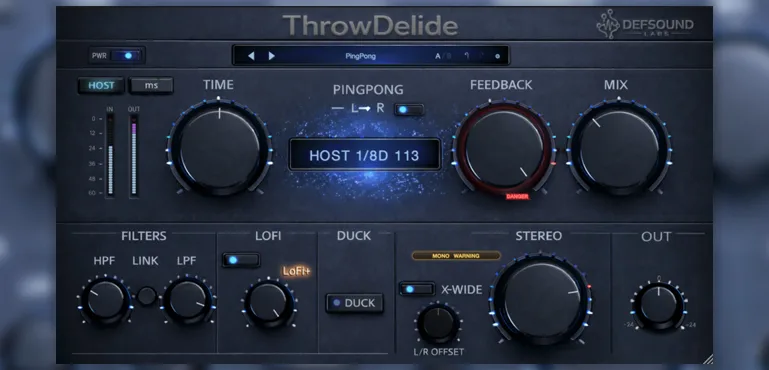
DSL ThrowDelide Review: Where This Stereo Delay Plugin Fits in Modern Mixing Workflows
Most delay plugins don’t fail because they sound bad. They fail because they slow down the session. Modern mixers already have access to countless delay processors capable of creating width, movement, modulation, and rhythmic effects. The challenge is rarely finding more features. It’s finding tools that reach a usable result quickly without adding unnecessary complexity to the workflow.
That is the environment DSL ThrowDelide enters. Defsound Labs is not trying to reinvent delay processing or introduce a new effect category. Instead, the plugin targets a much narrower question: can a streamlined stereo delay earn a place in professional mixing sessions already filled with established options from larger developers?
For engineers working on commercial productions, that question matters more than marketing claims or feature lists. A delay plugin survives long-term use when it solves a practical production problem, integrates naturally into existing workflows, and delivers results without requiring excessive setup. ThrowDelide enters a highly competitive market, but its success will likely depend less on innovation and more on execution.
Article Navigation
Why Stereo Delay Remains a Critical Mixing Tool
Stereo delay has become one of the most effective ways to create depth without sacrificing clarity. As modern productions grow denser, traditional reverb often creates more problems than it solves. Large vocal stacks, layered synth arrangements, programmed drums, and heavily processed low-end content leave less room for long decay tails and diffuse ambience.
That reality has pushed many mixers toward delay-based spatial design. A well-configured stereo delay can create width, separation, and perceived depth while preserving vocal intelligibility and transient definition. Rather than filling gaps with a continuous wash of ambience, delay introduces controlled reflections that support the source without competing with it.
This approach is particularly common in contemporary Pop, Hip-Hop, R&B, and EDM, where vocal presence remains the focal point of the mix. Short stereo delays, automated vocal throws, rhythmic echoes, and tempo-synced effects often contribute more to perceived size and movement than traditional reverb processing.
The shift is not simply aesthetic. It is largely practical. Streaming-focused productions are expected to translate across earbuds, car systems, Bluetooth speakers, and consumer headphones. Excessive ambience can quickly blur important details, while carefully managed delay tends to survive playback translation more consistently.
That is why stereo delay remains a core mixing tool despite the overwhelming number of options available. The goal is rarely to create a noticeable effect. More often, it is to generate space, energy, and dimension without drawing attention to the processing itself.
The Current Delay Plugin Market
Launching a new delay plugin in 2026 is considerably harder than launching a new compressor, EQ, or saturation tool. Most engineers already own multiple delay processors that cover both creative and technical requirements. The category is mature, highly competitive, and crowded with products that have spent years building trust inside professional workflows.
That creates a difficult challenge for smaller developers. Sound quality alone is rarely enough to justify adoption. Modern delay plugins are expected to deliver clean synchronization, flexible stereo control, tempo-aware operation, automation compatibility, and stable performance across large sessions. Those features are no longer differentiators. They are baseline expectations.
The market has gradually split into two camps. On one side are feature-heavy delay environments designed for sound design, modulation, and experimentation. On the other are workflow-focused tools built around speed and repeatability. While the first category attracts more attention in marketing campaigns and product launches, the second often sees more day-to-day use inside commercial projects.
Most professional sessions do not require elaborate delay architectures. More commonly, engineers need to create a vocal throw, widen a supporting element, add rhythmic movement to a synth line, or build a transition effect before moving on to the next decision. Under those conditions, speed becomes a competitive advantage.
That is where DSL ThrowDelide attempts to establish its position. Rather than competing directly with expansive multi-engine delay platforms, it appears designed for users who prioritize efficient execution over deep experimentation. Whether that approach gains traction depends less on feature count and more on how naturally the plugin integrates into real-world mixing workflows.
Core Workflow Analysis: What ThrowDelide Actually Solves
The delay category has reached a point where technical capability is rarely the deciding factor. Most professional-grade plugins can generate clean repeats, tempo-synced echoes, stereo movement, and automation-friendly effects. The more relevant question is how quickly those results can be achieved inside a real session.
That becomes increasingly important as project sizes grow. A modern mix may contain well over a hundred tracks, multiple vocal layers, parallel processing chains, automation lanes, and revision requests arriving long after the initial session was built. Under those conditions, workflow efficiency stops being a convenience and becomes part of the production process itself.
ThrowDelide appears focused on reducing the number of decisions required to create useful spatial effects. Instead of encouraging deep parameter exploration, it favors immediate deployment. For many engineers, that approach is not a limitation. It is often the reason certain plugins remain in regular use while others become occasional creative tools.
The practical applications are familiar. A lead vocal may need additional width without introducing excessive ambience. Background vocals may require separation from the center image. A synth line may need movement across the stereo field without adding another modulation processor. Transition moments often need a delay effect that can be inserted, automated, and adjusted quickly without interrupting the broader workflow.
These tasks occur daily in commercial mixing environments. They rarely demand elaborate routing structures or advanced sound-design features. More often, they require predictable results delivered with minimal setup. That is the segment of the market where workflow-focused delay processors can still justify their existence despite the overwhelming number of alternatives available today.
How Delay Decisions Affect Mix Translation
Delay is often evaluated in ideal listening conditions and judged by how wide, deep, or immersive it sounds through studio monitors. The problem is that commercial releases are rarely consumed under ideal conditions. Most listeners experience music through earbuds, Bluetooth speakers, vehicle audio systems, laptops, and consumer-grade headphones, where stereo information behaves very differently than it does in a treated control room.
As a result, delay settings that sound impressive during mixing can become problematic once the track leaves the studio. Excessive stereo offsets, overly wide feedback paths, and poorly controlled side information may weaken center-image stability, reduce vocal focus, or create inconsistencies when the mix is summed to mono. These issues are often subtle during production but become much easier to identify after distribution.
For that reason, experienced mixers rarely judge a delay plugin solely by the quality of its echoes. More important is how those echoes interact with the rest of the mix. A useful delay should add dimension without pulling attention away from the lead element, maintain intelligibility during dense passages, and preserve spatial balance across different playback systems.
Translation becomes even more important in modern streaming environments. Data compression, codec processing, and consumer playback limitations can expose weaknesses in spatial effects that seem perfectly controlled during mixing. Width is easy to create. Width that survives streaming platforms, low-cost speakers, and mono playback remains considerably harder to achieve.
When evaluating a stereo delay, factors such as mono compatibility, image stability, transient integrity, and vocal clarity often matter more than the specific delay algorithm itself. Many of the issues that appear to be mastering problems later are actually translation problems introduced during mixing, a distinction explored in greater detail in Mixing vs Mastering. A plugin may offer impressive spatial effects, but its real value is determined by how consistently those effects translate outside the studio.
Mixing Applications Where ThrowDelide Makes Sense
 The strongest use case for a streamlined stereo delay is not sound design. It is everyday mix work. Most commercial productions require dozens of small spatial decisions that need to be made quickly and revised just as quickly. In that environment, a delay processor earns its place by reducing friction rather than expanding creative possibilities.
Lead vocals are an obvious example. Modern Pop, Hip-Hop, and R&B mixes often rely on automated delay throws to add emphasis at the end of phrases without clouding the center image. The goal is rarely to create a noticeable effect. More often, it is to generate a brief sense of movement while keeping the vocal anchored at the front of the mix. Tools that reach that result quickly tend to remain part of regular workflows.
The same applies to ad-libs and supporting vocal layers. These elements frequently need additional width and separation without competing with the lead performance. Stereo delay is only one solution for creating a larger vocal image, and producers comparing delay-based widening against modern doubling techniques may also be interested in our IK Multimedia ReSing Doubling review. Stereo delay can create a larger perceived image while avoiding the density that longer reverbs often introduce. In busy arrangements, that distinction becomes important.
Synth-driven productions present another practical application. Layered pads, textures, and melodic elements often occupy similar frequency ranges, forcing engineers to create separation through spatial contrast rather than aggressive EQ moves. A controlled stereo delay can help establish depth and placement without altering the tonal balance of the source.
Transition effects are equally relevant. Contemporary productions rely heavily on movement between sections, whether that involves a vocal phrase leading into a chorus, a synth phrase carrying momentum into a drop, or a short effect helping connect arrangement changes. Delay is only one way to create that sense of motion, and engineers exploring broader sequencing-based approaches may also find value in our Effectrix 2 workflow and creative sequencing analysis. Under deadline-driven conditions, engineers rarely want to build complex routing structures for these moments. A focused delay processor can often achieve the desired result with far less effort.
These scenarios may not be the most exciting demonstrations of a delay plugin, but they represent the type of work that occurs repeatedly across professional sessions. For many engineers, that is ultimately where a tool proves its value.
The Marketing Narrative vs Production Reality
The audio plugin market rewards novelty, even when most production workflows do not. New releases are routinely presented as major advances in processing technology, yet the day-to-day reality inside commercial sessions is far less dramatic. Once the marketing language is removed, most products compete on a narrower set of factors: sound quality, reliability, workflow efficiency, and long-term usability.
Delay plugins are particularly vulnerable to this disconnect. The core principles behind delay processing have been established for decades, and most modern developers are working within a mature category where fundamental functionality is already well understood. As a result, genuinely transformative innovations are rare. What changes more often is the speed at which engineers can achieve familiar results.
Viewed through that lens, ThrowDelide does not need to reinvent delay processing to justify its existence. Its value depends on whether it helps users complete common production tasks with less effort than competing solutions. That may sound less exciting than promises of groundbreaking technology, but it reflects how many professionals actually evaluate new tools.
Commercial mixers rarely keep a plugin in rotation because of a feature that impressed them during a product demonstration. They keep using it because it consistently solves a problem, behaves predictably across projects, and integrates cleanly into established workflows. Those qualities tend to have a longer lifespan than any marketing narrative attached to a release.
For smaller developers, that reality can be both a challenge and an advantage. Competing directly against feature-rich platforms from established brands is difficult. Competing on simplicity, efficiency, and practical usability is often more realistic. Whether ThrowDelide succeeds ultimately depends on how well it performs in that role rather than how aggressively it is positioned in promotional material.
Limitations and Potential Weak Points
The biggest challenge facing ThrowDelide is not sound quality. It is differentiation. Delay is one of the most mature categories in audio production, and many engineers already have established solutions that cover everything from basic stereo widening to complex multi-tap processing and advanced modulation. Convincing users to replace a familiar tool requires a clear workflow advantage rather than marginal feature differences.
That creates a difficult position for streamlined delay processors. Simplicity can be a strength, but it can also narrow the plugin’s appeal. Engineers who regularly build intricate delay networks, automate multiple feedback paths, or use delay as a sound-design tool may find limited value in a workflow-first approach. For those users, deeper platforms often provide more flexibility.
There is also the question of session longevity. Many plugins perform well during initial testing because they solve an immediate problem quickly. The more important test is whether they remain useful after months of real-world projects. Professional workflows tend to reward tools that can adapt to a wide range of production scenarios rather than excelling in only a handful.
Another consideration is redundancy. Most commercial studios and independent mixers already own several capable delay plugins. Adding another processor to the collection requires more than competent performance. It requires a reason to reach for it instead of tools that are already deeply integrated into existing templates and workflows.
None of these limitations are unique to ThrowDelide. They are the realities facing nearly every new delay release. The plugin’s long-term success will likely depend on whether its streamlined workflow provides enough practical value to justify occupying space in sessions that are already crowded with proven alternatives.
Competitive Positioning
ThrowDelide enters a market dominated by mature delay platforms that have already secured places in countless professional workflows. Its competitive position is not based on offering more features than established alternatives. Instead, it appears aimed at users who value speed, simplicity, and immediate results over extensive customization.
| Plugin | Primary Focus | Typical Workflow Strength | Best Fit |
|---|---|---|---|
| DSL ThrowDelide | Fast stereo delay deployment | Quick spatial enhancement and vocal effects | Mix engineers prioritizing efficiency |
| Valhalla Delay | Multiple delay styles and textures | Wide range of creative and production tasks | Producers seeking versatility |
| Soundtoys EchoBoy | Character-driven delay processing | Mixing, coloration, and analog-style echoes | Engineers building signature delay sounds |
| FabFilter Timeless | Modulation and advanced routing | Complex automation and sound design | Users requiring deep control |
| Baby Audio Comeback Kid | Fast creative enhancement | Modern production effects and movement | Producers focused on immediacy |
Viewed from a workflow perspective, ThrowDelide is not competing directly with highly programmable delay environments such as Timeless, nor is it trying to replace character-heavy platforms like EchoBoy. The closer comparison is with tools designed to solve common mixing tasks quickly without requiring extensive setup.
That distinction matters because many engineers already own at least one advanced delay processor. The purchasing decision is often less about capability and more about efficiency. If a plugin consistently delivers usable results in fewer steps, it can justify a place alongside larger and more feature-rich alternatives rather than replacing them outright.
Who Should Consider ThrowDelide?
ThrowDelide is likely to appeal most to engineers who spend more time finishing projects than experimenting with effects. In high-volume production environments, the ability to create width, depth, and movement quickly often carries more value than access to an extensive collection of modulation options and routing possibilities.
Mix engineers working across multiple client projects are a natural fit. Sessions frequently require familiar delay treatments—vocal throws, stereo enhancement, transitional effects, and subtle spatial support—without turning those tasks into separate production exercises. Under deadline pressure, reducing setup time can be more important than expanding creative flexibility.
The same logic applies to producers who handle writing, production, editing, and mixing themselves. Many independent creators are not searching for another sound-design platform. They are looking for tools that solve common production problems efficiently and allow them to keep moving through a project without interruption.
That does not mean ThrowDelide is the right choice for every user. Engineers who treat delay as a primary creative instrument may prefer platforms built around deep modulation, unconventional routing, or extensive customization. Those workflows place a premium on experimentation rather than speed.
Ultimately, ThrowDelide appears best suited to users who view delay as a mixing tool first and a sound-design tool second. For that audience, simplicity can be a practical advantage rather than a compromise.
Real-World Production and Mastering Considerations
Delay decisions rarely remain isolated to the mixing stage. The way spatial effects are built into a production can directly influence how a track behaves during mastering, particularly when stereo enhancement and tempo-based effects play a significant role in the arrangement. Many of these downstream considerations are often misunderstood, especially by producers who have never examined how professional mastering works beyond the final loudness stage.
This often becomes apparent when a mix reaches the final review stage and engineers begin applying the same evaluation criteria found in a professional mastering checklist. Wide feedback structures, aggressive stereo offsets, and heavily automated effects can alter the perceived balance of a mix, weaken the center image, or introduce inconsistencies that become more obvious as overall level is increased during mastering.
These problems are not always apparent while mixing. A delay effect that sounds expansive in a controlled monitoring environment may behave differently once the track is encoded for streaming platforms and reproduced through consumer playback systems. Stereo information that feels impressive in the studio can become unstable on earbuds, collapse unpredictably in mono playback, or compete with the lead vocal under less-than-ideal listening conditions.
This is one reason experienced mixers often approach delay differently than less experienced producers. The objective is not simply to create width or movement. The objective is to create those qualities while preserving translation. Spatial effects must support the record without compromising vocal focus, transient impact, or playback consistency across a wide range of listening environments.
From that perspective, the long-term value of a delay plugin is determined by more than its feature set. A useful processor should allow engineers to create depth and dimension without introducing unnecessary complexity into the stereo image. The most successful delay effects are often the ones listeners never consciously notice, yet still contribute to a mix that feels larger, more engaging, and more stable after mastering.
Ultimately, any delay plugin should be judged in the context of a finished release rather than an isolated solo demonstration. What matters is not how impressive the effect sounds on its own, but how reliably it survives the entire production chain—from mixing and mastering to streaming delivery and real-world playback.
Overall Rating
| Category | Rating |
|---|---|
| Sound Quality | 8.5/10 |
| Workflow Efficiency | 9.3/10 |
| Mix Translation Potential | 8.8/10 |
| CPU Efficiency | 9.2/10 |
| Ease of Use | 9.4/10 |
| Creative Flexibility | 7.6/10 |
| Value for Money | 8.9/10 |
| Overall | 8.8/10 |
DSL ThrowDelide succeeds where many modern delay plugins struggle: reducing friction inside real-world mixing sessions. Its strongest attributes are workflow speed, ease of deployment, and the ability to create useful stereo movement without requiring extensive setup or parameter management. While it does not offer the depth, modulation complexity, or creative range of larger delay platforms, it addresses a different need.
For engineers focused on vocal processing, mix depth, spatial enhancement, and day-to-day production efficiency, ThrowDelide provides a practical solution that prioritizes execution over experimentation. Its value comes less from innovation and more from helping engineers reach reliable results quickly inside demanding production workflows.
Verdict
DSL ThrowDelide enters one of the most saturated segments of the audio software market. That alone makes differentiation difficult. Most engineers already have access to multiple delay processors capable of handling everything from routine mix duties to advanced sound-design work. As a result, competing on features alone is unlikely to move the needle.
What makes ThrowDelide interesting is that it appears to pursue a different objective. Rather than competing to become the most versatile delay platform available, it focuses on reducing friction during common mixing tasks. That may sound like a modest goal, but workflow efficiency remains one of the few areas where new plugins can still provide meaningful value to experienced users.
The plugin is unlikely to replace deeply established tools such as EchoBoy, Timeless, or Valhalla Delay for engineers who regularly rely on extensive modulation, complex routing, or highly customized delay structures. Those platforms occupy a different part of the market and solve different problems.
Where ThrowDelide makes the strongest case is in everyday production work. Creating vocal throws, adding stereo movement, supporting arrangement transitions, and building depth without excessive setup are tasks that occur far more often than elaborate delay programming. For many mixers, those routine decisions ultimately consume more time than the occasional sound-design experiment.
Viewed through that lens, ThrowDelide is not a plugin that attempts to redefine delay processing. It is a tool aimed at making familiar tasks faster and more direct. Whether that is enough to earn a permanent place in a workflow depends on the individual engineer, but it is also the most credible argument for why the plugin deserves attention in the first place.

Yurii Ariefiev is a mastering engineer and audio production editor specializing in mix translation, streaming playback behavior, stereo imaging, and mastering decisions that affect real-world listening environments. His work focuses on identifying how production choices made during mixing influence the final release across platforms, devices, and playback systems.
This analysis examines DSL ThrowDelide from a workflow and release-translation perspective, focusing on stereo delay implementation, playback consistency, and the practical impact of spatial processing on professional mixing and mastering outcomes.
FAQ
Is DSL ThrowDelide intended for mixing or sound design?
Based on its workflow-oriented approach, ThrowDelide appears better suited to mixing applications than advanced sound design. Engineers looking for fast vocal throws, stereo enhancement, and practical spatial effects are likely to benefit more than users building highly experimental delay structures.
How does ThrowDelide compare to stock DAW delay plugins?
Most modern DAWs already include capable delay processors. The advantage of a dedicated plugin typically comes from workflow, interface design, and speed of operation rather than access to fundamentally different delay technology.
Can stereo delay replace reverb in a mix?
Not entirely, but many mixers rely on stereo delay to create depth while preserving clarity. In dense productions, delay often occupies less space than reverb and can maintain better vocal intelligibility.
Is ThrowDelide a good choice for vocal mixing?
Vocal processing is one of the most practical applications for stereo delay. Short throws, rhythmic echoes, and subtle widening effects can add depth and movement without pushing vocals further back in the mix.
What should engineers listen for when evaluating a stereo delay plugin?
Mono compatibility, image stability, vocal clarity, transient preservation, and overall translation across playback systems are often more important than the number of available features.
Can stereo delay affect loudness during mastering?
Indirectly, yes. Excessive side information and unstable imaging can complicate mastering decisions, particularly when maximizing level while preserving balance and translation. Engineers often assume the issue is loudness itself when the real limitation comes from the mix, which is closely related to the relationship between loudness and clipping in mastering.
How important is CPU efficiency in large mixing sessions?
CPU usage becomes increasingly important as projects grow. Sessions containing large track counts, virtual instruments, and extensive automation benefit from plugins that deliver results without placing unnecessary strain on system resources.
Does ThrowDelide compete directly with EchoBoy or Valhalla Delay?
Not necessarily. EchoBoy and Valhalla Delay are often chosen for their flexibility, character options, and broader feature sets. ThrowDelide appears positioned as a faster, more focused workflow tool rather than a direct replacement.
Can stereo delay create phase issues?
Any stereo delay can introduce phase-related artifacts if settings are pushed too aggressively. Proper evaluation should include mono monitoring and playback testing across multiple listening systems.
Is there still a place for dedicated delay plugins in 2026?
Yes. While stock DAW effects continue to improve, many professionals still prefer specialized delay plugins that streamline common mixing tasks and provide faster access to frequently used workflows.